Darius Holloway pushed open the glass door of Holloway’s Homestyle Diner at 6:17 on a gray Tuesday morning, wearing a plain black cap, an old jacket, faded jeans, and the kind of tired expression no one bothered to study too closely.
The bell above the door rang softly, just like it had for twenty-eight years. Darius paused for half a second, letting the familiar smell of coffee, buttered toast, bacon grease, and old vinyl booths settle around him. He had built this diner from almost nothing after buying it from a family who could no longer keep it open. Back then, he had promised himself it would never become the kind of place where customers were treated like wallets and workers were treated like furniture.
But lately, something about the diner had changed.
The numbers still looked fine on paper, but the place felt wrong in ways numbers could not show. A few customer reviews had mentioned tense service, rude management, and “an uncomfortable atmosphere.” One supplier had called him personally to say the new manager, Carl Benson, had become difficult to deal with. Even the monthly reports Darius received looked too clean, too rehearsed, as if someone had scrubbed them before sending them upstairs.
So Darius decided to stop reading reports and see the truth for himself.
He did not call ahead.
He did not wear a suit.
He did not bring an assistant, lawyer, or regional supervisor.
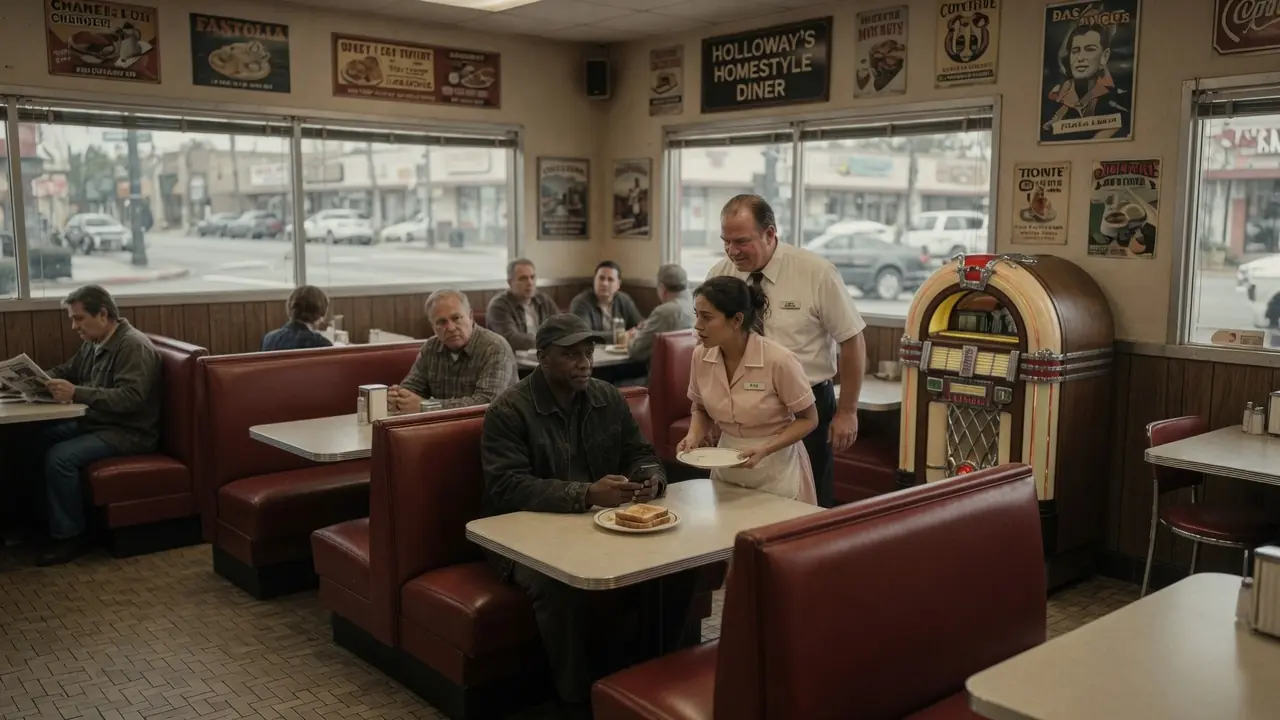
He walked in like any other middle-aged Black man looking for breakfast before work, chose a corner booth with cracked red leather, and sat down with his back near the wall. A menu rested on the table, but he did not open it. He already knew what he wanted. Toast and black coffee. Simple. Honest. The same breakfast his father used to order when Darius was a boy.
From his booth, he studied the room without making it obvious.
The diner looked normal at first glance. A few construction workers sat near the window, speaking quietly over plates of eggs. An older couple shared pancakes in a booth by the back wall. A young mother tried to keep her toddler busy with crayons and a napkin. The coffee machine hissed behind the counter, plates clattered, and pendant lights glowed over the polished metal tables.
But beneath the ordinary breakfast sounds, Darius sensed tension.
The staff moved too carefully.
A young dishwasher carried a tub of plates with his shoulders tight, glancing toward the counter before every step. The cook behind the service window worked fast, flipping eggs and sliding plates forward with short, stiff movements. A teenage busboy wiped the same table twice, then looked over his shoulder like he expected to be corrected. Nobody laughed. Nobody relaxed. Nobody seemed to breathe fully.
Then Darius saw the waitress.
Her name tag read Janelle.
She was in her late twenties, with tired eyes, a faded uniform, and an apron tied too tightly around her waist. She moved with the controlled caution of someone who had learned that one wrong word could cost her more than a bad shift. Her smile was polite, but it never reached her eyes. Before approaching each table, she glanced toward the counter, not like a waitress checking food, but like a woman checking the sky for thunder.
Darius followed her glance.
Behind the counter stood Carl Benson.
He was thick-necked, bearded, and dressed in a wrinkled button-down shirt with a manager’s badge pinned crookedly near his chest. He stood with his arms crossed, glaring at the room as if every customer had personally offended him. Darius remembered hiring him a year earlier. Carl had spoken confidently then, promising structure, discipline, efficiency, and stronger staff accountability.
Now Darius saw something else.
Control.
Not leadership.
Control.
Janelle approached his booth with an order pad in one hand and a strained smile on her face.
“Good morning,” she said softly. “What can I get started for you?”
Darius looked up with a warm expression.
“Just toast and black coffee.”
She nodded quickly.
“Coffee’s fresh. I’ll bring it right out.”
“No hurry,” he said. “Take your time.”
That simple sentence made her blink.
For a moment, she looked almost confused, as if customers rarely told her she was allowed to move at a human pace. Then she nodded again and walked away, gripping her order pad with white knuckles. Darius watched her pour coffee at the counter. Her hand shook slightly when Carl stepped near her.
Carl said something too low for Darius to hear.
Janelle’s face tightened.
She nodded quickly, whispered something, and hurried back with Darius’s coffee.
“Here you go,” she said, setting it down carefully with both hands.
“Thank you, Janelle.”
Her eyes flicked up when he used her name.
“Of course.”
Darius wrapped his hand around the mug.
The question hit her too hard.
Her mouth opened, then closed. She glanced toward Carl, then forced a smile that looked painful. “Just a regular morning,” she said.
Darius knew a lie when he heard one.
He did not press her.
Not yet.
Janelle returned a few minutes later with toast on a small white plate. She placed it in front of him, then lingered for half a second as if she wanted to say something. Behind the counter, Carl’s voice cracked through the air.
“Janelle. Order up.”
It was not loud enough to sound abusive to a casual customer, but it carried a warning sharp enough to make her flinch.
“I’m coming,” she said quickly.
She stepped away, and Darius saw Carl watching her with satisfaction.
That was the first moment Darius felt anger burn in his chest.
Not hot enough to move him yet.
But hot enough to sharpen his focus.
He ate one bite of toast, took a sip of coffee, and kept watching.
The longer he sat, the clearer the pattern became. Janelle apologized to customers who were not upset. She rushed to refill mugs before they were half-empty. She checked Carl’s face before speaking to anyone too long. Another server named Luis avoided the counter entirely unless he had no choice. The cook, a broad-shouldered woman named Nina, stopped humming whenever Carl stepped near the kitchen window.
Darius had owned businesses long enough to understand the difference between a strict manager and a poisonous one.
Carl was not keeping standards high.
He was keeping people afraid.
Janelle returned to clear a nearby table, and Darius leaned forward slightly.
“Janelle,” he said quietly.
She turned immediately.
“Yes? Did you need something?”
He kept his voice low.
“You’ve been working here long?”
She hesitated.
“A year and a half.”
“You like it?”
Her fingers tightened around the edge of the bus tray.
“It’s a job,” she said. “It pays the bills. Or tries to.”
There was truth in that, and exhaustion.
Darius nodded toward the coffee.
“You work hard. I can tell.”
She looked down at her apron.
“Some days more than others.”
Then she glanced toward Carl again.
Darius lowered his voice further.
“You don’t have to answer, but you look scared of him.”
Janelle’s face changed so quickly he almost wished he had not said it.
Fear flashed across her eyes.
She leaned closer, barely moving her lips.
“Please don’t say anything to him.”
Darius stayed still.
“To Carl?”
She nodded.
“He doesn’t like complaints. If a customer complains, he takes it out on us.”
Darius felt his jaw tighten.
“How?”
Janelle swallowed.
“Hours. Shifts. Tips. He finds ways.”
“Has he done that to you?”
She did not answer.
She did not need to.
Darius looked at the small gold cross hanging at her neck, the dark circles beneath her eyes, and the way she kept shifting her weight like she had not sat down in hours.
“I’ve got a little boy,” she whispered. “He’s five. If I lose this job, I don’t know what happens next.”
That sentence landed hard.
Darius had grown up watching his mother work two jobs after his father got sick. He knew the quiet terror of households held together by one paycheck and prayer. He knew what it meant when a worker stayed silent not because the harm was small, but because the consequences of speaking were too big.
He reached into his pocket and pulled out a folded twenty.
“Here,” he said gently. “For the service.”
Janelle’s reaction was immediate.
Panic widened her eyes.
“No,” she whispered. “Please don’t.”
“It’s just a tip.”
She shook her head fast.
“If he sees, he’ll say I’m stealing. He keeps them. All of them. Says tips belong to the house.”
Darius slowly pulled the bill back.
“He takes the tips?”
She glanced toward Carl.
“Yes.”
“For himself?”
Her voice dropped even lower.
“Most of it.”
Darius set the bill flat under his palm to hide it from view.
“What else?”
Janelle’s eyes filled with tears she fought hard not to shed.
“He cuts hours if we argue. Gives bad shifts if we ask questions. He tells us nobody else will hire us. He says people like us should be grateful to have work at all.”
Her voice cracked.
“Please don’t tell him I said anything.”
Darius looked at Carl standing behind the counter, smug and comfortable, completely unaware that his real boss sat twelve feet away eating toast.
“You’re not alone,” Darius said quietly.
Janelle looked confused.
“What?”
He almost told her then.
He almost said, “I own this place.”
But he stopped himself.
Not because Carl deserved protection.
Because Janelle deserved a solution, not another dangerous moment that might turn against her before Darius understood everything.
“Just know that,” he said. “You’re not alone.”
Janelle tucked her chin and nodded once before walking away.
For the next ten minutes, Darius watched with a colder kind of patience.
He saw Carl snap at Luis for taking too long with a coffee pot. He saw Nina’s shoulders tense when Carl leaned into the kitchen window and criticized an order she had prepared correctly. He saw the dishwasher, Mateo, lower his eyes when Carl passed him. He saw Janelle reach for a table’s tip, then stop herself and leave the money untouched until Carl collected it with one quick sweep of his hand.
That was enough.
But Carl was about to give him more.
Janelle returned to Darius’s table with a refill he had not requested.
“You doing all right?” she asked.
“I’m fine,” Darius said.
Before she could move away, Carl appeared beside the booth.
His fake smile was stretched tight across his face.
“Everything all right here?” Carl asked, looking not at Darius’s food, but at Janelle.
“Just checking on my table,” she said.
Carl leaned over the booth and looked Darius up and down.
The look was slow, dismissive, and ugly.
Darius held his coffee cup calmly.
Carl’s voice sharpened.
“You need something, or are you just keeping my waitress standing around?”
The nearby tables grew quieter.
Janelle stepped back.
Darius set his mug down.
“I’m eating breakfast.”
Carl gave a short laugh.
“Breakfast? You’ve been nursing cheap toast for half an hour.”
A construction worker in the next booth looked up.
Janelle whispered, “Carl, please.”
That only made Carl louder.
He pointed toward Darius’s plate.
“This diner isn’t for broke trash acting like somebody owes them respect.”
The room went silent.
Darius did not move.
His face stayed calm, but his eyes changed.
Carl, mistaking silence for weakness, leaned closer.
“You hear me? Either order something real or stop wasting space. My staff doesn’t need to babysit nobodies who camp out over toast.”
Janelle’s face went pale.
The older couple stopped eating.
Luis froze near the coffee machine.
Darius slowly placed his phone on the table, screen down.
He looked up at Carl.
“Careful.”
Carl smirked.
“Careful? You threatening me now?”
“No,” Darius said. “I’m giving you one last chance to speak like you still want a job.”
Carl blinked.
Then he laughed.
“A job? Man, who do you think you are?”
Darius stood.
He did not raise his voice.
He did not need to.
“My name is Darius Holloway.”
Carl’s laugh faded.
Darius continued, each word clear enough for the entire diner to hear.
“I own this diner.”
The silence became complete.
Carl stared at him.
Luis’s mouth fell open.
Nina stepped out from the kitchen doorway.
Janelle’s eyes widened, her hand still gripping the coffee pot.
Carl forced another laugh, but this one sounded dry and broken.
“Yeah, right.”
Darius pulled out his wallet and removed a business card. He placed it on the table, then unlocked his phone and opened an ownership document with the diner’s legal name visible at the top. He turned the screen toward Carl.
“Look closely.”
Carl looked.
The color drained from his face.
Darius stepped closer.
“You work for me.”
Carl swallowed.
“You should have told me you were coming.”
“I shouldn’t have had to.”
Carl’s eyes darted around the diner. For the first time, he realized everyone was watching him. The staff he had frightened for months stood still, no longer hiding. Customers leaned forward. Janelle stood with one hand over her mouth, tears gathering because she understood, finally, that the man in the booth had not been powerless at all.
Carl tried to recover.
“Mr. Holloway, listen. These employees exaggerate. They’re lazy. They need discipline. If I don’t keep them in line, this place falls apart.”
Darius’s voice lowered.
“This place is falling apart because of you.”
Carl’s jaw twitched.
“You don’t know what it’s like day to day.”
“I know enough.”
“No, you don’t. That girl plays victim.”
Darius’s eyes hardened.
Carl pointed toward Janelle.
“She cries about everything. Always has some sob story about her kid. I had to put her in line.”
The last phrase hung in the room.
Put her in line.
Darius stepped closer, and Carl instinctively backed up.
“You stole her tips.”
Carl opened his mouth.
“You threatened her hours.”
Carl said nothing.
“You made my staff afraid to work in a diner that was built to feed families and give people honest jobs.”
Carl’s confidence collapsed piece by piece.
“It was a tip pool,” he muttered.
“Show me the records.”
Carl froze.
Darius nodded once.
“That’s what I thought.”
The owner turned and looked at the staff.
“Luis, Nina, Mateo, Janelle, everyone here. Did Carl take tips from you?”
No one spoke at first.
Fear does not leave a room just because the bully is cornered.
Then Nina lifted her chin.
“Yes.”
Luis nodded.
“Every shift.”
Mateo stepped forward, voice shaking.
“He said if we complained, he’d cut us off the schedule.”
Janelle wiped her cheek.
“He told me single mothers are easy to replace.”
Darius turned back to Carl.
Carl lifted both hands.
“Okay, maybe I handled some things wrong.”
“No,” Darius said. “You didn’t handle things wrong. You abused people because you thought no one powerful was watching.”
Carl’s face reddened.
“This is ridiculous.”
“You’re fired.”
The words struck the room with force.
Carl stared.
“What?”
“You are fired, effective immediately. Gather your things and leave.”
Carl’s mouth opened and closed.
“You can’t just—”
“I can.”
Darius leaned closer.
“And if I find evidence of wage theft, stolen tips, or retaliation beyond what I already heard, my lawyer will contact you before sunset.”
Carl looked around the diner, searching for someone to defend him.
No one moved.
No one looked away.
The workers he had kept frightened now stood as witnesses.
Customers watched with open disgust.
Carl grabbed his jacket from behind the counter and shoved past Luis toward the door.
Before leaving, he turned back with one final bitter glare.
“This place will fall apart without me.”
Darius looked around at his staff.
“No,” he said. “It just started breathing again.”
Carl stormed out.
The bell above the door rang behind him.
For several seconds, nobody spoke.
The diner felt suspended between fear and relief.
Then Janelle set the coffee pot down on the nearest table because her hands were shaking too badly to hold it.
Darius turned to her.
“You all right?”
She tried to answer, but her voice broke.
“You really own this place?”
“I do.”
“And you came in like a regular customer?”
“I needed the truth.”
She covered her mouth, and the tears came then, fast and quiet.
“I thought I was losing my mind,” she whispered. “Every day he made us feel like we were the problem.”
Darius shook his head.
“You were never the problem.”
She wiped at her face, embarrassed.
“I didn’t want to complain. I need this job. My son needs me to keep this job.”
Darius’s expression softened.
“What’s your son’s name?”
“Malik.”
“How old?”
“Five.”
Darius nodded.
“You’ve been carrying too much alone, Janelle.”
She looked down.
“I didn’t have a choice.”
“You do now.”
He turned toward the rest of the staff.
“Everybody clocked in today stays paid for the full shift, even if we close early. Nobody loses hours for speaking to me. Nobody gets punished for telling the truth. Starting today, tips belong to the staff under a transparent system, and we are reviewing every dollar Carl handled.”
Nina let out a shaky breath.
Luis looked like he might cry.
Mateo whispered, “Thank God.”
Darius looked back at Janelle.
“And you. I owe you an apology.”
She blinked.
“Me?”
“Yes. I trusted the wrong man with a place that mattered to me. Because I wasn’t here enough, he hurt people under my roof. That is on me to repair.”
Janelle shook her head quickly.
“You didn’t know.”
“I should have checked before now.”
That sentence meant more to her than he knew.
Too many bosses treated ignorance as innocence.
Darius did not.
He pulled a white envelope from inside his jacket and handed it to her.
She stared at it.
“What is this?”
“Emergency support.”
“I can’t take—”
“You can,” he said gently. “And you earned more than this. It’s not charity. It’s back pay against what this place failed to protect.”
Her fingers trembled as she opened it.
When she saw the cash inside, her breath caught.
“Mr. Holloway…”
“Darius.”
She pressed the envelope to her chest.
“I don’t know what to say.”
“You don’t have to say anything.”
Her tears fell freely now.
Across the room, the older woman from the back booth dabbed her eyes with a napkin.
The construction worker near the window muttered, “Good for her.”
Darius stepped into the center of the diner, turning to face employees and customers alike.
“I’m closing for two hours,” he announced. “Anyone eating, your meal is on the house. Staff, I want everyone in the back room in ten minutes if you feel comfortable speaking. If you don’t, you can write it down. If you want to go home, you still get paid. But this place changes today.”
No one argued.
For the first time that morning, the silence felt different.
Not afraid.
Ready.
In the back room, the stories came slowly at first.
Then all at once.
Carl had taken tips for months. He had changed schedules as punishment. He had threatened workers who questioned missing cash. He had called Luis stupid, told Mateo he was replaceable, mocked Nina’s cooking when customers praised her, and told Janelle that “mothers with baggage” should be grateful for any job at all. He had created a system where every person felt alone, even though all of them were suffering the same abuse.
Darius listened to every word.
He took notes.
He apologized more than once, not to make himself look kind, but because the words needed saying.
When Janelle spoke, she held a napkin twisted in both hands.
“The worst part wasn’t even the tips,” she said. “It was how he made us afraid to be decent to each other. If Luis helped me, Carl punished him. If Nina gave me extra food to take home after a late shift, he called it theft. He made kindness feel dangerous.”
Darius looked around the room.
“That ends now.”
Over the next week, Holloway’s Homestyle Diner changed visibly.
A clear tip system was posted near the register. Darius brought in an accountant to review past tip records and payroll. Employees received adjustments where records could prove missing money. Carl received formal legal notice after the review uncovered enough irregularities to make him regret every dollar he had pocketed. A new interim manager was chosen from within the staff.
Nina became kitchen lead.
Luis handled front-of-house scheduling with Janelle’s help.
Mateo, who had been quietly taking night classes, was offered flexible hours so he could keep studying.
And Janelle was promoted to shift supervisor.
When Darius offered her the position, she stared at him like he had spoken another language.
“Me?”
“Yes, you.”
“I’m just a waitress.”
“No,” Darius said. “You’re observant, respected, hardworking, and you kept showing up when this place gave you every reason to quit. That’s leadership.”
She cried again, but this time she laughed through it.
“I’m going to tell Malik his mom got promoted.”
Darius smiled.
“Tell him his mom earned it.”
Two months later, the diner no longer felt heavy.
Customers noticed.
Reviews changed.
Staff laughed again behind the counter. Coffee refills came with real smiles instead of panic. Janelle moved through the room with her shoulders back, still busy, still tired sometimes, but no longer afraid of every voice behind her. Malik visited one Saturday morning, sitting in a booth with pancakes shaped like a bear because Nina insisted all important guests deserved special treatment.
Darius watched from the counter as Janelle wiped syrup from her son’s cheek.
Malik looked around the diner with wide eyes.
“Mom, is this where you’re the boss now?”
Janelle smiled.
“Not the boss. A supervisor.”
Malik nodded seriously.
“That means boss.”
Darius laughed.
From the front door, an older customer called out, “Best toast in Fresno still on the menu?”
Janelle glanced at Darius, and they both smiled.
“Always,” she said.
Darius took his usual corner booth that morning, not undercover this time, just present.
Janelle brought him black coffee and toast.
“Anything else?” she asked.
He looked around the diner, at the staff moving freely, the customers relaxed, the sunlight hitting the red booths, and the clear tip jar sitting proudly by the register.
“No,” he said. “This is exactly what I wanted.”
Janelle placed the plate down.
“You know,” she said softly, “that day you came in, I thought you were just another customer.”
“I was hoping everyone would think that.”
“I’m glad you did.”
He looked at her.
“Me too.”
She glanced toward the door Carl had once stormed out of.
“I still get scared sometimes. Like he’ll come back, or someone like him will.”
Darius nodded.
“That fear takes time to leave.”
“Does it ever?”
“Yes,” he said. “When enough good days prove the bad ones are over.”
Janelle looked around the room.
“Then we’re getting there.”
Darius lifted his coffee.
“We are.”
The bell above the door rang again.
A new customer walked in.
Janelle turned with a smile that was finally real.
“Good morning,” she said. “Welcome to Holloway’s.”
And for the first time in a long time, the diner sounded like home again.
Not because one cruel manager was gone.
Not because one owner revealed himself at the perfect moment.
But because fear had been named, confronted, and removed.
Because workers who had been told they were replaceable learned they mattered.
Because a single mother who had been forced to whisper discovered her voice could change a room.
And because Darius Holloway finally remembered the lesson his father taught him long before he ever owned a business.
A diner is not built from walls, tables, coffee, or toast.
It is built from people.
And if the people inside are afraid, the whole place is broken.
But if the people inside are respected, protected, and seen, then even a simple plate of toast can become the beginning of justice.