Colton Hail almost turned away the moment he saw her coat.
It was Christmas Eve in Wyoming Territory, the kind of night when snow did not fall gently but drove sideways through the station street like it had a personal grievance against every living thing outside. Clearwater Station stood at the end of town with frost sealing the windows and depot lamps struggling against the wind. Colton waited on the platform with his black hat pulled low, his collar turned up, and both hands buried deep in his coat pockets. He had faced stampedes, blizzards, bank men, wolves, and dead cattle, but none of them had made him feel as uncertain as the train now hissing into the station.
He had sent money to the agency in Denver because he needed help.
That was the plain version, the one he told himself and the one he had told his hired hands, Axel and Bjorn Lindfist, when they asked whether a strange woman was truly coming to the ranch. A schoolteacher, he had said. A respectable woman. Someone to teach Clara, manage the house, and bring order where grief had left silence.
He did not say the rest.
He did not say that his daughter had stopped laughing after Rosa died. He did not say Clara no longer sang while setting the supper table or asked questions about the cattle or ran to meet him when he rode in from the range. He did not say the house had grown so quiet that some evenings he stood outside longer than necessary because the sound of emptiness inside hurt worse than the cold. A man like Colton Hail could admit he needed help with chores, but not that he had failed to reach his own child.
The agency letter had described Evelyn Hart in careful language.
Thirty years old. Former schoolteacher. Good character. Modest means. Available immediately. Colton knew enough of the world to understand what those words meant when written by strangers arranging women’s futures for a fee. They meant she was poor, respectable, and out of options.
Still, the photograph had caught him.
Evelyn’s face in the little card had been composed and steady, her dark hair pinned neatly back, her eyes neither soft nor hard, but watchful. Colton had studied that photograph late at night after Clara slept upstairs, wondering whether the woman in it could survive his ranch. He wondered whether she would pity Clara too openly, whether she would fear his silence, whether she would leave after a month when she realized grief did not behave like a problem easily solved by kindness.
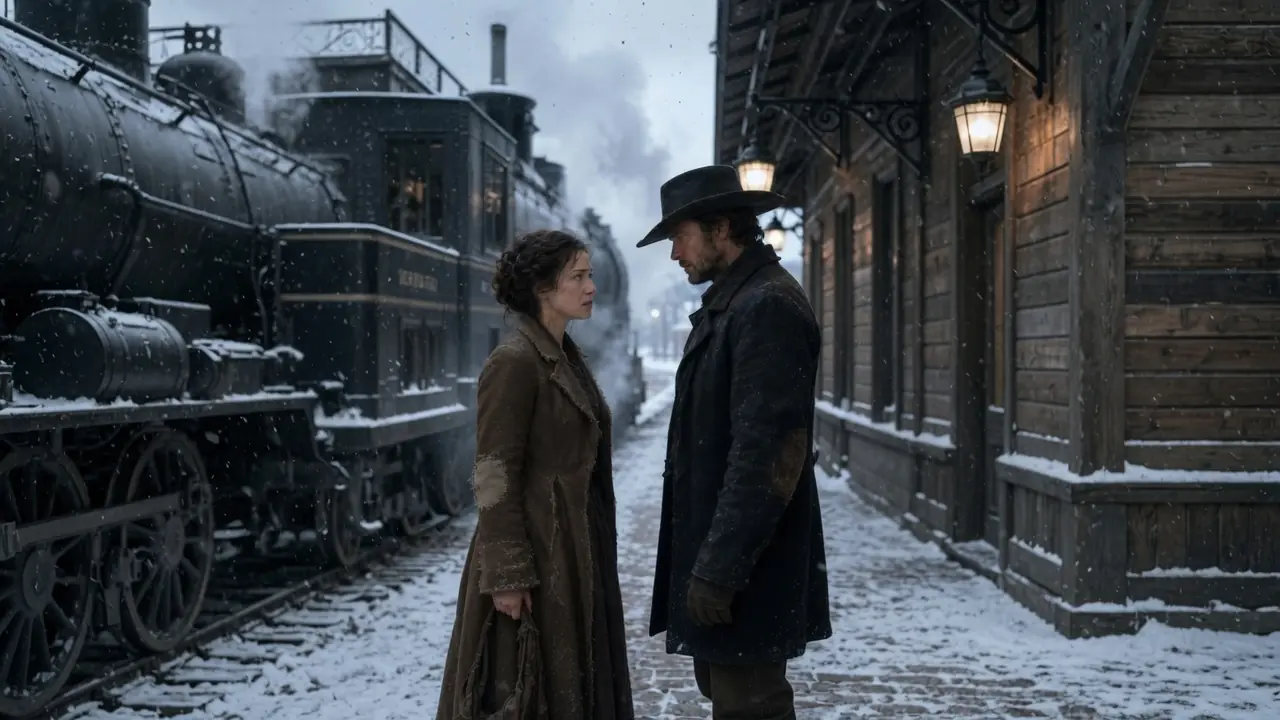
But when the train stopped and passengers hurried off into the Christmas Eve cold, the woman who stepped down last looked poorer than even the letter had warned.
Her coat was the first thing Colton saw.
It had once been wool, maybe fine enough in another life, but now it was faded brown, fraying at the collar, patched at both elbows, and too thin for a Wyoming winter. Her travel bag hung from one hand, small enough that Colton wondered if it held more than a change of clothes. Snow caught in her dark hair where loose strands had escaped their pins. She stepped carefully onto the platform as if she had learned not to trust ground simply because it appeared solid.
Colton’s first thought was unfair and sharp.
How could a woman with so little possibly hold his house together?
He hated himself for thinking it almost as soon as the thought formed, but hardship had made his judgment practical before it made it kind. He had paid two hundred and fifty dollars for help, not another person to feed and shelter. The spare room upstairs had been scrubbed and prepared, but preparation did not ease the fear that he had made a desperate mistake. He was still thinking of sending her back when Evelyn Hart lifted her eyes.
They found him across the platform.
Not pleading.
Not frightened.
Not proud in the brittle way desperate people sometimes become proud when they have nothing left to defend but their posture. Her eyes were steady, and that steadiness unsettled him more than her worn coat. She looked at him as if she had already survived worse judgments than whatever waited in his silence.
Colton forced himself forward.
“Miss Hart,” he said.
“Mr. Hail,” she replied.
Her voice was calm despite the cold.
The train whistle screamed behind them, and the last of the passengers disappeared toward the hotel and the saloon lamps farther down the street. For a moment, they stood facing one another in the falling snow, two strangers bound by money, need, grief, and a letter neither of them fully trusted. Colton looked at her coat again before he could stop himself. Evelyn noticed.
“You came all this way with one bag and a coat that won’t last the night?” he asked.
Her fingers tightened around the handle of the travel bag.
“I came with what I owned, Mr. Hail,” she said. “Not with what I wished I had.”
The answer struck him harder than it should have.
There was no apology in it.
No excuse.
Only fact.
Colton looked toward the waiting wagon beyond the depot, where Axel held the reins and pretended not to listen. “My ranch is twenty miles out,” Colton said. “Storm’s coming heavy from the north. Ride won’t be easy.”
Evelyn glanced toward the dark road.
“I did not come expecting easy.”
“No,” he said quietly. “I suppose not.”
They loaded her single bag into the wagon, and Colton helped her up without thinking. Her glove was thin, almost useless against the cold, and when his hand closed around hers, he felt how chilled her fingers were. She withdrew quickly, not from offense, but as if she had learned not to linger where warmth might make leaving harder. Colton climbed beside Axel, and the wagon rolled out of Clearwater Station into the white blur of Christmas Eve.
The ride to the Hail ranch was long and bitter.
Snow gathered in the creases of Evelyn’s coat, and the wind cut through the wagon cover in thin, vicious lines. She sat upright the whole way, one hand braced against the wooden sideboard, the other gripping her bag. Axel tried once to offer conversation about weather, horses, and the poor quality of depot coffee, but Evelyn answered politely and briefly. Colton said almost nothing.
The country opened wide and merciless around them, dark hills rolling beneath the winter sky, fence lines vanishing into white distance, cottonwoods clawing at the wind. This was not Denver. This was not a place that forgave softness. Colton wondered if she understood that.
Then he looked at her face in the pale lantern light.
She understood.
That made him look away.
They reached the ranch near midnight.
The house stood low and broad against the storm, lamplight shining from two downstairs windows. Axel jumped down first and called for Bjorn, who came from the barn with a blanket over his shoulders and a suspicious look toward the wagon. The two Swedish brothers had worked for Colton since before Rosa died, and both had loved Clara in their clumsy, rough-handed way. Neither had liked the idea of bringing a stranger into the house.
Evelyn stepped down carefully and looked at the place that was now supposed to be her home.
The front porch sagged slightly on one side.
Snow had piled against the steps.
A wreath Clara had refused to help hang twisted in the wind beside the door.
Colton took Evelyn’s bag and led her inside.
The house smelled of woodsmoke, beef stew, and polish applied too recently by men who did not usually polish anything. A Christmas garland hung unevenly over the mantel, clearly arranged by Axel and Bjorn with more determination than skill. The kitchen table had been cleared, the spare bedroom aired, and the lamp near the stairs burned low. Everything looked prepared, yet nothing felt welcoming.
Then Clara appeared at the top of the stairs.
She was small, pale, and silent in a blue wool dress Rosa had sewn before sickness took her. Her brown hair hung loose around her shoulders, and she gripped the banister with both hands. She looked down at Evelyn without curiosity, without excitement, without anger. Only distance.
Colton felt something inside him tighten.
“Clara,” he said, keeping his voice gentle. “This is Miss Hart.”
Clara did not answer.
Evelyn looked up at the child, and something in her expression changed so slightly Colton almost missed it. Not pity. Recognition. She seemed to see past the quiet face to the grief behind it, and instead of filling the silence with false cheer, she simply dipped her head.
“Good evening, Clara,” Evelyn said softly. “I am glad to meet you.”
Clara’s fingers tightened on the banister.
“It’s too late for evening,” she said.
Bjorn coughed sharply from the kitchen, trying to hide a laugh and failing.
Colton frowned.
But Evelyn did not seem offended.
“You’re right,” she said. “Then I suppose I should say good night.”
Clara studied her for another second, then turned and disappeared down the hall.
Colton closed his eyes briefly.
“I’m sorry,” he said.
Evelyn removed her gloves slowly.
“For what?”
“She can be difficult.”
“No,” Evelyn said, looking toward the stairs. “She is grieving.”
The word entered the room plainly, without shame and without softness trying to make it smaller.
Colton looked at her.
Most people avoided saying it.
They called Clara shy, delicate, quiet, touched by sorrow, poor little thing. Evelyn had named it directly and without cruelty. For the first time that night, Colton wondered if her thin coat had made him underestimate the wrong thing.
The next morning was Christmas.
Evelyn woke before anyone else except Colton, who found her in the kitchen struggling to light the stove with stiff fingers. She had folded her worn coat neatly over a chair and wore a dark dress mended at the cuffs. Her hair was pinned more tightly now, though snow-damp curls still escaped near her temples. On the counter beside her sat flour, leftover stew, and a small jar of molasses.
“You don’t have to start work today,” Colton said from the doorway.
She looked over her shoulder.
“Children still wake hungry on holidays.”
He had no answer to that.
Axel and Bjorn came in soon after, both pretending not to be moved when Evelyn turned leftover dough into molasses biscuits and set coffee to boil. Clara did not come down until the food was on the table. She sat in Rosa’s old chair, though nobody called it that anymore, and stared at her plate as if expecting someone to tell her not to eat. Evelyn placed one biscuit near her hand and said nothing.
Clara did not touch it.
Breakfast passed with the sound of spoons, wind, and the hired hands trying too hard to act natural.
Afterward, Evelyn helped clear the table while Colton brought in more wood. When he returned, he found Clara still sitting in the dining room, the biscuit untouched. Evelyn stood nearby, wiping the counter. She had not pushed the child. She had not coaxed. She had simply left the food within reach.
Finally, Clara whispered, “My mother made biscuits on Christmas.”
Evelyn’s hands stilled.
“I imagine hers were better.”
Clara looked up sharply, surprised by the honesty.
Evelyn turned around, her expression gentle but not sugary.
“I do not mean to replace what you lost.”
The child’s mouth tightened.
“Everyone says that.”
“Then I won’t say it again.”
Clara looked back down.
Evelyn took a slow breath and added, “But I can learn what she made, if you ever want to teach me.”
Clara did not answer.
But after Evelyn left the room, the biscuit disappeared.
Colton noticed.
So did Evelyn.
Neither mentioned it.
The first weeks were not easy.
Clara tested Evelyn with silence, refusal, and small acts of resistance that looked meaningless unless a person understood grief. She hid her primer. She refused lessons. She moved Rosa’s sewing basket from the parlor to her bedroom and cried when Evelyn asked whether she wanted help carrying it. Once she knocked over an inkwell and stared at Evelyn as if daring her to scold.
Evelyn only handed her a rag.
“Anger stains less if cleaned quickly,” she said.
Clara glared.
“That’s stupid.”
“It is also true.”
Colton watched these exchanges with a mixture of frustration and reluctant admiration. He had expected Evelyn to be gentle, perhaps too gentle. Instead, she was patient without surrendering authority, kind without begging to be liked. She did not chase Clara’s affection, and that somehow made Clara less able to run from her.
Still, the ranch carried suspicion.
Axel muttered in Swedish that the woman was too thin for Wyoming and would be sick by spring. Bjorn replied that she had eyes like a schoolmistress who could scare wolves into spelling lessons. Colton pretended not to understand them, though he knew enough of their language to catch most insults. Evelyn understood none of it, but she seemed to know when men were discussing her.
One afternoon, she looked at Bjorn over a stack of laundry.
“If you believe I will collapse, Mr. Lindfist, please wait until I finish these shirts first.”
Bjorn went red to his ears.
Axel laughed so hard he dropped a bucket.
From then on, the brothers respected her more.
By late January, Evelyn had repaired curtains, reorganized the pantry, taught Clara arithmetic, and discovered that the smoke vent in the kitchen had been half blocked for months. She also began walking to the old schoolhouse on the ranch property, a one-room building Rosa had once used to teach Clara before sickness made every routine fall apart. Evelyn cleaned it slowly, sweeping out mouse droppings, scrubbing the slate board, and placing Clara’s books on the front desk.
When Clara saw it, she froze in the doorway.
“My mother taught me here.”
“I know,” Evelyn said.
“Then why did you touch it?”
Evelyn set the broom aside.
“Because rooms left closed too long begin to forget their purpose.”
Clara’s eyes filled, but her voice hardened.
“It was hers.”
“Yes.”
“Not yours.”
“No.”
“Then leave it alone.”
Evelyn looked around the little schoolhouse.
“Would she want it to stay empty?”
That was the first question Clara could not answer.
She ran back to the house instead.
That evening, Colton found Evelyn standing outside near the barn, looking toward the schoolhouse in the fading light. Snow crunched under his boots as he approached. She did not turn, but he knew she heard him.
“You pushed too hard,” he said.
“Yes,” she replied.
The admission surprised him.
“I thought you’d argue.”
“I can be wrong without needing to defend it.”
Colton stood beside her, watching the smoke lift from the house chimney.
“Clara doesn’t forgive easily.”
“She shouldn’t have to.”
He looked at her.
Evelyn’s face was pale from the cold, but her eyes stayed steady.
“Children are always asked to be brave for adults who cannot bear their pain,” she said. “I won’t ask that of her.”
Something in Colton’s chest shifted.
“You talk like you know.”
Evelyn’s gaze lowered to the snow.
“I do.”
He waited, but she did not continue.
That became the first mystery between them.
Not a secret exactly.
A locked door.
February brought heavier snow and harder days.
Cattle broke through a fence near the north pasture, and Colton rode out with Axel before dawn. Bjorn stayed behind to repair harness, and Evelyn managed the house with the quiet efficiency of a woman used to stretching every hour until it held two hours’ worth of work. Clara followed her more often now, though she pretended she was only making sure Evelyn did things properly.
One morning, Clara stood beside the stove while Evelyn kneaded bread.
“Did you have children?” Clara asked suddenly.
Evelyn’s hands stopped.
Only for a second.
“No.”
“Did you want them?”
The dough folded beneath Evelyn’s palms.
“Yes.”
Clara watched her closely.
“Why didn’t you?”
Evelyn looked at the window, where snow had crusted along the edges.
“Because wanting does not always change what life takes.”
Clara said nothing for a long time.
Then she moved closer and put one small hand on the table.
“My mother wanted another baby.”
Evelyn’s breath caught softly.
Clara looked down.
“Papa won’t talk about it.”
Evelyn kept her voice gentle.
“Maybe because it hurts him too much.”
“It hurts me too.”
“Yes,” Evelyn said. “I know.”
That afternoon, Clara brought her primer to the kitchen table without being asked.
Colton saw it when he came inside.
He looked at Evelyn.
She only lowered her eyes and continued slicing bread, but there was a small softness in her mouth that had not been there before.
Spring came late.
The thaw turned the yard to mud, and the ranch house filled with the smell of wet wool, leather, and new grass trying to rise beneath old snow. Evelyn began teaching Clara outside whenever the weather allowed. They read near the cottonwoods, practiced sums on flat stones, and collected early wildflowers for pressing. Clara still had days when grief swallowed her whole, but they came less often.
Colton began noticing laughter again.
At first, he did not trust it.
Then one morning, while repairing a gate, he heard Clara giggle from the porch. He turned so quickly he struck his thumb with the hammer. Evelyn stood beside Clara holding a badly drawn picture of Bjorn’s horse, and Clara was laughing into both hands. The sound was small, but it traveled across the yard like a church bell.
Colton looked away before either of them saw his eyes.
That evening, he found Evelyn in the kitchen mending Clara’s dress.
“Thank you,” he said.
She glanced up.
“For the mending?”
“For the laughing.”
Her needle paused.
Outside, the sky beyond the window held the pale blue of early evening. Inside, lamplight touched her face and softened the tired lines around her mouth. Colton realized then how often he looked for her in a room before admitting he had entered it.
“She found it herself,” Evelyn said.
“You helped her remember where it was.”
Evelyn lowered the dress into her lap.
“You give me too much credit, Mr. Hail.”
“Colton.”
She looked up.
He had not asked her to use his first name before.
The silence after it was not uncomfortable, but it was dangerous.
“Colton,” she said softly.
He nodded once, as if the word had settled something inside him.
Then the past arrived.
It came in the form of a man named Silas Greer, who rode into the ranch yard one afternoon with two companions and a smile that turned Evelyn white the moment she saw it. Colton was near the barn when the riders approached. Evelyn had been on the porch with Clara, folding linens in the weak sun. The change in her body was immediate.
She stood too still.
Clara noticed first.
“Miss Hart?”
Evelyn did not answer.
The lead rider removed his hat.
“Evelyn,” he called. “You made yourself hard to find.”
Colton stepped away from the barn.
“Can I help you?”
The man smiled wider.
“That depends. Are you the one keeping my intended wife?”
Evelyn’s face tightened.
“I was never your intended wife, Silas.”
Silas Greer laughed softly.
“Denver judge might see it different.”
Colton walked closer, slow and controlled.
“What business do you have here?”
Silas reached inside his coat and pulled out folded papers.
“Contract.”
Evelyn’s hands shook.
Colton saw it, and anger moved through him with a coldness that frightened even him.
Silas explained with oily patience that Evelyn had accepted financial assistance after losing her teaching post, that certain debts were secured by an agreement of marriage, and that she had fled Denver before fulfilling it. The papers looked official enough to intimidate anyone who could not read the law closely. But Evelyn’s voice cut through his performance.
“You bought my landlord’s debt and forged my consent.”
Silas’s smile flickered.
Colton’s jaw tightened.
“Is that true?”
Silas looked amused again.
“Truth is what a court can prove, rancher.”
Clara slipped behind Evelyn, clutching her skirt.
That small motion changed everything.
Evelyn stepped in front of the child, her fear still visible but no longer ruling her.
“I came here because staying in Denver meant becoming property.”
Colton looked at her then, fully understanding what the ragged coat at the station had meant.
She had not arrived poor because she was helpless.
She had arrived poor because freedom had cost her everything.
Silas took one step toward the porch.
“I paid for you once,” he said. “I won’t pay twice.”
Colton moved before Evelyn could speak.
He placed himself between Silas and the porch, his hand resting near his holster, though he had no desire to draw unless forced.
“You’re leaving.”
Silas’s smile vanished.
“You willing to shoot over a hired woman?”
Colton’s voice dropped.
“She is not yours.”
The yard went silent.
Axel appeared from the barn holding a pitchfork.
Bjorn stood beside him with a hammer in one hand.
Neither brother said a word.
Silas looked from them to Colton, measuring risk against pride. His companions shifted uneasily in their saddles. The wind moved across the yard, carrying the smell of thawing earth and horse sweat. Evelyn stood behind Colton, one hand on Clara’s shoulder, breathing as if every second was being dragged out of her by force.
Silas finally folded the papers.
“This ain’t finished.”
Colton stepped closer.
“It is on my land.”
The men rode out before sunset.
But trouble rarely leaves when ordered.
Three weeks later, a territorial marshal arrived with a court notice.
Silas had filed a claim accusing Evelyn of breach of contract, theft of funds, and improper employment under false identity. It was a clever trap, ugly and polished. Evelyn could fight it only if she appeared in town before the judge. If she lost, she could be forced back to Denver under debt law.
Colton read the notice twice.
Then he set it on the table.
“We’ll fight it.”
Evelyn stood across from him, pale but composed.
“This is not your fight.”
Clara, seated beside Evelyn, snapped, “It is if he says it is.”
Both adults looked at her.
The child lifted her chin.
“Miss Hart stays.”
Something in Evelyn’s face broke.
Not fully.
Just enough.
Colton reached across the table and placed his hand over the notice.
“You gave my daughter back her voice,” he said. “You think I’ll let a man take yours?”
Evelyn looked at him, and for the first time since arriving in Wyoming, tears filled her eyes without shame.
The court hearing took place in Clearwater on a cold April morning.
People came because small towns always came when pain could be dressed as legal business. Silas Greer arrived in a dark coat with polished boots and two witnesses from Denver who looked uncomfortable before proceedings began. Evelyn wore her best dress, plain but clean, with her hair pinned back like the photograph Colton had once studied. Clara insisted on sitting beside her.
Colton stood behind them.
The judge listened.
Silas presented his papers with confidence, explaining debts, obligations, and Evelyn’s supposed agreement to marry. He described her as ungrateful, unstable, and dishonest. Evelyn sat very still through all of it, hands clasped in her lap. Only Clara could feel how cold her fingers had become.
Then the judge asked Evelyn to speak.
She rose slowly.
Her voice shook at first, then steadied.
She told the truth simply. She had taken a room in Denver after losing her position. Silas had offered help, then turned help into pressure. When she refused marriage, he bought debts against her and produced papers she had never signed. She left with one bag because everything else had been seized or sold.
Silas smiled through most of it.
Then Colton called Axel.
The room stirred.
Axel produced a packet of letters gathered from Denver through a contact of Bjorn’s cousin, who had once worked near the courthouse. The letters showed Silas had used similar debt claims against two other women, both of whom disappeared into marriages that gave him control over their property and wages. One woman had written to a church for help before her letter vanished into official hands. Another had left behind a statement naming Silas as a forger.
Silas’s face changed.
The judge noticed.
Then Clara stood.
Colton reached for her, but she had already stepped forward.
“She is not dishonest,” Clara said, her small voice trembling but clear. “She stayed when I tried to make her leave. She listened when I was mean. She taught me to remember my mother without feeling like I was betraying her.”
The courtroom fell silent.
Clara turned toward Silas with tears on her cheeks.
“You don’t get to call that woman yours. She belongs to herself.”
Evelyn covered her mouth.
Colton looked down because if he did not, the whole room would see what those words had done to him.
The judge dismissed Silas’s claim.
Then he ordered an inquiry into the forged papers.
Silas Greer left Clearwater under escort, furious and exposed. By dusk, every person in town knew enough to understand what Evelyn had truly escaped. Some who had judged her coat at the station now lowered their eyes when she passed. Others offered apologies wrapped in pies, wool, and invitations to tea.
Evelyn accepted what was useful.
She did not pretend hurt had never happened.
Back at the ranch, spring finally took hold.
Grass came up across the low pastures, calves stumbled near their mothers, and Clara began riding again on a gentle mare named Juniper. Evelyn taught lessons in the old schoolhouse, not only to Clara, but to three neighboring children whose families asked if she would take them. Colton repaired the roof, built new shelves, and pretended the schoolhouse needed improvement more often than it did.
He wanted reasons to be near her.
Everyone knew.
Especially Clara.
One evening, after supper, Clara left the table early and dragged Axel and Bjorn outside under the excuse of checking on kittens in the barn. Colton and Evelyn remained in the kitchen, suddenly aware of the quiet. The lamp flickered between them. A pan of biscuits cooled near the stove.
Evelyn folded a dish towel.
“Your daughter is not subtle.”
“No,” Colton said. “She gets that from Rosa.”
The name no longer shattered the room.
It entered gently.
Evelyn looked at him.
“You loved her deeply.”
“Yes.”
“I am glad.”
He frowned slightly.
“Most women wouldn’t be.”
“I am not trying to erase her.”
“I know.”
He stepped closer, slowly enough that she could move away if she wished.
She did not.
Colton removed his hat and held it at his side.
“I thought my house needed a teacher,” he said. “Then I thought Clara needed one.” His voice roughened. “But somewhere along the way, I started needing you for reasons that have nothing to do with lessons.”
Evelyn’s hands trembled against the towel.
“Colton.”
“If that frightens you, say so.”
She gave a soft, breathless laugh.
“Everything frightens me now.”
He lowered his gaze.
“I understand.”
“But not enough to leave.”
He looked up.
Evelyn stepped closer and placed one hand lightly against his chest, over the place where his heart beat hard beneath his shirt.
“I came here with one bag,” she said. “I thought I had lost everything.” Her eyes shone. “Then your daughter gave me a reason to stay, and you gave me room to breathe.”
Colton covered her hand with his.
“I don’t want to own any part of you, Evelyn.”
“I know.”
“I just want to stand beside you.”
Her smile trembled.
“Then stand close.”
He did.
By Christmas of the next year, Clearwater Station looked different to Colton Hail.
The depot lamps still fought the snow. The wind still cut down the street with Wyoming cruelty. The platform still carried strangers with bags, grief, and uncertain futures. But when Colton stood there again, he was not waiting in doubt.
Evelyn stood beside him in a proper wool coat he had given her, though she had argued over the expense for half an hour.
Clara stood between them, holding both their hands.
They had come to meet a new teacher traveling west, a young widow with two children who had written to Evelyn asking whether Wyoming was a place where a woman could begin again. Evelyn had answered honestly. Wyoming was hard. People could be cruel. Winter did not care who deserved mercy.
But yes.
A woman could begin again.
The train hissed into the station, and Evelyn’s hand tightened around Colton’s.
He looked down at her.
“You all right?”
She looked across the platform where she had once stood in a ragged coat with one empty bag and more courage than anyone had recognized.
“Yes,” she said softly. “I think I finally am.”
Clara leaned against her side.
“Papa almost sent you back, you know.”
Colton groaned.
Evelyn looked at him with raised brows.
“Did he?”
Clara nodded solemnly.
“He told Axel your coat looked like it would lose a fight with a dish towel.”
Evelyn laughed.
It was not a polite laugh.
It was full, warm, and free enough to turn several heads on the platform.
Colton felt heat rise in his face.
“In my defense,” he muttered, “it was a terrible coat.”
Evelyn squeezed his hand.
“Yes,” she said. “But it brought me here.”
Years later, Clara would remember that Christmas Eve not as the night a schoolteacher came to work for them, but as the night the whole house began breathing again. She would remember Evelyn standing in the snow, poor in possessions but rich in the kind of courage that did not need witnesses. She would remember her father’s silence changing slowly into tenderness. She would remember the first biscuit, the first lesson, the first time grief stopped being a locked room.
And Colton would remember something simpler.
He had almost judged a woman by the coat she wore.
But love, he learned, does not always arrive dressed like rescue.
Sometimes it comes thin, tired, cold, and carrying one small bag.
Sometimes it meets your doubt with steady eyes.
And sometimes the person who appears to have nothing is the one who brings back everything you thought your heart had lost.