“Sir, we don’t allow soliciting inside.”
Elijah Carter stopped just beyond the glass doors.
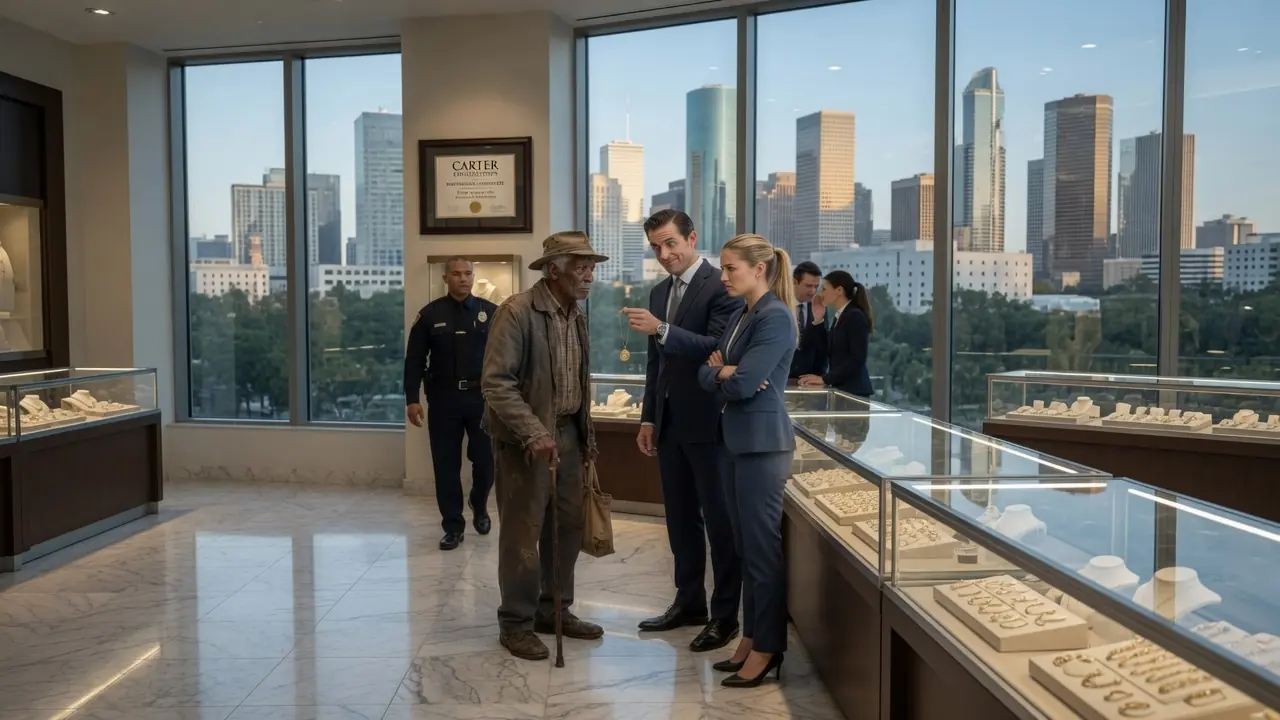
The young sales associate behind the jewelry counter looked at his tan hat, his wooden cane, and the carefully pressed jacket he had owned for nearly twenty years.
Then she gave him a thin professional smile.
“The outlet mall is about fifteen minutes south,” she added. “You might have better luck there.”
For half a second, Elijah wondered whether he had misunderstood her.
Soft piano music drifted from hidden speakers. Diamonds sparkled beneath white display lights. Beyond the floor-to-ceiling windows, downtown Houston glowed beneath a late afternoon sun.
Nothing in the luxurious boutique seemed out of place.
Except, apparently, him.
“I’m not selling anything,” Elijah said.
His voice was calm, but the words cost him more than the associate could possibly know.
“I’m looking for a graduation gift for my granddaughter.”
The associate’s name tag read Hailey Bennett.
She blinked as though the answer surprised her.
“Oh.”
Her eyes moved over him again.
Elijah wore polished brown shoes and a clean Sunday jacket. The cane in his right hand had been carved from walnut by his father almost fifty years earlier. His silver Buick waited in the parking lot outside.
He did not look homeless.
He did not carry merchandise.
He had not asked anyone for money.
Yet Hailey had decided what he was before he spoke.
She glanced toward the glass cases.
“Well, most of our jewelry begins around two thousand dollars.”
Elijah nodded.
“I understand.”
“We also have an online store.”
“I came here because I would like to see the pieces in person.”
At another counter, two employees exchanged looks.
A young man named Derek whispered something to the cashier. The cashier covered a laugh by lowering her head toward the register.
Elijah heard them.
At seventy-two, he had become skilled at hearing what people believed they were saying quietly.
He had heard the same laughter in school hallways in Mississippi.
He had heard it in banks when he requested his first business loan.
He had heard it in conference rooms when men half his age assumed he was the driver rather than the investor.
The words changed.
The meaning rarely did.
Hailey gave an exaggerated sigh and came around the counter.
“What exactly are you looking for?”
“A necklace.”
“For your granddaughter?”
“Yes. Her name is Maya. She graduates next Saturday.”
“What price range?”
Elijah looked toward a display near the center of the boutique.
“I haven’t decided.”
Hailey’s smile tightened.
She walked ahead of him, her heels clicking against the marble floor.
Elijah followed slowly.
The store was called Lux District, a flagship jewelry and fashion boutique occupying the ground floor of Carter Plaza. Its interior had been renovated eighteen months earlier. White marble covered the floor. Brass fixtures framed the glass cases. A curved staircase led to private consultation rooms on the second level.
Elijah had approved the renovation plans himself.
He had not visited since the reopening.
That had been intentional.
Whenever senior leadership announced a visit, stores became perfect for a day. Employees memorized greetings. Managers cleaned neglected corners. Problems disappeared until the important person left.
Elijah preferred to see businesses as ordinary customers saw them.
He had entered quietly that afternoon wearing the same clothes he wore to church.
He had expected to examine the new layout.
He had not expected to become the test.
Hailey stopped beside a display of gold pendants.
“This is one of our more affordable cases.”
Elijah looked at her.
“Affordable for whom?”
She shifted slightly.
“I only meant—”
“I know what you meant.”
Hailey unlocked the case.
Elijah’s eyes moved across several necklaces before settling on a small circular pendant. A fine gold ring surrounded a single diamond. The design was simple, but the stone caught the light each time he changed position.
“That one,” he said.
Hailey lifted the necklace using gloved fingers.
“This is from our Signature Heritage collection.”
“I would like to hold it.”
Her hands paused.
“Store policy requires us to keep high-value pieces on the presentation pad.”
Elijah knew the policy.
It did not say that.
Still, he did not argue.
Hailey placed the pendant on a dark velvet mat.
Elijah leaned closer.
Maya had never cared for large or flashy jewelry. She preferred things with meaning.
The circle reminded him of the promise he made when she was born.
Her mother, Elijah’s only daughter, had died from complications after childbirth. For the first years of Maya’s life, Elijah helped raise her while building a company that demanded nearly every hour he had.
He attended school meetings.
He learned to braid hair badly.
He sat through dance recitals and science fairs.
When Maya was accepted into the University of Houston, she called him before anyone else.
Now she was graduating with honors and planning to attend law school.
Elijah touched the edge of the velvet pad.
“This is the one.”
Hailey looked up.
“You want to purchase it?”
“Yes.”
“This exact necklace?”
Elijah gave her a patient look.
“That is normally what ‘this is the one’ means.”
Derek turned away quickly, hiding another smile.
Hailey recovered.
“Of course. I’ll prepare it.”
She carried the necklace toward the wrapping counter.
Elijah remained beside the display.
From behind him, Derek whispered to the cashier.
“He’s going to ask about layaway.”
The cashier, Lindsey, answered, “Maybe he thinks it’s two hundred, not two thousand.”
They laughed quietly.
Elijah closed his eyes.
His mother’s voice returned to him from decades earlier.
Don’t let strangers tell you who you are, baby. Their ignorance belongs to them. Don’t carry it home.
He had followed that advice most of his life.
But there were days when dignity felt less like strength and more like another burden placed on the person being mistreated.
Why was he always responsible for remaining calm?
Why did the person causing the harm get to make the first mistake while he had to provide the lesson?
Hailey returned with the necklace inside a white box.
“I’ve wrapped it as a gift.”
“Thank you.”
She slid the box toward him.
“You can pay at the main register. For purchases over five hundred dollars, we only accept credit or debit cards.”
Elijah picked up the box.
“That won’t be a problem.”
As he walked toward the register, his cane tapped softly against the marble.
Lindsey put away her phone and straightened.
“Can I help you?”
“I would like to pay for this.”
She opened the box and checked the product number as though verifying that he had not placed something else inside.
“This is the Signature Heritage pendant.”
“Yes.”
The total appeared on the register.
$2,183.74.
Lindsey looked at the screen and then at Elijah.
“Just so you’re aware, this purchase is final after the graduation date if the item has been worn.”
“I understand.”
“And we’ll need to verify the card.”
“Isn’t every card verified when it is processed?”
She gave him a quick smile.
“We’ve had issues before.”
“What kind of issues?”
“Fraud.”
The answer came too quickly.
Elijah reached into his jacket and removed a worn leather wallet.
Lindsey watched every movement.
“We’ve had people try to use stolen cards,” she continued. “You would be surprised.”
“I imagine I would.”
He removed a black charge card and placed it on the counter.
Lindsey’s gum stopped moving.
The card was issued only to a small group of private-banking clients. Its surface carried no printed limit.
She picked it up carefully.
Derek moved closer.
“That can’t be real,” he whispered.
Elijah looked directly at him.
Derek turned toward a display of watches.
Lindsey inserted the card.
The terminal processed for two seconds.
Then it beeped.
APPROVED.
Her posture changed immediately.
“Thank you, Mr. Carter.”
She had read his name from the card.
“Would you like a printed receipt, an email receipt, or both?”
“Both.”
“Of course.”
Her voice had become softer.
More respectful.
Elijah found that change almost more insulting than what came before it.
His money had accomplished in seconds what his humanity had failed to do.
Lindsey placed the receipt inside the shopping bag.
“Thank you for choosing Lux District, Mr. Carter. We hope your granddaughter loves the necklace.”
Elijah accepted the bag.
“I believe she will.”
He turned to leave.
Before reaching the door, he stopped.
The employees watched him.
Elijah looked back at Lindsey.
“You forgot something.”
Her eyes moved toward the counter.
“What did I forget?”
“Respect.”
Lindsey’s face flushed.
“Sir, I didn’t mean—”
“That is what makes it worse.”
He spoke quietly.
No anger.
No raised voice.
“People often think harm only matters when it is intentional. But you decided what I could afford before I opened my wallet. Your coworker decided I might be using a stolen card. The associate at the door decided I was asking for money.”
No one moved.
Elijah continued.
“You did all of that easily. Almost automatically.”
Hailey lowered her eyes.
Derek stared at the floor.
Lindsey opened her mouth, but nothing came out.
Elijah nodded once.
Then he walked toward the doors.
He was almost outside when a man’s voice called after him.
“Mr. Carter, one moment.”
Elijah turned.
The store manager approached from the rear office.
Charles Dalton was forty-seven, tall, and carefully dressed in a tailored navy suit. A gold pin bearing the Lux District emblem rested on his lapel.
Elijah recognized him from quarterly reports and management photographs.
Dalton did not recognize Elijah.
He extended one hand.
“I’m Charles Dalton, the general manager.”
Elijah shook it briefly.
“Is there a problem?”
Dalton’s smile appeared polished but cautious.
“I understand you made a premium purchase.”
“That is correct.”
“We occasionally perform additional verification on large transactions.”
“The card was approved.”
“Yes, of course. This is merely a protection for our customers.”
“Which customers?”
Dalton’s smile weakened.
“All of them.”
“Do you stop every customer after an approved two-thousand-dollar purchase?”
Dalton hesitated.
“We use staff judgment.”
Elijah looked toward Hailey, Lindsey, and Derek.
“Staff judgment appears to be the problem.”
Dalton’s eyes narrowed slightly.
“I’m sure there has been a misunderstanding.”
“No. Your employees understood exactly what they were doing.”
“Sir, if you are unhappy with the service, I would be glad to offer a discount on a future visit.”
Elijah almost laughed.
The manager thought the solution to humiliation was another sale.
“I don’t want a discount.”
“Then perhaps a complimentary cleaning plan for the necklace.”
“I don’t want that either.”
Dalton’s politeness began to thin.
“What would satisfy you, Mr. Carter?”
Elijah studied him.
“Knowing whether this is how your staff treats people every day.”
Dalton folded his hands in front of him.
“I can assure you this store maintains the highest service standards.”
“Can you?”
“Absolutely.”
“Then why did no one intervene?”
Dalton glanced at the employees.
Hailey looked frightened now.
Lindsey stared at the register.
Derek had become very interested in arranging a row of watches.
Dalton returned his attention to Elijah.
“I was not present for the original interaction.”
“You were present when your cashier implied my card might be stolen.”
“I did not hear that.”
“You were standing near the office door.”
Dalton’s expression changed.
Only slightly.
But Elijah saw it.
The manager had heard.
He had chosen not to act until the transaction became unusual enough to require his attention.
“I believe emotions are running high,” Dalton said. “Perhaps it would be best if we continued this conversation another time.”
Elijah looked at him for a long moment.
Then he nodded.
“You may be right.”
Dalton relaxed.
Elijah walked outside.
The Houston heat struck him immediately.
He crossed the parking lot and reached his silver Buick beneath a live oak tree. After placing the shopping bag on the passenger seat, he sat behind the steering wheel.
He did not start the engine.
Through the boutique windows, he saw Dalton speaking to the employees.
Hailey gestured toward the parking lot.
Derek said something that made Lindsey laugh nervously.
Within minutes, the room had begun returning to normal.
That was how these moments usually ended.
The injured person left.
The people responsible explained to one another that he had overreacted.
Then everyone continued as before.
Elijah rested both hands on the cane across his lap.
His mind returned to Jackson, Mississippi, in 1964.
He was twelve years old, standing beside his father outside a hardware store.
His father needed three boxes of nails and a replacement hinge. The clerk refused to serve him at the main counter.
“You people buy through the side window,” the man said.
Elijah remembered his father’s face.
Isaiah Carter did not raise his voice.
He simply placed one hand on his son’s shoulder and said, “Come on.”
Outside, young Elijah asked why they had left.
His father looked back at the store.
“One day,” Isaiah said, “we’ll have our own counter.”
Seven years later, Isaiah opened Carter Hardware in a rented building with a leaking roof.
The store survived for thirty-two years.
It became a place where contractors could buy supplies on credit when banks would not lend to them. Isaiah knew every customer’s name. He treated a child buying one screw with the same attention he gave a builder purchasing lumber for an entire house.
Elijah learned business behind that counter.
He also learned why dignity mattered.
When Elijah later formed a small investment company, he carried his father’s principle into every acquisition.
No customer would be treated as though entering a store were a privilege granted by the employees.
No person would need to display wealth before receiving respect.
At least that had been the promise.
Elijah looked again at Lux District.
The framed certificate behind the main counter was visible through the glass.
A CARTER HERITAGE RETAIL COMPANY
His own name was hanging on the wall while employees bearing that name’s authority treated him as though he did not belong.
His phone vibrated.
A message from Maya appeared.
Don’t forget graduation starts at ten. And no giant church hat when you come onstage.
Elijah smiled despite himself.
He typed:
No promises about the hat.
Then he looked at the necklace bag.
He imagined Maya entering the boutique alone.
She was confident, educated, and outspoken.
But even confidence could not protect a person from a room determined to misunderstand her.
Elijah placed the phone inside his jacket.
He could drive home.
He could call the corporate office and have Dalton dismissed before closing time.
He could send lawyers, investigators, and executives.
But none of those people would understand what happened unless the employees were forced to confront the person they had judged.
Elijah opened the car door.
His cane touched the pavement.
He adjusted his jacket, straightened his hat, and walked back toward the store.
The glass doors opened with a soft chime.
Conversation stopped.
Hailey saw him first.
“He came back,” she whispered.
Lindsey put down her phone.
Dalton stepped from behind the counter.
“Mr. Carter.”
His smile was gone.
“Is there a problem with the necklace?”
“No.”
“Then what can I do for you?”
“You can listen.”
Dalton glanced toward the other customers in the boutique.
“Perhaps we should speak privately.”
“No.”
Elijah’s answer was quiet but immediate.
“You were comfortable allowing the disrespect to happen publicly. The response does not need to be hidden.”
Two customers near the watch section turned toward them.
Dalton lowered his voice.
“I am trying to handle this professionally.”
“So am I.”
Elijah walked toward the main counter.
His cane tapped once, then twice, against the marble.
“I came into this store to buy a graduation gift. Before I spoke, your employee told me soliciting was not permitted. When I explained that I was a customer, she directed me toward cheaper options.”
Hailey’s face reddened.
“I only thought—”
“I know what you thought.”
Elijah looked at Lindsey.
“At the register, I was warned about fraudulent cards before I presented any card.”
Lindsey shook her head quickly.
“That’s standard procedure.”
“No, it is not.”
Dalton stepped forward.
“Mr. Carter, unless you are familiar with our internal policies—”
“I am.”
Something in Elijah’s tone made him stop.
Elijah turned toward the framed certificate behind the register.
“Read that.”
Dalton followed his gaze.
“I beg your pardon?”
“The certificate. Read the company name.”
Dalton stared at it.
“Carter Heritage Retail Company.”
“Again.”
Dalton looked back at Elijah.
“Carter Heritage Retail Company.”
Elijah reached into his jacket.
Derek’s body stiffened, but Elijah removed only a leather card holder.
He placed a business card on the counter.
The embossed lettering caught the light.
ELIJAH M. CARTER
FOUNDER AND EXECUTIVE CHAIRMAN
CARTER HERITAGE HOLDINGS
Dalton’s face became completely still.
Hailey looked at the card.
Then at the certificate.
Lindsey covered her mouth.
Derek stepped backward.
Elijah allowed the silence to settle.
Carter Heritage Holdings owned Carter Plaza.
It held the controlling interest in Lux District’s parent company.
Every lease, payroll account, renovation budget, and executive appointment eventually passed beneath Elijah’s authority.
He had founded the company forty-one years earlier with a ten-thousand-dollar loan secured against his parents’ home.
Now it managed retail properties, hotels, community developments, and investment funds across four states.
Dalton lifted the business card.
His fingers trembled.
“Mr. Carter.”
“Yes.”
“I had no idea.”
Elijah nodded slowly.
“That is the point.”
Dalton’s face lost its color.
“If we had known—”
“You should not have needed to know.”
The sentence struck the room harder than a shout.
Elijah looked at each employee.
“You did not owe respect to the chairman of the company. You owed it to the old man who walked through the door.”
Hailey’s eyes filled with tears.
“Mr. Carter, I am sorry.”
“What are you sorry for?”
She struggled to answer.
“For assuming you were not a customer.”
“Why did you assume that?”
Hailey looked toward Dalton as though hoping the manager might rescue her.
He could not.
“I don’t know,” she whispered.
“Yes, you do.”
Her shoulders lowered.
“I looked at you and decided you couldn’t afford anything here.”
Elijah waited.
“And?”
Hailey swallowed.
“I thought you might be asking customers for money.”
“Had I approached a customer?”
“No.”
“Had I asked anyone for anything?”
“No.”
“Then the judgment came from you.”
She nodded, crying now.
“Yes.”
Elijah turned to Lindsey.
“Why did you mention stolen cards?”
Lindsey’s face had become pale.
“We’ve had fraud before.”
“That was not my question.”
She looked down.
“I assumed the card might not be yours.”
“Before seeing it?”
“Yes.”
“Why?”
Her lips moved, but no sound came.
Derek spoke from the side of the counter.
“We were joking. It got out of hand.”
Elijah looked at him.
“Jokes reveal what people believe when they think no consequence is coming.”
Derek’s face reddened.
“I’m sorry.”
Dalton finally found his voice.
“Mr. Carter, I accept full responsibility. This conduct does not reflect the company’s values.”
Elijah looked toward the expensive store built beneath his name.
“What are company values?”
Dalton seemed confused.
“Respect. Excellence. Inclusion.”
“Those are words.”
“They are principles.”
“No. Principles are what remain when no important person is watching.”
Dalton lowered his eyes.
Elijah continued.
“You heard part of the interaction.”
Dalton hesitated.
“Yes.”
“You heard enough to intervene.”
“Yes.”
“But you did not.”
“No.”
“Why?”
Dalton looked toward the customers now watching.
“I trusted my staff.”
“You protected your staff.”
Dalton did not answer.
“You became concerned only after the card was approved,” Elijah said. “Then you approached me as though the problem might be the purchase rather than the way your employees behaved.”
“I handled it badly.”
“You handled it according to what you believed I was worth.”
The manager’s shoulders dropped.
Elijah had expected anger when he returned.
Instead, he felt tired.
He had no pleasure in watching people become frightened of losing their jobs.
Fear might produce obedience.
It rarely produced understanding.
“I am not firing anyone today,” Elijah said.
Everyone looked up.
Dalton appeared stunned.
“That does not mean nothing will happen.”
Elijah retrieved his business card and placed it back inside the holder.
“Beginning tomorrow, an independent team will review customer complaints, sales practices, employee evaluations, and security reports from this store.”
Dalton nodded quickly.
“Yes, sir.”
“You will not supervise that review.”
His face tightened.
“I understand.”
“All four of you will be interviewed separately. The security recordings from today will be preserved.”
Hailey wiped her eyes.
Elijah looked at her.
“Training may be part of the response, but no one is going to sit through a two-hour presentation, sign a form, and pretend the problem has been solved.”
“What do you want us to do?” she asked.
“I want you to understand the harm before you decide how to repair it.”
He looked toward Dalton.
“This store will establish a community advisory group. Employees will spend time with the people who live around this development, not simply the customers whose clothes make them comfortable.”
Dalton nodded.
“We can arrange that.”
“No. Corporate can arrange meetings. You will have to build trust.”
Elijah picked up the shopping bag.
“Your positions will depend on whether you accept responsibility honestly. Anyone who lies during the review will leave the company. Anyone who treats this only as a public-relations problem will leave too.”
The employees remained silent.
Elijah walked toward the doors.
Before exiting, he turned.
“My father opened a hardware store because another store refused to serve him with dignity. I built this company so people would not need to own the counter before being respected at it.”
He looked at the framed Carter Heritage certificate.
“Today, this store failed that promise.”
No one tried to stop him when he left.
Elijah drove home as the sun lowered over Houston.
His house stood in an older neighborhood lined with live oaks and magnolia trees. It was comfortable but not enormous. The furniture had been collected over decades. Family photographs covered more walls than artwork.
He placed the necklace on the coffee table beside a picture of Maya at age six, sitting on his shoulders during a community parade.
His phone rang.
The caller was his daughter’s widower, Aaron.
“Elijah, are you all right?”
“I’m fine.”
“I heard something happened at Lux District.”
News had traveled quickly.
“One of the customers recorded part of it,” Aaron explained. “It’s already online.”
Elijah closed his eyes.
“I didn’t want a spectacle.”
“You own a retail company. An employee told you to shop at an outlet mall. It was always going to become a spectacle.”
Elijah sat in his favorite chair.
“Does Maya know?”
“Not yet. She’s at graduation rehearsal.”
“Let her have tonight.”
“You should call communications.”
“I already know what they’ll want.”
“A polished statement.”
“A polished statement and a photograph of me shaking hands with everyone.”
Aaron laughed softly.
“You do know them.”
“I don’t want this turned into a story about a wealthy man surprising rude employees.”
“What is it about?”
Elijah looked at the necklace box.
“It is about how they would have treated me if I had been exactly who they assumed I was.”
That evening, the video spread across Houston.
It showed only the final minutes inside the boutique.
Elijah’s calm voice.
Dalton reading the company name.
The business card on the counter.
The sentence that people shared most often was not the revelation that Elijah controlled the company.
It was what he said afterward.
You should not have needed to know who I was.
By morning, television stations had parked vehicles near Carter Plaza.
Elijah’s communications director, Robert Hines, arrived at his house before eight.
Robert carried a laptop, two phones, and the exhausted expression of a man who had not slept.
“We need a statement.”
“I know.”
“The board wants to emphasize that the employees’ behavior does not reflect corporate values.”
“It happened in a corporate store under a corporate manager. It reflects something.”
Robert sat across from him.
“What do you want to say?”
Elijah handed him a single sheet of paper.
The statement contained no praise for Elijah.
No promise that the matter was isolated.
No announcement of immediate firings.
It acknowledged that a customer had been judged by appearance, that management failed to intervene, and that the company would commission an independent review of treatment across every retail location.
The final paragraph read:
Respect offered only after wealth or status is revealed is not respect. Every person who enters one of our businesses must be treated with dignity before we know what they can purchase, whom they know, or what title they carry.
Robert finished reading.
“The board may think this exposes us legally.”
“It exposes what already exists.”
“They’ll want to soften it.”
“Then they can explain publicly why.”
Robert looked at him.
“You planned that sentence.”
Elijah smiled faintly.
“I’ve negotiated with boards longer than you’ve been alive.”
The statement was released before noon.
Carter Heritage also opened a confidential reporting channel for current and former employees and customers.
Within forty-eight hours, more than one hundred responses arrived.
Many were positive.
Some were not.
Several customers described being followed through stores.
A woman said an employee repeatedly asked whether she understood the price of a handbag.
A young man was required to show identification for a return even though another customer at the next counter was not.
Former employees described sales managers who encouraged them to focus attention on customers who “looked ready to spend.”
The problem was larger than one boutique.
Elijah spent the week reading the reports.
With every page, the incident became less personal.
It was no longer only about what happened to him.
It was about a business culture that had learned to disguise bias as customer profiling, security awareness, and luxury service.
On Friday, Elijah attended Maya’s graduation.
He wore the tan hat despite her warning.
When she crossed the stage, he stood and applauded until his hands hurt.
Maya found him outside the auditorium.
Her red graduation gown moved behind her as she ran.
“You wore the hat.”
“I told you I made no promises.”
She hugged him tightly.
Then she stepped back and examined his face.
“You didn’t tell me what happened.”
“It was your graduation week.”
“I saw the video.”
Elijah sighed.
“Of course you did.”
Maya looked angry.
“Grandpa, they treated you like that in your own company.”
“They did.”
“Are you firing them?”
“Maybe some of them.”
“Maybe?”
Elijah removed the white jewelry box from his jacket.
“This is not how I imagined giving you this.”
Maya opened it.
The gold pendant shone in the afternoon light.
Her expression softened.
“It’s beautiful.”
“It is meant to remind you that a circle does not have a beginning or an end. You carry the people who came before you, and one day someone will carry what you leave.”
Maya looked at him.
“Is that why you bought it there?”
“No. I bought it because I thought it would look good on you.”
She laughed through tears.
Elijah fastened the necklace around her neck.
Maya touched the pendant.
“Now answer my question.”
“What question?”
“Why aren’t you firing everyone?”
They walked toward a quieter part of the campus.
“Because I need to know whether they are capable of changing,” Elijah said.
“They humiliated you.”
“Yes.”
“They would have done it to somebody else.”
“They probably have.”
“Then why give them another chance?”
Elijah stopped.
“Accountability and revenge are not the same thing.”
Maya folded her arms.
“I didn’t ask for revenge.”
“No. But firing four people would give the company an easy ending. Everyone would blame them, attend training, and continue exactly as before.”
Maya considered that.
“So you’re investigating the entire company.”
“Yes.”
“And if they don’t change?”
“Then they leave.”
She looked at him.
“You’re more patient than I am.”
“That is not always a virtue.”
“People online are calling you graceful.”
Elijah laughed softly.
“People call you graceful when they are relieved you did not become angry.”
Maya smiled.
“That sounds like something I should put in a law-school essay.”
“You may use it if I receive proper citation.”
The independent review lasted three months.
Charles Dalton was removed as general manager after investigators found that he had ignored four previous complaints about discriminatory treatment.
He was offered a lower-level position outside customer operations if he completed a year-long management program.
He declined and left the company.
Derek resigned during the investigation after denying comments clearly captured by security audio.
Lindsey remained employed but received a final warning and entered a structured development program. She later volunteered to help redesign transaction procedures so verification standards would be applied consistently rather than through employee discretion.
Hailey surprised Elijah.
During her interview, she did not minimize what happened.
She admitted that she had judged him immediately.
She described the assumptions she had carried from family, social media, and previous retail training that taught employees to identify “low-value traffic.”
Then she asked to meet Elijah.
He agreed.
They spoke inside the boutique before opening one morning.
Hailey sat across from him without the blue suit jacket she had worn during their first meeting.
“I keep remembering what I said when you entered,” she told him.
“You should.”
“I was afraid you were going to fire me.”
“Are you still afraid?”
“Yes.”
“Of losing your job?”
She shook her head.
“Of becoming someone who does things like that and doesn’t recognize herself anymore.”
Elijah studied her.
“That is a more useful fear.”
“I don’t expect you to forgive me.”
“This is not about making me feel better.”
“What do I do?”
“You begin by not making your guilt the center of the harm.”
Hailey looked confused.
“Then you listen. You examine the habits that made the judgment feel natural. You correct other people when you see it. And you accept that doing better tomorrow does not erase yesterday.”
She nodded.
“Can I stay?”
“That will depend on your work, not this conversation.”
Hailey stayed.
A year later, she became part of the team that trained new employees on equitable customer service. Elijah refused to allow the company to present her as a redemption story. The work, he said, mattered more than the image.
The framed certificate behind the counter was eventually replaced.
The new sign carried no executive names.
It displayed one sentence:
DIGNITY BEFORE TRANSACTION.
The phrase “Respect is luxury” had appeared online after the incident, but Elijah disliked it.
Respect was not luxury.
Luxury was optional.
Respect was not.
Lux District formed partnerships with neighborhood schools and small businesses. Carter Heritage removed sales incentives that rewarded employees only for serving high-value customers. Customer complaints were reviewed outside local management. Mystery shoppers from different ages, backgrounds, and income levels visited stores without advance notice.
The changes were imperfect.
Some employees resisted.
A few executives complained that the company was reacting too strongly to one incident.
Elijah reminded them that one incident had produced more than one hundred similar reports.
“That is not an exception,” he said during a board meeting. “That is a pattern we were comfortable not seeing.”
Months later, Elijah received a handwritten letter from Hailey.
She had served an elderly woman who entered the boutique wearing a housekeeping uniform. The woman wanted a bracelet for her daughter’s wedding but spoke limited English.
Another employee assumed she was waiting for someone.
Hailey recognized the moment.
She spent forty minutes helping the woman compare pieces. The woman purchased a modest silver bracelet and left smiling.
Hailey wrote:
I almost became the person I was that day again. Then I remembered you standing at the door. I realized change is not one apology. It is a choice that has to be made every time the old assumption returns.
Elijah placed the letter in the same drawer where he kept the receipt for Maya’s pendant.
He did not consider it proof that the problem was solved.
It was evidence that someone had begun the work.
That summer, Maya started law school.
She wore the pendant during her first day of classes.
Before entering the building, she sent Elijah a photograph.
Carrying the circle with me.
Elijah replied:
Walk in like you belong there.
Maya answered:
I do belong there.
Elijah smiled.
That was the difference between her generation and his.
He had spent much of his life proving he belonged in rooms that treated him as a visitor.
Maya entered knowing the room would have to adjust to her presence.
One evening, she joined him on the front porch.
Houston’s heat had softened after sunset. Cicadas filled the trees with their steady rhythm.
“Do you think those employees really changed?” Maya asked.
“Some of them.”
“And the company?”
“A company is always becoming what its people repeatedly allow.”
“That sounds exhausting.”
“It is.”
She touched the pendant at her neck.
“Was it worth going back inside?”
Elijah looked across the yard.
For years, he had believed dignity meant remaining calm enough that no one could accuse him of becoming the problem.
Now he understood something more.
Dignity could also mean refusing to leave the truth unspoken.
“Yes,” he said.
“Because you taught them a lesson?”
“No.”
He looked at Maya.
“Because I reminded myself that peace and silence are not always the same thing.”
Maya leaned her head against his shoulder.
They sat without speaking for a while.
Elijah thought about his father standing outside the hardware store in Mississippi.
Isaiah Carter had dreamed of owning a counter because another man denied him service at one.
Elijah had gone farther.
He built stores, purchased buildings, and created opportunities his father could not have imagined.
Yet ownership alone had not protected the promise.
A company could carry the Carter name and still forget what that name was supposed to mean.
That realization hurt.
It also gave Elijah purpose.
His legacy would not be measured only by revenue, properties, or the number of stores carrying his investments.
It would be measured by what happened when a person without status walked through one of their doors.
The employee would not know whether that person was wealthy.
They would not know whether he was a founder, a laborer, a retiree, or someone who had saved for months to buy one gift.
They should not need to know.
The dignity owed would remain the same.
Elijah looked at the pendant around Maya’s neck.
He had entered Lux District hoping to buy a symbol of everything she had achieved.
Instead, the necklace became a reminder of something larger.
Worth did not appear when a payment was approved.
It did not arrive with a title printed on a business card.
It did not increase when ownership was revealed.
Elijah Carter had been the same man when the associate told him to try the outlet mall as he was when the manager learned who controlled the company.
The only thing that changed was what they knew about him.
And that was exactly why they had been wrong from the beginning.