The Old Man Was Looked Down Upon in a Luxury Hotel — Then the Manager Read the Name on His Passport
The old man entered the Grand Meridian Hotel just after nine on a rain-soaked Thursday night.
Water ran from the shoulders of his weathered coat.
His gray hair clung to his forehead.
In one hand, he carried a scratched leather suitcase with a broken brass buckle. In the other, he held a black umbrella that had already turned inside out twice in the wind.
The hotel lobby looked like another world.
Crystal chandeliers glowed above polished marble.
Fresh white lilies filled a silver vase near the entrance.
A pianist played softly beside the lounge while guests in evening clothes crossed the floor toward the ballroom.
The old man paused beneath the chandelier.
For a moment, he simply looked around.
Then he walked toward the front desk.
The receptionist noticed him immediately.
Her name was Chloe Bennett.
She was twenty-seven, impeccably dressed, and had spent the last three years learning how to identify wealthy guests before they reached the counter.
Expensive luggage.
Tailored clothing.
Private drivers.
Luxury watches.
Those were the signs she trusted.
The old man had none of them.
His shoes were worn.
His coat was faded.
His suitcase looked as though it had survived several decades of train stations, ship decks, and airport conveyors.
Chloe offered the kind of smile hotel employees used when they wanted someone to leave without creating a scene.
“Good evening, sir.”
“Good evening.”
His voice was quiet but clear.
“I’d like a room.”
Chloe glanced toward the entrance.
There was no chauffeur waiting outside.
No assistant following him.
No porter carrying additional bags.
“Do you have a reservation?”
“No.”
“I’m afraid we’re nearly full tonight.”
The old man looked toward the ballroom doors.
“A conference?”
“A charity gala.”
“I see.”
Chloe tapped the keyboard, though she had not yet entered a search.
“There’s a motel about ten minutes east of here. It may be more suitable.”
The old man looked at her.
“Suitable in what way?”
Chloe hesitated.
“More affordable.”
A young couple waiting nearby heard the answer.
The man looked at the old suitcase and smirked.
His companion whispered something, then laughed softly behind her hand.
The old man heard.
He said nothing.
“My understanding is that this is a hotel,” he said.
“Yes, sir.”
“And hotels rent rooms.”
“When available.”
“Then perhaps you could check.”
Chloe’s smile tightened.
She pressed several keys.
Standard rooms were available.
So were three executive suites.
The Presidential Suite, occupying most of the top floor, had not been reserved.
But Chloe did not mention any of them.
“We have very limited availability.”
“How limited?”
“Only premium accommodations remain.”
“That will be fine.”
Chloe studied him.
“The rates are considerably higher than a normal room.”
The young man nearby laughed again.
The old man turned slightly.
The couple immediately pretended to study a painting.
Chloe lowered her voice.
“There is a budget hotel near the train station. It’s clean and perfectly respectable.”
“I didn’t ask for a recommendation.”
“No, sir.”
“I asked for a room.”
The exchange had begun attracting attention.
A bellman stopped near the entrance.
Two guests in the lounge looked toward the desk.
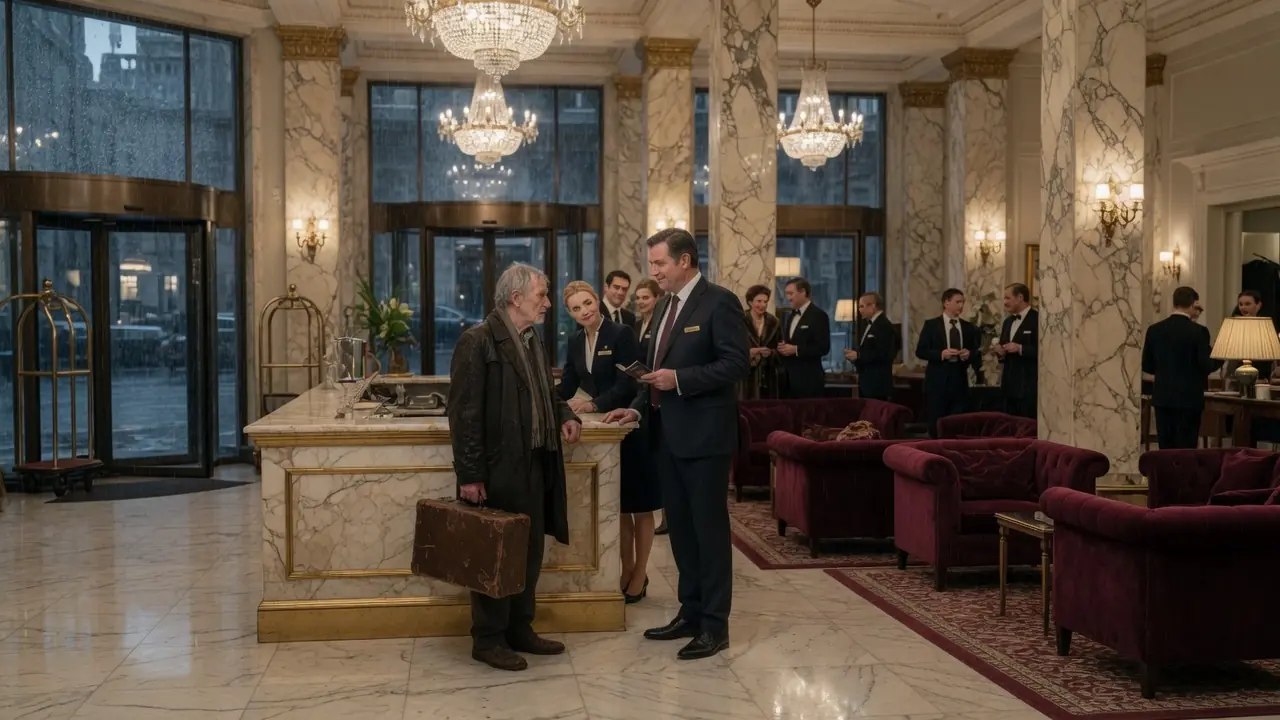
Behind Chloe, another receptionist named Maya Patel watched with growing discomfort.
Maya had started at the Grand Meridian only six weeks earlier. She had been trained to greet every visitor and never assume what a guest could afford.
But she had also been warned not to contradict senior staff in front of customers.
The old man set his suitcase beside the desk.
“What is your best available room?”
Chloe looked at him as if he had misunderstood the situation.
“Our best room?”
“Yes.”
“The Presidential Suite.”
“I’ll take it.”
For one second, the lobby went quiet.
Then the young couple laughed openly.
The man shook his head.
“Presidential Suite.”
His companion lifted her phone as if she might record what happened next.
Chloe’s expression changed from polite dismissal to annoyance.
“Sir, the Presidential Suite is eight thousand dollars per night.”
The old man removed a wallet from his coat.
“And?”
“That does not include taxes, service charges, or the security deposit.”
“I understand.”
“You would also need to provide a valid credit card.”
He placed a dark metal card on the counter.
Chloe looked at it.
She did not recognize the design.
There was no visible bank logo on the front, only a small silver crest.
She assumed it was some kind of membership card.
“This may not be accepted.”
“You haven’t tried it.”
The hotel manager stood across the lobby near the concierge desk.
Richard Cole was forty-six and had managed the Grand Meridian for seven years.
He had watched the entire exchange.
He noticed Chloe’s tone.
He heard the laughter.
He saw Maya’s discomfort.
He chose not to intervene.
Richard believed luxury service required discretion.
He also believed certain people did not belong in certain places.
As long as Chloe encouraged the old man to leave quietly, there was no reason for him to become involved.
Then the old man looked directly at him.
“You’re the manager?”
Richard had no choice now.
He approached with a controlled smile.
“Richard Cole, general manager.”
The old man nodded.
“I would like the Presidential Suite.”
Richard looked at the card.
Then at the suitcase.
“May I ask the purpose of your stay?”
“Rest.”
“Are you attending the gala?”
“No.”
“Do you have business in the city?”
“I do.”
Richard waited for more.
The old man offered nothing.
“The suite is generally reserved for heads of state, celebrities, and our most distinguished guests.”
“Is it occupied?”
“No.”
“Then I fail to see the problem.”
Richard lowered his voice.
“The problem is ensuring that every transaction is legitimate.”
The old man’s eyes sharpened.
“You believe mine is not.”
“I didn’t say that.”
“You didn’t need to.”
Maya looked toward the manager.
She expected him to correct the situation.
Instead, Richard nodded toward Chloe.
“Run the card.”
Chloe inserted it into the terminal.
The screen paused.
Then displayed a request for senior authorization.
She looked at Richard.
“It requires manager approval.”
Richard entered his code.
A second message appeared.
VIP ACCOUNT — VERIFY IDENTITY DIRECTLY WITH EXECUTIVE OFFICE.
Richard frowned.
“What kind of card is this?”
The old man looked at him.
“One that pays its bills.”
Richard removed it from the terminal.
“We need identification.”
The old man reached into the inside pocket of his coat.
He placed a passport on the counter.
The cover was worn at the edges.
Richard opened it.
He looked first at the photograph.
Then at the name.
His expression changed.
Not dramatically at first.
His eyes narrowed.
Then he looked again.
The color slowly drained from his face.
The name printed inside was:
ARTHUR EDWARD WHITMORE.
Richard stopped breathing for a moment.
Chloe leaned closer.
“Is something wrong?”
Richard did not answer.
He turned to the old man.
“Mr. Whitmore?”
The old man waited.
Richard looked toward the gold crest embossed on the metal card.
He recognized it now.
The Whitmore Hospitality Group private account.
Only five such cards existed.
One belonged to the chairman.
Another to the chief executive.
The original belonged to the founder.
Arthur Whitmore.
The man standing at the desk was not merely wealthy.
He had founded the company that owned the Grand Meridian Hotel and twenty-seven other luxury properties across Europe and North America.
His portrait hung in the executive conference room on the twenty-third floor.
But the photograph had been taken nearly thirty years earlier.
In it, Arthur had dark hair, a broad smile, and wore a formal suit.
The staff saw the portrait during orientation.
Few looked at it for more than a second.
None expected the man in the photograph to arrive alone in a wet coat carrying an old suitcase.
Richard closed the passport carefully.
“Mr. Whitmore, I sincerely apologize.”
The laughter in the lobby stopped.
The young couple lowered the phone.
Chloe stared at the passport.
Her mouth opened slightly.
Arthur looked at Richard.
“For what?”
Richard hesitated.
“For the misunderstanding.”
“What was misunderstood?”
Richard’s discomfort deepened.
“You were not immediately recognized.”
Arthur glanced toward Chloe.
“She understood what she saw.”
Chloe’s face turned pale.
Arthur continued.
“She saw old clothes. Wet shoes. Cheap luggage.”
His voice remained calm.
“She understood that perfectly.”
Richard lowered his head.
“We should have treated you differently.”
Arthur looked directly at him.
“No.”
The word carried across the marble lobby.
“You should have treated me exactly the same.”
Nobody moved.
The pianist had stopped playing.
Guests near the ballroom doors turned toward the front desk.
Arthur placed one hand on the old suitcase.
“I asked for a room.”
“Yes, sir.”
“I was told to find a cheaper hotel.”
Richard looked toward Chloe.
She began speaking quickly.
“I was only trying to be helpful.”
Arthur turned to her.
“Were you?”
She swallowed.
“I thought the rate might be beyond—”
“Beyond what?”
Chloe stopped.
Arthur waited.
“My budget,” he finished for her.
She lowered her eyes.
“Yes.”
“How did you calculate it?”
“I didn’t.”
“No.”
Arthur looked at her uniform.
“You calculated my worth from my clothing.”
“I’m sorry.”
He nodded.
“I believe you are sorry now.”
The words landed more heavily than anger.
Maya stood silently at the other end of the desk.
Arthur noticed her.
“What would you have done?”
Maya froze.
Richard looked toward her.
She answered carefully.
“I would have checked availability.”
“Why?”
“Because you asked for a room.”
Arthur nodded.
“And if the card failed?”
“I would have explained the problem privately.”
“And if I could not pay?”
“I would have helped you find another place without humiliating you.”
Arthur studied her.
“Thank you.”
“Mr. Whitmore, the Presidential Suite will be prepared immediately. Naturally, there will be no charge.”
Arthur’s eyes returned to him.
“Why not?”
“As an apology.”
“I can afford the room.”
“Of course.”
“Then charge me the listed rate.”
Richard looked confused.
Arthur continued.
“If you remove the bill because you know who I am, you repeat the same mistake.”
Richard said nothing.
Arthur picked up the metal card.
“Before you recognized the name, you thought I deserved less.”
He placed it back on the counter.
“Now you think I deserve more.”
His gaze moved across the staff.
“Neither is service.”
The young couple near the lobby began moving toward the ballroom.
Arthur looked at them.
“You may keep recording.”
They stopped.
The woman’s face reddened.
“We deleted it.”
“That was not necessary.”
“We’re sorry.”
Arthur studied them.
“Are you sorry because laughing was cruel or because you discovered who I am?”
Neither answered.
He nodded.
“That question may be useful later.”
Richard motioned toward the bellman.
“Please take Mr. Whitmore’s luggage.”
Arthur placed one hand on the suitcase.
“No.”
“Sir?”
“I can carry it.”
The bellman looked embarrassed.
Arthur softened.
“You may walk with me.”
The man nodded.
Richard began issuing instructions.
“Prepare the Presidential Suite. Send champagne, dinner, and—”
“No champagne,” Arthur said.
“Of course.”
“No special gifts.”
“Yes, sir.”
“No flowers.”
Richard stopped.
Arthur looked toward the lilies in the lobby.
“My wife preferred wildflowers.”
A small silence followed.
The staff knew Arthur Whitmore had stepped away from public life after his wife died five years earlier.
Few knew anything else.
Arthur had spent the previous six months traveling quietly among Whitmore properties.
No official visits.
No executive announcements.
No private jets or entourages.
He arrived as ordinary guests arrived.
Sometimes by train.
Sometimes in hired cars.
Once by bus.
He wanted to understand what the company had become when nobody expected the founder to be watching.
The Grand Meridian was the eighth hotel he visited.
It was also the first where staff advised him to sleep elsewhere before checking whether a room existed.
Richard escorted him toward the elevator.
Arthur stopped near the lounge.
An elderly woman sat alone beside a column, adjusting a bandage around her ankle. Her suitcase rested several feet away.
A server passed without noticing.
Arthur looked toward Richard.
“How long has she been waiting?”
Richard glanced at the woman.
“I don’t know.”
Arthur approached her.
“Are you all right?”
She looked up.
“My taxi canceled. I’m trying to reach my son.”
“Has anyone helped you?”
“I asked at the desk.”
“What did they say?”
“They told me the concierge was busy.”
Richard’s face tightened.
Arthur motioned toward the bellman.
“Please bring her luggage.”
Then he asked Maya to arrange a car and provide the woman somewhere comfortable to wait.
Maya moved immediately.
Arthur looked at Richard.
“Luxury begins when someone notices discomfort before being asked twice.”
“Yes, sir.”
They entered the elevator.
On the top floor, the Presidential Suite stretched across nearly four thousand square feet.
Floor-to-ceiling windows overlooked the city.
A grand piano stood near the dining area.
The marble bathroom contained a deep soaking tub, heated floors, and fixtures imported from Italy.
Arthur walked through the rooms slowly.
Richard followed.
“Is everything satisfactory?”
Arthur touched the edge of a table.
Dust marked his finger.
Richard’s expression changed.
“The room was inspected this afternoon.”
“Poorly.”
“Yes.”
Arthur entered the bedroom.
A small seam had separated along one curtain.
A lamp leaned slightly.
One electrical outlet was cracked.
Most guests would never notice.
Arthur did.
He had spent his career believing luxury existed in details no one should be forced to complain about.
He looked toward Richard.
“When did you last walk through this suite before a guest arrived?”
Richard hesitated.
“Our housekeeping director handles inspections.”
“That wasn’t the question.”
“Several months.”
Arthur nodded.
“You manage reports.”
Richard waited.
“You do not manage the hotel.”
The same words Samuel had once said to a salesman in another place might have sounded similar, but Arthur’s meaning was exact.
Richard knew occupancy numbers.
Revenue.
Guest-spending patterns.
Staffing ratios.
He did not know what happened in his lobby when an elderly woman needed a taxi.
He did not know how receptionists spoke to people carrying cheap luggage.
He did not know the Presidential Suite had dust on the table.
“Come to breakfast at seven,” Arthur said.
“In the executive dining room?”
“The staff cafeteria.”
Richard looked surprised.
“Yes, sir.”
Arthur closed the bedroom door.
For the first time that night, he was alone.
He removed the weathered coat and hung it carefully.
Then he opened the old suitcase.
Inside were three shirts, a shaving kit, a notebook, and a framed photograph of his late wife, Eleanor.
The suitcase had belonged to her father.
Eleanor refused to replace it even after the buckle broke.
She said luggage should show where it had traveled.
Arthur placed her photograph beside the bed.
“You would have hated that lobby,” he said quietly.
Then he looked toward the city.
Eleanor had helped him open the first Whitmore hotel in 1971.
It was a thirty-two-room inn beside a railway station.
They cleaned rooms themselves.
Cooked breakfast.
Carried luggage.
When travelers could not afford a room during winter, Eleanor often placed them in the small apartment above the kitchen.
Arthur used to object.
Then he added two more beds.
Their philosophy was simple.
A luxury hotel could charge for quality.
It could never charge people with surrendering their dignity.
Somewhere during expansion, that idea had become a sentence printed in company manuals nobody truly read.
At seven the next morning, Richard entered the staff cafeteria.
Arthur was already there.
He sat with kitchen workers, housekeepers, bellmen, and maintenance employees.
His weathered coat hung behind his chair.
A tray containing eggs, toast, and coffee rested in front of him.
Most employees did not know who he was.
Arthur preferred that.
A dishwasher named Luis complained that the freight elevator had failed three times that month.
A housekeeper said supervisors reduced room-cleaning times while increasing inspection standards.
A night receptionist described guests verbally abusing staff while managers apologized to the guests.
Richard stood near the entrance listening.
Arthur motioned toward an empty chair.
“Sit.”
Richard obeyed.
“Do you eat here often?” Arthur asked.
“No.”
“Why?”
“I usually have meetings.”
“So do they.”
Arthur looked toward the workers.
“But their meetings involve beds, dishes, repairs, and angry guests.”
Richard looked around.
Several employees avoided his eyes.
Arthur opened his notebook.
“How many staff vacancies?”
“Twenty-three.”
“Thirty-one,” said a housekeeper across the table.
Richard turned.
She lowered her eyes.
Arthur wrote the number.
“How many reported elevator failures?”
Richard answered.
“Four.”
Luis shook his head.
“Eleven.”
Arthur wrote again.
“How many complaints about discriminatory treatment in the lobby during the previous year?”
Richard stiffened.
“I’m not aware of any.”
Maya entered carrying a folder.
“I found seven.”
Everyone looked toward her.
Richard’s expression hardened.
Arthur noticed.
“Continue.”
Maya placed the folder on the table.
“Two guests said staff assumed they could not pay. One family said they were ignored while later arrivals were helped. A delivery driver was removed from the lobby while waiting for roadside assistance.”
“What happened to the complaints?” Arthur asked.
Maya looked toward Richard.
“They were marked resolved.”
“By whom?”
Richard answered.
“Guest relations.”
“Were staff interviewed?”
“I would need to check.”
Arthur closed the notebook.
“You already checked.”
Richard said nothing.
The investigation began that morning.
Arthur called the group’s executive office and ordered a full review of the Grand Meridian.
Not only the incident involving him.
Everything.
Security footage.
Complaints.
Hiring.
Promotions.
Guest feedback.
Employee turnover.
Service patterns.
Financial incentives.
Within a week, investigators found the problem was larger than one receptionist.
Staff had been informally trained to identify “high-value” guests before offering premium service.
Arrival vehicle, clothing, luggage, age, profession, accent, and perceived social status all influenced treatment.
Guests considered less profitable waited longer.
They received smaller rooms even when upgrades were available.
Some were discouraged from entering public areas.
Others were quietly directed toward cheaper hotels.
Managers called this protecting the brand.
Arthur called it discrimination disguised as strategy.
Richard had not written the unofficial rules.
But he allowed them.
He rewarded employees who attracted visibly wealthy customers.
He ignored complaints when revenue remained high.
He praised polished appearances while treating patience and empathy as secondary skills.
Chloe had learned exactly what the hotel taught.
That did not excuse her.
But it meant firing her alone would solve almost nothing.
Arthur met with her three days later.
She entered the conference room looking exhausted.
“Am I being terminated?”
Arthur looked toward the empty chair.
“Sit.”
She did.
“Why did you suggest the motel?”
“I assumed you couldn’t afford the Grand Meridian.”
“Why?”
“My judgment was poor.”
“That is not an explanation.”
Chloe looked down.
“At this hotel, we’re told to identify serious guests quickly.”
“Who told you?”
“Senior staff. Not in writing.”
“What is a serious guest?”
“Someone likely to spend.”
“And you believed I was not.”
“Yes.”
“Did you enjoy humiliating me?”
Her eyes filled.
“No.”
“You smiled.”
“I was nervous.”
“The guests laughed.”
“I should have stopped them.”
“Yes.”
Arthur waited.
Chloe took a breath.
“I became someone I don’t like.”
“That happened over time.”
She looked up.
“Yes.”
“Can it change over time?”
“I hope so.”
Arthur did not fire her immediately.
He removed her from the front desk and placed her in a six-month retraining program that included work with housekeeping, maintenance, reservations, accessibility services, and night operations.
She would return to guest-facing duties only if every department recommended it.
Some executives objected.
They believed dismissal would send a stronger message.
Arthur disagreed.
“Punishment makes an example,” he said. “Learning changes a person.”
Richard’s situation was different.
He had authority.
He saw the behavior.
He remained silent.
The investigation also found he had altered complaint summaries and pressured staff to prioritize wealthy guests.
He was removed as general manager.
Arthur offered him a nonmanagement operations role at another hotel after completing leadership training.
Richard refused.
He resigned instead.
Maya became interim guest-services supervisor.
She protested.
“I’ve worked here six weeks.”
Arthur nodded.
“And in six weeks, you remembered more about service than people who worked here six years.”
“I don’t know enough.”
“Good.”
She looked confused.
“People who know they have more to learn usually listen.”
Maya accepted the temporary role.
The Grand Meridian changed gradually.
The hotel removed internal guest-value rankings.
All visitors received the same initial welcome regardless of clothing or transportation.
Employees were trained to offer alternatives without humiliation when rooms were unaffordable.
Lobby staff were given authority to assist stranded travelers, elderly visitors, and people needing temporary shelter from severe weather.
Employee evaluations included how they treated people who never purchased anything.
Arthur also created a simple rule.
Every manager had to spend one full shift each month working beside frontline staff.
Checking rooms.
Carrying luggage.
Answering late-night calls.
Serving breakfast.
Listening.
Several managers complained privately.
Arthur heard about it.
He increased the requirement to two shifts.
A month after his arrival, he returned to the lobby wearing the same weathered coat.
The repaired suitcase remained in his hand.
This time, no one had been warned.
A new receptionist looked up.
“Good evening, sir. Welcome to the Grand Meridian.”
“Thank you.”
“May I help with your suitcase?”
“I can manage.”
“Of course. Do you have a reservation?”
“No.”
“I’ll check availability.”
The receptionist entered the request without looking at Arthur’s clothes again.
“We have a standard king room, an executive suite, and the Presidential Suite.”
“What would you recommend?”
“That depends on what would make your stay comfortable.”
Arthur smiled.
“A standard room will be fine.”
She completed the booking.
Then she noticed water on his coat.
“Would you like a towel or something warm to drink?”
“Tea.”
“I’ll have it sent up.”
Arthur looked toward Maya, standing near the concierge desk.
She did not approach him.
She did not announce his identity.
She simply watched the interaction and returned to helping another guest.
That pleased him more than a public welcome would have.
Arthur spent the night in room 614.
The heating worked.
The curtains closed properly.
The table held no dust.
At breakfast, he saw Chloe clearing plates in the staff dining area.
She noticed him and froze.
Arthur walked toward her.
“How is the training?”
“Hard.”
“Good.”
She smiled faintly.
“I worked with housekeeping last week.”
“What did you learn?”
“That cleaning twenty rooms is harder than judging people from behind a desk.”
Arthur nodded.
“And this week?”
“Maintenance.”
“Be careful. They may give you real tools.”
“They already did.”
She hesitated.
“I am sorry, Mr. Whitmore.”
“I know.”
“Not because of who you are.”
Arthur studied her.
“Why, then?”
“Because you were cold and tired, and I tried to make you feel ashamed for entering.”
He nodded once.
“That apology I accept.”
Arthur stayed involved with the company for two more years.
Then he retired formally.
At the farewell dinner, executives praised his business judgment, courage, and vision.
Arthur found the speeches too polished.
Maya, now the Grand Meridian’s general manager, gave him a small gift instead.
The old motel recommendation card once kept beneath the reception desk.
It had been framed.
Below it was a new company principle:
NEVER USE HELP TO TELL SOMEONE THEY DO NOT BELONG.
Arthur laughed when he saw it.
Eleanor would have approved.
Years later, staff still told the story of the wet old man who entered carrying a damaged suitcase and requested the Presidential Suite.
Most versions focused on the moment Richard opened the passport.
The sudden silence.
The manager’s pale face.
The discovery that the unwanted traveler owned the hotel group.
But Arthur believed the passport was the least important part.
His name changed how people treated him.
That was precisely what was wrong.
Before the passport opened, he was an elderly man soaked by rain.
He was tired.
He needed a room.
He deserved courtesy then.
Not because he had founded the company.
Not because he was wealthy.
Not because his signature could end careers.
Because he was standing at the desk asking for help.
The name in the passport revealed who owned the hotel.
The way the staff treated him before reading it revealed what the hotel had become.