Margaret Dawson had heard nearly every version of the same warning by the time she carried the third salvaged plank down to the old footbridge. The bridge had been closed for almost three years, and in Willow Creek most people had stopped thinking of it as anything more than a weathered skeleton over a narrow creek. Henry Bell, who had farmed the valley longer than Margaret had been alive, stopped on the path that morning and reminded her that there was a wagon crossing five miles north. Margaret shifted the board on her shoulder and told him that five miles was not a small distance for everyone.
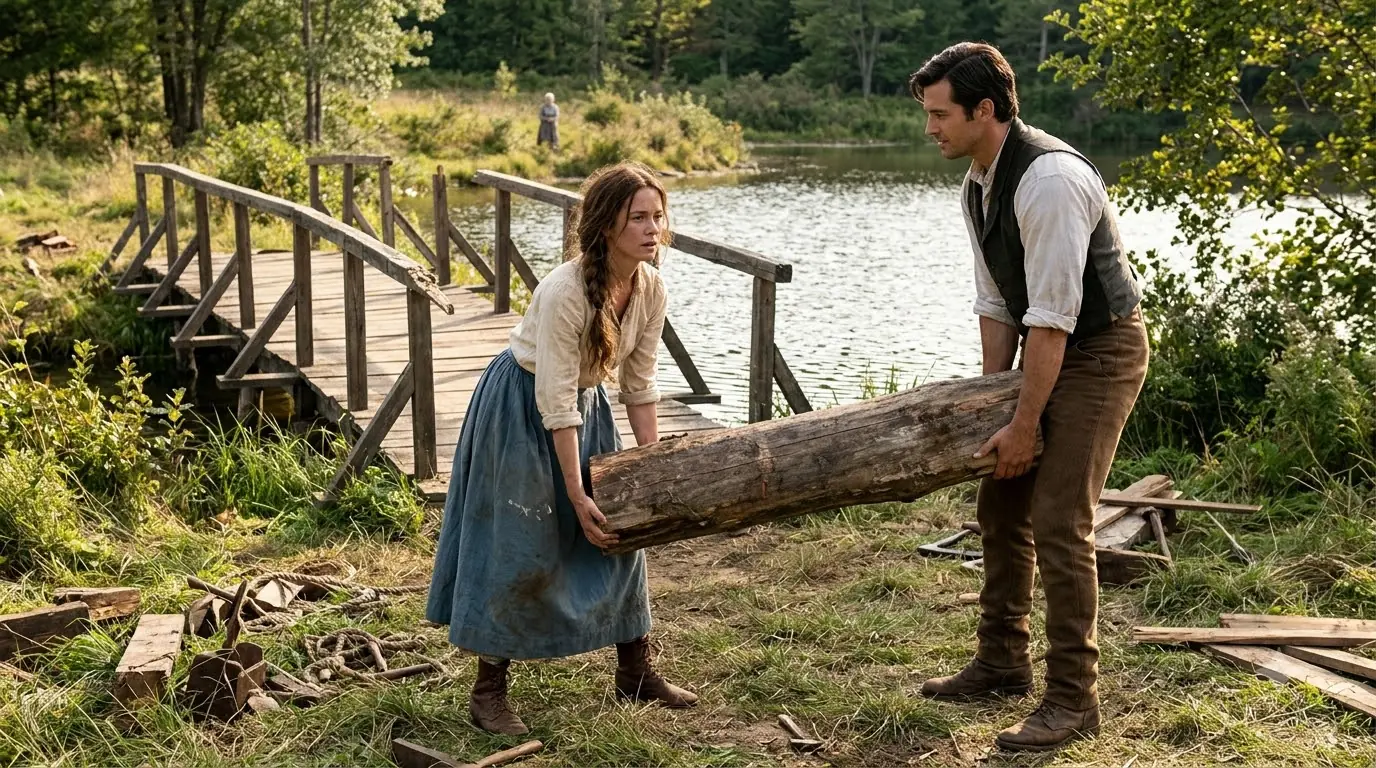
Henry gave her the long look people often gave when they thought she was being stubborn. He pointed out the missing boards, the leaning railing, the supports softened by rain and snow, and said there were better ways to spend useful lumber. Margaret knew he was not trying to be cruel, but she had already heard the same argument from half the town. She answered only that she had made up her mind. Henry shook his head, told her not to fall through, and continued toward his farm.
At twenty-six, Margaret had grown used to people speaking about her choices as though they were public property. She was unmarried, lived alone in the small cottage her parents had left her, and supported herself by sewing, mending, keeping accounts for neighboring farms, tending a kitchen garden, and accepting whatever honest work appeared. Her father had been a farmhand and carpenter, the kind of man who could repair a gate, straighten a chair, hang a door in a crooked frame, or turn discarded wood into something useful. He had taught Margaret to measure carefully, waste little, and never abandon a thing merely because saving it required patience.
Her father had been gone four years, her mother even longer. Margaret still kept his old wooden plane above the hearth and used his hammer whenever she trusted herself not to become lost in memory. The bridge had reminded her of him from the beginning because it looked like the kind of object he would have studied instead of dismissed. For three years she had watched it decay and thought that someone ought to repair it. Then one morning she had remembered the question her father always asked whenever someone said that someone ought to do something: why not you?