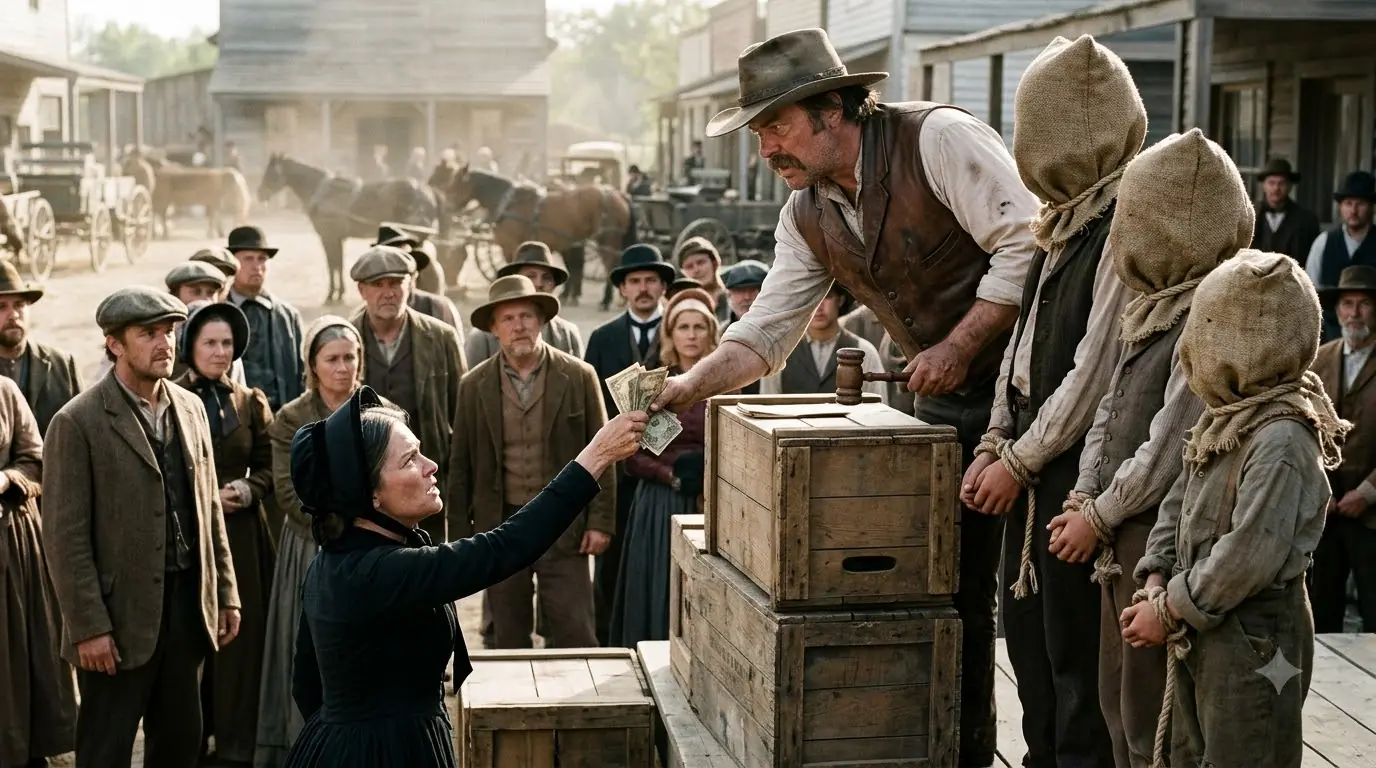
The auctioneer's hammer struck wood like thunder. Three orphan boys, $3 each. In the dusty Missouri town square, children stood with burlap sacks over their heads, hands bound with rope. Clara Boon pushed through the horrified crowd her widow's dress, still black from mourning.
When she bought all three boys without hesitation, the smallest one whispered through his sack, "Mrs. Boon!" He'd never seen her face, never heard her name, yet he knew her. How could a child she'd never met know exactly who she was? The morning sun cast long shadows across Hartsville's main street as Clara Boon stood at her husband's grave, pressing her weathered fingers against the cold stone.
Three years had passed since pneumonia took Samuel, leaving her with 40 acres of Missouri farmland, and a silence so heavy it pressed against her chest each morning when she woke. "Another day, Sam,"she whispered to the headstone, arranging fresh wild flowers she'd picked from the meadow behind their barn. "The corn's coming in strong this year. You'd be proud."
But Samuel couldn't answer, and Clara knew she was merely talking to herself again, as she had every morning for the past thousand days. At 52, with no children and no family within 500 miles, she'd become a ghost haunting her own life. The walk back to town took her past the Hendersons' farm, where children's laughter spilled over the fence posts like water over stones. She quickened her pace. The general store would be opening soon, and she needed supplies for the week ahead.
Flower salt, perhaps some new thread to mend the torn curtains in the parlor that she never used anymore. Main Street bustled with its usual Saturday morning crowd. Farmers brought their goods to market wives clustered around the milliner's window display, and the smell of fresh bread from Willer's bakery made Clara's stomach remember she hadn't eaten since yesterday noon. She'd simply forgotten again. But something was different this morning.
A crowd had gathered near the courthouse steps, their voices carrying a mixture of outrage and morbid curiosity. Clara noticed Martha Phillips, the minister's wife, pressing a handkerchief to her mouth, her face pale as winter cream. "It's ungodly," Martha was saying to anyone who would listen. "Selling children like cattle in broad daylight, no less." Clara's feet moved before her mind could process the words.
She pushed gently through the crowd, her black dress parting the colorful fabrics like a shadow through light. What she saw at the center of the gathering stopped her heart midbeat. A man in a stained leather vest stood on a makeshift platform, nothing more than old shipping crates stacked together. Beside him, three boys stood in a line. Burlap sacks covered their heads tied loosely at the neck.
Their hands were bound in front of them with coarse rope, and their clothes, if the tattered rags could be called such, hung from their thin frames like Spanish moss from dying trees. Ladies and gentlemen,"the man called out his voice, carrying the smooth oil of a practiced salesman, and the underlying rot of someone who'd sold his soul long ago. "Three strong boys, orphans, all ready for work. No family to come claiming them no pass to haunt your doorstep. $3 each, or eight for the lot."