The notice remained on the trading post wall for twenty-three days.
By then, the brown paper had curled at the corners, rain had blurred two words, and someone had drawn a mustache beneath the final line.
COOK WANTED.
Room and meals provided at Mercer Ranch, east of Cedar Hollow.
Must tolerate silence.
Men waiting for supplies read it and laughed.
Women buying flour shook their heads.
Everyone in Cedar Hollow knew Nathaniel Mercer.
They knew about his ranch, his temper, and the wife who had left him nearly a decade earlier.
Most agreed that cooking for Nathaniel would require more courage than chasing cattle through a hailstorm.
No one answered.
Then, on an October morning cold enough to silver the fence grass with frost, a wagon appeared on the road leading to Mercer Ranch.
Nathaniel saw it from the porch.
It was not a proper emigrant wagon.
It was an old farm cart with canvas stretched across bent wooden hoops. One wheel leaned slightly outward. The mule pulling it looked tired enough to lie down in the road and let winter take him.
Nathaniel set down his coffee.
He was forty-four years old, broad through the shoulders and heavy in the hands, with pale blue eyes that had learned not to expect anything pleasant from approaching strangers.
His ranch covered nearly three hundred acres of Colorado grazing land. A creek bordered the southern pasture. Low foothills rose to the north. Sixty-seven cattle occupied most of his attention and all of his patience.
The property contained a solid house, a barn, a bunkhouse, a corral, a chicken shed, and a root cellar.
Everything a ranch needed.
And almost no one to use it.
Nathaniel had once employed three ranch hands. He dismissed them one by one as cattle prices fell and his need for company disappeared.
He told himself he preferred solitude.
In truth, solitude had become easier than disappointment.
The wagon stopped near the gate.
A woman climbed down.
She was perhaps thirty-two, with dark brown hair twisted into a practical knot and a face made more striking by exhaustion rather than beauty. Her faded blue dress was clean. Her boots were worn but carefully repaired. Her hands carried the roughness of someone who had spent years working without being noticed.
Three children emerged behind her.
The oldest was a boy of eleven with serious eyes and a thin body held unnaturally straight.
The second was a girl of eight whose brown curls had escaped every pin meant to contain them.
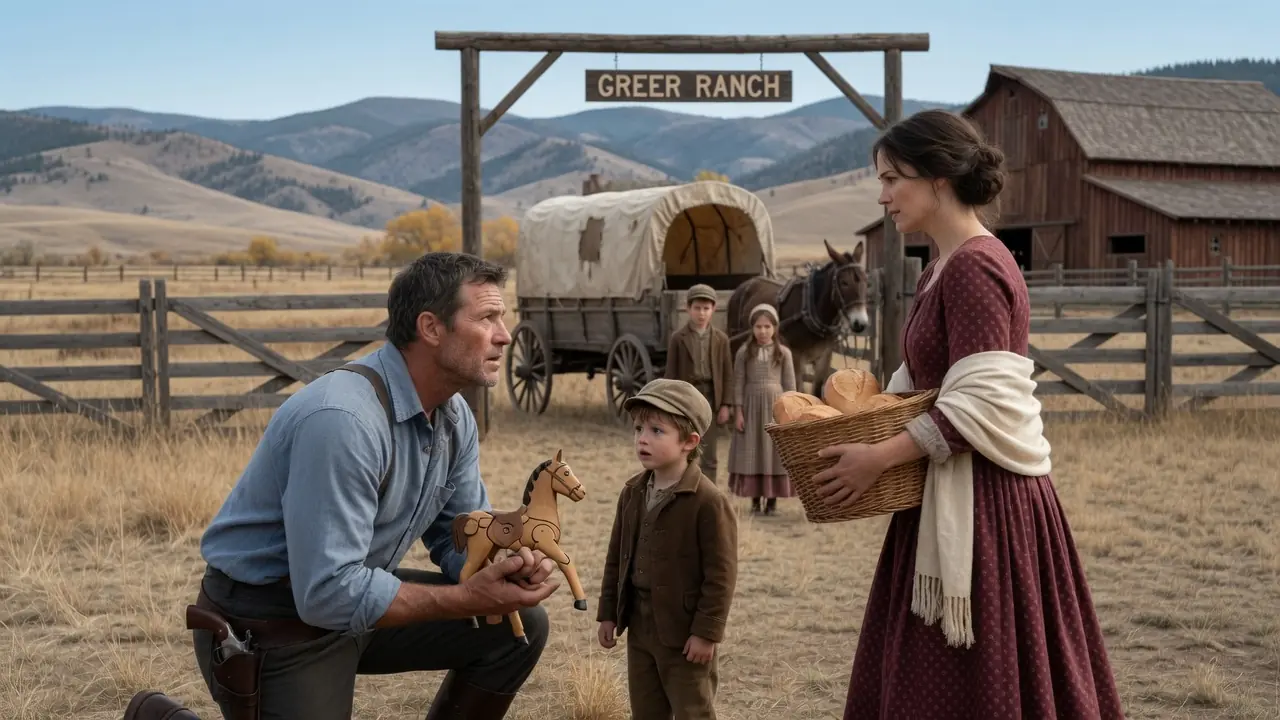
The youngest was a four-year-old boy holding a wooden horse by one chipped leg.
The woman approached the porch.
Nathaniel did not move to meet her.
“You lost?” he asked.
“No.”
Her voice was calm.
“I’m here about the notice.”
Nathaniel looked toward the wagon.
“You can cook?”
“Yes.”
“You have references?”
“No.”
“Experience?”
“Fifteen years.”
“Where?”
“In every house I ever lived in.”
Her answer nearly pulled a smile from him.
Nearly.
Nathaniel looked again at the children.
“I asked for one cook.”
“You would be hiring one cook.”
“And receiving four mouths.”
“I expect wages to cover our needs.”
“The notice says room and meals.”
“It does.”
“Then I have not misunderstood it.”
Nathaniel folded his arms.
The oldest boy watched him carefully.
The girl had already begun examining the chicken shed.
The youngest lifted his wooden horse as though presenting official identification.
The woman continued.
“My name is Clara Dawson. This is Matthew, Ruth, and Peter.”
Nathaniel nodded once.
“Children make noise.”
“Yes.”
“My notice said silence.”
“I noticed.”
“Can they tolerate it?”
Clara glanced toward Peter, who had begun whispering to his wooden horse.
“No.”
Nathaniel looked toward the empty bunkhouse.
For nine years, he had arranged his life so thoroughly against intrusion that even birds seemed reluctant to land near the porch.
He wanted meals.
He did not want children.
He did not want small boots by the door, questions at breakfast, or laughter crossing the yard.
He did not want to care whether another wagon someday left.
“Can you make biscuits?” he asked.
Clara’s expression did not change.
“Yes.”
“Good ones?”
“Good enough to make a hungry man forgive his own manners.”
Nathaniel looked at her for a long moment.
Then he stepped aside.
“Kitchen is through the front door.”
Clara blinked.
“The bunkhouse is clean enough. Meals at sunrise, noon, and sundown. Wages monthly.”
“You are hiring us?”
“I am hiring you.”
“We come together.”
“So you said.”
Nathaniel turned toward the house.
Behind him, Peter waved.
Nathaniel hesitated, then raised one hand in return.
The movement felt unfamiliar.
Clara and the children moved into the bunkhouse that afternoon.
The building had not housed anyone in three years.
Dust covered the windowsills. One bed frame leaned against the wall, and a mouse had built a nest inside an old boot.
Clara did not complain.
She opened both windows, swept every board, shook blankets outside, and arranged the children’s belongings with an efficiency that suggested she had learned how to create order before she ever possessed stability.
Matthew repaired the loose bed frame without being asked.
Ruth collected eggs and returned with an exact count.
Peter placed his wooden horse on the shelf beside the stove.
“His name is Major,” he told Clara.
“I know.”
“He protects us.”
“I know that too.”
At sundown, Clara entered the ranch house carrying a basket covered with cloth.
Nathaniel sat near the stove with a plate already waiting.
He usually ate standing at the counter.
The table belonged to another part of his life.
His former wife, Laura, had chosen it in St. Louis before they moved west. She had imagined dinners with neighbors, children doing lessons beside the lamp, and holidays crowded with people.
None of that happened.
After Laura left, Nathaniel removed her dishes, curtains, books, and rocking chair. He carried everything to the barn loft and never climbed the ladder again.
The table remained because it was too heavy to move alone.
Clara set down a bowl of beef stew.
Then cornbread.
Then the biscuits.
The smell entered the room before she removed the cloth.
Butter.
Flour.
Warm milk.
Something sweet and familiar that Nathaniel could not immediately name.
He took one.
Broke it open.
Steam rose from the center.
Clara waited.
Nathaniel took a bite.
The biscuit was soft inside, crisp along the bottom, and warm enough to melt the butter she had placed beside his plate.
“These are acceptable,” he said.
Clara looked at him.
“Only acceptable?”
Nathaniel took another bite.
“I am not given to dramatic praise.”
“I had noticed.”
She placed the stew ladle beside him.
“I’ll consider acceptable a beginning.”
Clara returned to the bunkhouse.
Nathaniel remained at the table.
Through the window, he could hear the children eating.
Ruth was telling Peter not to place bread inside his cup.
Matthew asked whether the mule should be fed before morning.
Peter began singing a song with no recognizable melody.
The noise entered the house through every gap in the boards.
Nathaniel expected irritation.
Instead, he found himself listening.
The house did not feel invaded.
It felt awake.
The following morning, breakfast was ready before sunrise.
Eggs.
Fried potatoes.
Fresh bread.
Coffee that did not taste as though it had been boiled with fence nails.
Nathaniel ate more than he had intended.
By noon, he felt stronger than he had in months.
Clara took charge of the kitchen without asking permission.
She scrubbed shelves.
Cleaned windows.
Threw away flour ruined by insects.
Hung sage and thyme from ceiling hooks.
She located dishes Nathaniel had forgotten he owned and arranged them beside the stove.
Within a week, the ranch house smelled less like smoke and old leather and more like a place where people expected tomorrow.
Nathaniel watched these changes with suspicion.
He had hired Clara to prepare meals.
She seemed determined to repair the entire house.
“You don’t need to clean the windows,” he told her.
“I know.”
“Then why are you doing it?”
“So we can see through them.”
“I could see enough.”
Clara wiped another circle into the glass.
“That may be the problem.”
Nathaniel had no answer.
The children proved harder to ignore.
Matthew maintained a distance.
He worked quietly, completed every task Clara assigned, and watched Nathaniel with an expression too guarded for an eleven-year-old.
When Nathaniel carried hay, Matthew appeared beside the wagon and helped without asking.
When a fence rail broke, he brought tools.
He spoke only when necessary.
Nathaniel recognized the boy’s silence.
It was not shyness.
It was preparation.
Matthew expected the man in charge to become cruel, unreliable, or absent. He was simply waiting to discover which one Nathaniel would be.
Ruth possessed no such caution.
She entered every part of the ranch as though it had been waiting for her supervision.
She counted chickens.
Named three calves.
Reorganized a shelf of horseshoes.
Asked questions without stopping long enough to hear whether Nathaniel had answered the previous one.
“Why do cattle face the same direction?”
“Wind.”
“Do horses remember people?”
“Yes.”
“How long?”
“Depends on the horse.”
“Why don’t you smile?”
Nathaniel stopped hammering a fence nail.
Ruth stood beside him holding two bent pieces of wire.
“I smile.”
“I haven’t seen it.”
“You may not have been looking.”
“I am always looking.”
He believed her.
Peter ignored boundaries because he did not understand that adults had them.
He followed Nathaniel through the yard with Major tucked beneath one arm.
At first, Nathaniel sent him back.
Peter returned.
Nathaniel told him the corral was dangerous.
Peter sat outside the gate.
Nathaniel moved to the barn.
Peter appeared beside the feed bin.
One morning, he held up the wooden horse.
“Major wants you to inspect his leg.”
The rear leg had begun splitting near the body.
Nathaniel took the toy.
“Major has seen hard service.”
“He fell from the wagon.”
“Careless?”
“Brave.”
Nathaniel examined the crack.
“I can repair him.”
Peter’s eyes widened.
“Today?”
“Possibly.”
“Before supper?”
“If you allow me to work.”
Peter nodded solemnly.
He sat beside the workbench for nearly an hour without speaking.
Nathaniel drilled a narrow hole, inserted a small peg, added glue, and wrapped the joint.
When he returned the horse, Peter held it against his chest.
“You saved him.”
“I repaired one leg.”
“That’s what saving is when the problem is a leg.”
Nathaniel looked at the boy.
For the first time in years, he laughed.
It was brief.
Rusty.
Almost unrecognizable.
But Ruth heard it from outside the barn.
She ran to Clara.
“He does smile!”
Clara glanced through the window.
Nathaniel had already turned away.
“I suspected he might.”
The first month passed.
Then the second.
Clara learned Nathaniel’s habits.
He checked the southern pasture before breakfast.
He drank coffee from the same chipped mug.
He sharpened tools on Sunday evenings.
He sat on the porch after supper but always left the second chair empty.
Nathaniel learned hers.
She rose before everyone.
She hummed when kneading bread.
She touched the children’s heads each night before they slept, even when they pretended to be too old.
She saved the final piece of pie but never ate it herself.
He began leaving that piece beside her coffee in the morning.
Neither mentioned it.
One evening after the children were asleep, Clara joined him on the porch.
The air smelled of dry grass and distant snow.
Nathaniel sat in his usual chair.
Clara remained standing.
“You can use the other one.”
She looked at the empty chair.
“It seems important.”
“It is a chair.”
Clara sat.
For several minutes, they watched the sun disappear behind the foothills.
Then Nathaniel asked, “What happened to their father?”
Clara folded her hands.
“Mine collapse.”
Nathaniel waited.
“Two years ago. Near Silver Junction.”
“Were they able to reach him?”
“After four days.”
Her voice stayed level.
“I identified him by his boots.”
Nathaniel looked toward the darkening valley.
Clara continued.
“John was not a gambler. He did not drink. He did not leave us willingly. He went to work on a Thursday and never came home.”
“Matthew remembers.”
“All of it.”
“That is why he watches me.”
“Yes.”
“Waiting for me to disappear.”
“Yes.”
Nathaniel nodded slowly.
“What happened after?”
“I sold our house to pay the debts. Moved three times. Worked in kitchens, laundries, and boarding houses.”
“Why leave the last one?”
“The owner wanted a cook, not children.”
Nathaniel looked toward the bunkhouse.
“You said I was the first man who agreed.”
“The first who understood we could not be separated.”
“I agreed because of biscuits.”
Clara smiled faintly.
“And now?”
From the bunkhouse came Peter’s laughter.
The sound crossed the yard.
Nathaniel considered his answer.
“Now I cannot remember what the silence sounded like.”
Clara looked toward him.
He added quietly, “I do not miss it.”
Winter arrived early.
Snow covered the valley before the end of November.
The bunkhouse roof leaked above Ruth’s bed.
Nathaniel discovered it during a storm and moved the family into the ranch house for the night.
One night became three.
Then a week.
When the roof was repaired, nobody returned immediately.
Nathaniel did not ask them to.
Clara placed the children in the two unused bedrooms.
Matthew took the small room facing the barn.
Ruth and Peter shared the larger room near the kitchen.
Small boots appeared beside the front door.
Drawings appeared on the wall.
Major stood guard on the windowsill.
The ranch house became noisy.
It also became warm in a way the stove had never managed alone.
Nathaniel climbed into the barn loft for the first time in nine years.
Dust covered Laura’s rocking chair.
One arm had loosened.
The seat fabric had faded.
He carried it down.
For several days, he repaired it in secret.
Then he placed it beside the kitchen window.
Clara found it after breakfast.
“Was this yours?”
“It belonged to the house.”
She ran one hand along the polished arm.
“It is beautiful.”
“It needs someone to use it.”
Clara sat.
The chair rocked smoothly.
Nathaniel stood in the doorway longer than necessary.
He did not see Laura.
That surprised him.
He saw Clara with flour on one sleeve, sunlight across her face, and Peter asleep against her shoulder.
The past did not disappear.
It simply made room.
Nathaniel carved a second wooden horse for Peter.
He left it on the boy’s pillow.
Peter ran into the kitchen holding both toys.
“Major has a brother!”
“A lieutenant,” Nathaniel corrected.
“What’s his name?”
“You decide.”
Peter studied the new horse.
“Silas.”
Nathaniel blinked.
“That is a person’s name.”
“He looks like a Silas.”
Nathaniel accepted the decision.
For Ruth, he built a shelf inside the chicken shed where she could keep a ledger.
She recorded eggs, broken shells, missing feed, and what she called “suspicious chicken behavior.”
Every Sunday, she presented Nathaniel with a report.
He began reading them seriously.
Matthew took longer.
Nathaniel never demanded trust from him.
Instead, he remained present.
They repaired fences together.
Moved cattle.
Cleaned stalls.
Nathaniel explained each task once and expected the boy to ask when uncertain.
For weeks, Matthew said almost nothing.
Then one morning, they stood beside a damaged gate.
Matthew examined the hinges.
“Did you build this?”
“Yes.”
“By yourself?”
“With one ranch hand.”
“Can you teach me?”
Nathaniel handed him a hammer.
Matthew accepted it.
The exchange contained no embrace, promise, or speech.
It mattered more than all three.
By spring, Matthew could repair most fencing on the property.
He began asking questions.
Then offering opinions.
The first time he disagreed with Nathaniel, Clara heard them from the porch.
She expected anger.
Instead, Nathaniel explained his reasoning and asked Matthew to demonstrate another method.
The boy did.
His method worked better.
Nathaniel used it without resentment.
That evening, Matthew smiled during supper.
Clara looked down so no one would see her cry.
The relationship between Clara and Nathaniel grew through details too small for either to name.
She mended his shirts.
He repaired the handle of her flour bin.
She left coffee near his gloves before dawn.
He brought wildflowers from the creek and placed them beside the kitchen window.
Neither mentioned love.
Both had already buried a marriage.
Both understood that affection could become another form of danger when hope arrived before trust.
They moved carefully.
Not away from one another.
Toward.
It was Ruth who finally forced the matter.
She found Nathaniel oiling a saddle one afternoon in May.
“Are you going to marry my mother?”
The brush stopped in his hand.
“Why would you ask that?”
“You look at her the way Papa used to.”
Nathaniel placed the brush down.
Ruth continued.
“She smiles after you leave the room. Peter calls you Papa when you aren’t listening. Matthew pretends he doesn’t care, which means he cares very much.”
Nathaniel looked toward the house.
Clara stood near the clothesline.
“What do you think?” he asked.
Ruth folded her arms.
“I have conditions.”
“Of course.”
“I keep my chicken ledger.”
“Agreed.”
“Nobody moves my shelf.”
“Agreed.”
“I get a horse when I turn ten.”
“That requires further discussion.”
“Then I remain undecided.”
Nathaniel nearly smiled.
“Would you object?”
Ruth considered him with exaggerated seriousness.
“No.”
Then her expression softened.
“But you cannot disappear.”
Nathaniel understood that the words did not belong only to her.
“I will not leave by choice.”
“Is that a promise?”
“It is the most honest one I have.”
Ruth nodded.
“That will do.”
Nathaniel spoke to Matthew next.
They were replacing a fence post near the creek.
“I intend to ask your mother to marry me.”
Matthew kept digging.
“Does she know?”
“Not yet.”
“Are you asking my permission?”
“I am telling you because your life would change.”
Matthew set down the shovel.
“Would we have to leave?”
“No.”
“Would you treat Peter like he’s foolish?”
“Only when he is.”
“Ruth?”
“She may be more intelligent than both of us.”
Matthew looked toward him.
“And me?”
Nathaniel answered carefully.
“I would never ask you to forget your father.”
Matthew’s jaw tightened.
“I won’t.”
“You shouldn’t.”
“What would I call you?”
“Whatever feels honest.”
Matthew looked down at the soil.
After a moment, he picked up the shovel.
“You should ask her before Ruth does it for you.”
Nathaniel proposed that evening.
Clara sat in the rocking chair while the last sunlight crossed the valley.
Nathaniel occupied the porch step.
He had spent the afternoon preparing words.
Every one disappeared when the moment arrived.
“I posted that notice because I needed a cook,” he said.
Clara waited.
“I believed food was the only thing missing from this house.”
“And now?”
“I was wrong.”
Nathaniel looked toward the yard.
Peter and Ruth were chasing each other near the chicken shed. Matthew was closing the barn.
“You brought more than I asked for.”
Clara’s hands tightened around the chair arms.
“Is that a complaint?”
“No.”
He looked at her.
“It is the first good mistake I have made in years.”
Clara’s eyes filled.
Nathaniel continued.
“I cannot promise an easy life. The ranch may fail. Winters will come. Cattle will get sick. I am still poor company before coffee.”
“That last part is severe.”
“I am asking seriously.”
“So am I.”
Nathaniel rose.
“I am asking you to stay.”
“We are already staying.”
“I mean as my wife.”
Clara looked toward the children.
Then back at him.
“Do you love them?”
“Yes.”
The answer came without hesitation.
“Even Matthew?”
“Especially when he disagrees with me.”
“Ruth?”
“She terrifies me.”
“Peter?”
“He has entrusted me with Major.”
Clara laughed through her tears.
“And me?”
Nathaniel stepped closer.
“I think I loved you before I understood why the house felt different.”
Clara stood.
“I was afraid to name it.”
“So was I.”
“I cannot survive losing another home.”
“You will own this one beside me.”
She studied his face.
For nine years, Nathaniel had trained it not to reveal hope.
That evening, it failed him.
“Then yes,” Clara said. “We will stay.”
They married in June.
The ceremony took place between the house and the barn.
A preacher rode from Cedar Hollow.
Matthew stood beside Nathaniel holding the ring.
Ruth carried her ledger because she intended to record the exact time of the vows.
Peter held Major in one hand and Silas the lieutenant in the other.
When the preacher asked whether anyone objected, Peter raised both wooden horses.
“Major says no.”
The guests laughed.
Nathaniel did too.
Not the brief, uncertain sound Ruth had heard months earlier.
A full laugh.
Deep and warm and rusty from disuse.
Clara looked at him as though the sound itself were another vow.
The years that followed were not perfect.
A winter storm killed nine cattle.
Peter broke his arm falling from a pony he had been specifically forbidden to ride.
Ruth once accused a neighbor of stealing eggs and conducted an investigation that embarrassed three adults and proved the actual thief was a raccoon.
Matthew struggled when Clara and Nathaniel’s first child was born, afraid the new baby would make the older children less important.
Nathaniel found him sitting behind the barn.
“You think I will forget you?”
Matthew did not answer.
Nathaniel sat beside him.
“I knew you before I knew this child.”
“That doesn’t mean—”
“You are my son because I choose you every morning.”
Matthew looked at him.
“Blood does not wake before dawn to teach a boy cattle work. Choice does.”
Years later, Matthew began calling him Father.
The word appeared naturally during an argument about pasture rotation.
Neither mentioned it.
Ruth became the most organized ranch manager in the county.
Peter grew into a gifted horseman and kept Major above his fireplace long after the wooden leg cracked again.
The ranch expanded.
The bunkhouse filled with hired hands.
The kitchen table became crowded.
Nathaniel still drank from the chipped mug, though Clara repeatedly tried to replace it.
He continued bringing her wildflowers.
She continued saving him the final piece of pie.
The original notice remained at the Cedar Hollow trading post for years.
Rain faded the writing until only fragments could be read.
COOK WANTED.
ROOM AND MEALS.
MUST TOLERATE SILENCE.
Travelers sometimes asked why the shopkeeper kept an old piece of paper on the wall.
People in town always told the same story.
A lonely rancher wanted someone to cook his meals and leave him alone.
Instead, a broken wagon arrived carrying a widow, three children, a wooden horse, and the smell of fresh bread.
The rancher believed he was giving them shelter.
He did not understand that they were bringing shelter to him.
They filled the rooms he had emptied.
Used the table he had avoided.
Sat in the chair he had hidden.
Asked questions he had stopped asking himself.
They dismantled his silence without force.
One laugh.
One repaired toy.
One loaf of bread at a time.
Years later, Nathaniel sometimes stood on the porch before sunrise and listened to the ranch wake.
Doors opening.
Children calling.
Horses moving inside the barn.
Clara humming in the kitchen.
The sounds would travel through the cold morning air and settle around him.
Once, he had believed silence protected a man from loss.
Now he understood that silence only ensured there was nothing left to lose.
Love had not arrived as a grand promise.
It had come slowly down a dirt road behind a tired mule.
It had stepped from a broken wagon in a faded dress and looked him directly in the eye.
It had brought three children who refused to remain outside his walls.
And it had asked one simple question.
Could he make room?
Nathaniel Mercer had spent nine years preparing to say no.
Then Clara Dawson opened a basket of warm biscuits.
And the loneliest man in Colorado remembered how to say yes.