In the courtyard of a crumbling orphanage, a 13-year-old boy called the comet quietly isolated lived in silent loneliness. In the park, he noticed a man who sat alone every afternoon carrying the quiet sorrow of losing his only daughter. Drawn not by curiosity, but by silent recognition, the boy offered unspoken kindness, small gifts, gentle presence. Slowly, two forgotten souls found warmth in the stillness they shared. 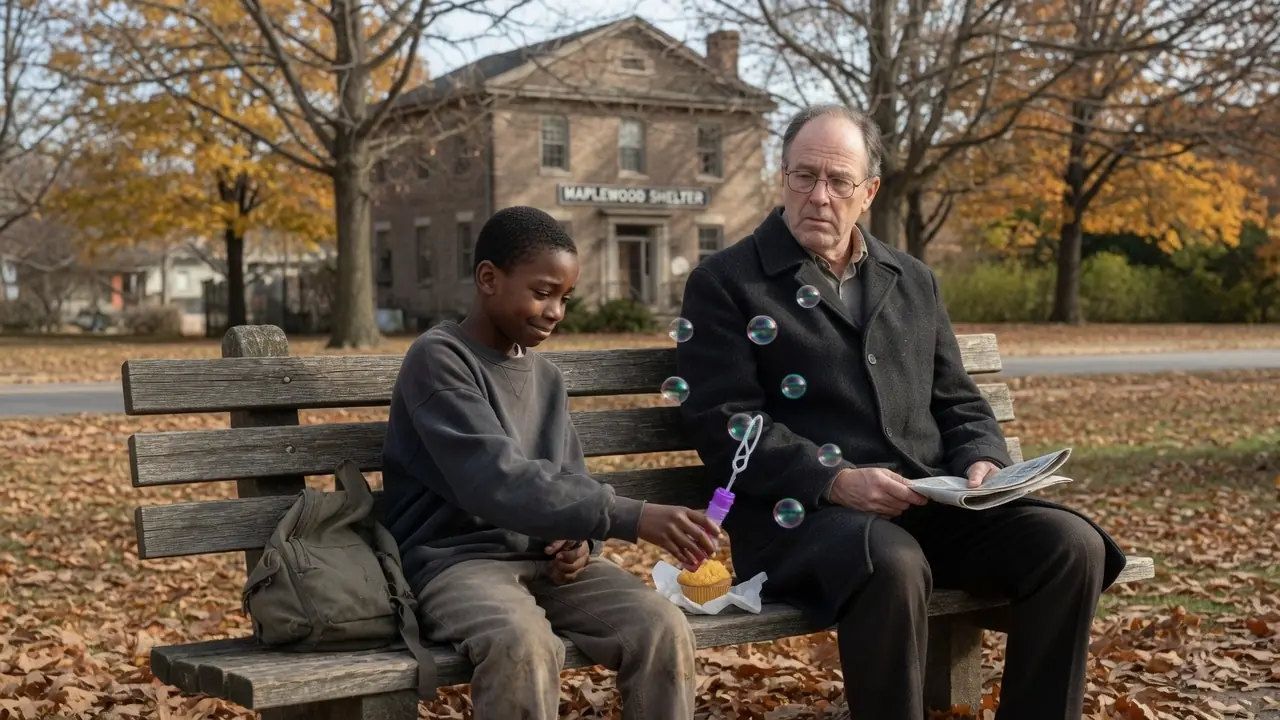
At Maplewood Shelter, tucked between a rusting railway line and a grove of thinning maple trees, the world seemed to forget the children inside. The old red brick building stood like a stubborn relic of a forgotten time. Its shutters creaked when the wind blew, and the paint peeled in flakes that danced on cold autumn gusts. In the back courtyard, laughter echoed faintly as the children ran across the cracked pavement, their shoes slapping against concrete, their voices bright with play.
They chased one another with paper airplanes and rubber balls, giggling over inside jokes only children understood. It was a world teeming with noise and movement, except for one quiet corner, where a boy sat alone on the stone steps, sketchbook in his lap, eyes filled not with the joy of the game, but with the longing to belong. Nathaniel Nate Brooks, 13, watched them from a distance that wasn't measured in feet, but in something deeper, something colder.
He was slight for his age, his frame thin beneath a hand-me-down sweatshirt two sizes too large, sleeves sagging over small hands that clutched his pencil like it was the only thing in the world that truly listened. His hair cropped short, his posture curled, not out of laziness, but habit, a habit born from years of shrinking into the background when the spotlight never seemed to want him.
From the edge of the courtyard, Nate's eyes followed the others, how they tagged each other and squealed, how someone always had someone to laugh with, to run toward. He wished quietly and without words that just once one of them would glance back and say, "Hey Nate, come on." But they never did.
His name was rarely spoken unless it was whispered with suspicion or muttered in annoyance. Some of the kids called him the comet, a cruel joke that began years ago when a new girl asked about his parents and someone sneered, "Ha! Didn't you know? His mom and dad died in a car crash. Boom! Just like a comet hit. He's bad luck." The nickname stuck. And so did the silence.
It wasn't that Nate was strange. He was quiet, yes, but not strange. He rose before the others each morning to help Mrs. Avery in the kitchen. He folded his clothes meticulously, swept the shared hallway without being asked, and always always gave away the last muffin if someone else wanted it more.
Today he sat alone again, sketching a picture of a boy with wings. The boy in his drawing wasn't real, not really, but Nate liked to imagine that this version of himself could soar above it all, unnoticed, no more. He paused, glancing at the small plastic tube tucked safely inside his jacket pocket. It was a bubble wand, a gift from last month's donation drive, cheap and half empty now, but sacred.
When he blew bubbles, even if only for a few moments, he wasn't the comet. He was the sky. The afternoon light stretched long over the ground as the children began to tire of their games. Some went inside, others sat in clusters talking about families they hoped would adopt them.
Once a couple leaned toward him, curious, until a boy near the swings called out, "That's the comet." The couple's faces changed. They moved on. Nate didn't cry. He had stopped crying a long time ago, the way some children forget how to speak when they are never heard.
He simply clutched his sketchbook tighter and looked away. That night, he folded the page of the winged boy and slid it under his mattress. At dinner, the table was loud, bowls clinking, chairs scraping, laughter bouncing across walls. Nate sat quietly at the end of the table, eating slowly, methodically.
No one noticed when he slipped the last slice of cornbread from his tray and wrapped it in a napkin. It wasn't for him. Later, while the other kids gathered in front of the television, Nate wandered toward the edge of the courtyard, then through the side gate, stepping carefully past the cracked stone path that led to the road.
He knew the way by heart now, past the old fence, across the narrow street, and into the park, where something or someone waited. Not with words, not with warmth, but with space. Space enough for a boy like Nate to sit and not feel like a trespass.
There, he could pretend the world didn't see him, not as a burden, not as a mistake, but simply as a child who wanted to be seen. In the fading light, Nate pulled out his bubble wand. The solution was thin now, nearly gone, but still enough for a few perfect spheres.
He dipped the wand, held it to his lips, and blew. One bubble, then two, then five, shimmering, fragile, catching the golden light as they rose and danced above the trees. He smiled, just barely, and not far from him, seated on a worn bench with a newspaper folded neatly in his lap, a man with salt and pepper hair and a furrowed brow turned his head slightly, not fully, just enough to watch the boy in silence.
And though neither of them said a word, something had already begun. The next day at precisely 4:00, Nate returned to the park. He didn't run, he never did, but his steps were quicker than usual, light in a way that suggested anticipation rather than habit.
The autumn wind had a bite to it, brushing red and gold leaves across the pathway like scattered memories. Nate's sneakers crunched over them as he approached the familiar bench, his small hands tucked into his hoodie pockets, the bubble wand nestled safely against his chest. The man was already there.
Just like yesterday, he sat with his legs crossed, a folded newspaper balanced on one knee, eyes hidden behind a pair of simple reading glasses. He looked like someone who belonged to another time. His clothes were plain but well-kept, his shoes polished, his posture disciplined.
He didn't glance up when Nate approached, nor when the boy sat down. At a distance just close enough to feel the edge of the man's presence, Nate didn't expect acknowledgement. He didn't even hope for it. Being ignored wasn't new, but being allowed to stay, that was different. That meant something.
The first few afternoons unfolded in quiet repetition. Nate came, the man sat. They shared space and nothing more. Occasionally, Nate would offer a silent nod or whisper a soft hi, to which the man gave no response, not even a flick of the eye.
But he didn't move away either. Didn't frown or leave or shoo the boy as so many adults had done before. That in Nate's world was permission enough. By the fourth day, Nate brought with him half of a cornbread muffin carefully wrapped in the same napkin he had saved from lunch.
He didn't say anything when he placed it gently on the edge of the bench closest to the man. He didn't even watch to see what would happen to it. He just sat back in his spot and began blowing bubbles, watching the wind catch them and carry them over the tops of the oaks.
Behind the rustle of newspaper pages, a pair of eyes followed the iridescent orbs as they rose, hovered, and vanished into the sky. He came every day, always on time, never expecting some. The man never spoke, but he never left.
Nate noticed details. He noticed how the man's coat had a tiny tear near the sleeve that he never bothered to mend. He noticed how his watch was an older model, but always precisely set. He noticed that he never used his phone, never smiled, and never looked like he was really there, even when he was sitting right in front of him.
And though Nate was just a boy, he knew enough about sadness to recognize it in someone else. On the seventh day, Nate sat a little closer, not too close, just one board closer on the bench. He kept his eyes on the pavement, pretending to trace patterns in the dirt with his sneaker.
Then, in a voice barely above the wind, he said, "I don't think you're here because of the view." There was no response. "That's okay," he added quickly. "Not here for it, either."
Silence. Nate exhaled slowly, letting the cold air burn the inside of his chest. He looked up at the trees, at the long branches reaching toward nothing. "People think I'm bad luck," he murmured.
"They think my parents died because of me." He swallowed. The man's fingers paused on the paper. For the first time, he turned his head, only slightly, just enough that Nate could see the side of his face.
There were lines carved deep into the man's expression, not from age, but from grief that had sat too long on the heart. Nate didn't push. He just kept coming. Days passed, then a week.
The man, whose name Nate still didn't know, began to shift subtly in posture when the boy arrived. He sat straighter, uncrossed his legs, sometimes even folded his paper before Nate sat down. Once, he set a thermos beside him with two cups, not looking up as he did.
Nate stared at it for a moment, then reached for the smaller cup and whispered, "Thank you." Then, on the 10th afternoon, the man spoke. His voice was dry, rusted from disuse, but clear. "You don't ask for anything."
Nate froze, bubble wand halfway to his lips. He turned, eyes wide. "You come here, you sit, you give things away, but you never ask for anything back." The man looked straight ahead. "Why?"
Nate considered his answer. "Because people don't like when I do." The man didn't reply, but the next day he brought an extra muffin and placed it silently between them. There was no dramatic breakthrough, no tears, no sudden hugs, just space gradually shrinking, words carefully planted, and in between it all the bubbles floating like tiny pieces of hope across an October sky that seemed somehow a little warmer each afternoon.
For the first time in years, Thomas Whittaker began to feel the faintest tug toward the world again, not because someone had shouted or demanded or fixed him, but because a quiet boy with gentle eyes and the patience of someone twice his age had simply stayed. It was the 12th afternoon when the silence between them cracked open.
Not like glass shattering, but more like old hinges finally giving way. The park was quieter than usual. The wind sharp with the coming of early November. Leaves scraped across the path in swirling eddies, and the sun sat low in the sky.
A thin orange disc bleeding through bare branches. Nate arrived, as always, bubble wand in one pocket, sketchbook in the other. The small backpack on his shoulders faded at the corners from years of use. Thomas was already there.
The paper folded, but unread in his lap. His hands clasped loosely together. He didn't speak at first. He didn't need to. Nate knew now when Thomas was listening.
Nate sat down beside him, one board away on the bench. Nate looked over, surprised. The man's eyes weren't on him, but on the patch of grass just beyond the bench, as if it held the outline of someone long gone.
His voice didn't shake, but it held weight. Like stones dropped gently into a still pond every Saturday. She loved the park, said the trees looked like giants. She'd bring a little red ball and roll it back and forth between us while we sat.
Sometimes she'd blow bubbles. Not because she was a baby, she just liked the way they floated. Said they didn't obey rules. He gave a breath that might have been a laugh once. She called them rebel soap.
Nate listened, quiet as ever, his fingers tracing the carved initials on the bench slat beside him. He didn't speak right away. He didn't want to interrupt the current of memory. Thomas continued.
Her name was Caroline. She had this laugh that sounded like it had wind chimes in it. She was smart, kind, looked like her mother. She died 3 years ago, heart condition, one of those rare ones. We didn't know until it was too late.
The confession came like rain on a dry roof. Unexpected, gentle, but deeply felt. Nate turned his face toward the man, not with shock, but with understanding. He knew what it was to lose someone and still expect them to walk into a room.
To carry their voice in your head because the world had stolen their body. He knew, even without saying so, that grief was a long, slow ache that settled into the bones like winter. "I'm sorry." Nate said simply and meant it.
Thomas nodded once, then looked at him fully. "You remind me of her. Not in the way you look. In the way you sit in silence and still somehow speak." The boy blinked, unsure what to say to that.
So, he opened his sketchbook and flipped through a few pages until he found the one he had drawn just last week. A girl with wild curls and a bubble wand standing beside a man on a bench. The sky in the drawing was full of color, shades of purple and green and blue.
The way Nate imagined the world might look to someone who still believed in magic. He handed the page to Thomas without a word. Thomas studied it for a long time. When he finally looked up, there was a sheen in his eyes.
Nate hesitated, then asked, "Do you think it was your fault that she left?" The man exhaled slowly, resting the drawing on his knee. "Every day, I worked too much when she was little. Thought I'd make it up to her when she was older. Spoiled her a bit when I finally had the time.
Told myself I was being a good father, but when the doctors said we were out of options, all I could think was, what if I'd noticed sooner? What if I'd given her more time with me instead of more toys, more trips, more money?" He paused, voice low. "Grief's like a bad accountant. It keeps tally of things you never owed and demands payment you can't afford."
Nate looked down at his hands. "People think I caused the crash that took my parents. I was five. I don't even remember it, just flashes, sirens, broken glass, someone calling my name, but they say I survived when they didn't, so I must have brought the bad luck."
"That's not true," Thomas said, his voice firmer now. "That's not on you." Nate nodded slowly, but the pain in his chest didn't lift. "I know it's not fair, but I also know people like stories, and I'm the easiest one to blame."
A pause settled between them, quiet but not empty. Then Nate straightened a little, shoulders squaring in a way that surprised even him. "But I'm not going to let them be right. I don't know why I'm still here, but I am, and if I'm here, I'm going to make it matter. I'm going to do something good, be someone good.
That way, when people look at me, they won't see a comet. They'll see a reason to hope." Thomas didn't speak for a long while. He stared out into the horizon.
Winter pressed gently against the town as the days shortened, and the wind carried the scent of frozen soil and fallen pine. By late November, the park emptied earlier each afternoon, the benches cold to the touch, the trees stripped bare. But still, Nate came, always on time, always to the same bench. And Thomas was no longer just there, he was present.
Something had changed in the air between them. It wasn't sudden, like a switch. They spoke more now, not always with stories, but with thoughts, small reflections, observations. Nate would point out cloud shapes or how the frost on the leaves made them look like sugar.
Thomas, in turn, would explain how to read the rings of a tree stump or why squirrels bury acorns in clusters. It wasn't about teaching. It was about noticing together.
One afternoon, Thomas pulled out a simple pocket chessboard. "You ever played?" he asked. Nate shook his head and so Thomas showed him how the knight moved in an L shape, how pawns could become queens. They played slowly, the cold forgotten for a while.
When Nate made his first checkmate, he didn't smile, but Thomas did. Day by day, something inside Thomas began to rise again, something old and buried. He found himself thinking of Nate when walking past bookstores, wondering if the boy would like a particular novel.
He caught himself packing an extra sandwich without realizing why. He thought of what Caroline, his daughter, would have said, how she might have liked Nate's quiet thoughtfulness, how she would have told Thomas that healing wasn't forgetting, but choosing to live anyway.
Then came the moment. It was a small thing, so small it might have been missed. Nate had just finished helping a little girl fix her broken balloon string near the fountain. He tied the knot with care, offered a quiet, "Here you go." then returned to the bench.
Thomas watching said softly, almost to himself, "You do that a lot." Nate looked over. "Do what?" "Give more than you have."
The boy didn't reply. He just looked out across the empty field and nodded as if he wasn't sure how else to exist. Thomas didn't say more that day, but he felt something stir so powerfully in his chest that he had to excuse himself early.
That night, back at home, he stood in front of a mirror he hadn't looked into properly in years. He smoothed his collar. He stared at his own reflection like seeing a man not yet finished.
The next morning, he opened his old filing cabinet. It stuck from disuse. He forced it open and found the forms, papers he had printed over a year ago but never filled in. Petition to adopt. His name already typed at the top.
He had once laughed bitterly at the thought. Who would he adopt? What did he have left to give? Now, he knew. By the end of that week, the papers were signed.
He didn't go to the park that afternoon. Instead, he went to Maplewood Shelter. When he arrived, the receptionist looked up in mild confusion. "Can I help you?"
"Yes," Thomas said, adjusting his coat. "I'm here to speak with the director. I'd like to begin the process to adopt a boy named Nathaniel Brooks." There was a pause. The room, though warm, felt still.
"And," he added gently, "please don't tell him just yet. I'd like to be the one to do it." And outside, just beyond the window, the sky began to shift. Soft clouds parting, pale winter sun spilling through as if the world, too, was preparing to begin again.
The day Thomas returned to the park, he wasn't in his usual coat or scarf. "You didn't come yesterday," Nate said softly, trying to sound casual but unable to keep the edge of worry from his voice. "I know," Thomas replied, stepping closer. "I had something I needed to do."
He sat beside Nate, a quiet breath escaping. Then he turned and looked the boy in the eyes, not as someone fragile or lost, but as someone becoming. "I went to see the director at Maplewood." "And a lawyer?" Nate blinked. "Why?"
Thomas didn't hesitate. "Because I want you to come home with me, for good." For a moment, time seemed to hold its breath. Nate stared at him, unsure if he'd heard right, unsure if this was a joke or a test or a dream dressed in daylight.
"You mean live with you?" Thomas nodded. No more waiting. No more wondering if you belong somewhere. I want you to be my son, Nate.
Not because you need saving, but because I do. The boy's hands trembled just slightly, his lips parting as if to speak, but no sound came. Then, slowly, he nodded. Once, then again.
And Thomas reached over, placing a hand gently on his shoulder. It was the first time either of them had truly touched the other, and it didn't feel forced. It felt like something whole.
Within a month, the papers were processed. Nate left Maplewood quietly. No one made a scene. No hugs, no cheers. Just a few curious glances, one jealous mutter, and Mrs. Avery standing by the gate, blinking rapidly as she handed him his backpack.
Go make the world better. Thomas had prepared a room for him. Not big, but full of light. There was a new bed, a desk, shelves, and waiting on the window sill, a glass jar filled with bubble solution and a polished silver wand.
Nate stood in the doorway for a long time before stepping inside. Years passed. Nate grew taller, stronger, more certain in his step. He excelled in school, not because he needed to prove anything, but because someone finally believed he could.
Thomas never pushed. He simply stood behind him, steady as a foundation. By the time Nate turned 28, he no longer introduced himself as a boy from the system. He introduced himself as Nathaniel Brooks Whitaker, co-founder and director of the Second Light Foundation, a nationwide network of support centers for orphaned children and teens aging out of care.
He and Thomas ran the foundation together. Not as saviors, but as witnesses to what kindness could build. They didn't save thousands with grand speeches. They saved them one quiet conversation at a time.
A meal left at a doorstep. A room painted in calming colors. A folder of college applications already printed and ready. No grand gestures. Just presence.
And perhaps the most remarkable thing was this. Nate never let go of who he'd been. He still visited parks. He still carried a sketchbook. And he still kept that little silver bubble wand.
No longer fragile plastic, but carefully remade, engraved with one word, begin. Because that was what he had done. What they both had done. They had begun again.
And this time they brought others with them. And sometimes, on soft autumn days, when the wind curled just right, and the leaves rustled in that certain way, Nate would sit beside his father on that same old bench, open the jar of bubble solution, dip the wand, and send a rainbow sphere floating into the sky.
Fragile. Beautiful. And utterly alive. And Thomas would watch, a soft smile on his face, and whisper, "Thank you for not giving up." Because in the quiet space between sorrow and healing, they had found each other. And from there, they built something that even time could not undo.