In the spring of 1869, the last “marriage auction” at Fort Granger began just before sunset.
The outpost stood along a forgotten branch of the Oregon Trail, where wagon wheels had carved deep scars into the dry earth and men carried loneliness like another weapon on their belts.
The place smelled of pine dust, horse sweat, tobacco, and old rain.
A platform had been built from freight crates and warped planks. It was not a true courthouse, though Deputy Amos Reddick liked to call it one. His badge was rusted, his records incomplete, and the papers he issued were recognized only by desperate men, frightened women, and anyone too far from civilization to challenge them.
Around the platform gathered loggers, trappers, prospectors, and drifters.
They were not all cruel.
Some were merely lonely.
Others had lived so long without tenderness that they mistook possession for companionship.
Reddick struck a wooden mallet against the railing.
“All right. Last contract of the day.”
Two men laughed before he even continued.
On the platform stood a woman with her hands tied loosely in front of her.
She wore a faded brown dress, torn at the hem, and no shoes. Dust covered her feet. A rough sack had been pulled over her head and tied beneath her chin.
She stood very still.
Only her breathing revealed fear.
Quick.
Shallow.
Carefully controlled.
Reddick lifted a stained piece of paper.
“No family willing to claim her. No money. No references. Won’t show her face.”
A man near the stage shouted, “Maybe she hasn’t got one.”
Laughter moved through the crowd.
Another called, “Take off the sack.”
The woman’s fingers tightened.
Reddick ignored the demand.
“Says she can cook, sew, tend animals, and work a field. Starting amount is two dollars to cover the debt attached to her passage.”
The auction was called a marriage arrangement.
Everyone understood what it truly was.
The woman had been transported west by a man who claimed she owed him for food, shelter, and protection. When he realized no wealthy settler would take her, he sold the debt to Reddick.
Now the outpost wanted its money back.
“Two dollars,” Reddick repeated. “Anyone?”
No hands rose.
One man spat into the dirt.
“Wouldn’t marry a woman who won’t show her face.”
“Could be wanted,” someone else said.
“Could be sick.”
“Could be ugly enough to sour milk.”
The woman lowered her head.
At the back of the crowd, Elias Boone stood beside a mule loaded with flour, salt, lamp oil, and a new saw blade.
At thirty-six, Elias had lived alone in the northern timberlands for nearly nine years.
He was taller than most men at the outpost, broad from felling trees and hauling wet logs. His dark beard had begun to show gray at the chin. A canvas coat covered his shoulders, and the handle of his ax was wrapped in leather strips polished by use.
People in the territory knew him.
They called him quiet.
Some called him strange.
Nobody called him weak.
Elias had come for supplies.
He had no intention of taking a wife home.
Then the woman shifted her weight.
The movement was small.
But something about it struck him.
The way she held herself.
The way she kept one shoulder slightly forward, as though protecting an old injury.
And when a man near the stage stepped too close, she spoke.
“Please don’t touch me.”
The words were muffled beneath the sack.
Soft.
Measured.
Tired.
Elias stopped breathing.
Three winters earlier, inside a cave hidden behind a wall of ice, a woman with the same voice had said:
“You don’t need to know who I am. I’m not going to let you die.”
Reddick lifted the mallet again.
“No bids?”
Elias stepped forward.
The men moved aside.
“Two dollars,” he said.
Silence fell over the outpost.
Reddick squinted.
“You sure, Boone?”
“Yes.”
“You haven’t seen her.”
“I heard her.”
A few men laughed nervously.
Reddick leaned toward him.
“She could be trouble.”
“So could I.”
“You understand the arrangement?”
Elias looked toward the woman.
“I understand she leaves this platform owing no man anything.”
Reddick’s smile faded.
“The two dollars covers the debt. The marriage paper protects the transfer.”
“She is not being transferred.”
“That is what the paper says.”
“Then write a different paper.”
Murmurs moved through the crowd.
Reddick tapped the mallet against his palm.
“This is how we do things here.”
Elias removed two silver dollars and placed them on the post.
“No. This is how you do things.”
The deputy glanced at the men watching.
He did not want a dispute with Elias Boone.
Not over two dollars.
Not when half the loggers in the territory relied on Boone’s winter timber deliveries.
Reddick scratched several lines across the document, then pushed it forward.
Elias read slowly.
The paper declared that the woman’s passage debt had been paid and that she had entered a voluntary marriage arrangement with Elias Boone.
The word voluntary made something cold move through him.
He looked at the woman.
“You don’t have to come with me.”
Her head lifted beneath the sack.
Reddick snorted.
“She has nowhere else.”
“That wasn’t what I asked.”
Elias stepped closer but remained beyond her reach.
“If you walk with me, you will have food, shelter, and your own room. No man will touch you without your permission. If you choose to leave later, I will take you wherever you want to go.”
The crowd had become completely silent.
The woman stood motionless for several seconds.
Then she nodded.
Elias signed.
Reddick turned toward her.
“Name for the record.”
Nothing.
The deputy raised his voice.
“You need to give a name.”
The sack shifted as she swallowed.
“Mara Crowe.”
Elias’s hand froze over the paper.
Mara Crowe.
He had never heard the name before.
Yet the voice carried him backward instantly.
Snow filling his boots.
Blood freezing inside his trousers.
A fire glowing beneath a ceiling of stone.
A woman whose face he never saw placing a cup against his mouth.
Drink.
You will die if you sleep now.
Elias looked toward the sack.
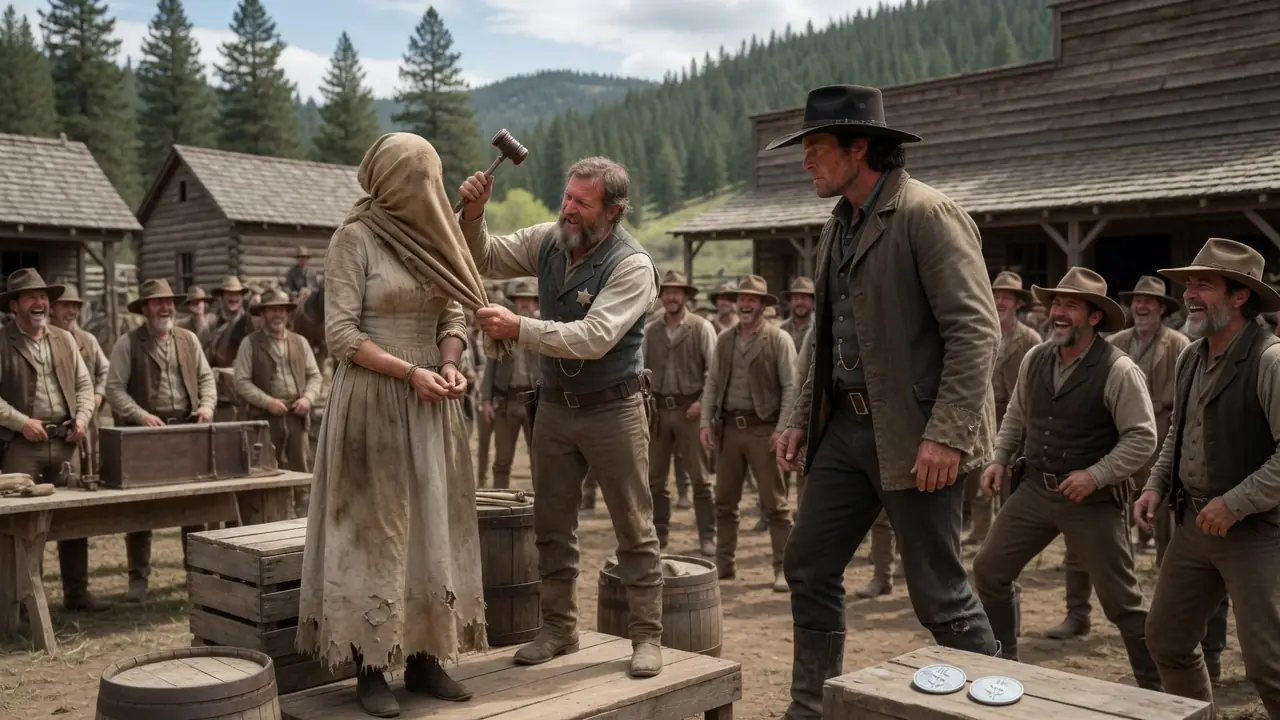
The woman who had saved his life stood before him three years later, bound on an auction platform.
Reddick tore the paper free and handed it over.
“Done.”
Elias did not reach for Mara.
Instead, he untied the rope around her wrists.
“You can walk beside me,” he said. “Or behind me. Whichever feels safer.”
Her hands remained close to her body.
“Beside,” she whispered.
They left the outpost before darkness settled.
Nobody tried to stop them.
The trail north entered the forest within a mile.
Tall pines closed around them, their branches swallowing the evening light. Elias led the mule while Mara walked several steps to his right.
The sack remained over her head.
Twice, the wind tugged it sideways.
Each time, she caught the fabric quickly and held it in place.
Elias did not ask her to remove it.
He did not tell her he recognized her voice.
Not yet.
They traveled until the moon appeared between the trees.
When Mara stumbled, Elias stopped.
“There’s a stream nearby. We can rest.”
“I can continue.”
“That wasn’t a test.”
She stood silently.
Elias led the mule toward a small clearing beside the water. He made a fire, warmed beans in a tin pot, and placed a folded blanket several feet away from his own.
Mara remained near a tree.
“You can sit wherever you choose,” he said.
She lowered herself slowly.
Elias filled two bowls.
He placed one close enough for her to reach, then returned to the fire.
For several minutes, she did not touch it.
Finally, she asked, “What is in it?”
“Beans. Salt pork. Onion.”
“No laudanum?”
“No.”
“No whiskey?”
“No.”
“Nothing to make me sleep?”
Elias looked into his own bowl.
“Only bad cooking.”
A faint sound came from beneath the sack.
Not laughter.
Almost.
Mara lifted the lower edge of the fabric just enough to bring the spoon beneath it.
She ate carefully.
Every movement suggested practice.
The next afternoon, they reached Elias’s cabin.
It stood in a clearing beneath a ridge, built from dark pine logs fitted tightly against winter. A stone chimney rose beside the roof. Firewood had been stacked beneath a lean-to, and a small barn stood beyond the garden fence.
The place was simple.
Clean.
Strong.
Elias opened the door and stepped aside.
Mara stopped at the threshold.
“No one is going to push you through it,” he said.
She entered.
The cabin had one main room, a small kitchen space, and two sleeping areas separated by plank walls.
Elias pointed toward the smaller room.
“That one is yours.”
“Where will you sleep?”
“Other side.”
“You paid for a wife.”
“I paid a debt.”
“The paper says wife.”
“The paper is ink.”
Mara turned her covered face toward him.
“You don’t want one?”
Elias thought about the empty place at his table.
The second cup he still owned though he lived alone.
The woman he had once married and buried six years earlier after a logging accident took her from him.
“I wanted one once,” he said. “Wanting does not create an obligation.”
Mara stood in the center of the room.
Elias added, “There is a lock on your door. It works from inside.”
Her shoulders lowered slightly.
That evening, he cooked venison stew.
Mara sat near the wall with her back protected and the sack still tied around her head.
Elias placed a bowl near her.
She asked, “What do you call this?”
“Stew.”
“It smells better than stew.”
“I call it supper when I’m hopeful.”
“And when you’re not?”
“The last meal of a stubborn man.”
This time, Mara laughed.
The sound was brief and immediately swallowed.
But Elias remembered it.
After they ate, he washed the bowls.
Mara watched him.
“You had a wife?”
“Yes.”
“What happened?”
“A tree came down wrong.”
“I’m sorry.”
“So am I.”
He placed the bowl upside down to dry.
“Her name was Rebecca.”
Mara looked toward the empty chair opposite him.
“Did she sit there?”
“Yes.”
“Why keep the chair?”
Elias considered the question.
“Because removing it felt more final than burying her.”
Mara said nothing.
That night, Elias slept badly.
He sat before the fading fire and returned in memory to the winter of 1866.
He had gone too far north in search of cedar.
A storm arrived before he could descend.
His mule broke loose.
Elias slipped on an icy slope, twisted his leg, and struck his head against a rock.
He remembered snow covering his shoulders.
The cold entering slowly.
Then hands dragging him.
He woke inside a shallow cave behind a curtain of frozen water.
A small fire burned beside him.
Across from it sat a woman with a sack tied over her head.
Her clothes were stitched from mismatched wool and leather. Her hands were scarred and red from cold.
She gave him tea made from pine bark and dried plants.
She reset his leg.
She kept him awake.
He never saw her face.
She never gave her name.
By morning, she had disappeared.
Beside the fire, Elias found a square of cloth embroidered with small purple flowers.
He carried it in his coat for three years.
Now Mara slept ten feet away.
The next morning, she stood beneath a pine tree at the edge of the clearing.
Elias worked beside the barn, sharpening his saw.
He watched without staring.
Mara lifted both hands to the knot beneath her chin.
Slowly, she loosened it.
The sack rose only to her mouth at first.
She breathed deeply.
Open air touched her face.
Elias looked back toward the saw.
“I was hurt near Black Ridge three winters ago,” he said.
Mara stopped moving.
“Storm caught me. Broke my leg. I should have frozen.”
Silence.
“Someone found me.”
Elias passed the sharpening file across the blade.
“She hid her face. Would not say her name.”
Mara’s hands trembled at the edges of the sack.
“She made a fire and kept me alive.”
Elias reached into his coat pocket.
He removed the embroidered cloth.
Purple flowers, unevenly stitched.
“I woke with this beside me.”
Mara turned.
The sack remained halfway lifted.
She stared at the cloth.
“That was yours?” Elias asked.
Her voice came softly.
“Yes.”
He did not move closer.
Mara lowered the sack completely.
For the first time, he saw her face.
She was perhaps thirty.
Her hair was dark brown, cut unevenly near her shoulders. Her eyes were gray-green and steady despite the fear in them.
A long scar crossed the right side of her face from the temple to the jaw.
It was deep.
Old.
Impossible to miss.
Elias felt anger, but not at the scar.
At whoever had given it to her.
Mara waited for him to look away.
He did not.
“You saved me,” he said.
“I found you.”
“You could have left me.”
“I knew what it was to be left.”
Elias held out the cloth but did not approach.
She crossed the space between them and took it.
For a moment, their fingers almost touched.
Mara pulled her hand away first.
“What happened to you?” he asked.
The question was gentle.
Still, she recoiled.
“You don’t have to tell me.”
“I will.”
She sat beneath the tree.
Elias remained near the saw bench.
Mara folded the embroidered cloth in her lap.
“I worked at the Ridley House in Independence.”
“A boarding house?”
“Yes.”
“The owner was named Charles Ridley.”
Her voice changed when she spoke the name.
“He rented rooms to travelers. Women paid less if they agreed to entertain his guests.”
Elias’s jaw tightened.
“I worked in the kitchen. He told me my room cost more than my wages. Said there were other ways to pay.”
“You refused.”
“Yes.”
Mara touched the scar lightly.
“One night, he cornered me in the pantry. He cut me when I fought him.”
“With what?”
“A broken bottle.”
Elias looked toward the trees until the first rush of anger passed.
“What happened to him?”
“I pushed him.”
She swallowed.
“He fell against the stove. His head struck the iron edge.”
“He died?”
“Yes.”
“You were defending yourself.”
“No one cared.”
Mara looked down.
“His brother owned part of the boarding house. He told everyone I had invited Charles inside and killed him after he refused to marry me.”
“That makes no sense.”
“It did not need to.”
Her fingers tightened around the cloth.
“I had no family. No money. No respectable man willing to speak for me.”
“What about other workers?”
“They were afraid.”
“So you ran.”
“I was held in a storeroom for two days before they decided what to do. I escaped during a storm.”
Mara looked toward him.
“That was when I found you near Black Ridge.”
Elias understood.
She had saved his life while running for hers.
“After the cave?”
“I traveled west under another name. A wagon master recognized the description on a notice. He threatened to turn me over unless I worked off the cost of passage.”
“And the sack?”
“They put it on me.”
Her voice remained steady, which made the words worse.
“They said men would pay more if mystery hid what was underneath.”
Elias closed his eyes briefly.
Mara continued.
“Every time I tried to leave, the debt increased. Food. Blankets. Space in the wagon. Protection.”
“They sold you to Reddick.”
“Yes.”
She looked toward the sack lying beside her.
“I kept wearing it after I no longer had to.”
“Why?”
“Because people saw the scar and decided the rest of the story before I spoke.”
Elias sat several feet away.
“You are not what happened to you.”
“No.”
Her answer surprised him.
Mara looked directly at him.
“But I am what I survived.”
He nodded.
“That sounds true.”
She waited for pity.
He offered none.
Only attention.
The following morning, Mara entered the kitchen without the sack.
Elias had placed a small mirror on the table.
Beside it lay a faded green scarf.
Mara stopped.
The mirror was old but clean.
The scarf had been folded carefully.
Elias stood near the stove.
“That belonged to Rebecca,” he said.
Mara did not touch it.
“Why are you giving it to me?”
“I’m not.”
She looked at him.
“I’m offering it.”
“What is the difference?”
“You can refuse an offer.”
Mara approached the table.
“She wore it when we came to town,” Elias continued. “Said it reminded her she belonged to herself before she belonged to any place.”
Mara lifted the scarf.
The fabric moved softly through her fingers.
“She would mind?”
“She is dead.”
“That doesn’t answer me.”
Elias smiled faintly.
“No. She would not mind.”
Mara looked into the mirror.
For a long time, she studied the scar.
Not with disgust.
Not with courage either.
Simply recognition.
Then she tied the green scarf over her hair, leaving her face fully visible.
Elias said nothing.
Mara turned.
“How does it look?”
“Like you chose it.”
Her expression softened.
Days became weeks.
Mara worked because she wanted to, not because Elias required it.
She repaired the garden fence.
Organized the pantry.
Showed him which herbs eased the pain in his old leg injury.
She could read and write well.
She kept records of supplies better than he did.
Elias taught her to use the crosscut saw safely.
She taught him how to make bread that did not resemble building material.
They spoke in the evenings.
Slowly.
Neither demanded more than the other could give.
The marriage paper remained inside a drawer.
They slept in separate rooms.
Elias never entered hers without knocking.
Mara began walking beyond the clearing alone.
At first, only to the stream.
Then farther.
She learned the ridge paths and the safest route into town.
People stared at her scar.
She stared back.
Peace arrived gradually.
Then a bounty hunter named Lucas Cutter rode into North Ridge.
He was lean, patient, and careful with his words.
He claimed to be looking for timber work.
Elias saw the wanted notice folded inside Cutter’s saddlebag when the wind lifted the flap.
A woman named Mara Crowe.
Accused of killing Charles Ridley.
Scar on the right side of the face.
Reward offered by Ridley’s brother.
Elias returned home before dark.
“He found you.”
Mara stood near the stove.
She did not ask who.
“The bounty hunter?”
“Yes.”
Her hand moved instinctively toward the green scarf.
“I can leave tonight.”
“No.”
“If I stay, he will come here.”
“Then we prepare.”
“You don’t owe me that.”
Elias looked toward her.
“You saved my life before you knew my name.”
“That does not mean you must risk yours.”
“No.”
He crossed the room and placed the old wanted notice on the table.
“It means I know what kind of woman the notice is lying about.”
Mara read the paper.
Her expression hardened.
“I am tired of running.”
“Then we don’t run.”
They went to Sheriff Nathan Cole in North Ridge.
Unlike Reddick, Cole carried a lawful appointment and cared what his name meant.
He read the notice.
“Missouri warrant,” he said. “Old, but active.”
“Will you arrest her?” Elias asked.
Cole looked at Mara.
“Did you kill Ridley?”
“I pushed him while he attacked me.”
“Any witnesses?”
“One woman may have seen part of it. Mavis Green. Kitchen worker.”
“Where is she?”
“I don’t know.”
Sheriff Cole leaned back.
“Cutter will not care about the difference between murder and self-defense. He gets paid for delivering bodies.”
“Alive?” Elias asked.
“If convenient.”
They developed a plan.
Mara objected when Cole suggested hiding her in the jail.
“I have spent enough of my life behind locked doors.”
Instead, they allowed Cutter to believe she had fled east along the old fire road.
Mara chose to wear the sack again.
Elias watched her tie it beneath her chin.
“You don’t have to.”
“I know.”
Her voice was calm.
“That is why I can.”
She rode at dawn.
Cutter followed before noon.
He caught up near a narrow passage between rocky slopes.
Mara stopped her horse.
Cutter dismounted with a rope in one hand.
“You’ve caused people a great deal of trouble.”
Mara remained mounted.
“You came a long way for a dead man’s lie.”
“He paid better than your truth.”
Cutter reached for her reins.
Sheriff Cole stepped from behind the rocks.
“Remove your hand.”
Elias and two deputies appeared along the ridge.
Cutter drew his pistol.
He was fast.
Cole was faster.
The sheriff’s shot struck the ground beside Cutter’s boot.
Elias moved from the side and knocked the weapon away with the handle of his ax.
Cutter fell hard.
The deputies bound him.
Inside his coat, they found forged warrants, letters promising payment for Mara’s death, and instructions from Ridley’s brother to prevent her from reaching a court.
When Cutter was taken away, Mara remained on the hill.
Elias approached slowly.
“You can remove it now.”
She lifted the sack.
Fresh air touched her face.
Mara folded the fabric once.
Then again.
“It was my prison,” she said.
Elias waited.
“Today it was my choice.”
“What will you do with it?”
“Keep it.”
“Why?”
“To remember that the same thing can mean different things depending on who holds the knot.”
The evidence found on Cutter delayed the Missouri warrant.
It did not erase it.
For that, they needed a witness.
Three weeks later, a woman arrived at Elias’s cabin.
She was in her forties, with dark skin, tired eyes, and a red travel dress covered in dust.
She held her hat in both hands.
“My name is Mavis Green.”
Mara froze in the doorway.
Mavis looked at her scar.
Then at the ground.
“I heard Cutter was arrested.”
“What do you want?” Mara asked.
“To tell the truth.”
They sat at the table.
Mavis described the night Charles Ridley died.
She had been carrying flour toward the kitchen when she heard Mara shout.
She saw Ridley drag her into the pantry.
She heard glass break.
She saw Mara emerge bleeding.
Then Ridley followed, caught her by the hair, and tried to pull her back.
Mara pushed him.
He fell against the stove.
“I saw everything,” Mavis said.
Mara’s hands remained folded tightly in her lap.
“You said nothing.”
“No.”
“Why?”
“I had nowhere to go.”
“So you let them call me a murderer.”
Mavis’s eyes filled.
“Yes.”
The honesty was painful.
Mara stood and walked outside.
Elias began to follow.
Mavis shook her head.
“Let her hate me.”
“She may.”
“I deserve it.”
Elias looked toward the door.
“Deserving anger does not mean you are beyond doing something useful now.”
Mavis signed an affidavit before Sheriff Cole.
She agreed to testify if Missouri officials reopened the case.
The documents taken from Cutter proved that Ridley’s brother had paid men to capture Mara without trial.
Combined with Mavis’s statement, they forced a judicial review.
Six weeks passed.
Then Sheriff Cole rode to the cabin carrying an envelope.
Mara opened it with shaking hands.
The language was formal.
The murder accusation had been dismissed.
The warrant was withdrawn.
The court recognized sufficient evidence that Charles Ridley died while Mara defended herself against an unlawful assault.
Mara read the page three times.
Elias stood across the room.
“You are free,” he said.
She looked up.
“No.”
He frowned.
“The paper—”
“The paper says they will stop hunting me.”
Mara pressed it against her chest.
“I became free before this.”
She looked toward the window.
“When I stopped hiding because men told me I should be ashamed.”
The following morning, Mara returned to Fort Granger.
Elias rode beside her.
Sheriff Cole accompanied them.
Deputy Reddick stood outside the trading post.
His face changed when he saw the sheriff.
Mara climbed the auction platform.
The same boards remained.
The same post.
The same place where men had laughed at the woman beneath the sack.
Several people gathered.
Mara placed the original marriage paper on the railing.
“This contract says Elias Boone paid my debt and became my husband.”
Reddick shifted uneasily.
“That was the arrangement.”
Mara tore the paper in half.
Then again.
The pieces fell into the dust.
Elias watched without speaking.
Mara turned toward him.
“You gave me shelter when I had none.”
“Yes.”
“You treated me as a person when the paper said I belonged to you.”
“You belonged to yourself.”
“I know that now.”
She stepped closer.
“I do not want this marriage.”
A murmur moved through the crowd.
Elias felt the words sharply but nodded.
“You are free to choose.”
Mara looked into his eyes.
“I want another one.”
He stared.
“One entered by my name. My face. My decision.”
The outpost became still.
Mara continued.
“Not today.”
Elias’s mouth lifted slightly.
“No?”
“I have spent too long having men decide the hour.”
“When?”
“When I ask.”
“Fair enough.”
They returned to the cabin unmarried in every way that mattered to Mara.
The torn paper stayed behind.
Spring deepened.
Mara began working with the settlement midwife, using the knowledge she had learned from women along the trail.
She helped deliver a child during a storm.
She treated a logger’s infected hand.
She traveled to isolated cabins where women were afraid to speak to male doctors.
People began seeking her rather than staring at her.
Mavis remained in North Ridge and opened a small kitchen beside the boarding house.
Mara did not forgive her quickly.
Some wounds required more than one truthful act.
But when Mavis became ill that autumn, Mara brought medicine.
Forgiveness did not erase what happened.
It changed what happened next.
Elias continued cutting timber.
He came home every evening.
Sometimes Mara sat in Rebecca’s old chair.
Sometimes she chose the floor near the fire.
The second bowl was no longer placed for a memory.
It belonged to someone living.
One evening, nearly a year after the auction, Mara found Elias repairing a harness in the barn.
“I have a question.”
He set the leather aside.
“Yes?”
“Do you still want a wife?”
Elias considered pretending not to understand.
Mara’s expression warned him against it.
“Yes.”
“Why?”
“Because the cabin feels different when you are in it.”
“That is not enough.”
“No.”
He stood.
“Because you are brave without pretending not to be afraid. Because you tell me when I am wrong. Because you make bread worth eating. Because you understand silence.”
Mara waited.
“And because I love you.”
The words left him simply.
No speech.
No demand.
Mara looked down at her hands.
“I love you too.”
Elias breathed out.
“But,” she continued, “I will not marry you because you paid two dollars.”
“I would be disappointed if you did.”
“I will marry you because you waited.”
“Yes.”
“And because you never touched the knot.”
Elias knew she meant the sack.
He also knew she meant much more.
“When?” he asked.
Mara smiled.
“Spring.”
They married beneath a wooden arch outside the cabin.
Mavis attended.
So did Sheriff Cole, the blacksmith, several logging families, and women Mara had helped through childbirth and illness.
Mara made her own dress from cream-colored muslin.
For the veil, she used the sackcloth.
Elias had washed it carefully.
Mara cut away the stained edges and sewed white thread along the border. In each corner, she embroidered small purple flowers like the ones on the cloth she had left beside Elias in the cave.
The veil did not cover her face.
It fell behind her head, leaving the scar fully visible.
When Mara stepped outside, Elias stood beneath the arch wearing a clean shirt and polished boots.
He looked at her as if the entire forest had opened.
Sheriff Cole asked whether she entered the marriage freely.
Mara answered first.
“Yes.”
Then Elias.
“Yes.”
They spoke no traditional vows.
Mara had written their own.
“I will not ask you to forget what came before me,” she said. “I will stand beside what remains.”
Elias took her hands.
“I will not call protection love if it takes away your choices. I will stand with you, not over you.”
Mara’s eyes filled.
When they kissed, wind moved through the trees and lifted the edge of the old sackcloth veil.
Mavis leaned toward the blacksmith.
“Never thought I’d see that thing at a wedding.”
The blacksmith watched Mara laughing beneath the pines.
“It isn’t the sack that changed.”
“No?”
“She did.”
Mavis shook her head.
“No. She was always that woman.”
Years later, travelers told the story incorrectly.
They said a lonely lumberman purchased a faceless woman for two dollars and saved her from a terrible fate.
That was only the part people found easiest to understand.
Elias paid a debt.
He opened a door.
He offered a room.
Mara did the rest.
She removed the sack.
Named the violence done to her.
Faced the man sent to capture her.
Found the witness who had once remained silent.
Returned to the platform where she had been treated as property.
Destroyed the paper.
Then chose love on her own terms.
Elias never considered the two dollars the beginning of their marriage.
Their marriage began the day Mara asked him in the barn.
Everything before that was shelter.
Trust.
Waiting.
The sackcloth veil remained folded inside a cedar chest.
Mara sometimes showed it to women who arrived at her door frightened, injured, or running from men who believed possession gave them rights over another life.
She never told them survival made a person stronger.
Some survived and felt broken.
Some remained afraid for years.
Instead, she said:
“What they used against you does not belong to them forever.”
She would place the cloth in their hands.
“You decide what it becomes next.”
Elias and Mara lived many years beneath the northern pines.
They expanded the cabin.
Built a larger table.
Raised two children born to them and one orphaned boy left after a winter fever.
The empty chair disappeared eventually, not because Rebecca was forgotten, but because memory no longer needed furniture to remain real.
Every winter, Elias’s old leg ached.
Mara made the same bitter tea she had given him in the cave.
He complained about the taste.
She reminded him it had kept him alive.
“So did you,” he would answer.
On certain quiet evenings, they sat together beside the fire.
The two silver dollars remained in a small wooden box.
Sheriff Cole recovered them from Reddick’s office after the deputy was removed for fraud.
Elias wanted to throw them into the river.
Mara kept them.
“Why?” he asked.
“Because someone will tell the story badly.”
She closed the box.
“They will say you bought me.”
“I did not.”
“I know.”
Mara looked toward the fire.
“These remind me that a price can be placed on a person without becoming her value.”
Outside, the forest moved beneath the wind.
The same forest that once hid them now held their home.
The same cloth that once erased Mara’s face became the veil she chose to wear with it uncovered.
The same man whose life she saved without giving her name became the husband who waited until she offered it freely.
Their love did not erase the scar.
It did not restore the years Mara lost.
It did not turn cruelty into destiny or suffering into something beautiful.
It simply gave two people a place where the past no longer made every decision.
At Fort Granger, a crowd once laughed because no man would pay two dollars for the woman beneath the sack.
They believed Elias Boone was purchasing a mystery.
He understood something they did not.
A hidden face was still a face.
A silenced woman still had a voice.
And the moment Mara Crowe spoke her name, Elias recognized not someone he had saved—but the woman who had once crossed a frozen wilderness, found a dying stranger, and decided his life was worth carrying back to the fire.