On a merciless July morning in rural Wyoming, Ethan Holloway stood on the sagging porch of his old farmhouse and stared at the broken gate at the end of his road. The sun had not yet climbed high, but the heat was already pressing down over the prairie like a heavy hand. Dry grass bent in the wind, dust moved in thin restless lines across the yard, and the fence posts leaned like tired old men who had given up arguing with time. Ethan held a tin cup of black coffee in one hand and wondered, not for the first time, why he still bothered waking up at all.
He was fifty-three years old, though some mornings he felt older than the land itself. His farm had once been a place of noise, work, laughter, and purpose, but now it stood quiet and half-starved under the Wyoming sky. The barn roof needed patching, the chicken coop leaned to one side, and the fields beyond the house were more dust than promise. Since his wife Anna died and his son Daniel left, Ethan had let the place decline in the same way he had let himself decline, slowly, stubbornly, and without asking anyone to save him.
The gate had been broken for three years. Wire held it upright where a proper hinge should have been, and every time the wind moved it, the wood groaned like something living in pain. Ethan had meant to fix it a hundred times, but intention was a poor substitute for will. It marked the edge of his land, but it did not keep anything out, and it did not welcome anything in.
That morning, something appeared beyond it.
At first, Ethan thought it was a trick of the heat. A small figure moved along the dirt road, wavering in the dusty air, slow and thin against the pale horizon. He narrowed his eyes, set his coffee cup on the porch rail, and gripped the wooden post beside him. It was not a man, not a rider, not one of the neighbors coming to borrow tools or ask for help with a broken wagon.
It was a child.
The closer she came, the harder Ethan’s chest tightened. She was small, much too small to be walking alone on a road that led nowhere but dying farms and forgotten people. Her dress was pale blue cotton, too light for the sun and too worn for decency, with a torn hem brushing against her knees. Her dark hair hung loose and tangled around her face, and she carried no bundle, no bag, no shoes.
No shoes.
Ethan’s eyes dropped to her feet, and something in him recoiled. They were bare against the hot dirt, dusty and raw from travel, the kind of feet no child should have to stand on under a July sun. She stopped at the broken gate and folded her hands tightly in front of her, as if she had practiced looking calm even when the world had given her no reason to be. Then she lifted her chin and looked straight at him.
“Sir,” she called, her voice thin but steady. “Can you give me work?”
Ethan blinked. He had expected begging, crying, maybe a request for food or water. Work was not the word he expected from a child who looked as though the road itself had nearly swallowed her. His voice came out rough from disuse. “Work?”
“Yes, sir,” she said quickly, as if afraid he would send her away before she finished. “I can clean, cook, mend clothes, sweep floors, carry water, gather eggs, anything you need. I do not need much. I do not eat much.”
Ethan stepped down from the porch, his boots thudding against the dry yard. “Where is your family?”
The girl’s face changed, not dramatically, not with tears at first, but with the small stillness of someone who had answered that question too many times. “Gone.”
“Gone where?”
She swallowed. “Just gone.”
The heat seemed to grow heavier. Ethan looked past her down the road, expecting someone to appear, a mother, an uncle, a wagon, anyone who had a right to claim the child standing at his gate. But the road lay empty behind her, stretching into a shimmer of dust and white sun. The only sound was the dry rattle of grass and the faint creak of the broken gate.
“How old are you?” he asked.
“Eleven.”
“You walked here?”
“Yes, sir.”
She hesitated. Her hands twisted together, but her eyes stayed on his. “Everywhere.”
Ethan let out a hard breath. “What is your name?”
“Clara Wells.”
The name felt too small for the weight the child carried. Ethan looked again at her bare feet, then at the way she held herself upright through exhaustion and fear. A familiar old instinct rose inside him, one he had spent years burying under silence and bitterness. It was the instinct Anna had loved in him, the one she used to call his soft spot hiding behind a hard head.
“I do not need help,” he said, mostly because he needed to hear himself say it.
Clara nodded, as if she had expected that answer. “Everyone needs help, sir.”
The plain truth of it struck him harder than any plea could have. She did not say it boldly. She did not say it to shame him. She said it as though it were simply a fact, like heat in July or dust on the road.
“There is a church in Miller’s Crossing,” Ethan said. “Eight miles east. You would do better there.”
“I tried the church.”
His jaw tightened. “And?”
“They said they would pray for me.”
The words landed between them in the hot yard. Ethan looked away, anger rising in him, not at Clara, but at a world where prayers were sometimes offered because bread and shelter cost more. He had known men like that, good at speaking mercy and poor at making room. He had been one of them, in his own way, for too long.
Clara’s voice trembled, and for the first time, her bravery began to crack. “Please, sir. I do not need money. I do not need anything fine. I just need somewhere to sleep where nobody tells me to leave before morning.”
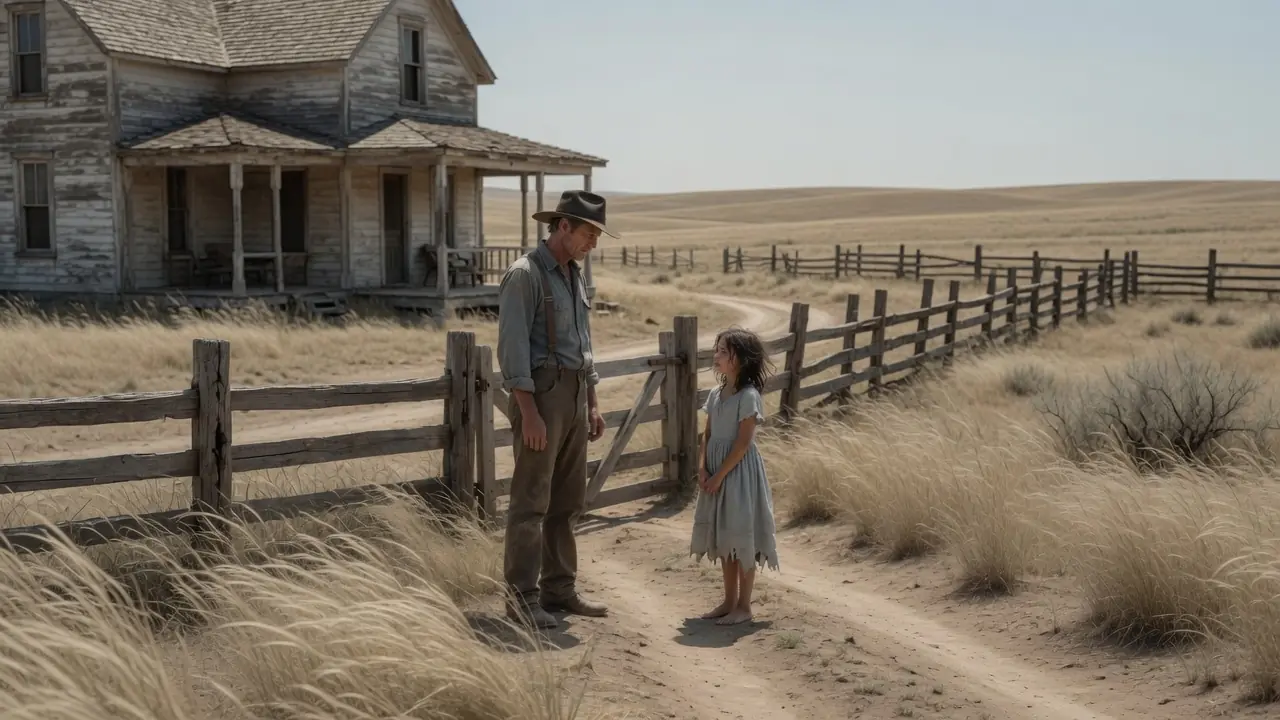
Ethan stood still.
Her lower lip shook. She tried to stop it, tried to hold herself together, but she was only eleven. The tears came then, sliding down her dusty cheeks in quiet lines. “I will work hard. I promise. I can be useful. I will not be trouble.”
Something inside Ethan broke open.
He saw, for one terrible second, not a stranger at his gate, but every loss he had refused to mourn properly. Anna fading in the bed upstairs. Daniel walking down that same road with fury in his shoulders and a suitcase in his hand. His own pride standing silent when it should have called his son back. And now this child, barefoot in the July heat, asking to earn the right to be safe.
“Come through the gate, Clara,” he said, his voice rougher than before. “You are not walking another step alone.”
For a moment, she did not move. Hope passed over her face so quickly it looked like pain. Then her courage collapsed all at once. She pushed through the broken gate, ran across the dry yard, and threw her arms around his waist with a sob that seemed too large for her small body.
“Thank you,” she cried against his shirt. “Thank you, sir. I will work hard. Please do not send me away.”
Ethan froze. He had not been hugged in years, not like this, not with trust so desperate it felt like a responsibility placed directly into his hands. Slowly, awkwardly, he rested one hand on her back. She was trembling from heat, hunger, fear, and relief.
“I said you are coming inside,” he muttered. “That means inside.”
She held on tighter for one more second, then pulled away quickly, embarrassed by her own need. Ethan pretended not to notice. He turned toward the house, gesturing for her to follow. The porch boards groaned under their combined steps, and when he opened the door, the stale air of the farmhouse greeted them like something ashamed of itself.
Inside, the kitchen was a mess. Dishes sat in the sink. A flour sack had fallen near the pantry and spilled a pale dust over the floor. The table was cluttered with old receipts, a dull knife, a crust of bread, and a coffee pot that had seen better days. Ethan saw the room through Clara’s eyes and felt a rare flush of embarrassment.
“Sit,” he said, nodding toward the chair.
Clara lowered herself carefully, as if the chair were a gift she did not want to damage. Her feet hovered just above the floor for a moment before she set them down. Ethan noticed the way she winced, then forced herself still. He moved to the stove and stirred the coals until a small flame caught.
“When did you last eat?” he asked.
She did not answer quickly.
Ethan turned. “Clara.”
“Yesterday morning,” she said.
He stared at her.
“Maybe the day before,” she added softly.
He said nothing after that because he was afraid of what might come out of his mouth. He found beans, a heel of bread, and a little salted pork, then set water to boil. The meal was plain, but it was food. When he placed the bowl in front of her, her hands shook so badly that he nearly took the spoon from her and fed her himself.
“Slow,” he said. “Eat too fast and you will be sick.”
She nodded, taking small careful bites. After the third bite, tears began again, but she kept eating. Ethan looked away toward the window, watching sunlight burn across the yard. He had seen grown men cry less honestly than this child cried over beans and bread.
When she finished, she set the spoon down as if it were something precious. “Thank you.”
“You keep saying that.”
“I mean it.”
He sat across from her with his coffee. “You said you can work.”
“Yes.”
“What kind of work have you done?”
“Cooking, cleaning, mending. I helped my mama before she died. I can tend a garden if there is water. I can gather eggs. I can wash clothes. I can sweep and scrub and sew buttons.”
“Your mother is dead?”
“Yes.”
“Father?”
“Never knew him.”
Ethan’s fingers tightened around the cup. “And after your mother died?”
“My aunt took me for a while.”
“For a while?”
Clara stared at the table. “She said I was too much trouble. She said she had her own life to manage.”
The phrase moved through the room like a blade. Ethan leaned back slowly. “So she sent you away.”
“She told me to go find somewhere I was useful.”
Ethan closed his eyes.
When he opened them, Clara was watching him with an expression too careful for a child. She was waiting for disgust, anger, rejection, the next adult voice telling her she had misunderstood her own suffering. Ethan had no kind words ready. He had been out of practice too long.
Instead, he stood. “You can stay tonight.”
Her face fell slightly, though she tried to hide it. “Only tonight?”
“We will talk again in the morning.”
“Yes, sir.”
“Stop calling me sir.”
She blinked. “What should I call you?”
“Ethan.”
“Yes, Ethan.”
The name sounded strange in her voice, like something being returned to him.
He led her down the short hallway to the back room. He had not opened the door in months. It had belonged to Daniel once, before anger and pride drove father and son apart. The bed was still there, the quilt Anna had sewn folded at the foot, a small wooden shelf against the wall, and a window looking out toward the fields.
Clara stepped inside and stopped.
“It is perfect,” she whispered.
“It is a room.”
“It is more than I have had.”
Ethan turned away because that sentence hurt. “Rest awhile. I will bring water so you can wash before supper.”
Clara looked at him, then at the bed, then back again. “I can start cleaning now.”
“You can start by sitting down before you fall down.”
For the first time, a faint smile touched her mouth. “Yes, Ethan.”
He closed the door softly and stood in the hall with one hand still on the knob. The house felt different already. Not better, not yet, but changed, as if a single small breath had entered rooms that had been holding still for years.
That evening, Clara washed at the basin and came to supper with her hair combed as best she could. Ethan found an old pair of Daniel’s childhood socks in a drawer and gave them to her, though they were too big. He also found a pair of worn boots that had belonged to a neighbor’s boy years ago. They did not fit properly, but they were better than bare feet on burning dirt.
Clara accepted them with both hands.
“I will pay you back,” she said.
“No, you will not.”
“But I said I would work.”
“You can work without paying me back for old boots.”
Her face tightened with uncertainty. “I do not want charity.”
Ethan almost smiled. “Neither do I.”
That seemed to satisfy her. They ate in silence, but it was not the same silence Ethan had known before. His old silence had been hollow, a room with no furniture. This one had a question inside it, fragile and alive.
The next morning, Clara woke before dawn. Ethan found her already in the kitchen, standing on a chair to reach the upper shelf, stacking dishes into neat piles. The floor had been swept. The table had been cleared. The coffee pot sat clean beside the stove.
“What are you doing?” he asked.
She nearly dropped a plate. “Working.”
“It is not even sunrise.”
“I wanted you to see I meant it.”
He looked around the kitchen, then back at her small serious face. “I see it.”
She climbed down carefully. “Did I do it wrong?”
“No.”
“Then I can stay?”
Ethan had expected the question and still was not ready for it. He took off his hat, rubbed a hand over his graying hair, and looked toward the window. Outside, the broken gate hung in the morning light. For years, he had believed nothing good could come through it.
“One week,” he said. “You work here for one week. Food and a bed. After that, we decide.”
Her face lit with such careful hope it nearly undid him. “I will not let you down.”
“See that you do not.”
But she did not let him down. By noon, the kitchen looked like a different room. By evening, the front room had been swept, the blankets folded, and the fireplace cleared of old ash. Clara worked with the fierce devotion of someone trying to prove she deserved the air she breathed. Ethan told her twice to slow down, and twice she pretended not to hear him.
On the third day, she found Anna’s recipe box.
It had been tucked in the cupboard behind a chipped pitcher and a jar of dried beans. Clara brought it to him like a sacred object. “Was this your wife’s?”
Ethan looked at the looping handwriting on the first card and felt his throat close. “Yes.”
“May I use it?”
He should have said no. He should have put it away. Instead, he nodded once and walked outside before she saw his face break.
That night, she made stew from Anna’s recipe. It was not exactly the same. Clara used too much salt and not enough onion, and the meat was tougher than Anna would have allowed. But when Ethan took the first bite, memory rose so sharply that he had to set down his spoon.
Clara went pale. “Is it bad?”
“No,” he said, voice low. “It is good.”
She smiled then, small and relieved.
The week passed. Clara cleaned, cooked, mended, gathered eggs, and followed Ethan through chores when he allowed it. The farmhouse began changing in quiet ways. A folded cloth appeared on the table. A jar of wildflowers stood near the window. The curtains were washed and rehung, threadbare but clean.
Ethan changed too, though he resisted noticing. He drank less. He fixed the loose porch board because Clara nearly tripped on it. He patched the chicken coop roof because she worried about the hens. He caught himself listening for her footsteps in the morning.
On the seventh evening, Clara stood near the sink drying a plate while Ethan sat at the table, staring at hands that had built fences, buried love, and held too tightly to pride.
“Your week is finished,” he said.
The plate stopped moving in her hands.
“Yes.”
He looked up. “Do you still want to stay?”
She turned slowly. “More than anything.”
“Why?”
“Because you did not turn me away.”
“That is not much.”
“It is everything when everyone else did.”
Ethan looked at her for a long time. “You can stay.”
Her lips parted, but no sound came out.
“Long as you want,” he added gruffly. “Long as this works. Long as you tell me if something is wrong instead of disappearing.”
She crossed the kitchen in a rush and hugged him again, just as she had at the gate. This time, Ethan did not freeze as long. His arms came around her, careful at first, then firm.
“I will work hard,” she whispered.
“I know.”
“I will not be trouble.”
“You already are,” he muttered.
She pulled back, stricken.
He cleared his throat. “The good kind.”
She laughed then, a wet, startled laugh that sounded like the first bird after a storm. Ethan felt something in his chest loosen. He had forgotten a house could hold that sound.
Winter came months later, but by then Clara belonged to the farm as surely as the porch, the fields, and the stubborn broken gate Ethan finally repaired. She filled the house with work and warmth, and Ethan filled her days with food, safety, and the quiet protection of a man learning how to care again. She asked him once about the photograph on the mantle, the woman with kind eyes and the young man beside her.
“That was Anna,” he said. “My wife.”
“And the man?”
“My son. Daniel.”
“Where is he?”
“Gone.”
Clara looked at him carefully. “Gone where?”
“Chicago, last I knew.”
“Do you miss him?”
Ethan’s first instinct was to say no. Pride reached for the word before truth could stop it. But Clara had already given him too much honesty for him to answer with a lie.
“Every day,” he said.
“Then you should write to him.”
“It is too late.”
“I do not believe that.”
“You are eleven. There is plenty you do not know.”
Clara’s eyes shone, but her voice stayed steady. “I know what it feels like to wish you had said something before someone was gone. If he is alive, you still can.”
That night, Ethan sat at the kitchen table long after Clara went to bed. The repaired gate stood outside in the dark, visible beneath the moon. He took out paper, dipped a pen in ink, and began writing to the son he had lost to pride.
Daniel, I do not know if this letter will reach you, but there is something I should have said years ago.
The words came slowly, then faster. He wrote about Anna’s death, about the fight, about regret, about the girl who appeared barefoot at his gate and somehow reminded him that love was not meant to be locked away. When he finished, his hand ached and his eyes burned.
He mailed the letter the next morning.
Weeks passed before Daniel answered. When the letter came, Ethan opened it in the barn with trembling hands. Daniel wrote that he was angry, that he was not ready to forgive everything, but that he would come to Miller’s Crossing and meet him at the train station. Ethan read the words three times before Clara found him crying quietly on an overturned crate.
“He wrote back,” Ethan said.
Clara’s face opened into joy. “I told you.”
“You did.”
“Will he come home?”
“I do not know.”
“But he is coming?”
“Yes.”
She hugged him hard. “Then that is a beginning.”
And it was.
When Daniel stepped off the train two weeks later, older, broader, and carrying five years of pain in his face, Ethan thought his heart might fail from the force of seeing him alive. They stood on the station platform like strangers who still knew the shape of each other’s grief. Then Ethan said the only word that mattered.
“Son.”
Daniel’s face crumpled.
They did not fix everything that day. Such wounds do not vanish because two men finally stand in the same place. But Daniel came back to the farm, met Clara, and listened while Ethan told the truth. Clara, small and solemn, served soup and bread, then quietly told Daniel that his father had been proud of him even when he had not known how to say it.
Daniel looked at Ethan then.
Ethan did not look away.
Spring came after a hard season, and with it came official papers. Daniel helped Ethan file for guardianship because Clara’s aunt tried to claim her back after hearing she had found a home. There was a hearing, testimony, fear, and one long morning in a county courthouse where Clara stood before adults and said, in a trembling but clear voice, that blood did not make a family if it only taught a child she was unwanted.
The judge granted Ethan guardianship.
Clara cried in his arms outside the courthouse while Daniel stood beside them, one hand on Ethan’s shoulder. In that moment, Ethan understood that families could break in ways no one expected, but they could also be rebuilt out of choice, courage, apology, and the stubborn refusal to let love die where pride had buried it.
A year after Clara first appeared at his gate, the farm no longer looked dead. The fields were green again. The porch had fresh boards, the barn roof held against rain, and the kitchen smelled often of bread, stew, coffee, and something close to peace. Daniel returned from Chicago for good and found engineering work nearby, helping design irrigation ditches that brought water back to farms the county had nearly forgotten.
Clara went to school in Miller’s Crossing, though she still rose early to gather eggs and help with breakfast. She grew stronger, less fearful, quicker to laugh. Sometimes, when Ethan watched her run across the yard in proper boots, her hair flying behind her, he remembered the barefoot girl at the gate and felt both sorrow and gratitude so fierce it nearly stole his breath.
One evening in late summer, Ethan stood by that same gate and ran his hand along the repaired wood. It no longer hung by wire. It swung smooth on proper hinges, strong enough to close, easy enough to open. Clara came to stand beside him, her shoulder brushing his arm.
“Thinking?” she asked.
“Remembering.”
“The day I came?”
“Yes.”
“I was scared you would send me away.”
“I almost did.”
She looked up at him. “Why didn’t you?”
Ethan watched the sun sink low over the Wyoming prairie, turning the dry grass copper and gold. He thought of Anna, Daniel, the years of silence, the letter, the courtroom, the first time Clara hugged him like he was safe. Then he looked down at the girl who had asked for work and given him back a life.
“Because I saw your feet,” he said. “And I knew no child should have to keep walking alone.”
Clara slipped her hand into his.
Ethan left the gate open that night.