Winter had a way of making even the smallest sound feel like a warning. On the Cole ranch, miles from the nearest town and half hidden beneath a sky full of frozen stars, the night was usually quiet enough for a man to hear his own grief breathing. Snow had been falling since dusk, soft at first, then heavier, covering fence rails, wagon tracks, and the narrow path that led from the creek to the front porch. Inside the house, Ethan Cole sat alone near the stove, holding a tin cup of cold coffee he had forgotten to drink.
He was forty-two years old, a widowed rancher with weathered hands, tired blue eyes, and a face people in town said had gone hard after his wife died. He did not think of himself as hard. He thought of himself as hollow, which was worse because hollow things still stood even when nothing warm remained inside them. Three winters had passed since he buried Anna behind the small chapel in town, and still he lit lanterns every night as if light could keep memory from turning into a ghost.
The knock came just after midnight. It was not loud, not steady, not the confident knock of a traveler who expected welcome. It came in three small taps, uneven and frightened, barely strong enough to reach through the wind. Ethan froze with the cup halfway to his lips, listening as the house settled around him.
For a moment, he thought it might be a branch brushing the porch rail. Winter liked to play tricks on lonely men, and grief liked to answer them. Then the knock came again, weaker this time. A child’s voice followed it, thin and shaking through the door.
“Mister… Mama needs help.”
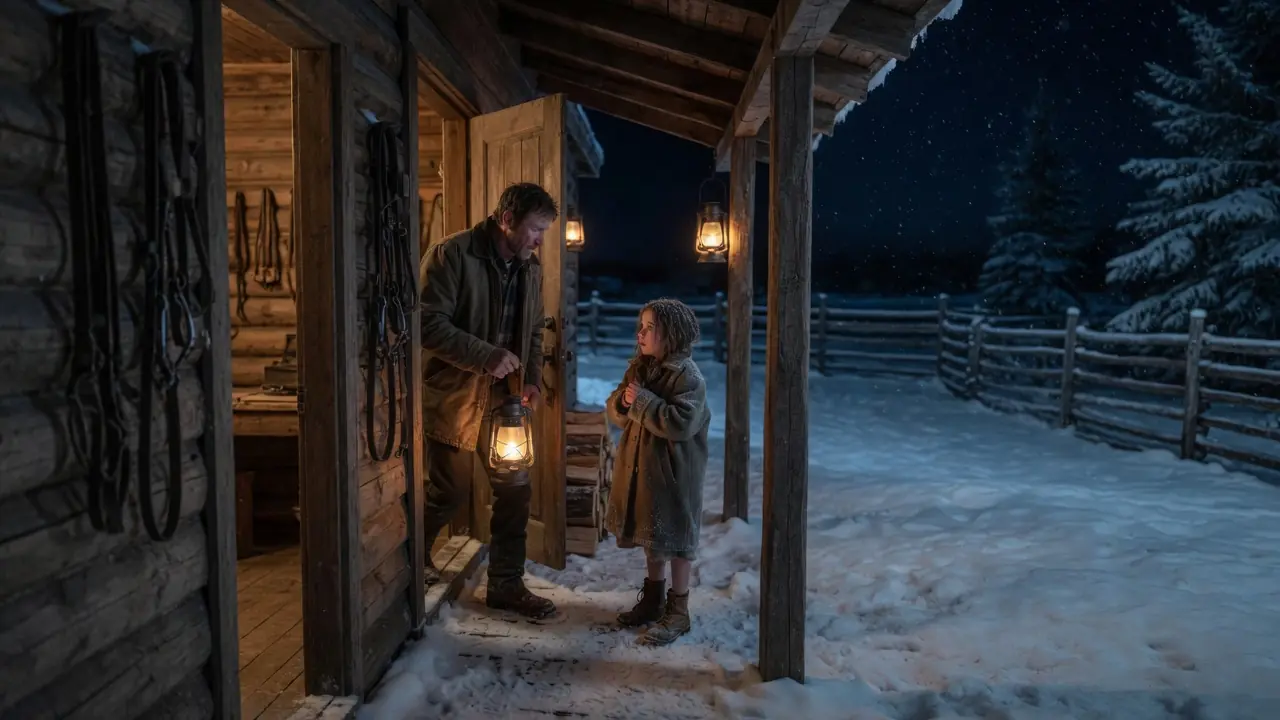
The cup slipped from Ethan’s hand and hit the floor, spilling coffee across the boards. He crossed the room in three strides, took the lantern from its hook, and pulled the heavy oak door open against the wind. Snow rushed inside around his boots, sharp and glittering in the lantern light. On the porch stood a little girl no more than seven years old, wrapped in a coat too large for her small body.
Her brown hair was tangled and dusted with frost. Her cheeks were raw from the cold, her lips pale, and her mismatched boots were half buried in the snow gathered on the porch boards. She clutched her sleeves with both hands as if she were holding herself together by force. When Ethan lowered the lantern, her wide hazel eyes lifted to his face with desperate trust.
“Easy,” he said, his voice rough from disuse. “You’re safe now.”
“She won’t wake up,” the girl whispered. “Mama won’t wake up, and the house is so cold.”
Ethan did not ask foolish questions. He stepped aside, brought her into the warmth, and shut the door hard against the storm. The little girl swayed as soon as the heat touched her, and Ethan caught her before her knees gave way. She weighed almost nothing in his arms, all cold bones, wet cloth, and fear.
He carried her to the stove and wrapped her in a wool blanket. “What’s your name?” he asked, kneeling so she could see his face.
“Clara,” she said.
Her lips trembled, but she did not cry. “Mama said if something bad happened, I should find the ranch with the big oak fence.”
Ethan’s chest tightened. Everyone in that part of Wyoming knew the Cole fence, though most people had stopped visiting the man who lived behind it. “How far is your house?”
“Past the creek,” Clara said, pointing toward the dark window. “The little house with the roof that leaks.”
Ethan stood at once. He put more wood in the stove, grabbed his heavy coat, pulled on his boots, and took a second lantern from the wall. He hesitated only long enough to look at the child’s shaking hands. She had walked through the storm alone because the world had given her no softer choice.
“Can you show me the way?” he asked.
Clara nodded, though exhaustion dragged at her small face. Ethan did not let her walk. He lifted her into one arm, took the lantern in the other, and opened the door again. The wind roared over the porch as if furious that he meant to step into it.
They moved into the snow, two lanterns swinging against the dark. Clara clung to his coat, her face turned into his shoulder, and gave small directions whenever he asked. Ethan knew the land by feel more than sight, knew where the creek dipped low, where the bank turned slick, where a man could trust the frozen ground and where he could not. The storm tried to blind him, but memory guided his boots.
The creek was half frozen, black water whispering beneath a crust of ice. Ethan crossed slowly, feeling each step before committing his weight. Clara did not speak, but he could feel her trembling through his coat. On the other side, beyond a stand of thin cottonwoods, a weak yellow light showed through one small window.
The house leaned against the night like it was tired of standing. Snow had gathered along the roofline, and smoke barely moved from the chimney. Ethan pushed the door open with his shoulder and stepped into air that smelled cold, stale, and wrong. Near the hearth, a woman lay beneath thin blankets, too still for comfort.
Clara slipped from his arm and ran to the bed. “Mama,” she whispered. “I brought him.”
Ethan set the lantern down and knelt beside the woman. She was beautiful in a worn, fragile way, with dark brown hair damp against her forehead, fair skin gone too pale, and lashes resting against cheeks touched by fever. He pressed two fingers gently to her neck and waited. There it was, faint but real.
“She’s alive,” he said. “Clara, your mama’s still here.”
The sound Clara made was half sob, half prayer. Ethan moved quickly after that. He stirred the dying fire, wrapped the woman in thicker blankets, and checked the hearth for anything useful. There was almost no wood left, no medicine on the shelf, and the cold had already settled too deeply into the walls.
“What’s your mama’s name?” he asked.
“Margaret Hale,” Clara said. “She was coughing yesterday. Then she stopped talking right.”
Ethan nodded. He had seen winter sickness before, seen it steal warmth from people a little at a time until the room gave up before the heart did. He lifted Margaret carefully, wrapping the blanket tight around her. “We’re taking her back to my ranch,” he said. “There’s heat there. Food. Medicine. She has a better chance there.”
Clara did not argue. She only grabbed the second lantern and followed close as Ethan carried her mother into the storm. The walk back was harder. Margaret’s weight pulled at his arms, the snow struck his face, and the cold clawed through his coat. Ethan did not slow.
He remembered another winter, another room, another woman he had carried too late. The memory tried to rise, but he forced it down. Not this time. Not while Clara’s small footsteps followed behind him like a promise he had no right to break.
By the time they reached the ranch, Ethan’s arms burned and Margaret’s breathing had turned shallow. He kicked open the door, carried her inside, and laid her in his own bed because it was nearest the stove and already layered with heavy quilts. Clara stood near the doorway, snow melting from her coat onto the floor, watching him with terrified eyes. Ethan moved from stove to lamp to hearth, lighting everything he could reach.
One lantern on the table. One by the bed. One in the front window. One on the porch. Then another, and another, until the whole ranch house glowed against the white night.
Clara watched him with wonder. “Why so many?”
“So the dark knows it isn’t welcome,” Ethan said.
That answer seemed enough for her. She sat near her mother, clutching the blanket around her shoulders, and did not take her eyes off Margaret’s face. Ethan worked through the night, giving Margaret small sips of warm broth when she could swallow, cooling her forehead, adjusting blankets, and keeping the fire steady. He did not sleep.
Just before dawn, Margaret stirred. Her fingers moved first, then her head turned slightly on the pillow. Clara leaned forward so fast she nearly fell from the chair. Margaret’s eyes opened, unfocused and full of fear, until they found her daughter.
“Clara?” she rasped.
“I’m here, Mama,” Clara said, climbing onto the edge of the bed. “I got help. I found the ranch.”
Margaret’s gaze shifted slowly to Ethan. Fear flickered there at first, the careful fear of a woman who had learned not to trust safety too quickly. Ethan stepped back, giving her room to understand. “You’re at the Cole ranch,” he said quietly. “Your girl came for me. You’re both safe.”
Margaret tried to speak, but a cough took the words. Ethan lifted a cup to her lips and helped her drink. She closed her eyes afterward, exhausted by even that small effort. Clara held her hand like she could anchor her mother to the world.
Morning came pale and slow. Snow stopped before sunrise, leaving the land wrapped in silence. Ethan sat at the table with his hands around a fresh cup of coffee and watched the firelight move across the room. For the first time in years, his house did not feel empty.
Margaret slept most of the day. Clara slept on the rug near the stove after fighting it for an hour, curled up beneath a blanket with one hand stretched toward the bed. Ethan tried once to carry her to the small spare room, but she murmured, “Don’t leave Mama,” even in sleep. So he let her stay.
By afternoon, Margaret woke stronger. She studied the room carefully, taking in the clean floor, the stacked wood, the neat shelves, the lanterns still burning low. Her eyes returned to Ethan. “I don’t know how to thank you,” she said, her voice hoarse.
“You don’t need to.”
“I do,” she said. “My daughter walked through that storm because I couldn’t protect her.”
Ethan looked toward Clara, still sleeping near the stove. “She protected you.”
Margaret’s eyes filled, but she blinked the tears back. “She’s braver than she should have to be.”
Ethan understood that too well. “Children usually are when adults run out of choices.”
They did not speak for a while after that. The silence was not uncomfortable. It sat between them like something shared, something both had carried before and recognized in the other. Margaret finally told him her husband had died two winters earlier while hauling timber through the pass, leaving her with Clara, a failing roof, and too many debts to count.
Ethan told her almost nothing about himself. Only that his wife Anna had died three winters ago, and that he had stayed on the ranch because he did not know where else to take his grief. Margaret did not press. She simply nodded as if she understood that some stories did not open all at once.
The storm kept them there for three days. The creek rose with ice, the road disappeared under drifts, and the doctor from town could not come. Ethan did what he could with the medicine he had, old remedies, steady heat, broth, and patience. Margaret slowly returned from the edge of fever, her color warming, her voice gaining strength.
Clara changed the house faster than sickness left it. She asked where everything was, named the hens outside through the window, and announced that one of them looked like a “Mrs. Buttercup.” She followed Ethan from room to room whenever Margaret slept, carrying small pieces of firewood like she was helping save the ranch. Ethan found himself answering her questions before he remembered he had spent years avoiding conversation.
On the fourth evening, Margaret sat at the table wrapped in a quilt, watching Ethan repair a loose chair leg. Clara was drawing crooked stars on a scrap of paper near the stove. Outside, the wind moved around the house but no longer sounded like it owned the place. Margaret looked at the lantern by the window.
“Clara said you lit every lantern that night.”
Ethan did not look up from the chair. “Seemed like the thing to do.”
“She said you told the dark it wasn’t welcome.”
His hands paused on the wood. “Sometimes children need something simple to believe.”
Margaret studied him. “And sometimes grown men do too.”
The words landed softly, but deep. Ethan looked up then, and for a moment their eyes held across the room. Margaret was not smiling. She was seeing him too clearly, and that unsettled him more than the storm had.
A knock came at the door that same night. Not Clara’s fragile midnight taps, but a firm, heavy sound. Ethan stood immediately. Margaret stiffened, and Clara’s pencil stopped moving.
“Stay here,” Ethan said.
He opened the door partway. Two men stood outside with horses behind them, snow on their hats and sharp hunger in their eyes. They claimed they had seen the lights and needed warmth. Ethan looked at their hands, their boots, the way one tried to see past him into the house.
“We’re fine,” he said.
The taller man smiled without warmth. “Looks like you got company.”
“Family,” Ethan answered.
The word surprised him as much as it surprised Margaret behind him. He did not turn to see her face. The men exchanged a look, then muttered something about cruel weather and colder hearts before riding off into the dark. Ethan shut the door and slid the bolt into place.
Margaret was watching him when he turned around. Clara stood close to her side, clutching her skirt. “Family?” Margaret asked softly.
Ethan removed his hat and set it on the hook. “It was the quickest word.”
Margaret’s expression shifted, not quite a smile, not quite tears. “It was a good one.”
After that, something changed without anyone naming it. Margaret healed enough to help with small tasks. She folded blankets, stirred stew, mended Ethan’s torn work shirt, and scolded him gently when he tried to lift too much alone. Clara began laughing in the mornings, and the sound seemed to travel through the house like sunlight.
Ethan kept telling himself they would leave when the weather cleared. Their own house needed repairs. Their own life waited beyond the creek. Yet each time he imagined the ranch empty again, the thought sat wrong in his chest.
One afternoon, Margaret found him in the barn checking tack. Snowmelt dripped from the roof in steady beads, and the air smelled of hay and thawing earth. She stood near the doorway, wrapped in a shawl, her brown hair braided over one shoulder. “You’ve done more than enough for us,” she said.
Ethan tightened a strap. “Haven’t done enough yet. Your roof still leaks.”
“You don’t owe us that.”
“No,” he said. “I don’t.”
She stepped closer. “Then why offer?”
Ethan did not answer right away. He looked past her toward the house, where Clara’s laughter drifted faintly from the kitchen window. “Because when she knocked, I remembered what it felt like to be needed by the living.”
Margaret’s face softened. “And did that frighten you?”
“Yes.”
Her smile was gentle and sad. “It frightened me too.”
By spring, Margaret could walk to the creek without stopping. Ethan repaired the roof of her little house, patched the door, and stacked enough wood to last until summer. He expected the work to bring an ending, but it did not. Margaret stood beside him on the last day, looking at the repaired house with quiet gratitude and something like reluctance.
“I should be glad,” she said.
“You’re not?”
“I am,” she said. “But Clara asked this morning whether we had to leave your ranch.”
Ethan looked down at the hammer in his hand. “What did you tell her?”
“That grown people make careful decisions.” Margaret turned to him. “Then I realized I did not know what the careful decision was.”
Ethan’s throat tightened. “Margaret.”
“I’m not asking you to replace anyone,” she said quickly. “And I won’t pretend I can forget my husband. But I know what that house felt like before Clara knocked on your door. I know what your house felt like after. We were alive there, Ethan. All of us.”
He looked at her then, really looked. She was still tired around the eyes, still carrying grief of her own, but she was standing in front of him with courage that did not shout. She was not asking for rescue now. She was offering truth.
“I don’t know if I remember how to be happy,” he said.
Margaret stepped closer. “Neither do I. Maybe we learn slowly.”
That evening, they returned to the ranch together. Clara ran ahead and burst through the front door like she already belonged there. Margaret stopped on the porch beside Ethan, looking at the lantern hooks along the wall. None of them were lit.
“You don’t light them every night anymore,” she said.
“No.”
“Why?”
Ethan watched Clara through the window, moving around the kitchen with the confidence of a child who had found safety. “Because the house isn’t dark the same way.”
Margaret reached for his hand. Her fingers slipped into his slowly, giving him every chance to pull away. He did not. His hand closed around hers with a steadiness that felt less like a promise and more like permission to begin.
They did not marry that spring. They did not rush love because both of them knew what it meant to bury vows and live after them. Margaret and Clara stayed at the ranch while her house became a place for supplies, storage, and eventually guests who needed shelter in bad weather. The town talked, as towns always do, but Ethan stopped caring what people said after he realized the house had begun to sound like home.
Clara grew strong in the open air. She learned to ride, to gather eggs, to read weather in the clouds, and to make Ethan laugh when he tried too hard not to. Margaret planted a garden near the kitchen window, and every seed she pressed into the ground felt like an act of defiance against all that winter had taken. Ethan fixed fences with lighter hands than before.
One night, months after the knock, a traveler came during a spring storm. His wagon had broken near the creek, and his young son stood trembling beside him on the porch. Ethan opened the door before the man finished explaining. Margaret was already bringing blankets, and Clara was already pulling out cups.
The man looked stunned. “You don’t even know us.”
Ethan stepped aside. “You knocked.”
The words settled in the room like a rule the house had chosen for itself. After that, people began saying the Cole ranch was the place with the lights. If someone was lost, hurt, cold, or desperate, they looked for the big oak fence and the house that did not turn people away. Ethan never planned to become known for mercy, but mercy had come to his door in mismatched boots and asked for help.
Years later, Clara would remember that first night in pieces. Snow on her eyelashes. The heavy door opening. A lantern lowered to her face. A man kneeling so she would not have to look up so far while telling him her mother might be gone.
She would remember Ethan’s voice most of all. Calm, rough, and certain when everything else in the world had become frightening. “You did right coming here,” he had said. For a child who had walked through winter alone, those words became a kind of shelter she carried forever.
Ethan remembered it differently. He remembered the knock as the moment the dead places inside him heard life asking to be let in. He remembered carrying Margaret through the storm and thinking he might not be too late this time. He remembered lighting every lantern not only for Clara and her mother, but for the part of himself that had been waiting years for a reason to stand up again.
On the first anniversary of Clara’s knock, Margaret lit one lantern on the porch and left the rest dark. Ethan came outside and stood beside her as snow began falling in slow, gentle flakes. Clara was inside, asleep near the stove with a book open on her lap. The ranch was quiet, but not empty.
“Just one?” Ethan asked.
Margaret smiled. “One is enough now.”
He looked out over the white yard, the oak fence, the dark creek beyond. Once, he had lit every lantern because he feared what the night might take. Now he understood light differently. It was not only a warning to the dark; it was an invitation to the lost.
Margaret slipped her hand into his. “Do you ever wish she had knocked on someone else’s door?”
Ethan looked at the lantern, then at the woman beside him, then through the window at the child who had brought them both back to life. “No,” he said. “Not once.”
The snow fell softly around the ranch. The lantern burned steady. And this time, when winter pressed close to the windows, Ethan Cole did not feel alone enough to fear it.