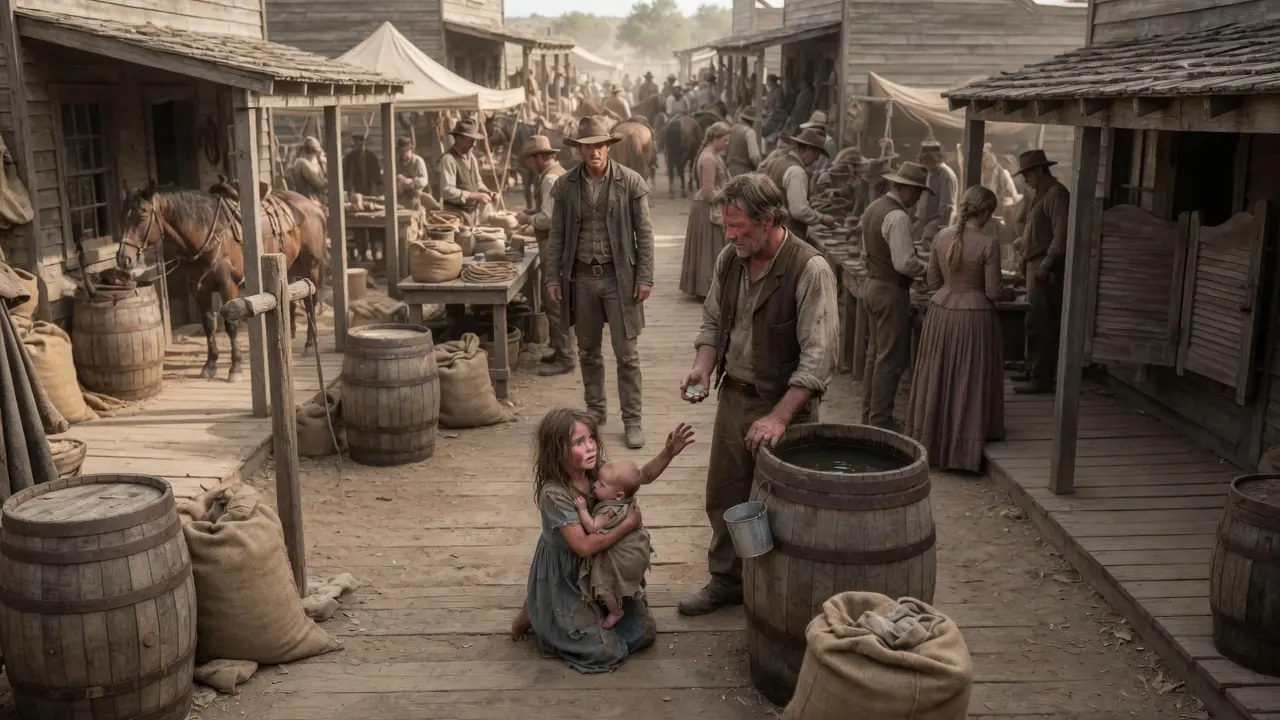
The little girl’s knees touched the dusty boardwalk before anyone in Caldwell Flats cared enough to stop. She was only four years old, barefoot, sunburned, and so tired that her small body seemed to fold under the weight of the baby in her arms. Her brother, Benjamin, was six weeks old, wrapped in torn cloth and pressed against her chest like the last thing in the world she knew how to protect. His lips were pale and dry, and every breath he took sounded too small.
Her name was Clara Dunn, though no one in that market had bothered to ask. She had been walking since before sunrise, one slow step after another, through heat, dust, and fear. Their mother had left them on a blanket two days earlier, saying she would come back before dark. She never came back, and Clara had carried Benjamin ever since.
The market at Caldwell Flats was loud enough to swallow almost any sorrow. Wagons rolled over packed dirt, horses shifted at hitching posts, merchants shouted prices, and customers argued over flour, beans, rope, leather, and coffee. A row of water barrels stood near the hardware stall, each with a tin cup hanging from a nail. To Clara, those barrels looked like heaven with wood around it.
She reached the first merchant with one hand extended and Benjamin held tight in the other arm. “Please, mister,” she said, her voice thin from thirst. “Water for my brother. He’s real little.” The man glanced down, saw no money in her hand, and turned back to counting coins.
“No money, no water,” he said. “Move along before you scare off paying customers.” Clara did not understand how a thirsty baby could scare anyone, but she moved because his boots shifted toward her. She tried the cloth seller next, then a man with sacks of grain, then a woman selling dried apples. Every answer was the same in a different shape.
Some looked away. Some waved her off before she finished speaking. One man laughed and told her babies cried all the time, as if Benjamin’s silence were not the thing frightening her most. Clara had learned in two days that grown people could make themselves very busy when a child needed them.
By the time she reached the middle of the market, her legs had begun to shake. She sat on the edge of the boardwalk, meaning to rest for only a moment. The moment became a fall, and her knees dropped hard into the dirt while she still managed to keep Benjamin from hitting the ground. She whispered, “I got you, Benny,” though she was no longer sure that she did.
The water merchant stood nearby with one hand on the barrel, watching her with irritation instead of concern. “Girl, I told you to move,” he snapped. Clara lifted her face toward him, her eyes too tired to produce tears. “Please,” she said again. “Just the cup. He can’t ask by himself.”
That was when a pair of boots stopped behind her. They did not hurry past like the others. They did not turn away. They stopped close enough that Clara could see the dust on the leather and the long shadow falling across the boardwalk.
Jack Harper had come to Caldwell Flats for seed, nails, and a new hinge for the barn door. He was thirty-eight years old, a widower, and the owner of a small ranch four miles east of town. His son Eli was ten, old enough to help with chores and young enough still to look toward his father whenever the world seemed uncertain. Jack had not come to town looking for trouble, but trouble has a way of kneeling in front of decent men and asking what they are made of.
He looked first at Clara, then at the baby. He saw the cracked lips, the bare feet, the torn dress, and the way Clara held Benjamin with the weary care of someone far older than four. Then he looked at the merchant beside the water barrel. “You heard a child beg for water,” Jack said quietly, “and still reached for her purse first?”
The merchant’s face hardened. “This ain’t a charity house, Harper.” Jack stepped closer, his voice still calm, but with a cold edge that carried across the nearest stalls. “It is a water barrel in a public market.” He reached into his coat pocket, pulled out coins, and dropped them into the man’s palm. “Now hand me the cup.”
The merchant muttered under his breath, but he took down the cup and filled it. Jack brought it to Clara and crouched in front of her, lowering himself until his eyes were level with hers. That small gesture nearly broke something inside her. For two days, every adult had looked down at her, over her, or through her, but this man looked directly at her.
“Drink first,” Jack said. Clara stared at the cup like she was afraid it might vanish. “Benny needs it,” she whispered. “You do too,” Jack said, steady and firm. “Drink first, then we will help him slow.”
She drank carefully, fighting the wild urge to swallow all of it. The water was warm and tasted faintly of tin, but to Clara it was better than anything she had ever tasted. She stopped halfway and looked anxiously at Benjamin. “How do I give it to him?” she asked. “He can’t hold the cup.”
Jack sat beside her on the boardwalk, ignoring the market eyes turning toward them. He tore a clean strip from the inside of his shirt cuff and twisted it thin. “Dip this in the water,” he said. “Let him suck on it. Slow, not too much at once.” Clara watched every movement as if he were teaching her how to keep the world from ending.
Benjamin’s lips found the damp cloth, and he began to suck weakly. Clara’s whole face changed. Not into happiness, not yet, but into something that remembered hope existed. Jack watched the baby’s color shift slightly, saw the tiny fingers twitch, and felt anger settle deep in his chest against every person who had walked past them.
“What is your name, little miss?” he asked. “Clara Dunn,” she said. “And this is Benjamin. I call him Benny.” She touched her cheek to the baby’s forehead as though apologizing for taking even that much time to answer. “He’s real little.”
“He is,” Jack said. “But he is breathing, and he is taking water. That counts for something.” Clara nodded as if she wanted badly to believe him. Around them, the market had softened into whispers. People who had refused her moments earlier now watched as though a miracle had appeared without any connection to their own shame.
Jack stood and held out one hand. “Come on,” he said. “There is a cook stall at the end of the street. May Sutton makes bean soup and cornbread.” Clara did not take his hand right away. Trust, for a child who had been abandoned and refused, had become a dangerous thing. Jack waited without rushing her.
“Why?” she asked. It was not childish curiosity. It was a survival question. Jack looked at Benjamin, then back at her. “Because no one else is going to,” he said, “and because you have carried him alone long enough.”
Clara studied him for another second, then placed her small hand in his. He helped her stand, steadying her when her knees wobbled. She leaned into his support for only one breath before straightening, still trying to prove she could manage. Jack pretended not to notice because pride, even in a child, sometimes needs kindness more than correction.
May Sutton’s cook stall sat near the far end of the market under a patched canvas awning. May was stout, gray-haired, and known for feeding cowhands until they could barely walk. She looked up when Jack approached, ready with a joke, but the words died when she saw Clara. Her eyes moved from the bare feet to the baby and then to Jack’s face.
“Lord in heaven,” May whispered. Jack said, “Two bowls if she can manage them, and anything that helps a nursing baby.” May was already moving before he finished. She came around the stall, bent near Clara without touching her, and asked, “When did you last eat, sweetheart?”
“Yesterday,” Clara said. “Some bread a man dropped.” May’s mouth tightened. She turned toward the market with a look that made two nearby customers suddenly examine the ground. Then she set Clara on a bench, brought soup, softened cornbread in broth, and helped her eat slowly because Clara’s hands shook too much to hold the spoon steady.
Jack sat across from them with a cup of coffee May had shoved into his hand. He watched Clara take small bites, pause, breathe, then try again. Benjamin rested against her shoulder, wet-mouthed and quieter now in a way that felt less frightening. For the first time, Clara allowed her eyelids to droop.
“You got a wife?” Clara asked suddenly. The question struck Jack in a place he did not show most people. He looked at the coffee in his hands. “Not anymore,” he said. “She died three years ago.”
Clara absorbed that with the solemnity of children who know loss too early. “My mama might be gone too,” she said. “She said she would come back, but she did not.” Jack looked at her, and the words he wanted to say had no place in a child’s ear. So he only said, “I know.”
After the soup, Jack walked her to his wagon. It was a working rig with a canvas cover, hay in the back, and sacks of supplies pushed to one side. Clara climbed up with effort, still holding Benjamin. Jack paused beside her. “Let me carry him for a while,” he said. “Just to the wagon seat and then home if you want.”
Clara looked at Benjamin, then at Jack’s hands. They were large, rough, and steady. Slowly, she passed the baby to him. Jack took Benjamin with the practiced care of a man who had once held a newborn son through long nights. Clara noticed immediately.
“You know babies,” she said. “I know one,” Jack answered. “His name is Eli.” Clara settled into the wagon bed, exhausted beyond fear. “Will Eli mind us coming?” she asked. Jack climbed onto the seat and gathered the reins. “He will understand.”
The road to Harper Ranch stretched east through open country under a fading sky. Clara tried to stay awake because staying awake had kept Benjamin alive for two days. But the wagon rocked gently, the baby breathed steadily against Jack’s chest, and the air no longer smelled like dust and refusal. Somewhere in the final mile, Clara fell asleep.
Jack heard the change in her breathing and glanced back. The little girl was slumped against the wagon side, her head tilted, one hand still reaching toward Benjamin even in sleep. He faced forward again, jaw tight. He had seen hard things in his life, but few had shamed him like the sight of a child so young unable to stop guarding someone else.
The Harper Ranch appeared through dusk with lamplight in the windows. Eli came onto the porch when he heard the wagon. He froze when he saw his father climb down with a sleeping girl over one shoulder and an infant in the crook of his arm. “Pa?” he said slowly.
“Get the spare blankets,” Jack said. “The soft ones from the cedar chest. Then fill the wash basin.” Eli stared for only one second longer before turning and running inside. He was a good boy, and good boys sometimes understood urgency before explanations.
Jack carried Clara to the back room, a space that had once been a sewing room and then became storage after Margaret died. He laid her on the narrow bed and tucked a blanket around her. Then he placed Benjamin in a dresser drawer lined with soft cloth, close enough that Clara’s hand still reached toward him. She did not wake, but her fingers relaxed when they touched the drawer edge.
Eli appeared in the doorway with the basin. “Who are they?” he asked. “Clara and Benjamin Dunn,” Jack said. “They were alone in town.” Eli looked at the sleeping girl and the tiny baby. His face changed in the quiet way boys’ faces change when childhood meets something it cannot ignore.
“Are they staying?” Eli asked. Jack looked at the children, then at his son. “For now.” Eli nodded, but he did not leave. “Their mama?” Jack shook his head once. “Not here.” That answer was enough for the moment.
Jack did not sleep much that night. He sat at the kitchen table with a glass of water and listened to the house breathe. After Margaret died, the ranch had gone quiet in a hollow way, but that night the quiet was different. It was watchful, full of small vulnerable lives now under his roof.
Just before dawn, Benjamin began to cry. It was weak, but it was a real cry, and Jack was on his feet before the second note. Clara was already awake, sitting upright in the bed, reaching for the drawer. “I got him,” she said quickly. “I got him.”
“I know,” Jack said, crouching beside her. “But you do not have to be the only one.” Clara looked at him with suspicion, not because she was rude, but because she had no experience with shared burdens. Jack warmed water, prepared the damp cloth again, and planned his next ride. Benjamin needed milk, and a six-week-old could not live on water and mercy.
He rode to the Whitfield place after sunrise. Caroline Whitfield had a nursing baby of her own and a heart that did not need long explanations. By the time Jack finished telling her about Clara and Benjamin, she was already pulling on her shawl. “I can help morning and evening,” she said. “And I will send milk in a jar for the hours between.”
Then her expression sharpened. “Jack, does Judge Voss know about them?” The name darkened the kitchen. Judge Henry Voss oversaw dependent children in the county, and rumors about his placements had followed him for years like flies around spoiled meat. Jack said, “Not yet.” Caroline replied, “He will.”
Jack returned to the ranch with milk and a warning in his saddlebag. He found Eli and Clara at the kitchen table with a bowl of cornmeal between them. Clara had not eaten at first because she did not know if she was allowed to take food. Jack sat across from her and said, “Everything in this house that keeps you alive is allowed. Food, water, blankets. You do not have to earn being safe.”
Clara stared at the spoon, then took a bite. Eli watched her carefully, curious but not cruel. “I am ten,” he said. “I know,” Clara answered. “Your pa told me.” Eli nodded as if this established proper introductions.
That afternoon, Jack rode into Caldwell Flats to wire his lawyer in Abilene and speak with Deputy Owen Marsh. Owen had heard rumors about Voss too, but rumors were not enough to bring down a man with county power. Jack told him everything about Clara, Benjamin, the market, and the likelihood that someone had already reported the children. Owen listened without interrupting.
When Jack finished, Owen leaned back and said, “Voss will claim jurisdiction.” Jack said, “Then I need guardianship papers filed before he can move.” Owen’s face tightened. “That may not be enough if he gets an emergency order.” Jack leaned forward. “Then we find out what he is hiding.”
By supper time, Judge Voss came to the Harper Ranch with two large men flanking him. He rode a fine gray horse and spoke with the pleasant voice of a man accustomed to obedience. He said the children needed county assessment and proper placement. Jack stood in the yard and said no.
Voss smiled, but the smile never reached his eyes. “You are interfering with county duty, Mr. Harper.” Jack did not move. “I am protecting two children who were refused water in your town.” Voss’s expression shifted almost invisibly, but Jack saw it. Men like Voss did not like being named plainly.
That night, Owen showed Jack records he had quietly collected for two years. Children placed through Voss’s office had vanished into households that paid suspicious fees. Some placement records ended the day the child was delivered, with no later check-ins. There was a hidden ledger, Owen said, and if they could find it, the whole structure might crack.
Jack took a risk that night because waiting meant giving Voss time. With Owen guarding the east road and printer Marcus Hail ready to make copies, Jack retrieved the hidden ledger from Voss’s office strongbox. It contained names, dates, payments, and enough ugliness to make the room go cold. Marcus Hail read it and whispered, “This is everything.”
By morning, copies were made and a wire had gone to Austin through Jack’s lawyer. Voss tried to move first, rushing to Magistrate Dills for an emergency placement order. Jack and Owen arrived before the signature dried, carrying a copied ledger like a thundercloud folded into paper. Dills read enough to understand that signing Voss’s order might attach his own name to a scandal too large to survive.
The order was not signed. Instead, Dills issued temporary protection for Clara and Benjamin under Jack’s care pending formal filing. Voss left with his composure intact only on the surface. On the street, people whispered as if the market itself had become a courtroom. The town that ignored Clara now could not stop saying her name.
Thirty-six hours later, a marshal arrived from Austin. Judge Voss was suspended and taken into custody while state investigators opened every placement record from the past eight years. Some children were found quickly. Others would take longer. Justice did not arrive as a clean, shining thing, but it arrived, and that mattered.
When Jack returned home after Voss was taken away, Clara sat at the kitchen table with Eli and a deck of cards. Benjamin slept in the drawer cradle nearby, full and breathing steadily. Clara looked up at Jack and asked, “Is it safe now? For real?” Jack sat down slowly, letting the answer be steady enough for her to believe.
“Yes,” he said. “For real.” Clara studied his face. Then she nodded, picked up her cards, and asked Eli whose turn it was. That small ordinary question felt like a blessing.
The guardianship papers were filed days later. Thomas Greaves came from Abilene, spread the forms across Jack’s kitchen table, and explained every line. No one asked Clara to leave the room. When he said the children would be legally in Jack Harper’s care, Clara pointed to the paper and asked what it meant.
“It means this can be home,” Greaves said. Clara looked toward Benjamin, then toward Eli, then toward Jack. “Okay,” she said. She smoothed the paper carefully with both hands, as if it were something that might fly away if not held properly.
The ranch changed after that. Caroline came daily to help with Benjamin, and the baby gained weight by ounces that Clara tracked with fierce seriousness. Eli began sitting near Clara on the porch without demanding conversation. He asked once if he could hold Benjamin, and Clara considered the matter like a judge before finally saying yes.
“You have to support his head,” she said. “I know,” Eli replied. “Pa showed me.” She passed the baby over carefully, ready to snatch him back at the first mistake. No mistake came, and something in her shoulders relaxed.
One evening, three weeks after the market, Jack came out to find Eli braiding rope, Clara watching critically, and Benjamin asleep in a clean blanket across her lap. The porch was quiet, but not empty. Not the old quiet that had followed Margaret’s death. This quiet had weight and warmth and small breathing in it.
“Jack?” Clara said. “Are we your family now?” Eli stopped braiding. Jack looked at her, understanding that she was not asking for comfort but truth. “Yes,” he said. “You are.”
Clara studied him long enough to measure the answer. Then she turned back to Eli’s rope. “You’re doing it wrong,” she told him. Eli sighed. “I am not.” Jack looked at the rope and said, “She is probably right.”
Life did not become easy, but it became possible. Benjamin grew stronger. Clara slept longer. Eli learned that sharing his father did not mean losing him. Jack learned that grief could make room for new love without betraying the old.
Sometimes Jack thought about that day in the market and the step he almost took past her. There had been a second, only one, when he could have kept walking like everyone else. He had seed to buy, a hinge to fetch, a ranch to run, and a son waiting at home. The world always gives a man excuses not to stop.
But Jack had stopped. He had looked at a barefoot girl with a baby in her arms and decided that whatever happened next was his problem now. That decision brought trouble, danger, law, scandal, and sleepless nights. It also brought Clara and Benjamin into a house that had been too quiet for three years.
Clara had begged for water in a market full of people who turned away. Benjamin had been too small to ask for anything at all. Jack Harper had not been the richest man in Caldwell Flats, or the most powerful, or the loudest. He was simply the one adult who refused to turn them away.
And sometimes, that is all it takes to change a child’s whole world.
One person stopping.
One cup of water.
One door opened at the right time.