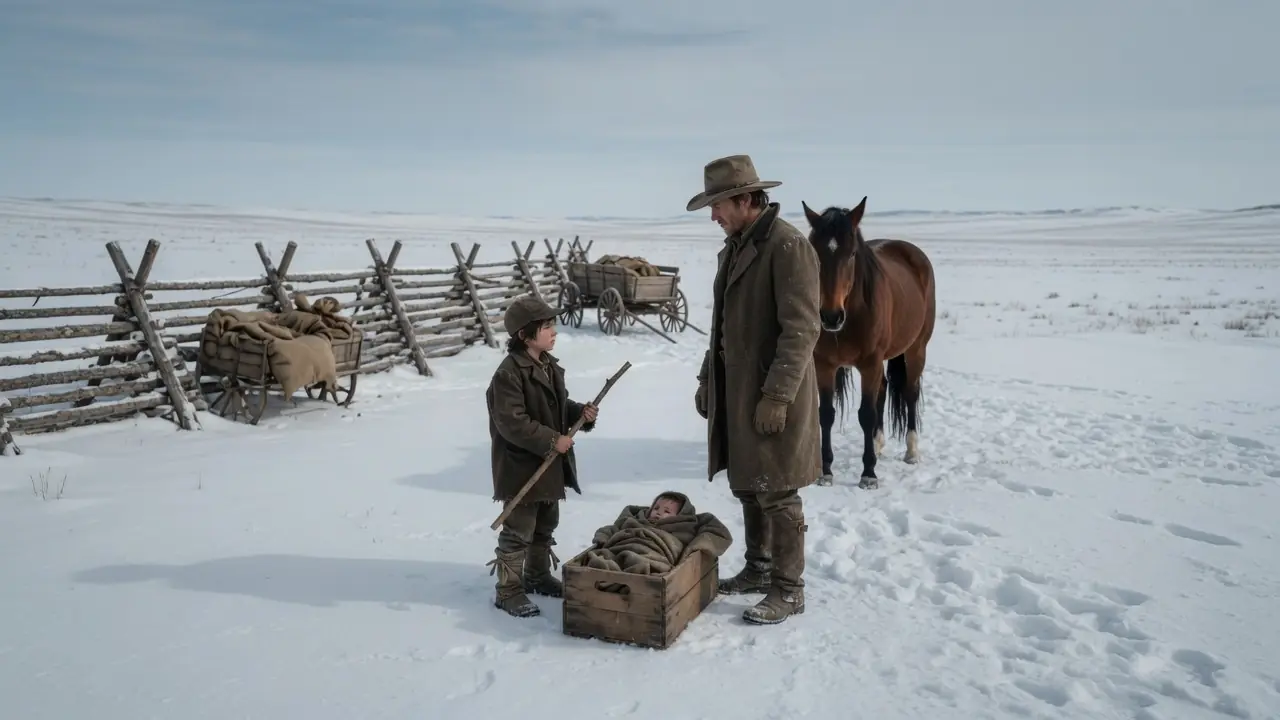
The winter wind came down over the Kansas plains like it had a mind of its own. It swept across the open fields outside Abilene, pushing clean white snow against fences, wagon wheels, and the empty supply trail that most travelers had abandoned before sundown. The road was nearly erased beneath the storm, and even the cattle had moved close to whatever shelter they could find. Out there, where the land stretched wide and merciless, a small wooden wagon sat half buried near a broken fence line.
Beside that wagon stood a boy no older than six. His name was Eli Turner, and the coat hanging from his narrow shoulders was far too thin for the weather. The sleeves were torn, the collar was stiff with frost, and his boots were too large, tied at the ankles with strips of cloth to keep them from slipping off. Still, he did not run, did not sit, and did not leave the rough wooden crate placed on the snow behind him.
Inside the crate, wrapped in every blanket Eli had been able to find, his baby sister Clara whimpered weakly. Her tiny face was tucked deep into the cloth, and Eli kept brushing snow away from the edges with hands that barely wanted to move anymore. Every time she made a sound, he turned toward her with a fear too old for his small face. “It’s all right, Clara,” he whispered again and again. “I’m here.”
Three days earlier, Eli had still had parents to answer to. His father had been trying to guide their wagon toward Abilene before the worst of the storm arrived, and his mother had held Clara in the back beneath a blanket. Eli remembered the horses growing restless, the wind turning white around them, and the wagon slipping hard near the edge of the trail. After that, the world became noise, cold, and silence.
By morning, Eli understood only one thing. His mother had pulled him close, her voice barely stronger than the wind, and told him to take care of his sister. He had nodded because he was a good boy, because children nod when mothers speak, and because he did not understand that a promise can become heavier than a grown man’s burden. When the storm settled again over the road, Eli dragged the crate close to the wagon, wrapped Clara in blankets, and stood guard.
He did not know how long he had been awake. Hunger had become a dull emptiness inside him, and the cold had crept into his fingers until the stick in his hand felt like part of him. He held that stick like it was a rifle, like it was a wall, like it was enough to keep wolves, strangers, hunger, winter, and the whole world away from Clara. Whenever his eyes began to close, Clara’s small cry pulled him back.
The trail stayed empty for so long that Eli started to believe no one would ever come. The snow made the world seem endless, with no house, no smoke, no rider, and no voice except the wind. Then, late in the afternoon, a dark shape moved through the white distance. Eli blinked hard, tightened both hands around his stick, and watched as the shape became a horse and rider.
Samuel slowed his horse as soon as he saw the wagon. One wheel was frozen into the drift, and the whole scene carried the stillness of something gone terribly wrong. Then he saw the crate. Then he heard the baby. His eyes moved from the bundle of blankets to the boy standing in front of it, stick raised, face pale with cold and determination.
Samuel swung down from the saddle slowly. His boots crunched into the snow, but he kept his hands visible and his movements careful. Eli stepped in front of the crate at once, lifting the stick higher even though his arms trembled. “Don’t come closer,” he shouted. His voice shook, but it did not break.
Samuel stopped where he was. He had faced angry men before, spooked horses, wild weather, and long winters that tested a man’s soul. Yet nothing struck him as hard as that little boy standing there ready to defend a baby with a branch. Samuel lowered himself to one knee in the snow so he would not tower over the child. “Easy, son,” he said softly. “I ain’t here to take your sister.”
Eli did not lower the stick. “She’s mine to protect,” he said, his lips barely moving from the cold. Samuel’s eyes softened, though his chest tightened with worry. Behind the boy, Clara whimpered again, weaker than before. Eli glanced back instantly, and the way he looked at her told Samuel everything.
This boy was not simply frightened. He believed he was the last living promise between his sister and the world. Samuel stayed still, letting the wind move between them, because trust on the plains could not be forced. “What’s your name?” he asked. After a long pause, the boy answered, “Eli.”
“Well, Eli,” Samuel said, “my name is Samuel Carter.” The boy stared at him like a name meant nothing, because to Eli, it did not. A name could not warm Clara. A name could not bring his parents back. A name could not prove whether a stranger meant mercy or danger.
Samuel reached slowly into his coat pocket, and Eli’s stick came up again. “What are you doing?” he snapped. Samuel froze, then pulled out a small cloth bundle with two fingers. “Food,” he said. “Nothing more.” He opened the cloth and showed him a biscuit and a strip of jerky from his saddlebag.
Eli’s eyes flicked to the food for one second. That one second was enough for Samuel to see how hungry the boy was. Still, Eli did not take it. “That’s yours,” he said. Samuel placed the food on the snow between them and pushed it forward. “I got more back at the ranch,” he said, though that was only partly true.
Eli waited a long moment before crouching. He snatched the biscuit without turning away from Samuel, then broke off the smallest piece and tucked it near Clara’s blanket before taking a bite himself. Samuel watched him chew slowly, carefully, like a child who had already learned to ration hope. It made the old rancher’s throat tighten. “You been out here long?” he asked.
Eli did not answer directly. He looked toward the wagon, then down at the snow. Samuel understood. The trail had been buried for days, and no child should have survived a night like that, much less guarded a baby through it. “Where were you headed?” Samuel asked. “Abilene,” Eli whispered.
“With your folks?” Samuel asked gently. Eli gave a small nod, then looked back at Clara as if talking about it might make her cry harder. Samuel removed his hat for a moment, bowed his head, and put it back on. He did not need every detail. The broken wagon, the empty road, and the child’s eyes told him enough.
The baby whimpered again, and this time the sound was so thin that Samuel felt urgency rise in him. “Eli,” he said, “your sister needs warmth.” “I know,” the boy said, his voice cracking. “Then let me wrap her in a dry blanket.” Eli shook his head fiercely. “No. You might take her.”
That answer struck Samuel harder than the storm. He saw then that Eli was not afraid for himself. He was afraid that accepting help meant losing Clara. Samuel leaned forward just enough to be heard above the wind. “Son, if she stays in those damp blankets, she won’t last much longer out here.”
Eli looked down at the crate. Clara’s tiny face was quiet now, too quiet, and the boy’s lips trembled though he fought to keep them still. Samuel saw the battle inside him. A promise to protect, and the terrible truth that protecting sometimes meant letting someone help. “You did real good keeping her alive,” Samuel said. “But now you need help.”
No one had said that to Eli since the storm began. No one had told him he had done well. His eyes filled, but he would not cry. “If I let you help,” he whispered, “you won’t take her away?” Samuel met his gaze and gave the kind of answer frontier men did not give lightly. “I promise.”
The stick fell from Eli’s hands into the snow. Samuel moved at once, but carefully, so the boy could watch every motion. He lifted Clara from the crate, peeled away the cold outer blanket, and wrapped her in thick dry wool from his saddle. She gave a soft cry, then settled as the warmth reached her. Eli stood close enough to touch the blanket, his eyes fixed on her face.
Samuel took a small canteen from inside his coat. “Warm broth,” he said. “Only a little.” He touched a drop to Clara’s lips, and the baby stirred. Another drop, then another. Color slowly returned to her cheeks, faint but enough to make Eli release a breath he had been holding for what felt like days.
“Is she going to stay?” Eli asked. Samuel knew what he meant. He had lost people too, and he knew how children sometimes asked the largest questions with the smallest words. “She’s tough,” he said. “Just like her brother.” Eli looked down, embarrassed, but something in his face loosened.
The sky darkened behind them. Samuel looked east toward his ranch and saw the storm thickening again across the plains. They could not stay there. “We need to get you two somewhere warm,” he said. Eli stiffened. “Where?” “My ranch,” Samuel answered. “Six miles east.”
“That’s far,” Eli said. “Not if we ride.” Samuel lifted Clara against his chest inside the wool bedroll, then turned to Eli. “Your turn.” Eli shook his head. “I can walk.” Samuel almost smiled. “Not six miles in this storm, you can’t.”
Eli tried to argue, but his legs were shaking too badly to make the lie convincing. Samuel lifted him onto the saddle and placed him carefully behind the bundle holding Clara. Eli wrapped both arms around the baby at once. “She’s right here,” Samuel said. The boy pressed his cheek near the wool and nodded.
The ride back was slow and punishing. Snow blew sideways across the land, and Samuel’s horse lowered its head against the wind. Eli drifted in and out of sleep, but even half awake, his arms never loosened around Clara. Samuel glanced back more than once, amazed by the strength packed inside that exhausted little frame. “Tough little fellow,” he muttered to the horse.
By the time the ranch came into view, the sky had turned iron gray. Lantern light glowed in the windows, and smoke rose from the chimney, thin but steady. Eli lifted his head weakly. “Is that it?” Samuel nodded. “That’s home.” He did not know why he said it that way, but the word felt right.
Then Samuel saw the open gate. It had been shut when he left that morning. The porch lantern swung wildly from its hook, and fresh horse tracks cut through the snow toward the barn. Samuel tightened the reins and felt his old caution return. Nobody came to his ranch in a storm unless they had business, and no honest business needed to sneak through an open gate.
Eli noticed the change in him. “What’s wrong?” he whispered. Samuel kept his voice low. “I need you to stay quiet for a minute.” He rode into the yard and stopped near the porch, then helped Eli and Clara down. The boy stood close to the baby, even now. Samuel guided them behind a stack of firewood near the door and put a finger to his lips.
From the barn came the faint sound of movement. A metal buckle clinked, and a horse snorted. Samuel stepped inside the barn with his revolver drawn but held low. Three strangers stood near the hay bales, their horses tied along the far wall. They were rough-looking riders, the kind the plains sometimes carried in with bad weather and worse intentions.
The tallest man smiled when he saw Samuel. “Storm drove us off the trail,” he said. Samuel looked at the open gate, then the men’s hands, then the lantern they had lit without permission. “You can ride on,” he said. “Plenty of empty land between here and Abilene.” The smile faded.
The men tried to sound harmless, but Samuel knew trouble when it stepped into his barn. One of them looked past him toward the house. “You live out here alone?” he asked. Samuel did not answer. Then, from outside, Clara gave a soft cry. The tallest man’s smile returned, slower this time.
Samuel’s voice changed. “Leave them out of it.” The man tilted his head. “Them?” The other two men shifted, and the barn grew tense enough to feel like a rope pulled too tight. Samuel thought of Eli in the snow, thought of the stick in his small hands, and felt anger move through him like heat.
“You boys are about to make a mistake,” Samuel said. The tallest man’s hand moved toward his gun. “Three of us, one of you,” he said. “Storm outside. No neighbors close.” Samuel raised his pistol just enough to make his answer clear. “Then I reckon you better choose wisely.”
The confrontation did not last long. A gust of wind slammed the barn door open, spooking the strangers’ horses and scattering snow across the floor. In the confusion, Samuel fired into the lantern above them, shattering the light and plunging the barn into darkness. The men shouted, stumbled, and lost their nerve faster than they had found it. Within minutes, two were disarmed and the tallest one was backing toward his horse with his hands raised.
“Take your horses and ride,” Samuel ordered. This time, they obeyed. They disappeared into the storm, cursing the weather, the rancher, and their own bad luck. Samuel stood in the barn doorway until their hoofbeats faded. Then he lowered his pistol and let out a breath.
When he returned to the house, Eli was still holding Clara, eyes wide but steady. “Are they gone?” the boy asked. Samuel nodded. “They’re gone.” Eli looked down at his sister, then back at Samuel. “You kept your promise.”
Samuel felt those words settle somewhere deep in him. “Yeah,” he said quietly. “I did.” He opened the ranch house door and guided them inside. Warmth from the fireplace rolled over them, and for the first time in days, Eli stepped into a room that did not belong to danger.
Samuel placed Clara in a cradle near the fire, the same cradle that had sat empty in his house for years. He had never been able to throw it away, though he had tried more than once. Eli watched carefully as the baby settled into sleep. Then Samuel handed the boy a bowl of stew and a piece of bread.
Eli ate slowly at first, then faster when his body remembered how hungry it was. Samuel pretended not to notice the tears the boy kept blinking away. The rancher poured more stew into the bowl and set it down without asking. After a while, Eli looked toward the cradle and asked, “What happens tomorrow?”
Samuel leaned back in his chair. Tomorrow had been a word he had stopped caring much about years ago. His wife had passed many winters earlier, and their little child had followed before spring. Since then, Samuel’s days had been cattle, fences, weather, and silence. But now a boy sat at his table, and a baby slept by his fire.
“Well,” Samuel said, “tomorrow we’ll see about finding the right people in town.” Eli’s face fell, and Samuel saw the old fear return. “Are they going to split us up?” the boy asked. Samuel’s answer came faster than he expected. “Not if I’ve got anything to say about it.”
Eli stared at him. “You’d say something?” “I reckon I already started,” Samuel said. “This ranch could use another hand one day.” Eli looked down at his small hands, still red from the cold but finally warming. “I don’t know cattle.” Samuel gave the faintest smile. “Then I reckon I’ll teach you.”
The next days tested that promise. Samuel rode into Abilene, spoke with the sheriff, then with the church women, then with a judge who knew him by reputation more than friendship. Papers had to be filed, questions asked, names recorded, and the remains of the Turner wagon brought in from the trail. People shook their heads at the story of the little boy and the baby in the snow. Some offered pity, but Samuel had little use for pity.
He asked for guardianship. The judge looked at him over his spectacles and said that raising two children was no small duty for a widowed rancher. Samuel answered that he had land, food, a home, and enough years left to teach a boy how to stand tall and a girl how to be safe. The judge studied him for a long moment. Then he said they would begin the process.
Eli did not trust town people easily. Whenever someone tried to pick up Clara, he moved closer. Whenever a woman offered to take the baby “just for a while,” Eli’s shoulders tightened. Samuel never scolded him for it. At night, he simply told the boy, “You don’t have to guard her from everybody forever, but I understand why you do.”
Weeks turned into months. The snow melted, the plains turned brown, then green, and Clara began to laugh more than she cried. Eli learned to carry feed, brush horses, mend small things, and read his letters beside the fireplace. Samuel learned to keep extra milk warm, to quiet a baby in the night, and to answer a child’s questions even when they opened old grief. The ranch, once silent, began to sound like life.
Years passed in the steady way frontier years do. Eli grew tall and strong, with Samuel’s patience in his hands and his mother’s promise still tucked inside his heart. Clara grew into a bright, fearless girl who chased chickens, named every calf, and believed Samuel Carter had always been her family. Sometimes Eli would stand by the fence during the first snow of winter and go quiet. Samuel never asked too much.
When Eli turned sixteen, he could rope cattle better than most grown men in Abilene. Folks praised Samuel for saving the children, but he never accepted the story that way. He would look across the yard at Eli leading a horse and Clara laughing near the barn, and he would shake his head. “Truth is,” he would say, “I didn’t rescue that boy. He rescued something in me.”
On the coldest nights, when the wind moved across the Kansas plains and rattled the windows, Samuel sometimes remembered the frozen supply trail. He remembered the small boy in the oversized coat, the stick in his shaking hands, and the baby tucked in a crate behind him. He remembered kneeling in the snow and making a promise that changed all their lives. And every time, he thanked God that he had ridden west that day.
Eli never forgot either. He carried the memory not as fear, but as proof that love could keep standing even when everything else fell away. His mother had asked him to protect Clara, and he had done it with nothing but a stick, a torn coat, and a heart bigger than the storm. Samuel had helped him keep that promise. In time, the ranch became more than shelter.
It became home.