The television camera was already recording when the glass doors opened.
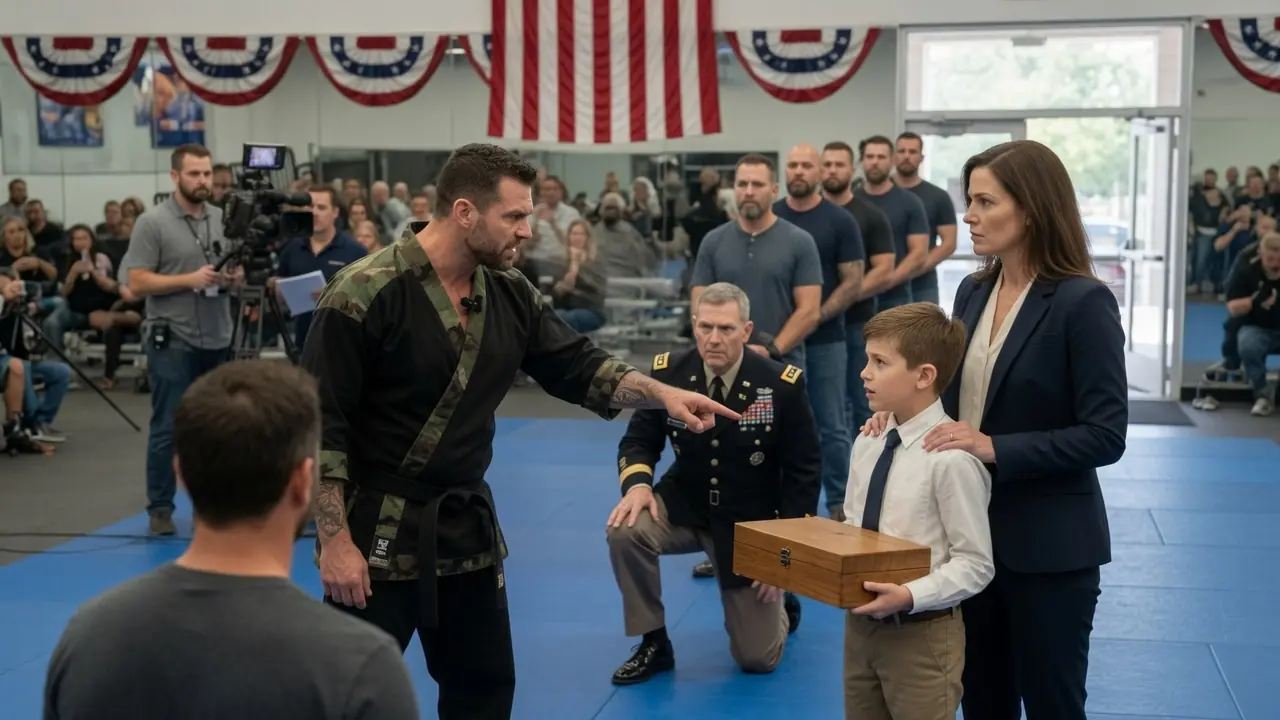
Blake Harlan stood in the center of Victory Forge Martial Arts wearing a custom black uniform with camouflage trim. A wireless microphone was clipped to his collar, and an American flag nearly twenty feet wide hung above the competition mat behind him.
Rows of parents filled the folding chairs.
City officials occupied the front row.
Children in white uniforms knelt in perfect lines beneath the bright fluorescent lights, waiting to demonstrate board breaking, controlled sparring, and the aggressive drills Blake advertised as battlefield-tested discipline.
It was Veterans Day, and Blake believed the morning belonged to him.
Then Sarah Carter entered the dojo with her ten-year-old son.
Eli walked beside her in khaki pants, a white dress shirt, and a navy tie that seemed too formal for a child. His nose had healed since the sparring accident six days earlier, but a faint purple mark remained beneath his left eye.
In both hands, he carried a polished oak box.
Blake stopped speaking.
The practiced smile left his face.
“What are you doing here?”
His voice echoed through the microphone.
Every parent turned.
Sarah continued walking.
Her dark blazer was buttoned neatly, her shoulders straight, and her expression controlled in a way Blake should have found more alarming than anger.
He lowered the microphone but forgot to switch it off.
“I told you that you and your son were banned from this academy.”
The words rang through the speakers.
Eli’s hands tightened around the wooden box.
Sarah stopped at the edge of the blue mat.
“We were invited.”
“By whom?”
A deep voice answered from behind Blake.
“By me.”
Lieutenant General Victor Lang stepped away from the line of uniformed guests near the entrance.
Three silver stars shone on each shoulder of his dress uniform. His chest carried ribbons earned across decades of service, but nothing about the decorations drew attention as strongly as the cold expression on his face.
Six men stood behind him in civilian clothes.
They wore jeans, dark boots, and plain jackets.
Some had gray in their beards. One walked with a slight limp. Another carried burn scars along the side of his neck.
They looked nothing like Blake’s carefully posed photographs of himself in tactical equipment.
They did not need to.
The entire room felt the difference.
Blake forced a nervous smile.
“General Lang, sir, I apologize. This is a private matter involving a former student.”
Victor’s eyes moved to Eli.
The severity in his face disappeared.
He walked past Blake, stepped off the mat, and lowered himself onto one knee in front of the boy.
“Hello, Eli.”
Eli looked at him.
“Hello, Uncle Victor.”
A gasp moved through the audience.
Blake’s face lost color.
Victor looked at the oak box.
“Did your mother explain why you brought it?”
“She said Dad’s friends should be here when we opened it.”
“That’s right.”
The general placed one hand gently on Eli’s shoulder, then rose.
When he turned toward Blake, the warmth vanished again.
“Mr. Harlan, Mrs. Carter tells me you said something to her son last Saturday.”
Blake glanced toward the news camera.
“This has been greatly exaggerated.”
“What did you say?”
“It was part of a lesson.”
Victor took one step closer.
“Repeat it.”
Blake’s mouth tightened.
“General, with respect, you weren’t present.”
“No.”
Victor looked toward Sarah.
“But forty-two parents were.”
Several people in the audience lowered their eyes.
“Three of them sent me recordings.”
Blake looked toward the camera again.
The local reporter had stopped checking her notes. The lens remained trained on him.
Victor’s voice became quieter.
“What did you say to the boy?”
Blake attempted to recover the authority that usually filled the dojo.
“I said children without strong male leadership sometimes struggle with discipline.”
“That is not what the recording shows.”
The six men behind the general remained motionless.
One of them, Master Sergeant Cole Brennan, stared at Blake with an expression so controlled it was more frightening than open anger.
Victor continued.
“You stood over a bleeding ten-year-old child and told him he was weak because he did not have a real man at home.”
No one moved.
“You told him he fought like a coward because his father was not there to teach him courage.”
Blake swallowed.
“He cried during a match. I was trying to toughen him.”
Victor looked at Eli.
The boy stared at the floor.
Then the general faced Blake again.
“You chose the wrong child’s father to use as a punchline.”
The room became completely silent.
Six days earlier, Eli Carter had still believed Blake Harlan understood what strength meant.
That belief began breaking at nine thirty on a humid Saturday morning.
Victory Forge Martial Arts occupied the largest unit inside a commercial complex outside Austin, Texas.
Blake had transformed the former furniture showroom into a monument to himself.
Tournament trophies filled glass cabinets near the reception desk.
Photographs of Blake breaking concrete, firing rifles at civilian ranges, and standing beside military vehicles covered the lobby walls.
His social media videos showed him wearing tactical vests and shouting phrases about warriors, wolves, and weakness.
Parents paid high fees because they believed he could give their children confidence.
Sarah had believed it too.
Her husband had been dead for three years.
Captain James Carter had been killed during a Special Forces extraction mission in Afghanistan when Eli was seven.
Before his death, Eli had been a loud, energetic child who asked endless questions and laughed at jokes before understanding them.
Afterward, he changed.
The boy who once climbed trees without fear began checking every door twice before bed.
He stopped raising his hand at school.
He avoided eye contact when other children asked what had happened to his father.
Then the bullying began.
Children sensed vulnerability with the same instinct animals used to detect injury.
They mocked his silence.
They hid his backpack.
One boy told him his father had died because he had not been strong enough to come home.
Sarah tried counseling, therapy, and a different school.
Some things improved.
Others remained.
When a friend recommended Victory Forge, Sarah watched three classes before enrolling Eli.
Blake spoke constantly about courage and discipline.
She wanted to believe the words meant what they had meant to James.
Her husband had been one of the most disciplined people she had ever known.
He woke before sunrise.
He kept promises.
He listened before speaking.
He had never needed to frighten anyone weaker than himself to feel powerful.
Blake’s version of discipline was louder.
He carried a bamboo training stick and slapped it against his palm while inspecting rows of children.
“Line up!”
His voice exploded through the dojo.
Children scrambled toward colored squares marked on the mat.
Eli stood in the back.
Blake paced between them.
“Martial arts is not a hobby,” he announced. “It is a furnace. Fire burns away weakness.”
He stopped in front of a girl whose belt had loosened.
“You think the real world will wait while you fix your uniform?”
“No, Sensei.”
“Louder.”
“No, Sensei!”
Blake smiled.
Sarah sat in the bleachers, uneasy.
She told herself the methods were unfamiliar, not harmful.
Then Blake began singling out Eli.
“Hands up, Carter.”
He slapped the top of the boy’s padded headgear.
Eli stumbled.
“You move like prey.”
The other children watched.
Blake looked toward them.
“What happens to prey?”
No one answered.
“It gets eaten.”
He turned back to Eli.
“Are you going to let people eat you alive?”
“No, Sensei,” Eli whispered.
“What was that?”
“No, Sensei!”
Blake sighed dramatically.
“Soft as baby food.”
Several students laughed.
Sarah’s fingers tightened around the edge of the bleacher.
After class, she asked Eli whether he wanted to leave.
He shook his head.
“Dad wouldn’t quit.”
The answer stopped her.
James had taught their son not to surrender merely because something was difficult.
But he had also taught him that leaving a cruel person was not surrender.
Sarah struggled to explain the difference without making Eli believe she was protecting him from every challenge.
So they returned.
Each week, Blake’s behavior worsened.
He paired anxious children with aggressive students.
He mocked tears.
He treated pain as dishonesty unless he could see an injury.
His senior student, twelve-year-old Logan Pierce, copied everything.
Logan was taller and heavier than the other children. He pushed opponents after drills ended and smiled whenever they became afraid.
Blake called it competitive instinct.
The quarterly sparring exhibition filled the dojo with parents and phones.
Blake arranged the matches personally.
When Sarah saw Eli’s name paired with Logan’s, she immediately stood.
“Mr. Harlan.”
Blake looked toward the bleachers.
“Is there a problem?”
“Logan is almost thirty pounds heavier.”
“It’s a controlled exhibition.”
“They aren’t evenly matched.”
Blake smiled toward the other parents.
“Mrs. Carter, the world doesn’t arrange itself by weight class.”
“This is not the world. This is a children’s class.”
Several parents looked uncomfortable.
Blake lifted the microphone.
“Do you want your son to learn courage, or do you want him protected from every difficult moment?”
Sarah sat down slowly.
Eli had heard the exchange.
His face carried the silent plea not to remove him in front of everyone.
He wanted to prove he could stay.
The boys entered the mat.
Eli bowed.
Logan gave the smallest possible nod.
“Begin!”
Logan charged.
He threw a heavy roundhouse kick that crashed into Eli’s guard and drove the smaller boy backward.
Eli tried to reset his feet.
Logan struck again.
The match was supposed to demonstrate technique.
Instead, Logan used size.
Blake allowed it.
A straight punch slipped between Eli’s gloves and struck his nose.
The sound carried through the quiet dojo.
Eli staggered.
Blood immediately ran over his upper lip.
He fell to both knees and covered his face.
Sarah was moving before the first drop touched his uniform.
Ben, Blake’s teenage assistant, entered the mat with a towel.
“Stop the match.”
Blake blocked him.
“Wait.”
He walked toward Eli.
The boy’s breathing had become short and rapid. Tears mixed with the blood on his hands.
“What is this?”
Blake’s microphone carried his voice through the room.
“Are you crying on my mat?”
Eli could not answer.
“Stand up.”
Sarah reached the edge of the mat.
Blake raised his voice.
“I said stand up!”
Eli pushed himself upright.
His entire body trembled.
Blake turned toward the parents.
“This is what happens when children are taught to think of themselves as victims.”
He pointed at Eli.
“You get hit, and you collapse.”
The boy tried to control his breathing.
“You fight like a coward.”
Sarah reached him.
Then Blake said the words that changed everything.
“But I suppose that’s what happens when you don’t have a real man at home to teach you.”
A shocked murmur passed through the audience.
Blake continued.
“No father. No backbone.”
Even Logan stepped away.
Sarah knelt beside Eli.
She pressed a tissue beneath his nose and looked directly into his frightened eyes.
“You’re all right.”
“I’m sorry,” he whispered.
“You have nothing to apologize for.”
She helped him leave the mat.
“Get your bag. We’re going home.”
Eli hurried toward the locker room.
Sarah remained.
She stood and faced Blake.
At five feet four, she was nearly a foot shorter than him.
No one watching believed she appeared smaller.
“You do not speak about his father.”
Blake laughed.
“You stepped into my class.”
“You humiliated my son.”
“I exposed a weakness.”
“He is ten.”
“The real world doesn’t care.”
“His father cared.”
Blake spread his hands.
“His father isn’t here.”
Sarah’s face became completely still.
A wiser man would have recognized the danger.
Blake saw only a grieving mother he believed he could intimidate.
“I served this country,” he continued. “I understand sacrifice. Your son needs a male role model, not someone protecting him every time he cries.”
Sarah looked at the military slogans printed across the wall.
“You served?”
“That’s right.”
“Where?”
His smile faltered.
“I don’t discuss operations.”
“What unit?”
“My record is private.”
Sarah understood immediately.
Real veterans sometimes avoided details.
They did not generally turn secrecy into advertisement.
“You use children to pretend you’re dangerous,” she said. “My son showed more courage walking onto this mat than you have shown in this entire room.”
Blake’s face reddened.
“Take him and leave.”
“We are.”
“You’re both banned.”
Sarah took one step closer.
“You enjoy talking about warriors.”
“Get out.”
“Next Friday, you’re going to meet one.”
She turned and walked away.
The car ride home remained silent until Eli spoke.
“I’m sorry, Mom.”
Sarah looked toward him.
“For what?”
“For being weak.”
The answer forced her to pull onto the shoulder.
She stopped the car, removed her seat belt, and turned toward him.
“Elijah James Carter, look at me.”
He raised his red-rimmed eyes.
“You are not weak.”
“I cried.”
“Your nose was bleeding.”
“Dad wouldn’t have cried.”
“Your father cried.”
Eli stared at her.
Sarah continued.
“He cried when you were born. He cried when his father died. He cried after his first soldier was killed.”
“But not because he was scared.”
“Yes, because he was scared.”
The boy looked confused.
“Courage is not pretending fear doesn’t exist. Courage is doing the right thing while it is there.”
She touched his cheek.
“Your father never made weaker people feel small. Men who need to do that are not strong.”
“Mr. Harlan said Dad should have taught me.”
“Your father did teach you.”
“How?”
“You bowed to Logan even after he laughed at you. You tried the match even though you were afraid. You didn’t hit anyone after it ended.”
Sarah’s voice shook.
“That is your father in you.”
At home, she gave Eli hot chocolate and turned on his favorite movie.
Then she entered the bedroom and opened the closet.
A heavy oak box rested on the highest shelf.
James had made the box himself during the first year of their marriage.
Sarah carried it to the bed.
Inside lay his identification tags, unit patches, maroon beret, letters, and medals.
At the center rested the Medal of Honor.
The bronze star hung beneath a pale blue ribbon marked with thirteen white stars.
James had received it posthumously.
Three years earlier, Sarah had stood in the White House while a citation described the final hours of her husband’s life.
His Special Forces detachment had been trapped inside a damaged compound in eastern Afghanistan.
Enemy fighters surrounded the position.
Two evacuation helicopters arrived under heavy fire.
James ordered his wounded men loaded first.
When the final aircraft could not remain on the ground, he stayed behind with one other soldier and held the northern wall long enough for the helicopters to escape.
He was shot three times.
He continued firing.
A second rescue team returned and found him barely conscious.
James died during the flight to Bagram after asking the medic to tell Sarah and Eli that he had kept his promise.
He had brought his men home.
Sarah touched the medal.
Blake Harlan’s website described him as a former elite military operator.
His biography referred to battlefield-tested methods and frontline experience without naming a unit, deployment, or qualification.
Sarah contacted the Gold Star family liaison who had helped her after James’s death.
She did not access a secret database.
She did not need to.
Blake had spent years making public claims at veteran events, and several organizations had already questioned them.
Within two days, the truth was confirmed through official military records.
Blake had enlisted in the Army National Guard.
He served eighteen months.
He never deployed.
He failed to complete advanced individual training and was administratively separated following repeated disciplinary violations.
He had technically worn a uniform.
Almost everything else he implied was fiction.
Then Sarah saw the announcement for the Veterans Day event.
Guest of honor: Lieutenant General Victor Lang.
James’s former commanding officer.
The man who delivered the folded flag to Sarah’s home.
The man Eli called Uncle Victor.
Sarah called him.
Victor answered on the second ring.
“Sarah.”
“Hello, sir.”
“You don’t have to call me sir.”
“I know.”
He heard something in her voice.
“What happened?”
She told him.
Victor remained silent for several seconds.
Then he asked one question.
“What time is the event?”
On Veterans Day morning, Victor arrived with six surviving members of James’s detachment.
Blake greeted them in the parking lot with an incorrect salute and called the general a fellow brother-in-arms.
Victor did not return the gesture.
Now he stood in the middle of Blake’s dojo, facing the man who had used James’s death to humiliate his son.
Victor turned toward the audience.
“When Mr. Harlan invited my office, he described himself as an elite combat veteran.”
Blake’s breathing changed.
“General, my marketing team—”
“Be silent.”
The command cracked across the room.
Blake obeyed.
Victor continued.
“My staff verified his record before I agreed to attend.”
Parents began looking at Blake.
“Mr. Harlan served eighteen months in the Army National Guard.”
Blake’s eyes moved toward the exits.
“He never deployed.”
Murmurs spread through the chairs.
“He did not complete advanced individual training.”
The city officials in the front row stopped smiling.
“He was separated for failure to adapt and repeated misconduct.”
One parent raised a phone.
Another whispered to her husband.
Victor looked at the tactical photographs on the wall.
“Mr. Harlan built a business by encouraging civilians to believe he possessed combat experience.”
Blake stepped forward.
“I never claimed to be Special Forces.”
“You allowed newspapers, parents, and your own website to describe you as an elite operator.”
“That language is motivational.”
“It is deceptive.”
Victor’s voice remained controlled.
“But that is not why these men came.”
He gestured toward Eli.
“You told this child he had no real man at home.”
Victor opened the oak box.
The Medal of Honor caught the overhead light.
The room became silent again.
“This is the Medal of Honor awarded to Captain James Carter.”
Sarah stood beside Eli.
Victor faced the parents.
“Captain Carter commanded Operational Detachment Alpha 7216.”
The six men behind him straightened.
“Three years ago, their position was attacked by a force several times larger.”
He pointed toward the men.
“These soldiers are alive because Captain Carter remained behind.”
Master Sergeant Cole Brennan’s jaw tightened.
“He placed his wounded men on the evacuation aircraft. When there was no room for him, he stayed.”
Victor’s voice grew rougher.
“He held an exposed position after suffering multiple gunshot wounds. He prevented the enemy force from reaching the landing zone.”
Eli looked at the medal.
“He died after every surviving member of his team was safe.”
Victor turned toward Blake.
“You told his son that he lacked a father capable of teaching courage.”
Blake was shaking.
“I didn’t know.”
Sarah stepped onto the mat.
“Ignorance does not create cruelty.”
Blake looked at her.
“It only reveals where you were willing to aim it.”
Cole Brennan left the line of operators.
He approached Eli and knelt.
“My name is Cole.”
Eli nodded.
“I remember you.”
“You were much smaller the last time we met.”
Cole removed a dark metal challenge coin from his pocket.
One side carried James’s unit crest. The other bore the names of the seven men who survived the final operation.
He placed it inside Eli’s hand.
“Your father saved my life.”
Eli looked at him.
“Did he cry?”
The unexpected question struck Cole hard.
“Yes.”
Blake looked confused.
Cole continued.
“He cried when we lost men. He cried when he read letters from home. The night before his final mission, he showed us a photograph of you and your mother.”
Tears filled Cole’s eyes.
“He said he was afraid he wouldn’t see you again.”
Eli’s fingers closed around the coin.
“Was he still brave?”
Cole smiled through the pain.
“He was the bravest man I ever knew.”
The other operators approached.
Each introduced himself.
One had carried James onto the helicopter.
Another had applied pressure to his wounds.
A third had recorded James’s final message because the captain feared he might not remain conscious long enough to say it later.
“You have people,” Cole told Eli. “Your father made us promise.”
Eli looked at Sarah.
She nodded.
Blake remained alone near the center of the mat.
Victor turned toward him.
“A martial arts instructor is given authority over children.”
He looked at the students.
“That authority should make them safer.”
Then back at Blake.
“You used it to make yourself feel powerful.”
Blake’s voice was almost inaudible.
“I made a mistake.”
“No.”
Victor shook his head.
“You made a series of choices.”
He indicated the microphone.
“You matched a frightened child against a larger student. You allowed the match to continue after control was lost. You publicly mocked his pain.”
The general stepped closer.
“Then you attacked the one absence he could not change.”
Blake lowered his eyes.
“What do you want from me?”
Sarah answered.
“Nothing.”
He looked at her.
“That is the part you never understood.”
She closed the oak box.
“We did not come to destroy you.”
Several parents glanced at one another.
Sarah continued.
“We came so my son would hear the truth in the same room where you taught him to feel ashamed.”
She turned toward Eli.
“You ready?”
He nodded.
Victor saluted the boy.
Eli attempted to return the salute.
His hand was awkward.
No one laughed.
The operators formed around Sarah and Eli as they walked toward the doors.
Before leaving, Eli stopped.
He looked back at Logan, the larger student who had struck him.
Logan stood beside the wall, pale and uncertain.
“You hit too hard,” Eli said.
Logan lowered his eyes.
“I know.”
“But Mr. Harlan told you to keep going.”
“Yes.”
Eli nodded.
He understood more than the adults expected.
Then he left.
The news camera had captured everything.
By that evening, Blake’s record had become public.
His own statements were compared against the official history of his service. Videos showed him describing himself as a battlefield instructor and implying knowledge he had never earned.
But the most damaging footage was not the general revealing his record.
It was the sparring exhibition.
A parent had recorded Blake standing over Eli while blood ran down the boy’s face.
The clip spread through Austin.
Parents cancelled memberships.
Several instructors resigned.
Local veteran organizations withdrew support.
The city council declined to renew a youth-program partnership.
Victory Forge closed three months later.
Blake disappeared from public events.
For a while, Sarah was satisfied to know he could no longer treat children the same way.
Then something unexpected happened.
A letter arrived.
It was handwritten.
Mrs. Carter,
I spent weeks blaming you, General Lang, the media, and the parents who left.
Then I watched the sparring video without sound.
I saw your son on his knees.
I saw myself standing over him.
Without my voice explaining discipline, it looked exactly like what it was.
I was bullying a child.
I do not expect forgiveness. I am entering counseling and surrendering my instructor certification.
There is one thing I need Eli to know.
Crying did not make him weak.
I was the weak person in that room.
Blake Harlan
Sarah showed the letter to Victor.
“Do you believe him?” she asked.
“I believe he wrote it.”
“That’s not what I asked.”
Victor looked toward Eli, who was throwing a ball in the yard with Cole Brennan.
“Change is not proven by an apology.”
“What proves it?”
“What he does when no one is watching.”
Sarah kept the letter.
She did not show Eli immediately.
The boy needed confidence, not responsibility for Blake’s redemption.
Cole kept his promise.
Whenever he was home from Fort Cavazos, he visited.
He took Eli to baseball games, taught him how to fish, and helped him build a shelf for the oak box.
The other men called on birthdays.
They attended school events.
One helped with math homework through video calls from another state.
They never attempted to replace James.
They carried parts of him back into Eli’s life.
For physical training, Cole chose a small boxing gym on the east side of Austin.
The owner was a retired Marine named Anthony Ruiz.
The building smelled of old leather and floor cleaner. The paint had faded. The ring ropes were repaired with tape.
No military slogans covered the walls.
No one called children warriors.
Anthony’s first question to Eli was not whether he wanted to become tough.
It was whether he felt safe.
Eli nodded.
The old coach gave him a pair of used gloves.
“You’re allowed to be afraid here.”
Eli looked surprised.
“Aren’t fighters supposed to be brave?”
“They are.”
Anthony tightened one glove.
“Brave people are afraid all the time.”
He tightened the second.
“They just learn fear doesn’t get the final vote.”
Eli trained slowly.
For the first month, he did not spar.
He learned footwork.
Breathing.
Balance.
How to protect himself without panicking.
When he became overwhelmed, Anthony let him step outside.
No one called it quitting.
Cole sometimes held the pads.
He never shouted.
A year after the incident at Victory Forge, Eli entered a youth boxing exhibition.
He remained small for his age.
His opponent was taller.
When the bell rang, Eli walked to the center of the ring.
For one brief moment, he remembered Logan’s fist reaching his face.
His breathing shortened.
Anthony saw it.
“Look at me.”
Eli turned toward his corner.
“You don’t have to prove anything,” Anthony said.
Cole stood beside him.
Sarah sat in the front row with Victor and the rest of James’s team.
Eli looked at the challenge coin tied inside the corner of his robe.
Then he faced his opponent.
He did not win the exhibition.
He completed all three rounds.
Afterward, he shook the other boy’s hand.
Sarah met him outside the ring.
“I lost,” he said.
“No.”
Eli looked at the scorecard.
“It says I did.”
“You stayed present. You listened. You protected yourself. You respected the other boy.”
She touched his cheek.
“That is not the kind of loss you need to fear.”
Cole stepped closer.
“Your dad lost plenty of fights.”
Eli stared at him.
“He did?”
“Training exercises. Arguments. Card games.”
Victor smiled.
“He was a terrible card player.”
“I thought Dad was the best.”
Cole placed a hand on the boy’s shoulder.
“He was the best man I knew.”
“That’s different?”
“Very.”
As Eli grew older, he asked more questions about James.
The operators told him the funny stories too.
His father once burned an entire breakfast because he forgot he was cooking.
He became seasick on small boats.
He sang badly.
He hated spiders.
He cried when his dog died.
The Medal of Honor remained in the oak box.
It was important.
But it was not the only piece of James his son inherited.
Eli inherited the patience to listen.
The willingness to admit fear.
The instinct to protect someone smaller.
At fourteen, Eli saw a new student being mocked inside the boxing gym.
The boy was overweight, shy, and unable to complete the jump-rope drill.
Two experienced teenagers laughed.
Eli stepped between them.
He did not threaten them.
He did not mention his father.
He picked up another rope and struggled beside the new boy until the laughter stopped.
Anthony watched from across the room.
Later, he asked why Eli had intervened.
Eli shrugged.
“He looked like he wanted to disappear.”
“You know that feeling?”
“Yes.”
“What did you give him?”
“Nothing.”
Anthony smiled.
“You stayed.”
Eli considered it.
Then he understood.
Years after Victory Forge closed, Blake Harlan began volunteering at a youth center.
He did not teach martial arts.
He cleaned equipment, organized storage rooms, and drove a van when children needed transportation.
For nearly a year, no one knew his past.
When the center director discovered it, she confronted him.
Blake did not deny anything.
He showed her the video.
“I was that man,” he said.
“Are you still?”
“I don’t know.”
The director studied him.
“Then keep doing work that doesn’t require anyone to admire you.”
He stayed.
Sarah learned about it through a mutual acquaintance.
She felt no satisfaction.
No anger either.
Blake’s life no longer belonged to her.
What mattered was that Eli’s life had stopped being shaped by one cruel morning.
On the fifth anniversary of James’s death, Sarah, Eli, Victor, and the six operators gathered at a small memorial near Fort Cavazos.
Eli carried the oak box.
He placed the Medal of Honor beneath his father’s photograph.
Then he spoke.
He had prepared a long speech.
When the moment arrived, he used only a few sentences.
“My dad was brave because he stayed when other people needed him.”
His voice trembled.
“He was scared too. That doesn’t make the story smaller.”
Eli looked toward the men his father saved.
“It makes it real.”
After the ceremony, Cole handed him a folded letter.
James had written it before his final deployment.
Sarah had kept it until she believed Eli was old enough.
Son,
People may tell you that being a man means never being afraid.
They are wrong.
Fear is information. Anger is information. Pain is information.
None of them should be your commander.
Strength is having the ability to hurt someone and choosing protection instead.
It is telling the truth when lying would make life easier.
It is standing beside someone who is being made to feel small.
You do not have to become me.
Become someone kind enough that other people feel safer when you enter the room.
Love,
Dad
Eli folded the letter carefully.
He did not cry immediately.
The tears came later, in the truck beside his mother.
He allowed them.
Neither Sarah nor Cole told him to stop.
Years later, people still remembered the morning a three-star general exposed Blake Harlan inside his own academy.
They remembered the Medal of Honor beneath the fluorescent lights.
The six operators surrounding the boy.
The news camera recording the instructor’s humiliation.
But Eli remembered a different moment.
He remembered his mother pulling the car onto the side of the road.
He remembered believing he had failed his father because he cried.
Then she told him James Carter had cried too.
That truth saved him before the general, the medal, or the operators ever arrived.
The medal proved Eli’s father had performed an extraordinary act.
It did not prove Eli deserved dignity.
He deserved that before anyone opened the box.
Blake’s greatest mistake was not failing to recognize the son of a legendary soldier.
It was believing a child needed a legendary father before cruelty became wrong.
Eli grew up understanding what Blake never had.
True strength was not the ability to dominate a room.
It was the discipline to make room for someone weaker, frightened, injured, or alone.
His father had demonstrated that on a battlefield.
His mother demonstrated it in a parking lot.
Six soldiers demonstrated it by keeping a promise to a fallen friend.
And a frightened ten-year-old began demonstrating it the moment he stopped believing his tears made him weak.