They Invited an Old Man Onto the Mat as a Joke — Seconds Later, No One Was Laughing
“Marcus, wait!”
Master Robert Kim’s warning struck the dojo with enough force to stop every whisper.
Marcus Brooks froze with one foot already sliding forward.
Across from him, Thomas Hale stood barefoot on the polished mat, his faded brown jacket folded neatly beside the wooden weapons rack.
The old man’s hands were empty.
His shoulders were loose.
His breathing remained slow.
Nothing about him looked aggressive.
That was exactly what frightened Master Kim.
Marcus turned his head.
“What?”
Master Kim stepped closer.
His eyes remained fixed on Thomas.
“Who taught you to stand like that?”
Thomas looked toward him.
“No one for a long time.”
“That is not what I asked.”
The old man smiled faintly.
“No. It isn’t.”
The room had become silent enough to hear the heaters clicking near the ceiling.
Parents who had been gathering coats remained seated.
Children stopped rolling the practice mats.
Black belts who had laughed only moments earlier now watched Master Kim with growing uncertainty.
Marcus lowered his fists slightly.
“You know him?”
Master Kim did not answer.
He moved to the edge of the mat and studied Thomas’s feet.
The stance appeared almost ordinary.
No wide base.
No raised guard.
No exaggerated tension.
But Thomas’s weight rested exactly between both legs. His heels were light. His hips were positioned so he could move in any direction without first adjusting.
Master Kim had seen that posture once before.
Not in Colorado.
Not during a tournament.
Thirty-six years earlier, inside a small training hall outside Naha, Okinawa.
His instructor had called it empty stance.
Not because the body lacked preparation.
Because the opponent found nothing obvious to attack.
Master Kim looked at Thomas’s hands.
Rough skin.
Thickened knuckles.
The right index finger slightly bent from an old fracture.
A pale scar crossing the base of the thumb.
“You trained in Okinawa,” Kim said.
Several students looked surprised.
Thomas glanced toward the framed photographs on the wall.
“For a while.”
“With whom?”
“Different people.”
Master Kim stepped onto the mat.
“There were not many Americans taught that movement.”
Thomas’s expression softened.
“There were fewer who listened.”
The answer stirred something in Kim’s memory.
An old photograph.
Three young men standing outside a weathered dojo near the sea.
His instructor, Kenji Sato, stood in the center.
Beside him was an American serviceman with light hair, broad shoulders, and the same piercing eyes as the man on the mat.
Kim turned quickly toward his office.
A framed black-and-white photograph hung beside the door.
He removed it from the wall.
The younger students gathered around as he carried it back.
The image had faded with age.
Kenji Sato stood beneath a wooden sign.
Robert Kim, then twenty-three, appeared at the far right.
At the far left stood a tall American in a plain training uniform.
Marcus looked between the photograph and Thomas.
“That’s him.”
Master Kim nodded slowly.
“Thomas Hale.”
A whisper moved through the dojo.
Thomas looked at the floor.
“I was younger.”
Master Kim’s voice changed.
Not fear now.
Respect.
“My teacher spoke about you.”
Thomas glanced toward him.
“Kenji spoke about everyone.”
“Not like this.”
Kim looked at the students.
“He said there was one man who understood technique quickly but disliked being praised for it.”
Thomas sighed.
“He exaggerated.”
“He said you defeated the base champion without striking him.”
Marcus laughed once.
“How do you win without striking?”
Thomas answered.
“You allow someone to defeat himself.”
Marcus looked toward the surrounding students.
The attention that had once belonged completely to him was shifting.
He disliked that.
“So he trained a long time ago.”
Master Kim turned.
“Marcus.”
“What?”
“You were warned.”
“I only offered him one punch.”
“You offered it because you believed humiliating him would entertain the room.”
Marcus’s jaw tightened.
“He insulted our training.”
“No.”
Thomas spoke quietly.
“I answered your question.”
Marcus looked toward him.
“You said we move without thinking.”
“Many people do.”
“You think I do?”
“Yes.”
The direct answer landed harder than the earlier remarks.
Marcus raised his hands again.
“Then prove it.”
Master Kim stepped between them.
“This ends here.”
Thomas looked toward Kim.
“Let him try.”
“No.”
“He needs an answer.”
Marcus smiled.
“Finally.”
Thomas continued.
“But not the answer he expects.”
Master Kim studied him.
“You are sixty-two.”
“And he is impatient.”
“That does not make you unbreakable.”
“No.”
Thomas looked toward Marcus.
“It makes him predictable.”
The champion’s face hardened.
Parents began pulling younger children farther from the mat.
Several black belts stepped closer.
Phones appeared again.
Thomas noticed.
“No recording.”
Marcus laughed.
“Afraid people will see?”
Thomas shook his head.
“Afraid they will watch for the wrong reason.”
Master Kim raised his voice.
“Phones away.”
Some students hesitated.
“Now.”
One by one, screens disappeared.
Thomas looked toward Marcus.
“One attack.”
“Any attack?”
“One committed attack.”
Marcus rolled his shoulders.
“And if you cannot stop it?”
“Then you were right to laugh.”
Master Kim frowned.
“That is unnecessary.”
Thomas looked at him.
“So was the laughter.”
Marcus stepped backward to create distance.
His expression changed as he settled into a fighting stance.
The teasing disappeared.
Tournament focus replaced it.
He had not remained undefeated for four years through strength alone.
He was fast.
Disciplined.
Dangerous when motivated.
Thomas stood with his hands open near his waist.
Marcus bounced lightly on his feet.
“You should raise your guard.”
Thomas smiled.
“You should lower your pride.”
A few students inhaled sharply.
Marcus moved.
His first step was a feint.
Thomas did not react.
Marcus shifted left.
Still nothing.
Then he launched forward with a straight right punch aimed at Thomas’s chest.
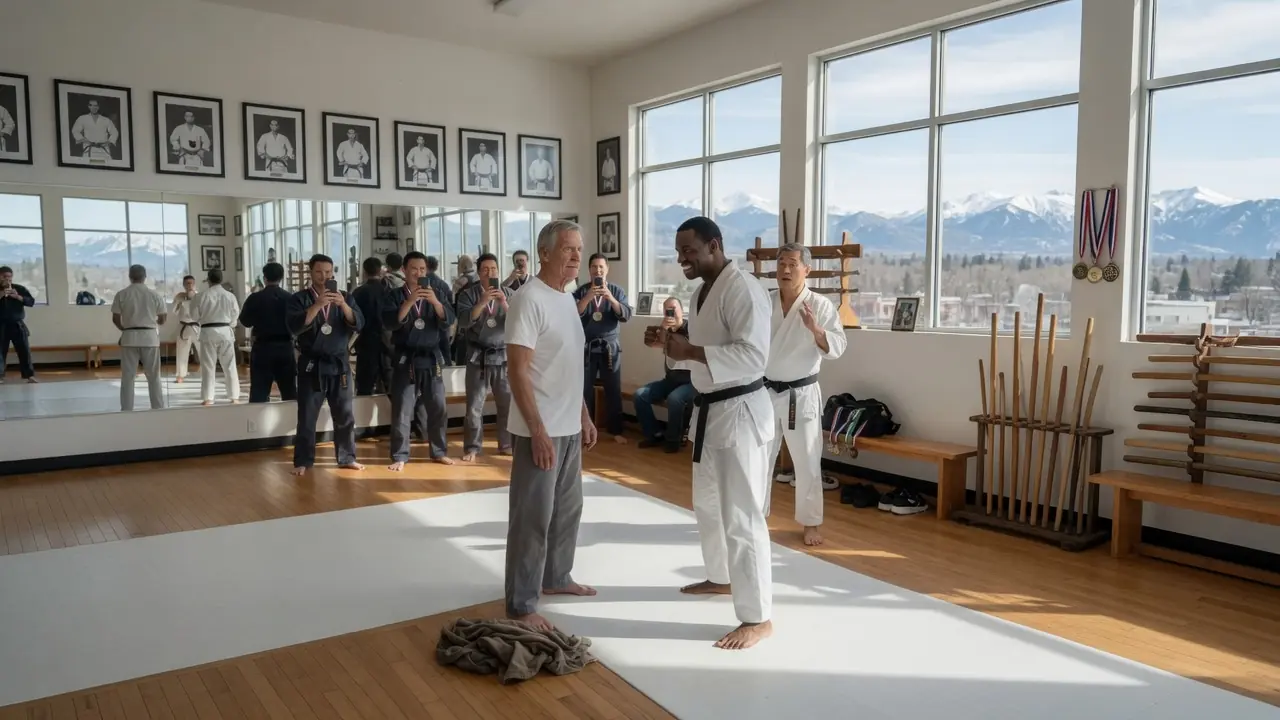
It was fast enough that several students saw only the beginning and the end.
Thomas moved once.
His left foot slid barely six inches.
His torso turned.
One hand redirected Marcus’s wrist.
The other touched the champion’s upper arm.
Marcus’s own momentum carried him forward.
Thomas rotated his hips and stepped aside.
The larger man passed him completely.
Marcus tried to recover.
His front foot crossed too far.
Thomas placed two fingers lightly against the back of his shoulder.
The touch was gentle.
The timing was not.
Marcus stumbled three steps and dropped to one knee near the edge of the mat.
No one laughed.
Thomas had not struck him.
Had not thrown him.
Had not used visible strength.
He simply removed the place where Marcus expected resistance to exist.
The room remained frozen.
Marcus looked over his shoulder.
His face showed disbelief before anger covered it.
“That was luck.”
Thomas nodded.
“Try again.”
Master Kim stepped forward.
“You said one attack.”
Thomas kept his eyes on Marcus.
“He did not learn from the first.”
Marcus stood quickly.
This time, he did not smile.
He attacked with a left jab, followed by a powerful right cross and a low kick intended to limit Thomas’s movement.
The old man avoided the jab by turning his head.
His forearm guided the right hand past his ribs.
Before the kick could develop full force, Thomas stepped inside.
His shoulder touched Marcus’s chest.
His foot hooked lightly behind the champion’s planted ankle.
Marcus lost balance.
Thomas caught his uniform at the elbow and lowered him onto the mat rather than allowing him to fall.
The entire exchange lasted less than three seconds.
Marcus lay on his back staring at the ceiling.
Thomas remained standing beside him.
“You keep deciding how the exchange will end before it begins,” the old man said.
Marcus sat up.
“You tripped me.”
“Yes.”
“That isn’t fighting.”
Thomas offered him a hand.
“Falling usually feels that way.”
Marcus ignored the hand and stood by himself.
His face had turned red.
Students shifted uncomfortably.
They had expected comedy.
Now they were watching someone they admired unravel in public.
Master Kim recognized the danger.
“Enough.”
Marcus did not respond.
Thomas bent to retrieve his jacket.
The champion’s voice stopped him.
“Face me properly.”
Thomas straightened.
“I have.”
“No.”
Marcus pointed toward the center.
“Fight me.”
Thomas looked around the room.
“At children’s class?”
“You know what I mean.”
“I do.”
“Then stop treating me like a student.”
Thomas’s expression changed.
The warmth remained.
But something harder appeared beneath it.
“You are behaving like one.”
Marcus took a step forward.
Master Kim blocked him.
“Leave the mat.”
The champion stared at his instructor.
“You’re taking his side?”
“There should not be sides.”
“You embarrassed me.”
“You embarrassed yourself before he stood up.”
Marcus looked toward the other black belts.
Nobody met his eyes.
That injured him more than Thomas’s movements.
He removed his belt.
The black fabric fell onto the mat.
“Maybe I trained in the wrong place.”
Master Kim’s face tightened.
“Do not make decisions while angry.”
Marcus walked toward the changing room.
“Isn’t that what everyone thinks I do?”
The door slammed behind him.
The sound echoed through the dojo.
Thomas picked up the belt.
He brushed dust from one end and handed it to Master Kim.
“I should not have agreed.”
Kim accepted it.
“No.”
“You warned him.”
“I should have stopped it.”
Thomas looked toward the students.
“They needed to see something.”
“What?”
“That skill without judgment is unfinished.”
Master Kim lowered his voice.
“And Marcus?”
“He needed to feel it.”
The parents began leaving quietly.
Nobody spoke to Thomas.
The same students who had mocked him now kept a respectful distance.
He did not seem pleased by the change.
Respect based on fear disturbed him almost as much as laughter based on ignorance.
A young black belt named Adrian remained near the mat.
“Mr. Hale?”
Thomas looked toward him.
“Yes?”
“Were you holding back?”
Master Kim gave the boy a sharp look.
Thomas considered the question.
“I was being careful.”
“Could you have hurt Marcus?”
“Yes.”
“How badly?”
Thomas folded his jacket over one arm.
“That is not the question you should ask.”
“What should I ask?”
“Why would I?”
Adrian looked down.
Thomas continued.
“If ability exists only to be displayed, it becomes vanity. If it exists only to hurt, it becomes cruelty.”
“What is it supposed to be?”
“A responsibility.”
Thomas walked toward the door.
Master Kim followed.
“You said you were waiting for someone.”
Thomas stopped.
“I am.”
“Who?”
Before he could answer, the front door opened.
A teenage boy stepped inside carrying a duffel bag.
He was sixteen, thin, with dark hair falling across his forehead. His left leg moved stiffly, and a metal brace was visible beneath his sweatpants.
He looked around nervously.
Then he saw Thomas.
“Grandpa.”
The old man’s entire expression softened.
“There you are.”
The boy approached.
“Mom said the bus would stop closer.”
“It usually does.”
He looked toward the silent students.
“Did I miss class?”
Thomas glanced toward Master Kim.
“No. We arrived early.”
The boy’s name was Daniel Hale.
He had been born with a weakness in his left hip that worsened after a bicycle accident two years earlier.
Physical therapy restored most movement, but he remained self-conscious about the brace.
At his previous school, boys imitated his uneven walk.
One shoved him down a staircase.
Daniel stopped attending sports classes after that.
Thomas brought him to Iron Summit because Master Kim had once told a mutual friend that the dojo welcomed students with physical limitations.
That was why Thomas had been waiting.
Not to demonstrate.
Not to challenge champions.
To sit beside his grandson during a beginner lesson.
Master Kim looked toward Daniel’s leg.
“Welcome.”
The boy nodded.
“Thank you.”
“Have you trained before?”
Daniel glanced toward Thomas.
Thomas shook his head.
“He has watched me move furniture.”
“That counts,” Daniel said.
Master Kim smiled.
“Beginner class starts in twenty minutes.”
The boy looked toward the black belts.
Several had witnessed Marcus humiliating Thomas before being humbled himself.
Now embarrassment moved across their faces.
Adrian stepped forward.
“I can show you where to change.”
Daniel looked uncertain.
Thomas nodded.
“Go ahead.”
As Adrian led the boy away, Master Kim turned toward Thomas.
“You never told me you had a grandson.”
“You never asked.”
“Why bring him here?”
“He needs to trust his body again.”
“And you believed we could help.”
Thomas looked toward the changing-room door Marcus had slammed.
“I believed you might.”
The words carried neither accusation nor forgiveness.
Master Kim received them quietly.
Beginner class began at noon.
Daniel stood near the back wearing a borrowed white uniform.
The pants had been adjusted to fit over the brace.
He struggled with balance during the first warm-up.
Several younger children stared.
Adrian, assisting with the class, demonstrated each movement slowly without calling attention to the difference.
Thomas sat in the same chair beside the weapons rack.
This time, nobody laughed.
Halfway through class, Marcus emerged from the changing room dressed in ordinary clothes.
His belt remained in Master Kim’s office.
He walked toward the exit.
Then noticed Daniel.
The boy attempted a forward stance.
His left leg trembled.
He lost balance and nearly fell.
Adrian caught him.
Two small children giggled.
Daniel’s face reddened.
He moved toward the edge of the mat.
“I can’t do it.”
Thomas remained seated.
“You cannot do it yet.”
“It feels wrong.”
“New things often do.”
“Everyone’s watching.”
Thomas looked around.
Most students immediately pretended to focus elsewhere.
“Then give them something worth watching.”
Daniel frowned.
“That doesn’t help.”
“It wasn’t supposed to.”
Marcus stood near the door.
Something in the boy’s frustration held him.
Perhaps because he understood what it meant to feel an entire room watching failure.
He walked toward the mat.
Master Kim noticed but did not interfere.
Marcus removed his shoes.
Daniel looked up nervously.
The champion crouched in front of him.
“Your back foot is too far out.”
Daniel stared.
“What?”
Marcus pointed.
“That is why the brace catches when you turn.”
Thomas watched silently.
Marcus placed his own foot at a narrower angle.
“Try this.”
Daniel copied him.
The stance remained uneven.
But he did not fall.
“Again,” Marcus said.
The boy repeated it.
Better.
Marcus adjusted his hips.
“Do not force the bad side to look like the good side.”
Daniel frowned.
“Isn’t that the point?”
“No.”
Marcus glanced toward Thomas.
“Apparently the point is to stop deciding what something should look like before understanding what works.”
Thomas’s eyebrows lifted slightly.
The lesson had landed after all.
Daniel tried again.
This time, he completed the movement.
Marcus stood.
The boy looked toward him.
“Are you a teacher?”
“No.”
Master Kim answered from across the room.
“Not yet.”
Marcus’s expression tightened.
He walked toward the door again.
Thomas followed him outside.
Cold air moved along the Denver street.
The Rocky Mountains rose beyond the rooftops, their upper slopes covered in snow.
Marcus stopped beside his car.
“You came to find me?”
Thomas stood several feet away.
“I came to thank you.”
“For what?”
“Helping Daniel.”
Marcus laughed bitterly.
“I moved his foot.”
“You saw what he needed.”
“That doesn’t erase what happened.”
“No.”
Marcus looked toward the dojo windows.
“I have trained there for eleven years.”
“I know.”
“You embarrassed me in front of everyone.”
Thomas shook his head.
“You attacked an older man because people were watching.”
Marcus’s jaw tightened.
“I know what I did.”
“Then why are you blaming me for the result?”
The champion looked away.
Thomas continued.
“I did not enjoy it.”
“You looked calm.”
“Calm is not enjoyment.”
Marcus opened his car door.
“What do you want?”
“To know why losing frightens you so much.”
Marcus stared.
“It doesn’t.”
“You left your belt.”
“That was anger.”
“Yes.”
“Not fear.”
Thomas nodded toward the dojo.
“You have not gone back inside.”
Marcus’s hand tightened on the door.
Thomas waited.
Finally, the younger man spoke.
“My father trained me.”
Thomas remained quiet.
“He believed second place meant you wasted first.”
Marcus looked toward the mountains.
“When I was twelve, I lost a local final. He made me walk home carrying the trophy because he said getting into the truck would make me comfortable with failure.”
“How far?”
“Six miles.”
Thomas’s expression did not change.
Marcus continued.
“He died before my first regional title.”
“So you kept winning for him.”
“I kept winning because that was the only time he treated me like I mattered.”
Thomas looked toward the dojo door.
“And now?”
Marcus’s voice lowered.
“Now I don’t know who I am when I lose.”
Thomas nodded.
“That is different from not knowing how to lose.”
Marcus stared at him.
“Is this where you give me some old-man lesson?”
“No.”
“What then?”
“I’m telling you the problem is not your pride.”
Marcus looked surprised.
“It is what the pride is protecting.”
The car door remained open.
Neither man moved.
After a while, Marcus asked, “Why did you stop training?”
Thomas looked toward the snow-covered peaks.
“I didn’t.”
“You said you don’t have a style anymore.”
“That is not the same.”
“You disappeared.”
“So you’ve heard.”
“Master Kim told us.”
Thomas exhaled.
“I left competition.”
“Why?”
The old man’s eyes settled on a distant point.
“My son.”
“Daniel’s father?”
“Yes.”
Thomas had one child, Michael Hale.
Michael grew up watching his father train, travel, teach, and compete.
As a boy, he wanted only Thomas’s attention.
Thomas believed discipline meant refusing distractions.
He missed school plays.
Birthdays.
One Christmas morning.
He told himself he was building something that would one day make his son proud.
By the time Thomas stopped traveling, Michael no longer wanted what he offered.
They argued often.
At nineteen, Michael enlisted in the Army.
He returned from his first deployment changed.
Restless.
Angry.
Unable to sleep.
Thomas responded with the only language he understood.
Control your breathing.
Stand properly.
Master yourself.
Michael heard judgment.
Not help.
Their final argument ended with Michael shouting that his father knew how to face any opponent except his own family.
Two weeks later, Michael drove after drinking.
His vehicle crossed the center line on a mountain road.
He survived.
The woman in the other car did not.
Michael served six years in prison.
Thomas visited every month.
Sometimes Michael spoke.
Sometimes he sat on the other side of the glass and stared at the floor.
When he was released, he struggled to rebuild his life.
Daniel was born three years later.
Michael tried to become a better father.
But guilt and addiction followed him.
He died from an overdose when Daniel was nine.
Marcus listened without interrupting.
Thomas continued.
“I spent years learning how to redirect force.”
His voice weakened slightly.
“I never learned how to recognize pain before it became destruction.”
“That is why you train Daniel?”
“That is why I sit while he trains.”
Marcus looked toward him.
“You blame yourself.”
“Yes.”
“Was Michael’s death your fault?”
“No.”
The answer came too quickly.
Thomas corrected himself.
“Not entirely.”
Marcus understood the qualification.
“Why tell me?”
“Because someone taught you that love had to be earned through victory.”
Thomas looked directly at him.
“If you keep believing that, you will teach it to someone else.”
Marcus closed the car door.
He did not enter the dojo immediately.
But he did not leave.
They stood outside until the beginner class ended.
Daniel emerged wearing the white belt loosely around his waist.
He saw Marcus.
“I did the turn without falling.”
Marcus nodded.
“I saw.”
“Will you be here next week?”
The champion hesitated.
Thomas said nothing.
Daniel waited.
“Yes,” Marcus answered.
He returned the following Saturday.
Not as the center of the room.
Not wearing his black belt.
He arrived early and helped Master Kim clean the mats.
Students whispered.
Marcus ignored them.
When advanced class began, he stood at the end of the line wearing a white belt.
Master Kim approached.
“What is this?”
Marcus looked toward the black belt hanging inside the office.
“I need to start over.”
“You earned that rank.”
“I earned techniques.”
“That is part of rank.”
“Not all of it.”
Master Kim studied him.
“You do not erase progress by pretending it never happened.”
Marcus looked toward Thomas, seated beside Daniel.
“What should I do?”
Master Kim removed the white belt and handed him the black one.
“Wear what you earned.”
Marcus accepted it.
Kim continued.
“Then become worthy of what it means.”
The training changed after that.
Marcus still competed.
Still won.
Still possessed extraordinary speed and power.
But he began helping beginners.
He stayed after class to clean.
He stopped mocking mistakes.
When younger fighters tried to imitate his aggressive style, he corrected their balance before praising their force.
Most importantly, he learned to apologize without explaining himself.
One Saturday, he stood before the advanced class.
“I encouraged all of you to laugh at Mr. Hale.”
The students became still.
“I used rank to turn someone into entertainment.”
He looked toward Thomas.
“I am sorry.”
Thomas nodded.
“Accepted.”
Marcus hesitated.
“That is all?”
“What else do you need?”
“I expected a speech.”
“You have heard enough speeches.”
Daniel smiled.
Months passed.
The boy’s movement improved.
His brace remained.
Thomas never promised it would disappear.
Instead, Daniel learned to build techniques around his actual body.
His left side lacked strength.
His right side became exceptionally stable.
He developed careful timing and a strong sense of distance.
Marcus taught him how to use smaller movements.
Thomas taught him how to breathe when other students watched.
Master Kim taught him that adapting was not cheating.
At his first youth exhibition, Daniel faced a boy who moved faster and had no physical limitation.
Daniel lost the first two exchanges.
From the edge of the mat, Thomas watched quietly.
Marcus leaned toward him.
“Should we tell him to change stance?”
“No.”
“He’s getting caught.”
“I know.”
“Then why not help?”
“He already knows what to do.”
Daniel stepped back onto the mat.
The other boy attacked quickly.
This time, Daniel did not retreat in a straight line.
He turned at an angle.
Used the opponent’s movement.
Scored with a controlled touch to the chest.
The crowd applauded.
Daniel did not win the match.
He lost by one point.
Afterward, he approached Thomas carrying the second-place medal.
“I almost had him.”
“Yes.”
“I know what I did wrong.”
Thomas smiled.
“Then you did not lose everything.”
Marcus watched the exchange.
Years earlier, his father had made him walk six miles for finishing second.
After the exhibition, Marcus drove Daniel home.
He stopped for ice cream.
The boy asked whether losing deserved ice cream.
Marcus answered, “Learning does.”
Iron Summit Dojo changed gradually.
Master Kim introduced a mentorship requirement for advanced ranks.
Tournament records no longer determined promotions by themselves.
Students were evaluated on teaching, restraint, judgment, and behavior toward beginners.
Some competitors disliked the change and left.
Kim allowed them.
A dojo that produced champions but failed to produce responsible adults had misunderstood its purpose.
Thomas refused every official title.
Students called him Mr. Hale.
A few tried to call him Master Hale.
He corrected them.
“I am Daniel’s grandfather.”
“But you trained in Okinawa.”
“So did many foolish men.”
“You defeated Marcus.”
“I moved twice.”
“You were famous.”
Thomas looked toward the old photograph.
“Fame is memory owned by strangers.”
Master Kim eventually persuaded him to teach one class each month.
Thomas called it the class of less.
Students expected secret techniques.
Instead, he removed things.
Extra movement.
Unnecessary tension.
Showy combinations.
The desire to win every exchange.
He asked black belts to stand quietly while beginners approached.
Most discovered they could not remain relaxed.
He made champions practice falling.
He made fast fighters move slowly.
He made strong students partner with smaller ones and judged them by control rather than dominance.
“When you are young,” he told them, “you believe mastery means adding more.”
He looked toward Marcus.
“When you grow older, you discover that most of your work involves removing what should never have been there.”
Marcus became a different kind of champion.
He won two more regional titles.
Then lost in a national semifinal to a younger fighter from California.
The old Marcus would have left before the medal ceremony.
This time, he stayed.
He bowed to the winner.
Later, he watched footage with Master Kim and identified his own mistakes.
No excuses.
No anger.
The following year, he won the national title.
Reporters asked what changed.
Marcus answered, “I stopped treating every opponent like someone who could take my value away.”
The sentence was printed in martial arts magazines.
He gave Thomas credit privately.
Thomas refused it.
“You did the work.”
“You started it.”
“No.”
Thomas looked toward the folded brown jacket beside the weapons rack.
“You started it when you chose to come back.”
Daniel graduated from high school four years later.
He walked across the stage without using his cane, though the brace remained beneath his trousers.
Thomas sat beside Master Kim.
Marcus sat on the other side.
After the ceremony, Daniel handed Thomas a small wrapped box.
Inside was the faded brown jacket, cleaned and carefully repaired.
Thomas ran one hand across the fabric.
“You kept this?”
“You stopped wearing it after the first day.”
“The sleeve tore.”
“I know.”
Daniel had stitched the inside lining himself.
Near the pocket, he embroidered a short sentence.
REAL POWER WHISPERS.
Thomas read it twice.
His eyes filled.
“I sound overly serious.”
“You are.”
Marcus leaned closer.
“He’s right.”
Thomas wore the jacket to Daniel’s college orientation.
Years later, Daniel became a physical therapist specializing in young athletes recovering from serious injuries.
He continued training.
Never became a tournament champion.
Never wanted to.
He returned to Iron Summit every Saturday to teach children who believed their bodies had failed them.
Marcus opened a second dojo across town.
Above the entrance, he placed no photograph of himself.
No tournament record.
Only a sign.
STRENGTH WITHOUT HUMILITY IS STILL WEAKNESS.
Master Kim retired at seventy-one.
He gave Iron Summit to a nonprofit foundation rather than selling it.
The dojo continued serving children, veterans, and families who could not afford training.
Thomas remained near the back of the room.
His movements slowed.
His knees eventually required a cane.
New students sometimes assumed he was only waiting for a grandchild.
Older members smiled but did not correct them immediately.
Thomas preferred it that way.
“How people treat someone they believe is unimportant tells you more than a bow ever will,” he said.
At seventy-eight, Thomas stopped stepping onto the mat.
He sat beside the same wooden weapons rack and watched.
One Saturday, a talented teenage fighter mocked a nervous beginner.
Marcus’s daughter, now an instructor, stopped the class.
She pointed toward Thomas.
“Do you know who that is?”
Thomas raised one finger.
“No.”
Everyone looked toward him.
The instructor smiled.
Thomas continued.
“Do not teach respect by revealing that an old man was once dangerous.”
He looked toward the teenager.
“He deserved respect before you knew anything about him.”
The boy lowered his eyes.
That lesson became more important than the stories.
Thomas Hale died at eighty-one.
The funeral took place on a clear winter morning.
Snow covered the mountains west of Denver.
Students from four decades attended.
Some wore black belts.
Others had stopped training years earlier.
Daniel stood near the casket wearing the old brown jacket.
Marcus delivered the eulogy.
He did not describe the two times Thomas put him on the floor.
Everyone already knew those stories.
Instead, he spoke about the moment after.
“I believed he defeated me when I hit the mat.”
Marcus looked across the crowded room.
“He didn’t.”
His voice weakened slightly.
“He defeated the part of me that thought strength gave me permission to humiliate people.”
Master Kim sat in the front row with both hands resting on his cane.
Marcus continued.
“Then he spent the next nineteen years helping me build something better in its place.”
After the funeral, Daniel and Marcus returned to Iron Summit.
The dojo was empty.
Afternoon light crossed the polished floor.
The old weapons rack remained near the back wall.
Daniel placed Thomas’s folded jacket on the chair where he once sat.
Marcus stood beside him.
“Do you remember that first day?”
“Some of it.”
“You asked if I would be there the next week.”
“You almost said no.”
“I should have.”
Daniel looked toward him.
“Why?”
“Because then you might have chosen a better teacher.”
Daniel smiled.
“I did.”
Marcus looked confused.
“My grandfather.”
They stood quietly.
On the following Saturday, students entered the dojo and found a new framed photograph beside the old Okinawa picture.
It showed Thomas at sixty-two.
Not fighting.
Not posing.
He sat in the chair beside the weapons rack, wearing his faded jacket, watching Daniel’s beginner class.
Below the photograph were three lines.
THOMAS HALE
HE NEVER ASKED TO BE FEARED.
HE TAUGHT US TO BE WORTHY OF TRUST.
The story told outside Iron Summit grew larger over time.
People claimed Thomas defeated an undefeated champion with one finger.
Some said Marcus never touched him.
Others insisted Thomas had been a secret military instructor or an underground fighter.
The truth was less dramatic.
And more important.
An older man came to watch his frightened grandson train.
Young fighters mocked him.
A champion tried to turn him into entertainment.
Thomas stepped onto the mat and showed them that speed could be redirected, strength could be wasted, and confidence could collapse beneath its own momentum.
But the real victory came after everyone stopped laughing.
Marcus returned.
Daniel continued.
Master Kim changed the dojo.
Thomas stayed.
That was how mastery revealed itself.
Not in the brief moment when an old man moved faster than expected.
In the years that followed, when he used what he knew to make everyone around him less cruel.
The students at Iron Summit once believed real power announced itself with medals, muscles, and applause.
Thomas Hale taught them differently.
Real power was the ability to cause harm and choose restraint.
The courage to admit error.
The patience to help someone stand after pride had knocked him down.
It did not need to roar.
It did not need an audience.
And often, it entered quietly, sat near the back of the room, and waited to see how people behaved before they knew who was watching.