Everyone believed Rex was saying one final goodbye to his fallen partner during the funeral. The church was packed with uniforms and quiet faces, and the air smelled of polished leather, lilies, and the heavy stillness that settles when a department loses one of its own. Officer Michael Daniels lay in an open casket at the front, dressed in his formal uniform with medals aligned and gloves folded with practiced care. Rex sat rigid beside the honor guard, ears forward, eyes fixed on the coffin as if the world had narrowed to a single point only he could see.
The eulogies spoke of duty, of late-night calls, of a man who ran toward trouble when others stepped back. Daniels’ captain described a partner who never complained about the cold, never rushed a search, never treated the dog like equipment. Rex had worked with him for years, through training fields and alleyways and the long hours when a trail went cold and patience became the only tool left. To the crowd, the dog’s intensity looked like grief sharpened into silence, the kind of mourning people expect from animals who do not understand death but understand absence.
But the veteran police K9 wasn’t grieving—he was working. His breathing had shifted into the focused rhythm handlers recognize during a scent problem, steady and deliberate, not the loose panting of distress. His nostrils flared and held, flared and held again, as if he were sorting through layers of perfume, wax, wood, and wool to find one thread that did not belong. Rex’s body leaned forward in small increments, muscles coiled, tail still, the posture of a dog on task even while sitting in a place where no one ever expected work to begin.
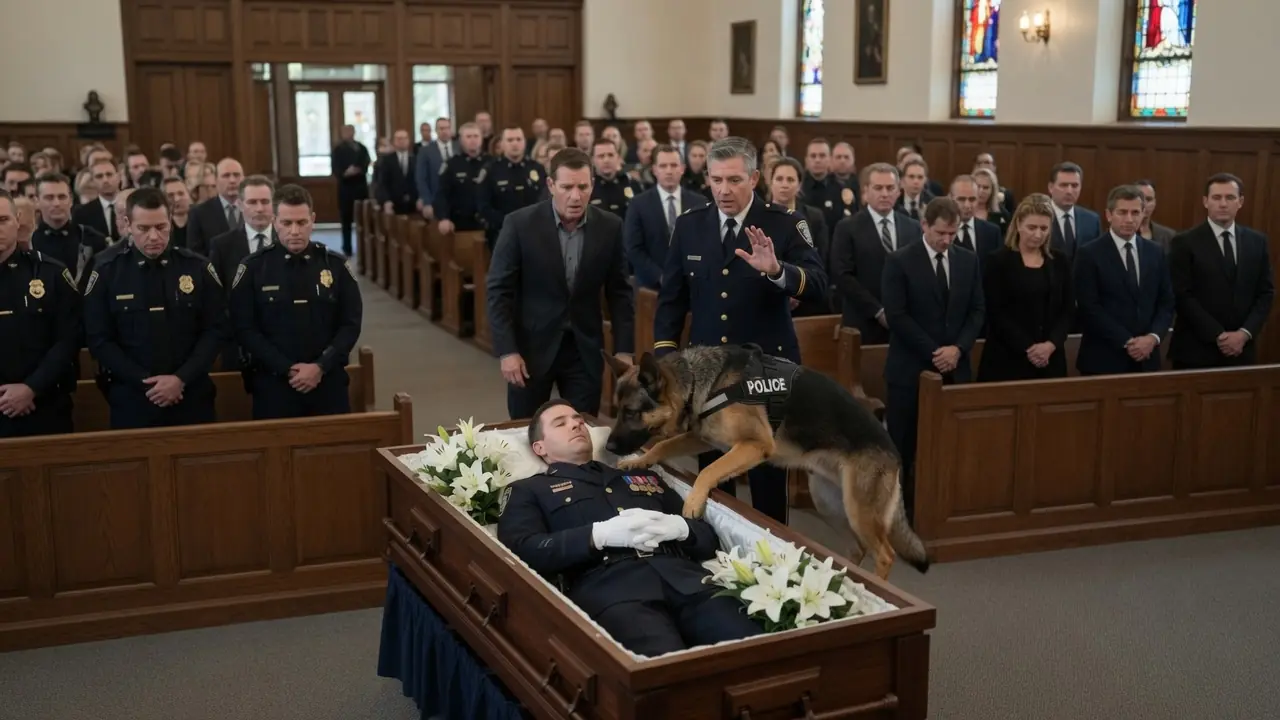
When the service reached its final moments and the congregation stood for the last salute, Rex moved without command. He slipped past the knees of an honor guard member, ignored the soft gasps that rippled through the front pews, and placed his paws on the coffin’s edge with a confidence that made the action look inevitable rather than impulsive. An usher stepped forward, then stopped, uncertain whether protocol allowed interruption when the interruption came from a partner. Rex did not look at the crowd. He looked only at the uniform.
Moments after leaping into Officer Michael Daniels’ coffin, Rex locked onto a hidden pocket in the officer’s dress uniform and refused to move. He buried his nose against the fabric with the precision of a dog trained to locate what human eyes miss, and his front legs braced against the casket lining as if anchoring himself against anyone who might pull him away. The hidden pocket was not part of standard display preparation; it sat along an inner seam where a folded layer of cloth created a narrow space meant to hold small items flat against the body. Rex’s focus on that spot was unwavering, the kind of refusal that turns a trained animal into a statement.
Whispers spread through the church, turning into a low murmur that threatened to break the solemn order of the service. A department chaplain lifted a hand as if to calm the room, then hesitated, seeing the dog’s behavior was not frantic but controlled. Rex did not paw at the casket lining, did not whine, did not search randomly. He stayed on the pocket as if the scent there had activated a chain of certainty in his mind, the same certainty he showed when he committed to a find and waited for his handler to catch up. People who had never worked K9s interpreted the scene as heartbreak. People who had worked K9s felt something else tighten in their chests.
An officer moved to remove Rex, speaking softly, using the calm voice used to de-escalate without shaming. Rex ignored the voice. A second attempt, gentler, with a hand on his harness, met the same result: the dog’s weight shifted to resist, not aggressively, but with the immovable logic of a partner who would not leave a job unfinished. The captain’s jaw tightened as he weighed the impossible choice between dignity for a fallen officer and respect for a living one who served beside him. In that pause, the funeral stopped being only a funeral, and the room began to sense that the dog might be pointing at something the service had not been built to address.
When a retired K9 handler realized what the dog was trying to say, the handler’s expression changed from sympathy to recognition. He had spent decades reading the difference between a dog mourning a handler and a dog reporting a detection, and Rex’s body language belonged to the second category with unmistakable clarity. The handler moved up the aisle with the careful steps of someone who did not want to startle the animal into a false alert or a startled snap. He did not reach for Rex’s collar immediately. He looked first at where Rex’s nose was fixed, then at the uniform’s inner seam, then at the faces of the officers standing closest to the casket.
The handler asked one question, quietly, directed not to the crowd but to the department’s lead investigator standing near the front. The question was simple enough to sound harmless in a church, yet it carried the weight of procedure: “When was the last time anyone besides the funeral detail handled this uniform?” The investigator’s answer came quickly, because the detail had followed protocol and the uniform had been prepared by designated staff after the medical examiner’s release. The handler nodded once, then asked the second question that mattered more than the first: “Was the uniform sealed from the time it left evidence control until it was placed on him today?”
Silence returned, but it was a different silence, alert and thin, the kind that forms when routine answers no longer fit the moment. The investigator stepped closer, not to the dog first, but to the uniform’s inner fold, using a pen to lift the fabric without touching what might be inside. Rex’s tail gave a single controlled movement, not a wag of joy, but the subtle confirmation signal trained into him when a handler approached the correct source. The hidden pocket held a stiff edge, something flat and wrapped, something that did not belong to the standard contents of dress blues.
One question turned a memorial service into the beginning of a criminal investigation. The investigator requested that the church be cleared of civilians in a manner that preserved respect, and the captain agreed with a nod that cost him visible effort. Honor guard members maintained their positions, but the service was paused, not ended, suspended in the space between mourning and duty where police departments are forced to live too often. A crime scene protocol that was never meant to intersect with an open casket began to assemble in whispers: photographs, gloves, chain of custody, a supervisor notified, a prosecutor’s office alerted that the day’s tragedy might contain a second story.
Rex remained on task, refusing to move until the handler verbally released him with the specific command that meant the find was acknowledged and secured. Only then did the dog shift his weight, still watching the pocket as it was documented, still tracking the movement of hands that did not belong to his partner. The handler rewarded him with brief pressure on the harness, the professional praise used in training, because in K9 work recognition is not sentiment; it is part of the system that keeps the dog reliable. Rex sat at the edge of the casket then, exhausted in the way working dogs become after intense focus, but no longer frantic.
The item removed from the hidden pocket was small enough to disappear inside a folded uniform, yet significant enough to change the meaning of Daniels’ death overnight. It was packaged in a way that suggested intent to conceal rather than accidental placement, and the investigator’s face hardened as he labeled it and placed it into an evidence bag. The medical examiner was contacted again, not for a routine follow-up, but for a re-evaluation prompted by a detection that human preparation had missed. Detectives who had spent the previous days building a narrative around a line-of-duty loss found themselves reopening timelines, reinterviewing witnesses, and pulling security footage from places that had seemed irrelevant when the case appeared straightforward.
Everyone had come to the funeral believing they understood the story’s ending. Daniels had died in the course of police work, and the department had gathered to honor sacrifice, to promise remembrance, to let a partner dog grieve in public because the public understood that image. Rex had been cast in the role of mourning without anyone asking whether his training was still listening underneath the sorrow. The veteran K9 had been on the street long enough to know that scent does not care about ceremonies, and that a dog’s duty does not always end when a handler’s heartbeat does.
By nightfall, the investigation had shifted from memorial statements to case files lit by desk lamps and the glow of monitors. The question about the uniform’s custody became a line of inquiry that branched quickly: who had access, who had opportunity, who had reason to use a funeral as cover because a coffin and a dress uniform are places people hesitate to search out of respect. The hidden pocket, once a tailoring trick or a discreet storage seam, became a focal point that suggested someone understood uniforms well enough to exploit their formal presentation. Rex’s alert did not solve the case, but it forced the case to exist in a form the department had not prepared for in front of a grieving congregation.
The retired handler stayed close to Rex as the church transformed into a controlled scene, speaking to the dog in the steady tones that keep a K9 from associating conflict with detection work. He told the younger officers what to watch for in Rex’s behavior, not to anthropomorphize it, not to call it grief when it was communication through training. He explained that Rex had not “jumped” in a chaotic sense; he had committed to a source the way he committed to a vehicle sweep or a room search, because to him the uniform was still part of the partnership’s operational world. The handler’s calm translation helped the department move without insulting the family, even as the family’s private pain collided with public procedure.
Officer Michael Daniels’ name remained at the center, but the center moved. The funeral’s planned closure—final salute, bagpipes, the slow roll of a department mourning its own—was replaced by a different kind of urgency that would continue after the last note faded. Rex was led out on a loose lead, not in disgrace, not as a disruption, but as a witness in the only language he possessed. People who had whispered “goodbye” now whispered questions they could not yet speak aloud, and those questions followed the evidence bag out of the church like a second procession.
In the days that followed, the story the public had been given—an officer lost, a K9 grieving—split into two tracks that could not be merged without facts. One track belonged to memorial traditions, folded flags, and the ache of a partner missing from the kennel. The other track belonged to interviews, warrants, and the cold reconstruction of hours before Daniels’ death, hours that now included the possibility that someone had tried to bury a secret with him. The investigation changed overnight because a dog trained to find what people hide had refused to pretend that hiding ended at the cemetery doors.
Rex returned to the department kennel that evening, fed and checked, his paws washed, his harness removed. He slept in the way working dogs sleep after a long deployment, deeply but ready. Handlers logged the alert, preserved the training record, and noted the conditions: crowded environment, emotional stressors, open casket, uniform fabric, concealed pocket. They knew defense attorneys would ask whether scent could transfer, whether contamination occurred, whether a church full of flowers could distort detection. They also knew Rex’s record, and they knew the retired handler’s read, and they knew the stiff edge in the pocket was not imagination.
The captain stood in the empty church after everyone else had gone, looking at the space where the coffin had been. He had led departments through funerals before, but he had never watched a service become a scene. He thought of Daniels’ habit of checking his gear twice, of the way he always acknowledged Rex before every shift, of the partnership that made them effective because they trusted each other’s signals. In a terrible symmetry, Rex had delivered a signal one last time, and the department had no honorable choice except to listen, even if listening meant delaying the comfort of a clean ending.
The criminal investigation did not erase the loss; it complicated it. Daniels was still gone, still mourned, still entitled to the truth regardless of what that truth contained. The overnight change was not a reversal of respect, but an expansion of it, the kind that insists a fallen officer will not be used as a vessel for someone else’s concealment. Rex had not performed for the crowd, and he had not acted out of confusion. He had done what he was trained to do when his partner’s world still held an unresolved scent problem, and he had done it at the moment when every human in the room was looking for symbolism instead of evidence.
When the department finally released a statement, it was careful, limited, and stripped of drama, because investigations do not belong to spectacle. They confirmed that an item had been recovered during services, that protocols were enacted, that the matter was under active review, and that Rex remained in the care of trained handlers. They did not turn the dog into a hero on a poster, because K9 units know hero language can distort accountability. But inside the building, everyone understood the pivot: the case had reopened not because of a hunch, but because a veteran K9 locked onto a hidden pocket in Officer Michael Daniels’ dress uniform and refused to move until the humans caught up.
The retired handler visited Rex the next morning and ran a short training routine to restore normalcy, because normalcy is part of how dogs stay stable after abnormal deployments. Rex worked the exercise with clean focus, rewarded, released, then allowed to rest. The handler told the team what he had seen in the church, not as gossip, but as instruction: when a dog commits that hard, you do not pull him away for aesthetics; you secure the source and you document the world around it. His words became the unofficial report that traveled faster than paperwork, shaping how supervisors treated Rex’s alert when the lab requests came in and when the interviews began.
Officer Michael Daniels’ funeral had been meant to close a chapter. Instead, Rex’s leap into the coffin opened one, and the question about the uniform’s handling became the first key turned in a lock nobody had admitted was there. The memorial service could not return to what it had been, but the department could still honor Daniels by pursuing whatever truth the hidden pocket implied. Everyone had believed Rex was saying a final goodbye, and in a way he was, because goodbye in police work is not only emotion; it is also the last duty shared between partners.
The investigation changed overnight, and Rex’s role in that change remained exactly what the prompt had promised: not grief displayed for the crowd, but work performed with relentless clarity. He had leaped, he had locked on, he had refused to move, and a retired handler had understood the message in time to ask the question that mattered. A church built for mourning became the doorway to warrants, statements, and reexamined evidence, while the fallen officer’s name stayed at the center, protected now by the same institutional refusal to look away that Daniels had lived by on the street.
In the weeks that followed, detectives traced access logs and uniform preparation steps with the grim patience of people who know how easily respect can be exploited. They revisited the last days of Daniels’ life, not to tarnish memory, but to ensure memory was not being used as camouflage. Rex’s detection became one piece in a larger puzzle, logged, tested, challenged, and defended through the routines that keep alerts from becoming rumors. The dog returned to scheduled training and supervised deployments, because a working K9 cannot live forever in one moment, even a moment that altered the department’s understanding of its own loss.
The public still told the story in simplified form: a K9 who could not leave his partner. Inside the department, the story was more precise. Rex had followed scent and training through a room full of symbols, and he had anchored himself to a hidden pocket until humans translated his refusal into procedure. That translation began with one question, and it grew into an investigation that would not accept a concealed item as a footnote to a funeral. The overnight change was not merely dramatic; it was operational, a shift from assumed closure to active inquiry, driven by a veteran police K9 who was not grieving in that coffin, but working.
And so the memorial’s intended ending—tears, salute, silence—became a beginning dressed in the same uniforms and the same restrained pain. Rex had made the hidden pocket impossible to ignore, and Officer Michael Daniels’ death could no longer be treated as fully explained while evidence sat folded against his dress uniform. The department moved forward with the dual weight of honor and suspicion, knowing both could be true at once. Everyone had witnessed what looked like a final goodbye, but the truth was sharper: Rex was doing his job, and the job changed everything overnight.