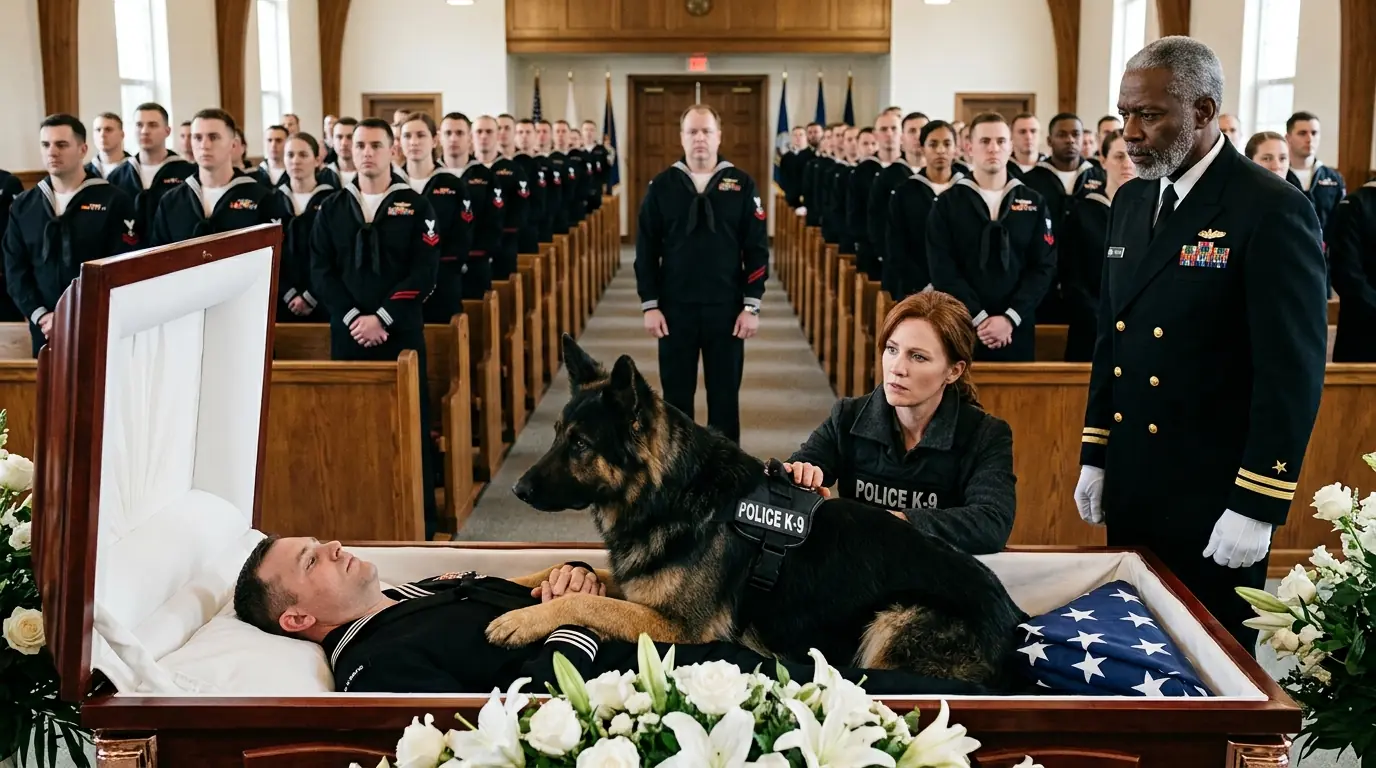
The funeral hall had been silent for almost twenty minutes when Atlas lifted his head from Officer Michael Hayes’s chest.
Until that moment, the German Shepherd had ignored everything around him.
The honor guard standing beside the casket.
The white roses.
The folded American flag.
The quiet commands from handlers he had known for years.
Atlas lay inside the open casket with his body pressed against Michael’s uniform, one front paw resting across his partner’s chest as though he believed anyone who approached might take the officer away again.
Then Sergeant Grant Collins entered the hall.
Atlas changed instantly.
His ears rose.
The loose skin around his muzzle tightened.
His breathing stopped for one long second.
A low growl began deep inside his chest.
The sound was not loud, but every officer in the first six rows heard it.
Collins stopped halfway down the aisle.
He wore his dress uniform, though his collar sat unevenly and sweat had already appeared along his temples.
“What’s wrong with him?” he asked.
Nobody answered.
Atlas stood inside the casket.
His paws pressed into the white lining. The fur along his spine lifted until he appeared larger than he had moments before.
His eyes locked on Collins.
“Atlas,” Lieutenant Aaron Brooks whispered.
The dog did not look away.
Collins took one step backward.
Atlas barked.
The sharp explosion of sound struck the wooden walls and made several mourners jump.
It was the same alert Atlas used when he located a hidden armed suspect.
Not grief.
Not confusion.
Identification.
Police Chief Elena Warren moved from the first row.
“Sergeant Collins, remain where you are.”
Collins looked toward the doors.
“Chief, the dog is traumatized.”
“Remain where you are.”
“I wasn’t even near the warehouse when Michael was killed.”
The chief’s expression changed.
Nobody had mentioned the warehouse.
Not in the hall.
Not since Collins entered.
Atlas barked again.
Collins realized his mistake.
Every officer around him realized it too.
Chief Warren raised one hand.
Two detectives moved quietly into the aisle behind him.
Three days earlier, Officer Michael Hayes had left his house believing Atlas was sick.
The dog had spent most of the night pacing between the bedroom and the front door.
His nails clicked across the hardwood floor in short, anxious patterns. He stopped only to stare through the living-room window or press his nose against Michael’s jacket.
Michael sat on the edge of the couch watching him.
“You’re going to wear a path through the floor.”
Atlas moved toward the front door again.
Then returned and nudged Michael’s hand.
At eight years old, Atlas was one of the most disciplined dogs in the department. He did not pace without reason. He did not whine for attention or bark at ordinary noises.
Michael placed both hands along his ribs and shoulders, checking for pain.
“No swelling. No injury.”
Atlas turned his head toward the window.
A vehicle passed slowly outside.
The dog followed the headlights until they disappeared.
Michael’s expression tightened.
He had noticed the same dark sedan twice during the previous week.
Once near the station.
Once outside the small storage facility on Brenton Avenue.
He had told himself it was coincidence.
Atlas did not believe in coincidence.
Michael lowered his voice.
“You smelled him again, didn’t you?”
The dog looked at him.
Michael reached beneath Atlas’s collar and touched the small waterproof capsule he had attached there two days earlier.
Inside it was a brass storage-unit key and a folded piece of paper protected by plastic.
The note contained only six words.
If I disappear, take Atlas seriously.
Michael hated himself for preparing it.
He hated what the preparation suggested.
For seventeen years, Michael had trusted the department with his life.
He trusted officers to answer when he called.
Trusted evidence technicians not to alter reports.
Trusted supervisors not to turn a criminal investigation into a private business.
That trust had begun breaking three months earlier.
It started with a weapon recovered during a narcotics arrest.
The serial number connected the handgun to a federal seizure from two years before.
A weapon from the evidence room had somehow returned to the street.
Michael reported it.
Sergeant Grant Collins explained that the database probably contained an error.
The gun disappeared from the evidence room before an audit could examine it.
A week later, Michael found two sealed evidence boxes listed as destroyed even though the destruction forms lacked required signatures.
Both boxes had been connected to weapons-trafficking cases.
Michael began searching quietly.
He discovered irregular dispatch records, patrol vehicles appearing near private warehouses while assigned elsewhere, and evidence-access logs altered minutes after midnight.
Collins’s identification number appeared repeatedly.
So did the names of two other officers.
Michael did not immediately report the discovery because Collins supervised the internal reporting route.
He needed proof strong enough that no one could bury it.
He began storing copies outside the department.
Atlas accompanied him whenever possible.
The dog learned the scent of Collins’s private storage facility, the oil used inside the warehouse, and the chemical residue from packaging materials connected to illegal firearm shipments.
Michael was close.
Too close.
The following morning, he brought Atlas to the station.
During briefing, Collins entered carrying a paper cup of coffee.
Atlas stood from beside Michael’s chair.
His body became rigid.
A growl barely escaped his throat.
Collins stopped.
“What’s his problem?”
Michael placed one hand on the dog’s back.
“Atlas.”
The dog continued staring.
Collins smiled without humor.
“Maybe your animal is getting too old for duty.”
Michael looked at him.
“He only reacts like this when something is wrong.”
Several officers glanced between them.
Collins took a sip of coffee.
“Then perhaps he senses your paranoia.”
The room became quiet.
Michael said nothing.
Atlas followed Collins with his eyes until the sergeant left.
Later that afternoon, Michael checked the dog’s equipment.
Beneath the collar, the waterproof capsule remained secure.
He had recorded two conversations with Collins.
One involved missing weapons.
The other included a threat disguised as advice.
“You have a good career, Michael. Stop opening doors you won’t know how to close.”
Michael copied the recordings onto drives inside Storage Unit 47.
He also left photographs, timelines, evidence records, and names.
If something happened, Atlas carried the key.
Michael trusted the dog more than he trusted any secure department locker.
At ten forty-two that night, the dispatch radio crackled inside Michael’s patrol vehicle.
“Unit Twelve, suspicious activity at the Ashford industrial warehouse. Possible unauthorized entry. No other units currently available.”
Atlas stood in the rear compartment.
His ears flattened.
Michael reached for the radio.
“Dispatch, confirm no additional unit?”
“Affirmative. Nearest backup approximately twelve minutes.”
Michael looked at the clock.
Then at Atlas.
The dog began whining.
Ashford Warehouse appeared in Michael’s investigation.
It was one of the locations Collins visited while supposedly off duty.
A routine suspicious-person call to that address was not routine.
Michael pressed the transmission button.
“Unit Twelve responding. Advise backup to stage before entry.”
The dispatcher acknowledged.
Atlas refused to leave the vehicle when they arrived.
The warehouse stood behind a rusted fence near the abandoned freight district. Most windows had been broken or painted black. A side entrance hung partly open.
“Atlas, out.”
The dog remained in place.
Michael opened the rear door.
Atlas jumped down but immediately grabbed Michael’s sleeve.
The behavior shocked him.
The German Shepherd pulled backward with desperate force.
“Easy.”
Atlas growled toward the warehouse.
Michael crouched.
“I know.”
The dog whined.
Michael touched the capsule beneath his collar.
“If I’m wrong, we wait twelve minutes and get laughed at.”
Atlas pulled again.
“If I’m right, someone inside is moving evidence.”
Michael contacted dispatch.
“Unit Twelve holding exterior. Any update on backup?”
Static answered.
Then a voice.
“Proceed if safe. Second unit delayed.”
Michael recognized the dispatcher’s phrasing.
He did not recognize the voice.
Someone had accessed the channel.
He drew his weapon.
“Atlas, heel.”
They entered.
The warehouse smelled of machine oil, damp wood, and a sharp solvent Michael associated with weapon packaging.
Atlas moved low.
His nose worked rapidly along the concrete.
The interior appeared empty.
Crates created narrow corridors beneath steel beams.
Michael’s flashlight crossed a black SUV parked near the loading area.
Its plate had been removed.
Atlas stopped.
A growl began.
Michael heard a metallic click behind the crates.
“Police. Show your hands.”
Gunfire erupted.
Michael pushed Atlas behind a concrete support and returned fire toward the muzzle flash.
A second shooter fired from the upper walkway.
Michael’s shoulder struck the support beam as he moved.
“Shots fired! Officer needs assistance!”
The radio produced only static.
Atlas lunged toward a figure moving between crates.
Someone caught the dog with a catch pole.
Atlas twisted and snapped, but the metal loop tightened around his neck.
Michael heard him yelp.
“Atlas!”
A small explosive detonated behind the crates.
The pressure wave threw Michael across the floor.
Dust and smoke erased the room.
He tried to rise.
A bullet entered beneath his vest near the side panel.
Michael fell.
Through blurred vision, he saw Atlas break free from the catch pole.
The dog ran toward him.
A man moved through the smoke behind Atlas.
Broad shoulders.
Police boots.
Michael recognized the stance.
“Collins.”
The figure stopped.
Atlas turned and barked.
The man swung the metal pole into the dog’s ribs and fled through the side exit.
Atlas could have followed.
He did not.
He crawled beside Michael and pressed his body against him.
Michael’s hand found the dog’s fur.
“Stay.”
Atlas whined.
“Keep the key safe.”
Michael’s fingers touched the collar.
Then fell.
When responding officers finally entered, Atlas stood over Michael’s body and refused to allow anyone close until Lieutenant Aaron Brooks arrived.
Aaron had trained beside Michael for eleven years.
He approached without a weapon in his hand.
“Atlas.”
The dog looked at him.
“It’s Aaron.”
Atlas remained protective.
Aaron lowered himself to one knee.
“We have to help him.”
Atlas looked at Michael.
Then stepped aside.
Michael was already dead.
The department described the incident as an ambush connected to a warehouse burglary.
The official report said an unknown attacker escaped after detonating an improvised explosive.
It also stated that Michael entered without waiting for backup.
Aaron read the report twice.
Michael had requested backup.
The request appeared on his vehicle recording.
But the dispatch log showed no transmission.
Someone had removed it.
Atlas sat in the station’s K-9 room wrapped in a medical blanket.
He refused food.
Bruising darkened the skin beneath the fur around his neck and ribs.
The veterinarian believed the injuries were inconsistent with the blast.
“Something restrained him,” Dr. Claire Moreno said.
Aaron looked toward the metal marks around the collar area.
“A catch pole?”
“Possibly.”
“Why would a warehouse burglar carry one?”
Claire looked at him.
“Someone knew a police dog might arrive.”
The funeral was scheduled two days later.
Michael’s mother requested Atlas attend.
“He was Michael’s family,” she said.
No one disagreed.
The morning of the service, Atlas slipped from his temporary handler when the funeral-home doors opened.
He ran directly to the casket.
Before anyone could catch him, he placed both front paws on the edge and climbed inside.
He curled beside Michael.
The handler attempted a recall command.
Atlas ignored it.
Aaron tried.
The dog stayed.
Chief Warren finally ordered everyone to leave him alone.
“He lost his partner.”
That explanation satisfied the room until Collins arrived.
After Atlas barked at him, Chief Warren moved closer.
“Sergeant, where were you at ten thirty on the night Michael died?”
Collins looked toward the dog.
“Home.”
“Your official report says you were off duty.”
“I was.”
“You just said you were not near the warehouse before anyone accused you of being there.”
Collins’s face tightened.
“I’ve heard the rumors.”
“What rumors?”
“That Hayes was investigating people inside the department.”
Several officers exchanged glances.
The investigation had not been public.
Aaron stepped toward Collins.
“How did you know that?”
Collins looked toward the doors again.
Atlas climbed out of the casket.
The dog stood on the floor with his attention fixed on him.
Chief Warren spoke quietly.
“Detectives will escort you to an interview room.”
“You’re detaining me because a dog growled?”
“No.”
Her gaze remained steady.
“I am detaining you because you lied, disclosed protected information, and are attempting to leave while being questioned.”
Collins backed away.
Atlas barked.
The sergeant turned and ran.
He made it six steps.
Two officers intercepted him near the doors.
Collins struck one and reached toward his holster.
Atlas launched forward.
Aaron gave a single command.
“Hold.”
The dog stopped inches from Collins’s arm.
Teeth exposed.
Waiting.
Collins froze.
Officers removed his weapon and placed him in handcuffs.
Atlas returned to Michael’s casket.
Dr. Moreno knelt beside him.
As she examined the bruising around his neck, her fingers found the hard capsule beneath the collar.
“What is this?”
Aaron looked closer.
The device was not standard K-9 equipment.
Claire opened it.
A small brass key fell into her hand.
So did the folded note.
Chief Warren read the words.
If I disappear, take Atlas seriously.
A number had been written beneath them.
The funeral stopped.
Not formally.
No announcement was made to the families waiting in the rear rows.
But the department’s focus shifted.
Chief Warren assigned a small group of detectives who had no direct reporting relationship to Collins.
Aaron carried a scent article belonging to Michael and allowed Atlas to examine it.
Then they drove to the storage facility on Brenton Avenue.
Atlas moved past the office and along the rows of metal doors.
He stopped at Unit 47.
The key opened it.
Inside was an investigation Michael had built alone.
Photographs of Collins meeting men with known trafficking connections.
Copies of altered property-room records.
Vehicle-location logs.
Bank transfers.
Warehouse maps.
Audio recordings.
An encrypted laptop.
Names of officers and civilian buyers.
A sealed envelope sat on the table.
Chief Warren opened it.
There is corruption inside the department. Collins is moving seized weapons through Ashford Warehouse. I believe two officers and at least three civilians are assisting him. I do not know who controls dispatch access. If I report through normal channels before the evidence is complete, it will disappear. Atlas recognizes Collins and the warehouse scent. His reaction is a lead, not proof. The proof is in this room.
Aaron stopped reading over her shoulder.
Michael had underlined the final sentence.
Do not make the dog carry what people are responsible for proving.
Chief Warren looked toward Atlas.
The dog stood beside the table with his head lowered.
“He knew.”
“He suspected he might not return,” Aaron said.
Investigators opened the laptop.
One recording contained Michael confronting Collins inside a parking garage.
“You signed evidence out under a dead officer’s credentials.”
Collins’s voice answered.
“You need to stop.”
“Where are the weapons?”
“Go home to your dog, Michael.”
“I have copies.”
A long silence followed.
Then Collins spoke again.
“You keep pulling this thread, and someone is going to bury you with it.”
Vehicle tracking placed Collins’s unmarked car near Ashford Warehouse three minutes before Michael arrived.
His personal phone had been switched off.
A prepaid phone connected to the warehouse tower at the exact time dispatch sent Michael the call.
Security footage from a nearby freight yard showed Collins’s vehicle leaving through the rear access road after the explosion.
The damaged body camera recovered from Michael’s uniform contained seventeen usable seconds.
In one frame, Collins appeared behind the crates.
His face was unclear.
His badge and distinctive duty belt were not.
Atlas had pointed toward the right man.
But the evidence did the accusing.
During interrogation, Collins denied everything for six hours.
Then investigators played the recording.
Showed him the vehicle footage.
Placed the financial records before him.
Finally, they displayed a photograph of the catch pole found inside his garage.
Atlas’s blood and fur remained embedded in the loop.
Collins’s story collapsed.
He admitted participating in a network that stole seized weapons, altered evidence records, and sold firearms through criminal intermediaries.
He claimed he did not plan to kill Michael.
The buyers had planted the explosive, he said.
He merely sent the false call and delayed backup.
“You sent an armed officer into an ambush,” Chief Warren replied.
Collins looked down.
“I thought he would back off.”
“You threatened him.”
“He wouldn’t stop.”
“That was why people trusted him.”
The arrest led to five more.
Two police officers.
One evidence technician.
Two civilian traffickers.
Search warrants recovered dozens of weapons that should have remained inside secure storage or been destroyed.
Some had already been used in violent crimes.
Every case connected to Collins underwent review.
The department could not undo the harm.
It could only stop protecting itself from the truth.
Michael’s funeral resumed the following afternoon.
This time, Atlas walked beside the casket rather than lying inside it.
The hall remained full.
No reporters were permitted.
Chief Warren stood at the podium.
“Officer Michael Hayes died because he refused to ignore corruption inside the institution he served.”
She looked toward the rows of officers.
“He also left instructions reminding us of something important.”
Atlas sat beside Aaron.
“A dog can alert us to danger. A witness can point toward a door. Instinct can tell us something is wrong.”
The chief paused.
“But justice requires evidence, courage, and people willing to act after the warning.”
Her gaze moved across the uniforms.
“Michael collected that evidence. Atlas protected it. Our responsibility was to believe neither blindly, but to investigate both honestly.”
Michael’s mother spoke next.
She did not discuss the investigation.
She spoke about the son who brought groceries every Sunday.
The boy who once hid an injured bird inside his bedroom.
The officer who called her after every late shift because he knew she remained awake.
Then she knelt beside Atlas.
“You brought him home.”
The dog lowered his head into her hands.
After the eulogies, Aaron connected a small audio device to the hall’s speakers.
Michael’s voice filled the room.
The recording had been made during an ordinary training session months earlier.
“Good boy, Atlas. Right here.”
Atlas’s ears rose.
He looked toward the casket.
“Stay with me.”
The dog stood.
He approached Michael one final time and placed his front paws against the casket’s lower edge.
He did not climb inside.
He rested his muzzle against the sleeve of the dress uniform.
The recording continued.
“That’s it. Job’s done.”
Atlas closed his eyes.
A quiet sound escaped him.
Not a bark.
Not a growl.
A breath that seemed to empty days of tension from his body.
When Aaron called him, Atlas stepped back willingly.
The honor guard closed the casket.
The click of the latch traveled through the silent hall.
Atlas sat beside Aaron as Michael was carried toward the doors.
Outside, officers lined both sides of the street.
The procession moved slowly through the city.
Atlas rode in Michael’s patrol vehicle, seated upright in the passenger position he had occupied during hundreds of night shifts.
Residents stood along sidewalks.
Children held signs with his name.
People placed flowers near the station.
The department credited Atlas publicly with helping preserve Michael’s final investigation.
Chief Warren corrected reporters who described the dog as having solved the case.
“Atlas gave us a warning,” she said. “Michael gave us proof.”
The distinction mattered.
Collins eventually pleaded guilty to conspiracy, weapons trafficking, obstruction, and involvement in Michael’s murder.
He received a sentence that ensured he would spend most of his remaining life in prison.
During sentencing, he looked toward Atlas sitting beside Aaron at the back of the courtroom.
“That dog destroyed me,” Collins said.
The judge shook her head.
“No.”
She looked toward the boxes of evidence.
“Officer Hayes documented you. Your own decisions destroyed you.”
The department established an independent evidence-audit division.
Dispatch records became impossible for one supervisor to alter without generating an external alert.
Whistleblowers could report outside the chain of command.
K-9 handlers received new training on documenting behavioral changes without treating them as unquestionable facts.
Michael’s case became part of the academy curriculum.
Recruits listened to the false dispatch call.
Studied the missing backup request.
Examined how Collins exploited trust and procedure.
They also watched footage from the funeral hall.
Atlas lying across Michael’s chest.
Collins entering.
The dog’s head rising.
The instructor always stopped the video before the bark.
“What does this prove?” she asked.
At first, recruits gave the expected answers.
That Collins was guilty.
That the dog recognized him.
The instructor corrected them.
“It proves the dog reacted.”
She allowed the sentence to settle.
“That reaction justified attention. It did not justify conviction. The investigation that followed produced proof.”
The lesson was about more than dogs.
It was about resisting easy certainty, even when certainty felt emotionally satisfying.
Two years after Michael’s death, Atlas retired.
Aaron adopted him.
The dog spent his remaining years in a quiet house with a fenced yard, a soft bed near the fireplace, and Michael’s old patrol jacket hanging beside the door.
Sometimes Atlas slept beneath it.
Sometimes he carried one sleeve gently in his mouth.
He no longer searched warehouses.
He no longer wore a badge.
On the anniversary of Michael’s death, Aaron took him to the cemetery.
Atlas always walked directly to the correct grave.
He sat beside the stone and waited.
Aaron never hurried him.
One autumn morning, when Atlas had grown gray around the muzzle and slower in his hips, Aaron found him lying beneath Michael’s jacket.
The dog’s breathing was shallow.
Aaron lowered himself beside him.
“You kept your promise.”
Atlas opened his eyes.
Aaron placed one hand against his neck where the waterproof capsule had once rested.
“We found it all.”
The dog’s tail moved once against the floor.
“Michael’s story wasn’t buried.”
Atlas exhaled.
Then became still.
The department buried his ashes beside Michael’s grave.
A small bronze plaque carried no dramatic description.
Only two names.
OFFICER MICHAEL HAYES
K-9 ATLAS
Beneath them were the words:
PARTNERS TO THE END.
Most people remembered the funeral because of the moment Atlas growled at a corrupt officer.
Aaron remembered what happened afterward.
The dog returned to Michael’s side.
He did not celebrate.
He did not understand arrests, trials, headlines, or institutional reform.
He understood only that his partner had been threatened.
That something important remained unfinished.
And that the humans Michael served had finally begun listening.
Atlas had not refused to leave the casket because he believed Michael would wake.
He stayed because Michael had given him one final duty.
Guard the key.
Recognize the danger.
Lead the others toward the truth.
Only when the evidence was safe, the guilty were exposed, and Michael’s final message had been heard did Atlas step away willingly.
The dog could not testify.
He could not explain what he smelled inside the warehouse or why Collins’s presence filled him with rage.
He could only warn them.
Fortunately, this time, someone paid attention.