Three months earlier, Elijah Carter had stood in a Fulton County courtroom and listened to twelve strangers decide whether the rest of his life belonged to him.
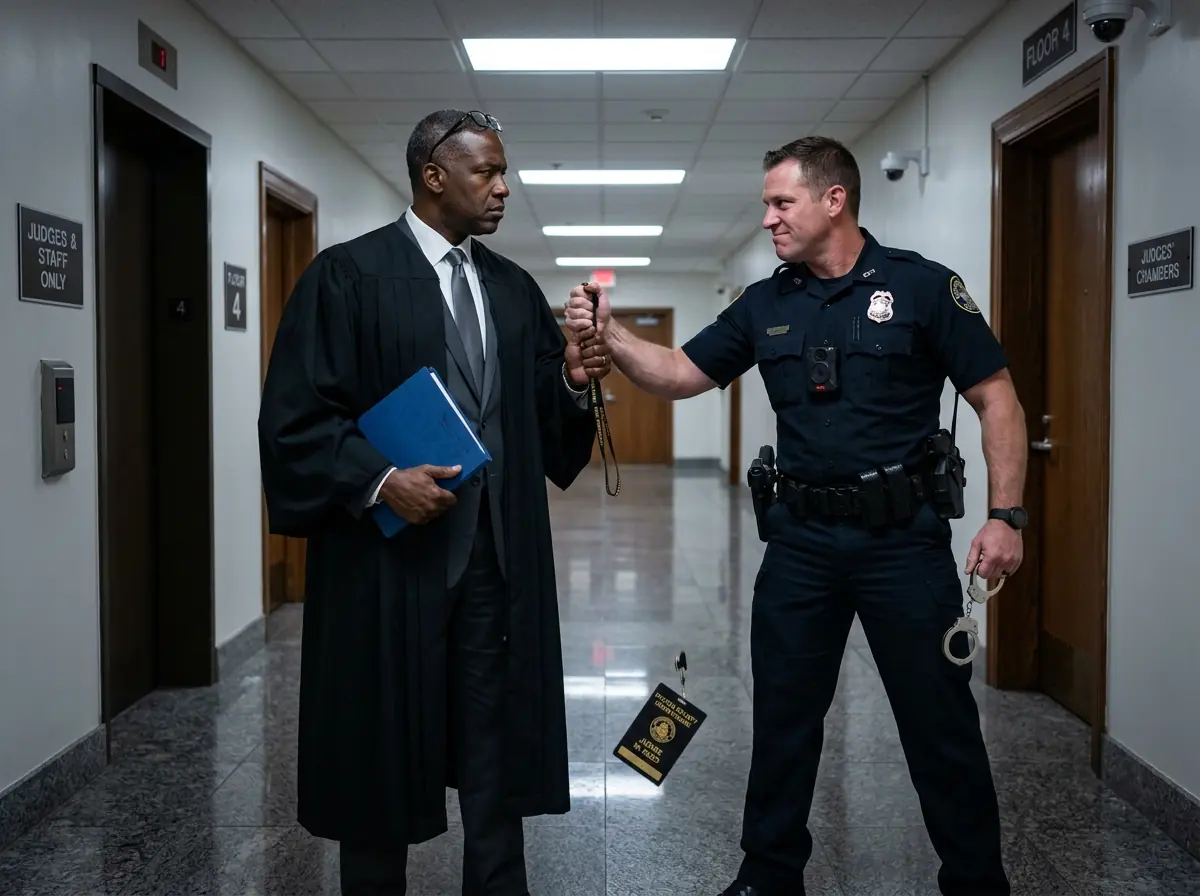
The room looked exactly the way Americans expected a courtroom to look: polished wood, muted carpet, an American flag hanging motionless beside the bench, and the state seal mounted behind Judge Raymond Harrison’s chair. Nothing about the architecture suggested corruption. That was one of the things Elijah had learned during twelve years in federal law enforcement. Systems rarely announced where they were broken. Most failures wore ordinary clothes, used official letterhead, and spoke through people who understood procedure well enough to make abuse resemble routine. When the clerk read the guilty verdict on four counts of computer fraud, theft, wire-related financial offenses, and conspiracy, Elijah did not react. His wife Nicole covered her mouth in the gallery. Their eight-year-old daughter Maya buried her face against her mother’s shoulder. Elijah simply looked toward the bench and waited.
The prosecution’s case had seemed devastating. Elijah had worked as a senior cybersecurity consultant for Catalyst Financial, a midsized investment company managing pension and municipal accounts across Georgia. Company records showed nearly $750,000 leaving internal accounts through a sequence of transfers that eventually reached foreign holdings bearing identifiers linked to him. Investigators traced the transactions to credentials assigned to his workstation. Emails appeared to show Elijah approving elevated access requests shortly before the money moved. Assistant District Attorney Monica Reeves presented the evidence with the certainty of someone describing gravity. “The defendant had access, opportunity, and technical sophistication,” she told the jury. “This wasn’t an accident. It was a theft committed by someone who believed his knowledge of computer systems made him untouchable.”
Reeves also gave the jury something more emotional than server logs. She displayed photographs of Elijah’s modest house, his decade-old sedan, and then a series of luxury watches, hotel invoices, and international travel records supposedly recovered during the financial investigation. “Mr. Carter earned a comfortable salary,” she said, “but not this comfortable.” What the jury did not know was that several of those purchases did not belong to Elijah at all. The photographs had been tied to him through compromised expense records and accounts created by people inside Catalyst who knew exactly how the company’s cybersecurity system logged users. The real money had been stolen by executives Elijah had begun quietly investigating months earlier.
Judge Raymond Harrison did not know that part either.
What he did know was that someone wanted Elijah convicted.
Harrison had served on the Superior Court bench for fifteen years and built a reputation around the word discipline. Television commentators praised him for refusing “excuses.” Police associations invited him to dinners. Local political donors admired his willingness to impose severe sentences in financial and property cases. Lawyers who practiced before him knew another version. Harrison interrupted certain defense attorneys relentlessly, restricted expert funding more aggressively than neighboring judges, and treated some defendants’ explanations as insults rather than testimony. An internal statistical screen later performed by investigators would find a troubling sentencing disparity between Black and white defendants even after controlling imperfectly for criminal history, loss amount, plea status, and offense category. Statistics alone could not prove motive. But they were enough to ask why the same discretion always seemed to bend in the same direction.
Elijah saw the pattern from the defense table. His court-appointed attorney, Sarah Whitman, had received the case only two weeks before trial after the previous lawyer suffered a medical emergency. She was competent, exhausted, and working with a budget that could not match Catalyst’s technical resources or the state’s forensic consultant. During her opening statement, Harrison interrupted five times in eleven minutes. “Counsel, get to evidence.” “Move along.” “The jury understands the theory.” Yet when Reeves gave a longer opening filled with speculation about Elijah’s supposed lifestyle, Harrison leaned back and listened without a word.
The prosecution’s central technical witness was Dr. Robert Klein, a private digital-forensics consultant who had testified for law-enforcement agencies dozens of times. Klein told jurors that the transaction credentials, workstation logs, and authentication sequences made external compromise “extremely unlikely.” Sarah approached carefully on cross-examination. “Dr. Klein, credentials can be stolen, correct?” Reeves objected that the question lacked foundation. Harrison sustained. Sarah tried another route. “Did your examination determine whether administrative accounts could impersonate an individual workstation user?” Another objection. Sustained. When she attempted to ask whether Catalyst’s centralized authentication server retained logs showing privilege escalation from another account, Harrison told her, “Counsel, this court will not permit a speculative technical seminar.”
Sarah requested funding for an independent expert.
Harrison denied it before she finished the motion.
“Your Honor, the entire case depends on the interpretation of digital evidence.”
“This court has heard from a qualified expert.”
“From the prosecution.”
“And you had the opportunity to cross-examine him.”
“Without independent forensic assistance, I cannot meaningfully—”
“Motion denied.”
Sarah remained standing.
Harrison looked over his glasses.
“Sit down, Ms. Whitman.”
She did.
Three men in dark suits sitting near the rear of the gallery wrote something down at almost the same time.
Elijah noticed.
He knew all three.
He did not acknowledge them.
That was the hardest part of the operation.
Because Elijah Carter was not merely the cybersecurity consultant Catalyst Financial believed it had hired.
He was Special Agent Elijah Carter of the Federal Bureau of Investigation.
For eight months, he had been working undercover inside Catalyst as part of a joint public-corruption and financial-crimes investigation. The Bureau originally believed Catalyst executives were moving client funds through shell companies and bribing officials who could protect them from scrutiny. Judge Harrison’s name had surfaced gradually—first in communications between a Catalyst executive and a politically connected attorney, then in a series of unusual case assignments, then through a shell consulting company that received money shortly after Harrison issued favorable rulings for certain wealthy defendants and harsh ones against people who threatened the network.
The FBI had not manufactured the criminal case against Elijah.
That mattered.
The people inside Catalyst had.
When Elijah’s undercover work got too close to a hidden set of internal transfers, somebody recognized that his cybersecurity activity was not ordinary consulting. They did not know he was FBI. They thought he was an internal whistleblower preparing to expose them. Rather than fire him, Catalyst’s chief financial officer and technology director used administrator-level credentials to construct a trail pointing toward him. They moved operational money, altered access logs, created linked accounts, and quietly delivered an anonymous packet to local investigators.
By the time the FBI realized Elijah was being framed, the indictment was already moving.
His supervisors wanted him extracted immediately.
Elijah argued against it.
Not because he wanted to be convicted.
Because something unexpected had happened.
A cooperating witness inside Catalyst reported that one executive had told another, “Harrison will take care of the courtroom side.”
That sentence changed the investigation.
Federal prosecutors sought sealed warrants. Investigators began monitoring communications that were independently supported by probable cause. They could not create fake rulings, direct Harrison’s judicial decisions, or manufacture evidence for him to misuse. They could, however, observe whether a judge already suspected of corruption treated a real criminal case involving secretly fabricated corporate evidence differently after corrupt actors contacted people around him.
The ethical arguments inside the FBI were fierce.
Elijah was permitted to remain undercover only under strict limits. His lawyers would make genuine defense motions. No federal official would ask Harrison to violate the law. No fabricated government evidence would be introduced. If the risk of prolonged incarceration became unacceptable, federal prosecutors would intervene through sealed proceedings and disclose the operation to a separate judge. Elijah had agreed.
Then the trial began.
And Harrison kept making decisions nobody had asked him to make.
Sarah attempted to introduce twelve years of spotless professional evaluations from the identity Elijah had built inside Catalyst. Harrison excluded most of them as marginal to the charges. When Elijah testified, Reeves attacked him aggressively but professionally. Harrison went further. “Mr. Carter,” he said after one answer, “this is a courtroom, not a cybersecurity conference. Speak plainly.” Elijah had been speaking plainly. Later, when Elijah explained how a privileged administrator could impersonate his account, Harrison gave a small smile and asked, “So your position is that somebody constructed an entire digital life around you without your knowledge?”
“Yes, Your Honor.”
“How convenient.”
Sarah stood immediately. “Your Honor, the court is commenting on the credibility of the witness.”
Harrison stared at her.
“Sit down, counsel.”
The jury heard everything.
The trial lasted four days.
The prosecution had twenty-three witnesses. Sarah called six. Most of what she wanted from the final two technical witnesses was limited after Harrison ruled their opinions insufficiently disclosed. Five hours after deliberations began, the jury returned guilty verdicts.
Elijah looked once toward the three men in suits.
Special Agent in Charge Thomas Greer sat between two federal public-corruption investigators. His gray temples and still posture made him look like someone’s corporate attorney.
Greer gave no sign.
That was what Elijah had asked for.
Three weeks later came sentencing.
Judge Harrison looked down at Elijah as if the verdict had confirmed something larger than criminal liability. “You had education. Opportunity. A profession people respect. Yet you abused all of it. Men like you make it difficult for honest people from your community who spend their lives trying to prove that success and integrity belong together.” Sarah’s head lifted sharply. Reeves stopped writing. Harrison continued. “You had every advantage and chose greed.”
Elijah felt Nicole’s grief behind him more than he heard it.
Maya was crying now.
The judge imposed fifteen years.
The sentence was severe, but not outside the range Harrison claimed the loss amount, obstruction findings, and abuse of trust justified.
When the clerk finished, Harrison looked at Elijah.
“Anything further?”
Elijah stood.
“Yes, Your Honor.”
Sarah touched his sleeve.
He continued anyway.
“You should have investigated more carefully.”
Harrison’s eyes narrowed.
“Is that a threat?”
“No, sir.”
Elijah looked directly at him.
“It’s a fact.”
The courtroom murmured.
Harrison ordered the marshals to remove him.
For twelve days, Elijah disappeared into federal detention under a sealed protective arrangement known only to a handful of officials. Publicly, he was a convicted fraudster waiting for transfer. Privately, the operation had entered its most dangerous stage. Federal agents were not celebrating Harrison’s sentence. They were building the evidence needed to determine whether the judge’s conduct had been bias, poor judgment, corruption, or some combination of all three.
The answer arrived through money.
Seven days after sentencing, investigators executed a warrant on a consulting company called Meridian Civic Advisory. It had no real employees, no meaningful clients, and no legitimate reason to receive recurring payments from Catalyst executives and lawyers appearing before Harrison.
The beneficial owner was Harrison’s brother-in-law.
That alone proved little.
Then forensic accountants found the timing.
Payments from Catalyst-related entities repeatedly reached Meridian within days of favorable rulings, suppressed discovery disputes, expedited trials, and unusually harsh sentencing decisions involving people who threatened corporate interests. In Elijah’s case, $38,000 moved through three accounts after Harrison denied the independent forensic expert. Another $25,000 appeared after the guilty verdict.
Still not enough.
Money could be explained.
Investigators needed communication.
The next warrant found it.
A recovered encrypted message from Catalyst CFO Graham Vance to an intermediary read:
CARTER HAS TO BE FINISHED BEFORE FEDERAL REVIEW. RAYMOND SAYS HE CAN KEEP THE DEFENSE FROM TURNING IT INTO A TECH CASE.
A response followed:
WHAT ABOUT SENTENCE?
DOUBLE DIGITS. HE KNOWS WHAT WE NEED.
The FBI did not stop there.
They compared the messages with call records, bank transactions, courtroom rulings, and case assignments. Every important claim had to survive independently of Elijah’s identity.
Then investigators obtained the recording that changed everything.
A cooperating intermediary met Vance under controlled conditions. During the conversation, Vance complained that Harrison wanted more money because “the Carter thing brought heat.” The intermediary asked why a judge would care about one cybersecurity consultant.
Vance laughed.
“Because Carter found the accounts. If he walked, he’d keep digging. Harrison knows the type.”
“What type?”
“Educated Black guy who thinks the rules protect him.”
The intermediary said, “Harrison said that?”
“Close enough.”
Investigators did not treat “close enough” as a quote.
Two weeks later they obtained an actual recording under a lawful wiretap order.
Harrison’s voice was unmistakable.
“The defense wanted a forensic audit. I killed it.”
Another man answered, “Good.”
Harrison continued. “If they had gotten an outside examiner, the entire theory might have cracked. Your people were sloppy with the authentication logs.”
There was a pause.
Then:
“Carter’s done now. Fifteen years.”
The other man asked, “Payment clears Friday.”
Harrison said, “Use Meridian.”