Eleven days after his father died, fourteen-year-old Caleb Turner walked into Green Valley John Deere carrying a grease-stained envelope and wearing boots that moved half a second behind his feet.
They had belonged to his father.
The brown leather was cracked along the toes, and the soles had been worn smooth near the heels. Caleb had folded two pairs of socks inside them that morning, but they still felt too large as he crossed the dealership showroom.
Each step made a dull scrape against the polished floor.
Men standing near the parts counter turned to look at him.
They saw a thin boy in a faded denim jacket, dirt beneath his fingernails, and exhaustion beneath his eyes. They saw someone too young to hold a driver’s license, much less the future of a farm.
Caleb ignored them.
He walked toward the counter and placed the envelope in front of a man named Vernon Briggs.
Vernon was fifty-six years old and had managed Green Valley John Deere for more than two decades. He had sold tractors, planters, combines, and equipment loans to nearly every farmer in Hollow Creek County, Indiana.
He was a heavy man with silver hair, clean hands, and a voice that grew louder whenever he believed someone needed correcting.
Vernon looked at the name written across the envelope.
TURNER FARM.
His expression changed.
“You’re Daniel Turner’s boy.”
“Yes, sir.”
The dealership became quieter.
Everyone in the county had heard about Daniel.
He had died in the north cornfield during the hottest afternoon of September.
Caleb found him beside the John Deere 4020, lying between two rows with one hand still wrapped around a wrench. The tractor had been stopped with the engine running.
Daniel had been trying to repair a fuel problem when his heart failed.
The ambulance reached the farm in fourteen minutes.
It was thirteen minutes too late.
Daniel Turner was forty-five years old.
He had farmed two hundred acres outside Millstone since his own father died. The operation consisted of corn, soybeans, a small cattle herd, and equipment older than most men working at the local dealership.
Caleb’s mother had left when he was five.
After that, father and son learned how to become a family of two.
Daniel taught Caleb to drive a tractor before the boy could push the clutch without sliding forward in the seat. He taught him how to sharpen a sickle section, repair fence wire, judge moisture in corn, and recognize a failing bearing by smell.
He never told Caleb that farming would be easy.
He told him something more useful.
“Nothing on a farm fails all at once,” Daniel often said. “It whispers first. Your job is to hear it.”
Now Daniel was buried beneath an oak tree in Millstone Cemetery.
The farm remained.
So did the harvest.
Vernon removed his glasses.
“I was sorry to hear about your father.”
Caleb nodded.
“Thank you.”
“What can I help you with?”
“My father ordered a part before he died.”
“What part?”
“A fuel-injection pump seal kit for the 4020.”
Vernon looked toward the service department.
“That tractor still down?”
“Yes.”
“How long?”
“Since the day Dad died.”
Vernon opened the envelope.
Inside was an order slip and a receipt showing the part had already been paid for.
He read the date.
Daniel had ordered it the morning before his death.
Vernon placed the receipt on the counter but did not reach for the part.
“Who brought you here?”
“I drove the pickup.”
“You’re fourteen.”
“I have a farm permit.”
“Where is your grandmother?”
“At home.”
Caleb’s grandmother, Ruth Turner, had moved into the farmhouse after the funeral. She was sixty-nine, sharp-minded, and strong enough to manage bills and meals.
But arthritis had twisted her hands, and a recent surgery made walking difficult.
She could not climb onto a tractor.
Vernon folded his arms.
“What are you planning to do with the seal kit?”
“Install it.”
“Who is helping you?”
“No one.”
The men near the coffee machine exchanged glances.
Vernon studied Caleb more carefully.
“Come into my office.”
“I only need the part.”
“There are matters larger than a seal kit.”
Caleb remained still.
Vernon opened the gate beside the counter.
“Five minutes.”
The office walls were covered with photographs of new tractors and framed awards from John Deere. A coffee cup sat beside a stack of financing papers.
Caleb did not sit.
Vernon lowered himself into the chair behind the desk.
“I spoke with Hollow Creek Farm Bank.”
Caleb’s eyes narrowed.
“Why?”
“Your father had an operating note.”
“I know.”
“How much?”
“Thirty-four thousand dollars due after harvest.”
“And the mortgage?”
“Current until January.”
Vernon leaned back.
“You have read the papers.”
“Yes.”
“Then you know the situation.”
“The crop pays the operating note.”
“If it is harvested.”
“It will be.”
Vernon looked at the boy’s oversized boots.
“Caleb, your father was an experienced farmer. He understood those machines and fields better than anyone.”
“So do I.”
“No.”
The answer came quickly.
Too quickly.
Caleb’s jaw tightened.
Vernon continued.
“You helped him. That does not mean you can replace him.”
“I am not trying to replace him.”
“Then what are you doing?”
“Finishing his harvest.”
“You have two hundred acres.”
“I know.”
“The corn is ready now.”
“I know.”
“Strong wind is forecast before the end of the month.”
“I heard the radio.”
“The combine has not moved.”
“I am repairing it.”
Vernon laughed quietly, not because he found the situation funny, but because he believed the answer was impossible.
“That machine is older than your father was.”
“It still runs.”
“The separator bearing is failing.”
“I have another bearing.”
“The unloading auger chain is stretched.”
“I shortened it.”
“The corn head has two damaged gathering chains.”
“I repaired one yesterday.”
Vernon stopped.
Caleb knew the machine.
That was clear.
But knowing machinery and saving a farm were not the same thing.
“Even if you repair everything,” Vernon said, “you cannot operate the combine, haul grain, manage storage, attend school, and meet every bank deadline alone.”
“I can work after lunch and weekends.”
“You will not finish.”
“I will.”
Vernon opened a drawer and removed a brochure.
It showed a family standing in front of a clean suburban home.
“There is no shame in selling the ground.”
Caleb looked at the brochure.
“Why would I sell?”
“Because the farm has enough equity to give you and Ruth a fresh start.”
“Who wants it?”
Vernon hesitated.
That hesitation answered the question.
“Charles Whitmore,” Caleb said.
Vernon looked away.
The Whitmore operation surrounded the Turner farm on the east and south. Charles owned more than four thousand acres and had tried to purchase Daniel’s land twice.
The Turner property included a spring-fed creek and the only reliable irrigation pond in that part of the county.
Daniel refused every offer.
“Mr. Whitmore is prepared to make a fair purchase,” Vernon said.
“My father said he wanted the water.”
“That is part of the value.”
“He offered less than half what the farm is worth.”
“The bank may not wait for full value.”
Caleb looked toward the office window.
Behind the glass, several farmers pretended not to watch.
“You told Mr. Whitmore we might sell.”
Vernon’s expression hardened.
“I discussed possibilities.”
“You discussed our farm.”
“I am trying to prevent a foreclosure.”
“You are trying to make the decision before we fail.”
Vernon removed his glasses.
“Boy, listen carefully. You cannot save that farm because wanting it is not enough.”
Caleb met his eyes.
“My father said wanting something never fixed it.”
“That is exactly my point.”
“He also said the next step usually does.”
Vernon stared at him.
Caleb placed the receipt on the desk.
“Give me the part.”
The manager opened the parts cabinet and removed a small cardboard box.
Before handing it over, he said, “If you keep going, you may lose everything.”
Caleb took the box.
“If I sell now, I lose it before I try.”
He turned toward the door.
Vernon spoke once more.
“Caleb.”
The boy stopped.
“Three weeks from now, that corn may be flat on the ground.”
Caleb looked back.
“Then I have three weeks.”
He crossed the showroom without looking at anyone.
Outside, sunlight reflected from a row of new tractors.
Caleb climbed into Daniel’s old pickup and placed the seal kit on the passenger seat.
He did not start the engine immediately.
Vernon’s words had entered the same place where Caleb’s own fear had been hiding.
You cannot save the farm.
For eleven days, Caleb had acted as though grief were only another broken part.
Something to identify.
Remove.
Replace.
But grief did not stay in one place.
It appeared in the driver’s seat when he reached for the radio and remembered Daniel always controlled the station.
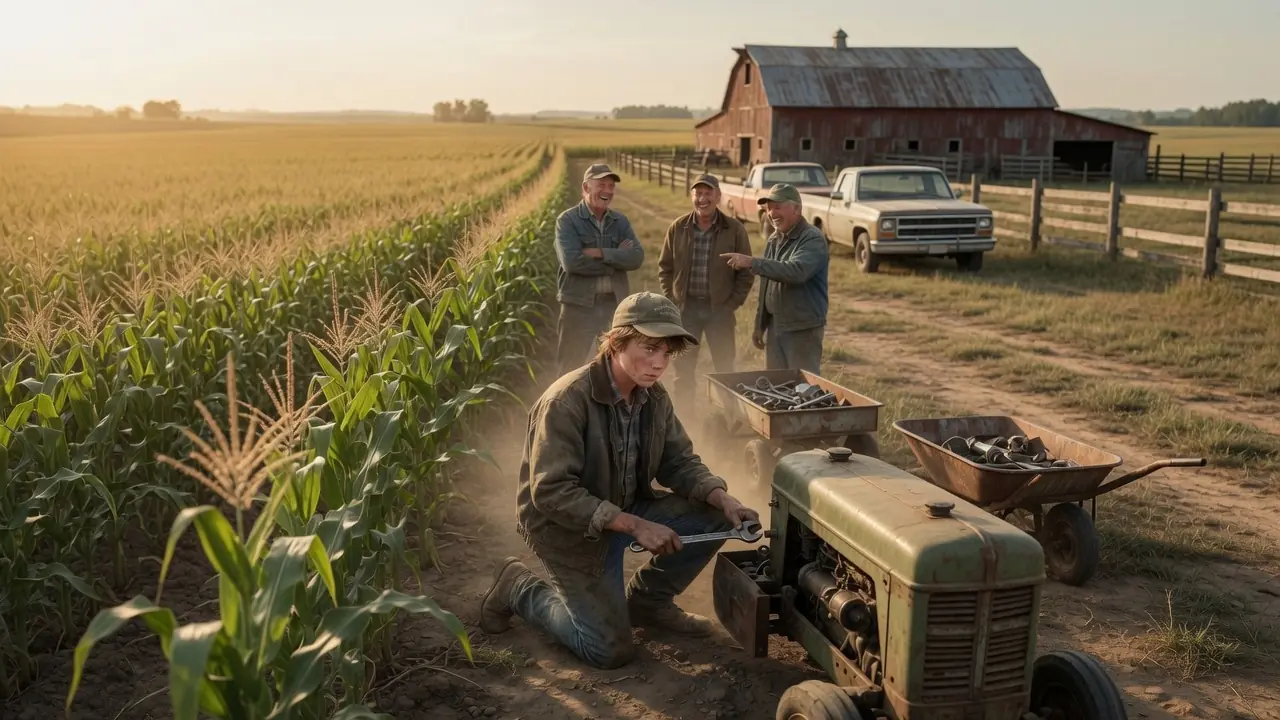
It appeared in the barn when a wrench fell and Caleb waited for his father to complain about where he had left it.
It appeared at supper when Ruth placed two plates on the table, then quietly returned one to the cupboard.
Caleb pressed his forehead against the steering wheel.
He allowed himself to cry for less than a minute.
Then he started the truck and drove home.
Ruth sat at the kitchen table with Daniel’s farm ledger open in front of her.
She looked at the box.
“You got it.”
“Yes.”
“What did Vernon say?”
“That I should sell.”
Ruth closed the ledger.
“To Whitmore?”
“Yes.”
“He wastes no time.”
“Do you think I can do this?”
Ruth looked through the window toward the fields.
“I think your father should be here.”
Caleb lowered his eyes.
“That was not my question.”
“No. But it is the truest answer.”
She removed her glasses.
“I think two hundred acres are too much for one fourteen-year-old.”
Caleb gripped the box.
Ruth continued before he could speak.
“I also think your father never farmed them entirely alone.”
“He did most of it.”
“Most is not all.”
“He ran the combine.”
“You hauled grain.”
“He repaired equipment.”
“Neighbors lent tools. I handled books before my hands became bad. Your mother helped before she left.”
Caleb looked away.
Ruth reached across the table.
“You believe saving the farm means proving you do not need anyone.”
“I do not want people thinking I am helpless.”
“Then do not be helpless.”
She tapped the cardboard box.
“But needing help and being helpless are not the same thing.”
Caleb carried the seal kit to the machinery shed.
The 4020 stood near the open door.
Daniel’s wrench remained on the floor where it had fallen on the day he died. Caleb had walked around it for eleven days.
He finally picked it up.
The fuel-injection pump had been leaking around the main shaft. Daniel’s service manual lay open on the workbench, covered in handwritten notes.
MARK PUMP POSITION BEFORE REMOVAL.
KEEP EVERYTHING CLEAN.
DO NOT FORCE SHAFT.
IF TIMING MOVES, START OVER.
Caleb read every instruction twice.
He disconnected the battery and cleaned the area around the pump. The first fitting loosened easily. The second refused to move.
Caleb pulled harder.
The wrench slipped.
His knuckles struck the engine block.
Pain moved through his hand.
He stepped backward and shouted a word Daniel had forbidden in the house.
The empty shed returned it as an echo.
For a moment, Caleb wanted to kick the toolbox.
Instead, he sat on an overturned bucket and waited until his breathing slowed.
Then he heated the fitting carefully and tried again.
It loosened.
By midnight, the pump was on the workbench.
Caleb replaced the seals, checked the shaft, and reinstalled the unit according to Daniel’s marks.
He bled the fuel lines.
Ruth appeared at the shed door carrying a flashlight.
“You have school in the morning.”
“I need to test it.”
“You also need to stay awake in algebra.”
“I can do both.”
“That is what your father said whenever he was about to make a poor decision.”
Caleb climbed onto the tractor.
He turned the key.
The engine rolled slowly.
Nothing.
He tried again.
White smoke came from the exhaust.
The engine failed to start.
Caleb checked the timing marks.
One had shifted.
He had installed the pump slightly out of position.
Ruth remained near the doorway.
Caleb expected her to say he had worked too quickly.
She said nothing.
He removed the pump again.
At one thirty in the morning, he reinstalled it correctly.
The 4020 started on the second attempt.
The diesel settled into a steady rhythm.
No fuel leaked.
Caleb climbed down.
He placed one hand on the hood and felt the engine vibration move through the metal.
For half a second, he could almost hear Daniel saying, “Do not celebrate until you check it twice.”
Caleb checked it twice.
The next problem was the combine.
Daniel owned a 1974 John Deere 4400 that had worked every harvest since before Caleb was born.
It had faded paint, a cracked seat, and a cab door that closed only when lifted slightly.
The machine still worked.
But not yet.
The starter needed rebuilding.
Two header guards were broken.
The clean-grain chain had stretched.
The separator bearing made a faint rough sound when spun by hand.
Daniel had left a list taped near the steering column.
STARTER BRUSHES.
REAR BEARING.
CHECK AUGER FLIGHTING.
REPLACE LEFT GATHERING CHAIN.
GREASE BEFORE STARTING. NOT AFTER.
Caleb began working each afternoon after school.
He drained the old fuel.
Removed mouse nests.
Repaired damaged wiring.
Rebuilt the starter using brushes Daniel had kept in a coffee tin.
On Friday, the combine started.
Black smoke rolled above the shed.
The separator turned.
The corn head moved.
Then the main drive belt began slapping against the guard.
Caleb shut everything down.
The tensioner spring had broken.
He called Green Valley John Deere.
The parts clerk answered.
“This is Caleb Turner. I need a tensioner spring for a 4400.”
“One moment.”
Vernon came onto the line.
“You got the tractor running?”
“Yes.”
“The pump sealed?”
“Yes.”
“What do you need?”
Caleb repeated the part number from Daniel’s manual.
Vernon typed something.
“Discontinued.”
“Do you have used parts?”
“Possibly.”
“How much?”
“I need to check.”
“When?”
“Tomorrow.”
“I need it today.”
“Caleb, it is nearly five.”
“The corn does not know that.”
Vernon became quiet.
“I will call you back.”
At six thirty, a dealership service truck entered the Turner driveway.
A young mechanic named Nathan Cole climbed out carrying a used spring and a drive belt.
Nathan was twenty-eight and had once worked summer harvests for Daniel.
“Vernon sent these.”
“I did not order the belt.”
“He said you would need it.”
“How much?”
Nathan handed him an invoice.
The price listed for both parts was twenty dollars.
“That is not the real price.”
“No.”
“I cannot take charity.”
Nathan looked toward the combine.
“Then call it scrap inventory.”
“It is not scrap.”
“Neither are you.”
They installed the spring and belt together.
Nathan did not perform the repair for him. He showed Caleb how to measure alignment and set tension.
When the combine started again, the belt tracked correctly.
Nathan listened to the separator.
“Bearing is rough.”
“I know.”
“You have a replacement?”
“Dad bought one last year.”
“Change it before harvest.”
“I will.”
Nathan looked across the standing corn.
“How much time do you have?”
“Three weeks.”
“For what?”
“Before the wind.”
Nathan smiled faintly.
“Then you had better stop talking to me.”
Harvest began Monday afternoon.
The school principal allowed Caleb to leave after lunch if he completed all assignments and maintained his grades.
He drove directly home, changed clothes, and entered the corn by two o’clock.
The first field covered forty acres.
The combine moved slowly.
Caleb filled the grain tank, stopped, drove the tractor and wagon into position, unloaded, then returned to the combine.
Every transfer took fifteen minutes.
By sunset, he had finished only seven acres.
The following afternoon, he harvested nine.
On Wednesday, the unloading chain jumped off.
Thursday, a gathering chain broke.
Friday, a wagon tire went flat halfway to the elevator.
At the end of the first week, twenty-nine acres were finished.
The bank officer came Saturday morning.
His name was Leonard Price.
He wore a brown suit and carried a folder beneath one arm.
Ruth invited him into the kitchen.
Caleb remained standing.
“The operating note is due December twentieth,” Leonard said.
“We know,” Ruth replied.
“The outstanding balance is thirty-four thousand dollars.”
“The crop will cover it.”
“If harvesting is completed.”
Caleb looked at him.
“It will be.”
Leonard did not laugh.
That made him more frightening than Vernon.
“How many acres have you harvested?”
“Twenty-nine.”
“How many remain?”
“One hundred and seventy-one.”
“The weather service is warning of high wind.”
“I heard.”
“The bank cannot extend the note without additional collateral.”
“We are not asking for an extension.”
“Not yet.”
Leonard placed a document on the table.
It was a voluntary-sale authorization.
“If the family chooses to market the farm before default, the bank can delay further action.”
Caleb looked at the purchaser named on the page.
Whitmore Agricultural Holdings.
“You already have a buyer.”
Leonard removed his glasses.
“Mr. Whitmore has expressed interest.”
“In our land.”
“In preventing a foreclosure loss.”
“For the bank or for us?”
Leonard closed the folder.
“The offer is valid for ten days.”
Caleb pushed the document back.
“The corn is not sold.”
Ruth watched Leonard leave.
Then she turned toward Caleb.
“What happens if the wind arrives before you finish?”
“I keep going.”
“What if the combine breaks?”
“I repair it.”
“What if you cannot?”
Caleb looked toward the fields.
“I find another way.”
The second week went better.
Nathan stopped after work and drove grain for three evenings.
A retired farmer named Walter Ames brought a second wagon.
One of Caleb’s teachers delivered sandwiches to the field.
Each person had a story about Daniel.
Daniel repaired Walter’s planter during a storm.
Daniel pulled Nathan’s truck from a ditch.
Daniel stayed overnight with Mrs. Collins’s cattle when her husband was hospitalized.
Caleb had never known the number of people his father helped.
Daniel never talked about it.
By the end of the second week, ninety acres were harvested.
The corn still stood.
Across the county, wind had already damaged several fields.
Charles Whitmore’s ground suffered the worst.
His corn had been planted at high population and pushed with heavy nitrogen. The stalks grew tall but shallow-rooted.
A storm flattened hundreds of acres.
Whitmore’s combines crawled through lodged corn, leaving ears behind.
Caleb’s rows leaned but did not fall.
Daniel had planted fewer seeds per acre.
He used less nitrogen.
He seeded cereal rye after soybeans and left residue between the rows.
The roots went deeper.
The ground held more moisture.
No one noticed those decisions in spring.
Now the field was the only one along County Road 6 still standing nearly straight.
Three weeks after telling Caleb he could not save the farm, Vernon Briggs drove out to see it.
He arrived shortly before noon.
Caleb had stopped the combine to grease the corn head.
Vernon stepped from his truck and looked across the unharvested field.
The stalks moved in the wind but remained upright.
“What did your father do here?”
Caleb continued pumping grease into the fitting.
“Planted corn.”
“You know what I mean.”
“Lower population. Rye cover. Less nitrogen. Shallow cultivation.”
Vernon walked between the rows.
He pulled one stalk.
The root system held.
He kicked aside residue and found cool soil beneath.
“Whitmore’s field is flat.”
“I heard.”
“Yours took the same wind.”
“Yes.”
Vernon looked toward the boy.
“I thought the corn would be down by now.”
“You told me it would.”
“I did.”
Caleb wiped the grease fitting.
“Is that why you came?”
“I wanted to see why I was wrong.”
Caleb closed the grease gun.
“My father said people usually come looking for a miracle after ignoring years of preparation.”
Vernon looked toward the combine.
“How many acres remain?”
“Seventy-eight.”
“How long?”
“Eight or nine days if nothing breaks.”
“The next storm arrives in four.”
“I know.”
“You cannot finish alone.”
Caleb said nothing.
Vernon stepped closer.
“You know that now, don’t you?”
“Yes.”
It was the first time Caleb admitted it aloud.
Vernon nodded.
“That answer may save you.”
The separator bearing failed that afternoon.
It began with a low vibration beneath the cab.
Caleb shut down immediately.
The bearing housing was hot.
When he removed the guard, metal dust had collected around the seal.
The replacement Daniel stored in the shed was the wrong size.
Caleb called every parts store within sixty miles.
No one had the bearing.
The earliest delivery was five days.
The storm would arrive in three.
Caleb sat on the combine tire as evening moved across the field.
For three weeks, he had repaired every failure.
This one stopped him.
He looked toward the standing corn.
Seventy-eight acres.
Enough grain to make the bank payment.
Enough grain to lose the farm if the wind flattened it.
For the first time, he spoke to his father as though Daniel could still hear.
“I cannot finish it.”
The words hurt.
But they were true.
Headlights appeared along the field lane.
Vernon’s service truck stopped beside the combine.
Nathan climbed out first.
Vernon followed carrying a bearing housing.
“Where did you get it?” Caleb asked.
“Trade-in machine behind the dealership.”
“Is it good?”
“Nathan measured it.”
Nathan nodded.
“Better than the one that failed.”
“How much?”
Vernon set it on the tire.
“Pay us after harvest.”
Caleb shook his head.
“I do not take free parts.”
“It is not free.”
“What is the price?”
Vernon looked across the field.
“Tomorrow morning, you tell us where to begin.”
Caleb frowned.
“Tell who?”
At six the following morning, engines approached from the county road.
One combine entered the driveway.
Then another.
A third followed.
Six tractors pulled grain wagons behind them. Four trucks lined up near the barn.
More than twenty farmers gathered in the yard.
Some came from operations damaged by the same storm.
Nathan arrived in the dealership service truck.
Walter Ames carried a thermos.
Caleb’s principal stood beside his pickup.
Even Leonard Price from the bank arrived, though he kept his distance near the road.
Charles Whitmore did not come.
His son, Ryan, did.
Caleb stared at him.
“My father will be furious,” Ryan said.
“Then why are you here?”
“Daniel saved my life.”
Caleb had never heard the story.
Ryan explained that three years earlier, he entered a grain bin while the unloading auger was running. Corn collapsed around his legs.
Daniel shut down the system, cut through the side of the bin, and pulled him free.
“My father and yours never agreed about land,” Ryan said. “That does not change what I owe.”
Vernon unfolded a field map.
“You know the farm.”
The farmers turned toward Caleb.
He suddenly understood they expected him to lead.
His voice felt too small.
But he began.
“West field first. There is a washout near the north fence. Stay east of the orange stake. Unload at the center lane. The bottom twenty acres are soft near the creek.”
Men nodded.
Caleb assigned wagons and trucks.
Set radio channels.
Placed Nathan near the service truck.
At six twenty-five, the combines entered the corn.
Rows disappeared.
Grain tanks filled.
Wagons moved continuously toward the elevator.
Caleb operated the old 4400.
Daniel’s work gloves rested beside the controls.
By noon, thirty-eight acres were finished.
The wind increased.
Clouds gathered in the west.
One combine broke a gathering chain.
Nathan repaired it in twenty minutes.
A truck lost a fan belt.
Vernon drove to the dealership and returned with two.
At three thirty, the weather radio announced the storm had accelerated.
Thirty-five acres remained.
The crews tightened their spacing.
Dust rolled across the field.
At four twenty, the first strong gust bent the outer rows.
Several stalks snapped.
Caleb watched the temperature gauge.
The old combine ran steadily.
Twenty acres.
Then twelve.
Rain appeared as a gray wall on the western horizon.
At five forty, only five acres remained.
The three combines entered the final rows together.
Caleb looked toward the northern fence.
Daniel had planted those rows in May.
He had checked the depth.
Adjusted the planter.
Measured the seed spacing.
The field had survived because of work completed months before anyone knew it would matter.
At five fifty-three, the final ears entered the header.
Caleb reached the end row and disengaged the machine.
The engine idled beneath him.
Rain struck the windshield.
Every acre was harvested.
Caleb shut off the combine.
For several seconds, he sat alone inside the cab.
He had imagined finishing would feel like victory.
Instead, grief struck harder than it had at the funeral.
Daniel should have been standing near the wagon.
He should have been complaining about grain loss.
He should have been there.
Caleb placed both hands over his face.
When he climbed down, the farmers were waiting.
No one cheered immediately.
Ruth crossed the muddy field using her cane.
Caleb met her halfway.
“We finished,” he said.
She placed one hand against his cheek.
“You finished your part.”
He looked toward the men and machines.
Ruth continued.
“Your father finished his part before he left.”
Vernon approached.
Rain darkened his shirt.
“I owe you an apology.”
Caleb looked at him.
“You already brought a bearing.”
“That was not the apology.”
The farmers became quiet.
Vernon removed his cap.
“Three weeks ago, Caleb walked into my dealership for a part his father had paid for.”
He looked around.
“I told him he could not save this farm.”
Caleb lowered his eyes.
“I saw his age, the debt, the broken equipment, and the man who was no longer here.”
Vernon looked toward the harvested field.
“I did not see what Daniel had already built.”
He pointed toward the standing rows near the boundary.
“Deep roots. Healthy soil. Maintained machinery. And a lifetime of helping people who came back when his son needed them.”
Vernon turned toward Caleb.
“I was wrong.”
Caleb nodded.
“So was I.”
Vernon frowned.
“About what?”
“I thought saving the farm meant doing everything Dad did.”
Ruth smiled faintly.
Caleb looked at the farmers.
“He never did everything alone.”
The crop yield exceeded expectations.
The corn averaged one hundred and sixty-nine bushels per acre. The beans produced forty-eight.
After storage, drying, and expenses, the harvest generated enough to pay the operating note.
The margin was narrow.
But it was enough.
The farm survived the year.
Then Leonard Price returned with a document Daniel had never shown Caleb.
Two years earlier, Daniel purchased a life-insurance policy tied directly to the remaining mortgage.
The policy paid nearly the entire land balance.
Ruth stared at Daniel’s signature.
“When did he arrange this?”
Leonard hesitated.
“After a medical examination.”
Caleb looked up.
“What examination?”
Daniel had experienced chest pain during the previous winter.
A doctor recommended further testing.
Daniel postponed it until after planting.
Then spraying.
Then harvest.
The testing never happened.
Caleb stood from the kitchen table.
“He knew something was wrong.”
“He knew it was possible,” Ruth said.
“He taught me not to ignore warning signs.”
Her eyes filled.
“Your father listened better to tractors than to his own body.”
Caleb walked outside.
He entered the machinery shed and stood beside the 4020.
Daniel’s coat still hung from the nail.
Caleb reached for it.
Something inside the pocket made a paper sound.
He removed a folded envelope.
CALEB was written across the front.
Inside was a letter.
Son,
If you are reading this before I remember to hand it to you, then I waited too long again.
Do not keep the farm because you think it belongs to me.
I was only its caretaker for a while.
Farm it if you love the work.
Sell it if you do not.
No piece of land is worth becoming trapped inside a promise made to a dead man.
But if you choose to stay, remember this.
A farm is not saved during harvest.
It is saved every season before harvest.
It is saved when you build soil no one can see.
When you repair the small sound before it becomes a large failure.
When you help a neighbor without keeping score.
When you ask for help before pride takes everything.
No farmer works alone.
I did not.
Neither will you.
Dad
Caleb read the letter twice.
Then he sat on the same bucket Daniel once used while repairing machinery.
For weeks, Caleb believed his father had left him an impossible job.
Now he understood Daniel had left instructions for a life.
The farm entered winter almost debt-free.
Caleb returned to school full-time.
He worked afternoons and weekends but no longer tried to become an adult before he was ready.
Vernon arranged for him to train at the dealership service department on Saturdays.
On his first morning, Caleb crossed the showroom wearing Daniel’s oversized boots.
Vernon looked down at them.
“Those still do not fit.”
“They fit better.”
“You know we sell boots.”
“I know.”
“Why keep wearing those?”
Caleb looked toward the service bay.
“Because I am still learning what belongs in them.”
Years passed.
Caleb finished school and studied agricultural mechanics at a community college.
He returned to the farm.
He improved drainage, expanded the cover-crop rotation, and rebuilt the old combine one system at a time.
He did not purchase thousands of acres.
The farm remained two hundred.
That was enough.
Charles Whitmore never acquired the irrigation pond.
His son Ryan eventually took over the neighboring operation and ended the long dispute between the families.
Vernon retired when Caleb was thirty-three.
At the retirement dinner, he told the story of the boy who entered his dealership carrying a paid receipt and more responsibility than anyone his age should have known.
“I told him the corn would be flat in three weeks,” Vernon said.
He looked toward Caleb.
“Three weeks later, I drove out because every field around his was falling, and his was still standing.”
Vernon paused.
“I went looking for a farming trick.”
The room became quiet.
“What I found was a father’s work continuing after his death.”
Caleb never allowed anyone to tell the story as though he harvested two hundred acres by himself.
“I drove one combine,” he always said. “The county harvested the farm.”
When people asked why so many farmers came, he pointed toward Daniel’s letter.
“My father spent twenty-five years showing up before anyone asked.”
Daniel’s boots eventually became too small.
Caleb cleaned them and placed them above the workbench beside the service manual.
He did not keep them because he had become his father.
He had not.
No son does.
He kept them because they reminded him of the fourteen-year-old boy who believed strength meant filling a dead man’s place.
The farm survived because Caleb learned something else.
A good father does not leave an empty place behind.
He leaves roots.
Knowledge.
Relationships.
And work strong enough to continue after he is gone.
Vernon Briggs drove to the Turner farm expecting to see corn on the ground.
Instead, he found every row still standing.
He thought the explanation would be hidden inside a tractor, a seed variety, or a fertilizer decision.
Part of it was.
But the deepest roots were not beneath the corn.
They were inside the boy.
And inside every person Daniel Turner had helped before his son ever needed them.