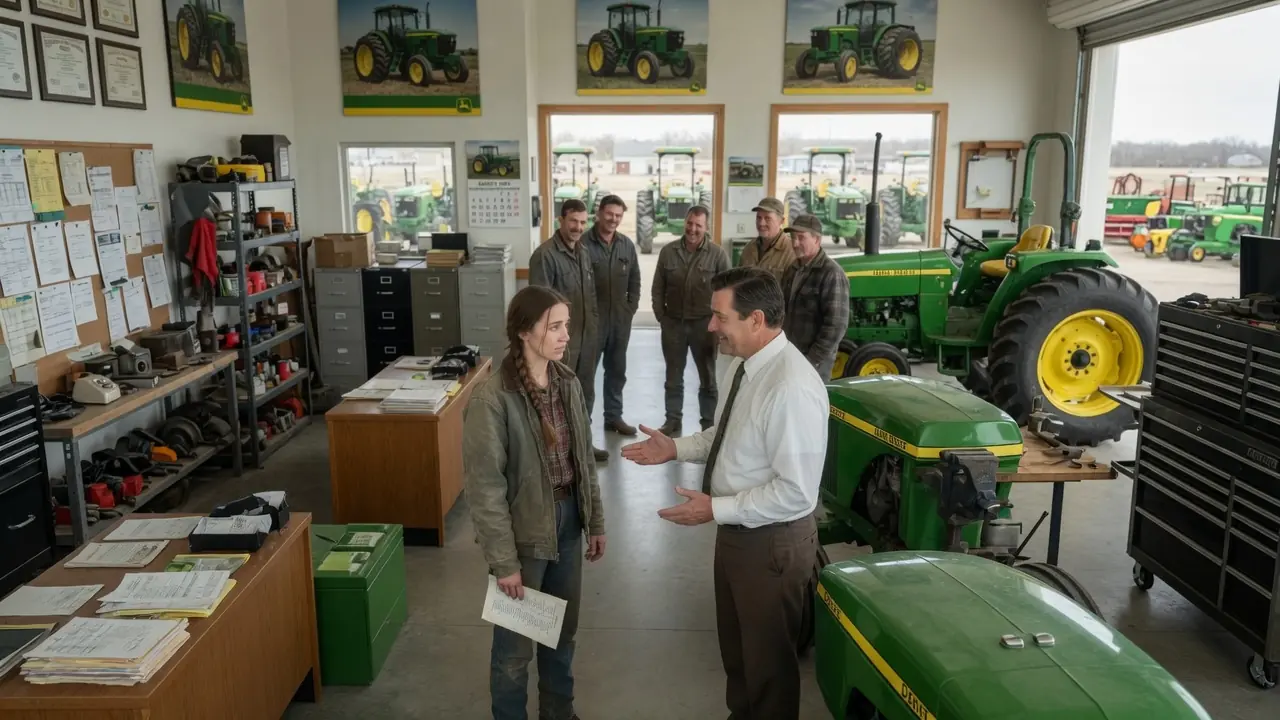
In March of 1963, three days after burying her father, twenty-year-old Margaret Holcomb walked into Dennison’s John Deere dealership in Russell, Kansas, and asked to see the used tractors.
Roy Dennison looked up from behind his desk.
He saw a young woman wearing a man’s work jacket that hung past her wrists. He saw dust on her boots, grease beneath her fingernails, and exhaustion in her face.
Then he laughed.
It was not a private chuckle.
It was the kind of laugh meant to travel.
Men near the parts counter turned to see what had amused him. A mechanic paused beside the service door. Even the secretary glanced up from her typewriter.
Margaret stood still until the laughter ended.
Roy leaned back in his chair.
“Can I help you, sweetheart?”
“I need a tractor.”
That answer only seemed to amuse him more.
“What for?”
“To farm.”
Roy studied her as if she had misunderstood the question.
Margaret’s father, Frank Holcomb, had collapsed in the barn the previous Friday morning. A massive stroke took him before the ambulance reached the county hospital.
He had been fifty-one.
For twenty-six years, Frank had farmed two hundred and forty acres of dryland wheat and grain sorghum west of Russell. He was a quiet man who believed bills should be paid before anything unnecessary was purchased.
Margaret’s mother had died of pneumonia when Margaret was eight. After that, Frank raised his daughter alone.
He never treated her as though farm work belonged only to men.
At twelve, he taught her to drive the tractor.
At fourteen, he showed her how to weld.
By sixteen, she could rebuild a carburetor, replace bearings, set a plow, and tell from the smell of freshly turned earth whether a field had held enough winter moisture.
Frank often said soil had a language.
Most people simply never stayed quiet long enough to hear it.
Now he was gone.
And the only tractor on the Holcomb farm, a 1951 Farmall M, had thrown its crankshaft two months earlier.
Frank had intended to rebuild it before spring planting.
He never got the chance.
Margaret had inherited the land, the farmhouse, the damaged tractor, and a season that would not wait for grief.
Roy Dennison knew all of that.
“I heard about Frank,” he said, letting his smile fade just enough to resemble sympathy. “He was a good customer.”
“Thank you.”
“So what are you planning to do with the farm?”
“Run it.”
“By yourself?”
“Yes.”
Roy rested both elbows on the desk.
“Margaret, your father worked himself nearly to death on that place. Two hundred and forty acres is not a little garden. It’s a full operation.”
“I know how many acres it is.”
“You’re twenty.”
“I know that too.”
One of the men near the counter smiled.
Roy continued as though she had not spoken.
“Harold Brewer has been adding ground. He might lease it from you. Or you could sell while land values are still decent.”
“I’m not selling.”
“You should at least think about it.”
“I have.”
Roy rose and walked around the desk.
He wore a pressed white shirt, a dark tie, and shoes that had never stood in a muddy wheat field. His hands were clean, the nails neatly trimmed.
He placed one hand on Margaret’s shoulder.
“You’re a pretty young woman. Buy a house in town. Find a good husband. Let him worry about tractors and harvests.”
Margaret stepped backward until his hand fell away.
“My father did not spend his life building that farm so I could sell it four days after his funeral.”
Roy’s expression hardened slightly.
“Sentiment does not make bank payments.”
“Neither does standing here.”
He sighed.
“All right. You asked about tractors.”
He led her toward the showroom floor, where a green 1958 John Deere 730 stood polished beneath the fluorescent lights.
“Twelve thousand dollars,” he said. “Ten percent down. Seven years at nine percent. Your payment would be about one hundred sixty dollars a month.”
Margaret calculated the numbers without needing paper.
Nearly two thousand dollars each year.
Almost fifteen thousand dollars before the loan was finished.
More than three thousand in interest.
“I can’t spend that.”
“That is what a dependable tractor costs.”
“I need a machine that works. I don’t need seven years of payments.”
Roy folded his arms.
“Farming requires capital.”
“I’m not trying to build the biggest operation in the county. I’m trying to plant my fields.”
“You cannot survive with worn-out machinery.”
“My father did.”
“And what did that leave you?”
The question struck harder than Roy seemed to realize.
He looked toward the showroom windows.
“Frank was stubborn. He refused to modernize, refused to expand, refused to borrow when he should have. Now you have old equipment, a leaking roof, and more work than one person can handle.”
Margaret looked at him for a long moment.
“My father left me land that is paid for.”
“That land will eat every dollar you have.”
“He also left me what he knew.”
Roy shook his head.
“Knowledge does not pull a plow.”
Margaret turned toward the door.
Before leaving, she looked back.
“People who tell you what you cannot do are usually the ones most afraid you might prove them wrong.”
She stepped outside.
Behind her, Roy spoke to the mechanic near the service entrance.
He did not bother lowering his voice enough.
“Little girl’s going to ruin herself.”
Margaret continued toward her pickup.
But she remembered those two words.
Little girl.
Two weeks later, she heard about an estate auction forty miles east in Ellsworth County.
The listing mentioned old tools, field equipment, and two Farmall tractors.
Margaret had eleven hundred dollars.
It was every dollar she possessed.
Some came from summers working at the grain elevator. The rest came from a coffee can Frank had hidden behind spare fan belts in the workshop.
On Saturday morning, she drove to Ellsworth with the cash folded inside her father’s wallet.
The auction attracted fewer than thirty people.
Most had come for implements or parts. The tractors stood near the back of the property, their red paint faded almost brown beneath dust and sunlight.
One was a 1949 Farmall M.
The other was a 1953 Super M.
Neither was beautiful.
Both were familiar.
Margaret had grown up around the same engines, gearboxes, and hydraulic systems. She knew how they sounded when healthy and where they usually failed.
The auctioneer began with the older machine.
“Who’ll give me one thousand?”
No response.
“Eight hundred?”
Silence.
“Five hundred?”
Margaret raised her hand.
A man near the barn turned to look at her but did not bid.
The auctioneer dropped the number.
“Four hundred?”
Margaret nodded.
“Sold.”
The Super M came next.
Margaret opened at five hundred.
A man wearing a seed-company cap offered five-fifty.
Margaret raised him to six hundred.
He looked at the tractor, then at her, and shrugged.
The auctioneer brought down his gavel.
Two tractors.
One thousand dollars.
Margaret had one hundred left.
An older farmer approached while she examined the tires.
His name was Tom Weber. He farmed near Ellsworth and had spent the auction watching her.
“Those machines need work,” he said.
“I know.”
“You know Farmalls?”
“My father owned an M. I rebuilt most of its engine before I turned eighteen.”
Tom looked at her again.
This time, he did not see a young woman who had made an impulsive purchase.
He saw another farmer.
“Then your father taught you properly.”
“He did.”
Tom placed one hand on the Super M’s hood.
“These are still solid. People stopped noticing them because the paint got old.”
Margaret nodded.
“Paint never planted a field.”
A faint smile crossed his face.
“You’ll do all right.”
A neighbor helped her borrow a flatbed.
By evening, both tractors were sitting beside Frank’s workshop.
The M needed a clutch, hydraulic seals, and a new set of battery cables.
The Super M required a fuel-pump rebuild, rewiring, and work on the charging system.
Margaret spent the next three weeks inside the workshop.
The room still smelled like her father.
Oil.
Sawdust.
Steel.
Coffee that had soaked into the edge of the workbench after years of mornings begun before sunrise.
His tools remained exactly where he had placed them.
Margaret followed his repair notes line by line.
She dismantled the clutch assembly, cleaned each component, replaced what could not be saved, and reused what could.
She rebuilt the fuel pump on a clean cloth at the kitchen table after midnight.
She tested the wiring with an old meter whose glass face had cracked years earlier.
By the middle of April, both tractors were running.
The 1949 M started with a deep, steady rhythm.
The Super M smoked during its first few minutes, then cleared.
Margaret stood between them in the yard, listening.
They were not new.
They were hers.
That first farming year nearly defeated her.
Frank had already planted one hundred and twenty acres of winter wheat before his death. Margaret put the remaining ground into grain sorghum.
She worked alone.
Plowing.
Planting.
Cultivating.
Repairing.
She woke before dawn and often stopped only when darkness made it impossible to see the equipment clearly.
The neighbors watched.
Some admired her quietly.
Others spoke in feed stores and cafés.
“She’ll work herself sick.”
“Someone needs to talk sense into her.”
“She might finish planting, but she’ll never bring in harvest alone.”
Roy Dennison heard the same talk.
In June, he drove to the Holcomb farm and found Margaret beneath the Super M replacing a leaking hydraulic line.
She saw his polished shoes first.
Then his shadow crossed the concrete.
“Margaret?”
She slid from beneath the tractor.
Grease marked one cheek. A wrench remained in her hand.
“What do you need, Mr. Dennison?”
“I didn’t come to sell you anything.”
“That’s surprising.”
“I came because I knew Frank.”
Margaret waited.
“People are concerned.”
“People are talking. That isn’t the same thing.”
Roy glanced toward both Farmalls.
“These machines are old.”
“So am I supposed to stop using them because the paint faded?”
“They will break at the worst possible time.”
“All machines do that eventually.”
“Parts will become difficult to find.”
“I can rebuild most of what fails.”
“You say that now.”
Roy looked at the workshop, then toward the fields.
“Your father thought his tractor would keep running too. Then it threw a crankshaft.”
The remark landed exactly where he intended.
Margaret felt it in her chest.
She tightened her hand around the wrench but kept her voice calm.
“My father’s tractor worked more hours than either of these has seen.”
“That doesn’t change what happened.”
“No. But it changes what the lesson means.”
Roy shook his head.
“I hope you know what you are doing.”
“I know enough to continue.”
He drove away.
Margaret returned beneath the tractor.
For several minutes, her hands trembled too much to fit the replacement line.
She hated Roy for noticing the fear she worked so hard to hide.
But by sunset, the Super M was operating again.
Harvest arrived in September.
The wheat averaged twenty-eight bushels per acre.
It was not an exceptional yield, but it was respectable for dryland Kansas during a lean year.
The sorghum did well enough.
Margaret sold the grain, paid the property taxes, set aside money for fuel and seed, and finished the season with forty-two hundred dollars in the bank.
To people who had predicted failure, it looked like victory.
To Margaret, it looked like one narrow season between survival and ruin.
One drought could erase it.
One engine failure could consume it.
One accident could leave the farm with no one to run it.
After harvest, the fields became empty.
The days shortened.
Cold wind crossed the plains without anything to slow it.
For the first time since Frank’s death, Margaret had no immediate task large enough to drown the silence inside the farmhouse.
One November evening, she sat at the kitchen table with her bank statement and a sharpened pencil.
Four thousand two hundred dollars.
Everything she had.
Roy’s words returned.
Sell the farm.
Move into town.
Find an easier life.
The following morning, Margaret drove to Russell.
She told herself she needed feed supplies.
Instead, she parked across the road from Dennison’s dealership.
Through the showroom windows, she watched farmers enter and leave.
Men with new hats.
Men discussing financing.
Men who belonged inside that building in ways she never had.
Margaret rested one hand on the truck door.
All she had to do was cross the street.
Tell Roy she had reconsidered.
Ask him to help find a tenant.
Lease the land and collect rent.
Take work at the grain elevator.
Sleep without wondering whether a hailstorm or broken bearing might destroy the next year.
Her fingers closed around the handle.
Then she noticed her reflection in the side mirror.
Frank’s oversized jacket.
Her face beneath his old cap.
Hands marked with the same small cuts and calluses she remembered on his.
She thought about him driving through thirty Kansas summers in a Farmall with no air conditioning and dust gathering in the folds of his shirt.
She remembered how he washed at the kitchen sink and looked through the window toward his fields.
Not because the work was easy.
Because it belonged to him.
Margaret released the door handle.
She drove home.
For forty-five years, she told no one about that morning.
Much later, sitting at the same kitchen table, she finally explained it.
“Everyone thinks I kept the farm because I never doubted myself,” she said. “That isn’t true. For the first five years, I doubted myself almost every day.”
Then she smiled faintly.
“The difference between quitting and continuing was never confidence. It was driving home and doing the next job anyway.”
That winter, Margaret decided to organize Frank’s workshop properly.
She emptied drawers, sorted receipts, cleaned shelves, and opened boxes she had avoided since his death.
At the bottom of his workbench, beneath old seed invoices and repair bills, she found a brown leather journal.
Frank’s handwriting filled every page.
It was not a diary.
It was a record of the soil.
For twenty-three years, he had documented every field.
Rainfall.
Soil temperature.
Worm counts.
Organic matter.
Crop yields.
Moisture depth.
Cover crops.
He had drawn diagrams showing a seven-year rotation of wheat, sorghum, fallow periods, rye, and clover.
Margaret knew her father planted cover crops.
She had helped spread the seed.
Neighbors called it wasteful.
Why plant something that would never be harvested or sold?
Frank never argued.
The journal revealed his answer.
He had been building the farm beneath the surface.
The rye protected the soil from wind.
The clover added nitrogen.
The roots broke hard ground and left channels for water.
Rotations reduced disease.
Fallow years preserved moisture.
While neighboring farms pulled nutrients from their land season after season, Frank quietly returned something.
His wheat did not always produce the largest harvest.
His ground became stronger each year.
On the final page, Margaret found a note written in a shakier hand.
Maggie,
If you are reading this, I hope you kept the farm.
The land is better than it looks.
I have been building it for you.
Do not let anyone tell you it is only dirt.
It is twenty-three years of work, and it is ready.
Trust the soil.
It will not let you down.
Margaret sat on the workshop floor and cried until the winter light disappeared from the windows.
Then she carried the journal to the kitchen.
She began studying.
For the next seventeen years, she farmed the Holcomb ground with the same two tractors she had purchased for one thousand dollars.
She followed Frank’s rotation.
Each fall, she planted cover crops into the stubble.
The neighbors continued laughing for a while.
Then the yields began speaking for her.
By the early 1970s, Margaret’s wheat routinely outperformed the county average by ten to fifteen percent.
During dry seasons, her sorghum suffered less because her soil held moisture longer.
The drought of 1974 devastated Russell County.
Some farmers harvested almost nothing.
The county average for wheat fell near eleven bushels per acre.
Margaret’s fields produced twenty-two.
People noticed.
They did not yet respect her methods.
They were confused by them.
How could a woman using old Farmalls and spending less on fertilizer outperform operations with new machinery and larger budgets?
The answer lay beneath their feet.
But almost no one asked Margaret.
Roy Dennison’s dealership prospered during those years.
Agriculture was expanding.
Commodity prices were strong.
Farmers bought larger tractors, more land, and new combines. Banks encouraged borrowing. Equipment dealers encouraged growth.
Roy visited Margaret nearly every year.
The conversation rarely changed.
“Those tractors still running?”
“Every day.”
“You know I don’t even come to sell anymore.”
“Then why do you come?”
“Curiosity.”
“They’re maintained.”
“They’re more than twenty years old.”
“So are some of your customers.”
Roy would laugh, look around the farm, and shake his head.
“I don’t understand how you keep them alive.”
“The same way I keep the soil alive. I put something back before everything is gone.”
By 1980, Margaret had ninety-two thousand dollars in savings.
She had no mortgage.
No equipment loan.
No operating debt.
Her two hundred and forty acres were hers completely.
Around her, other farmers had expanded.
New tractors were financed at double-digit rates.
Land had been purchased near the peak of the market.
Equipment loans sat on top of operating loans, which sat on top of mortgages.
The good years made every risk appear intelligent.
Margaret read farm magazines and listened to economists explain that leverage was the path to growth.
Then she remembered a sentence Frank had written beside a soil record in 1958.
The soil gives back what you put into it.
Debt takes back more than you borrowed.
Every time.
In 1981, the world around her began collapsing.
Interest rates climbed above twenty percent.
Grain prices dropped.
Land values fell.
Farmers who had borrowed to expand discovered that they owed more than their land and equipment were worth.
Russell County filled with auction signs.
Between 1982 and 1987, forty-three farms entered foreclosure.
Families who had survived drought, dust, war, and generations of hard harvests were destroyed by debt.
Dennison’s dealership began to fail.
Roy had helped finance millions of dollars in equipment during the boom.
Now farmers could not make the payments.
Returned machines filled the rear lot.
The showroom that once displayed rows of new John Deere tractors grew empty.
Margaret watched neighbors lose their farms one by one.
Harold Brewer, the man Roy once suggested she lease her land to, lost six hundred acres in 1984.
Gene Whitfield lost his farm the following year after the interest rate on his combine loan rose beyond what he could pay.
Margaret attended the auctions.
Never to celebrate.
She went because she remembered Tom Weber at Ellsworth, the first man outside her family who had looked at her as a farmer rather than a girl pretending to be one.
She also went because careful years had given her the ability to help without risking the farm Frank left her.
In 1983, she purchased one hundred and sixty acres of Brewer’s land for sixty-eight thousand dollars.
Cash.
In 1985, she bought eighty acres from the Whitfield property for thirty-one thousand.
Cash again.
In 1987, she acquired another one hundred and twenty acres at an estate auction for fifty-four thousand.
By 1988, Margaret Holcomb owned six hundred acres.
Every acre was paid for.
She owed no bank.
She signed no payment book.
She was forty-five years old and controlled more land than any individual farmer in her part of Russell County.
But the conversation that mattered most occurred two years earlier.
In October of 1986, Dennison’s John Deere dealership closed.
The bank called Roy’s loans.
The inventory was marked for liquidation.
Thirty-four years of business ended in one morning.
That evening, Margaret was replacing the water pump on the Super M when a pickup entered her yard.
Roy sat behind the wheel after the engine stopped.
He stared through the windshield without moving.
Margaret wiped her hands and walked outside.
“Roy?”
No answer.
She stood beside the open window.
“Are you all right?”
He turned toward her.
His eyes were red.
He looked older than he had a month earlier.
“The dealership closed today.”
“I heard.”
“I spent the whole afternoon watching strangers put prices on everything.”
Margaret lowered her eyes.
“I’m sorry.”
Roy laughed once.
It was a tired, broken sound.
“You’re sorry?”
“Yes.”
“I laughed at you. Told you to sell the farm. Told you to find a husband. Called you a little girl.”
“I remember.”
“And now you’re sorry for me.”
“Losing something you built hurts, even when you made mistakes building it.”
Roy looked toward her fields.
“How much land do you own now?”
“Six hundred acres.”
“All paid for?”
“Yes.”
He closed his eyes briefly.
“I pushed debt on farmers for twenty years.”
“You sold machinery.”
“I sold more than machinery. I sold the idea that old was failure. That smaller meant falling behind. I told men they needed bigger equipment, more ground, more debt.”
“No one forced them to sign.”
“No. But I made it sound safe.”
Roy looked toward the workshop, where both old Farmalls remained.
“I laughed at the one farmer who understood what was coming.”
“I didn’t know what was coming.”
“You were prepared anyway.”
“My father taught me to make decisions that would survive a bad year, not only decisions that worked during a good one.”
Roy nodded slowly.
“Frank was the smartest farmer I ever knew.”
“He would have appreciated hearing that.”
Roy looked at her.
“And I owe you an apology.”
Margaret waited.
“I was wrong when you walked into my dealership. I was wrong every year I came out here and told you those tractors would fail. I was wrong when I believed new equipment made someone a better farmer.”
He swallowed.
“You were doing it correctly from the beginning.”
Margaret leaned against the truck.
“I was not correct about everything.”
“You were correct about enough.”
“I was careful.”
“Maybe that was the thing the rest of us stopped respecting.”
For a while, neither spoke.
Then Roy nodded toward the workshop.
“Are those Farmalls truly still running?”
“Every day.”
He shook his head.
“One thousand dollars for two tractors.”
“The clutch cost extra.”
For the first time that evening, Roy smiled.
“Best equipment purchase anyone in this county ever made.”
He started his truck and drove away.
Margaret watched the taillights disappear along the road.
She felt no victory.
Only sadness.
Roy Dennison was not an evil man.
He had believed the promises of an industry that profited whenever farmers confused expansion with survival.
Margaret continued farming until 2008.
Forty-five years.
Over time, she increased the operation to eight hundred and forty acres.
She purchased every parcel with cash.
She never carried a mortgage.
She never bought a new tractor.
Every machine came from an estate sale or farm auction and was rebuilt inside Frank’s workshop.
The 1949 Farmall M worked until 1991.
Forty-two years after it left the factory.
Margaret cleaned it, drained the fuel, and parked it inside the barn.
The tractor remains there today.
The 1953 Super M worked until 2004.
Margaret rebuilt its engine three times.
When she finally parked it, she sat in the driver’s seat for nearly an hour.
She cried in the private way one cries after saying goodbye to an old companion who had carried every burden without asking for praise.
Frank’s soil journal remained at the center of every decision.
Margaret followed his rotations, adjusted them, and continued recording what she observed.
When university scientists tested the Holcomb fields in 2002, they found topsoil approaching seven inches in places where neighboring fields averaged closer to four.
Organic matter measured nearly three times the regional average.
The researchers asked what special treatment Margaret used.
She placed one hand on Frank’s old journal.
“I listened to my father.”
When she retired, Margaret leased the farm to a young couple who had spent years working as hired labor on a corporate operation.
She offered fair rent.
A long-term agreement.
The first opportunity to purchase the land if she ever sold.
Then she handed them Frank’s journal.
“Take care of the soil,” she said. “Everything else begins there.”
Roy Dennison died in 2001 at the age of eighty-four.
Margaret attended the funeral.
She sat near the back and left quietly after the service.
Roy’s son caught her near the church door.
“You’re Margaret Holcomb?”
“Yes.”
“My father talked about you during his last years.”
Margaret waited.
“He said you were the best farmer he ever knew and the worst customer he ever had.”
Margaret smiled.
“That may be the kindest thing anyone has ever said about me.”
Today, Margaret still lives in the farmhouse Frank built.
The roof no longer leaks.
She repaired it herself in 1978.
Some evenings, she opens her father’s soil journal and reads his notes the way another person might read old letters.
She runs her fingers over the uneven block handwriting and remembers what he truly left her.
Not only land.
Not only machinery.
Not only knowledge.
He left her the belief that a twenty-year-old woman with eleven hundred dollars, two worn tractors, and no one’s permission could build something lasting.
The John Deere dealer told her to sell.
He told her to find a husband.
He said the farm was too much for her and the old Farmalls were waiting to fail.
Twenty years later, Margaret owned six hundred acres without debt.
The dealership was gone.
The tractors remained.
But Margaret never considered that revenge.
To her, the story was always about the ground.
“My father spent twenty-three years improving that soil,” she once explained. “Every season, he returned more than he removed. When the farm crisis came, the land remembered.”
Then she paused and looked through the window toward the wheat fields.
“That isn’t luck. It is arithmetic.”
The same lesson shaped her machinery, her savings, and her life.
Maintenance returned reliability.
Restraint returned freedom.
Patience returned choices.
And knowledge returned power no banker, salesman, or doubting neighbor could take from her.
The dealer had seen a little girl in an oversized jacket.
The land had seen Frank Holcomb’s daughter.
And in the end, the land was the better judge.