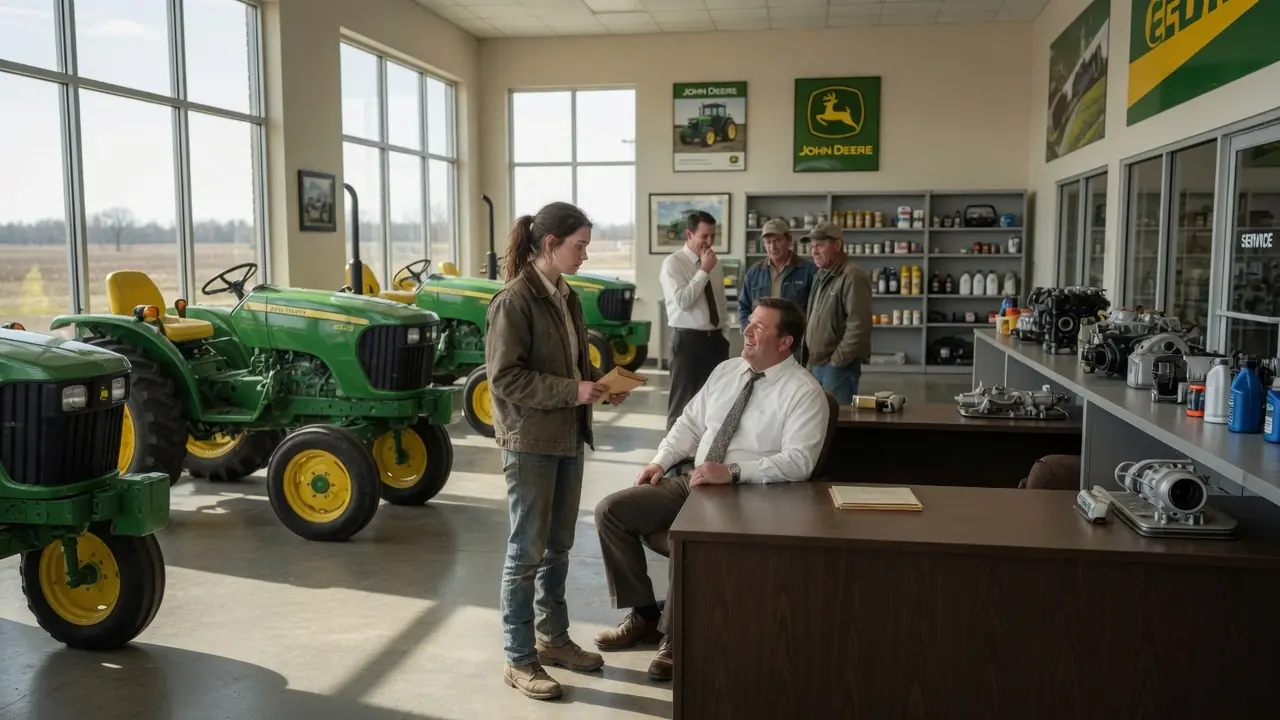
On a cold Tuesday afternoon in March of 1963, twenty-year-old Clara Bennett walked into Whitaker John Deere in Russell, Kansas, and asked to see the used tractors.
The showroom fell quiet before anyone said a word.
Clara was five feet four inches tall. She wore her father’s brown work jacket, which hung past her wrists, mud-stained boots, and jeans faded white at the knees. There was grease beneath her fingernails and a bruise across one knuckle from trying to free a seized bolt the night before.
She had not slept properly in four days.
Her father, Samuel Bennett, had collapsed in the barn the previous Friday morning. A massive stroke took him before the ambulance reached the county hospital.
He was fifty-two.
Samuel had farmed two hundred forty acres of dryland wheat and grain sorghum west of Russell for almost twenty-seven years. He was a quiet man who spoke more easily about rainfall than feelings and who believed a debt should be treated like a fire near dry grass—small enough to manage at first, dangerous if ignored.
Clara’s mother died of pneumonia when Clara was nine.
After that, Samuel raised her alone.
He taught her to drive a tractor before her feet reached the pedals comfortably. He taught her to weld with an oversized helmet balanced on her head. He taught her to listen to machinery before taking it apart and to read soil slowly, pressing it between her fingers and asking what it lacked instead of demanding what she wanted from it.
Now Samuel was gone.
The farm remained.
So did the property taxes, seed bill, leaking roof, and broken tractor sitting in the workshop.
Samuel’s only machine, a 1950 Farmall M, had thrown a crankshaft in January. He intended to rebuild it before planting season.
He never got the chance.
Clara had less than six weeks before fieldwork needed to begin.
That was why she entered Whitaker John Deere.
Harold Whitaker looked up from his desk.
He was forty-seven, broad through the shoulders, with silver beginning at his temples and a white shirt so sharply pressed it seemed untouched by weather. He had sold farm equipment in Russell County since the early 1950s.
He recognized Clara immediately.
Then he laughed.
It was not a cruel roar, but it was loud enough to cross the showroom and bring the parts clerk from the back room.
“Clara Bennett,” Harold said. “What brings you in here?”
“I need a tractor.”
His smile remained.
“For what?”
“The farm.”
“You mean you need help selling Samuel’s equipment?”
“No. I need something I can work two hundred forty acres with.”
Harold leaned back.
“You’re planning to farm it?”
“Yes.”
“Alone?”
“Yes.”
His laughter came again, softer this time, though more dismissive.
“Clara, your father was one of the toughest men in this county, and that place nearly worked him into the ground.”
“It didn’t kill him.”
Harold’s expression changed slightly.
She regretted the words immediately, but did not take them back.
He folded his hands over his stomach.
“I’m sorry about Samuel. Truly. He was a good customer and a good man.”
“Thank you.”
“But farming that ground yourself is not realistic.”
“I didn’t ask whether it was realistic.”
“What did you ask?”
“Whether you had a used tractor.”
Harold stood and walked around the desk.
He spoke in the slow tone adults used when explaining difficult facts to children.
“I have a 1959 John Deere 730 diesel. Excellent condition. More machine than your father ever owned.”
“How much?”
“Seven thousand eight hundred.”
Clara kept her expression still.
It was more money than Samuel had ever spent on a piece of equipment.
“I can finance it,” Harold continued. “Fifteen percent down. Seven-year note.”
“At what rate?”
“Eight and a half.”
She calculated the payments quickly.
Too much.
Even in a good year, the farm could not support the tractor, seed, fuel, insurance, and repairs without another loan.
“What else?”
Harold shook his head.
“Nothing I would put you into.”
“What does that mean?”
“It means older tractors become repair bills. You need dependable equipment if you are determined to attempt this.”
“I can repair older equipment.”
“That is not the same as keeping a farm operating.”
Clara looked toward the row of green machines beyond the glass doors.
“What about trade-ins?”
“Nothing suitable.”
He rested one hand on her shoulder.
“Listen to me. Lease the acreage to George Miller or Will Parker. Both men have been expanding. They would give you a reasonable price.”
“I don’t want to lease it.”
“Then sell.”
The word sat heavily between them.
“You could purchase a house in town,” Harold continued. “Find steady work. You’re young. You’ll marry eventually. Let someone else carry this burden.”
Clara stepped backward, causing his hand to fall.
“My father did not leave me a burden.”
Harold glanced toward the muddy boots and oversized jacket.
“He left you two hundred forty acres, a leaking house, and a tractor with its engine in pieces.”
“He left me a farm.”
“That is not always the same thing.”
Clara looked at his spotless hands.
Then at the polished tractors behind him.
“Do you have anything I can afford?”
“No.”
“Then we’re finished.”
She turned toward the door.
Behind her, Harold spoke to the parts manager.
“She’ll be back before harvest.”
The other man asked why.
“Because little girls eventually get tired of playing farmer.”
Clara heard every word.
She walked out without turning around.
Two weeks later, she saw an estate-auction notice pinned to the bulletin board inside the feed store.
The sale was forty miles east in Ellsworth County.
Household goods.
Shop tools.
Farm machinery.
Two tractors were listed near the bottom in small print.
A 1948 Farmall M.
A 1953 Super M.
Neither was described as running.
Clara drove to the auction with eleven hundred dollars in cash.
It was everything she had.
Six hundred came from money Samuel kept inside a coffee tin beneath the workshop bench. The rest was Clara’s savings from two summers working at the grain elevator.
The auction drew fewer than forty people.
Most were older men looking for tools and spare parts. They examined the Farmalls briefly, saw faded paint, worn tires, and leaking seals, then moved on.
Clara stayed near them.
The M had compression.
Its oil showed no water contamination.
The clutch pedal had too much free travel, but the transmission shifted.
The Super M had a dirty fuel system, brittle wiring, and one rear tire nearly bald.
Neither machine was good.
Both were familiar.
Clara had grown up inside a Farmall engine. She knew its weaknesses and knew which failures could be repaired without buying new parts.
The 1948 M came up first.
The auctioneer asked for eight hundred dollars.
Nobody responded.
He dropped to six hundred.
Then five.
Clara raised her hand at four hundred.
A scrap dealer bid four fifty.
Clara bid five.
The scrap dealer shrugged.
Sold.
The Super M drew more interest.
An older farmer offered five hundred.
Clara went to six.
He bid six fifty.
Clara counted the remaining bills in her coat pocket.
“Seven hundred.”
Silence.
The auctioneer looked around.
“Sold.”
Clara had spent twelve hundred dollars.
She only possessed eleven.
The auction clerk frowned when she approached.
“I miscounted,” Clara admitted.
An elderly farmer standing nearby had watched the bidding.
His name was Walter Jensen.
He farmed outside Ellsworth and had once traded parts with Samuel.
“You Frank Bennett’s girl?”
“Samuel Bennett.”
“Right. Samuel.”
He looked toward the two tractors.
“You know what you bought?”
“Yes.”
“Do you have the extra hundred?”
“No.”
Walter took out his wallet.
Clara stiffened.
“I’m not asking for charity.”
“Good. I’m not offering any.”
He placed a hundred-dollar bill on the clerk’s table.
“You can help me repair a hay rake next Saturday.”
“That is not worth a hundred dollars.”
“It is if I say it is.”
Clara looked at him.
Walter held her gaze the way one farmer measured another.
No pity.
No amusement.
Only terms.
She nodded.
“All day.”
“Until it runs.”
They shook hands.
The tractors arrived at the Bennett farm on a borrowed flatbed.
For the next three weeks, Clara worked inside Samuel’s shop.
The M needed a clutch, hydraulic seals, and a cleaned carburetor.
The Super M required a fuel-pump rebuild, rewiring, wheel-bearing service, and a repaired radiator neck.
Clara used parts from Samuel’s broken tractor wherever possible.
She worked by lantern after dark.
Sometimes she reached for a tool and remembered precisely where her father would have placed it.
Sometimes she found his pencil notes inside repair manuals.
Check the simple thing first. Pride makes expensive mechanics.
Or:
If the bolt won’t move, heat the housing—not your temper.
The first tractor started on April 8.
The engine coughed twice, released a cloud of dark exhaust, then settled into a rough but steady rhythm.
Clara stood beside it with one hand on the hood.
For a moment, she expected Samuel to emerge from the workshop and tell her the idle was too high.
Instead, only the engine answered.
The Super M started four days later.
By mid-April, Clara had two functional tractors and fourteen dollars remaining.
Her first year nearly broke her.
Samuel had planted one hundred twenty acres of winter wheat before his death. Clara put the remaining ground into grain sorghum.
She plowed.
Planted.
Cultivated.
Repaired fences.
Changed bearings.
Carried fuel in cans when the farm tank clogged.
The work began before dawn and ended after darkness made mistakes more likely than progress.
Neighbors watched from the road.
Some offered help kindly.
Others offered it in the tone Harold Whitaker had used, as though every favor should move her closer to admitting defeat.
George Miller offered to lease the fields.
Will Parker offered to purchase the southern eighty acres.
Clara refused both.
In June, Harold drove to the farm.
He found her lying beneath the Super M replacing a hydraulic hose.
“Clara?”
She slid out.
Grease covered one cheek.
“What do you need?”
“I came to see how you were managing.”
“People sent you?”
“People are concerned.”
“People are talking.”
Harold looked toward the tractors.
“These machines are old.”
“They were old when I bought them.”
“Parts will become difficult to find.”
“I have three parts tractors behind the barn.”
“You cannot build an operation from salvage forever.”
“I’m not trying to build the biggest operation.”
“Then what are you trying to build?”
“One that survives.”
Harold walked around the M.
“Your father believed he could repair everything too.”
The remark struck exactly where he intended, whether he meant it that way or not.
Clara’s hands began trembling.
She curled them around the wrench.
“My father’s tractor worked more hours than any machine you’ve sold.”
“Until it didn’t.”
“Everything fails eventually.”
“That is why people upgrade.”
“That is why people maintain.”
Harold sighed.
“I hope you know what you’re doing.”
“So do I.”
After he left, Clara lay beneath the tractor again.
For ten minutes, she could not hold the wrench steadily enough to continue.
Harvest came in September.
The wheat averaged twenty-eight bushels per acre.
The sorghum performed better than expected.
After paying taxes, seed, fuel, repairs, and Walter Jensen’s hauling fees, Clara had forty-one hundred dollars.
It was more money than she had ever possessed.
It was also terrifyingly little.
One failed crop could consume it.
One broken transmission could take half.
One medical emergency could end everything.
The fields stood empty by November.
The wind came across western Kansas without obstruction, rattling windows and pressing cold through every crack in the farmhouse.
For the first time since Samuel’s death, Clara stopped moving long enough to feel his absence.
She ate alone at his kitchen table.
His coat still hung near the door.
His coffee cup remained on the upper shelf because she could not bring herself to use it or put it away.
One evening, Clara wrote her expenses on a sheet of paper.
Forty-one hundred dollars.
That was the distance between her and failure.
The following morning, she drove into Russell.
She told herself she needed bolts from the hardware store.
Instead, she parked across from Whitaker John Deere.
Farmers entered the showroom.
Men wearing clean hats and confident expressions.
Men who belonged in that building.
Clara sat behind the wheel with the engine running.
She could walk across the street.
Tell Harold he had been right.
Ask him to contact George Miller.
Lease the ground.
Take a job at the elevator.
Sleep through the night.
Stop wondering whether rain would come or machinery would start.
Her hand moved toward the door handle.
Then she caught her reflection in the side mirror.
Samuel’s jacket.
Her own tired face.
Hands marked by the same work that had shaped his.
She remembered watching her father return from the fields coated in dust. He would wash at the kitchen sink, eat quietly, then stand at the window looking across the land.
He did not smile because farming was easy.
He smiled because the work belonged to him.
Clara released the door handle.
She drove home.
Forty years later, she would tell someone about that morning.
“People thought I stayed because I believed in myself,” she said. “That wasn’t true. I doubted myself every day for years. Confidence had nothing to do with it. I simply kept choosing to go home and do the next job.”
In December, Clara began cleaning Samuel’s workshop.
Not sweeping.
Not moving tools from one surface to another.
Really cleaning.
She opened every drawer, sorted every bolt, and examined every box.
At the bottom of the main workbench, beneath receipts and old seed tags, she found a leather-bound notebook.
Samuel’s handwriting filled every page.
It was not a diary.
It was a soil record.
For twenty-three years, Samuel had documented every field.
Rainfall.
Planting dates.
Soil temperature.
Worm counts.
Residue cover.
Moisture depth.
Disease pressure.
He drew rotation diagrams and noted how the land responded to wheat, sorghum, fallow periods, rye, clover, and vetch.
Clara had helped plant those cover crops as a child.
Neighbors mocked Samuel for spending money on seed he never harvested.
Samuel never explained.
The notebook did.
The cover crops reduced erosion.
Legumes returned nitrogen.
Roots opened compacted layers.
Residue preserved moisture.
Long rotations interrupted weeds and disease.
While nearby farms removed nutrients year after year, Samuel quietly rebuilt his ground.
Each page contained evidence.
Organic matter slowly increasing.
Water infiltration improving.
Yields holding steady during dry seasons.
On the final page, written in a weaker hand, was a note.
Clara,
If you find this, I hope it means you kept the farm.
The ground is better than it looks. I spent twenty-three years building it because someday you might need it more than I did.
People will tell you it is only dirt. They are wrong. It is time, roots, rain, and everything we returned instead of taking.
Trust the soil. It remembers.
Clara sat on the workshop floor.
She pressed the notebook against her chest and cried until there was nothing restrained left in her.
Then she carried it to the kitchen table and began studying.
For the next seventeen years, Clara farmed the same two hundred forty acres using the same two Farmalls.
She followed Samuel’s rotation.
Wheat.
Sorghum.
Fallow.
Cover crops.
She changed the sequence when conditions required it but never abandoned the principle.
Put back more than you remove.
She lived below her means.
She bought used equipment.
She repaired what broke.
She did not take loans for convenience.
Her house remained plain.
The roof leaked until 1977, when she replaced it herself with help from Walter Jensen’s sons.
People interpreted her caution as poverty.
Clara did not correct them.
The results appeared slowly.
Her wheat began outyielding the county average.
Not dramatically at first.
Five percent.
Then eight.
In dry years, the difference widened.
Her soil held moisture longer.
Roots reached deeper.
Windstorms lifted less topsoil from her fields.
During the drought of 1974, neighboring wheat averaged barely twelve bushels an acre.
Clara harvested twenty-three.
Farmers drove past slowly.
They blamed seed variety.
Then fertilizer.
Then luck.
Few asked her directly.
Those who did expected one secret product.
A chemical.
A machine.
A particular date.
Clara showed them Samuel’s rotation charts.
Most lost interest.
Good soil required patience, and patience was difficult to sell in fifty-pound bags.
Harold visited once each year.
Sometimes in spring.
Sometimes near harvest.
He stopped trying to sell her equipment after 1970.
Instead, he came to see whether the Farmalls were still running.
“They’re older than half my mechanics,” he said once.
“They complain less.”
“How many times have you rebuilt that Super M?”
“Twice.”
“You could save yourself trouble with a newer machine.”
“I would replace mechanical trouble with financial trouble.”
“Not all debt is bad.”
“Not all machinery is necessary.”
Harold laughed.
“You remain the worst customer I never had.”
Clara almost considered it a compliment.
By 1980, she had ninety-three thousand dollars in the bank.
The farm was free of debt.
The tractors, combine, drill, and truck belonged entirely to her.
Across Russell County, the mood was different.
Agriculture had expanded rapidly through the 1970s.
Grain prices rose.
Land values climbed.
Banks encouraged farmers to grow.
Dealers encouraged them to modernize.
Larger tractors.
Larger combines.
More acres.
More loans.
Harold sold machinery faster than manufacturers could deliver it. His showroom expanded. He added financing services and used farmers’ land as collateral for equipment packages.
Many buyers believed they could not compete without upgrading.
Clara attended auctions but rarely bid.
Prices were too high.
Debt appeared cheap.
Everyone assumed good years would continue.
Clara read farm journals and watched interest rates rise.
Inside Samuel’s notebook, she found a margin note from 1958.
Soil gives back what you put into it.
Debt takes back more than you borrowed.
In 1981, the agricultural economy turned.
Interest rates climbed sharply.
Grain prices fell.
Export markets weakened.
Land values collapsed.
Farmers who had borrowed against rising property discovered they owed more than their land was worth.
Operating notes came due.
Equipment loans reset at higher rates.
Families that had farmed for generations began receiving foreclosure notices.
Russell County auctions became common.
First one each month.
Then one every week.
Sometimes two on the same Saturday.
Clara attended many of them.
Not to celebrate.
She stood at the edges, watching families sell tools their grandfathers had purchased and land their children expected to inherit.
George Miller lost four hundred acres in 1983.
Will Parker surrendered equipment the following spring.
Harold’s customers began missing payments.
Because Whitaker John Deere had guaranteed portions of several financing arrangements, unpaid loans became the dealership’s problem too.
The showroom emptied.
New machinery stopped moving.
In 1983, Clara purchased George Miller’s western quarter at auction.
One hundred sixty acres.
Sixty-seven thousand dollars.
Cash.
She had known George since childhood.
Before bidding, she asked whether he wanted her to stay out.
He shook his head.
“The bank will sell it either way.”
Clara offered him a five-year lease on the farmhouse so he would not have to move immediately.
He accepted without looking at her.
In 1985, she purchased eighty acres from the Parker estate.
Two years later, she bought another one hundred twenty acres south of her original farm.
By 1987, Clara owned six hundred acres.
Every acre was paid for.
She continued farming with used machinery.
One October evening in 1986, she was rebuilding a water pump inside the workshop when a pickup entered the yard.
Harold Whitaker sat behind the wheel.
The engine remained running.
Clara wiped her hands and approached.
Harold looked older than he had the previous spring. His cheeks had thinned. His white shirt was wrinkled.
“Harold?”
He stared through the windshield.
“The bank closed the dealership today.”
Clara waited.
“Thirty-four years,” he continued. “Tomorrow an auction company starts tagging the inventory.”
“I’m sorry.”
He laughed once.
“You’re sorry?”
“Yes.”
“I told you to sell this place.”
“I remember.”
“I told you to find a husband.”
“I remember that too.”
“I called you a little girl.”
“Behind my back.”
“Not far enough behind it.”
Clara leaned against the truck.
Harold rubbed both hands over his face.
“I pushed debt on half the county.”
“You sold machinery.”
“I sold certainty.”
He looked toward the dark fields.
“I told men they needed bigger equipment to survive. Told them land would always rise. Told them payments would become easier after the next harvest.”
“Nobody forced them to sign.”
“No.”
His voice broke slightly.
“But I made fear sound like wisdom.”
Clara said nothing.
Harold looked toward the workshop.
“How many acres do you own now?”
“Six hundred.”
“Free and clear?”
“Yes.”
He lowered his head.
“I laughed at the only farmer in this county who understood what was happening.”
“I didn’t understand what would happen.”
“You understood enough not to owe anyone.”
“I was afraid of debt.”
“And I taught everyone else to be afraid of old equipment.”
He looked at her.
“You were right.”
“Not about everything.”
“About enough.”
Clara thought of George Miller watching his farm sell.
Of families leaving houses before winter.
Of Harold’s empty showroom.
There was no victory in it.
“My father taught me to take care of the ground and avoid giving the bank more power than necessary,” she said. “That is all.”
“Samuel was smarter than I gave him credit for.”
“He would have liked hearing that.”
Harold started the truck more firmly, then paused.
“Those two Farmalls?”
“Still running.”
“One thousand two hundred dollars for both.”
“And one day repairing Walter Jensen’s hay rake.”
Harold shook his head.
“Best equipment purchase I ever heard of.”
Before leaving, he rolled down the window again.
“Clara.”
“Yes?”
“I am sorry.”
She knew he meant more than the dealership.
“I know.”
He drove away.
Clara stood in the yard until the taillights disappeared.
She farmed for another twenty-one years.
Her acreage eventually reached eight hundred forty.
She never bought land with borrowed money.
She never purchased a new tractor.
Every machine came from an auction or private sale, then entered Samuel’s workshop for repair.
The 1948 Farmall M remained in service until 1992.
Clara parked it only after a cracked block made another rebuild unreasonable.
The 1953 Super M worked until 2003.
By then, she had rebuilt its engine three times and replaced nearly every component except the main frame and transmission housing.
The final morning she drove it into the barn, she rested her forehead against the steering wheel and cried.
The machine had carried her through droughts, harvests, grief, expansion, and the years when everybody expected her to fail.
It was not a person.
But it had been reliable in ways many people were not.
Samuel’s soil notebook remained on the kitchen table.
Clara added her own observations in separate volumes.
By 2001, agricultural researchers from Kansas State University began studying her fields.
They found topsoil significantly deeper than neighboring properties.
Organic matter measured nearly three times the local average in several sections.
Water infiltration was higher.
Erosion was lower.
During interviews, researchers asked which commercial system she had followed.
Clara placed Samuel’s first notebook on the table.
“My father’s.”
When she retired in 2008, she did not sell to the highest bidder.
She leased the farm to a young married couple named Isaac and Nora Ramirez, who had spent years working for a large corporate operation.
They could not afford land of their own.
Clara offered fair rent, a long-term agreement, and the first right to purchase parcels gradually.
She gave them Samuel’s rotation records, though she kept the original notebook.
“Take care of the soil,” she told them.
Nora nodded.
“We will.”
Clara looked directly at both of them.
“People say that easily.”
Isaac asked what she expected.
“Do not treat the ground as though you are the last people who will need it.”
They understood.
Harold Whitaker died in 2002.
Clara attended the funeral and sat near the rear of the church.
Afterward, Harold’s son approached her.
“You’re Clara Bennett.”
“I am.”
“My father spoke about you.”
“That worries me.”
“He said you were the finest farmer he ever knew.”
Clara looked down.
“And the worst customer he ever had.”
She smiled.
“That sounds more accurate.”
At eighty-three, Clara still lived in the farmhouse Samuel built.
The roof no longer leaked.
The workshop remained organized according to his system.
The original Farmall M stood cleaned and protected inside the barn. School groups sometimes visited to see it.
Children asked how such a small tractor farmed hundreds of acres.
Clara explained that it had not done the work alone.
Neither had she.
There was Samuel’s knowledge.
Walter Jensen’s hundred dollars.
Neighbors who helped during harvest.
Mechanics who shared parts.
Families who leased land rather than selling it away permanently.
The soil itself.
People preferred stories with a single hero.
Farming rarely provided one.
Late in the evening, Clara sometimes opened Samuel’s notebook.
The pages smelled faintly of oil and dust.
She ran her fingers across his handwriting.
For years, people described her life as a story of revenge.
A young woman was mocked by a powerful dealer, then became successful while he lost everything.
Clara rejected that version.
Harold had been wrong about her.
He had also been caught inside an industry that mistook expansion for survival and debt for progress.
She did not build the farm to punish him.
She built it because Samuel had prepared the ground for a future he would not live to see.
“My father put more into that soil than he took out,” Clara once explained to a group of students.
“The ground remembered.”
One student asked whether she meant it literally.
“Yes.”
She smiled.
“And not only the ground.”
The student looked confused.
Clara continued.
“Every patient thing remembers. Soil. Machines. Skills. People. If you maintain them, feed them, and refuse to strip away everything useful for one quick profit, they carry something forward.”
She looked through the workshop door toward the fields.
“The results may take twenty years to become visible. That does not mean nothing is happening.”
When Clara entered Whitaker John Deere in 1963, Harold saw a grieving young woman wearing an oversized jacket.
He saw no capital.
No husband.
No experience he considered legitimate.
He saw a person who did not belong in the future he understood.
Clara did not prove him wrong in one harvest.
She did it slowly.
One repaired tractor.
One cover crop.
One debt avoided.
One difficult season at a time.
That was the part most people left out.
They remembered the six hundred acres.
The cash purchases.
The dealership closing.
They forgot the morning Clara sat across the street from the showroom with her hand on the truck door, nearly ready to surrender.
They forgot the shaking hands beneath the tractor.
The winter evenings studying soil records.
The fear that never disappeared completely.
Clara’s strength was not certainty.
It was returning home despite uncertainty.
She had been told to sell the farm.
She kept it.
She had been told old equipment would destroy her.
She learned every sound those machines made.
She had been told a woman alone could not manage two hundred forty acres.
She eventually managed more than three times that amount.
But the greatest inheritance Samuel left her was not land, machinery, or even knowledge.
It was a principle.
Anything worth keeping must be given more than it takes.
The soil.
A machine.
A family.
A life.
Clara followed that principle for forty-five years.
And when the storms came—drought, grief, debt, and the collapse of an entire agricultural economy—what she had patiently built was strong enough to remain.