Nine days after his father died, fourteen-year-old Eli Greer walked into Bickford Farm Equipment wearing boots two sizes too large.
They had belonged to his father.
So had the faded plaid shirt beneath his canvas jacket and the old green pickup parked outside the dealership.
Almost everything Eli touched that week seemed to belong to a man who was no longer there.
The dealership stood beside a two-lane road outside Lancaster, Pennsylvania. Rows of green tractors gleamed beyond its large front windows, their yellow wheels clean enough to reflect the morning sunlight.
Inside, metal shelves held oil cans, repair manuals, filters, belts, and neatly labeled tractor components. The air smelled of rubber, grease, coffee, and freshly cut cardboard.
Eli stopped at the service counter.
In his right hand, he held several folded bills.
In his left, he carried a handwritten order receipt that had been sitting beneath a magnet on the Greer family refrigerator for nearly three weeks.
Behind the counter, Monroe Bickford looked up from a parts catalog.
Monroe was fifty-five, heavy through the shoulders, with weathered skin and gray hair combed carefully away from his forehead. Reading glasses hung from the collar of his clean green work shirt.
He recognized the boy immediately.
Everyone in Lancaster County knew what had happened to Daniel Greer.
The farmer had collapsed beside his tractor while repairing a damaged hay wagon. By the time Eli found him, Daniel was barely conscious.
A heart attack, the doctor said.
Massive.
Sudden.
There had been nothing anyone could do.
Monroe closed the catalog.
“Eli.”
The boy nodded.
“Mr. Bickford.”
“I heard about your father.”
“Thank you.”
Monroe waited for the boy to say more.
Eli did not.
“What can I do for you?”
Eli placed the receipt on the counter.
“My father ordered a clutch component for our John Deere 4020.”
Monroe looked down at the paper.
The order had been written in Daniel Greer’s uneven handwriting.
One clutch pressure plate assembly.
Paid deposit: $125.
Balance due: $248.
Monroe remembered the transaction.
Daniel had come into the dealership almost a month earlier. He said the tractor had begun slipping whenever he pulled the disc harrow uphill. He planned to replace the clutch before planting season became too busy.
The part had arrived three days after Daniel’s death.
Monroe had considered returning it to the supplier.
“You still need this?” he asked.
“Yes, sir.”
“For what?”
Eli looked toward him.
“For the tractor.”
Monroe leaned back.
“I understand what it fits. I’m asking what you intend to do with it.”
“Install it.”
“You?”
“Yes.”
Monroe looked past the boy toward the parking lot.
“Is your mother outside?”
“No.”
“Who drove you here?”
“I did.”
“You’re fourteen.”
“I know.”
“You don’t have a license.”
“The truck didn’t ask.”
Monroe stared at him.
Under different circumstances, the answer might have amused him.
That morning, it did not.
“Eli, where is your mother?”
“At home with my sister.”
“And she knows you’re here?”
“She knows I came for the part.”
Monroe walked toward the storage shelf and found the box.
It was not large.
The clutch component inside weighed less than twenty pounds.
He carried it to the counter but did not give it to Eli.
Instead, he placed one hand over the box.
“Your father ever teach you how to split a tractor?”
“I watched him do it.”
“That isn’t what I asked.”
“He explained it.”
“Explaining and doing are different things.”
“I know.”
Monroe studied the boy’s face.
Eli had Daniel’s blue eyes, but none of his father’s easy humor. His cheeks were sunburned. The skin beneath his eyes was dark from lack of sleep.
The bills in his hand were worn and folded tightly.
Monroe looked toward the oversized boots.
“Go home, son.”
Eli did not move.
“A fourteen-year-old boy cannot run one hundred sixty acres alone.”
“I didn’t come here for permission.”
The words were quiet.
Monroe’s eyebrows rose.
“That farm will break you before the first field is finished.”
Eli placed the money on the counter.
“Then sell me the part and come watch.”
Monroe’s hand remained over the box.
“Your father owed nearly two hundred fifty dollars on this.”
“I have it.”
“That money should be buying groceries.”
“The tractor plants the groceries.”
“Not if you destroy it installing a clutch you don’t understand.”
Eli slid the receipt beneath Monroe’s hand.
“Tomorrow morning, you’ll either see me fail or learn why my father left those fields to me.”
For several seconds, the only sound inside the dealership came from the ceiling fan.
Monroe looked at the name on the receipt.
Daniel Greer.
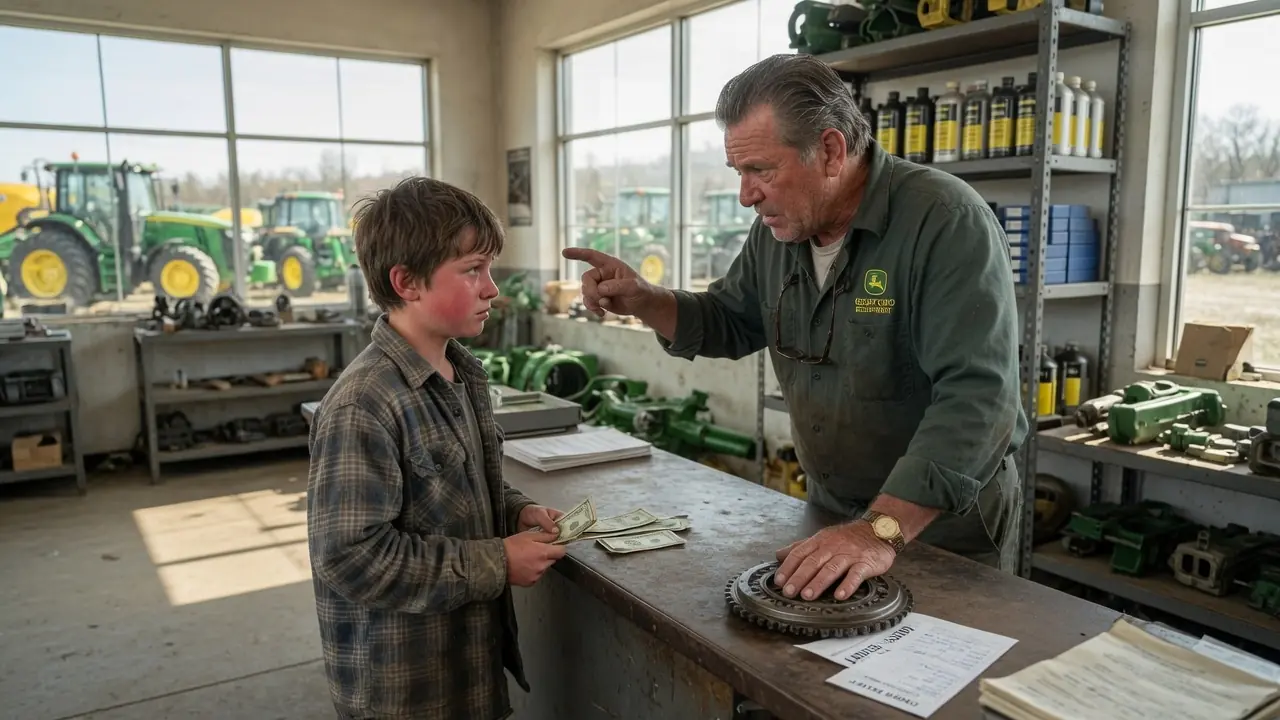
He remembered Daniel standing at the same counter years earlier with Eli sitting on his shoulders.
He remembered Eli at seven, asking why tractor tires were taller than people.
At ten, the boy could identify every piece of equipment on the Greer farm.
At twelve, he began driving wagons between fields.
Still, none of that made him old enough to become responsible for a farm.
Monroe counted the bills.
Two hundred forty-eight dollars exactly.
Some were tens.
Most were fives and ones.
“Where did you get this?”
“I sold my bicycle.”
Monroe looked up.
“You sold your bicycle for a tractor clutch?”
“And two fishing rods.”
“You should not be paying your father’s bill.”
“It’s our bill.”
Monroe pushed the money back.
“I’m not taking it.”
Eli’s face tightened.
“I’m not asking for charity.”
“It isn’t charity.”
“Then take the money.”
“Your father paid the deposit.”
“And I owe the rest.”
Monroe looked at him for a long moment.
Then he removed his hand from the box.
“Do you have an engine hoist?”
“Yes.”
“Splitting stands?”
“My father built two.”
“Service manual?”
“On the workbench.”
“Torque wrench?”
“Yes.”
“Someone helping you?”
“My uncle is coming.”
The answer came too quickly.
Monroe knew it was a lie.
“Which uncle?”
Eli looked toward the tractors outside.
Monroe sighed.
“You’re doing this alone.”
“I can do it.”
“You don’t know that.”
“No.”
Eli met his eyes again.
“But I know what happens if I don’t.”
Monroe understood.
Without the tractor, the Greers could not prepare their fields.
Without a crop, they could not make the mortgage payment due after harvest.
Without that payment, the bank would take the land.
Daniel’s death had not paused the calendar.
Corn still needed planting.
Cattle still needed feeding.
Bills still arrived.
Monroe opened the box and examined the component.
Then he pushed it across the counter.
“Keep your money.”
Eli did not touch the part.
“I said I’m paying.”
“Consider the balance covered.”
“By who?”
Monroe hesitated.
“By the dealership.”
“No.”
“Eli—”
“My father didn’t raise me to leave debts for other people.”
Monroe felt something uncomfortable move through his chest.
He took one hundred dollars from the pile and pushed the rest back.
“That covers my cost.”
“It doesn’t.”
“It does today.”
Eli knew better.
But after a moment, he returned the remaining bills to his pocket.
Monroe wrote something on the receipt.
PAID IN FULL.
He stamped it.
Then he handed Eli the part.
“If that tractor is not separated by noon tomorrow, you stop.”
Eli lifted the box.
“Why?”
“Because I’m coming to check.”
“You don’t need to.”
“I know.”
Eli walked toward the door.
Monroe called after him.
“Your father used blocking beneath the transmission case. Don’t trust the jack alone.”
Eli stopped but did not turn.
“I remember.”
The door closed behind him.
Monroe watched through the window as the boy placed the part in the passenger seat of the old pickup.
The engine coughed twice before starting.
Then the truck rolled out of the parking lot.
A salesman named Curtis emerged from the back office.
“You really let him take that?”
“It belonged to his father.”
“He’ll never install it.”
Monroe looked toward the empty road.
“I hope not.”
The Greer farm sat eleven miles north of the dealership, where the paved road narrowed into gravel and passed between dairy fields.
The farmhouse was white with a green roof that Daniel had planned to repaint in spring.
A red barn stood behind it.
Beyond the barn stretched one hundred sixty acres of corn ground, pasture, and hay fields that had supported the Greer family for three generations.
Eli parked beside the machinery shed.
His mother, Sarah, was waiting.
She stood on the porch holding his six-year-old sister, Lily, by the hand.
“You got it?”
“Yes.”
“How much?”
Eli avoided her eyes.
“How much, Eli?”
“One hundred dollars.”
Sarah knew that could not be right.
“Mr. Bickford reduced it.”
She looked toward the box.
“You sold your bicycle.”
“We needed the part.”
“You should have told me.”
“You would have said no.”
“I am still your mother.”
“And the corn still needs to be planted.”
Sarah closed her eyes.
Since Daniel’s death, every conversation seemed to place her between two impossible choices.
Protect her son from adult burdens.
Or allow him to carry the burden necessary to keep their home.
“Your uncle Ray called,” she said.
Eli looked up hopefully.
“He can’t come.”
“When?”
“He has a roofing job in Harrisburg. He said maybe next week.”
“Next week is too late.”
“I know.”
Eli lifted the box.
“I’ll start tonight.”
“No.”
“Mom.”
“You have slept six hours in three days.”
“I’m fine.”
“You are fourteen.”
“I was fourteen yesterday when I fed the cattle.”
“That’s different.”
“How?”
Sarah had no answer.
Daniel had prepared Eli for farm work from the time he could carry a bucket. But he had never intended the boy to inherit everything in a single week.
“Your father would not want you getting hurt,” she said.
“He would not want us losing the farm.”
Sarah’s face changed.
Eli immediately regretted the words.
“I’m sorry.”
“No.”
She looked toward the fields.
“You’re right.”
The admission frightened him more than an argument would have.
Sarah stepped from the porch.
“I’ll help.”
“You don’t know how.”
“Neither do you.”
“I watched Dad.”
“And I listened to him for eighteen years.”
Together, they pushed the tractor into the center of the machinery shed.
The John Deere 4020 had been built long before Eli was born.
Its green paint was faded.
Rust appeared near the wheel hubs.
One front tire lost air slowly enough that Daniel had stopped repairing it and simply inflated it every few days.
The tractor had plowed, planted, baled, and hauled almost every acre of the farm.
It had also been Daniel’s favorite machine.
Eli opened the service manual.
His father’s notes filled the margins.
Support rear section before removing final bolts.
Mark hydraulic lines.
Do not rush alignment.
Eli read each note twice.
He disconnected the battery.
Drained fluids.
Removed the hood panels.
Labeled every line with masking tape.
Sarah held the flashlight.
Lily sat on an overturned bucket watching.
By midnight, the tractor looked wounded.
Components covered the workbench.
Bolts rested in labeled jars.
The front and rear halves remained connected.
Eli’s hands shook from exhaustion.
Sarah touched his shoulder.
“Enough.”
“We’re close.”
“That is what tired people say before making mistakes.”
It sounded like something Daniel would have said.
Eli lowered the wrench.
They went inside.
He slept in his clothes.
At 4:30 the next morning, he woke before the alarm.
The sky was still dark when he returned to the shed.
He positioned the splitting stands.
He checked the blocks beneath the transmission case.
Then he checked them again.
By sunrise, Sarah joined him carrying coffee and bread.
At seven, they removed the final housing bolts.
The tractor resisted.
Eli rocked one rear tire gently.
The halves separated by less than an inch.
Sarah inhaled sharply.
“Is that supposed to happen?”
“Yes.”
“Are you sure?”
“No.”
He adjusted the stands.
They rolled the rear section backward.
The clutch assembly became visible.
Eli stared at it.
The pressure plate was badly worn.
One release finger had cracked.
Dark dust covered the housing.
His father had diagnosed it correctly.
For a moment, relief overcame him.
Then he noticed damage along the input shaft.
A narrow groove had formed where the bearing contacted the metal.
The new clutch part alone would not be enough.
Eli sat on the concrete.
Sarah saw his face.
“What is it?”
“The shaft.”
“Can you repair it?”
“No.”
“Can it be replaced?”
“Yes.”
“How much?”
Eli did not know.
But he knew it would be more than the money left in his pocket.
At 8:15, Monroe Bickford’s truck entered the driveway.
He had brought Curtis, two toolboxes, and a tractor splitting jack.
Eli stood quickly.
“You said you were coming at noon.”
“I changed my mind.”
Monroe entered the shed and stopped.
The tractor had been separated cleanly.
Every bolt was labeled.
Hydraulic lines were plugged.
The transmission housing rested safely on blocking.
He looked toward Sarah.
“You helped?”
“I held things and worried.”
Monroe crouched beside the clutch.
He examined the damage.
Then he saw the shaft.
“That’s a problem.”
“I know.”
“You saw the groove?”
“Yes.”
Curtis leaned closer.
“We have one in the salvage shed.”
Monroe looked at him.
“From the wrecked 4010?”
“Same spline count. Might fit.”
Eli stepped forward.
“How much?”
Monroe stood.
“We need to measure it first.”
“How much if it fits?”
“We’ll discuss that later.”
“No.”
Monroe sighed.
“Boy, you are becoming difficult.”
“My father said people delay prices when they think you can’t afford them.”
Curtis hid a smile.
Monroe looked toward the handwritten notes in the service manual.
“Your father said too much.”
“He usually did.”
That was the first time Eli had spoken about Daniel without his voice tightening.
Monroe heard it.
He drove back to the dealership and returned with the salvage shaft, a new bearing, alignment tool, and seals.
The shaft fit.
For the next six hours, Monroe did not take over.
He made Eli perform every major step.
“Clean the housing again.”
“I already did.”
“Then cleaning it twice won’t hurt.”
“Check the pilot bearing.”
“It’s new.”
“New parts can still be defective.”
“Torque pattern?”
“Opposite sides.”
“How many foot-pounds?”
Eli read from the manual.
Monroe nodded.
They aligned the clutch.
Rolled the tractor halves together.
The first attempt failed.
The shaft would not seat.
Eli became frustrated and pushed harder.
Monroe stopped him.
“Force is not alignment.”
“It’s less than an inch.”
“That last inch can cost you a transmission.”
They separated the tractor again.
Eli checked the angle.
The rear section sat slightly low.
He raised it.
On the second attempt, the halves joined smoothly.
By evening, the tractor was whole.
The fuel tank, hood, and battery remained disconnected.
Eli’s clothes were covered in grease.
Monroe packed his tools.
“You’ll finish tomorrow.”
Eli looked toward the fields.
“Rain is coming Thursday.”
“You cannot plant tonight.”
“I can finish tonight.”
“You can also install a line incorrectly because you’re exhausted.”
Eli clenched his jaw.
Monroe stepped closer.
“Your father knew when to stop.”
“You don’t know that.”
“I worked beside him for twenty-three years.”
Eli looked up.
“You worked with my father?”
“Before I owned the dealership.”
Monroe sat on the tractor step.
“Daniel and I repaired equipment for the same harvesting crew. He was twenty. I was twenty-six.”
Eli had never heard the story.
“He was better than me,” Monroe continued. “Could hear a bad bearing from fifty feet away.”
“Why didn’t he tell me?”
“We had an argument.”
“About what?”
“Money.”
Monroe looked toward the floor.
“When my father’s dealership began failing, Daniel loaned me part of his savings. I promised to repay him after harvest.”
“Did you?”
“Yes.”
“But?”
“I offered interest. He refused. I became embarrassed and accused him of treating me like charity.”
Eli understood the shape of that mistake.
“What happened?”
“He told me pride was expensive maintenance.”
Curtis laughed quietly from the doorway.
Monroe ignored him.
“Daniel and I remained friendly, but never close again.”
He looked toward the repaired tractor.
“That hundred dollars yesterday did not cover my cost.”
“I knew it.”
“I owed your father more than money.”
Eli wiped his hands on a rag.
“You helped today.”
“That doesn’t settle it.”
“My father didn’t keep accounts like that.”
“No.”
Monroe smiled faintly.
“That was another thing he did better.”
He left before dark.
Eli returned to the shed after dinner.
This time, he did not rush.
He attached the hydraulic lines according to the labels.
Installed the fuel tank.
Connected the battery.
Filled the fluids.
At 11:40, the tractor was ready.
Sarah stood beside him.
“You’re not starting it tonight.”
“I need to know.”
“If something is wrong, can you repair it tonight?”
“No.”
“Then it can wait until morning.”
Eli looked at the ignition key.
Daniel’s key chain still hung from it.
A small brass tag read:
GREER FARM — KEEP MOVING
Eli removed his hand.
At 5:12 the next morning, the sun appeared behind the ridge.
Eli climbed into the tractor seat.
Sarah stood near the shed door holding Lily.
Monroe’s pickup waited beside the barn.
He had arrived before sunrise without announcing himself.
Curtis stood beside him.
Two neighboring farmers had also heard about the repair and stopped along the road.
Eli inserted the key.
The starter turned.
The engine coughed.
Then stopped.
His stomach dropped.
He tried again.
The engine fired.
Blue-gray exhaust rose from the stack.
The old John Deere settled into a familiar uneven idle.
Lily cheered.
Sarah covered her mouth.
Eli pressed the clutch pedal.
Shifted into first gear.
Slowly, he released it.
The tractor moved.
No slipping.
No grinding.
No violent vibration.
It rolled from the machinery shed into the morning light.
Eli drove one circle around the barn.
Then he shifted higher and headed toward the lower field.
Monroe watched the oversized boots working the pedals.
The boy’s shoulders no longer looked as narrow as they had at the dealership.
For the next three days, Eli prepared the fields.
He worked in sections.
Monroe sent one of his mechanics each afternoon to inspect the tractor.
Neighbors began arriving.
Some brought food.
Others repaired fences or helped load seed.
A dairy farmer named Walter Benson offered to plant the western acres with his larger tractor.
Eli refused at first.
Sarah pulled him aside.
“Accepting help is not the same as surrendering.”
Eli looked toward the field.
“Dad did everything himself.”
“No.”
Sarah shook her head.
“He only made it look that way to you.”
Eli accepted Walter’s help.
The corn went into the ground before the Thursday rain.
The storm lasted nearly eleven hours.
Water filled the low places.
The newly planted fields darkened beneath it.
Eli stood on the porch watching.
For the first time since Daniel’s death, there was nothing he could do.
The seed was planted.
The tractor was repaired.
The rest belonged to weather, soil, and time.
Three weeks later, thin green lines appeared across the fields.
Some rows were uneven.
One low section required replanting.
But the crop lived.
The Greer farm did not become prosperous overnight.
There were more repairs.
A hydraulic hose failed during hay season.
The cattle broke through the northern fence.
Corn prices fell before harvest.
Sarah began bookkeeping for a local veterinary clinic to cover household expenses.
Eli attended school in the mornings and worked until dark.
Monroe refused to let him quit his education.
When Eli missed three consecutive days, the dealer appeared at the farm.
“Your father asked me once what I would do if he died.”
Eli froze.
“When?”
“Last winter.”
“What did you say?”
“I told him not to talk foolishly.”
Monroe looked toward him.
“He said you would try to become forty years old before the funeral flowers wilted.”
Eli looked away.
“He made me promise that if anything happened, I would help you keep the farm without letting the farm take your childhood.”
“You didn’t tell me.”
“You weren’t ready to hear it.”
“And now?”
“You are missing algebra to repair a manure spreader.”
Eli returned to school the following morning.
At harvest, the Greers produced less corn than Daniel had hoped for but enough to meet the farm payment.
The bank manager accepted the check from Sarah.
Eli stood beside her wearing his father’s plaid shirt.
The sleeves finally fit a little better.
The following spring, Monroe offered Eli a paid Saturday position at the dealership.
He started by sweeping floors and organizing oil filters.
Within months, he was rebuilding starters and carburetors under supervision.
Customers began requesting the quiet teenager because he listened carefully before touching a machine.
At sixteen, Eli could diagnose equipment by sound nearly as well as Daniel had.
At eighteen, he graduated high school and enrolled in an agricultural mechanics program.
He continued running the farm with Sarah.
Lily learned to drive the 4020 before her feet could reach the pedals without blocks.
The old tractor remained part of every planting season.
Its paint faded further.
The seat cracked.
The engine needed an overhaul.
But the clutch Eli installed at fourteen never failed.
Years later, Bickford Farm Equipment expanded into a larger building.
Monroe placed the original order receipt inside a frame near the service counter.
Beneath Daniel Greer’s handwriting were the words Monroe added that morning:
PAID IN FULL.
Beside it hung a photograph.
Eli, fourteen years old, stood on the customer side of the counter holding several folded bills.
Monroe leaned over the tractor part with one hand covering it.
Neither man looked happy.
Customers often asked why the photograph mattered.
Monroe gave the same answer.
“That was the morning I tried to convince a boy he was too young to save his family’s farm.”
“What happened?”
Monroe pointed through the dealership window toward a man repairing a tractor outside.
Eli had become service manager two years earlier.
“He told me to come watch.”
At thirty, Eli purchased part ownership in the dealership.
He renamed the service department the Daniel Greer Agricultural Workshop.
The program trained teenagers from struggling farms in equipment repair, welding, bookkeeping, and crop management.
Students were paid.
Eli refused to call them apprentices until they understood one rule.
Knowing how to repair a machine did not mean they had to carry every burden alone.
On the wall above the workbench, he hung his father’s brass key tag.
KEEP MOVING.
Eli had once believed the words meant never stopping.
As an adult, he understood them differently.
Moving forward did not always mean working harder.
Sometimes it meant accepting help.
Sometimes it meant returning to school.
Sometimes it meant admitting that grief had made a decision too heavy.
And sometimes it meant walking into a dealership wearing a dead man’s boots, placing every dollar you owned on the counter, and refusing to leave without the one small part standing between your family and the loss of everything.
Monroe had been right about one thing.
Fourteen-year-old Eli Greer could not run one hundred sixty acres alone.
No fourteen-year-old should have been expected to.
But Monroe had been wrong to believe that meant the boy was powerless.
Eli did not save the farm alone.
His mother stood beside him.
Neighbors arrived.
A tired dealer honored an old promise.
And a machine Daniel Greer had carefully maintained carried them through another season.
The farm survived not because a grieving boy suddenly became a grown man.
It survived because he had enough courage to begin—and eventually enough wisdom to let others finish beside him.