The part had been waiting behind the counter for nine days.
A small cardboard box.
Oil-stained at one corner.
The name GREER written across the top in blue pencil.
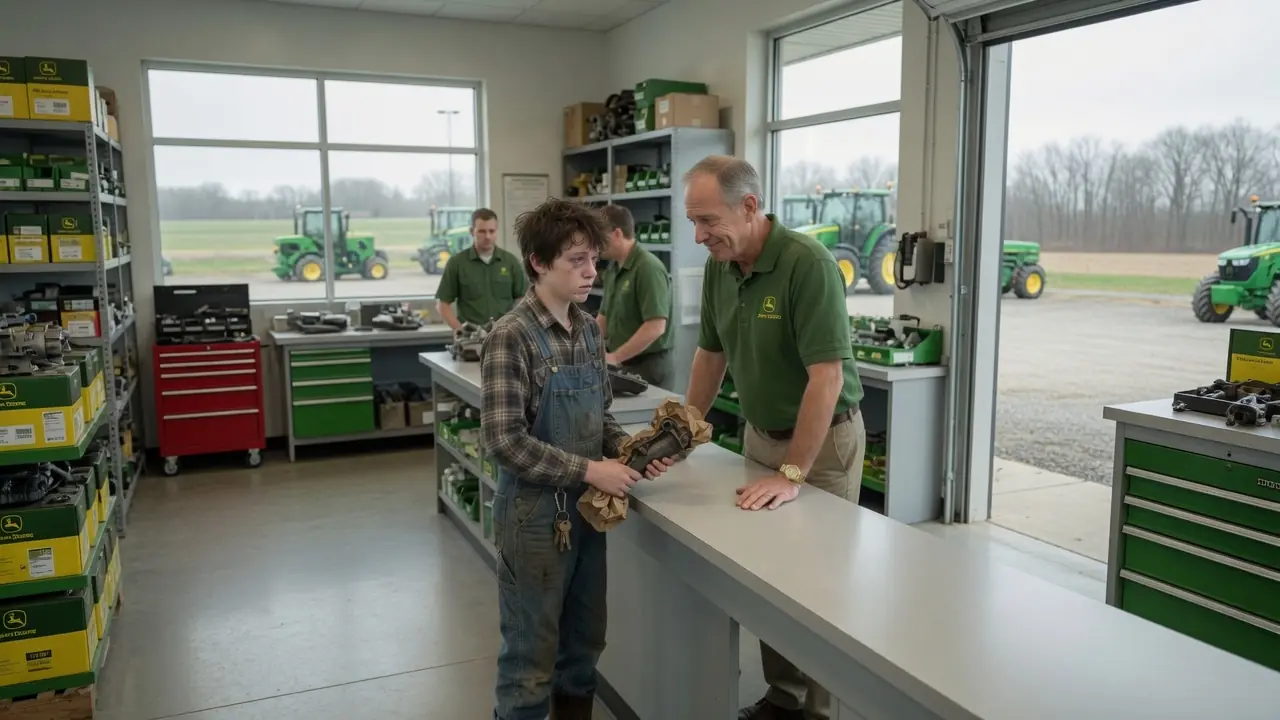
Eli Greer stood beneath the fluorescent lights of Whitaker John Deere wearing his father’s brown work coat and boots two sizes too large. Every time he shifted his weight, his heels lifted inside them.
He was fourteen years old.
His father had been dead for nine days.
“I’m here for the part Thomas Greer ordered,” Eli said.
The dealership owner looked up from a stack of invoices.
Harold Whitaker was fifty-eight, broad through the shoulders, with silver hair combed back from a face that had spent thirty years negotiating with farmers. He knew the Greer family. Everyone in Cedar County, Iowa, knew them.
Thomas Greer had farmed 160 acres west of Millbrook.
Good corn ground.
Heavy black soil.
Old machinery.
Too much debt.
Harold removed his glasses.
“Where’s your mother?”
“At home.”
“She send you?”
“No.”
Eli placed the order receipt on the counter.
“My father already paid half.”
Harold looked at the receipt but did not touch it.
The part was a replacement governor housing for a 1948 John Deere G. Thomas had ordered it because the tractor’s engine surged under load and would not hold steady speed on the corn picker.
The housing cost forty-one dollars.
Thomas had paid twenty in advance.
The balance was written in the corner.
$21.00.
Eli took a folded envelope from his coat.
“I have the rest.”
Harold looked through the showroom window toward the parking lot.
An old Chevrolet pickup sat near the road. Eli’s mother was not inside.
“You drove here?”
“Yes.”
“You have a license?”
“Farm permit.”
“That permit doesn’t cover town driving alone.”
Eli said nothing.
Harold leaned back.
“Son, I heard about your father.”
Eli stared at the box behind the counter.
“I’m sorry.”
“Thank you.”
“How is your mother doing?”
“She gets up.”
The answer made Harold pause.
Eli continued.
“I need the governor housing.”
Harold closed the invoice book.
“What are you planning to do with it?”
“Put it on the G.”
“Who’s doing the work?”
“I am.”
One of the mechanics near the parts shelves looked over.
Harold’s expression hardened slightly.
“You ever opened a governor assembly?”
“I watched Dad do one on Mr. Keller’s tractor.”
“Watching and doing are different things.”
“I know.”
Harold stood.
He was not trying to be cruel.
Years later, he would insist on that point whenever people retold the story.
He had seen farms fail.
He had watched grown men with decades of experience lose crops, machinery, and land because one accident or illness removed the person holding everything together.
Thomas Greer had been that person.
Eli’s mother, Margaret, could manage books and livestock, but she had never run field equipment. Eli had helped since he could reach the pedals, yet fourteen was still fourteen.
Outside the dealership, October wind pushed dry leaves across the lot.
Harvest had started across the county.
The Greer corn remained standing.
“You need to go home,” Harold said.
Eli looked at him.
“Your family needs to talk to the bank. Sell the crop standing or rent the ground to someone who can bring it in.”
“My father said we’d harvest it.”
“Your father isn’t here.”
The words came out harder than Harold intended.
The mechanic near the shelves stopped moving.
Eli’s face changed, but only for a second.
Harold lowered his voice.
“I’m saying this because somebody has to be honest with you. A boy cannot run 160 acres alone.”
“I’m not alone.”
“Who’s helping?”
“My mother.”
“She doesn’t run equipment.”
“My sister keeps the house.”
“She’s eleven.”
“Mr. Jensen said he can haul when his beans are finished.”
“That could be two weeks.”
“The corn will wait.”
“Maybe. Maybe not.”
Harold came around the counter.
“Listen to me. There is no shame in letting the farm go before it takes everything else with it.”
Eli’s fingers tightened around the money envelope.
“My father didn’t let it go.”
“Your father was forty-three years old.”
“He was forty-two.”
Harold exhaled.
“Eli.”
The boy placed twenty-one dollars on the counter.
“I’m not asking if I should farm.”
He pointed toward the box.
“I’m asking for the part my father bought.”
For several seconds, nobody spoke.
Then Harold picked up the money.
He brought the box from the shelf and placed it on the counter.
“Sales tax is included.”
Eli took the package.
It was heavier than he expected.
Harold wanted to say something softer before the boy left.
He wanted to tell him courage and foolishness could look alike from the front. He wanted to warn him that the farm did not care how much he loved his father.
But Eli had already turned away.
The large boots struck the tile unevenly.
At the door, Harold called after him.
“You’ll need a new gasket.”
Eli stopped.
“It isn’t in the box?”
“No.”
Harold went to the parts shelf and found one.
He held it out.
Eli reached for his envelope.
“No charge,” Harold said.
“It came with the order.”
It had not.
Eli knew that.
Harold knew he knew.
The boy accepted it anyway.
“Thank you.”
Then he walked into the wind.
Nine days earlier, Thomas Greer had climbed the wooden ladder inside the west grain bin to inspect a section of rust near the upper seam.
The bin was empty.
Harvest had not begun.
Margaret was hanging laundry when she heard metal tear.
The ladder mounting bracket pulled from the wall.
Thomas fell twenty-two feet.
He was alive when Eli reached him.
Barely.
His breathing was shallow. Blood darkened the back of his work shirt. One leg bent beneath him at an angle that made Eli look away.
“Don’t move,” Eli said.
Thomas attempted to laugh.
“Wasn’t planning to.”
Margaret ran to call the ambulance from the house.
Eli knelt beside his father in the dust.
Thomas looked toward the fields.
The corn had turned brown and dry after a difficult summer. Ears hung heavy beneath the husks. A storm forecast for the end of the month could flatten portions of the crop if they waited too long.
“The G,” Thomas whispered.
“What?”
“Governor.”
“The part’s coming.”
“Whitaker called yesterday.”
Eli leaned closer.
“Don’t talk.”
“Picker’s greased.”
“I know.”
“Elevator chain needs tightening.”
“I know.”
“South field first. Ground’s firmer.”
“Dad.”
Thomas looked at his son.
For the first time, fear entered his eyes.
Not fear for himself.
Fear for everything that would remain without him.
“Get the corn in.”
Eli’s throat closed.
“You’ll be here.”
Thomas gripped his sleeve.
“Promise.”
The ambulance arrived eleven minutes later.
Thomas Greer died before reaching the county hospital.
At the funeral, neighbors filled the small Lutheran church.
They brought casseroles, pies, and carefully worded offers of help.
Men told Eli his father had been dependable.
Women told Margaret to call if she needed anything.
The bank manager stood near the back and shook hands with everyone.
Afterward, people returned to their own harvests.
That was not cruelty.
It was October.
Every farmer in Cedar County had crops waiting, weather coming, machinery breaking, and bills due. Sympathy could fill a church on Sunday, but it could not stop corn from losing moisture or soybeans from shattering in the field.
On the morning after the funeral, Eli entered his father’s machine shed.
The John Deere G stood beside the mounted corn picker.
Its faded green hood carried scratches from thirty years of work. One yellow rear wheel had been repainted with a brush. The seat cushion was split, exposing dark horsehair beneath the vinyl.
Thomas bought the tractor in 1959 for $650.
It had already been old then.
He trusted it because its weaknesses were familiar.
The governor problem had started in September.
Under load, the engine surged.
Fast.
Slow.
Fast again.
The picker needed a steady speed to pull stalks through the snapping rolls and carry ears into the wagon. If the engine surged, the chains jerked and the machine plugged.
Thomas had disassembled the governor and found the housing worn where the shaft rode. He ordered the replacement from Whitaker.
Now the tractor waited.
Eli placed his hand on the hood.
The metal was cold.
His father had left tools arranged on the bench.
Half-inch wrenches hung in order.
Grease gun near the vise.
Service manual opened to the governor section.
A pencil mark circled one sentence:
ALIGN TIMING MARKS BEFORE INSTALLATION.
Eli swallowed.
His father had been preparing to do the job that week.
Eli set the new part on the bench and opened the manual.
The exploded diagram made the assembly look simple.
Nothing looked simple once bolts had been tightened for twenty-five years.
He removed the hood side panel.
Disconnected the throttle rod.
Marked the linkage position with chalk.
The first housing bolt came free.
The second resisted.
He used a longer wrench.
The bolt moved suddenly, throwing him forward against the tractor.
His knuckles struck the casting and split open.
Eli sucked blood from the cut, wrapped it with a rag, and continued.
By noon, the old housing lay on the bench.
The shaft opening was visibly oval.
His father had been right.
Eli cleaned the gasket surface with a scraper. He compared the timing marks three times before installing the new housing.
The final linkage adjustment worried him.
The manual described a measurement using a special gauge he did not own.
Thomas had written a number in the margin.
Three and one-quarter inches.
Eli set the rod to that length with a ruler.
At 4:37, he opened the fuel valve and climbed into the seat.
His boots barely reached the clutch comfortably.
He pressed the starter.
The engine turned.
One compression stroke.
Then another.
The two cylinders fired.
The John Deere came alive with its heavy, uneven rhythm.
Pop.
Pause.
Pop.
Pause.
Eli watched the throttle linkage.
The engine accelerated too high.
He pulled the lever back.
The speed dropped.
Then stabilized.
He increased the throttle slowly.
The governor held.
For the first time since his father’s death, Eli smiled.
Then oil began running down the side of the new housing.
He shut off the engine.
The gasket had shifted.
He removed the housing again.
Cleaned everything.
Made a new paper alignment guide.
Installed it a second time.
Darkness filled the shed before he restarted the tractor.
This time, no oil leaked.
The governor held the engine at a steady rhythm.
Margaret stood in the doorway wearing Thomas’s old blue sweater.
“You fixed it?”
“I think so.”
She looked at the tractor.
Then at the blood on Eli’s rag.
“You shouldn’t have to do this.”
He did not answer.
She stepped closer.
“The bank called.”
“What did they want?”
“To discuss our options.”
“What options?”
Margaret looked toward the floor.
“Selling the corn standing. Renting the farm. Maybe selling eighty acres to cover the loan.”
Eli’s face hardened.
“No.”
“We owe thirty-eight thousand dollars.”
“The crop will pay it.”
“Not all of it.”
“Enough for the payment.”
“If the corn is good.”
“It is.”
“If the picker works.”
“It will.”
“If you don’t get hurt.”
Eli looked at her.
She began crying without sound.
That frightened him more than shouting would have.
“I buried your father six days ago,” she said. “I will not bury my son trying to become him.”
“I’m not trying to become Dad.”
“You’re wearing his coat.”
“It’s warm.”
“His boots.”
“Mine leak.”
“His watch.”
Eli looked at the silver watch on his wrist.
It had stopped the day Thomas fell.
Margaret stepped forward and placed both hands on his shoulders.
“You are fourteen.”
“I know.”
“You don’t have to save everything.”
“I promised him.”
“He should never have asked you.”
Eli’s eyes filled.
“But he did.”
Margaret closed hers.
For a long time, the tractor cooled between them, metal ticking softly in the shed.
Finally, she said, “You don’t run the picker alone.”
“Mom.”
“Not alone.”
“Who will ride with me?”
“I will.”
“You don’t know how.”
“Then teach me what you know.”
The Greers began harvest three days later.
The mounted picker had two snapping rows and a wagon hitch at the rear. Thomas usually harvested with a neighbor driving the wagons to the crib.
That year, there was no available neighbor.
Eli mounted the picker himself.
He tightened the elevator chain.
Greased every fitting.
Replaced one cracked gathering-chain link with a used spare from a coffee can.
Margaret sat on the tractor’s left side on a narrow auxiliary platform Thomas had added years earlier. She wore a scarf over her hair and held the service manual.
Their first pass entered the south field at 8:11 on a cold Wednesday morning.
Eli eased the tractor into the rows.
Dry stalks bent beneath the gatherers.
The snapping rolls pulled them downward.
Ears broke free and moved up the elevator.
For thirty yards, everything worked.
Then the left row plugged.
Eli stopped the tractor.
He shut off the power before climbing down.
His father had repeated that rule since Eli was six.
Never touch a picker while anything is moving.
Never trust a clutch.
Never reach toward a chain with the engine running.
The plug came from a bent stalk wedged between the gathering points. Eli removed it with a steel hook.
They restarted.
Halfway across the field, the engine surged once.
Eli’s heart stopped.
Then the governor corrected.
The John Deere kept pulling.
By noon, they had filled one wagon.
The wagon held roughly sixty bushels.
The south field contained forty acres.
At that pace, harvest would take weeks.
Margaret looked at the wagon.
“How did your father do this?”
“He started before sunrise.”
“And stopped?”
“When it broke.”
They ate sandwiches beside the field.
Eli checked the sky.
Clouds moved from the northwest.
The radio forecast called for rain in four days.
After lunch, Margaret drove the truck while Eli pulled the full wagon to the crib.
He backed beneath the elevator poorly.
The wagon tongue jackknifed.
A rear tire sank into soft ground.
It took an hour to free it.
The elevator belt slipped twice.
By sunset, they had harvested less than three acres.
Eli sat on the tractor after Margaret returned to the house.
His hands hurt.
His shoulders hurt.
The first load of corn made a small pile in the crib, barely covering the floor.
One hundred and sixty acres no longer felt like land.
It felt like a number designed to defeat him.
The next morning, a neighbor named Paul Jensen arrived in his pickup.
He was sixty-one and had farmed across the road since before Eli was born.
“I heard you started.”
Eli nodded.
Paul looked at the mounted picker.
“Governor holding?”
“Yes.”
“Your father ordered that housing?”
“Yes.”
“You install it?”
“Yes.”
Paul examined him.
“Whitaker said you came into town.”
Eli did not respond.
Paul walked around the tractor.
“I can help haul Sunday.”
“We need to work before the rain.”
“My beans are ready.”
“I know.”
Paul looked toward the corn.
“I can send my hired man for half a day.”
Eli wanted to say yes.
Then he thought of money.
“What does he cost?”
Paul frowned.
“He doesn’t.”
“We can’t take free work.”
“Why?”
“Because everyone offered after the funeral. We can’t owe the whole county.”
Paul looked at him for several seconds.
“Your father helped me rebuild a corn head in 1968.”
“I wasn’t born.”
“That doesn’t erase the debt.”
Eli shook his head.
“Dad wouldn’t want—”
“Your father isn’t the only stubborn Greer.”
Paul climbed into his truck.
“My man will be here at one.”
At 12:45, a red International tractor appeared on the road pulling two empty wagons.
Paul’s hired hand drove.
Behind him came another farmer.
Then another.
By 1:30, five wagons waited at the edge of the field.
Nobody asked permission.
Men simply started working.
One hauled.
One repaired the elevator.
Another brought fuel.
A woman from the next farm arrived with coffee and bread.
Margaret stood beside the house staring at the line of vehicles.
Eli found Paul near the crib.
“You told them.”
“I told one.”
“You knew what would happen.”
Paul shrugged.
“News travels.”
Eli looked toward the men.
“We can’t pay them.”
“They didn’t ask.”
“I promised Dad I’d get the corn in.”
Paul placed one hand on his shoulder.
“You think keeping a promise means nobody can touch it but you?”
Eli looked away.
“Your father never farmed alone,” Paul continued. “He just made it look that way to you.”
For the next three days, the Greer farm became a coordinated operation.
Eli ran the John Deere and picker.
Margaret kept records and meals moving.
Neighbors hauled wagons.
Paul managed the crib elevator.
By Saturday evening, twenty-two acres were finished.
Then the rain came.
It fell for two days.
The ground softened.
Wind pushed through the standing corn.
On Monday morning, Eli walked the fields.
Several patches had gone down.
Not flat.
But leaning enough that the old picker would struggle.
The bank manager arrived that afternoon.
His name was Raymond Cole.
He wore a brown suit and polished shoes that collected mud beside the porch.
Margaret invited him into the kitchen.
Eli remained standing.
Raymond placed a folder on the table.
“Your December payment is twenty-one thousand, four hundred dollars.”
“We know,” Margaret said.
“The operating note is secured by the crop and machinery.”
“We know that too.”
Raymond looked at Eli.
“I understand harvest has started.”
“Twenty-two acres,” Eli said.
“At what yield?”
“About one hundred eighteen bushels.”
The manager did the calculation silently.
It was a decent crop.
Not enough yet.
“There is another option,” he said.
Eli knew before he continued.
“A neighboring investor has offered to purchase the western eighty acres.”
“No.”
Margaret looked at him.
“Eli.”
“No.”
Raymond kept his voice even.
“The offer would clear the payment, reduce your principal, and leave the family with eighty acres free of immediate pressure.”
“It splits the farm.”
“It preserves half.”
“My father bought that eighty from Grandpa Keller.”
“Yes.”
“He drained it.”
“I know.”
“He planted the windbreak.”
“I know.”
“Then stop talking like it is just eighty acres.”
Raymond closed the folder.
“It is also collateral.”
Margaret looked pale.
“What happens if we refuse?”
“If the payment is missed, the bank can begin collection proceedings.”
“Foreclosure?”
“Not immediately.”
“But eventually.”
“Yes.”
Eli looked toward the window.
The John Deere sat beneath the shed roof.
“What if the corn covers the payment?”
“Then we continue under the existing note.”
“It will.”
Raymond studied him.
“I hope you’re right.”
After the manager left, Margaret sat at the table.
“We may have to sell.”
“No.”
“We cannot lose all of it to save part of it.”
“We won’t.”
“You don’t know that.”
Eli picked up the bank folder.
His father’s financial notes were clipped inside.
Fertilizer.
Seed.
Fuel.
Machinery repairs.
Expected yield.
Thomas had calculated that 160 acres at 115 bushels per acre would produce 18,400 bushels.
After storage losses and family use, approximately 17,900 could be sold.
At the current price, the crop would gross around $36,000.
Enough to make the bank payment.
Pay harvest expenses.
And leave almost nothing.
There was no margin for a major breakdown.
No margin for weather.
No margin for a fourteen-year-old’s mistake.
Tuesday morning, the John Deere lost oil pressure.
The gauge needle dropped from thirty pounds to ten while Eli was halfway through a downed section.
He shut off the engine immediately.
Paul arrived twenty minutes later.
They checked the oil level.
Full.
Removed the gauge line.
Clear.
Paul frowned.
“Could be the pump.”
Eli looked at the picker attached behind the tractor.
“How long to fix?”
“If it’s the pump, two days. If the bearing clearances opened, longer.”
“We don’t have longer.”
Paul said nothing.
They towed the John Deere to the shed.
Eli removed the oil-pressure regulating plug.
The spring came out in two pieces.
Paul held them in his palm.
“Found it.”
“Whitaker have one?”
“Probably.”
Eli drove to the dealership.
Harold Whitaker saw him enter and immediately looked toward the cardboard box in his hand.
“What happened?”
“Oil-pressure spring broke.”
“You shut it down?”
“At ten pounds.”
Harold nodded.
“Good.”
He searched the parts catalog.
The exact spring was not in stock.
“I can have one tomorrow afternoon.”
“We need it now.”
“I don’t have one.”
Eli looked toward the shop.
“Used?”
Harold hesitated.
“There may be one in the salvage engine out back.”
“Can I buy it?”
“If it tests right.”
The old engine sat beneath a tarp behind the dealership. Harold and Eli removed the regulating assembly together.
The used spring showed surface rust but retained proper length and tension.
Harold measured it.
“It will work.”
“How much?”
“Nothing.”
Eli shook his head.
“I’m paying.”
“Two dollars.”
Eli put two dollars on the workbench.
Harold wrapped the spring in paper.
As Eli turned to leave, Harold spoke.
“How much corn is out?”
“Twenty-two acres finished.”
“That’s all?”
“Rain.”
Harold looked toward the sky.
More weather was coming.
“Eli.”
The boy stopped.
“I was wrong to speak to you the way I did.”
“You were wrong about the gasket too.”
Harold almost smiled.
“I know.”
Eli waited.
Harold continued.
“But I wasn’t wrong that this is too much for one boy.”
“I have help.”
“Good.”
“My father had more help than I knew.”
Harold nodded slowly.
“That sounds like Thomas.”
Eli placed the spring inside his coat.
“You told me to give up the farm.”
“I told you to protect what you could.”
“That isn’t the same thing?”
“Sometimes it is.”
“Not this time.”
Eli left.
The John Deere returned to the field before dark.
The used spring restored oil pressure to thirty-two pounds.
The engine held.
Harvest continued.
The downed corn slowed the picker.
Stalks entered at angles and wrapped around the gathering chains. Eli stopped repeatedly to clear plugs.
Every shutdown cost time.
Every clog tested his patience.
On Thursday evening, he ignored a small accumulation near the right snapping roll.
He believed it would clear itself.
It did not.
The chain jumped the sprocket.
A bent slat tore through the sheet-metal elevator housing.
The machine stopped with a grinding crash.
Eli shut down the tractor.
Paul climbed from the wagon.
“What did you hear before it broke?”
“Nothing.”
Paul looked at him.
“What did you ignore?”
Eli stared at the damaged housing.
“Small plug.”
Paul nodded.
“Your father did the same thing once.”
“When?”
“1971.”
“What happened?”
“Broke the same chain.”
Eli looked at him.
“Did he fix it?”
“No.”
Paul smiled.
“I did.”
They removed the chain in the field.
The slat was bent beyond repair.
No replacement existed locally.
Harold Whitaker searched three dealerships by telephone.
Nothing.
A used-machinery yard in Waterloo had an entire elevator assembly for eighty-five dollars, but it was eighty miles away.
They could retrieve it the next morning.
Another day lost.
That night, Eli sat at the workbench turning the bent slat in his hands.
It was made from flat steel with riveted chain attachments.
His father could have repaired it.
Not with a factory part.
With metal.
A torch.
A hammer.
A drill.
Eli’s father had been a farmer, but he had also been a mechanic because farmers with old machinery had no choice.
Eli heated the slat in the forge.
Paul held it with tongs.
They straightened it against the anvil.
The steel had cracked near one rivet hole.
Eli ground the crack into a V and welded it in short passes.
The first weld was ugly.
He ground it out.
The second held.
They reinforced the back with a narrow strap cut from an old cultivator bracket.
At 1:17 in the morning, the chain was repaired.
Paul looked at the clock.
“You have school tomorrow.”
“I haven’t been in two weeks.”
“Your mother know?”
“She signs the notes.”
“That doesn’t make it wise.”
“The bank doesn’t care about attendance.”
Paul wiped grease from his hands.
“Your father did.”
Eli looked at him.
“He made me promise to harvest.”
“He also planned on living.”
The words hurt.
Paul continued before Eli could turn away.
“You are treating the last thing he said as if it was the only thing he ever taught you.”
“What else am I supposed to do?”
“Remember the rest.”
Eli thought of mornings when Thomas made him leave the field to catch the school bus.
Books spread across the kitchen table.
His father checking arithmetic homework with dirty fingernails.
Thomas saying land could be lost and bought again, but a mind had to be built before a person needed it.
“I can go back after harvest,” Eli said.
“Yes.”
Paul looked at the repaired chain.
“And harvest ends faster if you sleep.”
The repaired elevator held.
By the end of the second week, sixty-eight acres were finished.
Word of Eli’s work spread through the county.
People came to watch.
Some arrived out of curiosity.
Others came carrying fuel, parts, or food.
A local newspaper photographer took a picture of Eli beside the John Deere.
The photograph showed a thin boy in his father’s coat, one hand resting on the faded green hood.
The headline read:
FOURTEEN-YEAR-OLD KEEPS FAMILY HARVEST MOVING.
Eli hated it.
He did not feel heroic.
He felt tired.
The article made it sound as though he had conquered grief through hard work.
He had not.
Grief rode beside him on every pass.
It sat where his father once sat.
It spoke whenever the engine changed tone.
It waited in the empty chair at supper.
One morning, Eli reached the end of a row and instinctively turned to ask his father whether the picker sounded right.
The platform beside him was empty.
He shut off the tractor and cried against the steering wheel.
No one saw.
He remained there until the tears stopped.
Then he restarted the engine.
The weather held through the end of October.
One hundred acres came in.
Then one hundred twenty.
The crib filled.
They stored additional grain in a neighbor’s bin under a handshake agreement.
The western forty acres remained.
Those were the best acres.
They were also the wettest.
On November 3, the temperature dropped below freezing.
The ground hardened enough to carry wagons.
But the forecast predicted snow within three days.
Everyone understood the deadline.
Paul finished his harvest and brought his combine.
It was a six-year-old John Deere 45 with a two-row corn head.
Compared with the old mounted picker, it seemed enormous.
“We can finish in two days,” he said.
Eli looked at the combine.
“My father said we’d harvest with the G.”
Paul’s expression hardened.
“Your father said get the corn in.”
Eli looked away.
“You think using a combine breaks the promise?”
“I don’t know.”
“Promises are about outcomes, boy. Not worshipping the hardest method.”
Margaret stood beside them.
“Let him help.”
Eli finally nodded.
Paul’s combine entered the western field.
The John Deere G continued working beside it with the mounted picker.
Old and new moved through parallel rows.
Neighbors drove wagons.
Women prepared meals in the Greer kitchen.
High school students came after classes and shoveled grain.
Harold Whitaker arrived in a dealership truck carrying spare chains, bearings, and two mechanics.
He found Eli greasing the picker.
“What are you doing here?” Eli asked.
“Protecting my parts investment.”
Eli almost smiled.
Harold looked across the field.
Paul’s combine moved steadily through the corn.
“You’ve done more than I expected.”
“I’m not finished.”
“No.”
Harold placed a box beside the tractor.
“What’s that?”
“Governor housing seal.”
“I already have one.”
“A spare.”
Eli looked at him.
“No charge?”
“Absolutely not. I’ve learned you’re difficult about charity.”
“How much?”
“Forty cents.”
Eli handed him two quarters.
Harold returned a dime.
The snow arrived early on the morning of November 6.
By then, only seven acres remained.
The first flakes melted on the tractor hood.
Then they began sticking to the dry leaves and corn husks.
Paul’s combine plugged twice as damp snow entered the head.
The old picker kept moving more slowly.
By noon, visibility dropped.
Margaret stood near the field waving for Eli to stop.
He shook his head.
They had three acres left.
The temperature was falling.
If they stopped, wet snow could freeze the stalks together overnight.
The John Deere’s governor held the engine steady.
The repaired elevator chain carried ear after ear into the wagon.
Harold rode on the edge of the field in his truck.
Paul cut rows from the opposite side.
At 2:46, Eli entered the final pass.
Snow covered his father’s coat.
His hands were numb inside wet gloves.
The large boots slipped on the platform.
He kept the tractor centered between the rows.
The last stalks disappeared beneath the snapping rolls.
The final ears rattled up the elevator.
At the field edge, Eli disengaged the picker.
The engine returned to idle.
Pop.
Pause.
Pop.
Pause.
He looked back.
The field was empty.
Not clean.
Broken stalks and husks remained.
But the corn was out.
One hundred sixty acres.
Twenty-three days.
Margaret reached him first.
She climbed onto the platform and held him so tightly he could not breathe.
“You did it,” she whispered.
Eli looked toward the wagons.
“We did.”
Neighbors gathered near the road.
Nobody cheered.
These were farmers.
They understood harvest was not a game won with noise.
Paul removed his cap.
Harold stood beside the dealership truck.
He watched the fourteen-year-old boy climb from the tractor in boots too large for him.
For the first time, Harold saw what he had misunderstood at the counter.
Eli had never believed he could replace his father.
He had only refused to abandon what his father left unfinished.
The corn sold for enough to make the December payment.
Barely.
After fuel, storage, repairs, and labor expenses, the Greers had $613 remaining.
Margaret placed the bank receipt inside Thomas’s account book.
The farm was safe for one year.
Only one.
The following spring would require seed, fertilizer, and another operating loan.
Raymond Cole approved the loan with stricter conditions.
Margaret considered renting out half the ground.
Eli agreed.
That surprised her.
“You fought to keep all of it.”
“We are keeping it.”
“But someone else will farm eighty.”
“For a year.”
She studied him.
“What changed?”
“I thought doing everything Dad did was how we kept the farm.”
“And now?”
Eli looked toward the John Deere.
“Keeping it means doing what works.”
He returned to school in December.
He had missed twenty-four days.
His classmates treated him differently.
Some admired him.
Some mocked the newspaper article.
One boy called him Little Farmer Thomas.
Eli struck him.
The principal suspended both students.
Margaret did not defend the fight.
Thomas would not have either.
Eli made up the schoolwork over winter.
Math came easily.
English did not.
His agriculture teacher asked him to write a report about the harvest.
Eli wrote six pages on governor repair, picker-chain failure, oil-pressure regulation, grain moisture, weather loss, and field logistics.
The teacher returned it with one sentence underlined:
A machine does not care who you lost. It only responds to what you understand.
Below it, the teacher wrote:
Neither does land. That is why knowledge matters.
Eli kept the paper.
At sixteen, he began working Saturdays at Whitaker John Deere.
Harold offered the job.
“Because I fixed the G?” Eli asked.
“Because you paid forty cents for a gasket.”
Eli swept floors, cleaned parts, and carried tools.
Wesley Boone, the senior mechanic, taught him how to read wear patterns.
“Broken parts tell you what happened,” Wesley said. “Worn parts tell you what kept happening.”
Eli learned transmissions.
Hydraulic systems.
Diesel injection.
Electrical diagnosis.
He discovered that repairing his father’s tractor at fourteen had not made him a mechanic.
It had only made him unafraid to begin.
At eighteen, Eli graduated near the top of his class.
He received offers from two technical colleges.
He stayed home.
Margaret objected.
“Your father wanted you educated.”
“I am learning at Whitaker’s.”
“That isn’t the same.”
“It can be.”
Harold surprised both of them.
“Go to school,” he told Eli.
Eli looked offended.
“You hired me.”
“And I’ll hire you again.”
“The farm needs me.”
“The farm needed your father too. It survived him.”
Eli stared.
Harold continued.
“You kept the farm alive at fourteen. Don’t let that become the reason you remain fourteen forever.”
Eli attended a two-year agricultural mechanics program in Waterloo.
He returned every weekend.
Margaret rented most of the ground to Paul Jensen and maintained the house, livestock, and finances.
The John Deere G remained in the shed.
At college, Eli learned why certain repairs he had made worked.
He learned metallurgy.
Combustion.
Bearing loads.
Fluid systems.
He learned to calculate what his father had often judged by sound and touch.
In 1981, Eli returned to Millbrook and became Whitaker’s youngest full-time mechanic.
Farm equipment was changing rapidly.
Larger tractors.
More hydraulics.
Diesel engines.
Complex electrical systems.
Some older mechanics resisted.
Eli did not.
He respected old machines without believing age made them superior.
Farmers began asking for him.
He had a habit of listening to the entire complaint before touching a wrench.
When a tractor overheated only at the west end of a field, he asked about wind direction and found chaff drawn against the radiator screen.
When a combine lost power only with a full grain tank, he found a cracked fuel line pinched by frame flex.
When an engine repeatedly ruined one main bearing, Eli measured the block instead of replacing the crankshaft again.
The main saddle was out of alignment.
He repaired machines other shops had given up on.
Not through magic.
Through patience.
At twenty-six, he bought half ownership in Whitaker John Deere.
Harold retained the other half.
“You told me to give up the farm,” Eli said while signing the papers.
Harold leaned back.
“You’ve been saving that.”
“Thirteen years.”
“I was wrong.”
“Partly.”
Harold smiled.
“What part was right?”
“A boy couldn’t run 160 acres alone.”
Harold looked at him.
“But you did.”
“No.”
Eli signed his name.
“A county did.”
After Paul Jensen retired, Eli took back the full Greer acreage.
He farmed evenings and weekends while managing the dealership.
The operation grew slowly.
He purchased neighboring ground when he could afford it.
Not with reckless loans.
Not for pride.
Only when the numbers worked.
By forty, Eli farmed eight hundred acres and employed fourteen mechanics.
Farmers drove from three states to bring difficult repairs to Greer-Whitaker Equipment.
The shop had modern diagnostic tools, but Eli required every new technician to spend one year working on mechanical systems before specializing in electronics.
“You need to understand what the computer is measuring,” he told them. “Otherwise you’re only replacing what the screen accuses.”
The John Deere G became a symbol of the business.
Eli restored the mechanical systems but left the paint faded.
He kept the split seat.
The brush-painted wheel.
The repaired elevator-chain slat mounted on the office wall.
Beneath it was the original receipt for the governor housing.
$41.00.
Harold retired in 1996.
At his retirement dinner, he stood before nearly two hundred farmers, mechanics, and family members.
He told the story of a fourteen-year-old boy entering the dealership nine days after his father’s death.
“I looked at his boots,” Harold said. “They were too large. I looked at his hands. They were too small.”
He paused.
“I decided those facts told me what he could do.”
The room became quiet.
“I was an equipment dealer. I should have known better than to judge capacity by appearance.”
Eli sat beside Margaret.
Harold looked toward him.
“I told that boy to give up the farm.”
A few people laughed softly.
“Three weeks later, he harvested it.”
Eli shook his head.
“Twenty-three days,” he called.
Harold smiled.
“He has always corrected details.”
Then his expression became serious.
“But the lesson wasn’t that children should carry impossible burdens. They should not.”
He looked around the room.
“The lesson was that adults often call something impossible when what they mean is inconvenient to support.”
Margaret began crying.
Harold continued.
“Eli became a remarkable mechanic. A successful farmer. A fair employer. People call him a legend.”
He looked directly at Eli.
“But at fourteen, he did not need to become a legend. He needed neighbors.”
The room stood.
Eli did not.
He remained seated beside his mother, staring at his father’s old watch on his wrist.
It still did not run.
He wore it anyway.
Years later, people exaggerated the harvest.
They claimed Eli harvested 160 acres entirely alone.
He corrected them every time.
“Paul Jensen brought the combine.”
“Neighbors hauled.”
“My mother managed everything.”
“Whitaker found parts.”
“Women fed the crews.”
“Kids shoveled cribs.”
The truth mattered.
Not because it reduced what Eli had done.
Because it revealed the larger thing that saved the farm.
A promise may begin with one person.
Keeping it can require a community.
In 2019, the state agricultural museum asked to display the John Deere G.
Eli refused.
“It still works.”
The curator smiled.
“That is why we want it.”
“If you put it behind a rope, it stops being a tractor.”
They compromised.
The machine remained at the farm but appeared at exhibitions, harvest festivals, and agricultural mechanics programs.
Eli demonstrated the governor repair to students.
He showed them the worn original housing.
He explained how the shaft opening had become oval.
How the linkage was measured.
How the gasket shifted during the first installation.
A student once asked, “How did you know you could fix it at fourteen?”
Eli considered the question.
“I didn’t.”
“Weren’t you scared?”
“Yes.”
“Then why did you do it?”
“Because the tractor didn’t need confidence.”
He held up the service manual.
“It needed the marks aligned.”
The students laughed.
Eli did not.
“People wait to feel ready. Machines rarely give you that time. Neither does weather.”
He looked toward the old tractor.
“You inspect. You read. You ask. You try. When you’re wrong, you shut it down before you destroy something.”
“Did your father teach you that?”
“Most of it.”
“What did you learn yourself?”
Eli touched the scar across his right knuckle from the first housing bolt.
“That promises should not be confused with methods.”
At seventy-two, Eli still lived on the Greer farm.
The original 160 acres remained intact.
He had placed them in a family trust so no single medical bill, lawsuit, or poor decision could split the ground easily.
His daughter managed Greer-Whitaker Equipment.
His grandson studied agricultural engineering.
Margaret lived to ninety-one.
Before she died, she asked Eli whether he remembered their first harvest pass after Thomas’s death.
“Every day,” he said.
“You were terrible.”
Eli laughed.
“I know.”
“You backed the wagon into the crib wall.”
“You said we’d never tell anyone.”
“I’m dying. Agreements expire.”
She reached for his hand.
“You thought your father asked you to save the farm.”
“He did.”
“No.”
Eli looked at her.
“He asked you to get the corn in.”
“That was the same thing.”
“It felt the same.”
Margaret shook her head.
“The farm didn’t need saving forever. It needed carrying until morning.”
Eli sat silently.
“You were a child,” she said. “I should have protected you more.”
“You stayed on the tractor.”
“I was terrified.”
“So was I.”
Margaret smiled.
“That may be why it worked.”
After her funeral, Eli walked to the machine shed.
The John Deere G stood in the same bay where he had installed the governor housing fifty-eight years earlier.
The machine had changed.
New tires.
Rebuilt magneto.
Repaired radiator.
Fresh wiring.
But the governor housing remained.
The forty-one-dollar part his father ordered.
The part Harold Whitaker almost refused to sell him.
Eli opened the fuel valve.
Climbed into the seat.
Pressed the starter.
The engine turned twice and fired.
Pop.
Pause.
Pop.
Pause.
He drove toward the south field.
Corn no longer grew there that year. His grandson had planted soybeans in rotation.
At the edge of the field, Eli stopped near the place where the picker first plugged in 1973.
The land looked smaller than he remembered.
When he was fourteen, every row seemed endless.
Every acre carried the weight of his father’s final breath.
Now the field was simply ground.
Valuable.
Loved.
But not alive enough to demand a boy become a man overnight.
A truck approached along the road.
His grandson, Thomas Greer II, pulled beside him.
“You taking the G out alone?”
Eli looked over.
“I’ve been driving it longer than your father’s been alive.”
“That wasn’t my question.”
Eli smiled.
“What do you need?”
“We’re testing the restored picker at the heritage field.”
“I’ll follow.”
Thomas looked at the old coat Eli wore.
It had belonged to his grandfather.
The sleeves had been repaired twice.
The boots were Eli’s own now.
“You know the story people tell about you isn’t accurate,” Thomas said.
“I know.”
“They say you saved the farm by yourself.”
“I know.”
“Does that bother you?”
Eli looked across the 160 acres.
“Yes.”
“Why?”
“Because boys hear it and think asking for help makes the story smaller.”
He shifted the tractor into gear.
“It doesn’t.”
The John Deere rolled toward the road.
Thomas followed in the truck.
At the heritage field, nearly one hundred people waited.
Farm families.
Young mechanics.
Retired dealers.
Students.
The mounted picker had been restored using photographs from the Greer harvest.
The repaired chain slat remained in the office, so a replica was installed.
Eli drove the G into the first two rows.
Dry stalks entered the gathering points.
Ears broke free.
The elevator carried them upward.
The governor held the engine steady beneath load.
The same rhythm.
The same green hood.
The same fields beneath an autumn sky.
At the end of the pass, Eli disengaged the picker.
A fourteen-year-old student approached him.
“My dad died last spring,” the boy said.
Eli climbed down slowly.
“I’m sorry.”
“He had a repair shop.”
Eli waited.
“Everyone says I should keep it open because I know engines.”
“How old are you?”
“Fourteen.”
“What do you want?”
The boy looked confused.
“To do what he wanted.”
“That isn’t what I asked.”
The student stared at the ground.
“I want to finish school.”
“Then finish school.”
“But the shop—”
“Can be rented. Sold. Managed. Closed. Reopened later.”
The boy looked at the John Deere.
“You kept your farm.”
“With help.”
“You didn’t quit.”
Eli placed one hand on his shoulder.
“Keeping everything is not the only form of courage.”
The boy’s eyes filled.
“My dad asked me to take care of Mom.”
“That does not mean becoming him.”
The student wiped his face quickly.
People nearby pretended not to watch.
Eli continued.
“When my father died, adults praised me for carrying too much because they were relieved I could carry it.”
He looked toward the old tractor.
“I survived it. That doesn’t make the burden right.”
The boy nodded.
“Thank you.”
After he walked away, Thomas approached.
“You just ruined your own legend.”
Eli smiled.
“Good.”
The sun lowered behind the corn.
Visitors gathered around the John Deere.
They touched the faded hood and read the small plaque mounted beside it.
It did not say that a fourteen-year-old boy saved a farm alone.
Eli had written the words himself:
IN OCTOBER 1973, THIS TRACTOR HELPED HARVEST 160 ACRES AFTER THOMAS GREER’S DEATH.
HIS SON ELI REPAIRED IT.
HIS WIFE MARGARET KEPT THE FARM TOGETHER.
THEIR NEIGHBORS BROUGHT THE CROP IN.
NO ONE DID IT ALONE.
Beneath the plaque remained the original governor housing.
Worn.
Oval at the shaft opening.
Useless as a machine part.
Valuable as evidence.
The experts who later called Eli Greer a legend often pointed to the shop he built, the farms he saved, the mechanics he trained, and the thousands of machines repaired under his name.
Eli pointed somewhere else.
To a dealership counter.
A forty-one-dollar part.
A free gasket.
A frightened mother sitting on a tractor platform.
Neighbors arriving with wagons.
An old combine entering a snowy field.
A boy discovering that wearing his father’s boots did not make them fit.
Harold Whitaker had been right about one thing.
A fourteen-year-old boy could not run 160 acres alone.
What Harold failed to understand was that Eli never truly had to.
The farm did not survive because one grieving child became strong enough to replace a dead man.
It survived because, when the child entered the field, an entire county eventually entered behind him.
And nearly sixty years later, whenever the old John Deere climbed beneath load, the governor still held its rhythm.
Pop.
Pause.
Pop.
Pause.
Steady enough to finish the row.