Nine days after his father’s funeral, fourteen-year-old Eli Greer walked into Miller & Sons John Deere wearing a pair of boots that still belonged more to a dead man than to him.
They were too wide through the heel and nearly an inch too long at the toe. Eli had stuffed folded newspaper inside them that morning, but the paper had already flattened beneath his weight. Each step made the boots shift around his feet as he crossed the showroom floor.
The building smelled of rubber, coffee, diesel, and new paint.
Three polished tractors stood beneath bright ceiling lights. Their green hoods shone without dust. Their tires had never touched a field. A salesman near the front window was explaining financing terms to two farmers wearing clean caps and pressed shirts.
No one greeted Eli.
They noticed him, though.
The old work jacket.
The red dirt on his jeans.
The cardboard parts receipt folded in his hand.
And the fact that he looked too young to be there alone.
Behind the parts counter stood Raymond Miller, owner of the dealership and one of the most recognized men in Clay County, Nebraska.
Raymond was fifty-eight years old and built heavily through the shoulders. His silver hair was always combed neatly, even during harvest season. He had sold machinery to nearly every farmer within forty miles and believed he understood the difference between people who belonged on the land and people who merely wished they did.
He looked over his glasses when Eli approached.
“Can I help you?”
“My father ordered a part.”
Raymond’s expression changed.
“Samuel Greer’s boy?”
“Yes, sir.”
The men near the coffee machine became quiet.
Everyone in the county knew what happened to Samuel Greer.
He had collapsed beside the grain bin during a hot afternoon in late August. By the time Eli found him, Samuel was sitting against the concrete foundation with one hand pressed to his chest.
The ambulance came from town.
It arrived too late.
Samuel was forty-seven.
He had farmed one hundred and sixty acres of corn and soybeans outside Latham since inheriting the ground from his father. The farm was small, heavily mortgaged, and surrounded on three sides by larger operations.
It had never made Samuel rich.
But it had kept Eli fed, clothed, and close to the only parent he remembered.
Eli’s mother died in a car accident when he was four.
After that, Samuel raised him alone.
He taught Eli to steer a tractor before the boy’s legs could comfortably reach the pedals. He taught him to change oil, repair a broken chain, sharpen mower blades, and judge corn moisture by twisting a kernel beneath his thumbnail.
Samuel rarely gave long speeches.
Most lessons arrived while both of them were working.
“Machines warn you before they quit,” he once told Eli while they replaced a bearing on the planter. “People do too. Trouble is, we usually listen better to the machine.”
Now Samuel was gone.
The farm was still there.
So was the debt.
Raymond removed his glasses.
“I was sorry to hear about your father.”
“Thank you.”
“What did he order?”
“A hydraulic pump coupling for the 4020.”
Raymond glanced toward the service department.
“That tractor still down?”
“Yes, sir.”
“When did it fail?”
“Three days before Dad died.”
The John Deere 4020 had lost steering and hydraulic pressure while Samuel was moving a grain wagon. He diagnosed the problem that evening and ordered the coupling the following morning.
The part arrived the day after his funeral.
Raymond opened a metal drawer beneath the counter and found the order slip.
“Paid in full,” he said.
Eli nodded.
Raymond did not hand over the box.
Instead, he looked toward the office behind the showroom.
“Come sit down for a minute.”
“I only need the part.”
“There are things we should discuss.”
Eli remained where he was.
Raymond lowered his voice.
“Your father had an operating note with First Plains Bank.”
“I know.”
“Seed, fuel, fertilizer, land payment.”
“I know that too.”
“Do you know when the next payment is due?”
“December fifteenth.”
That answer surprised him.
“How much?”
“Twenty-nine thousand, seven hundred and forty dollars.”
The men near the coffee machine looked away.
Raymond studied Eli more carefully.
“Who told you that?”
“My father kept the loan papers in the kitchen cabinet.”
“And who is managing the estate?”
“My grandmother.”
“June Greer?”
“She moved in after the funeral.”
June was seventy-one and walked with a cane after two knee surgeries. She could sign documents and manage household expenses.
She could not harvest one hundred and sixty acres.
Raymond folded the order slip.
“Eli, what exactly are you planning to do?”
“Fix the tractor.”
“After that?”
“Harvest.”
Raymond’s face tightened.
“By yourself?”
“Yes, sir.”
A salesman near the office gave a quiet laugh.
Raymond glanced toward him, then back at Eli.
“Your father was an experienced farmer.”
“I know.”
“He worked that farm for twenty-five years.”
“I know that too.”
“You have school.”
“I can work after class.”
“You cannot harvest one hundred and sixty acres after school.”
“I can on weekends.”
Raymond leaned back against the counter.
“The corn is already dry enough to begin.”
“I know.”
“Wind is forecast next week.”
“I know.”
“If the stalks go down, your losses increase every day.”
“That is why I need the part.”
Raymond sighed.
There was genuine concern in him.
But concern can become cruelty when mixed with certainty.
“Eli, I knew your father. He was a good man, but even Samuel was struggling to keep that place.”
“The crop is good.”
“The crop is standing. That does not mean it will become money.”
“It will if I harvest it.”
“With what combine?”
“My uncle’s International.”
“The one behind your machine shed?”
“Yes.”
“That machine has not run in two years.”
“I can make it run.”
Raymond looked toward the farmers by the coffee pot.
Then he lowered his voice again.
“You need someone to tell you the truth.”
Eli’s fingers tightened around the receipt.
Raymond continued.
“You cannot save that farm.”
The showroom became still.
Eli looked directly at him.
“Why not?”
“Because you are fourteen.”
“The tractor does not know how old I am.”
“That is not the point.”
“What is the point?”
“The point is that farming is more than turning a key. You need credit, insurance, hauling, storage, repairs, contracts, and decisions that could cost your family everything.”
“My father taught me.”
“Your father is not here.”
The words came out harder than Raymond intended.
Eli did not move.
One farmer lowered his coffee cup.
Raymond softened his tone.
“I am trying to keep you from losing more.”
“You think selling the farm would do that?”
“Yes.”
The answer came too quickly.
Eli noticed.
Raymond continued.
“Harold Pike has been asking about that ground for years. Your farm joins his west section. He could make a fair offer before the bank gets involved.”
“My father refused him.”
“Your father’s circumstances were different.”
“No. He refused because Mr. Pike wanted the creek bottom and the irrigation rights.”
Raymond’s eyebrows rose.
“You know about that?”
“My father told me.”
“Then you also know the farm may be worth more sold than operated.”
“To Mr. Pike.”
“To your family.”
Eli looked at the box behind the counter.
“Give me the part.”
Raymond hesitated.
“If I give this to you, you will go home and crawl beneath a tractor without anyone supervising.”
“My grandmother will be home.”
“That does not make it safe.”
“My father wrote the procedure in the service manual.”
“Eli—”
“The part is paid for.”
Raymond stood still for several seconds.
Then he placed the cardboard box on the counter.
Eli picked it up.
Before he reached the door, Raymond called after him.
“Boy.”
Eli stopped.
“There is no shame in selling before the bank takes it.”
Eli looked back.
“There is no shame in trying before it does.”
Then he left.
Outside, the afternoon sun reflected from the rows of new tractors.
Eli climbed into Samuel’s old Ford pickup and placed the part on the passenger seat.
He drove home without turning on the radio.
The road passed fields already entering harvest. Combines moved in the distance, leaving pale dust behind them. Grain trucks waited near driveways. Farmers were already turning corn into checks, payments, and another year.
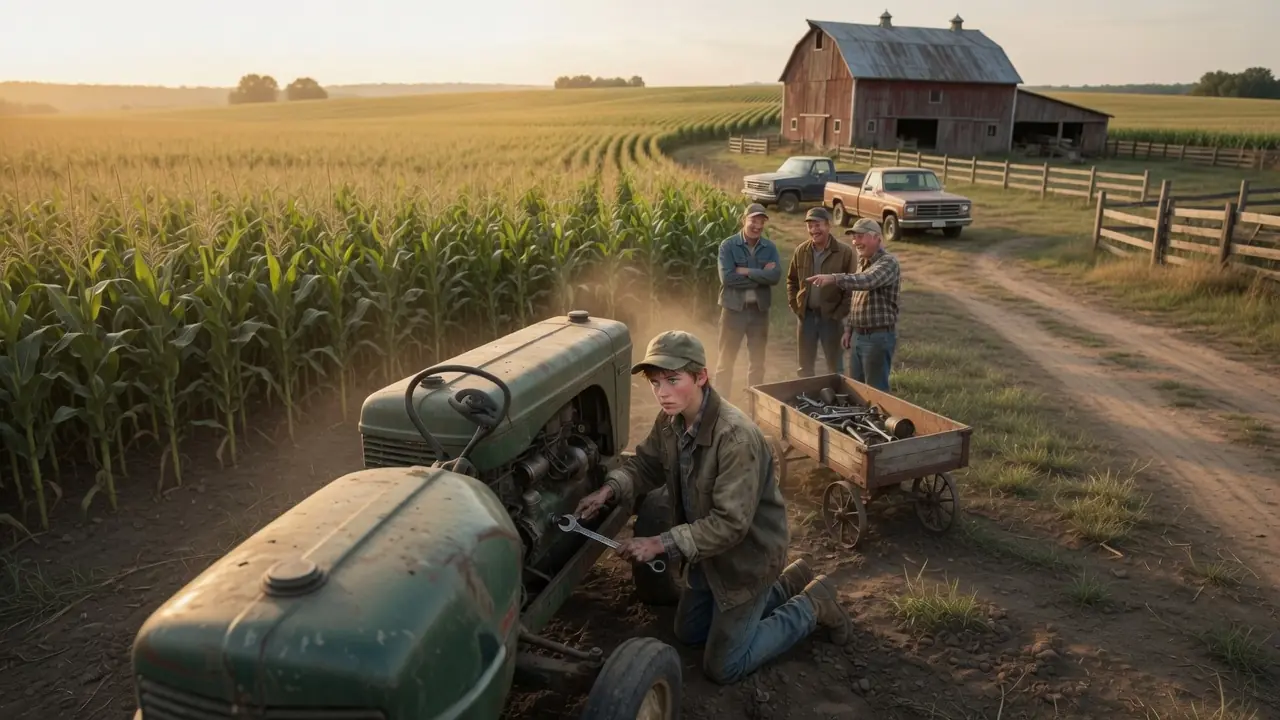
Eli’s corn remained untouched.
When he reached the farm, June sat at the kitchen table with the bank papers spread in front of her.
She looked at the box beneath his arm.
“You got it.”
“Yes.”
“What did Raymond say?”
“He said I cannot save the farm.”
June adjusted her glasses.
“Did he?”
“He said we should sell to Harold Pike.”
“That sounds like Raymond.”
“You knew?”
“I expected it.”
“Why?”
“Because adults confuse likelihood with certainty.”
Eli placed the part on the table.
“Do you think he is right?”
June studied him.
“About what?”
“That I cannot do it.”
She did not answer immediately.
That frightened Eli more than if she had simply said yes.
June folded the bank statement.
“I think one hundred and sixty acres is too much work for one fourteen-year-old boy.”
Eli looked down.
“I also think it was too much for your father alone.”
“He did it.”
“No. He hired hauling when he could. Neighbors helped during breakdowns. Your uncle loaned equipment. You worked beside him.”
“That was different.”
“It was not.”
June reached across the table.
“You are trying to prove you can replace Samuel.”
“I am trying to keep the farm.”
“Those are not the same thing.”
Eli pulled his hand away.
“If we do nothing, the bank gets it.”
“Yes.”
“So I have to do something.”
“Yes.”
“What?”
June nodded toward the machine shed.
“Begin with the part.”
The 4020 sat exactly where Samuel had left it.
Dust covered the hood. A crescent wrench rested on the workbench. Samuel’s brown canvas coat still hung from a nail near the door.
Eli avoided looking at it.
He opened the service manual.
Samuel’s handwriting appeared in the margin beside the hydraulic pump diagram.
SUPPORT PUMP BEFORE REMOVING COUPLING.
CHECK SHAFT SPLINES.
DO NOT FORCE ALIGNMENT.
IF IT DOESN’T FIT, FIND OUT WHY.
Eli read the note twice.
He placed a floor jack beneath the pump and disconnected the battery. The first mounting bolt loosened easily. The second was rusted tight.
He pulled until the wrench slipped and struck his knuckles against the frame.
Blood appeared across two fingers.
For a moment, he wanted to throw the wrench.
Instead, he wrapped the hand in a shop rag and heated the bolt carefully with Samuel’s small propane torch.
It loosened on the second attempt.
By nine that night, the damaged coupling lay on the concrete.
Its internal splines were worn nearly smooth.
Eli compared it with the replacement.
His father had been right.
He greased the new part lightly, aligned the shafts, and reassembled the pump.
Near midnight, he refilled the hydraulic reservoir.
June appeared at the shed door wearing Samuel’s old coat over her nightgown.
“You have school.”
“I know.”
“You need sleep.”
“I need to test it.”
She watched him climb into the seat.
Eli turned the key.
The diesel engine rolled twice before catching.
Smoke filled the open shed.
He waited for the hydraulic pressure.
Then he turned the steering wheel.
The front tires moved.
He pulled the control lever.
The grain-cart tongue rose slowly from the floor.
Eli sat very still.
June leaned against the doorframe.
“Well?”
“It works.”
She smiled.
“Then shut it down before you find another problem tonight.”
The combine was the next problem.
It was a 1976 International 915 belonging to Samuel’s younger brother, David. David had moved to Colorado and no longer farmed, but the machine remained parked at the Greer place.
The combine had not run since the previous harvest.
Mice had nested beneath the cab.
The diesel fuel smelled sour.
Two belts were cracked.
The left rear tire had gone soft.
Samuel had taped a handwritten list to the steering wheel.
DRAIN OLD FUEL.
CLEAN TANK SCREEN.
REPLACE HEADER BELT.
CHECK SICKLE SECTIONS.
GREASE EVERYTHING TWICE.
Eli began after school.
He drained the fuel into old cans and cleaned the tank. He replaced the filters, repaired a chewed wire near the starter, and removed a dead mouse from behind the instrument panel.
The starter clicked but did not turn.
Eli pulled it.
The brushes were worn nearly to nothing.
He called Miller & Sons.
A young parts clerk answered.
“This is Eli Greer. I need brushes for a Delco starter.”
“What machine?”
“International 915.”
There was a pause.
“We are a John Deere dealer.”
“I know.”
“Hold on.”
A different voice came on the line.
Raymond.
“Eli.”
“I need starter brushes.”
“For the combine?”
“Yes.”
“Have you checked the armature?”
“Yes.”
“Commutator?”
“Cleaned it.”
“Bearings?”
“Good.”
Raymond seemed surprised by the answers.
“We can order the brushes. Three days.”
“I do not have three days.”
“The nearest set may be in Lincoln.”
“How far?”
“Ninety miles.”
Eli looked toward the darkening field outside the kitchen window.
“I will drive.”
“You cannot drive to Lincoln alone.”
“I have a license for farm use.”
“Not after dark.”
“I will leave before school.”
Raymond exhaled.
“I’ll see what I can do.”
The next morning, the brushes were sitting in a paper bag beside the dealership door before it opened.
No note.
No invoice.
Only a price written across the top.
Eli left the exact cash beneath the bag and returned home.
By Friday evening, the combine started.
The engine smoked heavily for the first minute, then settled.
Eli tested the header in the yard.
The reel turned.
The auger moved.
The separator engaged without vibration.
He shut it down and smiled for the first time since the funeral.
Then he noticed grain beneath the machine.
A rusted section of the clean-grain elevator had split open.
The repair took another day.
Harvest began Monday afternoon.
Eli attended school until noon under a temporary arrangement approved by the principal. He completed his assignments at night and drove home during lunch.
The first twenty acres were soybeans.
The combine moved slowly but steadily.
Eli filled the grain tank, stopped, climbed into the tractor, pulled the wagon into position, unloaded, then returned to the combine.
Every transfer wasted time.
Samuel had operated the combine while Eli hauled grain.
Now one person had to do both jobs.
By sunset, Eli had harvested nine acres.
At that rate, weather would reach the crop first.
The next day, he managed eleven.
On Wednesday, a sickle section broke.
He lost two hours.
On Thursday, the unloading auger chain jumped.
By Friday, forty-two acres were finished.
At school, students talked about him.
Some admired him.
Others repeated what their parents said.
“The bank will take the place anyway.”
“My dad says he is going to destroy the combine.”
“He should sell before the corn goes down.”
Eli ignored them.
He had no energy left for anger.
Each evening, he returned home covered in dust and grease. June made him eat before repairing whatever had failed that day.
On Sunday, the weather forecast changed.
Strong winds were expected within five days.
The corn stood dry and brittle.
If the stalks snapped, the header could not recover every ear. Losses of even ten bushels per acre could erase the money needed for the bank.
Eli began with the south field.
The first rows fed cleanly.
At the top of the hill, the combine shuddered.
A low vibration passed through the floor.
Eli stopped immediately.
The main separator bearing was hot.
Too hot to touch.
Grease around the seal had turned black.
The bearing was failing.
He shut down the machine and removed the guard.
Metal fragments clung to the housing.
He called three implement dealers.
No one had the correct bearing.
The nearest replacement could arrive in four days.
The wind was due in three.
Eli sat on the rear tire while the corn whispered around him.
For the first time, Raymond Miller’s words felt less cruel than accurate.
You cannot save the farm.
Eli looked toward the machine shed in the distance.
He could sell.
Harold Pike would buy the land.
The bank would be paid.
June could move into town.
Eli could finish school without waking before dawn to check weather and machinery.
He placed his head in his hands.
Then he heard a truck approaching across the field.
A Miller & Sons service vehicle stopped beside the combine.
Raymond climbed out.
He carried a metal housing beneath one arm.
Eli stood.
“How did you know?”
“Your grandmother called the parts desk.”
“I told her not to.”
“She did not ask permission.”
Raymond placed the housing on the tire.
It contained a used bearing assembly.
“Came from a trade-in behind the dealership.”
“How much?”
“Nothing.”
“I pay for parts.”
“Then pay after harvest.”
Eli examined the bearing.
The rollers were smooth.
No discoloration.
Minimal play.
“Why are you helping?”
Raymond looked toward the field.
“I came because I heard your corn was still standing.”
“That is why corn does before harvest.”
“Not this year.”
Eli waited.
Raymond continued.
“Wind took down nearly half the Pike field last night.”
Eli looked across the county road.
From the south field, he could not see the Pike ground.
“Why?”
“Stalk rot.”
“Too much nitrogen?”
“Possibly. Shallow roots too.”
Raymond walked toward one of Eli’s rows and pulled gently against a stalk.
It bent but did not break.
He kicked at the soil.
The ground beneath the residue was firm but not hard.
“What did your father do differently?”
“Planted a rye cover after soybeans. Reduced nitrogen in the low ground. Ran the cultivator shallow so he would not cut the brace roots.”
Raymond looked toward the unharvested corn.
“Your father told me cover crops were a waste of fuel.”
“He told you what you wanted to hear.”
“What does that mean?”
“He stopped buying seed from the dealership because your salesman laughed at him.”
Raymond’s face changed.
“Who?”
“Mr. Dalton. Three years ago.”
Dalton no longer worked there.
Still, the statement landed.
Raymond looked across the field again.
The Greer corn had endured the same drought and wind as every other farm nearby.
Yet the stalks remained upright.
Three weeks after telling Eli the farm could not be saved, Raymond had driven out expecting to find a boy surrounded by failure.
Instead, he found the corn still standing because Samuel Greer had spent years building roots no one could see.
Raymond knelt beside the failed bearing.
“Let’s install this.”
They worked for two hours.
Raymond had begun his career as a mechanic before moving into sales and ownership. His hands were slower than they once were, but he still knew how to align a housing without damaging the shaft.
Eli held the flashlight.
“Why did you tell me to sell?”
Raymond did not look up.
“Because I believed you would fail.”
“That is not a reason.”
“No.”
The older man tightened one bolt.
“I knew your father’s loan situation. I knew the bank. I knew your age.”
“You did not know me.”
“No.”
Raymond sat back on his heels.
“I measured the farm by what was missing.”
“What was missing?”
“Your father.”
Eli looked away.
Raymond continued.
“I did not measure what he left.”
The bearing was installed before dark.
Eli started the combine.
The separator turned smoothly.
Raymond listened.
“Good.”
Eli shut it down.
“The wind comes Wednesday.”
“How many acres remain?”
“One hundred and eighteen.”
“You will not finish alone.”
“I know.”
The admission hurt.
But it was true.
Raymond picked up the old bearing.
“Good.”
Eli frowned.
“What is good about that?”
“You finally said it.”
“Said what?”
“That you cannot do it alone.”
“I never said I had to.”
“You acted like it.”
Raymond walked toward the service truck.
“Be ready at six tomorrow.”
“For what?”
“You’ll see.”
At five forty-five the next morning, Eli heard engines coming down the county road.
One combine appeared first.
Then another.
Then three grain trucks.
Two tractors pulling wagons followed.
By six, more than twenty people stood in the Greer yard.
Some were customers of Miller & Sons.
Some were farmers Samuel had helped during breakdowns.
One was Harold Pike’s own son, Mason.
Eli stared at him.
“My father does not know I am here,” Mason said.
“Why are you?”
“Samuel pulled me from a grain bin when I was seventeen.”
Eli knew the story.
Mason had entered the bin while corn was unloading. Samuel shut down the auger and cut a hole in the side before the grain reached the boy’s chest.
Mason looked toward the field.
“I owe him more than my father wants your creek bottom.”
Raymond climbed onto the porch step.
“We have three combines, six wagons, and enough trucks to keep grain moving.”
Eli looked across the group.
“I cannot pay everyone.”
A retired farmer named Curtis Bell laughed.
“No one asked you to.”
“I do not want charity.”
Raymond shook his head.
“This is not charity. Your father spent twenty-five years repairing equipment after dark, pulling trucks from snow, and helping neighbors finish harvest.”
Eli looked toward June.
She stood in the doorway wearing Samuel’s coat.
“He did not tell me about all of that.”
June smiled sadly.
“Your father never kept an account of kindness.”
Raymond unfolded a field map.
“You know the farm better than anyone here.”
The men turned toward Eli.
For the first time, he understood that they were waiting for him to speak.
He stepped onto the porch.
“South eighty first. Low ground near the creek is soft, so stay east of the marker flags. Unload at the center lane. The north field has a washout near the western fence.”
The farmers listened.
Eli assigned wagons.
Directed trucks.
Set radio channels.
At six twenty, the combines entered the corn.
Rows disappeared beneath the headers.
Grain poured into tanks.
Dust rose above the field in a pale cloud.
Eli operated the old International.
Samuel’s gloves remained inside the cab.
He placed them beside the controls.
By noon, sixty acres were finished.
Wind began increasing from the northwest.
The crews moved to the north field.
At two fifteen, one combine stopped with a broken gathering chain.
Raymond drove to the dealership and returned with a replacement.
At three, a wagon tire blew.
Mason Pike brought another wagon from his family’s farm without asking his father.
At four thirty, the sky turned gray.
The weather radio warned of winds above fifty miles per hour before evening.
Thirty acres remained.
The combines tightened their formation.
Trucks lined the road.
June stood near the field entrance with coffee and sandwiches no one had time to eat.
At five twenty, the first hard gust crossed the corn.
Stalks leaned.
Some snapped near the edge.
Eli increased speed slightly, careful not to overload the separator.
The old machine shook beneath him.
He watched the temperature gauge.
Steady.
Twenty acres.
Then twelve.
The wind pushed dust across the windshield.
A metal panel on the grain cart began flapping.
Men secured it with wire and continued.
Six acres remained.
Three combines entered the final rows side by side.
Eli looked through the glass toward the northern boundary.
Samuel had driven those rows every year.
His hands had planted them.
His decisions had kept the roots strong.
The boy was not saving the farm alone.
He was completing work his father had begun long before dying.
At six eleven, the final ears disappeared beneath the header.
Eli reached the fence and disengaged the machine.
He shut off the engine.
Wind moved across the empty field.
For several seconds, he remained inside the cab.
The harvest was finished.
The promise was kept.
But Samuel was not there to see it.
Eli placed both hands over his face.
When he climbed down, the crew stood near the field entrance.
No one cheered immediately.
They knew what the moment cost.
June reached him first.
“We did it,” Eli said.
She took his face between both hands.
“No.”
Eli looked confused.
“You kept going long enough for people to reach you.”
She looked toward the farmers.
“That is what saved it.”
Raymond stood several steps away.
Eli approached him.
“You came because the corn was standing.”
“Yes.”
“Did you think it would not be?”
Raymond looked across the harvested field.
“I expected the wind to take it.”
“Why?”
“Because I looked at the age of your equipment, your debt, and your age. I assumed the field had been managed with the same weakness.”
Eli waited.
Raymond removed his cap.
“I was wrong.”
Several farmers became quiet.
The dealer continued.
“I told you that you could not save the farm because your father was gone.”
His voice lowered.
“I should have understood that a good farmer’s work remains after him.”
Eli looked toward the stubble.
“The roots were deeper than they looked.”
Raymond nodded.
“So were you.”
The harvest produced better yields than the bank expected.
The corn averaged one hundred and seventy-two bushels per acre. The soybeans reached fifty-one.
After drying, storage, and operating expenses, the Greers had enough to make the December payment.
Barely.
The farm was not safe yet.
But it had another year.
Then the final surprise arrived.
First Plains Bank officer Charles Nevin visited the farmhouse carrying Samuel’s loan file.
He sat with June and Eli at the kitchen table.
“Your father purchased a debt-protection policy two years ago.”
June adjusted her glasses.
“What policy?”
“It pays the remaining land balance if the primary borrower dies unexpectedly.”
Eli stared at Samuel’s signature.
“Why did he buy it?”
Charles hesitated.
“Samuel experienced chest pain the previous winter.”
Eli looked at June.
“You knew?”
“He told me it was indigestion.”
“The doctor recommended more tests,” Charles said. “Samuel postponed them.”
“Why?”
“Planting. Then spraying. Then harvest.”
Eli stood abruptly.
“He taught me never to ignore a warning.”
June’s eyes filled.
“People often care for land better than they care for themselves.”
The policy paid almost the entire remaining mortgage.
The harvest covered the operating note.
For the first time in decades, the Greer farm entered winter without the bank holding its future.
That evening, Eli went to the machine shed.
He stood beside the 4020 where Samuel’s coat still hung from the nail.
Behind the seat, he noticed a white envelope wedged inside the manual pouch.
His name was written across it.
ELI.
He opened it.
Son,
If you find this before I remember to give it to you, then life moved faster than I planned.
Do not keep the farm because you think you owe me.
Land is worth loving, but it is not worth becoming trapped inside a dead man’s dream.
Farm it if the work becomes yours.
Sell it if it does not.
You owe me honesty, not sacrifice.
One more thing.
No farmer works alone.
Your grandfather helped me. Neighbors helped me. You helped me more than you know.
A man who refuses every hand eventually loses the strength to hold his own tools.
Ask when you need help.
Give it before someone asks.
That is how a farm outlives the farmer.
Dad
Eli read the letter three times.
Then he carried it into the house.
June cried quietly as she read.
Over winter, Eli returned to school full-time.
He worked on the farm after class and during weekends, but he stopped trying to become Samuel overnight.
Mason Pike helped with tillage.
Raymond arranged for Eli to spend Saturdays inside the dealership service department, learning proper repair procedures under experienced mechanics.
The first morning Eli returned, he crossed the same showroom floor wearing Samuel’s boots.
They still did not fit perfectly.
Raymond stood behind the counter.
“Need another part?”
“No.”
“What are you here for?”
“To work.”
Raymond looked toward the service bay.
“You know, we sell boots in the clothing section.”
“These are fine.”
“They are too large.”
Eli glanced down.
“I am growing into them.”
Raymond smiled.
“I suppose you are.”
Eli did not become famous.
The Greer farm did not expand into thousands of acres.
He did not purchase a line of new machinery or transform the place into the richest operation in Clay County.
He finished high school.
Studied agricultural mechanics.
Returned home.
He added cover crops, improved drainage, and rebuilt the old International combine one system at a time.
The 4020 continued working.
The farm remained one hundred and sixty acres because Eli learned that survival was not measured by how much land a person could control.
It was measured by whether the land could endure another generation.
Harold Pike never acquired the creek bottom.
His son Mason eventually took over the Pike operation and repaired the relationship between the families.
Raymond Miller retired when Eli was thirty-one.
At the retirement dinner, he told the story of the fourteen-year-old boy who came for a coupling nine days after burying his father.
“I saw a child carrying a debt,” Raymond said. “I should have seen a farmer carrying instructions.”
Eli stood near the back of the room.
Raymond looked toward him.
“Three weeks later, I drove to his farm because I could not understand why the corn was still standing after the county’s strongest wind.”
He paused.
“The answer was beneath the ground. Samuel Greer had spent years building roots no storm could easily pull loose.”
Then he smiled faintly.
“The same was true of his son.”
Years later, people told the harvest story as though Eli alone had cut every acre.
He corrected them every time.
“I ran one combine,” he said. “The county harvested the farm.”
When asked why so many people came, Eli gave the same answer.
“My father spent his whole life arriving when other people’s machines stopped.”
He kept Samuel’s letter inside the farm office.
The boots eventually became too small.
By the time Eli was seventeen, his toes pressed against the leather.
He cleaned them, stuffed them with newspaper one final time, and placed them on a shelf above the workbench.
Not as a symbol that he had become his father.
He had not.
No child does.
He kept them because they reminded him of the morning he walked into the dealership believing saving the farm meant filling Samuel’s place alone.
The farm survived because that belief was wrong.
Samuel had not left Eli an empty position.
He left knowledge.
Deep roots.
Paid insurance.
Repair notes.
And twenty-five years of kindness scattered through the county, waiting to return when his son needed it most.
The dealer drove out expecting to see corn falling.
Instead, he found a field still standing.
He thought the mystery was agricultural.
Part of it was.
The rest was human.
Good soil holds a crop through wind.
Good people hold a family through grief.
And sometimes what saves a farm is not the strength of the boy left behind.
It is everything his father quietly planted before he had to leave.