Warren Caldwell first realized he had misjudged Luke Mercer when he saw the corn.
It was still standing.
The field stretched across the low Nebraska hills beneath a sky the color of dirty steel. Wind bent the rows from west to east, carrying dry leaves across the county road and shaking the doors of Warren’s service truck.
Several farms nearby had already suffered damage.
Corn lay twisted across the Henderson ground. Stalks had snapped near the roots on the western half of Oliver Pike’s property. The radio forecast warned that gusts could exceed fifty miles per hour by the following evening.
Yet the Mercer corn remained upright.
Not perfectly.
The outer rows leaned, and patches near the hilltop showed signs of stress. But most of the stalks rose straight beneath the wind, their roots holding inside dark soil covered with the remains of last year’s rye.
Warren slowed his truck.
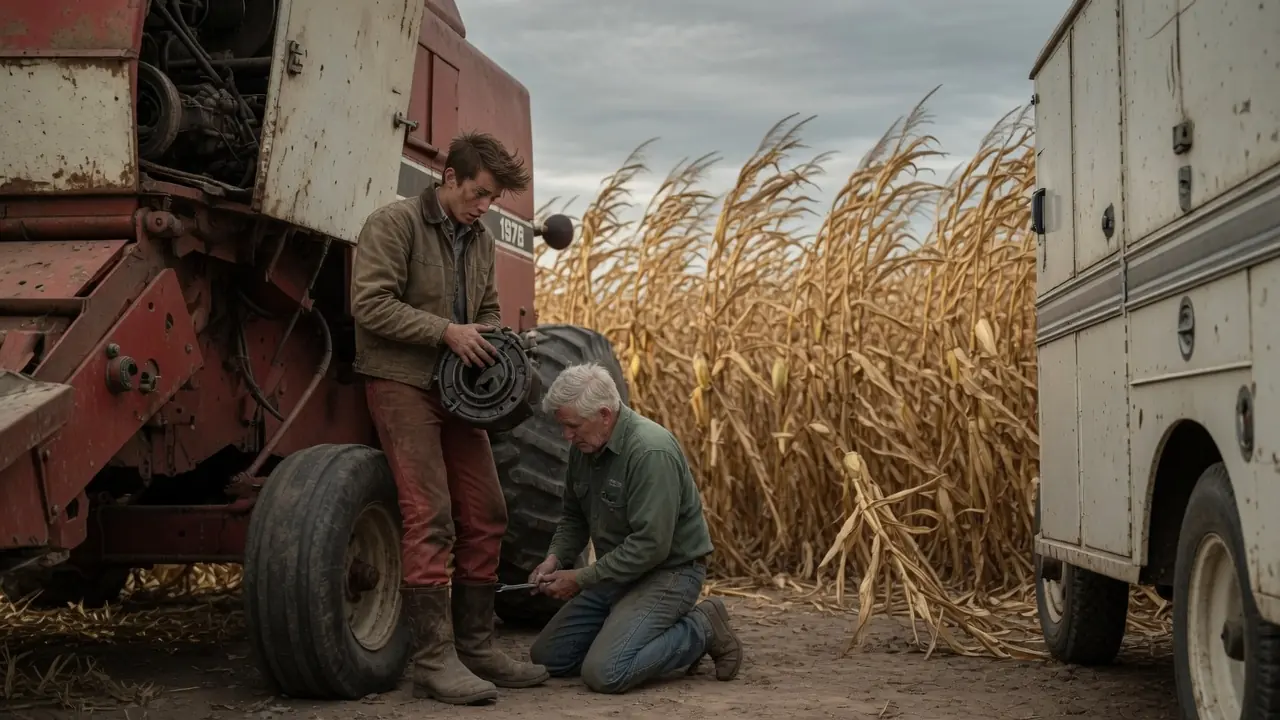
An old International combine sat motionless near the center of the field.
A boy was sitting on one of its rear tires with his head lowered into both hands.
From a distance, Luke Mercer looked even younger than fourteen.
Warren had driven out carrying a used separator-bearing assembly in the passenger seat. He told himself he was making a service call because Luke’s grandmother had contacted the dealership.
That was only partly true.
He had also come to see whether his prediction had been correct.
Three weeks earlier, Warren had told the boy that he could not save the farm.
Now the boy’s machinery had failed with more than one hundred acres still unharvested.
The wind was approaching.
The bank payment was due in December.
Everything appeared to prove Warren right.
But the corn would not cooperate.
It stood there like an accusation.
Warren parked beside the combine and shut off the engine.
Luke raised his head.
Dust covered his face. A dark line of grease crossed one cheek, and dried blood marked two knuckles on his right hand.
He did not look surprised to see Warren.
He looked tired.
“How did you know?” Luke asked.
“Your grandmother called our parts department.”
“I told her not to.”
“Ruth Mercer has never allowed instructions to interfere with her judgment.”
Warren lifted the bearing assembly from the truck.
Luke stood.
“How much?”
“We’ll discuss it later.”
“I don’t take free parts.”
“It isn’t free.”
“What does it cost?”
Warren looked toward the field.
“Let me help install it.”
Luke studied him as though searching for a hidden condition.
Warren could not blame him.
During their last conversation, the dealership owner had offered advice the boy never requested and treated surrender as though it were the only responsible choice.
Luke pointed toward the damaged housing beneath the combine.
“The shaft looks good. Bearing seized and damaged the seal, but I shut it down before it cut into the mount.”
“You checked the alignment?”
“Yes.”
“Heat discoloration?”
“Only on the inner race.”
Warren looked at him more carefully.
“You removed the housing yourself?”
“Yes.”
The answer should not have surprised him.
It did anyway.
Warren placed the replacement assembly on the tire.
“Show me.”
Luke led him to the exposed separator shaft.
The guards had been removed and arranged neatly on a tarp. Bolts were grouped inside labeled coffee cans. The failed bearing sat on a folded shop rag beside the service manual.
Nothing had been thrown carelessly into the dirt.
Warren picked up the old bearing.
The rollers were broken, but the shaft itself appeared undamaged.
“You caught it early.”
“The vibration changed.”
“You felt it?”
“Through the floor.”
Warren had employed trained technicians who ignored worse warning signs until metal came apart.
“What were you running?”
“About seventy percent load.”
“Why not faster? Weather’s coming.”
Luke looked at him.
“Because old machinery doesn’t care about my deadline.”
The words sounded like something Benjamin Mercer would have said.
Warren turned toward the corn.
“What did your father do to this field?”
Luke followed his gaze.
“Planted rye after soybeans.”
“Ben told me cover crops cost more fuel than they saved.”
“He stopped telling you what he was doing.”
“Why?”
“Your seed salesman laughed at him.”
Warren’s face tightened.
“Which salesman?”
“Dalton.”
Dalton had left the dealership two years earlier after several complaints about his treatment of smaller customers.
Warren had believed the problem concerned impatience and poor communication.
He had not asked enough questions.
“What else did Ben change?” Warren asked.
“Reduced nitrogen in the low ground. Added clover. Stopped deep cultivation near the hill because it cut brace roots.”
Warren walked into the nearest row.
He pushed against a stalk.
It bent and returned.
He scraped aside the residue with his boot and found the soil beneath it damp despite nearly three weeks without meaningful rain.
Across the road, Oliver Pike’s field had been cultivated bare between seasons. Wind had dried the surface, and shallow roots had failed under the first strong gusts.
Warren knelt and pressed his fingers into Mercer soil.
Ben had been building resilience where no one could see it.
The dealer stood again.
“Let’s install the bearing.”
Luke hesitated.
“Why are you helping now?”
Warren removed his coat and placed it inside the service truck.
“Because the machine is broken.”
“It was broken when I came to your dealership.”
The sentence stopped him.
Three weeks earlier, Luke had entered Caldwell Agricultural Equipment wearing boots that belonged to his dead father.
Warren remembered the sound before he remembered the boy’s face.
The leather heels dragged slightly across the polished showroom floor. Each step produced a soft scrape, followed by a heavier impact as Luke’s foot shifted inside a boot nearly an inch too long.
No one greeted him.
Warren noticed that now when he replayed the morning.
Three salesmen were present.
A parts clerk stood behind the second counter.
Two farmers drank coffee beside the service window.
All of them saw the boy.
No one asked what he needed.
Luke walked straight toward Warren.
“My father ordered a hydraulic pump coupling.”
Warren looked over his glasses.
“Benjamin Mercer’s son?”
“Yes, sir.”
The dealership became quieter.
Everyone in Clay County knew Benjamin Mercer had died.
He collapsed beside the grain bin during the final week of August. Luke found him against the concrete foundation and called for help, but the ambulance arrived too late.
Benjamin was forty-seven.
He had raised Luke alone since a car accident killed the boy’s mother nine years earlier.
The Mercer farm covered only one hundred and sixty acres. It was heavily mortgaged, surrounded by larger operations, and dependent on machinery old enough to have been repaired several times by men who were now dead.
Benjamin had never been one of Warren’s best customers.
He purchased used parts, delayed equipment upgrades, and challenged salesmen whenever they claimed a newer machine would solve problems created by poor soil or careless maintenance.
Warren respected him.
He also considered him stubborn.
“I’m sorry about your father,” Warren told Luke.
“Thank you.”
“What part did he order?”
“A pump coupling for the 4020.”
“That tractor is still down?”
“Yes.”
“When did it fail?”
“Three days before Dad died.”
Warren found the order in the parts system.
Paid in full.
Ready for pickup.
He could have handed over the box.
Instead, he looked at the boy’s jacket, the mud on his jeans, and the oversized boots.
He saw a child trying to perform an adult’s work.
And Warren became afraid.
Twenty-six years earlier, his own seventeen-year-old son had died beneath a raised corn header.
Matthew Caldwell had been helping at the dealership during harvest season. A hydraulic line failed while he was clearing debris. The safety stop was not installed.
Warren found him.
For years afterward, he could not watch young people work near machinery without imagining metal lowering unexpectedly.
He never spoke about it to customers.
Most of his younger employees knew only that Warren enforced safety rules with an intensity that sometimes resembled anger.
When Luke asked for the coupling, Warren did not see Benjamin’s training in the boy’s hands.
He saw Matthew.
“Come sit in my office,” Warren said.
“I only need the part.”
“There are things we should discuss.”
Luke remained at the counter.
Warren lowered his voice.
“Your father had a significant operating loan.”
“I know.”
“Seed, fuel, fertilizer, and a land payment.”
“I know that too.”
“When is the next payment due?”
“December fifteenth.”
Warren expected uncertainty.
Instead, Luke answered immediately.
“How much?”
“Twenty-nine thousand, seven hundred and forty dollars.”
One of the farmers near the coffee machine slowly lowered his cup.
“Who is handling the estate?” Warren asked.
“My grandmother.”
“Ruth?”
“She moved into the farmhouse.”
Ruth Mercer was seventy-one and walked with a cane after two knee replacements. She could sign documents.
She could not harvest one hundred and sixty acres.
“What exactly are you planning to do?” Warren asked.
“Fix the tractor.”
“After that?”
“Harvest.”
“By yourself?”
Luke nodded.
A salesman near the office gave a quiet laugh.
Warren looked toward him.
The laughter stopped.
But Warren did not defend the boy.
That omission stayed with him longer than anything he said afterward.
“Your father farmed for twenty-five years,” Warren continued.
“I know.”
“He understood the machinery, weather, loans, storage, and marketing.”
“He taught me.”
“You still have school.”
“I can work after class.”
“You cannot harvest the whole farm after school.”
“I can work weekends.”
“The corn is dry enough now.”
“That is why I came for the part.”
Warren removed his glasses.
He believed he was about to prevent another tragedy.
He told himself honesty was kinder than encouragement.
“Luke, you need someone to tell you the truth.”
The boy’s fingers tightened around the receipt.
“You cannot save that farm.”
No one moved.
“Why not?” Luke asked.
“Because you are fourteen.”
“The tractor doesn’t know that.”
“That is not the point.”
“Then what is?”
“Farming is not turning a key. It is credit, insurance, hauling, storage, repairs, contracts, and decisions that can cost your family everything.”
“My father taught me.”
“Your father is not here.”
The words came out too hard.
Warren saw the change in Luke’s eyes.
No tears.
No anger.
Only a door closing.
Warren tried to soften his tone.
“I’m trying to keep you from losing more.”
“You think selling the farm would do that?”
“Yes.”
Warren knew Oliver Pike had asked about the Mercer land for years. The creek bottom connected to Pike’s western acreage and included valuable irrigation access.
“Pike might make a fair offer before the bank becomes involved,” Warren said.
“My father refused him.”
“His circumstances were different.”
“He refused because Pike wanted the water rights.”
“You know about that?”
“My father told me.”
“The land may be worth more sold than operated.”
“To Pike.”
“To your family.”
Luke looked at the coupling box behind the counter.
“Give me the part.”
Warren hesitated.
“If I give it to you, you will crawl under that tractor alone.”
“My grandmother will be home.”
“That does not make it safe.”
“My father wrote the repair steps in the manual.”
The boy placed the receipt on the counter.
“The part was paid for.”
Warren had no legal reason to withhold it.
He placed the box in front of Luke.
The boy picked it up.
Before he reached the showroom door, Warren called after him.
“There is no shame in selling before the bank takes it.”
Luke turned.
“There is no shame in trying before it does.”
Then he left.
For several days, Warren tried to forget the conversation.
The dealership entered harvest season.
Phones rang continuously.
Technicians worked overtime.
Farmers arrived angry about belts, bearings, sensors, pumps, and parts that could not be delivered quickly enough.
Luke called two mornings later asking for starter brushes for an International 915 combine.
The parts clerk nearly dismissed him because Caldwell Agricultural Equipment was a John Deere dealership.
Warren took the call.
“You checked the armature?” he asked.
“Yes.”
“Commutator?”
“Cleaned it.”
“Bushings?”
“Good.”
“Solenoid?”
“Working.”
Luke knew what he was looking at.
The correct brushes were ninety miles away in Lincoln.
“I’ll drive,” the boy said.
“No.”
“I have a farm permit.”
“Not for a ninety-mile trip before daylight.”
“I don’t have three days.”
Warren called a dealer he knew and arranged for the brushes to be sent overnight with a parts truck already traveling east.
He left the paper bag beside the service entrance before opening time.
Luke took it and left the exact amount of cash beneath the door.
No thank-you note.
No request for credit.
Warren told himself the boy’s pride would exhaust itself.
Then he began hearing reports.
The old 4020 was working.
The International combine had started.
Luke had repaired a split clean-grain elevator.
The school principal allowed him to leave at noon if assignments remained complete.
Farmers passing the Mercer property saw the boy moving slowly through the soybeans.
Nine acres one day.
Eleven the next.
Each time the grain tank filled, Luke stopped the combine, climbed down, drove the tractor and wagon into position, unloaded, then returned to the combine.
He was doing the work of two people.
Warren heard men at the dealership discuss it.
“Waste of time.”
“The bank will get the farm anyway.”
“Somebody should stop him before he ruins the machinery.”
Warren said little.
Part of him agreed.
Another part counted every acre.
When Ruth called about the separator bearing, Warren immediately checked the inventory.
No new assembly was available.
Then he remembered an International trade-in behind the rear storage building.
The machine was being dismantled for scrap.
Its separator housing had been replaced the previous year.
Warren removed it himself.
A younger mechanic offered to go.
Warren refused.
He drove to the Mercer farm because he believed Luke had reached the moment when effort would finally surrender to mathematics.
Too many acres.
Too little time.
One broken machine.
One approaching storm.
Yet standing beside the old combine, Warren found no defeated child.
He found a mechanic who had shut the machine down before secondary damage occurred.
And he found corn rooted more deeply than neighboring crops.
Warren and Luke worked until sunset.
They cleaned the shaft, checked the mount, and installed the used housing. Luke followed every step closely but did not hover.
When Warren reached for the wrong bolt length, the boy corrected him.
“That one holds the upper guard.”
Warren compared the bolts.
Luke was right.
“You labeled them?”
“My father said memory becomes dishonest after midnight.”
Warren looked at the service manual.
Benjamin’s handwriting filled the margins.
Notes about belt tension.
Bearing temperature.
Places where the manual’s instructions were technically correct but impractical on an old machine.
The father had left a conversation inside the pages.
Luke was still listening.
When the new assembly was secured, Warren sat back on his heels.
“Why didn’t you ask anyone for help?”
Luke kept his eyes on the bearing.
“I asked for the part.”
“That is not what I mean.”
“Everyone said I should sell.”
“Not everyone.”
“Enough.”
Warren wiped his hands.
“You cannot finish one hundred and eighteen acres before the wind arrives.”
Luke’s face tightened.
“I know.”
Warren waited.
The boy did not argue.
That admission changed everything.
“What would your father do?” Warren asked.
“He would call people he had helped.”
“Then why haven’t you?”
“Because they helped him. Not me.”
Warren looked toward the darkening field.
“You think kindness dies with the person who gave it?”
Luke did not answer.
Warren stood.
“Have the combine ready at six tomorrow.”
“For what?”
“Harvest.”
Luke looked suspicious.
“With who?”
“We’ll find out.”
Warren spent most of that night making telephone calls.
He began with farmers who owed Benjamin favors.
Frank Nolan had once broken an axle during soybean harvest. Benjamin worked until two in the morning helping repair it.
The Ruiz family lost a tractor in a snow-filled ditch. Benjamin pulled it free.
Ethan Pike nearly suffocated inside a grain bin at seventeen. Benjamin stopped the auger, cut through the bin wall, and pulled him out.
One call became another.
Nobody asked how much they would be paid.
Some could not come because their own crops were waiting.
Others offered trucks, wagons, fuel, or parts.
At four thirty in the morning, Warren’s wife found him at the kitchen table writing names on a field map.
“You are helping the Mercer boy,” she said.
“Yes.”
“You told me he should sell.”
“I was wrong.”
She poured coffee.
“You rarely say that before sunrise.”
“I may not get another chance.”
At 5:45, engines began arriving at Mercer Farm.
Warren brought the first combine.
Frank Nolan brought another.
A third came from a customer twenty miles south.
Six wagons and three grain trucks followed.
Ethan Pike arrived without his father’s knowledge.
Luke stood in the yard staring at them.
“I cannot pay everyone,” he said.
Frank Nolan laughed.
“Your father never sent an invoice when my axle broke.”
“This isn’t charity,” Warren told the boy. “It is an account your father never collected.”
Ruth stood in the farmhouse doorway wearing Benjamin’s brown canvas coat.
Luke looked toward her.
“He never told me.”
“He did not help people so you would admire him,” she said.
Warren unfolded the field map.
“You know the land. Tell us where to begin.”
The men turned toward Luke.
For several seconds, the boy looked ready to step backward.
Then something settled inside him.
“South eighty first,” he said. “The creek bottom is soft, so keep heavy carts east of the marker flags. Use the center lane for unloading. There’s a washout near the western fence in the north field.”
He assigned radio channels and wagon routes.
No one questioned him.
At 6:20, the first headers entered the corn.
Warren had participated in community harvests before.
Usually they followed illness, fire, or a fatal accident. Farmers arrived, worked efficiently, ate food prepared by neighbors, and left before gratitude became uncomfortable.
This harvest felt different.
Benjamin was already gone.
The emergency had waited several weeks to reveal itself.
It lived inside a boy trying to replace two workers, a bank deadline approaching winter, and machinery that failed one component at a time.
Luke drove the old International.
Warren operated a grain cart beside him.
The boy’s movements were careful.
He did not race the machine.
He listened to it.
When engine speed changed, Luke reduced his ground pace before gauges showed a problem.
Benjamin had trained him well.
By noon, sixty acres were finished.
Wind increased after lunch.
At 2:15, one combine broke a gathering chain. Warren drove to the dealership and returned with a replacement.
At three, a wagon tire failed.
Ethan Pike brought another wagon from his family’s yard.
“My father is going to be furious,” he told Warren.
“Will that stop him eating grain produced by neighbors?”
“No.”
“Then keep moving.”
At four thirty, the weather radio issued a high-wind warning.
Thirty acres remained.
The first hard gust crossed the field shortly after five.
Corn leaned.
Dust covered the road.
Warren drove beside Luke’s combine and watched the grain-tank indicator rise.
“Your tank is nearly full,” he said over the radio.
“I can reach the center lane.”
“We don’t have time. Unload moving.”
Luke extended the auger.
Warren brought the cart alongside.
For several tense minutes, grain poured between two moving machines while the wind pushed both toward the rows.
Luke held the combine steady.
Twenty acres remained.
Then twelve.
A metal panel came loose from one cart. Two farmers secured it with wire and returned to work.
Six acres.
Three combines entered the final rows together.
Warren looked through the dust toward Luke’s cab.
On the floor beneath the boy’s seat rested Benjamin’s old boots.
Luke was not wearing them.
He wore his own work boots now.
That detail stayed with Warren.
The boy had walked into the dealership dressed in what his father left behind.
In the field, he had finally begun standing in something that fit him.
At 6:11, the final corn entered the headers.
The combines reached the northern fence and stopped.
Engines shut down one after another.
Wind continued across the stubble.
Luke remained inside the cab.
No one called for him to come down.
No one cheered.
They understood that completing the harvest did not return Benjamin.
Eventually, the cab door opened.
Luke climbed down.
His grandmother reached him first.
“We did it,” he whispered.
Ruth placed both hands against his face.
“No, sweetheart.”
Luke looked confused.
“You continued until people could reach you.”
She turned toward the assembled farmers.
“That is what saved us.”
Warren removed his cap.
Luke approached him.
“You expected the crop to fall.”
It was not phrased as a question.
“Yes,” Warren admitted.
“Because of the wind?”
“Because I saw your machinery, the debt, and your age. I assumed weakness in one place meant weakness everywhere.”
Luke looked across the harvested field.
“The roots were stronger than they looked.”
“So were you.”
Warren wanted to say more.
He wanted to apologize for the showroom, the laughter he failed to stop, and the sentence about Benjamin not being there.
Instead, he said only what he could say honestly in front of everyone.
“I was wrong.”
Luke nodded.
He did not forgive him immediately.
Warren respected that.
The harvest produced enough grain to cover the December operating payment after drying, hauling, and storage expenses.
Barely.
The family had earned another season.
Then a bank officer discovered a debt-protection policy Benjamin purchased two years earlier.
The policy paid most of the remaining land mortgage in the event of his unexpected death.
Warren heard about it when Ruth visited the dealership carrying a copy of the document.
“Benjamin planned better than any of us knew,” Warren said.
Ruth looked tired.
“He planned for dying better than he planned to stay alive.”
The previous winter, Benjamin had experienced chest pain.
A doctor recommended further testing.
Benjamin postponed it through planting, spraying, and harvest.
“He taught Luke never to ignore a machine’s warning,” Ruth said. “Then he ignored his own.”
The statement stayed with Warren.
Machines warned people.
So did bodies.
So did frightened boys walking through showrooms in oversized boots.
The difference was whether anyone listened.
Luke returned to school full-time that winter.
Warren offered him Saturday work in the dealership service department.
The first morning, Luke entered through the showroom.
He wore Benjamin’s boots again.
Warren looked down.
“Those still don’t fit.”
“They work.”
“We sell boots.”
“I know.”
“You have money now.”
“That doesn’t mean I should waste it.”
Warren almost heard Benjamin speaking.
“What are you here to do?” he asked.
“Learn.”
Warren pointed toward the service bays.
“Start by sweeping.”
Luke did not complain.
Over the following years, Warren watched him grow.
Luke studied agricultural mechanics, returned to the farm, and modernized only where the change solved an actual problem.
He expanded cover cropping.
Improved drainage.
Reduced unnecessary tillage.
Rebuilt the International combine section by section.
The Mercer farm remained one hundred and sixty acres.
Luke rejected opportunities to rent more ground when the numbers did not support it.
Warren once asked why he did not want to become one of the county’s largest operators.
Luke answered, “Dad spent too many years growing debt faster than soil.”
Warren could not argue.
Oliver Pike never acquired the creek bottom.
When Ethan Pike eventually took over his family’s operation, he repaired the relationship between the farms and began using some of Luke’s soil practices.
The old dealership changed too.
Warren removed sales targets that rewarded employees only for moving larger equipment.
He required staff to document customer needs before recommending machinery.
He also established a rule that no child entering the showroom could be ignored, even if the child appeared to be there only for a free calendar.
When employees asked why, Warren told them about Luke.
Not the harvest at first.
The entrance.
The boots.
The receipt held too tightly in one hand.
“I saw a child carrying debt,” Warren said. “I failed to see a farmer carrying knowledge.”
Years later, at Warren’s retirement dinner, Luke stood near the back of the room.
He was thirty-two, married, and still farming the same land.
Warren had prepared a speech about employees, customers, and forty-one years in the equipment business.
He abandoned most of it.
Instead, he told the story of the corn.
“I drove to Mercer Farm expecting to find a boy surrounded by proof that I had been right,” Warren said.
The banquet room became quiet.
“I found a failed bearing and more than one hundred acres still waiting. Every calculation said the farm was in trouble.”
He looked toward Luke.
“But the corn was still standing.”
Warren explained the rye, clover, reduced tillage, and stronger roots.
Then he paused.
“For years, I described that as an agricultural lesson.”
He shook his head.
“It was not only that.”
Luke watched from the rear table.
“Benjamin Mercer had spent twenty-five years helping neighbors without keeping track. When his son finally needed help, those people returned like a crop planted long before the boy knew it existed.”
Warren removed his glasses.
“I told Luke that he could not save the farm because his father was gone.”
His voice became quieter.
“The truth was that his father remained everywhere that mattered.”
In the service manual.
In the soil.
In the insurance papers.
In every neighbor who remembered a repair made after midnight.
Warren looked directly at Luke.
“And in the judgment of a fourteen-year-old boy who knew enough to shut down an old combine when the vibration changed.”
The room laughed softly.
Luke smiled.
Afterward, he approached Warren carrying a small wooden box.
Inside was the failed separator bearing from that harvest.
The metal had been cleaned but not polished.
A brass plate beneath it read:
THE PART THAT BROKE BEFORE THE FARM DID
Warren stared at it.
“You kept this?”
“My grandmother did.”
“Why give it to me?”
“Because you brought the replacement.”
Warren looked at Luke.
“After telling you to quit.”
“Yes.”
“I was not very kind.”
“No.”
Warren waited.
Luke continued.
“But you came back.”
The answer did not erase the earlier harm.
It did something more useful.
It acknowledged that a man could be wrong, recognize it, and choose a different action before the final row was lost.
Warren placed the bearing inside his retirement office at home.
Beside it stood a photograph of Matthew, his son.
For decades, Warren believed protecting young people meant preventing them from facing dangerous responsibility.
Luke taught him that protection could also mean giving someone proper tools, standing nearby, and allowing their knowledge to matter.
The Mercer farm never became famous.
Its harvest did.
Over time, people changed the details.
Some claimed Luke repaired the combine entirely alone.
Others said he harvested all one hundred and sixty acres before the storm.
A few insisted Warren donated a new John Deere machine.
None of that happened.
The truth was less spectacular.
A boy fixed what he could.
A bearing failed.
A dealer admitted his judgment had been wrong.
Neighbors brought machines.
And a county finished the harvest together.
Luke kept Benjamin’s letter in the farm office.
It reminded him not to preserve the property only from guilt.
He continued farming because the work became his—not because he believed a son had to complete every dream his father left unfinished.
Benjamin’s boots eventually became too small.
Luke cleaned them and placed them on a shelf above the workbench.
Warren saw them once during a visit.
“You finally outgrew them,” he said.
Luke looked at the shelf.
“I stopped needing them to fit.”
Outside, the old 4020 was attached to a grain wagon. The International combine waited inside the shed, its separator turning smoothly after another rebuild.
Beyond the buildings, winter rye covered the soil between harvest seasons.
The roots grew unseen.
That was the part Warren finally understood.
People often noticed a farm only when machinery entered the field and grain began moving.
They noticed character the same way—during the visible crisis, when a child climbed into a combine or a community arrived before a storm.
But endurance was built earlier.
In decisions no one praised.
In soil protected after harvest.
In repair notes written for someone who might need them later.
In insurance purchased quietly.
In favors given without keeping an account.
Warren had driven out expecting to witness the moment Luke Mercer lost his father’s farm.
Instead, he saw evidence of everything Benjamin Mercer had planted before his death.
The corn stood because its roots were deep.
The boy endured because his were too.
And when neither roots nor determination could finish the harvest alone, people came down the county road carrying the strength that one good farmer had spent a lifetime leaving behind.