The dealer’s hand came down on the box before Eli Greer could reach the loading-bay steps.
“Put it back.”
Eli stopped.
The heavy governor housing pressed against his chest, its sharp cardboard corners digging through the thin fabric of his faded gray T-shirt. His black funeral jacket hung awkwardly from his narrow shoulders, still wrinkled from the service nine days earlier. His father’s brown farm boots were two sizes too large, and each time Eli shifted his weight, his heels lifted inside them.
Behind him, an open delivery truck idled beside the rear loading dock of Whitaker John Deere. Green tractors stood in neat rows beyond the building. Wooden pallets were stacked beneath metal shelving, and two warehouse employees in gray uniforms had stopped unloading boxes to watch.
Harold Whitaker kept one hand pressed firmly against the part.
With the other, he pointed toward the distant county road.
“Go home, son.”
Eli looked at him through tired blue eyes.
“My father ordered this.”
“I know who ordered it.”
“He paid half.”
“I know that too.”
Eli’s jaw tightened.
The worn leather wallet in his back pocket held twenty-one dollars, almost every dollar he had saved from cleaning stalls, repairing fence, and helping a neighbor stack hay during the summer.
Harold’s narrow hazel eyes moved over the boy’s funeral coat, dusty jeans, and oversized boots.
“You don’t need a tractor part,” he said. “You need an adult who understands what’s happening.”
“I understand.”
“No, you don’t.”
Harold lowered his voice, but the contempt in it remained.
“Your father is gone. Your mother has never run a corn picker. You’re fourteen years old, and there are one hundred sixty acres standing out there while every real farmer in the county is already halfway through harvest.”
Eli did not look away.
“The corn is still good.”
“It won’t stay good.”
“I can bring it in.”
One of the warehouse employees glanced at the other.
Harold gave a short, humorless laugh.
“You?”
“Yes.”
“With a forty-eight-year-old tractor that cannot hold speed under load?”
“That’s why I need the part.”
Harold leaned closer.
“I have watched grown men lose farms with newer equipment, more money, and thirty years of experience. You think grief makes you stronger than all of them?”
Eli’s eyes became wet, but his voice stayed steady.
“No.”
“Then stop pretending.”
“I’m not pretending.”
Harold pressed harder against the box.
“You want the honest truth? Sell the crop standing. Let a neighbor rent the ground. Give the bank what it wants and save your mother from losing the house too.”
The words hung between them.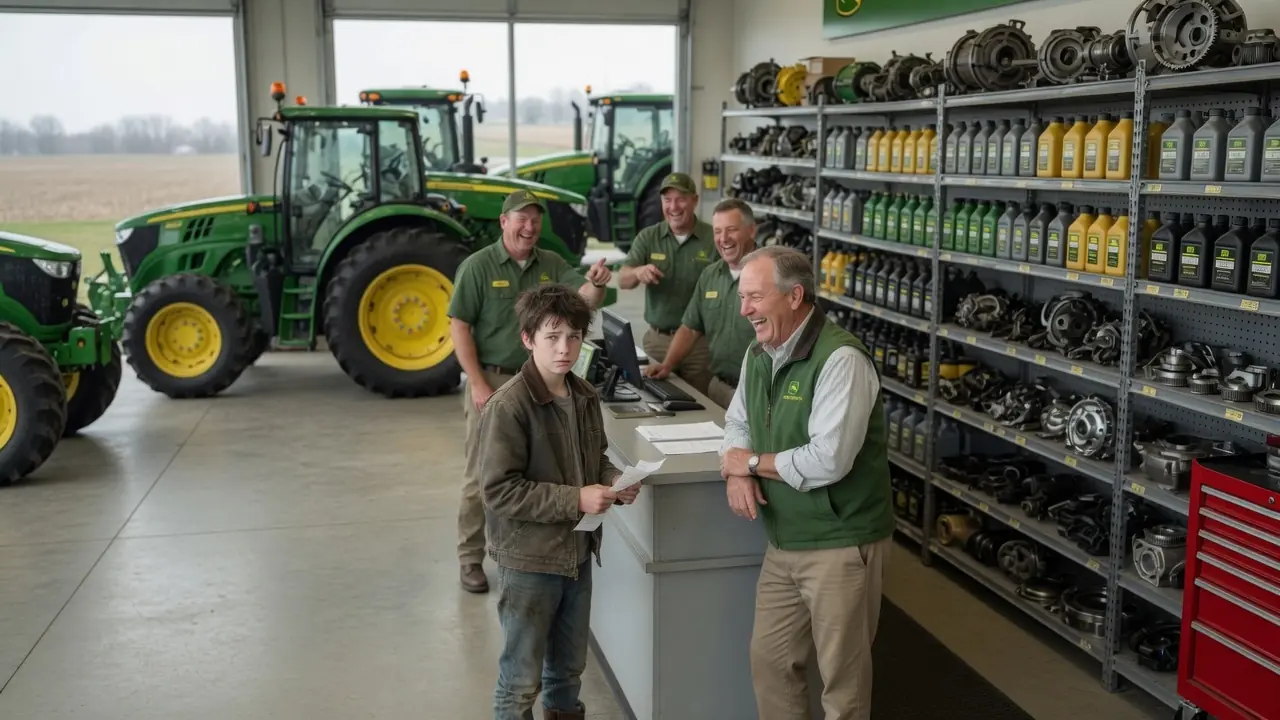
The employees near the truck stopped pretending to work.
Eli looked down at Harold’s hand on the box.
Then he looked back into the dealer’s face.
“My father said the part was ready.”
“It is.”
“Then move your hand.”
For the first time, Harold seemed uncertain.
Not afraid.
Surprised.
The boy in front of him did not sound angry. He sounded exhausted enough to have passed through anger already.
Harold removed his hand.
Eli shifted the box against his chest.
“You still owe twenty-one dollars,” the dealer said.
Eli reached into his wallet and placed the folded bills on a nearby pallet.
Harold counted them.
Exactly twenty-one.
“The gasket is separate.”
Eli stopped.
“How much?”
“Sixty cents.”
The boy opened his wallet again.
Two nickels and three pennies rested inside.
He looked at the money.
Then at the box.
One warehouse worker, a man named Calvin Price, quietly reached toward his pocket.
Harold saw him and shook his head.
“No.”
Calvin lowered his hand.
Eli began to set the box down.
Harold looked toward the employee, then back at the boy.
“The gasket was included in the original order,” he said.
It had not been.
Everyone there knew it.
Eli knew it too.
He accepted the small paper envelope without thanking him.
Harold stepped aside and pointed again toward the road.
“You’ll be back in a week asking us to haul that tractor in pieces.”
Eli walked past him.
At the edge of the loading bay, he stopped.
He did not turn around.
“My father said a machine only becomes useless when the person looking at it stops trying to understand what’s wrong.”
Then he carried the box toward the old Chevrolet pickup parked beyond the dealership.
Harold watched him leave.
Calvin looked at his employer.
“You didn’t need to talk to him that way.”
Harold returned the bills to the cash drawer.
“He needed someone to tell him the truth.”
Calvin watched the pickup disappear down the road.
“Maybe.”
He lifted another box from the truck.
“But that doesn’t mean you told him the right one.”
Nine days earlier, Thomas Greer had climbed the ladder inside the west grain bin to inspect a rusted seam.
The bin was empty.
Harvest had not started.
Eli was in the machine shed tightening the gathering chain on the old two-row corn picker when he heard metal tear.
The sound was short.
Then came the impact.
His father lay on the concrete pad beneath the bin with one leg folded beneath him and blood spreading through the back of his work shirt.
Eli dropped beside him.
“Dad.”
Thomas’s eyes opened.
“Don’t move,” Eli said.
His voice sounded too loud.
Margaret Greer came running from the house and screamed when she saw her husband.
“Call the ambulance,” Eli told her.
She stood frozen.
“Mom!”
That moved her.
She ran back toward the house.
Eli placed both hands near his father’s shoulders without touching him.
Thomas looked toward the south field.
The corn had dried early after a hot August. Most ears were full, but several late storms had left portions leaning.
“Picker,” Thomas whispered.
“Don’t talk.”
“Chain’s loose.”
“I tightened it.”
Thomas tried to smile.
“Good.”
“You’re going to be okay.”
His father’s eyes moved toward him.
There was fear in them.
Not fear of dying.
Fear of leaving too much unfinished.
“The G’s governor,” Thomas said.
“The part is coming.”
“Whitaker called yesterday.”
“Then we’ll get it.”
Thomas’s hand closed weakly around Eli’s sleeve.
“South forty first. Better ground.”
“Dad.”
“Promise me.”
The ambulance siren could be heard in the distance.
Eli looked toward the road.
Then back at his father.
“Promise what?”
“Get the corn in.”
“You’ll be here.”
Thomas tightened his grip.
“Say it.”
Eli felt something inside him begin to break.
“I promise.”
His father released the sleeve.
Thomas Greer died before the ambulance reached Cedar County Memorial Hospital.
For three days, the farmhouse filled with people.
Neighbors brought casseroles, bread, pies, and coffee.
Men stood in the kitchen and told stories about Thomas repairing balers in the rain, pulling trucks from snowdrifts, and helping with harvests before his own crop was finished.
Women hugged Margaret and whispered that she only needed to call.
At the funeral, the Lutheran church was so full that folding chairs were placed in the aisle.
Harold Whitaker attended.
He shook Margaret’s hand, touched Eli’s shoulder, and said he was sorry.
The next morning, nearly everyone returned to their own fields.
October did not pause for grief.
Corn moisture continued dropping.
Wind continued blowing.
Equipment continued breaking.
The bank continued counting days until the Greers’ December payment.
Eli entered the machine shed before sunrise.
The John Deere G stood beneath a hanging bulb, its faded green hood dulled by decades of dust and grease. Thomas had bought the tractor used in 1959 because he could not afford anything newer.
It had no cab.
No power steering.
No comfort beyond a split seat cushion stuffed with dark horsehair.
But the engine block was sound.
The transmission had never been opened.
The two-cylinder motor would pull harder than its age suggested, provided the governor held a steady speed.
That was the problem.
Under load, the engine raced and slowed.
Raced and slowed.
The mounted picker needed consistent power. If the speed changed too violently, the gathering chains jerked, the elevator plugged, and the snapping rolls swallowed stalks unevenly.
Thomas had removed the governor cover two weeks earlier.
The shaft opening in the housing had worn into an oval.
He ordered the new casting from Whitaker John Deere.
Now the box sat on the workbench.
Eli removed the black funeral jacket and hung it from a nail.
The shed smelled of oil, cold iron, and his father’s tobacco.
Thomas’s tools were still arranged above the bench.
Half-inch wrenches in size order.
Ball-peen hammer beside the vise.
Grease gun near the door.
A service manual lay open to the governor section.
One instruction had been circled in pencil.
ALIGN TIMING MARKS BEFORE INSTALLATION.
Eli read the entire procedure twice.
Then a third time.
The first housing bolt came free easily.
The second had not moved in years.
He pulled until the wrench cut into his palm.
Nothing.
He slid a length of pipe over the handle for leverage.
The bolt broke loose suddenly.
Eli fell forward and struck his knuckles against the engine casting.
Blood appeared immediately.
He wrapped the hand in a shop rag and continued.
By noon, the old housing rested on the bench.
The worn opening was obvious.
His father had diagnosed it correctly.
Eli cleaned the gasket surface with a razor scraper.
He compared the timing marks.
One on the fan shaft.
One on the governor gear.
The manual warned that incorrect alignment could leave the tractor out of time or damage the drive.
He rotated the flywheel carefully.
The marks came together.
Eli installed the new housing.
The throttle linkage required a special adjustment gauge he did not have.
In the manual margin, Thomas had written:
3¼ INCHES — CENTER TO CENTER.
Eli measured with a carpenter’s rule.
He connected the linkage.
Filled the housing with oil.
Opened the fuel valve.
Then he climbed into the seat.
His right foot barely reached the brake comfortably inside the oversized boot.
He pressed the starter.
The engine turned once.
Twice.
On the third compression stroke, the left cylinder fired.
Then the right.
The John Deere came alive.
Pop.
Pause.
Pop.
Pause.
The engine speed rose too quickly.
Eli pulled the throttle back.
It slowed.
He advanced it again.
The governor moved.
The engine stabilized.
For the first time since his father’s fall, hope reached Eli before grief could stop it.
Then a thin line of oil appeared beneath the new housing.
It widened.
Eli shut the tractor down.
The gasket had shifted.
He closed his eyes.
For several seconds, he sat motionless on the cracked seat.
Then he climbed down, removed the housing, cleaned everything, and began again.
The second installation took until after dark.
This time, the gasket stayed in place.
The governor held.
When Margaret entered the shed, the tractor was idling smoothly in the doorway.
She wore one of Thomas’s blue sweaters.
“You fixed it.”
“I think so.”
She looked at the engine, then at Eli’s bandaged hand.
“You should have waited for someone.”
“For who?”
“Paul Jensen. Calvin Price. Anyone.”
“They’re harvesting.”
Margaret stepped closer.
“The bank called.”
Eli shut the engine down.
“What did they want?”
“To discuss the farm.”
“What about it?”
She looked toward the open shed doors.
“The operating loan is thirty-eight thousand dollars. The December payment is twenty-one thousand four hundred.”
“The corn will cover it.”
“If we get it harvested.”
“We will.”
“Eli.”
“What?”
“I cannot lose you too.”
He looked at her.
“I’m not going anywhere.”
“Your father thought that nine days ago.”
The words struck both of them.
Margaret covered her mouth.
“I’m sorry.”
Eli looked away.
The cooling tractor ticked softly.
Metal contracting.
Oil settling.
A machine returning to silence.
Margaret reached for his injured hand.
“You don’t have to become him.”
“I’m not.”
“You’re wearing his clothes.”
“My coat is too small.”
“His boots?”
“Mine leak.”
“And his watch?”
Eli looked at the silver watch on his wrist.
The glass was scratched.
The hands had stopped at 10:26, the time Thomas fell.
“I promised him.”
Margaret’s eyes filled.
“He should not have put that on you.”
“But he did.”
She wiped her cheek.
“You will not run that picker alone.”
“I’ve done it before.”
“With your father beside the field.”
“I know how.”
“You know enough to get hurt.”
Eli opened his mouth.
Margaret raised one hand.
“If this harvest happens, I ride with you.”
“You don’t know anything about a picker.”
“Then tell me what not to touch.”
They entered the south forty three mornings later.
The mounted picker looked enormous behind the John Deere.
Two gathering points projected ahead of the tractor’s rear wheels. Chains carried stalks toward the snapping rolls. An elevator lifted the ears into the wagon behind them.
Margaret sat on a narrow auxiliary platform Thomas had built from angle iron and oak boards.
Eli advanced the throttle.
The governor held.
He eased the clutch out.
The first rows entered the picker.
Dry stalks rattled beneath the chains.
Ears broke free and climbed the elevator.
For fifty yards, everything worked.
Then the left gathering point plugged.
Eli stopped.
Disengaged the power.
Shut off the engine.
He climbed down with a steel hook.
Margaret watched from the platform.
“Can’t you pull it out by hand?”
“No.”
“It’s stopped.”
“Dad said never trust a stopped picker.”
He cleared the stalk.
Restarted.
They continued.
By noon, they had filled one wagon.
Approximately sixty bushels.
The south field contained forty acres.
At that pace, the harvest would take weeks.
They ate sandwiches beneath the wagon tongue.
Margaret looked at the standing corn.
“How did your father manage this?”
“He started earlier.”
“When did he stop?”
“When something broke.”
She almost smiled.
By sunset, they had harvested less than three acres.
The wagon became stuck near the crib.
Eli backed poorly and bent the hitch tongue.
The elevator belt slipped twice.
Grain spilled onto the ground when he misaligned the wagon.
After Margaret returned to the house, Eli sat on the John Deere alone.
The harvested corn made a thin layer across the crib floor.
One hundred sixty acres no longer felt like land.
It felt like a number large enough to bury him.
The following morning, Paul Jensen arrived.
Paul farmed across the road and had known Thomas for thirty years.
He looked at the picker.
“Governor fixed?”
“Yes.”
“You do it?”
“Yes.”
Paul nodded.
“I can send my hired man this afternoon.”
“We can’t pay him.”
“He’ll survive.”
“We don’t want free labor.”
Paul looked at Eli.
“Your father spent three nights rebuilding my corn head in 1968.”
“I wasn’t alive.”
“Debt doesn’t care.”
“Dad never mentioned it.”
“Thomas didn’t keep a ledger for favors.”
Eli stared toward the field.
“We can do it.”
Paul’s expression softened.
“Maybe.”
He climbed back into his truck.
“But you don’t need to prove that by refusing help.”
At 12:45, a red International tractor appeared with two wagons.
Behind it came another neighbor.
Then another.
By 1:30, five empty wagons waited at the edge of the field.
A woman from the church brought coffee and bread.
Two high school boys came with shovels.
Calvin Price arrived after finishing his dealership shift and began adjusting the crib elevator.
Eli found Paul near the wagon line.
“You told them.”
“I told one person.”
“You knew they’d come.”
Paul shrugged.
“Your father helped most of them.”
“We can’t owe everyone.”
Paul looked at him.
“You think your father farmed alone because you only saw him on the tractor.”
Eli said nothing.
“He borrowed equipment. Traded labor. Fixed machines. Hauled grain. Watched cattle. Men helped him because he helped them.”
Paul pointed toward the field.
“Keeping your promise doesn’t mean nobody else can touch it.”
For three days, the Greer farm ran like a larger operation.
Eli drove the John Deere.
Margaret tracked wagons, meals, fuel, and grain storage.
Neighbors hauled.
Calvin kept the elevator running.
Paul managed traffic around the crib.
Twenty-two acres came in before the rain.
It fell for two days.
Wind pushed through the wet corn.
On Monday morning, Eli found several acres leaning.
The old picker could gather downed stalks, but only slowly.
That afternoon, the bank manager arrived.
Raymond Cole wore polished shoes that collected mud before he reached the porch.
He placed a folder on the kitchen table.
“The December payment is twenty-one thousand four hundred dollars.”
“We know,” Margaret said.
Raymond looked toward Eli.
“How much is harvested?”
“Twenty-two acres.”
“Average yield?”
“One hundred eighteen bushels.”
“Moisture?”
“Seventeen percent.”
The manager performed the calculation.
The crop was good.
Not enough yet.
“There is an offer for the western eighty,” he said.
Eli answered immediately.
“No.”
Margaret looked at him.
“Let him finish.”
Raymond opened the folder.
“The buyer will pay enough to clear the December payment, reduce the principal, and leave the family with eighty acres.”
“It cuts the farm in half.”
“It protects half.”
“My father drained that ground.”
“I know.”
“He planted the windbreak.”
“I know.”
“Then don’t talk about it like it’s just collateral.”
Raymond folded his hands.
“To the bank, that is exactly what it is.”
Margaret’s face lost color.
“What happens if we miss the payment?”
“We begin collection proceedings.”
“Foreclosure?”
“Eventually.”
Eli stared at the folder.
“The corn will pay it.”
Raymond looked at him.
“Then bring in the corn.”
Two mornings later, the John Deere’s oil-pressure gauge dropped from thirty-two pounds to ten.
Eli was halfway through a downed section.
He disengaged the picker and shut off the engine immediately.
Paul arrived with a truck.
They checked the oil.
Full.
The gauge line.
Clear.
Paul removed the regulating plug.
The spring came out in two pieces.
“Found it.”
“How long to get one?”
“Depends on Whitaker.”
Eli drove the Chevrolet to the dealership.
Harold saw him enter.
“You’re back.”
“Oil-pressure spring.”
“Broken?”
Eli placed both halves on the counter.
Harold searched the catalog.
“None in stock.”
“When can you get one?”
“Tomorrow afternoon.”
“We need it today.”
“I cannot sell what I don’t have.”
“Used?”
Harold hesitated.
“There’s an old G engine behind the shop.”
They walked to the salvage row.
The engine sat beneath a torn canvas sheet.
Harold removed the regulating assembly while Eli held the light.
The spring showed rust but retained proper length.
Harold measured it.
“It should hold.”
“How much?”
“Take it.”
Eli reached for his wallet.
“Two dollars,” Harold said.
The boy paid.
As Eli turned away, Harold spoke.
“How much corn is still out?”
“Most of it.”
“More rain is coming.”
“I know.”
Harold looked at the broken spring on the counter.
“I was wrong about something.”
Eli waited.
“I said you’d return with the tractor in pieces.”
“This is one spring.”
“I know.”
“That doesn’t make you wrong yet.”
Harold almost smiled.
“You always this pleasant?”
“Dad said pleasant mechanics go broke.”
“Your father said that?”
“No.”
Eli put the spring in his pocket.
“But he might have.”
The used part restored oil pressure.
The John Deere returned to the field before dark.
Harvest continued.
The downed corn wrapped around the gathering points.
Eli stopped repeatedly to clear plugs.
On the fourth day, he saw a small accumulation near the right snapping roll.
He told himself it would clear.
The chain jumped the sprocket.
A steel slat tore through the elevator housing.
The machine stopped with a grinding crash.
Eli shut off the tractor.
Paul climbed from the nearest wagon.
“What did you ignore?”
“Nothing.”
Paul looked at the plug.
Eli stared at the ground.
“A small bunch of stalks.”
Paul nodded.
“Thomas did the same thing in 1971.”
“Same failure?”
“Same chain.”
“How did he fix it?”
“He didn’t.”
Paul smiled slightly.
“I did.”
No replacement slat existed locally.
A salvage yard in Waterloo had an entire elevator for eighty-five dollars, eighty miles away.
Another day lost.
That night, Eli placed the bent slat on the workbench.
It was flat steel with riveted chain attachments.
His father would not have searched for a perfect replacement.
He would have repaired the metal.
Eli heated it in the forge.
Paul held it with tongs.
They hammered the bend flat.
A crack had formed near one rivet hole.
Eli ground it into a V.
His first weld was too cold.
He broke it out.
The second held.
They reinforced the back with a strip cut from an old cultivator bracket.
At 1:17 in the morning, the chain was back together.
Paul looked at the clock.
“You going to school tomorrow?”
“No.”
“How many days have you missed?”
“Seventeen.”
“Your father cared about school.”
“The bank doesn’t.”
Paul wiped his hands.
“You are treating the last thing your father said like it is the only thing he ever taught you.”
The words stopped Eli.
Paul continued.
“He told you to get the corn in because he thought he was dying.”
“He was.”
“He also spent fourteen years telling you to learn more than he knew.”
Eli looked at the repaired chain.
“I’ll go back after harvest.”
“Then survive harvest without turning yourself into a machine.”
The weld held.
By the end of the next week, sixty-eight acres were finished.
A newspaper photographer arrived.
He took a picture of Eli beside the John Deere, one hand on the faded hood and Thomas’s coat hanging from his shoulders.
The article called him courageous.
Eli hated it.
Courage sounded clean.
Harvest was not clean.
It was grease beneath fingernails, wet socks, missed school, fear, and crying alone on the tractor when he turned to ask his father a question and remembered the seat beside him was empty.
One morning, Harold drove to the farm carrying a box of used parts.
He found Eli beneath the picker tightening the elevator chain.
“I brought bearings, links, and two sprockets.”
“We didn’t order them.”
“Consignment.”
“What does that mean?”
“You pay for what you use.”
“And the rest?”
“Comes back.”
Eli looked at him.
“Why?”
Harold watched Paul’s wagons cross the field.
“I have been selling machinery for thirty years. I thought that meant I understood farming.”
“You don’t?”
“Not all of it.”
Harold placed the box beside the shed.
“I understand equipment value. Loan value. Trade value.”
He looked toward the farmhouse.
“I forgot there are other kinds.”
Eli returned to the chain.
“You still told me to sell.”
“I did.”
“Do you still think I should?”
Harold looked at the standing corn.
“I think your mother should know every option.”
“That’s not an answer.”
“No.”
Harold nodded toward the tractor.
“Neither is a fourteen-year-old working until two in the morning.”
Eli said nothing.
“You are doing something remarkable,” Harold continued. “That does not mean the burden is fair.”
The weather held until early November.
One hundred acres came in.
Then one hundred twenty.
The western forty remained.
Those were the best acres.
They were also the wettest.
The ground finally hardened after two nights below freezing.
The forecast called for snow in three days.
Paul arrived with his John Deere 45 combine.
The machine had a two-row corn head and could harvest several times faster than the old mounted picker.
Eli looked at it.
“My father wanted the G used.”
Paul shook his head.
“Your father wanted the crop harvested.”
“I promised him.”
“Then stop worshipping the method.”
Eli looked toward Margaret.
She stood beside the wagons.
“Let him help,” she said.
The combine entered the field.
The John Deere G continued beside it.
Old and newer machines moved through parallel rows.
Neighbors hauled grain.
Women prepared food in the farmhouse.
Students came after school to shovel.
Harold brought two dealership mechanics to stay near the field.
By the morning of November 6, seven acres remained.
Snow began before sunrise.
At first, the flakes melted on the tractor hood.
Then they collected along the fuel tank and fenders.
The combine plugged twice as damp husks entered the head.
The mounted picker moved more slowly but continued.
Margaret stood at the field edge waving for Eli to stop.
He shook his head.
Three acres remained.
If wet snow froze overnight, stalks could become impossible to gather.
The governor held steady.
The repaired elevator chain carried ear after ear.
Snow coated Thomas’s coat.
Eli’s hands went numb inside wet gloves.
His boots slipped against the platform.
At 2:46 in the afternoon, he entered the final pass.
Paul’s combine worked from the opposite end.
The distance between them narrowed.
The last standing stalks disappeared into the machines.
Eli disengaged the picker.
The engine returned to idle.
Pop.
Pause.
Pop.
Pause.
He looked behind him.
The field was empty.
Broken stalks remained.
Husks covered the ground.
But the corn was out.
One hundred sixty acres.
Twenty-three days after the first pass.
Margaret reached the tractor and climbed onto the platform.
She held him so tightly that the breath left his chest.
“You did it.”
Eli looked toward Paul.
Harold.
Calvin.
The wagon drivers.
The women near the house.
The students shoveling grain.
“We did.”
The neighbors gathered near the road.
No one cheered.
They understood that harvest was not victory.
It was completion.
The corn sold for enough to make the December payment.
After fuel, storage, repairs, and other expenses, the Greer family had six hundred thirteen dollars left.
The farm was safe for one year.
Only one.
In spring, Margaret rented eighty acres to Paul Jensen.
Eli agreed.
That surprised her.
“You fought to keep every acre.”
“We are keeping it.”
“Someone else will farm half.”
“For now.”
“What changed?”
Eli looked toward the old John Deere.
“I thought keeping Dad’s promise meant doing everything the way he would.”
“And now?”
“It means doing what keeps the farm alive.”
Eli returned to school.
He had missed twenty-four days.
He completed winter assignments at the kitchen table.
In agricultural mechanics class, he wrote a report on the governor repair, oil-pressure failure, picker-chain damage, yield, grain moisture, and harvest logistics.
His teacher underlined one sentence.
A machine does not care who you lost. It responds only to what you understand.
Beneath it, the teacher wrote:
That is why knowledge matters when emotion is loud.
At sixteen, Eli began working Saturdays at Whitaker John Deere.
Harold offered him the job.
“Because I fixed the G?” Eli asked.
“Because you paid two dollars for a used spring.”
Eli swept floors, washed parts, and organized tools.
Calvin taught him how to read wear marks.
“Broken parts show what happened once,” Calvin said. “Wear shows what kept happening.”
Eli learned transmissions.
Hydraulics.
Carburetion.
Diesel injection.
Electrical diagnosis.
He discovered that repairing one governor at fourteen had not made him a mechanic.
It had made him willing to begin before he felt ready.
At eighteen, he received an offer from an agricultural technical college.
He planned to refuse.
“The farm needs me.”
Harold shook his head.
“The farm needed your father. It survived him.”
Eli stared.
“That sounds cruel.”
“It is meant to sound true.”
Harold leaned against the parts counter.
“You kept this place alive at fourteen. Do not let everyone praising you for it trap you at fourteen forever.”
Eli attended the two-year program.
He returned every weekend.
Margaret continued renting most of the ground to Paul.
The John Deere remained in the shed.
At school, Eli learned the mathematics behind repairs he once judged by sound.
He studied metallurgy, combustion, fluid pressure, and bearing load.
He learned why the governor housing wore.
Why the gasket shifted.
Why the oil-pressure spring failed.
Why the reinforced chain slat had held.
In 1981, he returned to Millbrook and joined Whitaker full-time.
Farmers began asking for him.
When a tractor overheated only at one end of a field, Eli asked about wind direction and found chaff collecting against the radiator.
When a combine lost power only with a full grain tank, he found a fuel line pinched by frame flex.
When another shop replaced a crankshaft twice because one main bearing kept failing, Eli measured the block.
The saddle was misaligned.
He repaired machines others had stopped trying to understand.
At twenty-six, he bought half the dealership.
Harold sat across from him while they signed the agreement.
“You remember the day I told you to give up the farm?” the older man asked.
“Every word.”
“I was wrong.”
“Not completely.”
Harold raised an eyebrow.
“You said a fourteen-year-old could not run one hundred sixty acres alone.”
“But you did.”
Eli shook his head.
“A county did.”
Harold leaned back.
“That sounds better than the story people tell.”
“It is the true one.”
The dealership became Greer-Whitaker Equipment.
Eli eventually returned to farming all 160 acres.
He expanded carefully.
Never buying ground simply because someone expected success to keep growing.
By forty, he farmed eight hundred acres and employed fourteen mechanics.
He required every new technician to spend a year learning basic mechanical systems before relying heavily on diagnostic computers.
“You need to understand what the machine is doing,” he told them. “Otherwise you only replace what the screen accuses.”
The old John Deere G became the symbol of the business.
Eli restored the mechanical parts but left the paint faded.
He kept the split seat.
The brush-painted wheel.
The repaired chain slat hung in the office beside the original receipt.
Governor Housing — $41.00.
Harold retired in 1996.
At the retirement dinner, nearly two hundred farmers, mechanics, and family members filled the community hall.
Harold stood at the front.
“I once looked at a fourteen-year-old boy wearing boots too big for him,” he said.
The room quieted.
“I decided those boots proved he could not do the work.”
Eli sat beside Margaret.
Harold continued.
“I thought experience meant knowing when people should quit.”
He glanced toward Eli.
“I later learned experience is also knowing when your own judgment has failed.”
A few people smiled.
“I told that boy to give up the farm.”
Harold paused.
“Three weeks later, I watched him finish the harvest.”
“Twenty-three days,” Eli called from his table.
The room laughed.
Harold nodded.
“He still corrects details.”
Then his expression became serious.
“But the lesson is not that children should carry impossible burdens.”
Margaret looked down.
“They should not.”
Harold’s voice roughened.
“The lesson is that adults sometimes call something impossible because helping would be inconvenient.”
He looked toward the men and women who had worked the Greer harvest.
“Eli did not need to become a legend at fourteen.”
Harold nodded toward them.
“He needed neighbors.”
Everyone stood.
Eli remained seated.
His father’s stopped watch rested against his wrist.
Years passed.
The story grew larger each time someone told it.
Some said Eli harvested all 160 acres alone.
He corrected them.
“Paul brought the combine.”
“Neighbors hauled.”
“Mom ran the operation.”
“Calvin repaired equipment.”
“Harold supplied parts.”
“Students shoveled grain.”
People often preferred the simpler version.
One brave boy.
One old tractor.
One impossible harvest.
Eli preferred the truth.
No one did it alone.
At seventy-two, he still lived on the original Greer farm.
The 160 acres had been placed in a family trust so one illness or poor decision could not easily divide them.
His daughter managed the dealership.
His grandson studied agricultural engineering.
Margaret lived to ninety-one.
Near the end of her life, she asked Eli whether he remembered their first pass after Thomas died.
“Every row.”
“You were terrible.”
Eli laughed.
“You told me I did fine.”
“I was trying to keep you from crying.”
“You backed the wagon into the crib wall.”
“You promised never to mention that.”
“I’m dying. Agreements expire.”
She smiled.
Then her eyes softened.
“You thought your father asked you to save the farm.”
“He did.”
“No.”
Eli looked at her.
“He asked you to get the corn in.”
“That was the same thing.”
“It felt the same because you were fourteen.”
She took his hand.
“The farm did not need you to save it forever. It needed you to carry it until enough people arrived.”
After her funeral, Eli entered the machine shed.
The John Deere G stood in the same bay where he had installed the governor housing nearly six decades earlier.
He opened the fuel valve.
Climbed onto the split seat.
Pressed the starter.
The engine turned twice and fired.
Pop.
Pause.
Pop.
Pause.
He drove to the south field.
The land looked smaller than it had when he was fourteen.
Then, every row seemed endless.
Every acre carried the weight of his father’s final request.
Now the field was simply ground.
Loved.
Valuable.
But not alive enough to demand that a child become a man overnight.
A pickup approached from the road.
Eli’s grandson, Thomas Greer II, stopped beside the tractor.
“You taking the G out alone?”
“I’ve driven it longer than your father has been alive.”
“That was not my question.”
Eli smiled.
“We’re testing the restored picker at the heritage field,” Thomas said.
“I’ll follow.”
The grandson looked at the wrinkled black jacket Eli wore.
Thomas’s funeral jacket.
Preserved all these years.
“You know the story people tell about you isn’t true.”
“I know.”
“They say you saved the farm by yourself.”
“I know.”
“Does it bother you?”
“Yes.”
“Why?”
Eli looked across the 160 acres.
“Because boys hear it and think asking for help would make their story smaller.”
He shifted the tractor into gear.
“It doesn’t.”
At the heritage field, nearly one hundred people waited.
Families.
Mechanics.
Students.
Retired farmers.
The mounted picker had been restored from old photographs.
Eli guided the John Deere into the first rows.
Dry stalks entered the gathering points.
Ears broke free.
The elevator carried them upward.
The governor held a steady speed.
At the end of the pass, a fourteen-year-old boy approached.
“My father died last spring,” he said.
Eli climbed down.
“I’m sorry.”
“He had a repair shop.”
Eli waited.
“Everyone says I should keep it open because I know engines.”
“How old are you?”
“Fourteen.”
“What do you want?”
The boy looked confused.
“To do what he wanted.”
“That is not what I asked.”
The student looked at the ground.
“I want to finish school.”
“Then finish.”
“But the shop—”
“Can be rented. Managed. Sold. Closed. Reopened.”
The boy looked toward the old John Deere.
“You didn’t quit.”
“Keeping everything is not the only kind of courage.”
“My dad asked me to take care of Mom.”
“That does not mean becoming him.”
The boy’s eyes filled.
Eli placed one hand on his shoulder.
“When my father died, adults praised me for carrying too much because they were relieved I could carry it.”
He glanced toward Harold, now ninety and seated beneath a tent near the field.
“I survived the burden.”
Eli looked back at the boy.
“That does not mean the burden was right.”
After the student walked away, Thomas approached his grandfather.
“You just ruined your own legend.”
“Good.”
Near the John Deere stood a small metal plaque.
It did not claim Eli had harvested the farm alone.
He had written it himself.
IN OCTOBER 1973, THIS TRACTOR HELPED HARVEST 160 ACRES AFTER THOMAS GREER’S DEATH.
HIS SON ELI REPAIRED IT.
HIS WIFE MARGARET KEPT THE FARM TOGETHER.
THEIR NEIGHBORS BROUGHT THE CROP IN.
NO ONE DID IT ALONE.
Beneath the plaque rested the original governor housing.
Its shaft opening worn oval.
Worthless as a machine part.
Valuable as evidence.
People later called Eli Greer a legend because of the dealership he built, the farms he saved, the mechanics he trained, and the machines he returned to work.
Eli pointed to something smaller.
A dealership loading bay.
A forty-one-dollar part.
A free gasket.
A used spring.
A mother sitting on a narrow tractor platform.
Neighbors arriving with wagons.
An old combine entering a snowy field.
A grieving boy discovering that wearing his father’s boots did not make them fit.
Harold Whitaker had been right about one thing.
A fourteen-year-old boy could not run 160 acres alone.
What he had failed to understand was that Eli never truly had to.
The farm survived because when the boy entered the field, an entire county eventually entered behind him.
And nearly sixty years later, whenever the old John Deere climbed beneath load, the governor housing Eli carried past the dealer still held the engine steady.
Pop.
Pause.
Pop.
Pause.
Strong enough to finish the row.