Grant Bellamy walked into the lobby of Halbert Security Corp. wearing a faded gray hoodie, dark jeans, and worn sneakers. In one hand, he carried an old leather folder with cracked edges and a broken clasp, the kind of folder most people would ignore without a second glance. Nothing about him looked expensive, powerful, or important. That was exactly why he had dressed that way.
Halbert Security stood in Midtown Atlanta, eighteen floors of glass, steel, and polished confidence. The company guarded government buildings, corporate towers, private estates, and luxury developments across the Southeast. Its logo hung above the reception desk in silver letters, bright enough to catch every eye entering the building. On paper, Halbert looked disciplined, respected, and profitable. Behind the numbers, Grant had already seen something rotten.
For eight months, Grant Bellamy’s private equity firm had studied Halbert’s books. He had read revenue reports, internal complaints, settlement records, employee reviews, contract losses, and leadership files. The company still had value, but its culture was breaking from the inside. Too many complaints had disappeared. Too many guards had been protected. Too many people had been treated like problems instead of human beings.
Grant was not a man who bought a company blindly. He believed numbers mattered, but behavior mattered more. A balance sheet could show declining revenue, but it could not show how a receptionist treated a stranger. A legal report could list complaints, but it could not show the tone of a guard’s voice when he thought no executive was listening. So before signing the final purchase agreement, Grant decided to walk through Halbert’s front door as someone no one would try to impress.
That morning, he left his tailored suits hanging in the closet. He passed the polished shoes, the expensive watches, and the luxury car keys on the counter. Instead, he took the hoodie from the back of the closet and the sneakers he still kept from years earlier. Then he picked up his mother’s old leather folder. Dorothy Bellamy had carried that folder for more than twenty years while cleaning office buildings in downtown Atlanta.
Dorothy had raised Grant with quiet discipline and a sharper understanding of people than any business school could teach. She cleaned floors for men who never learned her name. She emptied trash bins for executives who stepped around her without making eye contact. She never complained in front of Grant, but she taught him one lesson over and over. The way people treat someone they think has no power tells you who they really are.
Grant placed the confidential acquisition documents inside Dorothy’s folder. He also slipped in a small photograph of her wearing her cleaning uniform, holding a mop in one hand and a lunch bag in the other. Her smile in the photo was tired but proud. Grant looked at it for a moment before closing the folder. Then he drove to Halbert in an old Honda Accord with faded paint and a dented bumper.
When he stepped through the revolving glass doors, the lobby seemed to pause. The floor was polished white marble, the walls were tall glass, and the air smelled of leather furniture and expensive cleaning solution. Every sound echoed too clearly. Grant’s sneakers made soft squeaks against the marble as he walked toward the reception desk. He could feel eyes moving over him before anyone spoke.
Behind the desk sat two receptionists, Allison Pruitt and Tessa Drummond. Allison’s smile appeared for half a second, then faded when her eyes reached Grant’s hoodie and worn shoes. Tessa glanced at Allison, and Allison glanced back. Neither woman said hello. Their silence was not loud, but it was clear enough. Grant had seen that look before.
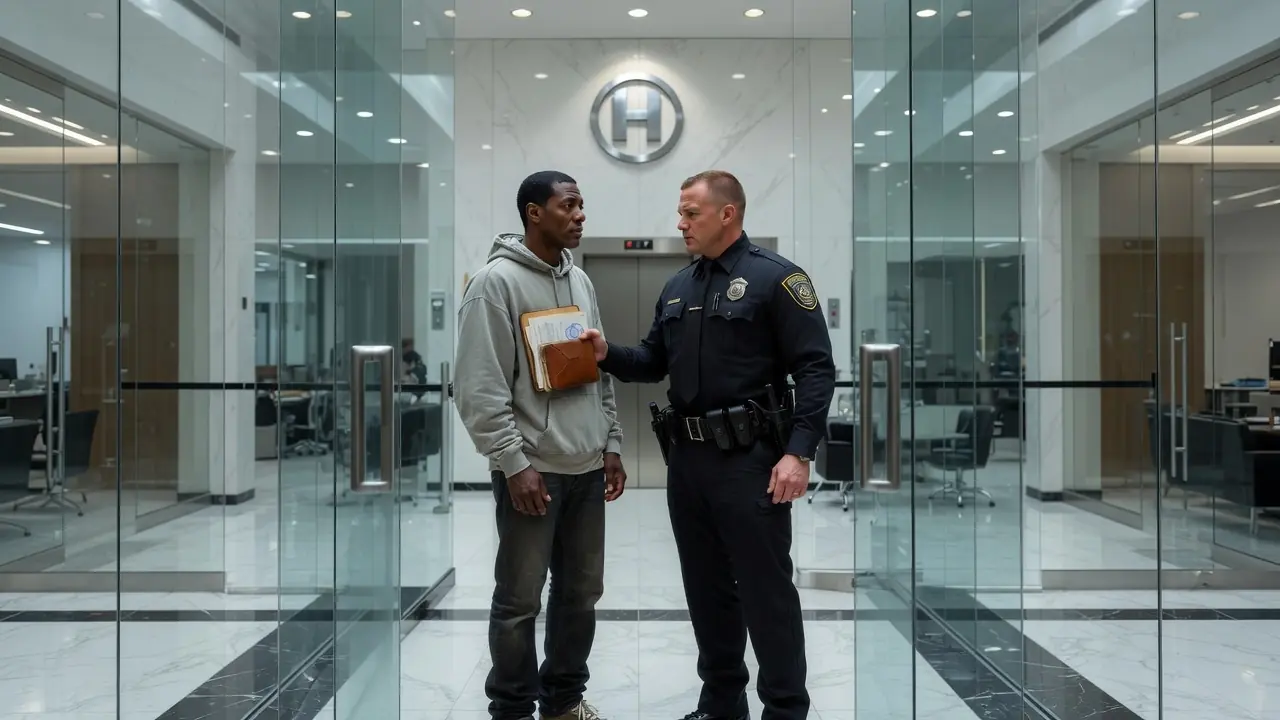
He was halfway to the desk when a sharp voice cut across the lobby. “Hey.” Grant stopped. A security guard stepped out from beside a marble pillar, broad-shouldered, tall, and stiff with authority. His black uniform was pressed hard, his badge polished, his boots shining like he had prepared for a ceremony. His nameplate read Derek Hollis.
Derek was forty-two, white, muscular, with pale skin, a buzz cut, hard blue eyes, and a square face that seemed built for suspicion. He looked Grant up and down slowly, from the hoodie to the sneakers to the leather folder. His mouth curled before he asked a single question. “Where do you think you’re going?” he said. The words landed across the lobby like a slap.
Grant kept his voice even. “Good afternoon. I have an appointment on the fourteenth floor.” Derek stared at him. Then he laughed once, short and mocking. It was not the laugh of a man hearing something funny. It was the laugh of a man trying to make another person feel small.
“You?” Derek said. “Fourteenth floor?” Grant did not answer the insult. He held the folder closer to his chest. “My name is on the visitor list.” Derek stepped forward until he was too close. Grant could smell the harsh aftershave on his skin and see the vein moving near his temple.
Derek reached out and tapped the leather folder with two fingers. “What’s in there? Job application? Cleaning schedule?” A few people near the elevator looked over, then looked away. Allison sat rigid at the desk. Tessa lowered her eyes to the keyboard. No one moved. No one wanted to be part of what was happening.
Grant took a slow breath. “If you check the visitor list, you’ll see my appointment.” Derek’s eyes narrowed. “Men like you don’t take meetings upstairs,” he said. “You wait where someone tells you to wait.” Grant’s face remained still, but something behind his eyes sharpened. He had heard enough to know exactly what kind of man stood in front of him.
“I’m asking you to check the list,” Grant said. Derek’s jaw tightened. “And I’m telling you to step back.” Grant did not move. He did not raise his voice or lift his hands. He only stood there, calm and steady, holding the folder that contained the papers to buy the very company Derek believed he was protecting. That calm seemed to make Derek angrier.
Derek planted one hand against Grant’s shoulder and gave him a sharp shove. It was not a wild attack, but it was forceful enough to knock Grant off balance. Grant stumbled backward, tried to steady himself, and dropped to one knee on the marble floor. The old leather folder slipped from his hand and hit the ground. Its broken clasp sprang open, sending stamped pages sliding across the polished surface.
For one second, the lobby froze. The papers fanned out near Grant’s knee, revealing headers, signatures, financial summaries, and the Bellamy Capital Partners logo. Allison’s eyes dropped to the pages. Her face changed. She leaned forward slightly, reading the top sheet before she could stop herself. “Acquisition Proposal. Confidential. Target: Halbert Security Corp.”
Derek did not notice. He stood over Grant with a cruel little smirk, satisfied by the sight of him on the floor. “That’s where men like you belong when they forget their place,” he said. Grant stayed on one knee, one hand on the marble, breathing evenly. His cheek was warm with humiliation, but his voice remained controlled. “You should read the papers you just stepped over.”
Derek looked down at the scattered documents and scoffed. “I don’t take orders from someone dressed like trash.” He reached down, grabbed Grant by the sleeve of the hoodie, and pulled him to his feet. The motion was rough enough to twist the fabric and stretch the collar. Grant did not resist. He let Derek drag him a few steps toward the side corridor.
Allison stood halfway behind the reception desk, her hands trembling. She knew now. Maybe not the full story, but enough. She knew the man in the hoodie was not a random visitor. She knew the papers on the floor were not fake. She knew something very serious had just happened in the lobby, and she knew Derek had no idea how badly he had misjudged the man he was humiliating.
Derek pushed Grant toward the service corridor. “Out,” he snapped. “You don’t come through the front like you belong here.” Grant looked back once, not at Derek, but at the leather folder lying open on the floor. The photograph of his mother had slipped halfway out of the pocket. Dorothy Bellamy’s tired smile stared up from the marble. Grant’s eyes lingered on it for one breath before Derek shoved him through the side door.
The corridor was narrow and colder than the lobby. The marble floor gave way to concrete, and the polished glass walls became gray painted cinderblock. Fluorescent lights buzzed overhead. Derek pushed Grant out through a metal service door into the alley behind the building. Dumpsters lined the wall, and the air smelled of diesel, old cardboard, and heat trapped between buildings.
The door slammed shut behind him. Grant stood still in the alley for a moment. His sleeve was stretched, his shoulder ached, and his dignity had been dragged across the marble floor in front of strangers. But he did not shout. He did not pound on the door. He did not run back inside and demand justice from people who had already shown him they did not know the meaning of the word.
He walked across the street to his old Honda Accord and sat behind the wheel. His hands rested on the steering wheel, steady but tight. He looked through the windshield at Halbert Security’s shining glass tower. Somewhere inside, his mother’s folder sat on a reception desk or on the floor, handled like trash by people who had no idea what it carried. Grant closed his eyes for three seconds.
Then he opened them and called Charles Whitfield, his attorney. Charles answered quickly. “How did it go?” Grant said nothing at first. Charles recognized the silence. “Grant?” Grant looked at the building and spoke quietly. “Sign tonight. Close the deal before eight tomorrow morning.”
Charles paused. “What happened?” Grant’s voice did not change. “He shoved me down in the lobby. Scattered the documents. Dragged me out through the service corridor.” Charles cursed under his breath. “I’ll call the police.” “No,” Grant said. “Not yet.”
Charles went silent. Grant continued. “I want to own the company first. I want the cameras preserved. I want the complaint records pulled. And tomorrow morning, I want to walk back through the front door in a suit.” Charles understood then. This was not about revenge. It was about exposing the truth with ownership, authority, and proof. “I’ll have everything ready by tonight,” he said.
That evening, Grant sat at his dining table in his Buckhead penthouse. The gray hoodie lay across a chair, one sleeve stretched, the front wrinkled from Derek’s grip. Charles arrived with the final documents in a black briefcase. Grant read every page slowly, even though he already knew the deal by heart. His mother had taught him to read everything before signing. Wealth had not changed that.
At 9:41 p.m., Grant signed the acquisition agreement. Three signatures, two initials, one date. With that, Bellamy Capital Partners became the new owner of Halbert Security Corp. Every floor, every contract, every desk, every camera, every badge. Including the lobby cameras that had recorded Derek Hollis shoving him to the marble floor and throwing him out through the service corridor.
Grant set the pen down and looked at Charles. “First thing tomorrow morning, I want the announcement on every screen in that building.” Charles nodded. “And Derek?” Grant’s expression hardened. “Bring him to the fourteenth floor.” He paused, then added, “And recover my mother’s folder.” Charles looked at him carefully. “We already did. Allison Pruitt kept it safe.”
Grant’s eyes softened for the first time that day. “Good.” He stood, walked to the bedroom, and laid out a charcoal suit on the bed. Beside it, he placed the small photograph of Dorothy Bellamy. The gray hoodie stayed on the chair. Tomorrow, he would not need the disguise anymore.
The next morning, Halbert Security employees entered the lobby expecting another ordinary day. Allison arrived first and froze near the revolving doors. Two unfamiliar men in dark suits stood near the elevator bank. A small camera crew had set up near the far wall. The company monitors above the elevators were blank, all of them waiting. Tessa came in behind Allison and whispered, “What’s going on?”
Allison did not answer. She already had a terrible idea. She had spent the previous evening replaying the moment Grant fell to one knee, the papers sliding across the floor, Derek smirking down at him. She had kept the folder under her desk until Bellamy Capital’s legal team arrived to collect it. She had told them everything. Now she stood in the lobby, pale and silent, waiting for the building to learn what she already knew.
At exactly 8:00 a.m., every screen in the lobby lit up. The message appeared in white letters against a black background. Halbert Security Corp. has been acquired. Please welcome our new owner: Grant Bellamy, Founder and CEO of Bellamy Capital Partners. A wave of whispers moved through the lobby. Then a photograph appeared beneath the announcement. It showed Grant in a charcoal suit, calm, polished, unmistakably powerful.
Derek Hollis walked in at 8:03. Same black uniform, same polished boots, same badge. He saw the cameras and frowned. Then he looked at the screens. His eyes moved from the name to the photograph. His face changed so quickly it was almost painful to watch. Confidence drained from him as recognition struck.
The man in the hoodie. The man he had shoved down. The man whose folder he had kicked aside. The man he had thrown out through the service corridor. That man now owned the company.
Derek’s radio crackled. “Derek, report to the fourteenth floor.” The voice belonged to Ray Calhoun, head of security operations, but it sounded thin and nervous. Derek looked toward the reception desk. Allison was staring at him. She did not look away this time. Her expression was not cruel, but it was final. Derek swallowed and walked toward the elevator.
The ride to the fourteenth floor felt longer than any ride he had taken in his life. The numbers climbed slowly. Four. Seven. Ten. Thirteen. Derek stared at his reflection in the metal doors and barely recognized himself. The badge on his chest suddenly felt heavy.
When the doors opened, a quiet executive hallway stretched before him. At the end, the boardroom doors stood open. Derek walked toward them with stiff legs. Inside, a long walnut table filled the room, and floor-to-ceiling windows looked out over the Atlanta skyline. At the head of the table sat Grant Bellamy in a charcoal suit. In front of him lay Dorothy Bellamy’s old leather folder.
Derek stopped. For a moment, he looked like a man who had forgotten how to stand. Grant did not rise. He did not raise his voice. He simply looked at Derek with the same calm he had shown in the lobby. That calm was worse than shouting. It gave Derek nothing to push against.
“Sir,” Derek began, his voice cracking. “I didn’t know.” Grant let the silence stretch. Then he said, “That’s the point.” Derek’s mouth closed. Grant rested one hand on the leather folder. “You didn’t know who I was, so you showed me who you are.”
Derek’s face went pale. Grant slid a sheet of paper across the table. “Sit down.” Derek sat. His hands shook slightly in his lap. Grant opened the folder and removed a stack of documents marked with red tabs. “Fourteen formal complaints,” he said. “Filed against you over three years.”
He laid them out one by one. A college student coming for an interview. A pastor visiting a client. A woman bringing lunch to her husband’s office. A contractor with a valid work order. Each complaint told a different version of the same story: Derek deciding someone did not belong and using his uniform to make them feel powerless. Every complaint had been sent to Ray Calhoun. Every complaint had been dismissed.
Derek lowered his head. “Please,” he said. “I have a family.” Grant’s eyes did not move from him. “So did the people you humiliated.” The words were quiet, but Derek flinched as if they had struck him. Grant pressed his palm flat against the folder. “I walked in yesterday on purpose. I wanted to see how my future company treated someone it thought had no power.”
He leaned back slightly. “You answered the question.” Then Grant pressed a button on the conference phone. “Send them in.” Two security officers entered, wearing Bellamy Capital badges. They stood beside the door, silent and professional. Grant looked at Derek one final time. “You are terminated effective immediately.”
Derek’s eyes filled with panic. “Mr. Bellamy, please.” Grant continued. “No severance. No recommendation. Your conduct has been documented. Your access is revoked.” Derek’s hands moved to his badge. His fingers struggled with the clip. When it finally came free, he stared at it for several seconds, then placed it on the table beside the leather folder.
“You will be walked out through the front door,” Grant said. Derek looked up. The words landed exactly as intended. Not the side corridor. Not the service exit. Not the alley. The front door, through the lobby where he had humiliated others for years. Grant did not say this with cruelty. He said it because consequences should be visible where harm was visible.
The two officers escorted Derek down the elevator. When the doors opened into the lobby, every conversation stopped. Employees watched him cross the marble floor without his badge. Allison stood behind the reception desk with her hands folded. Derek passed the spot where Grant had fallen the day before. His eyes dropped to the marble. Then he walked out through the glass doors for the last time.
The firing was only the beginning. Bellamy Capital released the lobby footage that afternoon, along with a statement announcing a full internal review. The video spread quickly. It showed Derek mocking Grant, shoving him off balance, the folder opening, the papers scattering, and Grant looking up from one knee with terrifying calm. The image that people shared most was not the shove. It was Grant’s face afterward.
There was no rage in it. No panic. No pleading. Just a calm so sharp it felt like a warning. The caption under countless reposts said the same thing in different words: he knew. He knew exactly what was coming. By evening, the story had become national news.
Investigators began reviewing Halbert’s complaint history. Former visitors and employees came forward. People who had once been dismissed as difficult, confused, or overly sensitive now had a record that matched their memories. Ray Calhoun was fired for suppressing complaints. The former CEO resigned after the internal audit revealed years of neglect. The polished reputation Halbert had enjoyed collapsed under the weight of its own hidden files.
Grant refused to make the story only about himself. In his first public statement, he said the incident was not an exception but a symptom. “If a guard can do this in a lobby full of cameras,” he said, “imagine what happens where no one is recording.” He announced new rules immediately: body cameras for all lobby security, independent complaint review, mandatory anti-discrimination training, and termination for any employee who used authority to humiliate rather than protect.
Then he announced the Dorothy Bellamy Foundation. It would fund college tuition for children of cleaners, janitors, service workers, and lower-wage security employees. He signed the foundation papers with the same pen he used to buy Halbert. When reporters asked why he named it after his mother, Grant looked down at the leather folder on the table. “Because she taught me how to see people,” he said.
Months later, the lobby of Halbert Security looked almost the same. The marble still shone. The glass still rose high above the entrance. The silver logo still caught the morning light. But beside the security checkpoint, a bronze plaque had been mounted at eye level. It read: Respect costs nothing. Cruelty doesn’t.
One Tuesday morning, a young Black man entered the building for a job interview. His shirt was clean but inexpensive, and his shoes were worn at the edges. He carried a plain manila folder under one arm and looked around the lobby with nervous eyes. Allison Pruitt looked up from the reception desk and smiled. A real smile. “Good morning,” she said. “How can I help you?”
The young man exhaled. “I have an interview on the ninth floor.” Allison checked the list and nodded. “You’re all set. Elevators are to your right. Good luck today.” At the security post, a new guard nodded politely as the young man passed. “Have a good one,” he said.
Fourteen floors above, Grant Bellamy watched the lobby feed from his office. He saw the young man walk toward the elevator. He saw Allison’s smile. He saw the guard’s nod. Small things. Simple things. Human things.
On Grant’s desk sat Dorothy Bellamy’s cracked leather folder. Beside it was her photograph, the same one that had nearly slipped onto the lobby floor when Derek pushed him down. Grant looked at it for a long moment. “We did it, Ma,” he said quietly.
He had not bought Halbert simply to punish one guard. He had bought it to prove that power reveals character, but so does powerlessness. Derek Hollis had believed the man in the hoodie was nobody. He had believed a uniform made him untouchable. He had believed cruelty was free. He was wrong.
Respect costs nothing. A greeting costs nothing. Checking a name on a list costs nothing. Treating a stranger like a human being costs nothing. But cruelty can cost a badge, a career, a company, and a legacy.
Grant Bellamy learned that truth from a woman who cleaned buildings no one ever thought she could own. Derek Hollis learned it on the fourteenth floor of the building he thought was his. And every person who walked through Halbert’s front doors after that saw the bronze plaque near the entrance. Some read it quickly and moved on. Others stopped for a second longer.
Respect costs nothing. Cruelty doesn’t.