“Don’t get into that car.”
The warning came from behind the rose hedge.
Jonathan Mercer stopped halfway down the stone path leading from his mansion to the front gate.
He had already answered three emails, rejected one contract amendment, and mentally entered a board meeting scheduled across the city. His briefcase was in his left hand. His phone was in his right.
A black town car waited beyond the fountain.
The driver stood beside the rear door.
Everything looked ordinary.
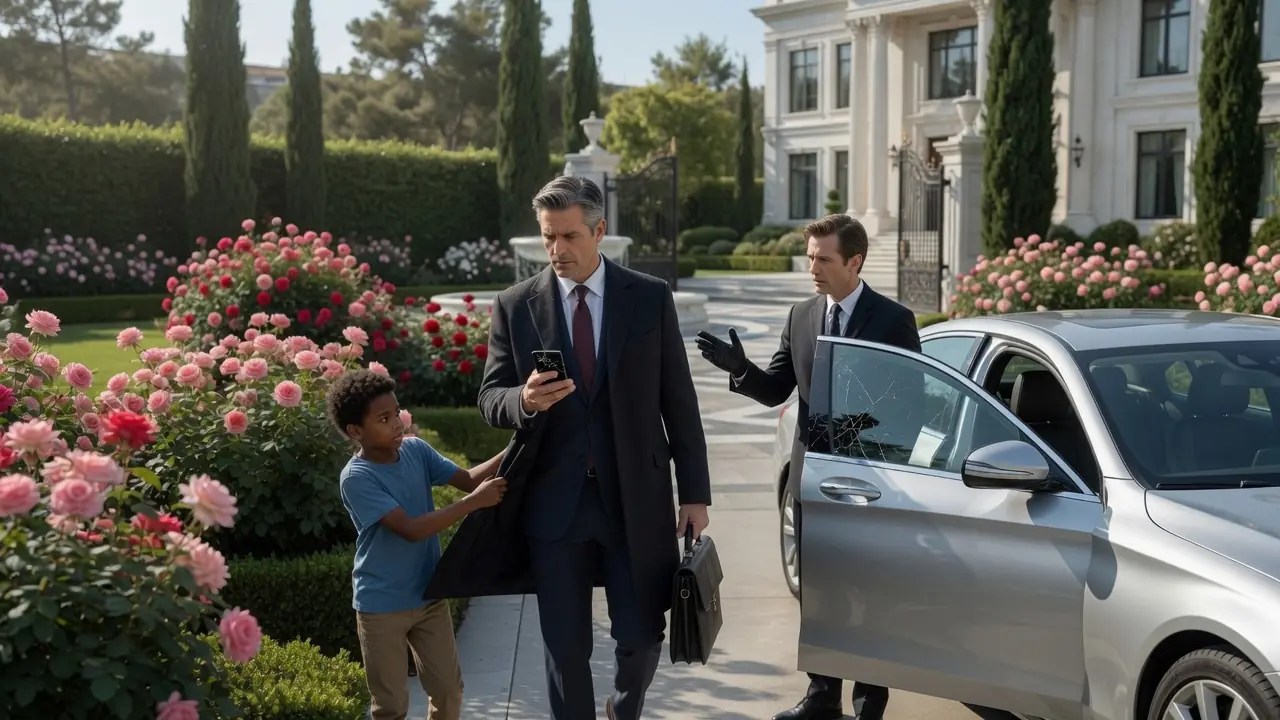
Then a boy stepped from behind the hedge.
He was perhaps ten years old, thin, dark-haired, and dressed in a faded blue shirt. Jonathan had seen him around the property carrying groceries or helping the housekeeper with laundry baskets.
He could not remember the boy’s name.
The child caught Jonathan’s sleeve.
“Please, sir. Don’t let the driver see you listening.”
Jonathan looked toward the gate.
The man beside the car glanced at his phone.
“Why?”
The boy swallowed.
“Because if you get inside, you won’t come home.”
Jonathan’s first instinct was irritation.
He was fifty-four years old, founder of Mercer Continental Freight, and responsible for thousands of employees across the eastern United States. He had built his career by ignoring panic until facts justified it.
He did not change plans because a frightened child appeared in his driveway.
“I’m late,” Jonathan said. “Tell your mother whatever happened, and I’ll speak to both of you tonight.”
The boy did not release his sleeve.
“I heard your wife.”
Jonathan went still.
“She was talking to a man behind the kitchen last night. They said your name. They said the driver would be different this morning.”
Jonathan looked again at the car.
His regular driver, Martin Hale, had worked for him for five years. Martin wore a silver ring on the thumb of his left hand. It had belonged to his father, and he never removed it.
The man at the gate had no ring.
Jonathan’s phone vibrated.
A message appeared from his wife.
You’re going to be late again. The car is waiting.
He placed the phone in his pocket.
“Walk beside me,” he said to the boy. “Do not run. Do not look at the gate.”
They turned away from the driveway and followed the side path toward the eastern garden. Jonathan kept his pace even.
The driver did not call after him.
Behind a wall of tall cypress trees, Jonathan stopped and crouched.
“What is your name?”
“Caleb Turner.”
“Your mother is Rosa?”
“Yes, sir.”
Rosa Turner had worked as the household housekeeper for nearly three years. She lived with Caleb in a small cottage behind the south wing.
Jonathan had approved the arrangement.
He had never visited the cottage.
“Tell me exactly what you heard.”
Caleb looked toward the trees.
His hands trembled, but his voice did not.
“I came down for my drawing book. Mom was in the kitchen making tea. The radio was on, so I don’t think she heard them outside.”
“Who was outside?”
“Mrs. Mercer and a man.”
“Did you know him?”
“No.”
“What did they say?”
Caleb took a breath.
“She said you always left at eight thirty. She said you walked to the car while reading your phone and never looked at the driver.”
Jonathan felt the muscles in his jaw tighten.
“What else?”
“She said the real driver had been taken off the schedule. The other man said the car would stop near Blackwater Reservoir.”
Jonathan knew the road.
It curved along a steep embankment outside the town of Fairmont. Several vehicles had gone through the guardrail over the years.
Caleb continued.
“They said it would look like an accident.”
The morning sounds around them became strangely sharp.
Water fell inside the fountain.
A bird moved through the hedge.
The town car’s engine idled beyond the trees.
Jonathan looked at the child.
“How do you know they meant me?”
“They said Jonathan Mercer three times.”
Caleb’s eyes filled.
“And Mrs. Mercer said when it was finished, she would finally be free.”
Jonathan had negotiated hostile acquisitions without revealing fear.
He had sat through federal investigations, strikes, lawsuits, and the near collapse of his company.
None had prepared him for hearing his own wife described as part of a plan to kill him.
“Did you tell your mother?”
“No.”
“Why?”
“I thought she might not believe me.”
Jonathan considered the honesty of that answer.
“Did you hear anything else?”
Caleb reached inside his shirt pocket and removed an old phone with a cracked screen.
“I recorded some of it.”
Jonathan stared.
“My mother gave me this when she bought another phone. It still records.”
He accepted the device.
One audio file had been saved at 11:18 the previous night.
Eleven minutes and forty-seven seconds.
Jonathan pressed play.
At first, there was only the sound of dishes and the faint hum of Rosa’s kitchen radio.
Then a sliding door opened.
His wife’s voice followed.
Celeste Mercer always spoke gently in public. At charity dinners, her words had the warm, careful rhythm of someone trained to make every guest feel important.
That same voice now said:
“He has to enter willingly. If anyone sees force, the entire plan becomes useless.”
A man answered.
“The replacement driver knows the route. Mercer will be reading his phone. He won’t notice.”
Jonathan raised the volume.
The man continued.
“The car stops where the road bends beside the reservoir. He gets out. The guardrail is already weak in that section.”
“And the driver?”
“Paid.”
Celeste spoke again.
“The insurance doubles if the death is accidental.”
A glass touched the patio table.
The man asked, “How much?”
“Seventy million.”
Caleb watched Jonathan’s face.
Jonathan gave no reaction.
The recording continued.
Celeste explained that the policy had been increased fourteen months earlier. She was the sole beneficiary. The ownership structure of Jonathan’s company had also been adjusted so that a trust controlled by her would receive a major portion of his personal shares.
“The board cannot stop it,” she said. “Jonathan signed the amendment.”
Jonathan remembered signing documents in a Boston hotel after a long merger negotiation.
He remembered Celeste placing a hand on his shoulder and telling him he looked exhausted.
He remembered a lawyer pointing toward several signature lines.
He did not remember reading the third page.
The man on the recording laughed softly.
“Afterward, we wait.”
“A year,” Celeste said. “Perhaps eighteen months. We do not change anything too quickly.”
“And then?”
“Then we stop pretending.”
Jonathan ended the recording.
Caleb stood very still.
“You saved the original?”
“Yes, sir.”
“No one knows?”
“No.”
Jonathan slipped the phone into the inner pocket of his jacket.
“Good.”
The boy looked toward him.
“What are you going to do?”
Jonathan studied the car beyond the trees.
The driver was no longer looking at his phone.
He was watching the house.
“First, I’m going to make them believe nothing has changed.”
Jonathan called his attorney.
Owen Price had represented him for nearly twenty years. He answered on the second ring.
“You should be halfway to the Fairmont meeting.”
“I’m not going.”
Owen heard something in his voice.
“What happened?”
“I need every document connected to my life-insurance policy. Every change made in the last two years. Beneficiaries, riders, witnesses, notaries.”
“How quickly?”
“Ninety minutes.”
“Jonathan—”
“Tell no one at Mercer Continental. Not the board, not legal, not my assistant.”
Owen stopped asking questions.
“I’ll call you.”
Jonathan ended the call.
His phone rang immediately.
Celeste.
He answered.
“Where are you?”
Her tone carried mild amusement.
“The driver says you disappeared into the garden.”
“I forgot a file.”
“Do you want me to help you find it?”
“No. I’m going inside now.”
“You have less than an hour before the meeting.”
“I know.”
A tiny pause followed.
“Come quickly, darling.”
Jonathan ended the call.
Caleb looked up.
“She’s inside?”
“She is now.”
“Are you going back?”
“Yes.”
The boy caught his arm again.
Jonathan placed one hand on Caleb’s shoulder.
“I am not entering the car.”
“Then why go inside?”
Jonathan looked toward the mansion where he had lived for twenty-six years.
“Because part of me still wants to believe you misunderstood.”
Caleb thought about it.
“You need to see her.”
Jonathan nodded.
“Yes.”
They moved along the side of the house, keeping behind hedges and low garden walls.
Near the rear patio, they crouched beneath climbing jasmine.
Celeste sat at the white iron table.
She wore a pale blue dress Jonathan had bought for her in Florence.
Across from her sat a tall man in his early forties. His hair was carefully styled. His dark jacket appeared expensive without being memorable.
His hand rested close to Celeste’s.
Neither noticed the figures behind the flowers.
“The driver says he’s delayed,” the man said.
“He forgot a folder.”
“Did he see anything?”
“No.”
Celeste smiled.
“He never sees what is directly in front of him.”
The words cut deeper than the recording.
Jonathan had spent most of his adult life believing his inattentiveness was simply the price of responsibility.
He remembered anniversaries through reminders.
He answered business calls during dinner.
He knew freight costs in thirty states but could not remember the name of the gardener who had worked on his property for seven years.
Celeste reached across the table and covered the stranger’s hand.
“By tonight, it will be over.”
The man lifted her wrist and kissed it.
“Then we begin.”
Jonathan turned away.
He felt no explosion of rage.
Only the quiet collapse of a structure he had assumed was permanent.
“Come with me,” he whispered.
They entered through the laundry room.
Jonathan called Martin.
The real driver answered from home.
“You’re off today?” Jonathan asked.
“Yes, sir. I received a message last week saying you’d use another service while my car was being repaired.”
“Is your car being repaired?”
“No. It’s in my driveway.”
“Who sent the message?”
“The dispatch system.”
“It was false.”
Martin became silent.
Jonathan continued.
“Drive toward my house, but park one street away. Do not approach the gate. Wait for my call.”
“Yes, sir.”
Jonathan looked at Caleb.
“I need you to return to your mother.”
“What should I say?”
“Tell her your stomach hurts. Stay in your room. If anyone asks, you have not seen me since breakfast.”
Caleb nodded.
Jonathan knelt until they were eye to eye.
“What you did today required more courage than anything I have done in my life.”
Caleb lowered his eyes.
“I was scared.”
“Courage does not mean you weren’t scared.”
Jonathan pointed toward the staff cottage.
“Go.”
Caleb disappeared through the hallway.
Jonathan waited, then entered his study.
He opened drawers and moved papers, creating the exact scene he had described to Celeste.
He selected an old forecast folder and carried it toward the foyer.
Celeste stood beside the mirror adjusting an earring.
“There you are.”
Her smile was flawless.
“Did you find it?”
“Yes.”
She approached and straightened his tie.
Jonathan studied her face.
This woman had held his hand after his mother died.
She had once slept beside him on a hospital chair while he recovered from surgery.
She had planned his death over drinks on the patio.
“You should hurry,” she said.
“I will.”
He kissed her cheek.
Her perfume was the same fragrance she had worn for nine years.
“I love you,” she whispered.
Jonathan smiled because not smiling would have been dangerous.
Then he walked outside.
The fake driver opened the rear door.
Jonathan moved down the path while pretending to read his phone.
Ten feet from the vehicle, he changed direction.
“Mr. Mercer?”
Jonathan raised his phone to his ear.
“I’m walking to the corner,” he said loudly. “The driveway is blocked.”
He passed through the pedestrian gate.
The fake driver did not follow.
He had been given a script.
Jonathan had stepped outside it.
Martin waited around the corner in his own sedan.
The silver ring caught the light on his left thumb.
Jonathan opened the passenger door rather than sitting in the back.
“Drive.”
“Where?”
“Anywhere away from the office, the airport, and Blackwater Reservoir.”
Martin pulled from the curb.
Two blocks passed before he spoke.
“Sir, should I call the police?”
“Not yet.”
Jonathan explained only enough for Martin to understand the danger.
When he finished, Martin’s hands tightened around the steering wheel.
“I should have confirmed that message.”
“You had no reason to distrust it.”
“I should have called.”
“So should I have read the documents I signed.”
Jonathan looked through the window.
“Today is not the day for either of us to pretend we caused someone else’s crime.”
They met Owen Price at a small coffee shop near the river.
The attorney sat in a corner with a leather folder and two untouched cups.
Jonathan told him everything.
Owen listened without interrupting.
Then he opened the folder.
“Your original policy was four million dollars. It increased to twelve million after Mercer Continental went public.”
“I remember.”
“Fourteen months ago, it increased to thirty-five million with double indemnity for accidental death.”
“Seventy million.”
“Yes.”
Owen showed him the beneficiary page.
Celeste was listed alone.
All contestable provisions had been removed.
Jonathan’s signature appeared at the bottom.
“This is mine,” he said. “But I was in Tokyo on the date beside it.”
“I confirmed your travel schedule.”
“The notary?”
“A man named Leonard Voss. He retired four months ago and moved to Arizona.”
“Can he be reached?”
“His phone is disconnected.”
Owen closed the folder.
“I called a private investigator before leaving home. Elena Ruiz. She is tracing Voss, the replacement driver, and the man on the patio.”
Jonathan looked toward Martin, who stood near the door watching the street.
“Caleb and his mother are still at the house.”
“Elena will place surveillance near their cottage.”
“I want them protected.”
“They will be.”
Jonathan’s phone rang.
Celeste.
He answered.
“Richard—”
“Jonathan,” he corrected automatically.
She paused.
“Where are you?”
“With Owen.”
“The driver said you walked past the car and entered another vehicle.”
“The car was wrong.”
“What do you mean?”
“The driver was not Martin. The dispatch office has no record of the substitution.”
Celeste remained silent long enough for Jonathan to hear calculation.
“That is frightening,” she said finally. “Should I call the police?”
“Owen believes it may have been an attempted robbery. We’re investigating first.”
“Come home.”
“I will.”
“When?”
“This evening.”
Her voice softened.
“Please be careful.”
Jonathan looked at Owen.
“I will.”
After ending the call, he placed the phone face down.
“She believes I suspect only the driver.”
“Keep it that way,” Owen said. “The longer she thinks the rest of the plan remains hidden, the more likely they are to communicate.”
Elena called that afternoon.
Jonathan had checked into a small hotel under another name.
He sat on the edge of the bed while Owen joined the call.
“The man from your patio currently calls himself Victor Dane,” Elena said. “He was born Caleb Harlan in Wisconsin.”
Jonathan said nothing.
“He changed his name after his first wife died in 2008. She fell from a hiking trail in northern Michigan. He received just over three million dollars in insurance.”
“Accident?”
“That was the ruling.”
Elena continued.
“In 2014, he became engaged to a software executive in Seattle. She ended the engagement and obtained a restraining order three weeks later.”
“Why?”
“Records are sealed.”
“And after?”
“He married a wealthy widow in Arizona. She died in a house fire twenty-two months later. He inherited property and received a life-insurance payment.”
Jonathan stared at the hotel carpet.
“This is not his first time.”
“No.”
“Does Celeste know?”
“I cannot determine that. He appears to have shown her a completely different history.”
Owen spoke.
“She may be manipulated.”
“She forged my signature,” Jonathan said.
“Yes.”
“She arranged my driver’s replacement.”
“Yes.”
“She chose the day.”
“Yes.”
Owen’s voice remained steady.
“She can be both manipulated and responsible.”
Jonathan walked to the window.
Below, strangers crossed the parking lot carrying grocery bags and luggage.
“Can we arrest them now?”
“We can go to the police with the recording, documents, and prior history,” Owen said. “An investigation would begin immediately.”
“But?”
“Elena believes Victor will deny everything and claim Celeste invented the plan. The recording proves conspiracy, but the false identity and earlier deaths may require more.”
Jonathan understood.
“You want him to act again.”
“We want him to believe the plan can be repaired.”
“He has already killed at least twice.”
“Possibly.”
Jonathan’s voice hardened.
“I do not want him walking away a third time.”
That evening, he returned home.
Celeste met him on the front steps.
She wore a cream sweater and soft gray trousers, the clothes she chose when she wanted to appear vulnerable.
“Thank God.”
She held both his hands.
“I was terrified.”
Jonathan allowed her to embrace him.
He felt the familiar weight of her body and the unfamiliar knowledge of what she had planned.
“What did Owen discover?” she asked.
“Someone impersonated the dispatch office. The theory is attempted kidnapping or robbery.”
Celeste exhaled.
Relief appeared briefly around her eyes.
“Will the police protect us?”
“Owen says not to involve them until the company finishes tracing the message.”
“That seems dangerous.”
“He believes publicity could encourage another attempt.”
She nodded slowly.
“You should stay home for a few days.”
“I may.”
They ate dinner together.
Celeste poured wine.
Asked questions.
Touched his hand.
Jonathan answered without revealing anything.
At ten thirty, she went upstairs.
He waited fifteen minutes, then slipped through the side door and crossed to the staff cottage.
Rosa Turner opened the door before he knocked twice.
She had a tired, intelligent face and did not waste time pretending his visit was normal.
“Caleb is asleep.”
“May I see him?”
She led Jonathan to a small bedroom.
Caleb slept beneath a blue blanket.
A sketchbook lay open on the chair, filled with careful drawings of trees, cars, and faces.
Jonathan stood in the doorway.
Then he sat with Rosa at the kitchen table.
“Your son saved my life this morning.”
Rosa did not speak.
Jonathan told her enough.
Not everything.
Enough.
When he finished, her hands were shaking.
“I knew he was hiding something.”
“He kept it from you because he feared placing you in danger.”
“I should have seen.”
“So should I.”
Rosa looked toward the bedroom.
“What happens now?”
“People are watching the cottage. You will not see them. Continue working normally. Caleb should remain near you.”
“And your wife?”
“She believes I suspect nothing.”
Rosa’s eyes hardened.
“You are going back upstairs to sleep beside her?”
“Yes.”
“I don’t know how.”
“Neither do I.”
Over the next two days, Jonathan maintained every habit.
Breakfast at seven.
Calls in the study.
A kiss on Celeste’s cheek when entering the dining room.
The ordinary life they had shared became a performance staged for an audience of one.
On Thursday evening, Jonathan mentioned the rescheduled Fairmont meeting.
“I have to go tomorrow.”
Celeste lifted her wineglass.
“Along the reservoir road?”
“Yes.”
“Who is driving?”
“Martin.”
A small disappointment crossed her face.
Then it disappeared.
“That is safer.”
“I agree.”
Unknown to Jonathan, Celeste sent Victor a message before midnight.
Police later recovered it.
He is using the original driver. Adjust the plan. Tomorrow is the last opportunity.
Friday morning arrived cold and bright.
Martin stood beside a black sedan at the gate.
His left thumb rested on the door handle.
The silver ring reflected the sun.
Jonathan entered the back seat.
As they left the property, Celeste remained in the doorway.
She raised one hand.
Jonathan returned the gesture.
Ten miles from the city, Martin checked the mirror.
“Gray sedan behind us.”
“How long?”
“Since the Wilcox exit.”
“Elena’s people?”
“No. Hers are farther back.”
Jonathan looked through the rear window.
Two men occupied the gray sedan.
The road narrowed near Fairmont.
Blackwater Reservoir appeared on the left, flat and dark beneath the morning sky.
A black vehicle waited at a roadside turnout ahead.
The fake driver from Monday stood beside it.
“He’s there,” Martin said.
“Continue.”
As they passed, the man entered his vehicle.
The gray sedan behind them slowed.
Martin pressed a hidden button beneath the dashboard.
Two unmarked SUVs pulled from a service road and blocked the highway.
Another vehicle moved behind the gray sedan.
Plainclothes officers emerged with weapons lowered but ready.
The two men inside the sedan were removed.
The fake driver raised his hands.
A fourth car accelerated from the turnout.
It traveled less than fifty yards before another team boxed it against the guardrail.
Victor Dane stepped from the passenger side.
Even at a distance, Jonathan recognized the carefully styled hair and expensive dark jacket.
Victor looked toward Jonathan’s sedan.
For one brief moment, their eyes met.
Victor did not appear frightened.
He appeared irritated.
As though Jonathan had failed to follow instructions.
Martin pulled onto the shoulder.
“It’s over.”
Jonathan watched officers place Victor in restraints.
“Not yet.”
He called Owen.
“They have him.”
“Detective Ruiz is moving on the house now.”
Jonathan looked across the reservoir.
Wind traveled over the water.
This was where the town car would have stopped.
Where his body would have disappeared.
Where Celeste would have received the phone call she had been awaiting.
He closed his eyes.
When Jonathan returned to the estate, unmarked police vehicles filled the driveway.
Detective Elena Ruiz waited beside the front steps.
She was in her fifties, with short dark hair and a face that revealed little.
“Celeste did not resist.”
“Did she say anything?”
“One thing.”
Jonathan waited.
“She said Victor told her he had done it before.”
Jonathan looked toward the house.
“Did she know?”
“She claims she learned about the previous wife only after the plan had begun.”
“That changes nothing.”
“No.”
Celeste emerged between two officers.
She wore the pale blue dress from Florence.
Perhaps she had chosen it because Victor once complimented it.
Perhaps because she expected to receive confirmation that Jonathan was dead.
She stopped when she saw him.
For a moment, neither spoke.
Jonathan saw the woman he married in a Virginia chapel.
The woman who held him at his mother’s funeral.
The woman who decided his life was worth seventy million dollars.
“Was any of it real?” he asked.
Celeste’s lips moved.
No answer came.
The officers guided her toward the car.
She looked back once.
Then the door closed.
The investigation expanded quickly.
The replacement driver accepted a plea agreement and identified everyone involved.
Leonard Voss, the retired notary, was found in Arizona. He admitted certifying Jonathan’s forged signature in exchange for money.
Victor Dane was charged with conspiracy, attempted murder, identity fraud, and insurance fraud.
The deaths of both former wives were reopened.
New evidence connected him to the hiking-trail fall and the Arizona fire.
Celeste pleaded guilty to conspiracy.
Her attorney argued that Victor manipulated her by convincing her Jonathan intended to leave her with nothing.
The court acknowledged the manipulation.
It did not excuse her decisions.
Jonathan attended only the first hearing.
He heard the recording played once inside the courtroom.
Caleb’s cracked phone sat inside an evidence bag on the prosecutor’s table.
Jonathan left before the proceedings ended.
The mansion changed afterward.
He moved into a smaller bedroom facing east.
He sold several cars.
Reduced the household staff.
Converted the formal dining room into a library employees and their families could use.
Martin received a permanent executive transportation position with the company and argued for twenty minutes about the salary before accepting.
Rosa remained at the estate.
Jonathan offered her and Caleb a larger cottage with a fireplace, two bedrooms, and a small sunroom.
She accepted only after insisting the arrangement be written as part of her employment contract rather than charity.
Jonathan agreed.
Caleb entered a private school the following autumn.
Jonathan paid the tuition.
He called it repayment.
Rosa called it excessive.
Caleb called it school.
Six months after the morning beside the cypress trees, Jonathan found him sketching near the greenhouse.
The boy had drawn the fountain, the rose hedge, and the long driveway.
The town car was absent.
Jonathan sat beside him on the stone wall.
“You still use that old phone?”
“The police kept it.”
“I’ll replace it.”
“I don’t need a better phone.”
“You recorded evidence that solved three murder cases.”
Caleb shrugged.
“It was just the phone I had.”
Jonathan smiled slightly.
“What are you drawing?”
“The garden.”
“You missed the cypress trees.”
“I’m adding them last.”
They sat quietly.
Then Caleb asked, “Do you still get scared?”
Jonathan looked toward the gate.
“Sometimes.”
“Of cars?”
“No.”
“Of your wife?”
“No.”
“What, then?”
Jonathan considered the answer.
“I think about how close I came to walking past you.”
Caleb lowered his pencil.
“I almost didn’t say anything.”
“Why?”
“I thought you might get angry.”
“I probably would have.”
“I thought you might tell my mom I was lying.”
Jonathan looked at him.
“That is what frightens me.”
Caleb waited.
“That you had every reason to stay silent,” Jonathan said. “You were a child speaking to a man who barely knew your name. You could have decided it was safer not to interfere.”
“But I did.”
“Yes.”
Jonathan looked across the garden.
“And I am alive because you did.”
Caleb returned to his drawing.
“My mom says doing the right thing doesn’t always make things easier.”
“She is correct.”
“She says it lets you look in the mirror without looking away.”
Jonathan nodded.
“Your mother is correct about many things.”
Wind moved through the cypress branches.
For years, Jonathan had believed danger would arrive from competitors, criminals, lawsuits, or men waiting in dark parking lots.
He had never imagined it would sit across from him at dinner.
Wear a familiar perfume.
Straighten his tie.
Tell him to drive safely.
But the person who saved him had not been a lawyer, detective, executive, or armed guard.
It was a ten-year-old boy with a cracked phone.
A child whom Jonathan had passed in his own hallways without once learning his name.
Caleb noticed the wrong driver.
He heard the voices adults ignored.
He understood that truth without evidence could be dismissed, so he pressed record.
He was frightened and spoke anyway.
Jonathan had built a company by believing important decisions belonged to powerful people.
That morning taught him otherwise.
Sometimes the most important person in the room was the quietest.
Sometimes the person everyone overlooked was the only one paying attention.
And sometimes a man survived not because he was wealthy, protected, or clever—
but because one child standing behind a rose hedge refused to let him walk toward the wrong car.