The first thing Mr. Carver noticed was the old man’s coat.
Not the little girl holding his hand. Not the way the man stood quietly in the middle of the lobby, careful not to block the flow of guests. Not the softness in his eyes when the child looked up at the Christmas tree. Carver saw only the frayed gray wool, the cracked brown shoes, and the scarf repaired with small uneven stitches. By the time Samuel Whitmore reached the front desk, the hotel manager had already decided he did not belong.
The Aurelius New York glittered around them like a palace made for winter.
Marble floors reflected the chandeliers overhead. A three-story crystal Christmas tree rose in the center of the lobby, silver branches sparkling beneath thousands of tiny white lights. Guests in designer coats took photographs beside gold-wrapped display boxes, while bellmen rolled leather luggage past polished brass columns. Outside, December wind pushed against the revolving doors, but inside the hotel, money seemed to keep even the cold at a respectful distance.
Samuel Whitmore stood near the reception desk with his granddaughter Emily beside him.
She was nine years old, small for her age, wearing a purple winter hat and a backpack with one broken zipper. Her cheeks were pink from the Manhattan cold, and her eyes were fixed on the Christmas tree like she had stepped into a dream. She held Samuel’s hand with both of hers, squeezing it whenever a guest brushed too close. Samuel looked down and gave her a small smile, the kind of smile grandfathers use when they want a child to feel safe even when they are not.
“Grandpa,” Emily whispered, “is it really made of glass?”
“Crystal,” Samuel said softly.
“Is that better than glass?”
He smiled faintly.
“People charge more for it.”
Emily looked up at the glowing branches again.
“It looks like snow that forgot to fall.”
Samuel’s face softened.
For a moment, the lobby disappeared. He saw another Christmas decades earlier, when the tree had been much smaller, the lobby less grand, and his wife Clara still alive beside him. Clara had stood with a clipboard in her hands, arguing with electricians about where each light should go. She had believed a hotel tree should make tired people stop walking for at least three seconds. If they stopped, she always said, maybe they would remember they were human before they became customers.
Samuel had brought Emily because Clara would have wanted it.
Emily’s mother, Samuel’s daughter Rachel, had died three years earlier after a long illness that drained both money and hope from the family. Since then, Samuel had raised Emily in a small Queens apartment above a bakery, using his pension, old savings, and the stubborn patience of a man who had already buried too much. Emily had heard stories about The Aurelius her entire life. She knew her grandmother had loved the hotel’s Christmas tree, and this year she had asked, with quiet seriousness, if she could see it in person.
Samuel had promised.
That promise brought him through the gold-trimmed doors on a freezing afternoon, wearing the best coat he had left.
The receptionist behind the black marble desk looked at them with a polished smile that cooled the longer she stared. Her name badge read Melissa Hart. She was young, perfectly dressed, and trained to make every word sound gentle even when it was not. She glanced at Samuel’s coat, then at Emily’s backpack, then at Samuel’s shoes. Her fingers stopped above the keyboard.
“Sir,” Melissa said, “may I help you?”
Samuel stepped forward carefully.
“Yes. I’d like to book a room.”
The two other receptionists behind the counter stopped typing.
One turned his head slowly. Another looked down quickly, pretending not to react. A bellman near the entrance paused with a suitcase in his hand. Even Emily looked up at her grandfather, surprised, because Samuel had not told her that part.
“A room?” Melissa repeated.
“Yes,” Samuel said. “One suite, facing Central Park, if available.”
For three seconds, the front desk went completely still.
Then the young male receptionist at the far station coughed into his fist, hiding a laugh badly. Melissa did not laugh right away. She let her eyes travel over Samuel again, slower this time, as if the full picture needed to be confirmed. Then her smile returned, thinner than before.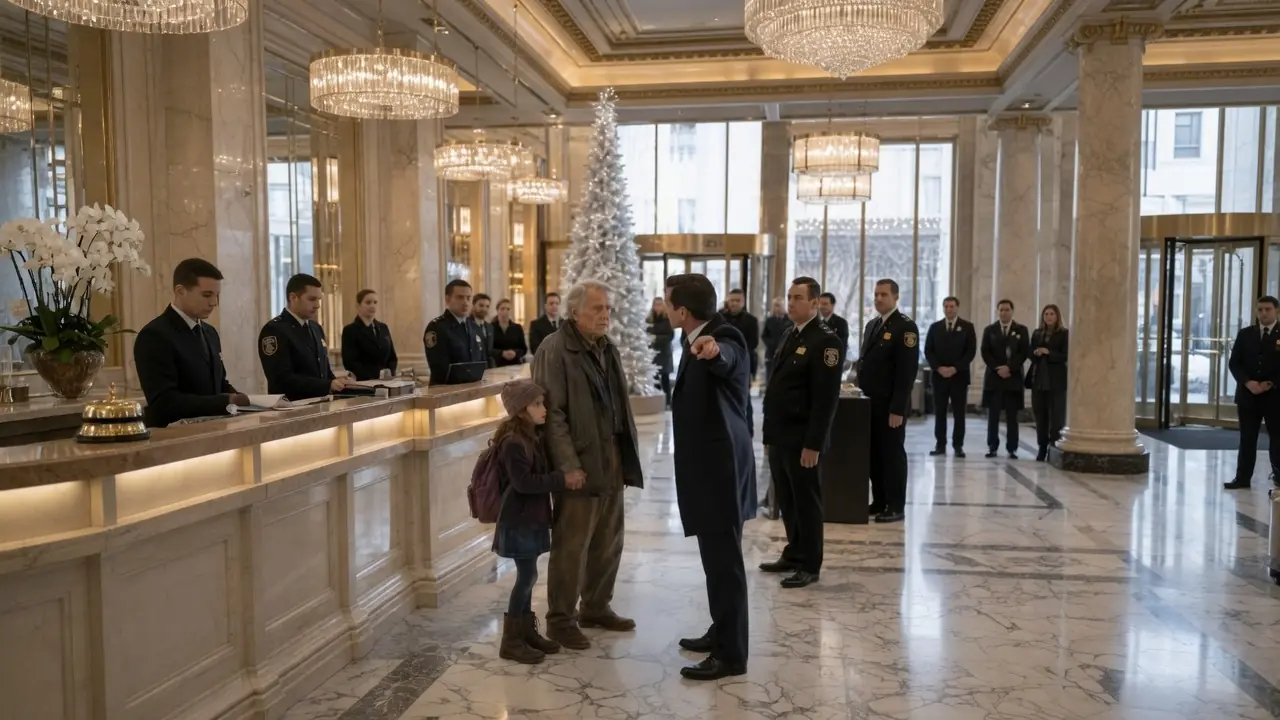
“Sir,” she said, “rooms here begin at six thousand dollars a night.”
“I understand.”
“Do you?”
Emily’s fingers tightened around Samuel’s hand.
Samuel felt the child hear the tone before she understood the insult. Children always know when adults are being cruel, even when the words are wrapped in manners. He kept his hand steady around hers. He had spent a lifetime learning not to tremble in rooms that wanted him to.
“I do,” Samuel said.
Melissa folded her hands on the counter.
“This is a private luxury hotel. The lobby is for registered guests and confirmed dining reservations.”
“I am trying to become a registered guest.”
The young male receptionist looked away, smiling.
Melissa leaned forward slightly.
“Sir, if you came to see the Christmas display, you may take a photograph from outside.”
Emily’s face fell.
Samuel looked at Melissa for a long moment.
“I brought my granddaughter inside because I promised her she could see the tree with her own eyes.”
Melissa looked at Emily for the first time.
“Honey,” she said, with a sweetness that made Samuel’s jaw tighten, “this isn’t a museum.”
Emily lowered her eyes.
Samuel’s voice stayed quiet.
Melissa’s smile vanished.
“Excuse me?”
“I said, do not speak to her like that.”
That was when Mr. Carver approached.
Jonathan Carver was the hotel manager, a tall man in a navy overcoat with a sharp face and a voice that carried authority before volume. He had been watching from near the concierge desk, where he had been speaking with a wealthy guest about a private car to Lincoln Center. Carver prided himself on spotting problems early. In his world, a problem often looked like a person whose clothes did not match the room.
He stopped beside Melissa and looked at Samuel.
“Is there an issue here?”
Melissa answered before Samuel could.
“This gentleman is attempting to book a suite without a reservation.”
Carver looked at Samuel’s wallet, still closed in his hand.
“I see.”
Samuel met his gaze.
“I would like to book a room for myself and my granddaughter.”
Carver glanced at Emily.
The little girl moved closer to Samuel’s side.
Carver’s face did not soften.
“Sir, The Aurelius is fully committed for the holiday week.”
Melissa looked down at her screen, surprised, because that was not true. There were suites available. Very few, but enough. Carver did not care about availability; he cared about appearance. Samuel knew it too, because he had seen the lie form before it reached the air.
“Then check again,” Samuel said.
Carver’s eyes narrowed.
“I assure you, I know my hotel.”
Samuel held his gaze.
“That remains to be seen.”
The nearby lobby began to notice.
A woman in a white fur coat paused near the tree. A businessman at the concierge desk stopped reading his phone. Two security guards near the entrance turned slightly toward the front desk. Moneyed rooms pretend not to watch public discomfort, but their attention always gathers like smoke.
Carver stepped closer.
“Sir, take the child and leave before I call security.”
The words struck Emily like a door slamming.
She looked up at Samuel, her eyes shining.
“Grandpa, did we do something wrong?”
Samuel placed one hand gently on her shoulder.
“No, sweetheart,” he said. “We’re exactly where we’re supposed to be.”
Carver gave a short laugh.
“That is not your decision.”
Samuel turned back to him.
“It was once.”
Carver’s expression hardened.
“I don’t have time for riddles.”
“I’m not speaking in riddles.”
“You walked in from the street, disturbed my staff, and made a child part of this performance.”
Samuel’s hand tightened once around Emily’s shoulder.
“She is not part of a performance. She is my granddaughter.”
“Then protect her from embarrassment and leave.”
A small sound moved through the lobby.
Someone near the tree whispered, “Oh my God.” Another guest lifted a phone slightly, not yet recording but ready. Melissa stared at her screen, suddenly less confident. The security guard closest to the door looked uncomfortable, but he did not move without Carver’s signal.
Samuel remained still.
That stillness irritated Carver more than shouting would have.
“I said leave,” Carver repeated.
Samuel reached into his coat pocket and pulled out his old leather wallet.
Carver’s eyes dropped to it, then back up with impatience.
“If you pull out a coupon, a gift card, or some story about a relative staying here, I will have you removed.”
Emily flinched.
Samuel looked at her and gently squeezed her hand.
Then he opened the wallet.
Inside were old photographs, a folded medical card, a faded picture of Clara beneath a Christmas tree, and one black card with a small gold crest pressed into its corner. He removed the card and placed it on the counter. Melissa looked at it, then froze.
Carver did not look closely enough.
“A card does not change policy,” he said.
Samuel’s voice lowered.
“Careful, son. You are speaking in a lobby my wife helped build.”
Carver stared at him.
The words seemed to annoy him more than frighten him.
“People like you always invent stories when money is mentioned.”
Samuel’s eyes cooled.
“Then call the owner and ask why Samuel Whitmore is still on the deed.”
This time, the silence was different.
Melissa’s fingers went motionless. The young male receptionist stopped smiling. The bellman near the entrance turned fully toward the desk. One security guard exchanged a quick glance with another, because the name Whitmore was not unknown in the hotel. It appeared in staff orientation videos, framed photographs near the executive corridor, and old documents most front desk employees never read.
Carver’s face tightened.
“What did you say?”
Samuel lifted his chin.
“You heard me.”
“That name belongs to the original ownership trust.”
“It belongs to me.”
“That is impossible.”
Samuel looked past him toward the crystal tree.
“My wife Clara and I opened the first Aurelius with forty rooms, one broken service elevator, and a lobby tree she decorated by hand.”
Carver’s mouth opened, then closed.
Melissa whispered, “Mr. Carver…”
He turned sharply.
“What?”
She had gone pale.
“The card.”
Carver looked down at the black card properly for the first time.
The gold crest was not a bank logo.
It was the Whitmore Family Trust emblem, used only for direct ownership verification and legacy accounts. Melissa had seen it once during training, in a slideshow about ultra-private guests. It was not something that could be issued by a concierge desk or purchased through a loyalty program. It represented access above the hotel chain’s public management structure.
Carver picked it up.
His fingers looked suddenly less steady.
“This could be old,” he said.
Samuel nodded.
“It is.”
“It could be invalid.”
“It is not.”
Carver turned to Melissa.
“Verify it.”
She entered the number with stiff fingers.
The system took longer than usual.
Those seconds stretched across the lobby like wire. Emily looked from the card to Samuel’s face, confused and frightened. Samuel kept his eyes on the tree, because if he looked at her too long, his anger might finally show. He had promised her wonder, not humiliation.
The screen changed.
Melissa’s face drained completely.
Carver saw it before she spoke.
“Well?” he demanded.
Melissa swallowed.
“Legacy ownership account confirmed.”
The lobby seemed to stop breathing.
Carver stared at her.
“What?”
Melissa’s voice trembled.
“Samuel Whitmore. Founding trust. Permanent residence access. Executive override authority.”
The words fell one by one.
Permanent residence access.
Executive override authority.
Founding trust.
The manager who had just threatened to throw him out stood frozen beside the desk, while the old man in the frayed coat placed his hand over his granddaughter’s trembling fingers. The guests who had been watching with curiosity now watched with caution. It is one thing to witness someone being disrespected when you believe he is powerless. It is another to realize the person being disrespected may own the walls around you.
Carver forced a laugh.
“There must be an error.”
Samuel looked at him.
“The error was yours.”
Carver stepped back slightly.
“Mr. Whitmore, I was not informed you would be visiting.”
“I did not want my name to arrive before I did.”
“Had we known—”
Samuel cut him off.
“That is exactly why I came without calling.”
Emily looked up at him.
“Grandpa?”
Samuel turned toward her.
“Yes, sweetheart?”
“Is this your hotel?”
The question broke something in him.
He knelt slowly, even though his knees protested, and took both of her hands.
“It was your grandmother’s dream first,” he said. “Then mine. Now it belongs to many people on paper, but a piece of it still belongs to our family.”
Emily looked at the tree.
“Grandma made that?”
“The first one,” Samuel said. “Not this one. But every tree after hers is supposed to remember it.”
Her eyes filled with tears.
“Then why did they tell us to leave?”
Samuel looked up at Carver.
The question belonged to the child, but the answer stood in a manager’s expensive coat.
Carver swallowed.
“Emily,” Samuel said gently, “some people forget that beautiful places are only beautiful if they treat people kindly.”
The child nodded slowly, though pain remained on her face.
Samuel stood again.
His knees ached, but he did not reach for the counter.
Carver’s voice changed completely.
“Mr. Whitmore, please allow me to apologize. There has been a misunderstanding.”
Samuel looked at him.
“No.”
Carver blinked.
“No?”
“There was no misunderstanding.”
The lobby stayed silent.
Samuel’s voice remained calm, but each word carried.
“You understood my coat. You understood my shoes. You understood my granddaughter’s backpack. You understood exactly what you wanted to believe, and you acted on it.”
Carver’s face reddened.
“That was not my intention.”
“Your intention pointed toward the door.”
A guest near the tree lowered her phone.
Samuel turned toward the two security guards.
“You were about to remove us?”
One guard looked down.
“We follow manager instruction, sir.”
Samuel nodded.
“Then remember this instruction. No guest, visitor, child, worker, courier, cleaner, or stranger is to be treated like dirt because their clothes make someone uncomfortable.”
The guard nodded quickly.
“Yes, sir.”
Samuel turned back to Carver.
“I want the general manager notified.”
Carver stiffened.
“I am the hotel manager.”
“I know. I asked for the general manager.”
Melissa reached for the phone immediately.
Carver’s jaw tightened.
“Mr. Whitmore, we can resolve this privately.”
Samuel looked toward the guests.
“You made it public.”
Those words landed hard.
Carver’s mouth closed.
Melissa spoke into the phone in a low, urgent voice. Within minutes, the elevator doors opened and a woman in a charcoal suit stepped into the lobby with two executives behind her. She moved quickly, not running but close to it. Her name was Diane Mercer, general manager of The Aurelius New York. She had worked in luxury hospitality for thirty years, and she knew before reaching the desk that something serious had happened.
Then she saw Samuel.
Her face changed instantly.
“Mr. Whitmore,” she said, breathless. “Sir, I am so sorry.”
Emily looked at her grandfather with wide eyes.
Carver turned pale.
Samuel did not accept the apology.
Not yet.
Diane reached the desk and looked from Samuel to Emily, then to Carver.
“What happened?”
Samuel answered simply.
“Your manager told me to take my granddaughter and leave before he called security.”
Diane looked at Carver.
He tried to speak.
“Diane, there were concerns—”
“Did you say that?”
Carver swallowed.
“Yes, but—”
Diane cut him off.
“Did you deny him service?”
“He did not have a reservation.”
Diane turned to Melissa.
“Was a suite available?”
Melissa hesitated only a second.
“Yes.”
Diane’s face hardened.
Carver looked at her desperately.
“He appeared to be loitering. He said he came for the tree. I was trying to protect the hotel environment.”
Samuel’s voice was quiet.
“From my granddaughter?”
No one answered.
Emily moved closer to Samuel’s side.
Diane saw that and looked as if the truth had just become heavier.
“Mr. Carver,” she said, “step away from the desk.”
Carver stared.
“Diane.”
“Now.”
The word cut through the lobby.
Carver stepped aside.
Diane turned to Samuel.
“Mr. Whitmore, I apologize without excuse. The Aurelius failed you and your granddaughter today.”
Samuel watched her carefully.
“An apology is a beginning.”
“Yes, sir.”
“Not an ending.”
Diane nodded.
“Yes, sir.”
Samuel looked at the Christmas tree.
“My wife believed this lobby should welcome people before it impressed them. She used to say that if the doorman smiled at a tired mother, the hotel had already done something right.” His eyes moved back to Diane. “Today, my granddaughter learned that a beautiful room can still make a child feel unwanted.”
Diane’s eyes lowered.
“I’m deeply sorry.”
Emily whispered, “It’s okay.”
Samuel looked down at her.
“No, sweetheart,” he said softly. “It is not okay just because someone apologizes.”
Emily nodded, absorbing another lesson she should not have needed yet.
The lobby remained still.
Samuel turned toward Carver.
“Look at her.”
Carver’s jaw tightened.
“Mr. Whitmore—”
“Look at her.”
Carver slowly looked at Emily.
The little girl stood in her purple hat, gripping her grandfather’s hand, her face trying to be brave and failing in small ways. Carver looked away first. That made Samuel’s expression colder.
“You did not only insult me,” Samuel said. “You taught a child that doors open faster for people who look expensive.”
Carver’s voice cracked slightly.
“I apologize to her.”
Emily hid partly behind Samuel’s coat.
Samuel did not move.
“Then say it to her.”
Carver swallowed.
“I’m sorry, Emily.”
She looked up at Samuel.
Samuel gave her no instruction.
He wanted the apology to belong to her.
Emily looked back at Carver and said quietly, “You were mean to Grandpa.”
The words were plain.
That made them devastating.
Carver’s face tightened as if he had been slapped by innocence.
“Yes,” he said. “I was.”
“And you made the tree feel bad.”
A few guests looked down.
Samuel closed his eyes briefly.
Diane’s face softened with visible pain.
“I am sorry,” Carver said again, but now his voice was smaller.
Emily did not answer.
She only held Samuel’s hand.
Diane turned to the assistant general manager beside her.
“Escort Mr. Carver to the executive office. He is suspended pending review.”
Carver’s head snapped toward her.
“Suspended?”
Diane’s voice remained firm.
“Immediately.”
“This is excessive.”
Samuel looked at him.
“No. Excessive was threatening a child with security because her grandfather’s coat offended you.”
Carver had no answer.
The assistant general manager stepped toward him.
For a moment, Carver looked around the lobby, perhaps hoping guests would see him as a man punished unfairly for a simple mistake. No one came to his rescue. The guests who had silently watched the humiliation now silently watched the consequence. In rooms like that, loyalty often follows power, not truth.
Carver walked toward the executive corridor.
His shoulders were stiff, his face pale, his authority gone.
Only after he disappeared did the lobby breathe again.
Diane turned back to Samuel.
“Mr. Whitmore, your family suite is always available. We keep it maintained according to trust requirements. I can have it prepared immediately.”
Samuel looked surprised despite himself.
“You kept Clara’s suite?”
Diane nodded.
“Yes, sir. The Whitmore Suite. It has not been sold to guests since the trust restrictions were updated. We maintain it every week.”
Samuel’s face changed.
For the first time, the anger loosened enough for grief to step through.
Emily looked up.
“Grandpa, Grandma had a room?”
Samuel nodded slowly.
“She did.”
“Can we see it?”
Samuel swallowed.
“Yes.”
Diane personally led them to the elevator.
But before Samuel stepped away from the desk, he turned toward the lobby.
Every guest looked anywhere but directly at him.
Samuel raised his voice just enough to carry.
“My granddaughter came here to see a Christmas tree. She should not have needed a deed, a trust account, or a famous name to be treated kindly.”
No one spoke.
Samuel continued.
“Remember that when you walk past someone whose coat has seen harder winters than yours.”
Then he took Emily’s hand and walked toward the elevator.
The doors opened.
Inside, polished brass reflected them both: the old man in the frayed coat and the little girl with the purple hat. Emily leaned against him as the elevator rose. Diane stood beside them, silent, giving them the respect of not filling grief with corporate language.
The elevator stopped on the thirty-second floor.
The doors opened into a private hallway.
At the end of it stood double doors with a brass plaque: The Whitmore Suite.
Samuel stared at the name.
His hand trembled for the first time that day.
Emily noticed.
“Grandpa?”
“I’m all right,” he said.
But he was not entirely all right.
Diane unlocked the doors and stepped back.
Samuel entered slowly.
The suite was quiet, untouched by ordinary hotel life. Large windows looked over Central Park, where winter branches stretched like dark lace against the pale sky. A grand piano stood near the sitting room. On the mantel rested a framed photograph of Clara Whitmore beside the first Aurelius Christmas tree, laughing with tinsel caught in her hair.
Emily walked toward the photograph.
“Is that Grandma?”
Samuel nodded.
“She was younger there.”
“She’s pretty.”
“She was stubborn.”
Emily smiled.
“Like you?”
“Worse.”
The little girl laughed, and the sound eased something in the room.
Samuel sat carefully on the sofa.
Diane stood near the entrance.
“Mr. Whitmore, I will leave you with privacy. A formal report will be prepared, and I will personally oversee the review.”
Samuel looked at her.
“Do more than review.”
“Yes, sir.”
“Change the training. Change the hiring. Change what managers are rewarded for. If luxury teaches staff to fear ordinary people, then it has become uglier than poverty.”
Diane nodded.
“I understand.”
“I hope so.”
She left quietly.
Emily climbed onto the sofa beside Samuel.
“Grandpa?”
“Yes?”
“Are we staying here tonight?”
Samuel looked around the suite.
At Clara’s photograph.
At the tree lights far below in the lobby.
At the child who had only wanted wonder and had been handed shame before she was given the truth.
“Yes,” he said. “We are staying tonight.”
Emily’s eyes widened.
“Really?”
“Really.”
“In Grandma’s room?”
“In Grandma’s room.”
She leaned against him.
“Will the tree still be downstairs tomorrow?”
“Yes.”
“Can we see it again?”
Samuel looked out the window.
“Yes. But tomorrow, we’ll walk down those stairs like we belong.”
Emily frowned.
“We did belong today.”
Samuel smiled softly.
“You’re right.”
That evening, Diane sent hot chocolate, dinner, and a handwritten apology.
Samuel let Emily eat by the window while the city glittered below. He did not call lawyers that night, though he could have. He did not issue a public statement, though phones in the lobby had already sent the incident far beyond the hotel walls. He simply sat near Clara’s photograph and told Emily stories she had never heard before.
He told her about the first Aurelius, which had opened during a snowstorm.
He told her how Clara had fired a concierge for refusing to help a delivery boy carry flowers through the service entrance. He told her how she once gave the presidential suite to a stranded family whose flight had been canceled on Christmas Eve. He told her how the hotel became famous not because it was expensive, but because Clara insisted even the richest guest should feel humbled by kindness.
Emily listened with her chin in her hands.
“Grandma sounds nice,” she said.
“She was not always nice.”
Emily blinked.
“No?”
Samuel smiled.
“She was good. That is harder.”
The next morning, Samuel and Emily returned to the lobby.
This time, Diane waited near the tree. Melissa stood behind the desk, visibly nervous. The staff had gathered in careful positions, not staged exactly, but aware. Carver was gone. His absence changed the air.
Emily held Samuel’s hand as they approached the crystal tree.
No one stopped them.
No one suggested they take a picture from outside.
A doorman smiled at Emily and said, “Good morning, Miss Whitmore.”
Emily looked startled.
Then she smiled back.
Samuel saw it happen.
A little piece of yesterday’s hurt loosened.
Diane stepped forward.
“Mr. Whitmore, Emily, we would be honored if you placed the first ornament for the children’s charity tree this year.”
Emily looked at Samuel.
“Can I?”
Samuel nodded.
Diane handed her a small silver ornament shaped like a key.
Emily stepped toward the tree and hung it on a lower branch.
The lobby watched in silence.
This time, not the cruel silence of judgment.
A different silence.
The kind Clara had always wanted, when a room stopped long enough to remember.
Samuel stood behind Emily, his old coat still frayed, his shoes still cracked, his scarf still repaired with tiny stitches.
Nothing about him looked richer than the day before.
But everyone saw him differently now.
That was the lesson, and also the shame.
When Emily returned to his side, Samuel looked around the lobby.
He thought about speaking. He thought about telling them all that respect given after proof is not the same as respect freely offered. But Emily slipped her hand into his, and he decided that some lessons did not need another speech. The hotel had heard enough. Now it would have to prove what it learned.
In the months that followed, The Aurelius changed.
Not all at once.
No beautiful institution becomes honest overnight. But Diane replaced the front-desk training program. Security procedures were rewritten. Staff were instructed that no one was to be judged, delayed, redirected, or refused based on appearance, clothing, age, accent, luggage, or visible wealth.
Samuel insisted on one addition.
Every December, the lobby would host an open hour for families who wanted to see the Christmas tree, no room key required.
Diane called it The Clara Whitmore Welcome Hour.
On the first morning it opened, the lobby filled with schoolchildren, nurses after night shifts, delivery workers, grandparents, tourists, and families who only wanted a few photographs under beautiful lights. Some guests complained. Samuel expected that. Diane handled them politely and did not change the rule.
Emily stood beside the tree that day wearing the same purple hat.
She watched a little boy in a patched jacket stare up at the crystal branches with his mouth open.
Then she whispered to Samuel, “Grandpa, he looks like I felt.”
Samuel looked at the boy.
“Yes,” he said.
Emily smiled.
“Then Grandma would like this.”
Samuel’s eyes grew wet.
“Yes, sweetheart. She would.”
Years later, people still told the story of the old man in the frayed coat who walked into The Aurelius and was nearly thrown out of the hotel his wife helped build. Some told it as a story about wealth hidden beneath worn clothing. Some told it as a warning to arrogant managers. Some told it as proof that names on deeds still mattered.
But Samuel knew the real story was smaller.
It was about a child who came to see a Christmas tree.
It was about a room that tried to teach her she did not belong.
It was about a grandfather who refused to let that lesson be the one she carried home.
And it was about Clara, whose dream had almost been buried beneath marble, chandeliers, and six-thousand-dollar suites, until an old man walked back through the front doors and reminded everyone what the hotel was supposed to be.
Not a palace for the rich.
Not a fortress against the ordinary.
Not a room where beauty was guarded from children with old backpacks and grandfathers in repaired scarves.
The Aurelius was supposed to be a place where someone cold from the street could step inside, look up at the lights, and feel for one brief moment that wonder did not require permission.
That was Clara’s legacy.
That was Samuel’s fight.
And when Emily stood beneath the crystal tree years later, older now, holding the hand of her own child, she would tell the story exactly as she remembered it.
“Your great-grandmother believed every beautiful room should have an open door,” she would say.
Then she would point to the silver key ornament still hanging near the lowest branch.
“And your great-grandfather made sure this one did.”