He Forced a Cleaner to Kneel Before the VIP Guests — Minutes Later, the Hotel Board Walked In
The first thing guests noticed about the Crown Imperial was the silence.
Not ordinary quiet.
Luxury quiet.
The kind created by thick carpets, polished marble, soft piano music, and employees trained to move without making guests aware that work was being done around them.
The Crown Imperial stood in the center of Boston like a monument to old money. Its chandeliers had been imported from Vienna. Its lobby floor was made from Italian marble. A single night in the presidential suite cost more than many of the hotel’s cleaners earned in a month.
Everything was designed to appear flawless.
On that rainy Thursday afternoon, however, the illusion cracked beside the grand staircase.
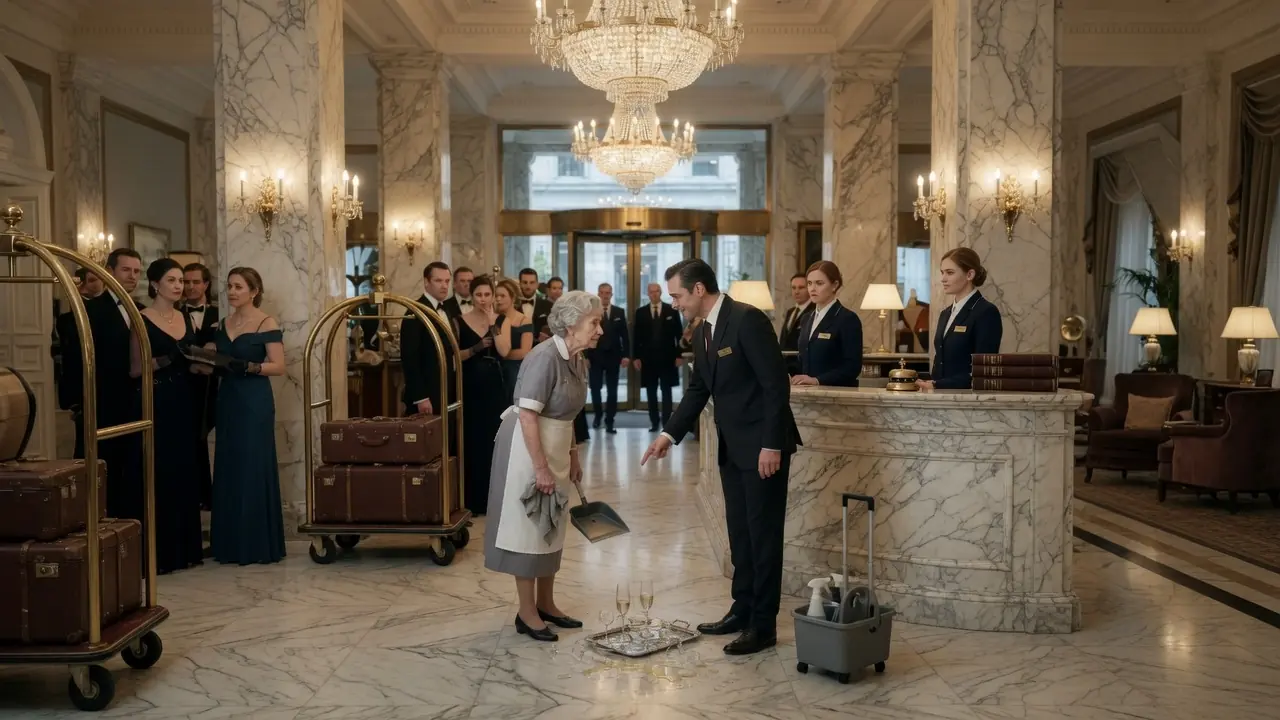
An elderly cleaner knelt on the marble floor with a cloth in her hand while the hotel’s general manager stood above her.
“Again,” Richard Vale said.
Eleanor Brooks looked up slowly.
She was seventy-two, with silver hair pinned neatly beneath a gray housekeeping cap. Her uniform was plain, her shoes practical, and her hands showed the fine lines and swollen knuckles of age.
A small crystal glass lay shattered near her knees.
Several drops of red wine stained the marble.
The glass had not been hers.
One of the VIP guests had placed it too close to the edge of a cocktail table, then brushed it with his sleeve.
But Richard had seen Eleanor nearby.
For him, that was enough.
“Clean it properly,” he said.
Eleanor’s fingers tightened around the cloth.
“I am cleaning it.”
“You missed a spot.”
He pointed toward a drop of wine near the toe of his polished shoe.
Around them, six members of an international investment delegation watched from the lounge.
Two hotel executives stood near the front desk.
A young receptionist named Sophie Bennett had stopped typing.
Every person in the lobby understood what was happening.
Richard was not correcting an employee.
He was creating a performance.
He wanted the VIP guests to see that he controlled the hotel.
More importantly, he wanted the staff to see it.
Eleanor moved the cloth toward the stain.
Her knees ached against the cold marble.
Richard leaned closer.
“Use both hands.”
The lobby became even quieter.
Eleanor looked up.
“I beg your pardon?”
“You heard me.”
His voice remained smooth.
He never shouted when important guests were present. He preferred cruelty delivered in the tone of professional instruction.
“You made the mess. Show our guests that Crown Imperial employees take responsibility.”
“I did not break the glass.”
Richard smiled faintly.
“Are you arguing with me?”
“No.”
“Then clean it.”
Sophie stepped away from the front desk.
“Mr. Vale, she didn’t break it.”
Richard turned.
Sophie was twenty-six, with dark brown hair pulled into a neat bun and a name badge pinned above her navy jacket.
She had worked at the Crown Imperial for fourteen months.
During that time, she had learned three things about Richard Vale.
He remembered every mistake.
He never admitted one of his own.
And he treated kindness as weakness.
Sophie had watched him reduce employees’ hours for speaking back, move cleaners onto night shifts as punishment, and force kitchen staff to pay for broken dishes.
But she had never seen him order an elderly woman to kneel before guests.
Richard’s expression hardened.
“Return to your station.”
“The guest knocked over the glass,” Sophie said.
One of the investors shifted uncomfortably.
Richard took one step toward her.
“She could hurt herself.”
“Miss Brooks knows how to do her job.”
Eleanor placed one hand against the floor and began rising.
Richard’s eyes snapped toward her.
“I didn’t say you could stand.”
That sentence changed the room.
The pianist near the bar stopped playing.
A bellman beside the entrance lowered his luggage cart handle.
Even the VIP guest who had knocked over the glass looked embarrassed.
Sophie moved closer.
“Mr. Vale, that is enough.”
Richard stared at her.
“You’re finished.”
Sophie’s breathing stopped.
“What?”
“Remove your badge.”
“Because I said she shouldn’t be kneeling?”
“Because you challenged management in front of guests.”
Sophie looked around the lobby.
No one spoke.
Not the executives.
Not the supervisors.
Not the employees who agreed with her.
Richard held out his hand.
“Your badge.”
Sophie slowly removed it.
Her fingers trembled as she placed it in his palm.
Richard looked toward the front doors.
“Security will escort you from the property.”
Eleanor had managed to stand.
She leaned slightly against the cocktail table, hiding the pain in her knees.
“You should not fire her.”
Richard turned.
The elderly cleaner’s voice was quiet, but something in it made him pause.
“Excuse me?”
“She defended an employee.”
“She undermined me.”
“She told the truth.”
Richard gave a humorless laugh.
“You seem to have forgotten your position.”
Eleanor studied him.
“No, Mr. Vale.”
Her eyes remained steady.
“I remember it very clearly.”
Richard pointed toward the service corridor.
“Finish the lobby and report to housekeeping. We’ll discuss whether you still have employment after today.”
A black sedan stopped beneath the hotel entrance canopy.
Then another.
A third arrived moments later.
The doorman straightened.
Several men and women in dark business clothes stepped into the lobby.
Richard’s expression changed immediately.
He recognized them.
The Crown Imperial board had arrived.
At the front of the group walked Jonathan Pierce, chairman of Imperial Heritage Hotels.
Beside him was board member Margaret Collins, followed by the company’s chief legal officer, head of human resources, and regional operations director.
Richard moved toward them with a welcoming smile.
“Mr. Pierce. We weren’t expecting you until four.”
Jonathan did not return the smile.
“We moved the meeting forward.”
Richard glanced toward the broken glass and the damp stain on the floor.
“Of course. We had a minor incident, but it’s under control.”
Jonathan looked past him.
His eyes settled on Eleanor.
For a moment, no one moved.
Then he walked directly toward her.
Richard followed.
“Mr. Pierce, this is one of our cleaning staff. There was a small disciplinary matter—”
Jonathan stopped in front of Eleanor.
He lowered his head respectfully.
“Mrs. Brooks.”
The name moved through the lobby like a whispered warning.
Richard’s smile faltered.
Eleanor removed her housekeeping cap.
Her silver hair fell slightly loose around her face.
“Jonathan.”
Margaret Collins stepped forward and took Eleanor’s hand.
“We were worried the assignment had become too physically demanding.”
“It was manageable.”
Eleanor looked toward Richard.
“Until today.”
Richard stared between them.
“I’m sorry. You know her?”
Jonathan turned.
“Everyone on the board knows Mrs. Brooks.”
The chief legal officer placed a leather folder on the front desk.
Richard’s face lost some of its color.
Jonathan continued.
“Eleanor Brooks founded Imperial Heritage Hotels forty-one years ago.”
The silence in the lobby became absolute.
Sophie stood near the security desk, still holding her handbag.
The hotel executives beside the front desk looked as though they had stopped breathing.
Richard’s mouth opened.
No words came out.
Jonathan gestured toward the marble floors, the chandeliers, and the gold Crown Imperial emblem above reception.
“This hotel exists because of her.”
Eleanor had opened the first Imperial Heritage property in 1985.
It was not a grand hotel.
It was a twelve-room boarding house near a railway station in Providence.
She had inherited it from an aunt while raising two children alone after her husband’s death.
The building had leaking pipes, broken windows, and debts larger than its value.
Eleanor repaired rooms herself.
She cooked breakfast.
Changed sheets.
Managed bookings.
Cleaned bathrooms.
When guests arrived after midnight, she carried their bags upstairs.
She believed people remembered how they were treated long after they forgot the wallpaper or furniture.
The boarding house developed a reputation for kindness.
Traveling nurses stayed there.
Rail workers recommended it.
Families passing through New England returned year after year.
Eleanor bought a second property.
Then a third.
Over four decades, the small boarding house became Imperial Heritage Hotels, a chain of thirty-two luxury and business hotels across the country.
Eleanor retired from daily operations at sixty-eight.
But she did not disappear.
Every year, she visited several properties without announcing who she was.
Sometimes she checked in as an ordinary guest.
Sometimes she worked briefly beside housekeeping, kitchen, or maintenance teams.
Only the board knew.
The purpose was not to trap employees.
It was to learn what reports and financial summaries could not reveal.
How managers behaved when they believed no one important was watching.
How staff treated guests who appeared poor.
How employees treated one another when rank divided them.
At the Crown Imperial, Eleanor had worked as a cleaner for eleven days.
Richard had never asked why a woman in her seventies had been hired.
He had never learned her background.
To him, cleaners were interchangeable.
Their names mattered only when he needed someone to blame.
Richard finally found his voice.
“This must be a misunderstanding.”
Eleanor looked at the wet cloth in her hand.
“Which part?”
“I was enforcing standards.”
“You ordered me to kneel.”
“The floor needed cleaning.”
“The floor was being cleaned.”
Richard glanced toward the VIP guests.
“They were watching.”
“Yes,” Eleanor said. “That appears to have been the point.”
He straightened his jacket.
“The Crown Imperial serves influential people. Discipline must be visible.”
Eleanor’s expression changed.
“Dignity should be visible.”
Richard looked toward Jonathan.
“Surely you understand the pressure of running a property at this level.”
Jonathan did not answer.
Eleanor did.
“I understand it better than you think.”
She placed the cloth on the table.
“I cleaned rooms for nine years before I could afford a full-time housekeeping staff.”
Richard swallowed.
“I didn’t know who you were.”
“That is not a defense.”
Her voice remained calm.
“It is the problem.”
The words struck harder than a shout.
“If you had known I founded the company, you would have treated me respectfully.”
“Of course.”
Richard realized his mistake immediately.
Eleanor nodded.
“And because you believed I was only a cleaner, you thought respect was optional.”
No one in the lobby looked away now.
Eleanor turned toward Sophie.
“You defended me before you knew my name.”
Sophie shook her head.
“I knew your name. I just didn’t know—”
“That I had power?”
Sophie hesitated.
“Yes.”
“That is why what you did matters.”
Richard stepped forward.
“Mrs. Brooks, Sophie violated policy. She openly challenged a manager.”
Eleanor looked toward him.
“She interrupted humiliation.”
“She was insubordinate.”
“She was brave.”
Richard’s jaw tightened.
“You cannot operate a luxury hotel if every employee questions authority.”
“No,” Eleanor replied. “You cannot operate one safely if nobody does.”
Jonathan opened the leather folder.
“Richard, this review did not begin today.”
He placed the first document on the front desk.
“Over the last eighteen months, human resources received eleven complaints involving your conduct.”
Richard’s eyes moved toward the papers.
“Most were unsubstantiated.”
“Because employees withdrew them,” the head of human resources said.
“They admitted the claims weren’t true.”
“No,” she replied. “Seven stated they feared losing shifts or being transferred.”
Richard looked around as though searching for support.
The regional operations director stepped forward.
“We also reviewed turnover.”
Housekeeping turnover at the Crown Imperial was nearly three times the company average.
The front desk had lost fourteen employees in two years.
Kitchen staff regularly requested transfers to other properties.
Guest complaints described tense service, frightened workers, and managers berating employees in public areas.
Richard had explained every number.
Young employees lacked commitment.
Cleaners were unreliable.
Receptionists were too emotional.
Kitchen workers were difficult.
The problem was always someone else.
Eleanor had come to discover whether the reports reflected bad luck or leadership.
She had her answer.
Richard looked toward the board.
“You sent her here to deceive me.”
Eleanor shook her head.
“I came here to observe.”
“Under a false identity.”
“My name was on every document.”
“You concealed your position.”
“Yes.”
“Then this was a test.”
Eleanor considered the word.
“No.”
She looked toward Sophie.
“A test is something people know they are taking.”
She returned her gaze to Richard.
“This was simply who you are when you believe the person in front of you cannot affect your career.”
The VIP guest responsible for breaking the glass stepped forward.
His name was Thomas Bennett, an investment-fund director from New York.
“I should clarify something.”
Richard looked at him.
“I knocked over the glass.”
Thomas glanced toward Eleanor.
“She tried to assure me it was no problem.”
He faced the board.
“Mr. Vale saw her cleaning the spill and began blaming her before I could explain.”
Richard’s expression hardened.
“You said nothing.”
“I tried.”
Thomas’s voice became colder.
“You spoke over me.”
Another guest raised a phone.
“I recorded part of the incident.”
Richard stared at him.
The man held up the screen.
The video showed Eleanor on her knees.
Richard’s voice was clear.
Use both hands.
The recording continued through Sophie’s intervention and firing.
Jonathan looked at Richard.
“Do you have anything else you wish to explain?”
Richard’s confident posture collapsed slightly.
“I have given nine years to this company.”
Eleanor nodded.
“You have.”
“I increased revenue by twenty-two percent.”
“You did.”
“Our guest-satisfaction numbers are among the best in the region.”
“They are.”
He seized on the acknowledgement.
“Then you understand my results.”
Eleanor’s expression remained sad rather than angry.
“I understand your results very well.”
She looked toward the employees gathered near the lobby entrance.
“You produced profit by making workers afraid to make mistakes.”
She turned toward the executives.
“You created quiet by teaching people that speaking truth would cost them their jobs.”
Then she looked at the polished marble around them.
“And you kept the hotel beautiful by treating the people who maintained it as though they were part of the equipment.”
Richard’s face reddened.
“That is unfair.”
Eleanor’s voice softened.
“Fairness was not a concern when you believed I was powerless.”
The chief legal officer opened another document.
“Richard Vale, effective immediately, your employment with Imperial Heritage Hotels is terminated for gross misconduct, retaliation, policy violations, and conduct inconsistent with company values.”
Richard stared at him.
“You cannot fire me in a lobby.”
Eleanor looked down at the wet floor.
“You fired Sophie in one.”
Richard’s eyes moved toward the security officers beside the entrance.
He seemed finally to understand what was happening.
“This is ridiculous.”
Jonathan nodded toward security.
“Please collect his access card.”
Richard stepped back.
“I built this hotel.”
Eleanor’s face became completely still.
“No.”
Her voice was quiet.
“You managed it.”
She looked around the lobby.
“The cleaners built every morning guests believed the rooms had always been spotless.”
She nodded toward the bell staff.
“The porters built every arrival that felt effortless.”
Then toward reception.
“The front desk built every moment a tired traveler felt welcomed.”
She returned her gaze to Richard.
“You stood above their work and mistook the view for ownership.”
Two security officers approached.
Richard pulled the access card from his pocket and slapped it onto the desk.
The sound echoed.
“You will regret this.”
Eleanor did not answer.
Security escorted him across the lobby.
The same employees who had lowered their eyes when he passed now watched him leave.
He crossed beneath the Crown Imperial emblem and disappeared through the revolving doors.
For several seconds, no one spoke.
Then Eleanor turned toward Sophie.
“You were fired?”
Sophie still held her handbag.
“Yes.”
“Would you like your position back?”
Sophie looked toward the board.
“I would.”
Eleanor nodded.
“Good.”
Relief appeared across Sophie’s face.
Then Eleanor continued.
“But not at reception.”
Sophie’s expression changed.
Jonathan took a document from the folder.
“The customer service manager resigned last month.”
Sophie stared at him.
Eleanor smiled faintly.
“You have demonstrated that you understand the most important part of the position.”
“What is that?”
“Recognizing when a person needs someone to stand beside them.”
Sophie looked overwhelmed.
“I’ve never managed a department.”
“Neither had I before I opened my first hotel.”
“I don’t know if I’m ready.”
“That is often a better beginning than believing you already know everything.”
Jonathan handed her the document.
The appointment was temporary for ninety days, with training and mentorship from the regional director. If successful, the promotion would become permanent.
Sophie read the first line twice.
“I don’t know what to say.”
“Say you will learn.”
Sophie looked up.
“I will.”
Eleanor extended her hand.
“Then welcome back, Manager Bennett.”
The employees around the lobby began applauding.
Sophie shook Eleanor’s hand, then unexpectedly pulled her into a careful embrace.
“I thought I had lost everything.”
Eleanor rested one hand against her back.
“You lost a job for less than five minutes.”
She glanced toward the doors Richard had exited through.
“He lost the trust of everyone who worked for him.”
The applause faded.
Eleanor looked toward the spilled wine.
The broken glass had been removed, but the stain remained.
She reached for the cloth.
Sophie stopped her.
“I’ll get someone.”
“No.”
Eleanor bent slowly.
Before she could kneel, three people moved forward.
Sophie.
A bellman named Marcus.
And the executive guest who had spilled the drink.
Thomas Bennett took the cloth.
“This one is mine.”
He crouched and wiped the remaining stain himself.
Eleanor watched him.
“Thank you.”
“No.”
Thomas looked up.
“I should have spoken sooner.”
Eleanor nodded.
“Yes.”
The honesty surprised him.
“But you are speaking now.”
Later that afternoon, the board meeting was moved from the executive conference room to the employee cafeteria.
For the first time in years, cleaners, cooks, receptionists, maintenance workers, and supervisors sat in the same room with company directors.
No one was required to speak.
Dozens did.
A housekeeper described being denied leave when her husband entered the hospital.
A kitchen assistant explained that Richard made staff pay for food returned by guests.
A bellman said schedules were changed as punishment.
Several receptionists admitted they had seen mistreatment and remained silent because they feared becoming the next target.
Eleanor listened.
She did not interrupt.
She took notes in a small blue notebook.
When everyone finished, she stood.
“I founded this company believing dignity should not depend on the price of the room someone can afford.”
She looked around the cafeteria.
“Somewhere along the way, we became too impressed by our buildings.”
The room remained silent.
“A hotel does not become luxurious because it has marble floors.”
She nodded toward a cleaner.
“It becomes luxurious when exhausted guests are treated patiently.”
Toward a cook.
“When meals are prepared with care.”
Toward reception.
“When the person behind the desk sees a human being rather than a reservation number.”
Then toward the entire room.
“And when employees can perform that work without being humiliated.”
The company announced several changes during the following weeks.
Managers could no longer deduct breakage or guest losses from employee pay.
All disciplinary actions required written documentation and review.
An anonymous reporting line was placed under outside supervision.
Retaliation against employees who reported mistreatment became grounds for immediate dismissal.
Most importantly, every manager was required to spend four full shifts each year working beside housekeeping, food service, reception, and maintenance teams.
Not observing.
Working.
Cleaning bathrooms.
Changing beds.
Carrying bags.
Handling complaints.
Eleanor insisted on the policy personally.
“You cannot respect work you refuse to understand,” she told the board.
Sophie began management training the following Monday.
She made mistakes.
During her first week, she scheduled too few people for a conference arrival.
During her second, she approved a guest refund without documenting it correctly.
She expected punishment.
Instead, the regional director helped her repair the errors.
By the end of her ninety-day trial, guest complaints had decreased and employee satisfaction had risen.
The board made the promotion permanent.
Sophie kept her old receptionist badge inside her desk.
Whenever she had to correct an employee, she looked at it first.
Not to remind herself how far she had risen.
To remember how quickly authority could make a person forget where they began.
Eleanor continued her quiet inspections.
But the Crown Imperial became the last hotel where she wore a cleaner’s uniform.
Her knees had not fully recovered from the afternoon on the marble.
Jonathan urged her to stop.
She agreed on one condition.
The company would create a permanent employee council with representatives chosen by hotel staff, not appointed by management.
The board approved it unanimously.
Six months later, Eleanor returned to the Crown Imperial as an invited guest.
This time, everyone knew who she was.
A black car stopped beneath the canopy.
The general manager stepped outside to welcome her.
It was Sophie.
She wore a charcoal suit and a gold name badge.
She did not stand behind a line of employees arranged for appearance.
She came alone.
“Welcome back, Mrs. Brooks.”
Eleanor stepped from the car.
“Thank you.”
“Do you have luggage?”
“One bag.”
Sophie reached for it.
Eleanor raised an eyebrow.
“You have bell staff.”
“I know.”
“Then why are you carrying it?”
Sophie smiled.
“Because I was already here.”
Inside, the lobby looked much the same.
Same chandeliers.
Same marble.
Same piano.
But the atmosphere had changed.
Employees spoke more naturally.
A cleaner laughed with a bellman near the service corridor.
A receptionist asked a supervisor for assistance without fear.
Managers greeted staff members by name.
Beside the grand staircase stood a new brass plaque.
Eleanor approached it.
The inscription read:
LUXURY IS NOT HOW HIGH WE PLACE OUR GUESTS.
IT IS HOW CAREFULLY WE REFUSE TO PLACE ANYONE BENEATH US.
Sophie stood beside her.
“The employee council chose the words.”
Eleanor touched the edge of the plaque.
“Richard contacted the company last month.”
Sophie looked surprised.
“What did he want?”
“A reference.”
“What did the board say?”
“That we would provide dates of employment and position held.”
Sophie smiled slightly.
“Nothing more?”
“Nothing less.”
They crossed the lobby.
A young cleaner was polishing the marble near the lounge.
She looked nervous when she saw Eleanor approaching.
Eleanor stopped.
“What is your name?”
“Maria.”
“How long have you worked here?”
“Three weeks.”
“Do they treat you well?”
Maria glanced toward Sophie.
Sophie said nothing.
The young woman thought carefully.
“Yes.”
Eleanor waited.
Maria added, “But the laundry carts are too tall. Two of us have trouble seeing around them.”
Sophie removed her phone.
“How many carts?”
“Four.”
“I’ll have facilities inspect them today.”
Maria looked surprised.
“Thank you.”
Eleanor nodded toward Sophie as they walked away.
“That was the test.”
Sophie frowned.
“What test?”
“Whether she would tell you the truth while you were standing beside me.”
“And?”
“She did.”
Eleanor smiled.
“That means she believes you will listen.”
Years passed.
Sophie eventually became general manager of the Crown Imperial.
Under her leadership, the hotel remained profitable.
More profitable, in fact, than during Richard’s final year.
But those were not the numbers she valued most.
Employee turnover dropped.
Internal promotions increased.
Housekeeping injuries declined after staff-selected equipment changes.
Guests regularly mentioned that employees seemed calm, attentive, and genuinely kind.
The hotel earned awards.
Sophie displayed some in the lobby.
Others remained in her office.
The brass plaque near the staircase mattered more.
Eleanor died peacefully at eighty-one.
Her memorial was held inside the ballroom of the first boarding house she had opened, restored years earlier as a company training center.
Hundreds of employees attended.
Cleaners sat beside executives.
Cooks sat beside board members.
No special section separated management from staff.
Sophie spoke last.
She told the story of the broken wine glass.
The cloth.
The badge placed in Richard’s hand.
The moment the board entered the lobby.
But she did not describe Eleanor’s revelation as the most important part.
“The lesson was not that Richard humiliated the wrong woman,” Sophie said.
The room became quiet.
“The lesson was that he believed there was a right woman to humiliate.”
She looked toward Eleanor’s photograph.
“She taught us that dignity cannot be reserved for founders, executives, or VIP guests.”
Sophie paused.
“It either belongs to everyone or it means nothing.”
After the memorial, Eleanor’s first housekeeping uniform was placed inside a display at the training center.
Not the expensive dresses she later wore to board meetings.
Not the tailored suits from the years she led the company.
A simple gray uniform.
Beside it sat the blue notebook she used during inspections.
The final page contained one handwritten sentence:
WATCH HOW PEOPLE TREAT THOSE THEY BELIEVE CANNOT REWARD OR PUNISH THEM.
THERE YOU WILL FIND THEIR CHARACTER.
At the Crown Imperial, new managers learned Eleanor’s story during orientation.
They were told about the day a general manager ordered an elderly cleaner to kneel before VIP guests.
They were told how he fired a receptionist for speaking up.
They were told that minutes later, security escorted him through the same lobby he once controlled.
But the story never ended with Richard.
It ended with Sophie.
A young receptionist who believed defending a cleaner might cost her livelihood and spoke anyway.
Richard assumed authority meant deciding who had to kneel.
Eleanor understood something he never did.
The strongest person in the room is not always the one standing.
Sometimes it is the person on the floor who still refuses to surrender her dignity.
And sometimes it is the frightened employee who takes one step forward and says:
“That is enough.”