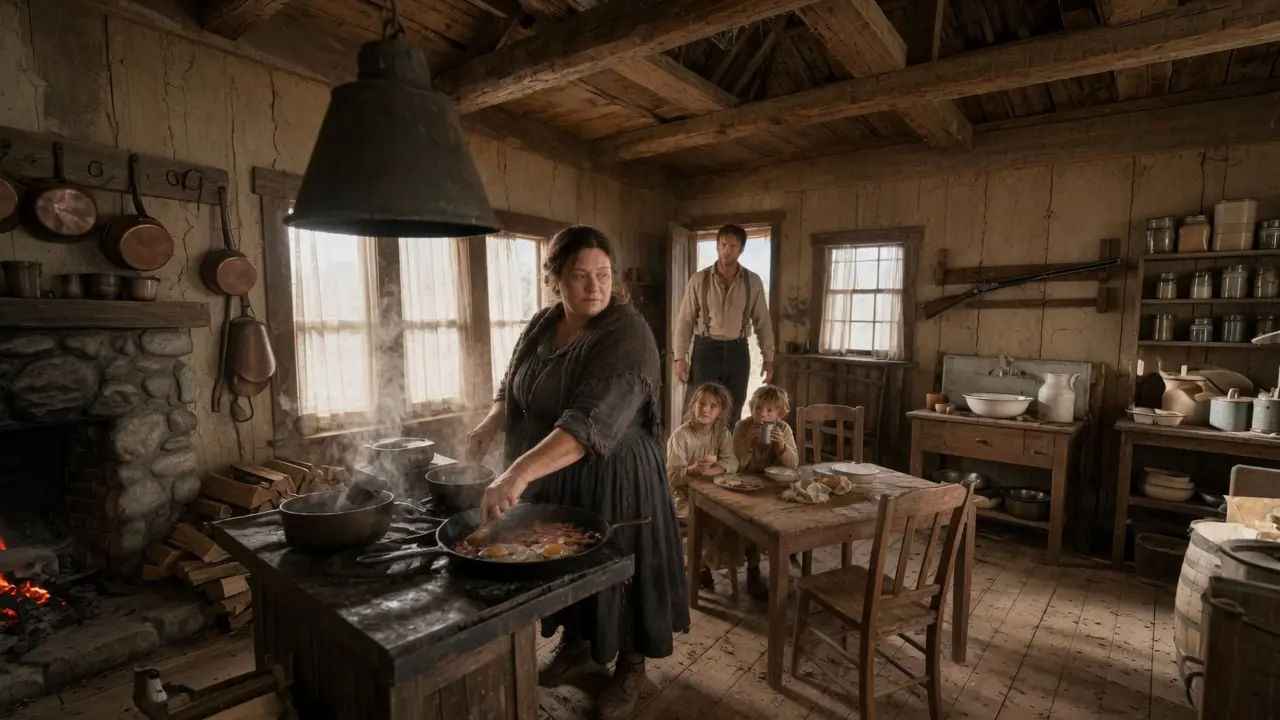
Margaret Dawson stepped into Cole Harper’s kitchen before the sun had cleared the ridge, carrying a cast-iron skillet in one hand and a decision in the other. The house was quiet in the way neglected homes become quiet, not peaceful, but hollow, as if every room had forgotten the sound of laughter. Wind slipped through cracks in the walls, lifting the thin curtains beside the window, and the old stove sat cold beneath a shelf with only flour, salt, and a chipped coffee tin. Margaret stood there for one breath, listening to two children crying somewhere down the hall, and knew she could not walk away.
She had slept in Cole Harper’s barn the night before with her shawl pulled tight around her shoulders and loose hay pressed against her cheek. The October night had been unkind, with a hard prairie wind pushing through the boards and making the horses restless in their stalls. Margaret had not meant to stay, only to rest until dawn and move on before the rancher noticed her. But before first light, she had seen the south fence sagging toward the creek and fixed it out of habit, because broken things had always bothered her.
The cries had come after that, small and tired, not loud enough to be anger and not strong enough to be spoiled complaining. Margaret knew hunger when she heard it, because hunger had followed her across three counties since her husband’s passing. It had a certain sound in children, a weak frustration that broke between breaths and left them too weary to ask properly. So she found eggs in the cold barn, a little bacon wrapped in cloth, bread hardened at the edges, and enough coffee to make a thin pot.
She lit the stove like a woman who had done it ten thousand mornings. Her hands shook at first, but once the heat caught and the skillet warmed, her body remembered its old work. She cut the bacon carefully, cracked the eggs into a bowl, and warmed milk in a tin cup with a pinch of sugar she found near the flour. The smell rose slowly, filling the kitchen with life it had not carried in a long while.
At the rough wooden table sat Cole’s two children, Emma and Jacob, both in nightclothes too thin for the weather. Emma was eight, with tangled brown hair and cautious eyes that measured every adult before trusting them. Jacob was five and still small enough to hold his cup with both hands, his cheeks hollow from too many skipped meals and half meals. They stared at Margaret like she was a storybook figure who had wandered in from the cold and decided to make breakfast.
“Eat slow,” Margaret told them softly, placing bread on their plates. “Food sits better when it knows it is welcome.” Emma looked down at her eggs, then at her little brother, waiting to see if it was safe. Jacob took one bite and closed his eyes so tightly that Margaret had to turn back to the stove before emotion showed on her face. Children should not be grateful for breakfast like it was a miracle, yet there they were, treating bacon and warm milk like Christmas morning.
Cole Harper woke to the smell of coffee and bacon drifting down the hallway. For one strange second, he believed he was back in a gentler year, before his wife Martha had gone, before the house learned silence, before grief turned every morning into a duty. He opened his eyes and stared at the ceiling beams, his heart tightening with confusion. Then he heard a woman humming in the kitchen, and the dream shattered.
Cole stopped so suddenly that Emma looked up from her plate. Jacob kept drinking his milk, too hungry to understand the danger in his father’s face. Margaret turned slowly from the stove, holding the skillet handle with a rag wrapped around her hand. She did not smile, did not beg, and did not lower her eyes.
“Who are you?” Cole demanded, his voice low and hard. “And why are you in my kitchen?” Margaret looked at him the way a person looks at a storm they have already decided to walk through. Her hair was pinned poorly, her dress was worn thin at the sleeves, and there was soot on one side of her cheek. But her eyes were steady.
“Margaret Dawson,” she said. “I slept in your barn last night because the road turned cold and I had nowhere else.” Cole’s jaw tightened, but she kept speaking before he could cut her off. “I repaired your south fence post before dawn because it was leaning into the creek. Then I heard your children crying, so I cooked breakfast.”
Cole’s eyes moved from her face to the children, then to the plates on the table. Emma dropped her gaze as if she had done something wrong by eating. Jacob held his tin cup closer to his chest, watching his father with wide eyes. The smell of bacon and coffee suddenly felt like an accusation against every hard morning Cole had let pass with only stale bread and apology.
“I left two dollars on the shelf for what I used,” Margaret added, nodding toward the window. Cole looked and saw the coins lying neat beside the coffee tin. That made it worse somehow, because thieves did not pay, and beggars did not fix fences before asking for mercy. Still, a stranger stood in Martha’s kitchen, touching Martha’s stove, feeding Martha’s children, and gratitude had to fight its way through anger before it could be heard.
“You had no right,” he said. Margaret nodded once, as if she had expected that answer. “No, sir,” she replied. “I did not.” Her fingers tightened around the rag, and the skillet hissed behind her. “But hungry children have a way of making rights feel smaller than duties.”
Cole stepped into the kitchen, and the boards groaned under his boots. He was thirty-six but looked older, with sun-cut lines around his eyes and grief sitting heavy on his shoulders. Since Martha’s death, he had kept the cattle moving, the roof patched, and the bank from taking the land. But the children had learned to whisper around him, and the house had grown colder than any barn.
Emma slid from her chair and stood between Jacob and the table, though she was far too small to protect anyone. “Pa,” she said carefully, “she made milk warm.” Cole looked at his daughter and saw shame cross her face for wanting such a simple thing. That small shame struck deeper than any accusation could have. He turned back to Margaret, and his anger had nowhere clean to stand.
“You can finish what is in that skillet,” he said at last. “Then you take your things and go.” Margaret lowered her eyes for the first time, not in fear, but because the children were watching. Jacob’s lip trembled, and Emma pressed both hands together at her waist. Margaret served the last of the eggs onto their plates, moving carefully so no one would see how much his words had landed.
Cole expected her to argue, but she only cleaned the skillet after breakfast. She washed every plate, wiped the table, swept the dirt near the back door, and poured the weak coffee into two cups, leaving one by Cole’s hand without comment. The kitchen looked less like a place abandoned by happiness and more like a room waiting for a family to remember itself. Cole hated that he noticed.
When Margaret stepped toward the door, Jacob slid down from his chair and reached for her skirt. “Are you going away now?” he asked. Margaret stopped, and something in her face cracked so quickly that Cole almost missed it. She bent and brushed crumbs from the boy’s chin with the back of one gentle finger. “That is for your father to decide, little one.”
Cole looked toward the window, where the repaired fence line could just be seen beyond the yard. A man ought to be able to feed his own children, keep his own kitchen warm, and stop strangers from solving problems under his roof. But pride did not fill cups, and pride had not heard the children crying before dawn. He turned back, finding Margaret waiting by the door with her shawl folded over one arm.
“You said you fixed the south post,” Cole said. Margaret nodded. “Wire was nearly gone loose. One good rain and you would have lost that stretch.” He looked at her hands then, broad and rough, marked by work rather than softness. She was no drifting fool, no lazy wanderer looking for a place to hide. Whoever Margaret Dawson had been, life had not taken usefulness from her.
“You can stay two days,” Cole said. His voice stayed cold because warmth still felt dangerous to him. “Barn only, meals in exchange for chores, and you do not make decisions in my house without asking.” Margaret looked at the children, then back at him. “Two days is more than I had yesterday,” she said.
By afternoon, Cole saw that Margaret worked like weather, steady and impossible to ignore. She mended a loose hinge, scrubbed the pantry shelves, and found three potatoes buried in a sack beneath dry onions. She asked permission before touching anything, but somehow the house began changing around her. Emma followed at a distance, pretending not to watch every movement.
That night, Margaret slept in the barn again, but Cole left an extra blanket on a nail by the door. He told himself it was because no worker was worth much frozen stiff by morning. He did not mention it when he saw her wrapped in it before dawn, already hauling water from the pump. She did not mention it either, and he was grateful for her silence.
On the second morning, Margaret made biscuits with careful hands and showed Emma how to press the dough without making it tough. Jacob sat on a stool, swinging his legs and talking more than Cole had heard him talk in months. He told Margaret about the creek, the old mule, and the tin soldier he had lost behind the woodpile. Cole stood outside the kitchen door listening, and grief rose in him like smoke.
Martha had filled that kitchen with song. After she was gone, Cole had not known how to keep the house alive without being swallowed by memories. He could rope cattle, mend harness, and argue with merchants over feed prices, but he did not know how to braid Emma’s hair or coax Jacob through nightmares. So he worked longer hours and called it sacrifice while his children learned loneliness beside him.
Margaret saw more than he wanted seen. She noticed the little dress with a torn hem hanging behind the door, the cracked cup Jacob favored because it had been his mother’s, and the untouched Bible on the shelf with dried flowers pressed inside. She did not pry. She only moved through the house with the quiet respect of a person walking past graves.
On the second evening, Cole found her in the yard repairing Emma’s doll with needle and thread. The child sat beside her, watching as if Margaret held gold in her hands. Jacob leaned against Cole’s leg, eating a biscuit with both hands. The setting sun turned the prairie grass copper, and for one strange moment, the ranch looked like something worth saving instead of something barely surviving.
“You have family somewhere?” Cole asked, harsher than he meant. Margaret pulled the thread through the doll’s cloth arm and tied a small knot. “Had a husband named Samuel,” she said. “Had a farm too, once.” Emma looked at her with sympathy too large for a child. Margaret smiled faintly, but it did not reach her eyes.
“Drought took the crop, debt took the land, fever took Samuel,” she continued. “After that, people took what was left in smaller pieces.” Cole looked away because he understood loss but hated hearing it spoken plainly. Margaret cut the thread with her teeth and handed the doll back to Emma. “I kept walking because stopping meant admitting there was nowhere left that wanted me.”
Cole said nothing for a long time. The wind moved dust across the yard, and a loose shutter tapped against the house. He wanted to tell her he was sorry, but sorry felt too small and too late. Instead, he looked at the repaired doll in Emma’s hands, the clean dress on the line, and Jacob’s biscuit crumbs on his shirt.
The two days ended the next morning. Margaret packed her small bundle before breakfast and placed the borrowed blanket folded neatly beside the barn door. Cole found her there with the first light touching her gray hair. She looked tired, but ready, the way people look when they have learned not to expect invitations. Her bundle held almost nothing.
Emma came running barefoot through the yard when she saw Margaret ready to leave. Jacob followed, crying before he fully understood why. Margaret knelt and opened her arms, and both children folded into her as if they had known her all their lives. Cole stood by the porch, one hand gripping the post, feeling something inside him tear quietly.
“You said two days,” Margaret told him, standing again with effort. Her face was calm, but her eyes shone. “I do not break terms once I agree to them.” Cole looked at the children, then at the kitchen window where morning light warmed the curtains she had washed. The house behind him seemed to hold its breath.
“I need a housekeeper,” he said. Margaret blinked once, and Emma went still. “Meals, mending, washing, some help with the children,” Cole continued, staring at the dirt because her face made him feel too much. “You will have a room, wages when the cattle sell, and no man in this county will call you a trespasser on my land.”
Margaret’s hands tightened around the bundle. “Do not offer out of pity, Mr. Harper.” Cole looked up then, and his voice roughened. “I am offering because my children laughed yesterday, and I had near forgotten that sound.” The truth sat between them, plain and unpolished. Margaret lowered her eyes, and a tear slipped down before she could stop it.
She stayed. Not easily, not magically, and not as some saint sent to repair what grief had broken in a week. The first months were awkward, full of careful words and rooms where Martha’s memory still sat in every chair. Margaret never tried to replace anyone, and that was why the children began to trust her fully.
She taught Emma to bake, sew, read measurements, and speak up without apologizing for having a voice. She taught Jacob to wash behind his ears, carry kindling, and say thank you before asking for seconds. She made Cole eat at the table instead of standing by the door with a plate in one hand. Slowly, meal by meal, the house remembered it was a home.
People in town talked, as people in town always do. Some called Margaret a stray widow, some called Cole desperate, and some wondered why a rancher would take in a woman with no name worth mentioning. Cole heard it outside the feed store one afternoon and turned so sharply that the men fell quiet. “Her name is Margaret Dawson,” he said. “And she has done more good in my house than most of you have done in your own.”
Margaret heard about it later from Emma, who repeated the story with shining eyes. She did not thank Cole directly because the words would have embarrassed them both. But that evening she set aside the best piece of cornbread on his plate and filled his coffee before he asked. Cole noticed, and for once, let the warmth of being understood reach him without fighting it.
Winter came hard across the prairie, burying the fence lines in frost and making the cattle press close to the barn. Margaret patched quilts, dried apples, and kept the children’s feet wrapped warm at night. Cole worked long days and came home to lamp light in the window. That lamp became the thing he looked for across the dark field, the sign that someone waited and the house had not gone cold again.
One night, a blizzard trapped them inside for two days. The wind hammered the walls, and Jacob woke frightened, calling for his mother in a broken little voice. Cole froze in the doorway, pain crossing his face. Margaret lifted the boy into her lap and rocked him by the stove, humming the same tune she had hummed that first morning.
Cole watched from the shadows, expecting jealousy toward the comfort she could give. Instead, he felt gratitude so deep it frightened him. Martha was not erased by Margaret’s arms around Jacob. If anything, Martha seemed honored by the fact that her children were being loved when she could no longer hold them.
Spring returned with mud, green shoots, and calves wobbling beside their mothers. Cole’s ranch began to recover, not because trouble disappeared, but because the house no longer fought him at the end of every day. Margaret kept accounts better than he expected and caught two mistakes in bills from the general store. When he stared at her in surprise, she only said, “A widow learns numbers when debt collectors come smiling.”
By summer, Cole had started asking her opinion before making decisions. At first it was about flour, seed potatoes, and whether the east fence could wait another week. Then it became about selling two cattle early, hiring a hand for harvest, and sending Emma to the schoolhouse in town. Margaret answered carefully, never forgetting the fragility of her place, though Cole had long since stopped thinking of her as temporary.
One evening, he found her on the porch mending his shirt while the children chased fireflies in the yard. The sky had turned purple over the prairie, and the air smelled of dust, grass, and cooling bread. Cole sat beside her, leaving enough space to be respectful. For a long while, neither spoke.
“You saved us,” he said finally. Margaret kept her eyes on the needle. “I cooked breakfast.” Cole shook his head, his hands clasped loosely between his knees. “No. You walked into a house full of grief and made it answer you.”
Margaret’s fingers stilled. “I was hungry too,” she whispered. Cole looked at her, confused, so she continued before courage failed her. “Not just for food. For a place where my hands mattered, where morning meant something, where I was not only the woman passing through.” Her voice trembled, and she lowered her chin as if ashamed of wanting such things.
Cole reached over slowly and covered her hand with his. She did not pull away. In the yard, Emma laughed as Jacob shouted that he had caught the brightest firefly in the whole territory. The sound rose into the evening, clear and alive, and Cole felt the last locked door inside him open a little.
Months later, when the harvest came in stronger than expected, Cole paid Margaret every cent he owed her wages. She counted the money, then looked at him with a question in her eyes. “This is too much,” she said. Cole leaned against the kitchen table, the same table where his children had eaten that first breakfast. “No,” he replied. “It is late.”
Margaret tucked the money away but did not leave. The difference was that now she could have. That mattered to both of them more than either said aloud. Staying means something different when leaving is possible.
By the next winter, people no longer asked why Margaret Dawson lived at the Harper ranch. They saw Emma’s clean dresses, Jacob’s rounder cheeks, Cole’s steadier face, and the smoke rising from a chimney that no longer looked lonely. They saw Margaret at church with the children on either side, her gray dress replaced by a dark blue one Cole had ordered from town under the excuse that “housekeepers ought to have decent clothes.” They saw Cole hold the door for her and remove his hat when she passed.
The proposal, when it came, was not grand. Cole found Margaret in the kitchen before sunrise, standing at the stove while bacon hissed in the skillet, just as she had on the first morning. Emma and Jacob were still asleep, and the sky outside was pale with coming light. Cole stood in the doorway, remembering suspicion, hunger, fear, and the woman who had turned it all toward mercy.
“I have been trying to find the right words,” he said. Margaret turned, wiping her hands on her apron. “For what?” Cole stepped into the room, nervous in a way cattle storms and bank letters had never made him. “For asking whether you would stay as more than kindness, more than work, more than a roof offered after the fact.”
Margaret stared at him, and her steady face broke open with emotion. “Cole Harper,” she whispered, “are you asking me to marry you in the kitchen?” He looked around at the stove, the table, the curtains, and the morning light. “Seems to me this kitchen is where our life began,” he said.
She laughed then, soft and disbelieving, with tears shining on her cheeks. Cole took her hands, rough palm to rough palm, and waited for her answer as if nothing in the world mattered more. Margaret looked toward the hallway where the children slept, then at the stove where breakfast warmed. “Yes,” she said. “But only if you understand I am not staying because I had nowhere else to go.”
Cole nodded, his eyes bright. “I know,” he said. “You are staying because this is home.” Margaret leaned her forehead against his chest and let herself believe it. Outside, the prairie wind moved across the land, but inside the house, warmth held.
Years later, Emma would tell the story differently each time, making Jacob laugh by describing how their father stood in the doorway with one boot unlaced and his hair wild from sleep. Jacob would insist that the bacon had been the best bacon ever cooked in the whole world. Cole would shake his head and say they were both making it bigger than it was. Margaret would only smile, because children remembered truth in the language of wonder.
But in her heart, Margaret never forgot the real shape of that morning. She remembered the cold barn, the leaning fence post, the children’s cries, and the terrifying decision to step inside a stranger’s home with nothing to protect her except a skillet and courage. She remembered Cole’s suspicion and the hard mercy of two days. Most of all, she remembered that sometimes a life does not change when someone opens a door for you, but when you enter anyway because love gives you no other choice.
Margaret Dawson had arrived as a homeless widow in a faded gray dress, expecting to be thrown back into the cold. Instead, she found two hungry children, one grieving rancher, and a house that needed more than repairs. She fed them before she was welcomed, loved them before she was trusted, and stayed only after dignity was offered beside shelter. And in that poor frontier kitchen before sunrise, a family that thought it had lost its heart began to beat again.