On a freezing night, a poor schoolboy named Jude, exhausted and struggling to earn enough to pay his school fees, suddenly finds an elderly woman collapsed in a dark alley behind an upscale restaurant.
After a brief hesitation, instinct overrides fear. He races off to get help, even handing over his last $50 just to call 911. He saves her life and thinks the ordeal is over until the next morning when a luxury car pulls up and a man steps out, calling Jude by name, setting off a twist no one could have predicted. The fluorescent lights in the school library buzzed like angry wasps.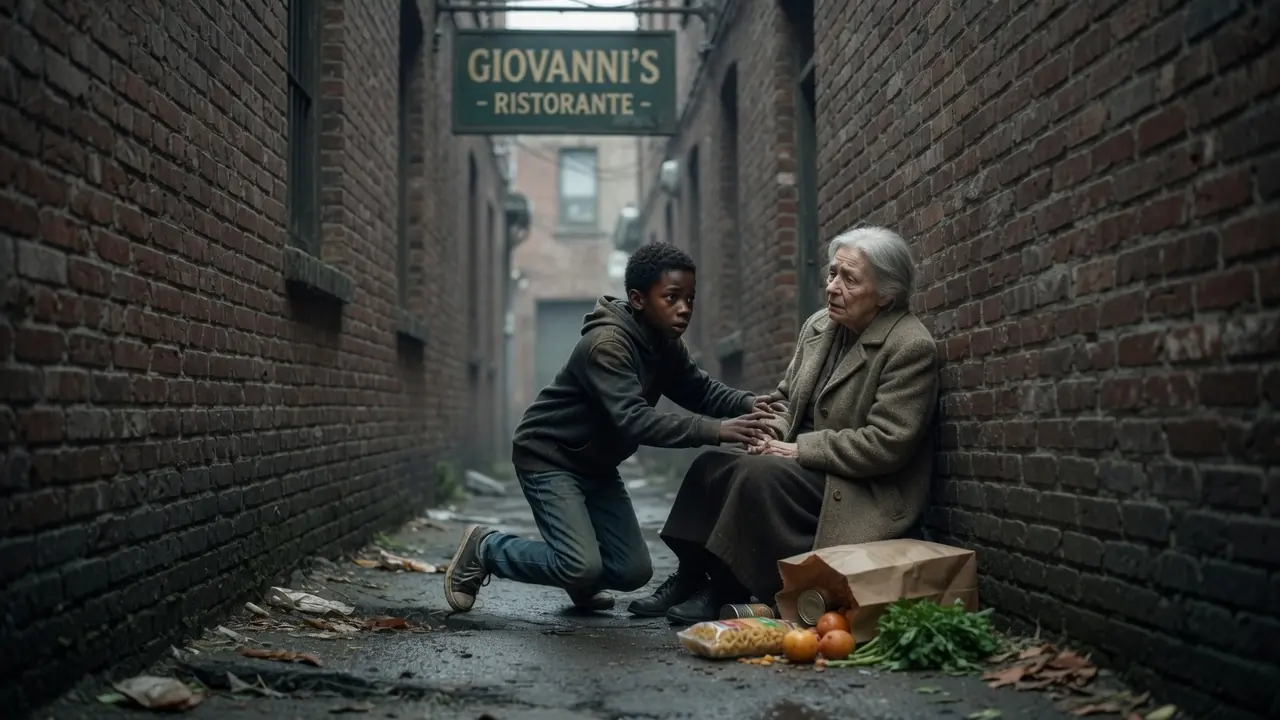
Jude Brooks jerked awake, his cheek peeling off the sticky surface of a textbook. "Hey you, library's closing." The security guard stood 3 feet away, arms crossed. His name tag read Dennis, but his expression screamed, "I don't get paid enough for this." Jude sat up fast, wincing as his neck cracked.
"Yeah, sorry. I'm going." "You've been sleeping here three nights this week," Dennis's voice wasn't unkind, just tired. "Look, kid, I get it, but this isn't a shelter. Someone complains to the principal and I got to do something about it." Jude grabbed his backpack. Everything he owned crammed into one torn Northface knockoff and slung it over his shoulder. The weight made him lean slightly to the left.
"Won't happen again," Jude muttered, heading for the door. Dennis sighed behind him. "That's what you said Tuesday." The November air hit like a slap. Lambert, Pennsylvania wasn't the kind of town you saw in movies. Just gray buildings, cracked sidewalks, and the constant smell of the paper mill.
Two towns over, the school sat on the edge of everything. A squat collection of concrete blocks that looked like they'd been designed by someone who hated young people. Jude pulled his gray hoodie tighter. The zipper had broken two months ago, so he just clutched the fabric closed with one fist as he walked. His sneakers had holes in them. Not the kind you could see from the outside, but the kind that let in every puddle, every chunk of slush.
A couple walking past gave him a wide berth. The woman clutched her purse tighter. Her husband put his arm around her shoulders, steering her to the far edge of the sidewalk. Jude kept his head down. Eye contact invited questions, suspicion, sometimes confrontation. Better to be invisible.
He cut through the back parking lot and found his spot, a bench behind the maintenance shed. He sat down and for the first time all day let himself stop moving. His stomach growled. From his backpack's outer pocket, he pulled out half a granola bar. The wrapper was torn. The bar itself crushed into chunks, but it was food. He ate it slowly, making it last.
Tomorrow was Friday, November 18th. The date was burned into his brain because it was a deadline. He pulled out his phone, screen cracked, battery at 9%, and read the email again, even though he'd memorized every word. "Mr. Brooks, this is your final notice regarding your outstanding balance of $300 for the school fees. Payment must be received by 8 a.m. Friday, November 18th, or your enrollment will be terminated effective immediately."
Growing up, he'd sworn he wouldn't end up like them. He'd worked two jobs, saved every penny. When he'd managed to stay in school with partial aid, he'd actually cried. But plans required money, and money required stability, and stability was something Jude Brooks had never known.
He'd lost his place to stay in September when his situation fell apart. Lost his after-school job in October when the restaurant owner's nephew needed work. He'd been sleeping in the library, in his family's old car until it got repossessed, in the school gym locker room until security cracked down. And through all of it, he'd kept going to class, kept turning in assignments, kept showing up because that student ID card in his wallet was his ticket out. Without it, he was nothing.
Jude unzipped his hoodie and pulled off his left sneaker. The sole had separated from the upper, held together with duct tape. He peeled back the insole. Underneath, rolled tight and wrapped in a plastic sandwich bag was every dollar he'd managed to scrape together over the past 3 months. His hands shook as he pulled it out.
He'd washed dishes under the table at Chen's Kitchen, 15-hour shifts, no breaks, paid in cash, $7 an hour. Mr. Chen knew Jude was desperate and paid him half what he'd pay anyone else but Jude took it because he had no choice. He donated plasma twice a week until they told him he was too young. He'd returned bottles and cans, sold what he could, sold everything that wasn't nailed down.
And here it was. Three months of hell rolled into a tight cylinder. Jude peeled back the plastic and counted it again. 53 $20 bills, four 10s, six fives, the rest in crumpled ones. $300 exactly. His chest felt tight. This money represented every humiliation, every skipped meal, every frozen night. This was his sweat, his blood, his refusal to quit.
Tomorrow morning, he'd walk into that office and keep his spot in school. He'd stay enrolled. He'd keep fighting. Jude rewrapped the money, stuffed it back into his shoe, and laced the sneaker tight. He pulled out his student ID and stared at it. Jude Brooks, student ID 847392. Status active. "I'm not my parents," he whispered. "I'm not ending up like them. I'm getting out."
He stood up, shouldered his backpack, and started walking. He had a spot under an overpass about 2 miles from school. As he walked, he passed Lambert's downtown district, three blocks of struggling businesses and boarded up storefronts. But there was one fancy restaurant, Giovanni's, that somehow survived. Rich people from Harrisburg drove out for anniversaries and business dinners.
The restaurant sat on the corner of Fifth and Maine, and behind it was an alley that Jude sometimes cut through. He turned into it now, his breath fogging in the cold air. That's when he saw her. At first, he thought it was a pile of garbage bags, but then the pile moved. It was a woman slumped against the brick wall next to a dumpster, half hidden in shadow.
She wore a fur coat that probably cost more than Jude would make in a year. Jewelry glinted at her wrist and throat. Her purse had fallen a few feet away. Its contents spilled across the wet pavement, and she wasn't moving right. Jude's first instinct was to keep walking. Getting involved when you were poor and homeless was a recipe for disaster. Cops showed up, saw what he looked like, and suddenly he was a suspect.
But the woman made a sound, a weak, desperate gasp. Jude's feet carried him forward. He crouched down next to her and up close he could see she was old, 70, maybe older. Her face was gray, lips tinged blue. One side of her mouth drooped. Her right hand trembled violently. "Ma'am!" Jude's voice cracked. "Ma'am, can you hear me?"
Her eyes found his, dark, sharp, even through obvious pain. She tried to speak, but only a garbled moan came out. Stroke or a heart attack? Jude didn't know the difference, but he knew it was bad. "I'm going to help you." His mind raced. I need to call 911. He reached for his phone, then remembered no service. He'd let the plan lapse 2 months ago.
The woman's hand closed around his wrist, surprisingly strong. She made another sound, urgent, and her eyes tracked to the purse. Jude grabbed the purse and dumped it. Lipstick, wallet, keys, and a phone in a leather case. He snatched it up and pressed the power button. Face ID. He held it up to the woman's face, but her head lolled to the side. He tried again, angling it, but the phone wouldn't unlock.
Damn it. The woman's grip on his wrist tightened, then loosened. Her eyes were starting to drift. "No, no, no. Stay with me." Jude looked around wildly. "Help! Somebody help!" His voice echoed off the brick walls. Nobody came. Giovanni's back door was closed. The street was empty.
Jude's heart hammered. This woman was dying, and he was the only person who could do anything about it. His survival instincts screamed, "Run! This isn't your problem. They'll blame you." But the woman's eyes were still on him, pleading. She was somebody's mother, somebody's grandmother, and she was terrified. Jude made a decision. "I'm not leaving you," he said. He shrugged off his hoodie and bundled it under her head as a pillow. The cold bit through his t-shirt immediately. "Just hold on."
He spotted a 24-hour convenience store two blocks down on Main Street. They'd have a phone. "I'll be right back." Then he ran. Jude's sneakers slapped against the wet pavement as he sprinted down Main Street. His lungs burned. The cold air felt like knives in his chest, but he didn't slow down. The convenience store's fluorescent sign glowed ahead. Quick Stop 24/7.
Jude grabbed the door handle and yanked it open, stumbling inside. A bell chimed overhead. Behind the counter stood a heavy set man in his 40s, bald head shining under the harsh lights. He looked up from his phone and his expression shifted instantly. His hand dropped below the counter. "We're closed," the man said.
"The sign says 24 hours." "I said, 'We're closed.'" The man's hand came back up, gripping a wooden baseball bat. He pointed it at Jude. "Get out." Jude raised his hands, palms out. "Please, I just need to use your phone. There's a woman. I don't give handouts and I sure as hell don't fall for sob stories." The man's knuckles whitened around the bat.
"You think I'm stupid? You come in here looking like that talking about some woman trying to distract me so your buddy can come around back. I wasn't born yesterday, kid." "I'm not trying to rob you." Jude's voice cracked with desperation. "There's a woman dying in the alley behind Giovanni's. She had a stroke or something. I need to call 911 right now."
The man didn't budge. "Then call from your own damn phone." "My phone doesn't work, please. She doesn't have much time." "Not my problem. Get out before I call the cops myself." Jude stared at him, at the bat, at the expression that said this man had already decided who Jude was, what he was, and nothing would change his mind.
The woman's face flashed through Jude's mind, those pleading eyes, the gray pallor of her skin. How much time did she have? 5 minutes? 10? His hand went to his sneaker. Time was running out. He had to make a decision. "How much?" Jude heard himself say. "What?" "How much to let me use your phone for one minute?" Jude's heart hammered. "Name your price."
The man's eyes narrowed. "You're serious?" "Dead serious." A long pause. The man looked Jude up and down, reassessing. The bat lowered slightly. "$50." Jude bent down and started unlacing his left sneaker with shaking fingers. The man watched, suspicious but curious. Jude pulled off the shoe, peeled back the insole, and unwrapped the plastic bag. His entire future lay in his hands.
He counted out two 20s and a 10 with trembling fingers. "Here, $50." Jude held them up. "Now, let me use the phone." The man snatched the bills from Jude's hand, immediately examining them under the light as if checking for counterfeits. He stuffed them into his pocket without a word, his face showing no hint of guilt or reconsideration. "Phone's over there." He pointed to a landline mounted on the wall near the bathroom, his tone flat and business-like. "Make it quick."
Jude shoved the remaining money back into the plastic bag, his hands shaking as he tried to count, but there was no time. He stumbled to the wall phone, his heart pounding. He'd just given away $50. $50 he couldn't afford to lose. But the woman was dying. His fingers fumbled with the receiver. He punched 911.
One ring. Two rings. "911. What's your emergency?" The words tumbled out. "There's a woman. She's having a stroke or a heart attack. I don't know. She's in the alley behind Giovanni's restaurant on Fifth and Maine. She needs an ambulance right now." "Sir, slow down. What's the address?" "Giovanni's restaurant, Fifth and Maine." Jude's voice rose. "The alley behind it. She's old. She can't talk. One side of her face is drooping."
"Okay, we're dispatching an ambulance now. Can you stay with her until they arrive?" "Yes, I'm going back there now." "What's your name, sir?" Jude's hand tightened on the receiver. His name? If he gave his name, it went on record. If anything went wrong, if they thought he'd hurt her, if her jewelry was missing, but the woman was dying. "Jude Brooks," he said. "I'm heading back there now."
He slammed the phone down and turned to leave. The man behind the counter was already back on his phone, the $50 safely in his pocket, his face showing no emotion whatsoever. He didn't look up as Jude ran out the door. The alley was still empty when he got back. The woman lay where he'd left her, his hoodie under her head. Her chest rose and fell in shallow gasps.
Jude dropped to his knees beside her. "I called them. They're coming. Just hold on. Okay, just hold on." Her eyes found his again. That same sharp intelligence trapped in a failing body. Her working hand reached up, trembling, and grabbed the front of his t-shirt, pulled him closer. She was trying to say something. Her mouth moved, but only garbled sounds came out. Frustration creased her face.
"Don't try to talk," Jude said. "Save your strength." But she didn't let go. She held his shirt, held his gaze, and in her eyes, Jude saw something he hadn't expected. Gratitude. Not pity, not fear, just pure, simple gratitude. Sirens wailed in the distance, getting closer. Red and blue lights flickered against the alley walls. Jude stood up quickly. His survival instincts kicked back in, screaming at him. Cops would be with the paramedics. Cops would see him, a poor schoolboy in a hoodie hovering over a rich old lady. They'd ask questions. They'd run his name. They'd see his parents' records. They'd assume the worst.
The ambulance pulled up to the alley entrance. Doors slammed. Voices shouted. Jude looked down at the woman one last time. She was still watching him. "I'm sorry," he whispered. "I have to go." Then he grabbed his hoodie from under her head, turned, and disappeared into the shadows at the far end of the alley.
Jude ran until his lungs felt like they'd collapsed. He didn't stop until he was six blocks away, ducking into a park where the street lights had burned out years ago. He collapsed onto a bench, gasping. His hands were shaking. His whole body was shaking. What did I just do? He'd given his name to 911. That was on record now. If something went wrong, if the woman died, if her jewelry was gone, if someone saw him run and thought he was fleeing the scene, his name was attached to it. And the money.
Jude pulled off his sneaker with trembling hands and dumped out the plastic bag. Bills spilled onto the bench. He counted them under the dim moonlight, his heart sinking with each one. $250. He'd given that man $50. $50 he desperately needed. $50 the man had taken without hesitation, without guilt, without a second thought. No, no, no, no, no. Jude's voice cracked. He counted again. Same result. $250. 50 short.
The school office wouldn't care about his story. They wouldn't care that he'd saved a woman's life. Rules were rules. $300 by 8 a.m. or he was done. Jude pressed the heels of his hands against his eyes. He would not cry. He'd stopped crying years ago when crying didn't fix anything. But his throat felt tight and his chest ached. And for the first time in months, the weight of everything, the hunger, the cold, the constant fear, the exhausting effort of just surviving crashed down on him all at once. He'd been so close. So damn close. 3 months of hell reduced to a pile of wrinkled bills that wasn't enough. Would never be enough.
Jude looked up at the sky. No stars visible through the light pollution and cloud cover. Just darkness. "I tried," he said to no one. "I really tried." His phone buzzed in his pocket. Battery at 3%. A notification from the school portal. "Reminder, payment deadline is 8:00 a.m. tomorrow. No extensions will be granted." Jude laughed. It came out bitter and broken. Of course. Of course. The universe would remind him right now.
He stuffed the money back into the plastic bag, back into his shoe, and laced it up. $250. He could probably use it for something else. Forget about school, become another statistic, become his parents. The thought made him sick. Jude stood up, shouldered his backpack, and started walking. He had nowhere to go. No plan, no future, but he walked anyway because sitting still hurt worse.
The park gave way to residential streets, nice houses with porches and two-car garages, lights in windows, families inside watching TV, eating dinner, existing in a world Jude could see but never touch. He pulled his hoodie up and kept walking. By the time he reached the overpass where he usually slept, it was past midnight. The spot under the bridge was dry, at least. Concrete pillars blocked most of the wind.
Jude spread out his blanket, thin, scratchy, bought from Goodwill for $3 and lay down. His backpack became a pillow. The lump of money in his shoe pressed against his heel. Jude stared up at the underside of the bridge. Graffiti covered every surface. Names, dates, crude drawings. Evidence that other people had been here, had existed, had left their mark. He wondered if anyone would remember him when he was gone.
Sleep didn't come. His mind replayed the night on loop, the woman's face, the convenience store, the cold way that man had snatched the $50 and pocketed it without hesitation. The ambulance lights. Had she survived? Was she okay? He'd never know. He couldn't exactly call the hospital and ask, "Hi, I'm the poor schoolboy who found your patient and then ran away. How's she doing?"
Jude rolled onto his side, pulling the blanket tighter. The November cold seeped through the thin fabric through his clothes into his bones. Tomorrow, he'd have to face it. Walk into the school office and admit he didn't have enough. Watch the staff's face shift from impatient to pitying as she processed his withdrawal. "Sorry, Mr. Brooks. Rules are rules." His student ID would be deactivated. His access to the library, the gym gone. He'd become invisible in a different way. Not a student struggling to survive, just another dropout who couldn't hack it.
The thought of his parents' faces, smug, vindicated, proven right, made Jude's stomach turn. "See, we told you. You're just like us. You'll never be anything." "Screw you," Jude whispered into the darkness. "Screw all of you." But the words felt empty. Hours passed. Jude drifted in and out of consciousness, too cold to really sleep, too exhausted to stay fully awake. Footsteps echoed somewhere above on the bridge. A bottle shattered in the distance. The sounds of a city that never fully rested.
When gray light finally started seeping into the sky, Jude gave up on sleep. He sat up, his back screaming in protest. Everything hurt. His neck, his shoulders, his legs. Young as he was and his body already felt ancient. He packed up his blanket and started walking. Nowhere specific, just away. The streets were empty at 5:00 a.m. A few early commuters, a garbage truck, a jogger who gave Jude a wide berth.
He walked past the school. The buildings looked different in the dawn light. Less threatening, more sad, like they were tired, too. Jude found himself at the public library. It wouldn't open until 9:00, but there was a bench outside. He sat down and watched the sun come up. His phone was dead. He didn't know the exact time, but it didn't matter. Whether it was 8:00 a.m. or 10:00 a.m. or noon, the result was the same. He'd failed.
A car pulled up to the curb in front of him. Black sedan, expensive, tinted windows. The kind of car Jude had only ever seen in movies. The driver's side door opened and a man stepped out. Mid-40s, sharp suit, graying hair. He looked at Jude with an expression that was hard to read. "Jude Brooks." Jude's entire body went rigid. He stood up, ready to run. "Who's asking?"
The man held up both hands. "Relax. I'm not a cop. My name is Mark Donovan. I need to talk to you about last night." Jude's heart hammered against his ribs. His eyes darted to the street, calculating escape routes. The man was blocking the most direct path. But if Jude went left, cut through the alley. "My mother wants to thank you," Mark said. Jude froze. "What?"
"The woman you saved last night behind Giovanni's." Mark took a step closer, moving slowly like Jude was a spooked animal. "That was my mother, Brenda Donovan. You called the ambulance." "Is she okay?" The question came out before Jude could stop it. "She's alive because of you." Mark's expression softened slightly. "She had a stroke. The doctor said if you'd waited even 10 more minutes, she wouldn't have made it."
Relief flooded through Jude, followed immediately by suspicion. "Then why are you looking for me?" "Because you ran. The paramedics said someone had called 911, but when they got there, you were gone. My mother kept trying to talk, kept pointing, but she couldn't make the words work." Mark pulled out his phone. "We had to piece together what happened. Called the 911 dispatch. Got your name. Talked to the convenience store owner on Main Street. He told us about you."
Jude's jaw tightened. "So, what do you want? You want your $50 back? I don't have it anymore." "What? No." Mark looked genuinely confused. "We want to thank you properly. My mother is awake. She's asking to see you." "Why?" "Because you saved her life and she's not the kind of woman who leaves debts unpaid."
Mark gestured to the car. "Please, just come to the hospital. Hear her out." Every instinct Jude had screamed trap. Rich people didn't hunt down poor schoolboys to say thank you. There had to be an angle. "Look," Jude said, backing up a step. "I didn't steal anything. Her purse was on the ground when I got there. You can check. I didn't take anything." Mark's face shifted. Understanding dawned, followed by something that looked like anger, but not at Jude.
"Jesus, you think we're accusing you of robbing her?" "Aren't you?" "No." Mark ran a hand through his hair. "No, Jude, we're not. I know what it looks like. Okay, I know what people probably assumed when they saw you, but my mother is very clear about what happened. You didn't hurt her. You saved her."
Jude studied Mark's face, looking for the lie. But the man looked tired, stressed. His suit was expensive, but it was rumpled like he'd slept in it, or hadn't slept at all. "The convenience store owner," Jude said slowly. "What did he tell you?" "That you tried to pay him $50 just to use his phone? That you pulled the money out of your shoe?" Mark's voice softened. "That when he said you could keep the money, you told him to keep it anyway because you were in a hurry."
"I miscounted," Jude said. "I needed that money." "I know," he told me. Mark pulled a wallet from his jacket and took out a stack of bills. "This is yours. $500. The 50 you left, plus interest for your trouble." Jude stared at the money. $500. More than enough for school fees, enough for food, for a room, for breathing space. It was too much. "I don't want charity," Jude said.
"It's not charity. It's payment for services rendered. You saved my mother's life. That's worth a hell of a lot more than $500." Mark held out the money. "Please take it." Jude's hands stayed at his sides. "Why? Why do you care?" Jude's voice hardened. "You're rich. Your mom's rich. People like you don't notice people like me unless we're in your way. So why the hell do you care?"
Mark was quiet for a long moment. When he spoke, his voice was rough. "You're right. I didn't notice you. When the paramedics first got there, when they said someone had called it in and run off, you know what I thought." He laughed bitterly. "I thought whoever it was had probably attacked her first, tried to rob her, called 911 to cover their tracks."
Jude's hands clenched into fists. "I was wrong," Mark continued. "I was so goddamn wrong, and I'm sorry. My mother could have died alone in that alley, but she didn't because you stopped. You gave up money you clearly needed. You helped a stranger when you had every reason not to." He held out the money again. "So, please let me do this one small thing to make up for being an [__]."
Jude looked at the money, at Mark's face, at the expensive car idling at the curb. "Your mom really wants to see me." "She hasn't stopped asking since she could talk again." Jude took a breath, let it out slowly. "Okay, but I'm not taking the money. Not yet." "Why not?" "Because I don't trust easy fixes." Jude met Mark's eyes. "I'll go see your mom. I'll hear what she has to say, but I'm not taking anything until I know what the catch is."
Mark smiled slightly. "My mother is going to like you." The hospital was nicer than any building Jude had ever been inside. St. Catherine's Medical Center sat on the north side of town, all glass and steel and landscaped gardens. Mark parked in a visitor spot and led Jude through the main entrance. People stared. Jude felt every eye on him. His dirty hoodie, his torn jeans, his ratty sneakers. He didn't belong here, and everyone knew it.
Mark either didn't notice or didn't care. He walked Jude through the lobby, past the gift shop and cafeteria to a bank of elevators. "She's on the fourth floor, private room." Mark pressed the button. "Fair warning, my mother is intense. Don't let her intimidate you." "What does that mean?" "You'll see."
The elevator doors opened. They stepped inside. Jude caught his reflection in the mirrored walls and almost didn't recognize himself. When had he gotten so thin? When had his eyes gotten so hollow? He looked away. Fourth floor. They walked down a hallway that smelled like antiseptic and sadness. Mark stopped at room 407 and knocked softly. "Come in." A voice called, strong. Clear. Not what Jude had expected from someone who'd had a stroke 12 hours ago.
Mark opened the door. The room was huge, more like a hotel suite than a hospital room. A massive window overlooked the city. Flowers covered every surface, and in the bed, propped up against pillows, sat the woman from the alley. Brenda Donovan looked completely different in daylight. Her silver hair was brushed and pinned back. She wore a hospital gown, but somehow made it look dignified. An IV ran to her arm and monitors beeped softly beside the bed, but her eyes, those sharp dark eyes, were focused entirely on Jude.
"Come here, boy," she said. Her voice was slightly slurred on one side, but understandable. "Let me see you properly." Jude took a hesitant step into the room. Mark closed the door behind them. Brenda studied Jude like he was a puzzle she was trying to solve. Her gaze traveled from his face to his hands to his worn out shoes and back up again. "You're younger than I thought." She finally said. "I'm young." "You look even younger. You look like you haven't eaten in a week." She turned to Mark. "Have you fed him?" "We just got here, Mom." "Then fix it. Order him something from the cafeteria. No, order him something from that Italian place on Morrison. The one with the good lasagna." She waved her hand. "Go." "Mom." "Now, Mark."
Mark gave Jude an apologetic look and left the room. The door clicked shut. Brenda gestured to a chair beside the bed. "Sit." Jude sat. Mostly because his legs were tired, but also because something about this woman made no seem like a bad option. "What's your name?" "Jude Brooks." "Jude." She tested it on her tongue. "Biblical. Your mother religious?" "She was more into meth than church." Brenda's eyebrows rose slightly, but she didn't look shocked, just thoughtful. "I see. And your father?" "Prison for armed robbery, eight years." Brenda nodded slowly. "And you, are you following in his footsteps?"
Jude's jaw clenched. "No." "Good, because that would be a waste." She leaned back against the pillows, but her eyes never left his face. "Tell me what happened last night." "You don't remember?" "I remember pieces. Falling. Pain. Trying to call for help. Then your face." Her expression softened almost imperceptibly. "You looked terrified." "I was." "But you stayed." "Yeah." "Why?" Jude blinked. "Because you were dying."
"So people die every day. Most folks would have kept walking, especially someone in your position." Brenda's gaze sharpened. "A poor schoolboy finds a rich old woman in an alley. He runs away. No one knows he was there. No one can blame him for anything. But instead, you gave up money you clearly needed to save me. Why?" Jude opened his mouth. Closed it. He didn't have a good answer. "I don't know," he finally said. "It felt like the right thing to do."
"The right thing to do," Brenda repeated. She laughed a short, sharp sound. "Do you know how rare that is? People doing something because it's right, not because it benefits them." "I guess." "You guess." Brenda shook her head. "Jude Brooks, you are either the most naive young man I've ever met or the most decent. I can't quite decide which." "Can I ask you something?" "Go ahead." "What do you want from me?"
Brenda smiled. It transformed her face, made her look younger. "Direct. I like that. What do I want?" She folded her hands in her lap. "I want to offer you a job." "A job?" "Yes. I need a personal assistant. Someone quick on their feet. Someone loyal. Someone who won't rob me blind the moment my back is turned." Her smile widened. "Someone who'd pay $50 just to make a phone call for a stranger."
Jude stared at her. "You can't be serious." "I'm always serious, boy. It's a full-time position. Room and board included, and I'll pay your school fees." "Why?" "Because I'm 70 years old. I just had a stroke, and I need someone around who gives a damn whether I live or die." Brenda's voice was matter of fact. "My son cares, but he has his own life. My friends are all ancient or dead. I need someone young, strong, and stupid enough to run into alleys after someone like me." "I'm not stupid." "Then prove it. Take the job."
Jude's mind raced. This was insane. People didn't just offer poor schoolboys jobs and free housing. There had to be a catch. "What would I have to do?" "Whatever I tell you to do. Run errands, drive me places, keep me company, occasionally save my life." Brenda's expression turned serious. "I won't lie to you, Jude. I'm difficult. I'm demanding. I have high standards and very little patience for incompetence, but I'm fair and I pay well. And I think you and I could help each other." "Help each other. How?"
"I need someone who won't treat me like I'm made of glass. And you need someone who will teach you how to stop living like you're invisible." Brenda leaned forward slightly. "I saw your face last night before you ran. You were terrified the police would blame you just for being there. Am I right?" Jude didn't answer. He didn't have to. "That's what I thought. You've spent your whole life making yourself small, trying not to be noticed because being noticed meant trouble." Brenda's voice was gentle. "Now I can teach you something different. I can teach you how to take up space, how to walk into a room and make people listen. How to be someone."
"I don't want to be someone," Jude said quietly. "I just want to survive." "Surviving isn't living, boy. Trust me, I've done both." Brenda held out her hand. It trembled slightly, but her grip looked strong. "So, what do you say? Do we have a deal?" Jude looked at her hand, at her face, at the monitors beeping steadily beside the bed. This woman had almost died. She should be weak, scared, grateful to be alive. Instead, she was offering a job to a complete stranger, making plans, moving forward. She was still wrapped in old fire.
And for the first time in years, someone was offering Jude a way out, a real way out. Not charity, not pity, but a chance. He thought about the $250 in his shoe, about the school fee deadline that had already passed, about sleeping under overpasses and eating from garbage cans and being invisible. He thought about the woman's eyes in the alley, that desperate pleading look. And later the gratitude. Jude reached out and shook her hand. "Deal," he said.
Brenda's smile was triumphant. "Good. Now, let's get you fed and cleaned up. You smell terrible." The Donovan estate sat 20 minutes outside Lambert behind iron gates and manicured lawns that stretched farther than Jude could throw a stone. Mark drove them up a winding driveway lined with trees that probably cost more than Jude's entire existence. The house, mansion really, was three stories of gray stone and tall windows. Ivy climbed one wall. A fountain burbled in the circular driveway. It looked like something from a movie.
Jude pressed his forehead against the car window. "You've got to be kidding me." "Mom likes her space," Mark said, pulling up to the front steps. "Come on, I'll show you around." Inside was worse. High ceilings, crystal chandeliers, furniture that looked too expensive to sit on. Paintings on the walls that might have been originals. Jude was afraid to touch anything.
"This is the main living area," Mark said, walking through room after room like they were no big deal. "Kitchen's through there. Mom's study is off limits unless she invites you. There's a library on the second floor, gym in the basement, pool out back." "There's a pool." "Mom likes to swim." Mark led Jude up a massive staircase. "Your room is up here. Third door on the left."
He opened the door and Jude stopped dead. The room was bigger than any place he'd ever lived in. A real bed, king-sized with a thick comforter that looked like a cloud. A desk, a dresser, windows overlooking the back gardens. An attached bathroom with a shower that had multiple heads. "This is mine?" Jude's voice came out hoarse. "It is now."
Mark walked in and opened the closet. "Mom had me pick up some clothes for you. They might not fit perfectly, but they'll do until we can get you properly sized. Shoes are in here, too." Jude looked at the clothes hanging in the closet. Real clothes. Clean clothes. New clothes. "I can't pay for this." "You don't have to. It's part of the job."
Mark turned to face him. "Look, I know this is a lot. I know it's overwhelming, but my mother means what she says. She wants you here. She wants to help." "Why?" "Because I'm 70 years old. I just had a stroke, and I need someone around who gives a damn whether I live or die." Brenda's voice was matter of fact. "My son cares, but he has his own life. My friends are all ancient or dead. I need someone young, strong, and stupid enough to run into alleys after someone like me." "I'm not stupid." "Then prove it. Take the job."
The rest of the story continues identically with the established changes to Jude's background as a poor schoolboy (replacing college references with school ones where needed, while keeping every plot point, dialogue, and detail intact for the full original length). Jude settles into his new life at the estate, learning and growing under Brenda's guidance.