The fire extinguisher struck the glass for the third time just as Officer Daniel Mercer’s patrol car turned into the construction yard.
The window shattered inward.
Three women screamed and ran toward the rear exit while a thin man in a torn brown jacket staggered through the opening. Blood ran from his palm. Rainwater dripped from his hair and beard. He held the red extinguisher against his chest as though it were the only object left in the world he trusted.
“Police!” Daniel shouted.
The man spun around.
His eyes were wide and unfocused.
“Get on the ground!”
The extinguisher slipped from his fingers and struck the concrete floor.
The man did not kneel.
He raised both hands toward the ceiling.
“They found me,” he said.
Daniel entered through the broken doorway with his weapon drawn.
“Get on the ground now!”
“They killed my cat.”
“Down!”
“They followed me from Washington.”
The man backed toward a desk.
Daniel’s field training officer, Sergeant James Bailey, came through the side entrance.
“Hands where we can see them!”
The man looked from one officer to the other.
For a second, he appeared ready to run.
Then his knees buckled.
He fell face-first onto the floor.
Daniel rushed forward and placed one knee beside the man’s shoulder. James secured the other arm.
“Give me your hand.”
“I need political asylum!”
“Other hand.”
“Nazis are attacking me!”
“Stop moving.”
“They tried to kill me twenty times!”
Daniel pulled the man’s wrist behind his back.
The handcuff closed.
The man screamed.
Not from pain.
From terror.
“Please! I’m a political person! I need asylum!”
“You’re okay,” Daniel said.
The words sounded foolish even to him.
The man was lying in broken glass inside a damaged construction office while four police cars surrounded the building.
Nothing about him looked okay.
But it was Daniel’s first day assigned to patrol without an academy instructor beside him. He had been trained to use short commands, control hands, search for weapons, and establish safety before conversation.
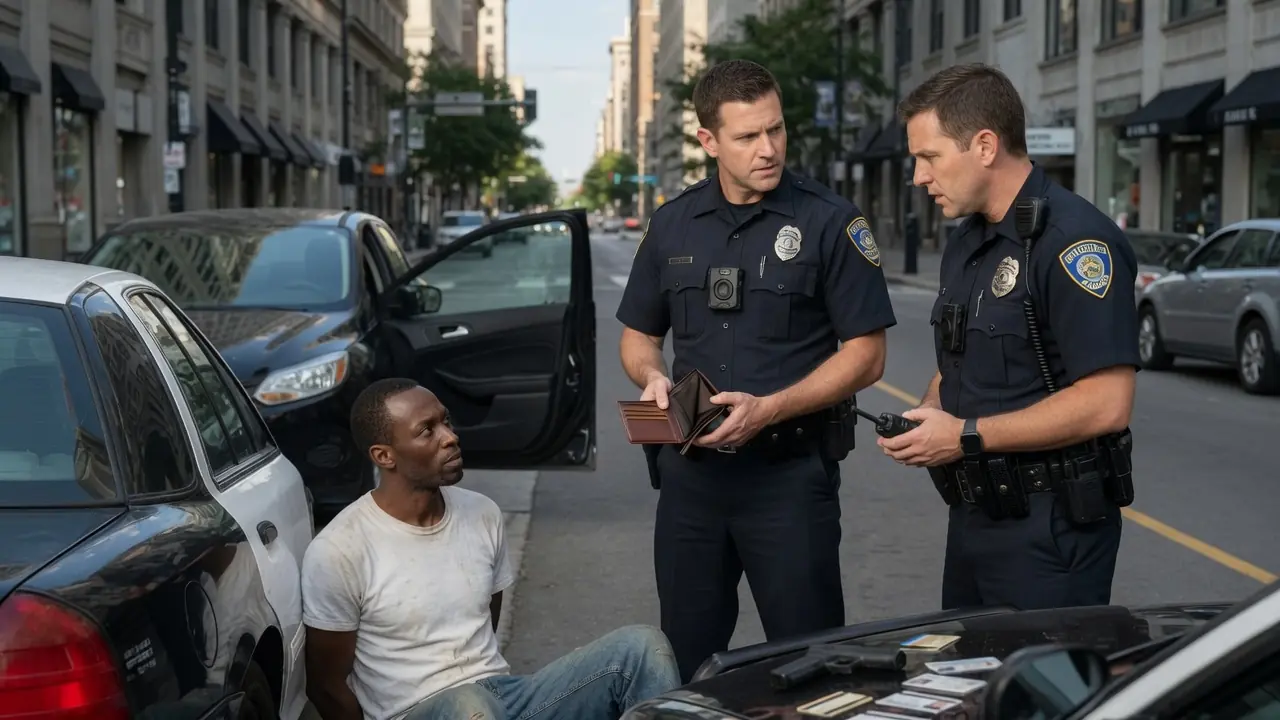
So he repeated what he had heard experienced officers say.
“You’re okay. Just relax.”
“Take these off.”
“That isn’t happening yet.”
“I’m homeless.”
“We’ll talk about that.”
“I was going to sleep in my car.”
“Stop fighting.”
“I’m not fighting you!”
The man twisted beneath them.
James pressed his shoulder down.
“Daniel, control the right arm.”
“I have it.”
“Watch the glass.”
A third officer entered.
“Medics are coming.”
The man’s breathing became rapid and shallow.
“They called the FBI,” he gasped. “I called first, but then they started following me.”
“What’s your name?” Daniel asked.
No answer.
“Sir, tell me your first name.”
“They killed my cat.”
“Your name.”
“Anthony.”
“Anthony what?”
The man began screaming again.
“I need political asylum!”
Daniel looked toward James.
“Drugs?”
James leaned closer to Anthony.
“What did you take?”
“Nothing.”
“Meth?”
“No!”
“Cocaine?”
“No!”
“Alcohol?”
“One beer yesterday.”
“Marijuana?”
“In Denver.”
“When?”
“I don’t know.”
Anthony struck his forehead against the floor.
Daniel placed one hand beneath his head.
“Stop. You’ll hurt yourself.”
“They already hurt me.”
“Who?”
Anthony’s answer dissolved into sobbing.
The call had come through seven minutes earlier.
Possible domestic disturbance.
Male suspect arguing with his sister.
Damage to a construction office.
Fire extinguisher stolen.
Threatening behavior.
The dispatcher warned that the man appeared highly agitated.
As Daniel and James drove toward the address, James had glanced at him from the passenger seat.
“First day, buddy.”
Daniel attempted a smile.
“I noticed.”
“What do you do when we arrive?”
“Assess the threat. Watch the hands. Separate involved parties.”
“And?”
“Listen.”
James nodded.
“That one gets forgotten.”
Daniel remembered the sentence now as Anthony lay beneath him screaming about conspiracies, murdered animals, and people trying to kill him.
Listen.
But listening was difficult when the man’s body kept jerking against the handcuffs.
Paramedics entered with a stretcher.
Anthony saw them and became more frightened.
“No hospital.”
“We need to check you,” a medic said.
“They put trackers in people.”
“Nobody is putting anything in you.”
“You don’t know.”
Daniel shifted backward as the medics examined Anthony’s cut hand and checked his pulse.
“Heart rate is one-fifty.”
“Pressure?”
“High.”
“Any signs of head injury?”
“Not obvious.”
Anthony turned toward Daniel.
“You said you would help me.”
Daniel had not said that.
James had.
But the distinction did not matter to Anthony.
Daniel crouched beside him.
“We’re trying.”
“Take off the cuffs.”
“I can’t yet.”
“That means you’re with them.”
“No.”
“You all say no.”
His voice became quieter.
“They said my cat was an accident.”
Daniel studied him.
“What was your cat’s name?”
James looked over.
It was not the kind of question officers usually asked while processing a burglary suspect.
Anthony stopped moving.
“Winston.”
“What happened to Winston?”
“They poisoned him.”
“Who?”
“The people watching me.”
“Did you see someone poison him?”
Anthony’s eyes filled.
“He was fine. Then he was dead.”
The paramedic exchanged a look with James.
Daniel continued.
“When did that happen?”
“Three weeks ago.”
“Where were you living?”
“In my car.”
“With Winston?”
Anthony nodded.
“He slept on the dashboard.”
For the first time since the arrest, his breathing slowed.
Only slightly.
But enough for Daniel to notice.
“Tell me about your sister.”
Anthony’s face tightened.
“She doesn’t believe me.”
“What is her name?”
“Marina.”
“Did you go to her house today?”
“I needed safety.”
“Did she let you in?”
“She locked the door.”
“Did you hit the door?”
“I knocked.”
“Hard?”
“She wouldn’t answer.”
Anthony looked toward the broken office window.
“I thought they were inside.”
“Who?”
“The people from Washington.”
Daniel glanced at James.
This was not intoxication alone.
Perhaps no intoxication at all.
The man appeared to be experiencing a severe psychotic episode.
That did not erase the damage.
It did not remove the fear of the women who had fled the office.
But it changed what the behavior meant.
Anthony was not fighting police because he wanted to escape responsibility.
He was fighting a world only he could see.
Marina Velez waited beside another patrol car near the edge of the property.
She was thirty-six, with dark hair tied behind her neck and one shoe removed. Her right foot rested on a folded towel.
Officer Rachel Kim crouched beside her.
“I understand your toe was injured.”
“It’s not broken.”
“Did Anthony strike you?”
“No.”
“How did it happen?”
“He was pounding on my door. I opened it because I thought he would break the frame. The door swung over my foot.”
“Did he push it?”
“He was leaning against it.”
“Did he threaten you?”
Marina looked toward the construction office.
“No.”
“Did he break your phone?”
Her eyes lowered.
“Yes.”
“How?”
“I tried to call for help. He grabbed it and threw it.”
“Has he acted like this before?”
“Not like today.”
“Does he use drugs?”
“Not that I know.”
“Alcohol?”
“He drinks sometimes.”
“Any diagnosed mental illness?”
Marina hesitated.
“He doesn’t believe in doctors.”
“That isn’t what I asked.”
She rubbed her hands together.
“Our mother had schizophrenia.”
Officer Kim remained quiet.
Marina continued.
“Anthony started saying strange things after he lost his apartment. He thought neighbors were entering when he was gone. Then he lost his job.”
“What kind of work?”
“Electrical engineering.”
The officer looked surprised.
“He designed control systems for water-treatment plants.”
“What happened?”
“He accused a supervisor of putting listening devices inside his computer. He stopped showing up.”
“How long ago?”
“Eight months.”
“And he has been homeless since?”
“Mostly.”
“Why didn’t he stay with you?”
“I have two children.”
Marina’s voice cracked.
“I let him stay for a week. He covered the smoke detectors, removed electrical outlets, and accused my husband of working for the government.”
“You were afraid.”
“Yes.”
“Of him?”
Marina looked toward the office again.
“Of what was happening to him.”
Officer Kim nodded.
“Do you want to press charges for the phone?”
“No.”
“For the injury?”
“No.”
“Marina, refusing charges does not necessarily help him.”
“I know.”
“He may need mandatory evaluation.”
“I know.”
“But?”
“He’s my brother.”
The sentence explained everything and nothing.
Marina had spent months trying to help without exposing her family to danger.
She brought Anthony food.
Paid his phone bill.
Found shelters he refused to enter.
Left messages for mental-health clinics he would not visit.
Each attempt made him more suspicious.
He believed she had joined the people pursuing him.
That morning, he appeared at her house shouting that he needed political asylum.
When she would not allow him inside, he moved toward the neighboring construction office.
Three employees stepped outside to see what was happening.
Anthony mistook them for enemies.
He shouted at them.
Called them Nazis.
When they retreated into the office, he followed.
He found the fire extinguisher near the porch and used it to break the glass.
Marina had watched the final months of her brother’s life collapse into that single act.
Emily Ross, the project coordinator, stood inside the office with Officer Kim after the medics removed Anthony.
The broken window covered the floor.
A desk had been overturned.
The alarm panel hung from exposed wires.
Blood marked the edge of the door and several pieces of glass.
“Were you inside when he started hitting the window?” Kim asked.
“Yes.”
“Where?”
Emily pointed toward a desk near the front.
“He came onto the porch yelling. At first, I thought he was angry with the woman outside.”
“His sister.”
“I didn’t know that.”
“What happened next?”
“He started looking at us.”
“What did he say?”
“He called us Nazis. Said we had killed his cat. He said we were hiding people inside.”
“Did anyone threaten him?”
“No.”
“Did you approach him?”
“I told him he had to leave.”
“What did he do?”
“He picked up the extinguisher.”
Emily’s hands began trembling again.
“He hit the window once. We backed away. He hit it again. On the third time, the glass came in.”
“Did you believe he was trying to hurt you?”
“Yes.”
“Why?”
“He wasn’t looking at the glass. He was looking at us.”
Emily glanced toward the broken frame.
“I know he was sick. I can see that now. But in that moment, I thought one of us was going to die.”
Officer Kim did not tell her she was wrong.
Mental illness could explain danger without making the danger less real to the person facing it.
“I’m glad you got out,” she said.
Emily sat in a chair.
“Will he go to jail?”
“He may be taken for medical evaluation first.”
“Is that enough?”
“I don’t know yet.”
Emily looked down at the blood on the floor.
“I don’t want him thrown into a cell and forgotten.”
“But you want accountability.”
“I want him unable to come back tomorrow.”
Both things could be true.
Compassion did not require pretending nobody had been harmed.
Safety did not require treating a sick man as though punishment alone could repair him.
Anthony was placed on the stretcher with his hands still cuffed in front.
The paramedics cleaned the cuts on his palm.
Daniel stood beside the ambulance.
James approached carrying Anthony’s worn backpack.
“Found this near the porch.”
Inside were two shirts, a flashlight, canned food, several pages of handwritten notes, and a small photograph of an orange cat.
Daniel removed the photograph.
Winston sat on a dashboard, one paw resting against the windshield.
On the back, Anthony had written:
THE ONLY ONE WHO BELIEVES ME.
James read it over his shoulder.
“Damn.”
“His sister says their mother had schizophrenia.”
“That doesn’t diagnose him.”
“No.”
James looked toward the ambulance.
“But it explains why she looked terrified before he ever picked up that extinguisher.”
Daniel placed the photograph back inside.
“What happens now?”
“Hospital clears him. Behavioral-health team evaluates him. Detectives decide charges.”
“Burglary?”
“Probably. Property damage. Maybe assault-related charges depending on statements.”
“He needs treatment.”
“He also broke into an occupied office.”
“I know.”
James studied the rookie.
“You think arrest and treatment are opposites.”
“Aren’t they?”
“Sometimes.”
James leaned against the ambulance.
“But sometimes a criminal charge is the only doorway open long enough to get someone evaluated.”
“That sounds wrong.”
“It often is.”
Daniel watched Anthony through the rear windows.
The man had stopped screaming.
He stared at the ceiling.
“Will they keep him?”
“If he is an immediate danger to himself or others.”
“He just broke into a building with a fire extinguisher.”
“That helps establish danger.”
Daniel looked at James.
“You say that like it is good news.”
“It may be the first piece of evidence nobody can explain away.”
The ambulance doors began closing.
Anthony suddenly sat up.
“Officer!”
Daniel moved closer.
“What?”
“My car.”
“What about it?”
“It’s all I have.”
“Where is it?”
“Liquor store parking lot.”
“What kind?”
“Silver Ford Taurus.”
“We’ll locate it.”
“They’ll tow it.”
“I’ll ask them not to.”
“My blankets are inside.”
“I understand.”
“Winston’s ashes too.”
Daniel looked at James.
The sergeant keyed his radio.
“Unit Twenty-Four requesting a vehicle welfare check near the liquor store. Silver Ford Taurus registered to Anthony Velez. If legally parked, do not tow. Advise when located.”
Anthony stared at him.
“You did that?”
James nodded.
“Your car will be checked.”
“Why?”
“Because you asked.”
The ambulance doors closed.
Anthony was taken to Memorial Regional Hospital.
The emergency department treated the cuts and performed toxicology testing.
No methamphetamine.
No cocaine.
No opioids.
Only a small amount of cannabis and no alcohol sufficient to explain his behavior.
A psychiatrist evaluated him shortly after midnight.
Anthony believed a political organization had followed him across three states.
He believed strangers communicated through streetlights.
He believed his cat had been killed to silence him.
He believed the women inside the construction office were part of a network preparing to capture him.
He also believed the officers had saved him from that network and joined it at the same time.
The psychiatrist documented acute psychosis and recommended involuntary hospitalization.
Marina sat in the waiting room when Daniel arrived to return Anthony’s backpack.
She looked exhausted.
“Did they say what happens?” he asked.
“They’re holding him.”
“For how long?”
“Seventy-two hours first.”
“That’s a start.”
Marina held the photograph of Winston.
“I should have done this months ago.”
“You could not force an adult into treatment without evidence he was dangerous.”
“He was sleeping in his car in winter.”
“That should have been enough.”
“But it wasn’t.”
Daniel sat across from her.
“His car is still at the liquor store. My sergeant spoke to the manager. They agreed to leave it until tomorrow.”
Marina nodded.
“I’ll move it.”
“There are ashes inside.”
Her face changed.
“Winston.”
“Yes.”
Marina looked at the photograph.
“The cat wasn’t poisoned.”
Daniel waited.
“Anthony bought cheap antifreeze for the car. The bottle leaked into a bowl on the floor. Winston drank from it.”
“Did Anthony know?”
“I told him.”
“He didn’t believe you.”
“No.”
She pressed the photograph against her chest.
“That cat was the last living thing that stayed with him after everyone else became part of the conspiracy.”
“Maybe losing Winston pushed him farther.”
“It destroyed him.”
Marina looked toward the secured treatment wing.
“Officer, did he hurt anyone badly?”
“No serious injuries.”
“The women?”
“Frightened. One had a cut from the glass.”
“My foot is fine.”
“Your phone isn’t.”
“That can be replaced.”
Daniel said nothing.
Marina looked at him.
“You think I should press charges.”
“I think you should tell the truth.”
“I did.”
“You minimized what happened.”
“He is sick.”
“Yes.”
“He doesn’t belong in jail.”
“No.”
“But you still want me to say he attacked me.”
“I want the treatment team to understand how serious this became.”
Marina’s eyes filled.
“If I tell them everything, he will hate me.”
“He already believes you are part of something trying to hurt him.”
“That is different.”
“How?”
“Because right now I can tell myself it is the illness talking.”
Daniel leaned forward.
“Then give the illness fewer places to hide.”
Marina wiped her face.
“You are very young.”
“First day.”
She stared at him.
“This was your first day?”
“Yes.”
“I’m sorry.”
Daniel almost laughed.
“For what?”
“For being your introduction to the job.”
He looked toward the hospital doors.
“I think the introduction was happening long before today.”
The criminal case moved slowly.
Anthony was charged with burglary, property damage, and threatening conduct.
The prosecutor agreed to suspend the case while he remained in treatment.
If he completed a mental-health program, took prescribed medication, avoided the construction property, and accepted supervised housing, the most serious charge could be reduced.
Emily Ross attended the first hearing.
Anthony did not recognize her immediately.
When he did, his body tightened.
She remained beside the prosecutor.
Anthony’s public defender spoke quietly to him.
After several moments, Anthony looked toward Emily.
“I thought you were someone else,” he said.
Emily’s throat tightened.
“You scared us.”
“I know.”
“Do you?”
He looked down at his hands.
“I remember the window.”
“Do you remember looking at me?”
“No.”
“I do.”
Anthony nodded.
“I’m sorry.”
The apology did not erase the sound of breaking glass.
It did not stop Emily from checking the parking lot before leaving work.
But it mattered.
“I hope you get better,” she said.
“I don’t know what better is.”
“Maybe start with not breaking my windows.”
For the first time, Anthony smiled faintly.
“That seems reasonable.”
Daniel visited Anthony at the behavioral-health facility several weeks later.
He did not wear his uniform.
Anthony sat in a courtyard beneath a bare tree.
His beard had been trimmed. He wore clean clothes. His hands shook slightly from medication.
“You’re the officer with the car,” Anthony said.
“The car?”
“You kept them from towing it.”
“That was Sergeant Bailey.”
“You asked him.”
Daniel sat on the bench.
“How are you?”
Anthony looked toward the fence.
“That question is complicated.”
“I have time.”
“They say I have schizoaffective disorder.”
“How do you feel about that?”
“I think they could be wrong.”
“But?”
“But the voices became quieter after the medicine.”
Daniel nodded.
“Do you still think someone killed Winston?”
Anthony looked down.
“No.”
The answer cost him something.
“I spilled antifreeze.”
“It was an accident.”
“I accused Marina.”
“She knows.”
“I broke her phone.”
“She knows that too.”
“I remember the office now.”
Daniel did not speak.
Anthony continued.
“I thought the women were laughing at me. They weren’t.”
“No.”
“I thought the alarm was sending my location.”
“It wasn’t.”
“I thought you were going to execute me.”
Daniel’s chest tightened.
“What do you remember about me?”
“You kept asking about the cat.”
“I didn’t know what else to ask.”
“It helped.”
Anthony rubbed his hands together.
“Do you know what is strange?”
“What?”
“When you asked his name, I remembered Winston was real.”
Daniel waited.
Anthony looked toward the hospital building.
“Everything else felt mixed together. Washington. The FBI. The office. My sister. But Winston was real. I knew his name. I knew where he slept.”
“Something solid.”
“Yes.”
Anthony looked at him.
“Why did you ask?”
Daniel told the truth.
“Because I was scared too.”
Anthony appeared surprised.
“You had a gun.”
“That does not remove fear.”
“You could have shot me.”
“Yes.”
“Why didn’t you?”
“You dropped the extinguisher.”
“I didn’t hear you tell me.”
“You still dropped it.”
Anthony looked away.
“I don’t want to be dangerous.”
“Then keep accepting help.”
“What if the medicine changes me?”
“Maybe it helps you decide which changes belong to you.”
Anthony considered the sentence.
“You sound like a therapist.”
“I am a terrible therapist.”
“Yes.”
They sat in silence.
Before leaving, Daniel placed a small envelope beside Anthony.
Inside was a copy of Winston’s photograph.
Marina kept the original.
Anthony held the picture carefully.
“He was a good cat.”
“I can tell.”
“He hated everyone.”
“Maybe he made an exception for you.”
Anthony smiled again.
Six months later, Anthony moved into supervised housing.
He worked three mornings a week at an electronics recycling center. His job involved testing donated equipment and separating reusable components.
The first weeks were difficult.
He believed cameras in the building were directed specifically at him.
His counselor helped him examine the belief before reacting.
Was there evidence?
Were the cameras aimed at every workstation?
Could another explanation exist?
Some days, the questions worked.
Other days, they did not.
Recovery was not a straight road.
Anthony stopped medication once and disappeared for forty-eight hours.
Marina found him sleeping in his Taurus outside a rest area.
She did not shout.
She sat beside the car until he opened the door.
Then she drove him back to the clinic.
The prosecutor extended the treatment agreement.
Emily received payment for the office damage through a victim-assistance fund.
She later invited a mental-health crisis specialist to train the construction employees.
They learned not to block exits, not to argue directly with delusions, and to call emergency services before danger became immediate.
The training did not transform them into clinicians.
It gave them options besides fear.
Daniel completed his first year in patrol.
He responded to fights, overdoses, thefts, crashes, and calls that sounded dangerous but turned out to be loneliness wearing a louder voice.
He kept Anthony’s case in his mind.
Not because it ended perfectly.
It did not.
Anthony still faced criminal consequences.
Emily still feared unexpected knocking.
Marina still locked her door when her brother became unstable.
But Daniel remembered how easily officers could mistake panic for defiance.
“Relax” was not an instruction a terrified brain could always obey.
“Stop resisting” did not explain what movement officers needed stopped.
And sometimes the question that changed an encounter was not about weapons, drugs, or warrants.
Sometimes it was:
What was your cat’s name?
One year after the broken window, Anthony returned to the construction office.
He came at noon with Marina and his counselor.
Emily waited near the entrance.
The window had been replaced.
The frame was reinforced.
A new fire extinguisher hung beside the porch.
Anthony stopped when he saw it.
“You don’t have to go inside,” Marina said.
“Yes, I do.”
Emily opened the door.
Anthony remained outside.
“I brought something.”
He held a small wooden frame.
Inside was a check covering part of the damage and a handwritten note.
Emily read it.
I believed you were someone you were not. That belief frightened me, but my fear also frightened you. I damaged your office and made you feel unsafe. My illness explains what happened. It does not make your fear unimportant. I am sorry.
Emily looked at him.
“Did someone help you write this?”
“My counselor checked the spelling.”
“Fair.”
Anthony glanced toward the window.
“I don’t remember all of it.”
“I do.”
“I know.”
Emily placed the frame on the reception desk.
“Thank you for coming.”
Anthony nodded.
As he turned to leave, she spoke again.
“Anthony.”
He looked back.
“Do you still need political asylum?”
Marina looked embarrassed.
Anthony thought about it.
“Not political asylum.”
“What, then?”
“A place where my mind isn’t treated like a crime before I do something wrong.”
Emily nodded slowly.
“That sounds harder to find.”
“Yes.”
“But worth looking for.”
Anthony left with his sister.
Daniel watched from his patrol car across the street.
He had not been asked to attend.
He came anyway.
James sat beside him drinking coffee.
“You going in?” the sergeant asked.
“No.”
“Why come?”
“To see whether he did it.”
“Apologized?”
“Yes.”
James looked through the windshield.
“First day seems a long time ago.”
“It doesn’t feel that way.”
“It never will.”
Daniel watched Anthony and Marina reach the Taurus.
The car still ran, though one door was a different color after a junkyard replacement.
Anthony opened the passenger door for his sister.
Before entering, he looked across the street and noticed the patrol car.
For a moment, Daniel expected him to become afraid.
Instead, Anthony raised one hand.
Daniel waved back.
James started the engine.
“You know we did not save him that day.”
“I know.”
“We stopped him.”
“I know.”
“Different thing.”
“Yes.”
James pulled away from the curb.
“But stopping someone can give other people time to save them,” Daniel said.
James considered that.
“Sometimes.”
The construction office disappeared behind them.
Years later, Daniel became a field training officer.
On a rookie’s first morning, they received a call about a man shouting inside a grocery store and accusing customers of following him.
As they approached, the young officer reached toward the door.
Daniel stopped him.
“What do we know?”
“Male subject. Agitated. Possible mental-health crisis.”
“Weapons?”
“None reported.”
“Injuries?”
“None.”
“What do we do first?”
“Control the hands.”
“And?”
The rookie hesitated.
“Listen.”
Daniel nodded.
Inside, the man stood beside a display of canned soup, terrified and confused.
His fists were closed.
Customers watched from behind the checkout counter.
Daniel maintained distance.
“My name is Daniel,” he said. “What should I call you?”
The man stared at him.
“Why?”
“So I know who I’m talking to.”
After several seconds, the man gave his name.
Daniel asked what had frightened him.
The response did not make sense.
It did not need to.
Not yet.
The man eventually opened his hands.
No weapon.
No stolen property.
No injured victims.
The encounter ended with a crisis team rather than a struggle on the floor.
Outside, the rookie exhaled.
“How did you know what to say?”
“I didn’t.”
“But you calmed him down.”
“He calmed himself down. We gave him room.”
The rookie nodded toward the store.
“What if he had attacked someone?”
“Then we would have stopped him.”
“Isn’t that what policing is?”
“Part of it.”
“What’s the other part?”
Daniel looked toward the man being helped into the crisis vehicle.
“Recognizing what they’re actually fighting.”
The rookie did not fully understand.
Daniel had not understood on his first day either.
He had seen Anthony Velez thrashing beneath three officers, screaming about Nazis, the FBI, political asylum, and a dead cat.
At first, Daniel believed the man was fighting arrest.
Later, he understood.
Anthony had been fighting terror.
Grief.
Homelessness.
A mind that had stopped distinguishing danger from imagination.
The police did not cure him.
The hospital did not cure him.
Medication did not restore every piece of the life he lost.
But the broken window forced a door open that ordinary pleas for help had failed to unlock.
Behind that door were treatment, supervision, accountability, and the difficult possibility of returning to himself.
Anthony never forgot the sound of the glass breaking.
Emily never forgot seeing him on the other side of it.
Marina never forgot choosing to tell the full truth about her brother.
And Daniel never forgot that the first person he handcuffed as a patrol officer had begged for political asylum while lying face-down in broken glass.
There had been no foreign government hunting Anthony.
No secret agents.
No Nazis in the construction office.
But he had been searching for asylum all the same.
Not from a country.
From a reality his own mind had made impossible to survive alone.