“People like you do not belong on the twelfth floor.”
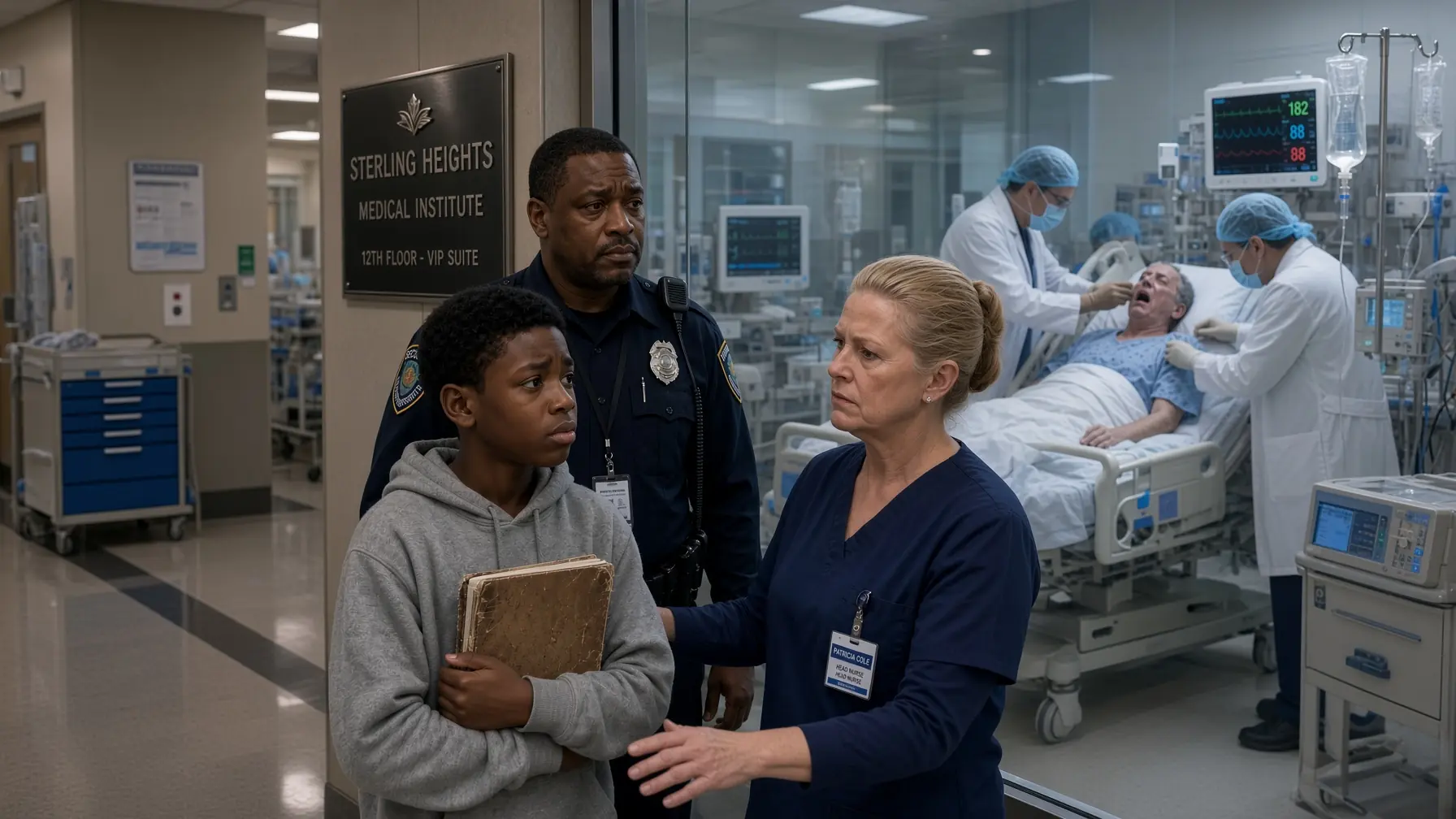
The words landed harder than the notebook.
Thirteen-year-old Benjamin Turner watched the battered black book skid across the polished hospital corridor, strike the wall beneath a framed donor portrait, and burst open. Loose pages fluttered across the floor beneath the Christmas garlands like frightened birds.
Head Nurse Margaret Voss stood between Benjamin and the glass-walled VIP suite, one hand still extended from throwing it.
She was fifty-four, silver-haired, perfectly composed, and known throughout Sterling Heights Medical Institute for running the executive floor with the efficiency of a military officer. Wealthy patients liked her because she remembered their names, their preferred pillows, their assistants, and which specialists should be summoned before anyone asked.
Benjamin knew none of that.
He knew only that she had just thrown three years of his handwriting across the floor.
His father, Gerald Turner, took one step forward.
“Ma’am.”
Margaret looked at the SECURITY patch on Gerald’s navy uniform and seemed irritated that he had spoken.
“This is a restricted clinical area.”
“My son is trying to tell the physicians something.”
“Your son is a child.”
Benjamin stared at the scattered pages.
Some were handwritten summaries of journal articles.
Some contained diagrams.
Several held notes from the worst night of his life.
Margaret followed his gaze.
“Then perhaps he should collect his things and go back downstairs.”
Gerald’s jaw tightened.
“My son believes your patient may have acute porphyria.”
That made her laugh.
Not loudly.
Worse.
A small, dismissive sound.
“The patient in that room is Charles Whitfield.”
“As if his bank account changes his metabolism,” Benjamin whispered.
Margaret’s eyes moved toward him.
“What did you say?”
Benjamin looked at the floor rather than her face.
He hated eye contact when people were angry. It made language harder. Fluorescent light reflected from the polished corridor and stabbed at the back of his eyes. The alarms inside the suite were too loud. Shoes squeaked. Someone dropped a metal instrument tray. The Christmas music from the nurses’ station repeated the same piano arrangement every four minutes and twenty-eight seconds.
Too much.
But through all of it, Benjamin could see one thing clearly.
The patient behind the glass was getting worse.
Charles Whitfield’s body drew inward beneath the blankets as another wave of abdominal pain tore through him. His blood pressure climbed while his heart rate raced. A physician shouted for another medication. A nurse adjusted an IV line. The urine in the catheter bag had gradually darkened over the previous hour.
The doctors were not fools.
That mattered.
Benjamin knew people liked stories where brilliant outsiders walked into rooms full of arrogant experts and magically knew more than everyone.
Medicine did not work that way.
The physicians inside that suite had trained for decades.
They had already ruled out myocardial infarction, aortic catastrophe, pancreatitis, bowel obstruction, sepsis, major toxic exposures, and several neurological emergencies.
Their problem was not stupidity.
It was probability.
They were looking first for the things that killed people most often.
Benjamin was looking for something else because once, three years earlier, the rare thing had killed his mother.
He forced himself to speak.
“His sodium is falling.”
Margaret frowned.
“You cannot possibly know that.”
“I heard Dr. Patel tell somebody it was one twenty-four.”
“You were eavesdropping?”
“The door was open.”
“That information is none of your concern.”
Benjamin pointed through the glass.
“He has severe abdominal pain without a surgical finding. Tachycardia. Hypertension. Confusion. Muscle weakness. Darkening urine. And his sodium is dropping.”
Margaret looked at Gerald.
“Take him downstairs.”
Benjamin’s voice became faster.
“Those findings together are important. Ask if the urine darkens after standing. Ask whether they ordered porphobilinogen.”
“That’s enough.”
“Ask them.”
Margaret stepped closer.
“You seem to have trouble understanding boundaries.”
Gerald moved between them.
“He understands boundaries.”
“Then teach him this one.”
She pointed toward the elevator.
“Basement staff and their family members do not enter VIP clinical areas because they think they read something useful on the internet.”
Gerald’s face changed.
Benjamin saw it.
His father had spent twelve years swallowing remarks like that inside Sterling Heights.
Security guards belonged near doors.
Housekeepers belonged near carts.
Maintenance workers belonged behind panels.
People who donated millions had their names engraved in marble.
People who emptied waste bins were lucky if someone remembered theirs.
Gerald said quietly, “My wife worked here.”
Margaret barely paused.
“I’m sure many people have.”
“She died here.”
That got no answer.
Benjamin crouched to retrieve the nearest page.
Margaret saw movement behind the glass.
A monitor alarm changed pitch.
One of the physicians called:
“Pressure’s one eighty over one ten.”
Another voice:
“Sodium’s down again.”
Then a third:
“Why is his urine getting darker?”
Benjamin stopped.
His whole body went still.
He stood.
“Please.”
This time he looked directly at Margaret.
It hurt.
He did it anyway.
“Just tell them to order a urine porphobilinogen test.”
Margaret stared at him.
“You are thirteen.”
“Yes.”
“You have no medical license.”
“I know.”
“You are not a physician.”
“I know.”
“Then stop pretending to be one.”
Benjamin’s lower lip trembled.
“I’m not pretending.”
His voice cracked.
“I’m trying to stop them from missing what they missed with my mother.”
Margaret’s expression did not change.
“Your personal tragedy does not make you qualified to practice medicine.”
“No.”
Benjamin swallowed.
“But it taught me what this looks like.”
She reached for Gerald’s radio.
“I’m calling security command.”
Gerald almost laughed.
“I am security.”
“Then perhaps you can save me the trouble and remove your son yourself.”
Inside the room, Charles Whitfield screamed.
It was not the dramatic scream of television.
It was worse.
Raw.
Confused.
A man who had spent sixty-three years believing his body belonged to him discovering suddenly that it did not.
Benjamin flinched.
Three years disappeared.
He was ten again.
His mother Sarah lying in an emergency department bed.
Her hands twisting the blanket.
Her voice begging someone to believe that the pain was not anxiety.
Then the seizures.
Then the silence.
Benjamin looked through the glass.
“No.”
Margaret stiffened.
“What?”
“I’m not leaving until somebody hears me.”
It was the first time Gerald Turner had ever heard his son openly refuse an adult in authority.
Margaret reached for the scattered notebook pages.
Benjamin moved faster.
“Don’t touch those.”
She stopped.
Something in his voice surprised her.
Then Dr. Richard Hayes stepped into the hallway.
Benjamin recognized him immediately.
Three years had changed his hair.
Not his face.
Dr. Hayes was sixty-one now, tall, narrow, still wearing the expensive rectangular glasses Benjamin remembered from the night Sarah Turner died.
He looked first at Margaret.
“What’s happening?”
“Security officer’s son is refusing to leave.”
Hayes looked at Gerald.
Then Benjamin.
Recognition did not come.
Gerald saw that.
Of course he did.
For Hayes, Sarah Turner had been one difficult patient among thousands.
For Gerald and Benjamin, Hayes had been part of the worst night of their lives.
Benjamin spoke first.
“Your patient might have acute intermittent porphyria.”
Hayes stared.
The corridor changed.
Not because he believed the boy.
Because the diagnosis was specific enough to demand at least a moment’s attention.
“Why?”
Benjamin answered immediately.
“Severe neurovisceral abdominal pain without an abdominal cause. Autonomic instability. Hyponatremia. Neuropsychiatric symptoms. Motor weakness. Dark urine.”
Hayes’s face shifted slightly.
“Dark urine is nonspecific.”
“Yes.”
“Porphyria is rare.”
“Yes.”
“Very rare.”
“Yes.”
Benjamin swallowed.
“So was my mother.”
Something entered Hayes’s expression.
Not recognition yet.
Memory trying to find a door.
Gerald said:
“Sarah Turner.”
Hayes’s eyes moved toward him.
Gerald continued.
“Environmental services. Research wing. Three years ago.”
The color slowly changed in Hayes’s face.
Benjamin watched it happen.
“My mother came to this hospital four times in two weeks.”
Hayes remained still.
“You were her attending on the final admission.”
“I see thousands of—”
“You wrote ‘possible medication-seeking behavior’ in her chart.”
Hayes stopped.
Now he remembered.
Not all of it.
Enough.
Sarah Turner.
Thirty-five.
Repeated abdominal pain.
Normal imaging.
Agitation.
Vomiting.
Then seizures.
Then respiratory weakness.
The diagnosis had come after death.
Acute intermittent porphyria.
Hayes had attended the morbidity review.
He had told himself the case was impossibly rare.
That the presentation had been atypical.
That several physicians had missed it.
All true.
None comforting.
Benjamin pulled a folded photocopy from his hoodie pocket.
“My mother died because nobody tested for it until the autopsy.”
Hayes looked through the glass toward Whitfield.
Then back.
“What is his sodium?”
“One twenty-four,” Benjamin said.
Hayes’s eyes narrowed.
“How do you know?”
“I heard it.”
The heart monitor alarm changed again.
Hayes turned toward the room.
A physician shouted:
“He’s getting weaker.”
Benjamin stepped closer.
“Order a spot urine porphobilinogen and total porphyrins. Protect the sample from light. If they’re markedly elevated during an acute attack, you’ll know quickly.”
Hayes looked back at him.
“You understand those tests are not instantaneous.”
“Yes.”
“And dark urine alone proves nothing.”
“I know.”
“And you cannot diagnose him from the hallway.”
“I know.”
Benjamin’s voice became smaller.
“That’s why I’m asking you to test him.”
That answer did something no boast could have done.
Hayes looked toward Gerald.
Then toward Margaret.
“Let them stay.”
Margaret stared.
“Doctor—”
“Let them stay.”
She lowered her hand.
Hayes returned to the suite.
Benjamin exhaled.
His knees almost gave way.
Gerald caught his shoulder.
“You okay?”
“No.”
“Good answer.”
Benjamin looked at the notebook pages.
Gerald crouched.
Together, father and son began collecting them.
Neither noticed Margaret watching.
Three hours earlier, nobody on the twelfth floor had expected Charles Whitfield to become a patient.
He had arrived as a donor.
Sterling Heights Medical Institute’s Christmas Eve gala occupied a glass ballroom connected to the executive wing. Two hundred guests attended. Business leaders, surgeons, university trustees, philanthropists, and people whose names routinely appeared on buildings.
Charles Whitfield stood at the center.
He was sixty-three, founder and executive chairman of Whitfield Biologics, a pharmaceutical research company with a market value in the billions. His personal wealth was estimated at more than five billion dollars.
He disliked that number being mentioned publicly while privately ensuring reporters always got it approximately right.
At 9:05 p.m., he announced a twelve-million-dollar donation to pediatric oncology.
Applause filled the ballroom.
Cameras flashed.
Whitfield smiled.
The donation was real.
So was the research it would fund.
Human beings were rarely simple enough to be entirely generous or entirely selfish.
Charles had funded useful science.
He had also killed useful science.
Eight years earlier, while his company was expanding rapidly, a small internal research group proposed exploratory work on several rare metabolic disorders, including acute hepatic porphyrias.