The laughter started before she even stepped off the curb.
Not loud at first.
Just a few chuckles, low and careless, the kind people made when they had already decided someone did not belong.
But it spread quickly.
One man laughed.
Then another.
Within seconds, half the bikers gathered beneath the gas station canopy were watching the teenage girl in the oversized leather jacket walk toward them.
The station sat beside a long desert highway twenty miles outside Flagstaff, Arizona, one of those places people passed through without remembering. Four fuel pumps stood beneath buzzing neon lights. A vending machine hummed beside the office, and hot wind pushed dry weeds across the edge of the parking lot.
Beyond the station, the highway stretched black and empty beneath a darkening sky.
The girl walked alone.
She looked sixteen, maybe seventeen.
Thin.
Sunburned.
Dust streaked the knees of her jeans, and one lace had broken on her right boot. Her dark brown hair had been tied back carelessly, with loose strands stuck to her face from sweat.
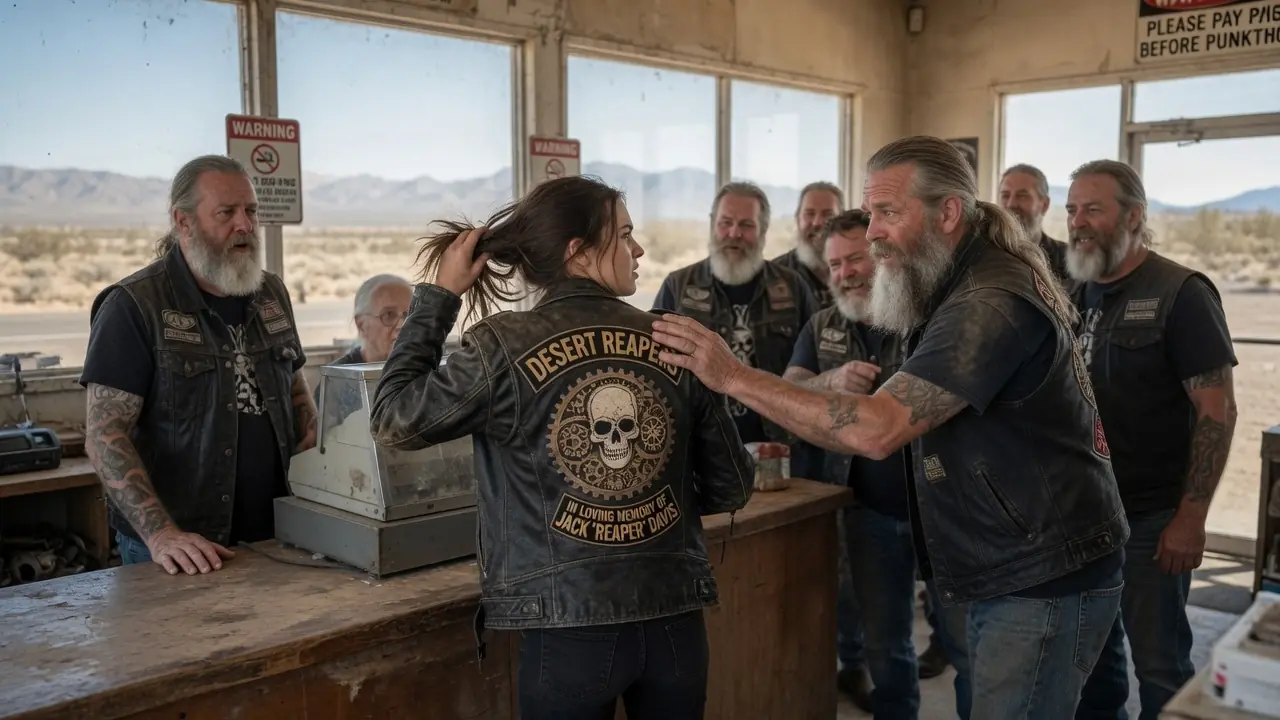
The jacket was what drew everyone’s attention.
It was old enough to have lost most of its shine, too broad in the shoulders, and long enough that the sleeves nearly covered her hands. Several patches had been removed, leaving darker shapes in the faded leather.
To the bikers, it looked like a costume.
A child wearing someone else’s history.
A heavyset man beside pump three looked her over.
“Wrong Halloween, sweetheart.”
The men around him laughed.
The girl kept walking.
Another biker leaned against a black touring motorcycle and grinned.
“Careful with that jacket. You might hurt yourself.”
More laughter.
She reached the edge of the group without responding.
There were fourteen bikers in all, members of the Iron Valley Riders, a club known throughout northern Arizona for charity rides, loud engines, and a reputation that changed depending on who told the story.
Most were older.
Gray beards.
Scarred hands.
Leather vests softened by years of sun and rain.
At the center stood their road captain, Vince “Rook” Callahan.
Rook was fifty-six, broad through the chest, with a thick salt-and-pepper beard and pale blue eyes that missed very little. He had been checking a map beneath the station light when the laughter began.
He looked up.
The girl stopped near the convenience store door.
For a moment, she stood with both hands hidden inside the long sleeves.
Then she looked at the motorcycles.
Not admiring them.
Counting them.
Rook noticed.
“So what is it?” called the heavyset biker. “You lose your scooter?”
The girl turned toward him.
“No.”
Her voice was quiet.
The man spread his hands.
“Then why are you dressed like somebody’s little road warrior?”
The group laughed again.
The girl looked away.
Rook folded the map.
Something about her silence made him uncomfortable.
Not because she appeared frightened.
Because she did not.
She looked tired.
More tired than someone her age should have looked.
A younger rider named Dallas stepped closer.
“Come on, kid. Let’s see the back.”
The girl moved away.
Dallas laughed.
“What? Afraid we’ll find a cartoon patch?”
He reached toward the shoulder of the jacket.
Her hand shot out.
She caught his wrist before he touched the leather.
The movement was fast enough to silence the nearest men.
Dallas looked down at her fingers around his arm.
“Let go.”
She did.
Immediately.
“I said don’t touch it.”
A few bikers began laughing again, but less confidently this time.
Dallas’s face hardened.
“Got some attitude.”
Rook stepped forward.
“That’s enough.”
Dallas looked at him.
“She grabbed me.”
“You reached first.”
“You need fuel?”
“No.”
“Phone?”
She glanced toward the station office.
“Does it work?”
“Usually.”
The clerk behind the glass lifted one shoulder.
The girl moved toward the entrance.
As she passed beneath the brightest light, the back of the jacket came fully into view.
The laughter stopped.
Not gradually.
All at once.
A large patch covered the center panel.
The stitching had faded.
The colors were dull.
But every biker in the group recognized it.
A black raven flying over a white desert cross.
Beneath it, a curved banner read:
IRON VALLEY RIDERS
And beneath that, in smaller letters:
MASON “GHOST” REEVES
ROAD CAPTAIN
1998–2009
No one moved.
Rook felt the air leave his lungs.
The map slipped from his hand.
The girl reached the store door before realizing the group had gone silent.
She turned.
Fourteen men stared at her back.
The heavyset biker’s grin had vanished.
Dallas looked as if someone had struck him.
Rook stepped closer.
“Where did you get that jacket?”
The girl’s shoulders tightened.
“It was my father’s.”
No one spoke.
Rook studied her face.
Dark eyes.
Sharp cheekbones.
A small scar near the left eyebrow.
He had seen those features before, softened by age and half hidden beneath a black helmet.
“What’s your name?” he asked.
“Emily Reeves.”
Rook closed his eyes.
For one brief second, the gas station disappeared.
He saw a desert road seventeen years earlier.
Rain falling sideways.
A motorcycle lying in a ditch.
Mason Reeves kneeling beside another rider with blood covering both hands.
Then a hospital hallway.
A coffin.
A widow holding a little girl who could not have been more than a year old.
Rook opened his eyes.
“You’re Ghost’s daughter.”
Emily looked at him carefully.
“You knew him?”
Rook touched the raven patch on his own vest.
“I rode behind him for eleven years.”
The men around him lowered their eyes.
The heavyset biker removed his cap.
Dallas stepped backward.
Emily looked from one face to another.
“You were all with him?”
“Some of us,” Rook said.
Others had joined later, after Mason’s death. But every rider knew the name Ghost Reeves.
The club’s old road captain.
The man who once turned an entire convoy around during a flash flood and prevented twenty riders from entering a washed-out canyon road.
The man who worked nights as a mechanic and spent weekends repairing motorcycles for veterans who could not afford shop rates.
The man who died on Highway 89 while trying to pull a stranger from a burning pickup.
His name remained in the club’s memorial ledger.
His photograph hung inside their meeting hall.
But his jacket had disappeared after the funeral.
Rook looked at Emily.
“What are you doing out here alone?”
She turned toward the store.
“I need to use the phone.”
“Where’s your car?”
“I don’t have one.”
“How did you get here?”
She hesitated.
“Walking.”
The nearest town was more than twelve miles away.
Rook looked toward the highway.
“From where?”
Emily’s jaw tightened.
“That isn’t your business.”
The answer carried the same quiet defiance Mason used whenever someone pushed too far.
Rook almost smiled.
Then he noticed the bruising around her right wrist.
Dark purple beneath the sleeve.
The smile disappeared.
“Who did that?”
Emily pulled the sleeve lower.
“No one.”
“That isn’t what it looks like.”
“I said I need the phone.”
She entered the store.
Rook watched through the glass as she spoke to the clerk. The clerk shook his head and pointed toward the wall phone.
Emily picked it up.
Waited.
Pressed the receiver harder to her ear.
Then replaced it.
The clerk spread his hands.
Dead line.
She closed her eyes.
Rook entered.
“What number are you calling?”
Emily turned.
“I can handle it.”
“The phone is dead.”
“I noticed.”
“You can use mine.”
“No.”
“Why?”
She looked through the window at the bikers.
“Because I don’t know you.”
Rook nodded slowly.
“That’s fair.”
He placed his phone on the counter and stepped away.
“You can dial it yourself.”
Emily stared at the phone.
Then at him.
Finally, she picked it up.
She dialed.
The call rang several times.
No answer.
She tried again.
Still nothing.
Her hand began shaking.
Rook pretended not to notice.
“Who are you trying to reach?”
“My mother.”
“What’s her name?”
“Sarah.”
Rook remembered.
Sarah Reeves.
Quiet, dark-haired, rarely comfortable around the club but always kind. After Mason died, she sold their house in Flagstaff and disappeared from the motorcycle community.
No one knew where she went.
“Where does she live?”
“Winslow.”
“That’s almost seventy miles.”
“I know.”
“How did you get here?”
Emily placed the phone down.
“I got out of a truck.”
Rook waited.
She did not continue.
Outside, thunder rolled across the desert.
A storm was moving down from the mountains.
The clerk looked through the windows.
“Road’s going to get ugly.”
Rook kept his eyes on Emily.
“What truck?”
She said nothing.
“Was someone driving you?”
“Yes.”
“Who?”
“His name is Derek.”
“Boyfriend?”
“No.”
“Relative?”
“My mother’s husband.”
Rook saw the answer in her face before she spoke again.
“He said we were going to Phoenix.”
“Why?”
Emily looked toward the bikers.
“Because he found the jacket.”
Rook’s stomach tightened.
“What happened?”
“He told me to burn it.”
“And you refused.”
She nodded.
“He said my father was a criminal. Said bikers were trash. Said my mother should have thrown everything away years ago.”
Rook said nothing.
Emily continued.
“He started yelling. Then he hit me.”
The clerk looked over sharply.
Rook’s voice became very still.
“Where is he now?”
“Gone.”
“You said you got out of his truck.”
“I jumped out when he stopped near the old quarry road.”
“How long ago?”
“Maybe three hours.”
“You walked from there?”
She nodded.
Rook looked down at her boots.
The right sole had begun separating at the heel.
“Did he follow you?”
“I don’t know.”
Rook turned toward the window.
The fourteen motorcycles stood beneath the lights.
Beyond them, darkness gathered over the highway.
He walked outside.
The others surrounded him.
“What did she say?” Dallas asked.
Rook looked at each man.
“She’s Ghost’s girl.”
“We know that.”
“She ran from her stepfather.”
The heavyset biker, Boone, clenched his jaw.
“He hurt her?”
Rook nodded once.
The mood changed instantly.
The earlier laughter felt poisonous now.
Dallas looked toward the store.
“I didn’t know.”
Rook faced him.
“You didn’t ask.”
Dallas lowered his eyes.
Rook pointed toward the riders.
“Two men stay here. The rest check the quarry road, both shoulders, and every turnout heading east. No hero work. No confrontation unless she’s in danger.”
Boone looked at the storm.
“What are we looking for?”
“Pickup. Dark color. Driver named Derek.”
“That’s not much.”
“It’s enough to start.”
One of the older riders, Wade, approached.
“What about the girl?”
“She stays with me.”
Rook returned inside.
Emily stood near the cooler, watching the bikers prepare to leave.
“What are they doing?”
“Checking the road.”
“I didn’t ask you to.”
“No.”
“Then tell them to stop.”
“Why?”
“Because Derek will call the police and say you kidnapped me.”
“You’re sixteen?”
“Seventeen.”
“He can still make trouble.”
“He always does.”
Rook leaned against the counter.
“Then we do this properly.”
He called the Coconino County Sheriff’s Office.
Emily tried to stop him.
“No.”
“If we hide you, he controls the story.”
“You don’t understand.”
“I understand men who depend on everyone else staying quiet.”
Her face tightened.
“He’s a corrections officer.”
Rook paused.
“Where?”
“State prison outside Winslow.”
The clerk stopped stocking cigarettes behind the counter.
Rook looked at Emily again.
“Has he done this before?”
She stared at the floor.
That was answer enough.
The sheriff’s dispatcher requested their location and sent a deputy.
Emily became increasingly agitated.
“You shouldn’t have called.”
“You need a record.”
“He’ll say I’m lying.”
“Then we give them evidence.”
“What evidence?”
Rook pointed toward the bruises.
“The jacket.”
“The jacket doesn’t prove anything.”
“Why did he want it burned?”
Emily looked toward the raven patch.
“I don’t know.”
Rook believed she did.
He waited.
Outside, the first drops of rain struck the pavement.
Finally, Emily spoke.
“My father left something inside it.”
Rook’s eyes narrowed.
“What?”
“I don’t know. A few weeks ago, I found stitching beneath the lining. There was a flat envelope sewn into the back.”
“Where is it?”
“At my house.”
“Did Derek see it?”
“He saw me reading it.”
“What was inside?”
Emily looked through the window toward the dark highway.
“Names.”
“What kind of names?”
“Prison officers. Police officers. Business owners.”
Rook felt something old and dangerous stir in his memory.
Before Mason died, he had begun helping a former inmate named Luis Ortega repair motorcycles.
Luis claimed guards at the county jail were moving drugs through inmate work crews.
Mason never told the club much.
Only that he had learned something he wished he had not.
Then he died in what everyone accepted as a roadside rescue accident.
Rook remembered the pickup.
The fire.
The driver who vanished before investigators arrived.
“Was there a date on the papers?” he asked.
“2009.”
The year Mason died.
“What else?”
“A note.”
“What did it say?”
Emily swallowed.
“If anything happens to me, take this to Rook.”
The store seemed to become quieter.
Rook stared at her.
“He wrote my name?”
She nodded.
“Robert Callahan.”
No one called him Robert anymore.
Mason had.
Rook walked to the window.
Rain streaked the glass.
Seventeen years.
Mason had trusted him with something, and Rook had never known.
“Why didn’t your mother give it to me?”
“She never found it.”
“And you?”
“I looked you up.”
“Then why didn’t you call?”
Emily’s expression hardened.
“I found videos of the club.”
Charity rides.
Bar fights from years earlier.
News stories mixing truth with rumor.
“I didn’t know if you were someone I could trust.”
Rook glanced toward the patch.
“And now?”
“You laughed at me.”
The words landed harder than shouting.
“I didn’t.”
“You stood there.”
Rook looked at his reflection in the glass.
She was right.
He had not laughed.
He had not stopped it either.
“I’m sorry.”
Emily crossed her arms.
“That doesn’t fix anything.”
“No.”
He turned back.
“But it is where fixing starts.”
The deputy arrived fourteen minutes later.
Deputy Carla Mendoza entered the store with rain on her shoulders and one hand resting near her belt. She was in her early forties, calm-eyed, and immediately separated Emily from the bikers.
She took photographs of the bruises.
Asked precise questions.
Requested Derek’s full name.
Derek Sloan.
Forty-two.
Corrections lieutenant.
No known vehicle description beyond a dark blue Ford pickup.
Mendoza spoke with dispatch.
The truck was registered to Sloan.
No outstanding warrants.
Then she looked at Rook.
“You said there may be documents connected to an old case.”
“Yes.”
“What case?”
“The death of Mason Reeves.”
Her expression changed slightly.
“You knew him?”
“He was our road captain.”
Mendoza remembered the name.
Most local officers did.
The 2009 crash had made regional news. A motorcyclist died while attempting to save someone from a burning vehicle.
The surviving driver was never identified.
The official conclusion blamed poor weather, excessive speed, and an accidental fuel fire.
“What makes you think the papers matter?” she asked.
Emily answered.
“My father wrote that if something happened to him, they should go to Rook.”
Mendoza turned back to her.
“Where are the documents now?”
“In my bedroom.”
“Does Sloan have access?”
“Yes.”
Mendoza called for another unit to secure the residence.
Then her radio crackled.
A dark blue Ford pickup had been spotted six miles west of the gas station.
Parked without lights.
One person inside.
Mendoza stepped toward the door.
“Stay here.”
Rook followed.
“You may need witnesses.”
“I need civilians not interfering.”
“We won’t.”
“You have fourteen motorcycles and a club history that says otherwise.”
Rook looked at her.
“That history includes helping your department search for a missing child in 2018.”
Mendoza held his gaze.
“It also includes six arrests after a bar fight.”
“Seven.”
She raised an eyebrow.
“Charges against one were dismissed.”
Despite herself, she almost smiled.
Then her radio came alive again.
The pickup had moved.
Heading toward the station.
Mendoza turned sharply.
“Everyone inside.”
Rook walked outside instead.
The riders had begun returning in pairs, rain shining on their jackets.
He raised one hand.
“Engines off. Nobody moves unless I say.”
The bikes fell silent.
Headlights appeared on the highway.
A dark pickup approached too quickly.
It entered the station lot and braked hard near the pumps.
The driver’s door opened.
Derek Sloan stepped out.
Tall.
Close-cropped hair.
Corrections uniform pants beneath a rain jacket.
His face carried the confidence of a man accustomed to having institutions behind him.
He saw the bikers first.
Then Emily through the store window.
His expression twisted.
“There you are.”
Deputy Mendoza moved between them.
“Mr. Sloan, stop where you are.”
He looked at her badge.
“She’s my stepdaughter.”
“She made an allegation of assault.”
“She ran away.”
“Stay where you are.”
Derek pointed toward Emily.
“She stole property from my home and climbed into a truck with these people.”
“No,” Emily said from the doorway.
Rook turned.
She had stepped outside.
Mendoza told her to return to the store.
Emily did not.
Derek’s voice softened suddenly.
“Come on, Em. Your mother is worried.”
“She isn’t answering.”
“She’s sleeping.”
“You took her phone.”
Derek’s jaw tightened.
Rook saw the change.
The soft voice had been a mask.
“She’s confused,” Derek told Mendoza. “Her father died when she was a baby. She has emotional problems.”
Emily’s hands curled into fists.
“He hit me.”
“She attacked me while I was driving.”
“Show me the mark.”
Derek looked toward her.
“What?”
“You said I attacked you. Show them.”
He said nothing.
Mendoza stepped closer.
“Mr. Sloan, turn around and place your hands behind your back.”
His face changed completely.
“For what?”
“Based on visible injuries and the victim’s statement, you are being detained while we investigate.”
“You don’t know who I am.”
“I know exactly who you are.”
Derek looked toward the bikers.
Then at Rook.
“You think that patch means something?”
Rook’s eyes narrowed.
Derek smiled.
“Mason Reeves was a thief who died running from his own mess.”
Emily moved before anyone expected it.
She struck him across the face.
The sound cracked beneath the gas station canopy.
Derek lunged.
Rook stepped between them.
Mendoza and another deputy seized Derek’s arms.
He struggled, shouting threats, calling everyone by names he believed would frighten them.
When the handcuffs closed, he looked at Emily.
“You have no idea what you just started.”
She stood behind Rook.
“Yes,” she said. “I do.”
The search of Derek’s truck uncovered a handgun, two cell phones, a plastic evidence bag containing prescription pills, and a half-empty can of gasoline.
In the back seat lay a bundle of clothing taken from Emily’s room.
Her father’s photographs.
A small wooden box.
And a torn section of leather lining.
He had been going back for the documents.
Deputies secured the Reeves house before midnight.
Sarah Reeves was found in the bedroom unconscious but alive.
She had bruising around her neck and a head injury.
Derek told officers she fell.
Doctors disagreed.
Emily sat beside her mother in the hospital until sunrise.
Rook remained in the hallway.
The other bikers filled the waiting area, quiet now, leather jackets darkened by rain.
Dallas sat farthest from the door.
He had not spoken since the gas station.
When Emily came out to get water, he stood.
“I owe you an apology.”
She looked at him.
“I shouldn’t have touched the jacket.”
“No.”
“And I shouldn’t have laughed.”
“No.”
He swallowed.
“I knew Ghost’s name. I didn’t know his face well enough to see him in yours.”
Emily looked toward Rook.
“That’s not why you should be sorry.”
Dallas lowered his eyes.
“I know.”
She continued walking.
The hidden envelope was recovered from beneath a loose floorboard in Emily’s room.
She had moved it after Derek saw her reading it.
Inside were photocopied jail transport records, handwritten names, dates, license plate numbers, and several photographs.
One showed corrections officers transferring boxes from a county van to a private towing yard late at night.
Another showed a younger Derek Sloan standing beside two deputies and a man identified as Victor Hale, owner of three bars and a trucking company.
Mason’s note explained the rest.
Luis Ortega had discovered that drugs and stolen property moved through inmate labor details. Officers used county vehicles to transport material outside normal evidence channels.
Mason helped Luis document it.
He intended to turn everything over to an honest investigator.
Before he could, someone learned what he had collected.
On October 17, 2009, Mason received a call about a stranded driver on Highway 89.
The burning pickup had not been an accident.
It was a trap.
He was struck before the vehicle ignited.
The old autopsy photographs, reviewed with modern techniques, showed injuries inconsistent with the official account.
The stranger Mason supposedly died trying to rescue had never existed.
Rook read the note alone in the Iron Valley clubhouse.
At the bottom, Mason had written:
Rook, if this reaches you, protect Sarah and Emily before you chase the men who did this. Revenge will make you useful to them. Evidence will make you dangerous.
Rook read the final line repeatedly.
Mason knew him too well.
The investigation expanded quickly.
Derek’s phones contained messages connecting him to retired sheriff’s deputies, corrections officials, and Victor Hale’s trucking company.
Old transport logs matched Mason’s records.
Financial audits revealed years of unexplained payments.
A former deputy confessed after investigators showed him the photographs.
He admitted helping stage the crash.
Mason had been beaten unconscious and placed beside the burning truck to make his death appear heroic but accidental.
The irony sickened Rook.
The lie preserved Mason’s reputation while destroying the truth he died trying to reveal.
Derek had not participated in the killing directly.
He had been twenty-five and working as a jail transport officer.
But he knew about the operation.
Years later, he married Sarah.
At first, he appeared kind.
Helpful.
Protective.
He slowly isolated her from Mason’s former friends, convinced her that the club blamed her for the disappearance of the jacket, and searched the house for anything Mason might have hidden.
When Emily found the envelope, Derek panicked.
He tried to destroy the last evidence connecting the old network to the present.
Sarah survived.
Recovery took months.
She remembered very little about the night she was attacked, but she remembered years of control clearly once someone finally asked the right questions.
Derek faced charges for assault, attempted destruction of evidence, unlawful possession of narcotics, witness intimidation, and conspiracy.
The old murder case reopened.
Victor Hale was arrested at seventy-one.
Two retired officers were indicted.
A former corrections captain died before trial, but his files helped confirm the network.
The news called it the Highway 89 Conspiracy.
Rook hated the name.
It turned years of pain into something designed for headlines.
Emily cared less about the headlines than the jacket.
The police kept it for six months as evidence.
When it was finally returned, the lining had been opened, photographed, and carefully resewn.
She brought it to the Iron Valley clubhouse.
The building stood outside Flagstaff behind an old repair shop. Motorcycles filled the gravel lot.
Inside, Mason’s photograph hung above the memorial wall.
Emily stood beneath it wearing the jacket.
The club gathered around her.
No one laughed.
Rook stepped forward holding a small wooden box.
Inside was a new patch.
Not a membership patch.
The club did not allow minors to wear one.
This patch showed a simple black raven above the words:
GHOST’S DAUGHTER
IRON VALLEY FAMILY
Emily looked at it.
“I don’t ride.”
“You don’t have to.”
“I don’t want people thinking I belong to something I didn’t choose.”
Rook nodded.
“Then don’t wear it.”
Several members shifted awkwardly.
Rook closed the box.
“The choice is yours.”
Emily looked toward her father’s photograph.
Then at the men who had mocked her at the gas station.
Dallas stood near the back.
She took the patch from the box.
“But I choose where it goes.”
Rook handed her a needle and heavy thread.
Emily sat at a worktable and stitched the patch onto the inside lining, directly over the place where Mason had hidden the documents.
No one would see it while she wore the jacket.
That was the point.
“It isn’t for strangers,” she said.
Rook smiled.
“Your father would understand.”
The Iron Valley Riders changed after that night.
Not completely.
Men did not become gentle because of one mistake.
They still argued.
Still rode too loudly.
Still told stories that grew with every retelling.
But something shifted.
At every gathering, Rook repeated one rule:
No mocking someone who walks into the circle alone.
“Why?” a new member once asked.
Dallas answered before Rook could.
“Because you don’t know whose history they’re carrying.”
The gas station clerk kept a photograph from that stormy night.
It showed fourteen motorcycles beneath the neon lights and a thin girl in an oversized jacket standing near the store.
Years later, a reporter asked Emily whether the bikers went silent because they respected her father.
“Partly,” she said.
“What was the other reason?”
“They realized they had become the kind of men he would have stopped.”
At twenty-one, Emily learned to ride.
Rook taught her on an old Honda Rebel in an empty parking lot.
She dropped it twice.
Swore both times.
Refused help lifting it the first time.
Accepted help the second.
“Progress,” Rook said.
“Don’t make it philosophical.”
“Your father would.”
“You’re not my father.”
“No.”
Rook looked toward the jacket hanging on the fence.
“I know.”
The answer mattered.
He never tried to replace Mason.
He only became what the note had asked him to be.
Someone who protected them before chasing the past.
Sarah eventually attended one club memorial ride.
She had avoided motorcycles for seventeen years.
The sound brought back hospital corridors, police reports, and men offering sympathy while hiding the truth.
Emily stood beside her.
“You don’t have to come.”
Sarah looked at the riders gathering beneath the morning sun.
“I know.”
That was why she came.
At the memorial site on Highway 89, the club installed a stone marker.
It did not repeat the old story about a rescue from a burning truck.
It told the truth.
MASON “GHOST” REEVES
MECHANIC, FATHER, ROAD CAPTAIN
KILLED WHILE DOCUMENTING CORRUPTION
HIS EVIDENCE SURVIVED BECAUSE HE HID IT WHERE LOVE WOULD KEEP IT SAFE
Sarah touched the stone.
Emily stood beside her wearing the old jacket.
Rook remained several steps away.
The wind moved across the desert.
Motorcycles cooled along the shoulder, engines ticking softly.
Dallas approached Emily.
“You remember the first thing I said to you?”
“Yes.”
“I wish you didn’t.”
“I’m glad I do.”
He looked confused.
She touched the raven patch.
“People should remember the moment before they decided to become better.”
Dallas nodded.
Years later, the story traveled far beyond Arizona.
People retold it as the night a group of bikers mocked a teenage girl until they recognized a famous patch.
That version was true.
But incomplete.
The patch did not silence them because it belonged to a legend.
It silenced them because it forced fourteen men to see the distance between the people they believed themselves to be and the way they had treated a stranger.
Mason Reeves had once led the Iron Valley Riders with a simple rule.
The strongest person in the group was responsible for making sure the weakest reached the destination.
On the night Emily walked into the Flagstaff gas station, the club forgot that rule.
Then they saw the raven on her back.
They remembered the man who wore it.
More importantly, they remembered what it meant.
The laughter ended beneath the neon lights.
But the lesson followed them long after the engines started again.
A jacket could be too large for the person wearing it.
A burden could belong to someone too young to carry it.
And the stranger everyone mocked might be walking toward them with the one piece of history capable of exposing who they had become.
Emily never replaced the faded leather.
She repaired it.
Reinforced the seams.
Preserved every scratch.
Inside the lining, above the hidden patch, she added one sentence in her own handwriting:
DO NOT JUDGE THE PERSON BEFORE YOU KNOW WHAT THEY SURVIVED.
The words were invisible when she wore it.
Just like the bruises beneath the sleeves.
Just like the evidence hidden behind the patch.
Just like the truth her father had carried until the day someone killed him for refusing to stay silent.
From the outside, it remained an old biker jacket hanging from the narrow shoulders of a young woman.
To those who knew the story, it was something else.
A warning.
A promise.
And proof that silence can begin with shame—but it does not have to end there.