Jonas Harlan had eaten stew at the Cedar Rail Boarding House more times than he could count, and most nights he forgot the meal before he reached his horse. The place sat on the edge of a growing frontier town, where rail workers, cattlemen, drummers, and tired travelers crowded shoulder to shoulder under smoke-dark beams. Tin cups clattered, boots scraped the plank floor, and men spoke loudly because the room was always full of dust, hunger, and opinions. Jonas came in that evening with trail grit on his coat, set his hat on the table, and asked if there was anything besides stew.
Edmund Hollis, the boarding house owner, did not look up from the ledger balanced beside his plate. He was a narrow man with a dry mouth and a habit of treating people according to what he believed they were worth. “There’s cornbread if you want it,” he said, scratching numbers with his pencil. “Woman in back made too much.” He said it the way a man might mention cold ashes, something present but unimportant.
Jonas was too hungry to question it. He had spent the day riding fence on the north range, where wind came hard across the prairie and made every mile feel twice as long. His ranch, the Harlan spread, was his now, left to him three years earlier after his father died with more debts than instructions. At twenty-six, Jonas had learned to carry responsibility like a saddle, tight, heavy, and worn into the shape of him.
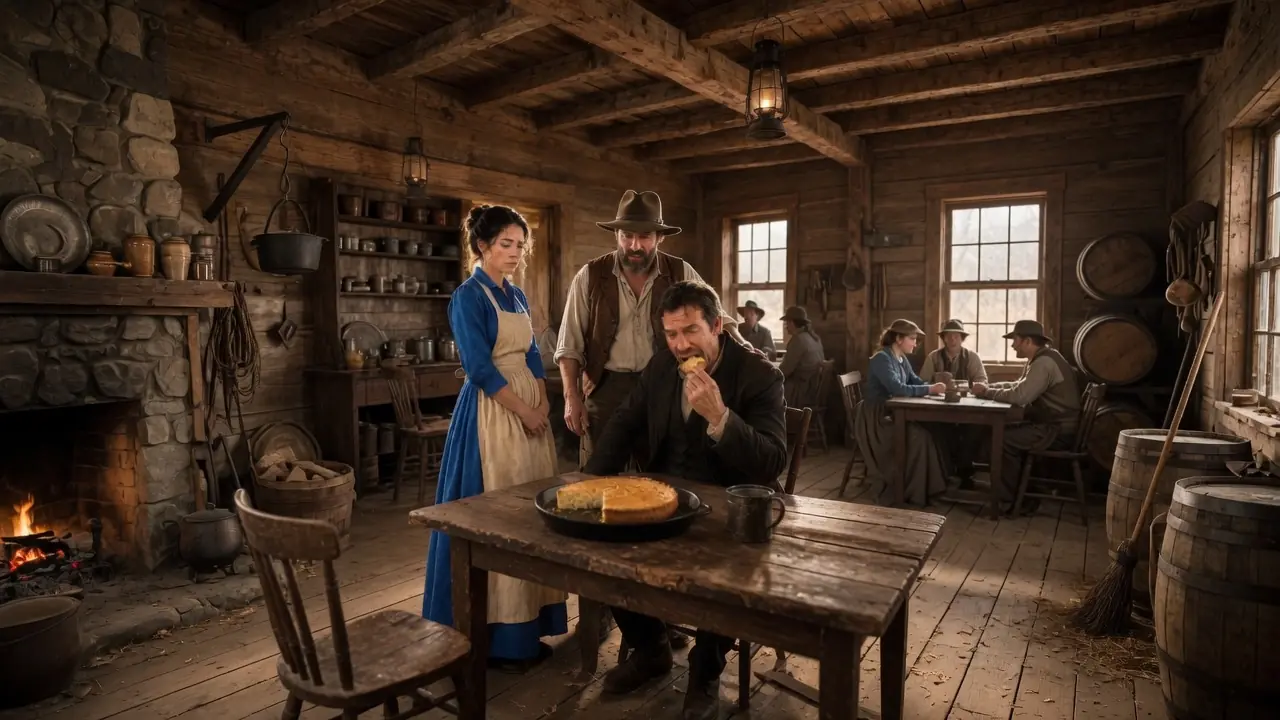
Lucy Bell brought the cornbread herself. She stepped from the kitchen with a black iron pan wrapped in a towel, her blue dress faded at the cuffs and her cream apron dusted with flour. Her dark hair had escaped its pins in soft strands near her face, and her eyes stayed lowered as if looking directly at people cost more than she could spare. She set the pan on the table and turned to go before anyone thanked her.
Jonas broke off a piece while standing, meaning only to taste it before sitting down. The first bite stopped him where he stood. The cornbread was crisp at the edge, tender inside, touched with honey, salt, and something smoky from the skillet that made it taste like a kitchen warmed against hard weather. It was not fancy, but it carried care in every crumb, the kind of care a man notices only after living too long without it.
“Who made this cornbread?” Jonas asked. The room did not stop at once, but the nearest men glanced over. Edmund Hollis sighed as if the question annoyed him. “I told you,” he said. “The girl in back made it.” Jonas turned toward Lucy, who had frozen near the kitchen doorway with one hand still gripping the towel.
“That’s the best cornbread I’ve ever had,” Jonas said, honest enough that his own voice surprised him. Lucy’s face changed, not into a smile, but into something more guarded, as if praise might become a trap if she accepted it too quickly. Her fingers tightened around the towel until the knuckles paled. “Glad it suits you,” she said quietly, then disappeared back through the kitchen door before the room could decide whether to notice her.
Jonas sat down, but the meal had changed. Around him, the dinner crowd kept eating like nothing had happened, but he could still see the doorway where Lucy had vanished. Rail men laughed over cards, a drummer boasted about tin samples, and two ranch wives whispered about new fabric arriving from Kansas City. None of them seemed to understand that a woman they had treated like smoke had just served something that tasted like home.
He thought about the cornbread on the ride back to the ranch. Moonlight silvered the grass, and the town lights shrank behind him until the prairie swallowed them whole. Jonas had never considered himself lonely, not exactly. He had hands to manage, cattle to count, fences to repair, and enough work to keep wanting from getting too loud.
The next evening, Jonas found an excuse to ride into town again. He told his foreman, Ben Cates, that he needed a hinge from the mercantile and a few pounds of nails, though the ranch had both. Ben looked at him with old eyes that missed little and said nothing. By supper, Jonas was back at the Cedar Rail, sitting at the same table with his hat beside his elbow and his gaze drifting too often toward the kitchen door.
Edmund Hollis noticed. “If you’re waiting on more cornbread, don’t,” he said. “Lucy makes what I tell her, and tonight it’s biscuits.” Jonas leaned back and looked at the man. “Lucy,” he repeated. “That her name?” Edmund flicked his pencil against the ledger. “Lucy Bell. Orphanage girl. Good enough cook if she remembers her place.”
The words struck Jonas sharper than he expected. “Her place?” he asked. Edmund finally looked up, and his eyes carried the dull irritation of a man challenged over something he believed was beneath discussion. “In the kitchen,” he said. “Same as any girl without kin, money, or prospects.” Jonas said nothing, but his jaw tightened.
Lucy came out later with a tray of biscuits and bowls of stew. She moved through the room carefully, avoiding elbows, boots, and wandering hands with the practiced skill of a woman who had learned where danger lived. When she reached Jonas, she set his bowl down without looking at him. Her sleeve had a small burn near the wrist, and there was flour on one cheek. Jonas wanted to say something kind, but he sensed kindness offered in front of the wrong people might wound her more.
“Evening, Miss Bell,” he said instead. Lucy paused. No one at the boarding house called her Miss. Her eyes lifted just enough to meet his, dark and wary. “Evening, Mr. Harlan,” she answered, and the use of his name told him she knew exactly who he was.
After that, Jonas began coming to town more often. Sometimes he brought beef for the boarding house, claiming he had too much after a slaughter. Sometimes he fixed a loose latch near the kitchen door or helped carry sacks of flour from the wagon. Edmund accepted the help without thanks, but Lucy noticed. She noticed everything, Jonas learned, though she rarely let anything show.
One rainy afternoon, Jonas found her behind the boarding house trying to lift a split crate of apples before the mud ruined them. Edmund was inside shouting at a supplier, and no one else seemed inclined to help. Jonas swung down from his horse and crossed the yard without waiting to be asked. Lucy straightened quickly, as if being caught needing help embarrassed her.
“Don’t trouble yourself,” she said. Rain had darkened her hair and plastered loose strands against her temples. Jonas picked up the crate, holding the broken side together with one hand. “Apples are already trouble once they hit mud,” he said. “Best save the ones that still have some dignity.” Lucy looked at him then, and for the first time, he saw a flicker of amusement touch her mouth.
They carried the apples into the kitchen, a room narrow as a freight box and hot from the stove. It smelled of yeast, onion, coffee grounds, and woodsmoke. Lucy pointed him toward a table scarred by years of chopping, kneading, and hurried meals eaten standing up. “Set them there,” she said. “And thank you, though Mr. Hollis will say you were in the way.”
“Mr. Hollis says a good many things,” Jonas replied. Lucy gave a short laugh before she could stop herself, then pressed her lips together. That laugh stayed with him longer than it should have. It sounded rusty from lack of use, but true.
Jonas began to learn pieces of her story the way a man gathers kindling, one small stick at a time. Lucy had grown up at the county orphanage two towns over, where she learned to cook because the woman who ran the kitchen had weak hands and too many mouths to feed. When Lucy turned sixteen, she stayed because younger children still needed breakfast, supper, and someone who knew how to stretch beans into comfort. By twenty, she left with one trunk, two dresses, and a letter that said she was hardworking.
The boarding house hired her because she asked for little and gave much. She cooked before dawn, washed dishes past midnight, scrubbed floors, mended linens, and slept in a narrow room off the pantry where winter air slipped through the wall. Edmund Hollis paid her barely enough to buy soap and thread. But Lucy stayed because a woman alone without family had to weigh hunger against insult and choose the one that left her standing.
Jonas heard the worst of it one evening when a rail worker sent a plate back because the beans were not salted enough. Edmund stormed into the kitchen, loud enough for half the dining room to hear. “You trying to ruin me, girl?” he snapped. “Folks pay for food, not orphan slop.” The room went quiet for a moment, then tried to pretend it had not heard.
Jonas rose before he thought better of it. He crossed to the kitchen door, where Lucy stood with both hands pressed flat against the worktable, her face pale but composed. Edmund turned when he saw Jonas and forced a smile that sat crooked on his mouth. “Kitchen matter,” he said. “No concern of yours, Harlan.”
“It became mine when you shouted it across my supper,” Jonas said. His voice was calm, but every man in the room heard the warning beneath it. Lucy lifted her eyes, not pleading, not grateful, but afraid of what his interference might cost her later. Jonas saw that fear and understood that defending someone badly could leave them alone with worse consequences after witnesses left.
So he turned back toward the dining room and picked up the returned plate. He took one bite of the beans, then another, and set the plate down in front of the rail worker. “Tastes fine,” he said. “Maybe your tongue got spoiled somewhere east.” Laughter broke the tension, and the rail worker grumbled but ate. Edmund glared, but he could not punish Lucy in front of a room that had just sided, even briefly, with Jonas Harlan.
Later that night, Lucy found Jonas outside by the hitching rail. The town had gone quiet except for saloon music drifting from down the street. She held a wrapped piece of cornbread in one hand and offered it without ceremony. “For the ride,” she said. Jonas took it, and their fingers almost touched through the cloth.
“You didn’t have to do that,” Lucy added. Jonas looked toward the boarding house window, where Edmund’s shadow moved across the curtain. “Neither did you,” he said, holding up the cornbread. Lucy’s face softened, but only for a second. “Food is easier than courage,” she said. Then she went back inside.
That sentence troubled him for days. Jonas had thought himself brave because he could ride a half-broke horse, face a winter storm, or argue down a cattle buyer trying to cheat him. But Lucy’s kind of courage was quieter and more expensive. She woke every morning in a place that did not honor her and still made food good enough to warm strangers who did not know her name.
By the time harvest season ended, Jonas knew he was in trouble. He found himself noticing how Lucy tucked loose hair behind her ear with the back of her wrist because her hands were always busy. He noticed how she saved the softest bread heel for an old freighter with no teeth, how she slipped extra potatoes into a child’s bowl when the mother was counting coins, and how she turned away quickly whenever anyone thanked her. She did not know what to do with kindness because life had taught her kindness often carried a hook.
One Sunday after church, Jonas saw Lucy standing alone near the mercantile, looking at blue ribbon in the window. She wore her plain dress and held a small purse with both hands, but she did not go inside. Women from town passed her in clusters, nodding politely but not inviting her into their circle. Jonas watched her turn away from the ribbon as if wanting it had been foolish.
He bought it after she left. Not the finest ribbon in the store, but the exact blue one she had looked at, soft as creek water under clear sky. He carried it in his coat for three days, unsure how to give a gift without making her feel bought. Finally, he left it wrapped in brown paper on the kitchen worktable with a note that said only, You ought to have something pretty that belongs to you.
Lucy knew it was from him. He saw the ribbon in her hair the next evening, tied simply, half hidden among dark curls. She did not mention it when she set down his plate. But her hand brushed the back of the chair beside him, and she said softly, “Some gifts are hard to accept.” Jonas looked up. “Then take your time,” he said. “I’m not asking anything back.”
The trouble came in winter, when Edmund Hollis decided attention toward Lucy threatened his control. A traveling widow named Mrs. Keene praised Lucy’s chicken pie aloud one night, saying it was better than anything she had tasted in Denver. Jonas smiled into his coffee, pleased to hear someone else say what he had known for months. Edmund heard it too, and his face went hard.
The next morning, Lucy was not in the kitchen. The biscuits were burned, the coffee was bitter, and the stew tasted like boiled rope. Jonas asked where she was, and Edmund shrugged too casually. “Let her go,” he said. “Girl got proud and forgot who paid her.” Jonas stood so fast his chair scraped the floor.
“Where did she go?” he asked. Edmund dipped his pen in ink and kept writing. “Not my concern.” Jonas leaned both hands on the table, and the nearby men stopped eating. “It had better become your concern real quick.” Edmund looked up then, pale anger tightening his mouth. “You’ve got no claim on that woman, Harlan.”
The words struck deeper than Jonas expected because they were true. He had admired Lucy, defended her in small ways, bought her ribbon, eaten her food, and thought about her on long rides. But he had never offered her anything solid enough to stand on. He had let her remain at the mercy of Edmund Hollis because he did not want to frighten her with intentions she had not invited.
Jonas found her two hours later on the road outside town, walking with a bundle in one hand and her coat buttoned badly against the cold. Snow dusted her shoulders, and the wind cut across the open ground. She did not turn when she heard his horse at first. When he called her name, she stopped but kept her back to him.
“I’m not going back,” she said before he could speak. Jonas dismounted slowly and kept distance between them. “I didn’t come to drag you back.” Lucy turned then, eyes red from cold or tears or both. “Then why come?” she asked.
Jonas looked at her bundle, then at the road stretching empty ahead. “Because a woman shouldn’t have to vanish just because a small man got mean.” Lucy laughed once, sharp and painful. “Small men own rooms too, Mr. Harlan. And women like me sleep where they are allowed.” Jonas stepped closer, his heart pounding harder than it ever had near cattle or storms.
“Then come to the ranch,” he said. Lucy’s face closed at once. “No.” The word was fast, frightened, and final. Jonas lifted both hands slightly, showing he meant no harm. “Not like that,” he said. “The cook at my ranch left last month to marry a blacksmith in Abilene. I need someone who knows food, accounts, stores, and how to keep a table from turning savage.”
Lucy stared at him, searching for the insult hidden under the offer. “And what would town say?” she asked. Jonas gave a humorless smile. “Town says plenty when it has nothing useful to do.” Lucy’s hands tightened around the bundle. “And what would you say?” she asked.
“I’d say Lucy Bell is the finest cook in the county,” Jonas replied. “I’d say she earns honest wages, a room with a door that locks, Sundays free if she wants them, and respect from every hand on my place or they can ride out hungry.” Lucy’s mouth trembled despite her effort to hold still. She looked away across the winter grass, and Jonas realized she was not deciding whether to trust him; she was deciding whether she could trust hope itself.
She came to the ranch that evening. Jonas put her in the east room, which had a real bed, a washstand, and curtains his mother had sewn years before. He gave her the key and turned away before she could worry what the gesture meant. “Kitchen’s yours in the morning,” he said. “Tonight, rest.”
The ranch changed faster than Jonas expected. Men who had once eaten standing by the stove now washed their hands before supper because Lucy looked at dirty fingers with silent authority. She organized the pantry, cut waste in half, stretched supplies through storms, and turned beef, beans, flour, and dried apples into meals that made the bunkhouse fall quiet from satisfaction. She kept accounts so clean Jonas stared at them like scripture.
At first, the hands tested her. Ben Cates, old enough to know better, set muddy boots too near her clean floor and received one look that sent him back outside to scrape them properly. A young hand named Davy joked that ranch cooks were usually twice her age and half as pretty, and Lucy set his plate in front of him without meat. When he complained, Jonas looked at him and said, “Apologize or saddle up.” Davy apologized before the beans cooled.
Weeks became months. Lucy’s shoulders loosened, and her laughter appeared more often, still brief but no longer accidental. She baked cornbread every Sunday because the men had come to expect it like church bells. Jonas never stopped asking, “Who made this cornbread?” and Lucy would roll her eyes while the hands laughed, knowing the answer had become part of the ranch’s weekly ritual.
But the town had not forgotten. Edmund Hollis began telling anyone who would listen that Jonas had stolen his cook and installed her at the ranch for reasons no decent man would admit. The whispers reached the mercantile, then the church steps, then the women who could turn rumor into judgment with a lifted eyebrow. Lucy heard them when she came to town for supplies and returned to the ranch pale and silent.
Jonas found her in the kitchen that night, packing sugar into a jar with more force than needed. “Say it,” he told her gently. She did not look at him. “They’re laughing at you now,” she said. “Because of me.” Jonas leaned against the doorframe, careful not to crowd her. “Let them laugh.”
Lucy turned, anger flashing through the hurt. “You can afford that. Men with land can ignore talk because talk does not take bread from them.” Her voice broke, but she pushed on. “Women without names get ruined by talk before they even know the trial started.” Jonas went still because she was right, and because he had not fully understood the price she paid for standing near him.
“What do you want me to do?” he asked. Lucy looked exhausted. “Nothing you do can make people see me proper if they’ve decided not to.” Jonas stepped toward the table, where a fresh pan of cornbread cooled under a cloth. “Then I’ll make them decide again,” he said.
Three days later, Jonas rode into town and hired the Cedar Rail dining room for Saturday supper. Edmund Hollis took his money because pride rarely defeats profit. Jonas invited half the town, including rail men, ranch families, merchants, church ladies, and every person who had repeated Edmund’s gossip with too much pleasure. Then he sent word that the supper would honor a business announcement for the Harlan ranch.
Lucy refused to come at first. “I am not walking into that room to be stared at,” she said. Jonas stood across from her in the ranch kitchen, hat in hand, nervous enough to feel foolish. “Then come because I am asking you to stand where they once made you invisible,” he said. “And because I should have asked sooner.”
She looked at him then, truly looked, and the room seemed to hold its breath. “Asked what?” she said. Jonas swallowed, his hands tightening around the brim of his hat. “Whether you would let me court you proper, with your permission, in daylight, where every gossiping mouth can see I am proud to stand beside you.”
Lucy’s face went still. For a moment, Jonas feared he had broken something fragile between them. Then she looked down at her hands, rough from work, and whispered, “Men do not court women like me.” Jonas stepped closer, but stopped before touching her. “This one does,” he said.
Saturday supper filled the Cedar Rail until people stood along the walls. Edmund Hollis wore his best vest and looked pleased with the money, though suspicion kept pulling at his mouth. Lucy entered beside Jonas in her blue dress with the ribbon in her hair, hands folded tightly, chin lifted because fear had not defeated dignity. The room noticed her this time.
Edmund tried to seat her near the kitchen door. Jonas took the chair, moved it himself, and placed it beside his at the front table. The gesture was simple, but it struck the room like a hammer on iron. Lucy sat slowly, her face pale but composed. Jonas remained standing.
“I asked you all here because the Harlan ranch has made a change,” he said. “From this day forward, Miss Lucy Bell will oversee food contracts, supply accounts, and kitchen operations for my ranch and any cattle camp I run.” Murmurs moved through the room. Edmund’s face darkened, but Jonas continued before he could speak.
“She is not charity,” Jonas said. “She is not a girl in back, not leftover help, and not someone to be spoken of like smoke.” Lucy looked down, but Jonas saw her fingers tremble on the table. “She is the reason my ranch hands eat better, waste less, and work stronger. She is also the woman I intend to court, if she continues to allow me the honor.”
The room went so quiet that the stove crackle sounded loud. Edmund stood, face flushed. “You can dress it pretty, Harlan, but she was my cook first.” Jonas looked at him with a calm that made men shift in their seats. “No, Hollis. She was a woman you paid poorly and treated worse. You never owned her.”
Mrs. Keene, the widow who had once praised Lucy’s chicken pie, stood with her cup raised. “To Miss Bell,” she said. “Best cook this town ever looked past.” One by one, people lifted their cups, some ashamed, some awkward, some sincere. Lucy’s eyes filled, but she did not let the tears fall.
Then Edmund made the mistake of laughing. “All this fuss over cornbread,” he said. Jonas reached. “All this fuss over cornbread,” he said. Jonas reached for the covered pan on the table and lifted the cloth. Inside sat the golden cornbread Lucy had baked that morning, crisp-edged and warm. Jonas broke off a piece, held it up, and looked around the room.
“Not over cornbread,” he said. “Over the hands that made it and the heart you all failed to see.” He took a bite, then placed the pan in front of Lucy. “Miss Bell,” he said softly, but loud enough for the room to hear, “would you do us the honor?”
Lucy stood. For a second, she looked like the orphan girl, the kitchen worker, the woman taught to disappear before she took up space. Then she squared her shoulders and lifted her chin. “If you eat at a table,” she said, voice trembling but clear, “remember somebody’s hands made it possible. And if those hands belong to someone poor, alone, or plain to your eyes, that does not make them worth less than yours.”
No one moved. Then Ben Cates, who had come in from the ranch, struck the table once with his palm. Another man followed, then another, until applause filled the Cedar Rail in rough, uneven waves. Lucy did not smile at first. She simply stood there, breathing through the shock of being seen without being mocked.
After that night, things did not become perfect, but they became different. People greeted Lucy by name at the mercantile. Mrs. Keene asked for her chicken pie recipe and accepted refusal with good humor. Edmund Hollis lost enough business that he stopped speaking ill of her, though Jonas suspected bitterness still fed him better than stew ever had.
Spring came bright and windy. Lucy remained at the Harlan ranch, not hidden, not pitied, and not purchased by gratitude. Jonas courted her carefully, asking permission for every ride, every walk, every Sunday supper after church. Sometimes she laughed at how cautious he was, but she also understood why he was careful. A woman who had been looked past for years needed time to believe a gaze could be kind.
One evening, they stood outside the ranch kitchen while the sun lowered over the pasture. The hands were finishing supper, and the smell of cornbread drifted through the open window. Jonas held his hat in both hands, which Lucy had learned meant he was gathering courage. She smiled before he spoke.
“You look like you’re about to buy a herd or confess a crime,” she said. Jonas laughed, then grew serious. “Lucy Bell,” he said, “I have spent months trying to find a way to ask without making you feel cornered.” Her smile faded into something softer. “Ask anyway,” she whispered.
He stepped closer, eyes steady on hers. “Would you marry me and make this ranch your home, not as the cook, not as a kindness, but as the woman I love?” Lucy turned away toward the prairie, and for a heartbeat Jonas feared the old wounds had answered before she could. Then she looked back at him with tears on her lashes and a strength in her face he would never stop admiring.
“I will,” she said. “But not because you noticed me when no one else did.” Jonas nodded, understanding the dignity in the correction. Lucy placed her hand in his. “I will marry you because after you noticed me, you kept seeing me.”
They married in June beneath cottonwood shade, with ranch hands, townsfolk, and even a few women who had once whispered now standing quietly in attendance. Mrs. Keene baked a cake that leaned to one side, and Ben Cates declared it respectable enough if viewed from the proper angle. Lucy wore a blue dress, new this time, with the same ribbon in her hair. Jonas looked at her like the whole prairie had narrowed to one woman.
Years later, people still spoke about the night Jonas Harlan stood in the Cedar Rail and asked who made the cornbread. Some told it as a romance, others as a town lesson, and a few as a joke on Edmund Hollis, who never again called a cook “the girl in back” where anyone could hear. But Lucy remembered the smaller truth beneath it all. A single bite had made one man ask a question everyone else had failed to ask.
Who made this? Who served this? Who stood behind the comfort we took without thanks? Those questions changed her life because Jonas did not stop at praise. He followed respect with action, and action with honor, until a woman taught to disappear found a place where she was welcome in the light.
On Sunday mornings at the Harlan ranch, Lucy still made cornbread in the same black iron pan. Jonas would break off a piece, taste it, and ask in front of anyone nearby, “Who made this cornbread?” The children they later had would roll their eyes, the ranch hands would laugh, and Lucy would pretend to scold him. But every time, before she turned back to the stove, Jonas saw the quiet smile she tried to hide.
It was not only cornbread anymore. It was proof that being overlooked did not mean being unworthy. It was proof that a life could rise from the back kitchen into the center of the room. And it was proof that sometimes love begins when one person finally sees the hands everyone else forgot to thank.