Preston Croft stepped out of his heated SUV as if the mud had personally offended him.
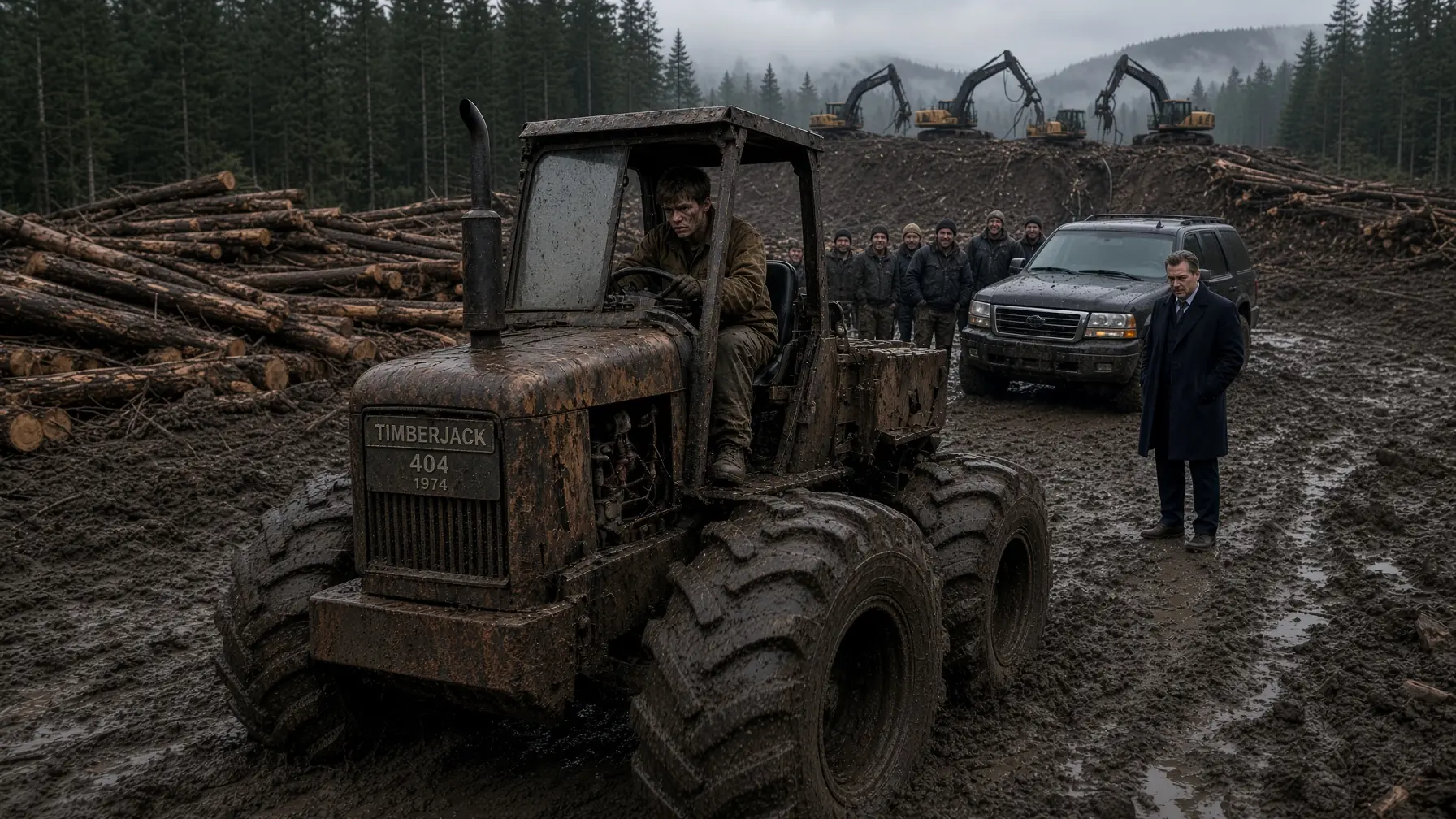
He paused beside the open door, buttoned an eight-hundred-dollar Italian wool coat, and studied the logging landing where rain had turned red Oregon soil into a mixture thick enough to steal a boot. Beyond him stood three loaders, two skidders, stacks of Douglas fir, and one nearly new Ironclad 8700 harvester that had become twenty-eight tons of useless steel twenty minutes earlier.
A broken cable hung from its grapple assembly.
Seventeen-year-old Declan Reed stood beside it with grease on both hands.
His father, Garrett, held the invoice.
“Two thousand four hundred dollars?” Garrett asked.
Preston smiled.
“Installed.”
Garrett looked at the broken assembly again.
“It’s steel cable.”
“It’s an Ironclad tension assembly.”
“It’s twelve feet of steel cable.”
“With certified hardware and machine authentication.”
Garrett turned the invoice over as though a reasonable number might be printed on the back.
“There’s a rigging supplier in Elk Junction that sells rated cable by the foot.”
“You can put whatever you want on the machine.”
Preston adjusted one cuff.
“It simply won’t run.”
Garrett looked up.
“What?”
“The control module verifies the authorized assembly before startup. No recognized part, no operation.”
“You shut the whole machine down over a cable?”
“It’s a safety feature.”
Declan looked at Preston for the first time.
Preston barely noticed him.
To Croft, the boy was simply Garrett Reed’s grease-stained son—the quiet kid who swept the landing, sharpened chains, changed filters, and occasionally climbed into a cab when somebody needed equipment repositioned.
Preston pointed toward the broken part.
“You gentlemen have a delivery quota Friday. I assume you’d like the replacement?”
Garrett’s face tightened.
Everyone at the landing knew the answer.
Garrett Reed had six employees, a timber contract that barely covered winter expenses, and a computerized harvester he had leased because the mills were demanding production his older equipment could no longer provide.
Every hour the machine remained dead cost money.
Every missed truck threatened the contract.
The decision was not really a decision.
Garrett removed his checkbook.
Declan watched him write $2,400.
Preston accepted the check with the expression of a man collecting something that had always belonged to him.
Then he returned to his SUV.
Declan watched the black vehicle disappear between the trees.
Only after the sound of the engine faded did he crouch beside the discarded cable.
“Leave it,” Garrett said.
Declan looked up.
“Why?”
“Junk.”
Declan picked it up anyway.
Garrett knew that look.
“What are you thinking?”
“Nothing yet.”
“That usually costs me money.”
Declan carried the broken assembly toward the truck.
“You just spent twenty-four hundred dollars.”
Garrett sighed.
“Fair point.”
In the winter of 1998, Bitterroot, Oregon, was the kind of place where machinery determined whether families ate well or worried.
Oak Hollow County sat beneath steep forested ridges where Douglas fir climbed so high the morning fog sometimes divided trunks in half. Logging roads wrapped around ravines that maps represented with innocent little contour lines. Men who worked those roads knew better.
One wrong wheel placement could roll eighty thousand pounds of equipment.
One overlooked crack could send a cable through a windshield.
One week of mechanical failure could erase the profit from an entire month.
Garrett Reed understood all of that.
He was forty-eight, widowed for eleven years, and built like someone who had spent more time lifting things than discussing feelings. His hands were permanently thickened by work. Two fingertips on his left hand were shorter than they had been when he was twenty. His right shoulder complained whenever temperatures dropped.
Declan was his only child.
The boy had inherited Garrett’s silence but not his relationship with machines.
Garrett operated them.
Declan wanted to understand why they worked.
At six, he dismantled a broken alarm clock and failed to reassemble it.
At nine, he repaired the electric motor in Garrett’s bench grinder.
At twelve, he began carrying machinery manuals home from the county library.
At fifteen, he could trace hydraulic circuits better than several adults on Garrett’s crew.
At seventeen, he kept three notebooks.
One for engines.
One for hydraulics.
And one labeled simply:
THINGS PEOPLE SAY CAN’T BE FIXED.
Garrett worried about him sometimes.
Not because the boy was troublesome.
Because he wasn’t troublesome enough.
Declan did not go to parties. Rarely dated. Barely cared about football. Most evenings he disappeared into the barn after supper and emerged several hours later smelling like diesel fuel.
His mother, Laura, would probably have known what to do with him.
Garrett mostly fed him and tried not to interrupt whatever was happening inside his head.
Ironclad Forestry entered Oak Hollow County at exactly the right time to become unavoidable.
Independent logging crews were being squeezed.
Mills wanted higher production.
Insurance costs were rising.
Environmental restrictions were changing harvest patterns.
Large forestry corporations could finance sophisticated harvesters, while small crews survived with equipment they had repaired so many times the original manufacturer would have struggled to identify it.
Then Ironclad offered a solution.
New computerized machines.
Low initial lease payments.
Dealer service.
Improved productivity.
Garrett resisted for almost a year.
Then a mill representative told him the next contract required mechanized output his old Timberjack and converted loader could not consistently provide.
So Garrett signed.
The Ironclad 8700 transformed his operation.
For six months, he loved it.
Then the expenses started.
A hydraulic-position sensor failed.
Nine hundred dollars.
A proprietary control switch failed.
Six hundred and eighty.
A pressure valve that Garrett’s crew could have rebuilt in an afternoon had to be replaced as a complete Ironclad assembly.
Fourteen hundred.
Then came the tension cable.
The first one lasted eight months.
The second failed after six.
Each time, the machine locked itself down.
Each time, Garrett called Preston.
Each time, Ironclad described the restriction as safety certification.
Garrett complained.
Preston smiled.
The contracts were already signed.
The morning after Garrett paid the latest $2,400 invoice, Declan carried the broken assembly into the barn.
He placed it beneath the yellow light above the workbench.
At first he expected something complicated.
Ironclad representatives had talked constantly about electronic authentication, certified component recognition, and integrated safety systems.
Declan imagined a coded sensor or embedded circuitry.
He examined the mounting collar.
There were no wires.
No visible electronics.
Only steel.
He cleaned the grease away.
Turned it over.
Measured it.
Then noticed a small recess inside the damaged mounting hardware.
Something metallic remained trapped beneath a cracked insert.
Declan used a pick to remove it.
A tiny magnet dropped onto the bench.
He stared.
Then placed it beside a loose screw.
The screw jumped toward it.
Declan said nothing.
He went inside and found the Ironclad service manual.
He read until after midnight.
The manual contained a vague diagram showing a “tension assembly presence sensor.”
Not strength.
Not cable condition.
Presence.
The next afternoon he visited the county library.
Bitterroot’s public library occupied an old brick post office beside the courthouse. The machinery section consisted of six shelves that almost nobody touched.
Mrs. Dowling, the librarian, had known Declan since elementary school.
“You skip school?”
“Study period.”
“It is eleven fifteen.”
“I’m studying.”
She looked at the engineering manuals in his arms.
Unfortunately, the boy had a point.
Declan spent four hours reading material on reed switches, magnetic proximity detection, cable fittings, and wire-rope inspection.
What he discovered bothered him.
The machine was not electronically measuring whether the Ironclad cable was stronger.
It was not monitoring internal cable condition.
It simply wanted confirmation that a particular magnetic element was positioned near the presence sensor.
That was different.
It meant the $2,400 assembly contained no secret intelligence.
The expensive part was ordinary industrial hardware arranged so the machine recognized it.
Declan did not immediately build anything.
That was the difference between curiosity and stupidity.
Cable failure around logging machinery could kill someone.
Instead he carried the damaged assembly to Harold Boone.
Harold ran Boone Rigging & Crane Supply twenty-eight miles south of Bitterroot. He was sixty-eight, missing half an ear from an accident forty years earlier, and had spent most of his life inspecting lifting equipment.
Garrett knew him.
Declan barely did.
Harold examined the Ironclad assembly.
“How much?”
“Twenty-four hundred.”
Harold looked at Declan.
“For this?”
“That’s installed.”
“Well, good. I was worried robbery had become expensive.”
Declan showed him the magnetic insert.
Harold’s expression changed.
“What are you planning?”