For twenty-seven years, nobody had a reason to walk into the western swamp on Caleb Foster’s farm.
Not Caleb.
Not his father before him.
Not the cattle.
Not even the alligators seemed particularly interested in it.
The Foster property sat outside a small farming community in south-central Florida, where pastureland slowly surrendered to cypress, sawgrass, black water, and mud.
Caleb raised cattle on the higher ground.
He grew hay when the weather cooperated.
And he spent most of his forty-six years learning which parts of his property could be improved and which parts were better left alone.
The western swamp belonged to the second category.
His father used to call it Dead Man’s Pocket.
Nobody knew why.
Maybe because farmers liked giving unpleasant places memorable names.
Maybe because an old hunting dog disappeared there in the 1980s.
Maybe because the mud could swallow a boot to the knee before a man realized the ground had changed beneath him.
Whatever the reason, Caleb stayed away.
Until the drought.
Florida’s dry season had been unusually severe that year.
By late April, ponds that normally held four feet of water had become cracked bowls of dark soil.
Ditches shrank.
Cypress roots appeared where Caleb had never seen them before.
Even Dead Man’s Pocket began pulling back.
That was how he noticed the metal.
At first, he thought it was an old water tank.
A curved patch of brown-red steel poked through the mud beneath several dead branches.
Caleb saw it while checking a fence line after one of his heifers wandered farther west than usual.
He stopped the ATV.
Looked again.
The exposed surface was maybe three feet long.
Rounded.
Covered with rust, algae, and years of dried vegetation.
He walked closer.
The cow behind him refused to follow.
That should have told him something.
Instead, Caleb crouched.
He scraped mud away with the edge of his boot.
More metal appeared.
Not corrugated.
Not farm equipment.
Smooth steel.
Curved like part of a cylinder.
Caleb frowned.
His father had buried plenty of junk over the years.
Old fencing.
Broken machinery.
A rusted refrigerator once, which Caleb spent an entire weekend digging out after inheriting the farm.
But this looked different.
He found a fallen branch and scraped harder.
Six inches beneath the mud, the branch struck something that made a hollow sound.
Caleb stopped.
He struck it again.
Metal.
Then he noticed a circular seam.
He cleared more mud.
A round plate slowly emerged.
A hatch.
Caleb took three steps backward.
“What in the world…”
The swamp gave no answer.
His first mistake was assuming it was some forgotten piece of agricultural equipment.
His second was mentioning it to his neighbor, seventy-year-old Dale Patterson.
Dale arrived twenty minutes later in a pickup with a shovel, rubber boots, and the enthusiasm of a man who had spent his retirement waiting for somebody else’s property to become interesting.
“You said hatch?”
“I said something that looks like one.”
“That’s a hatch.”
“You’ve been here thirty seconds.”
“I know a hatch.”
“From what?”
Dale ignored the question.
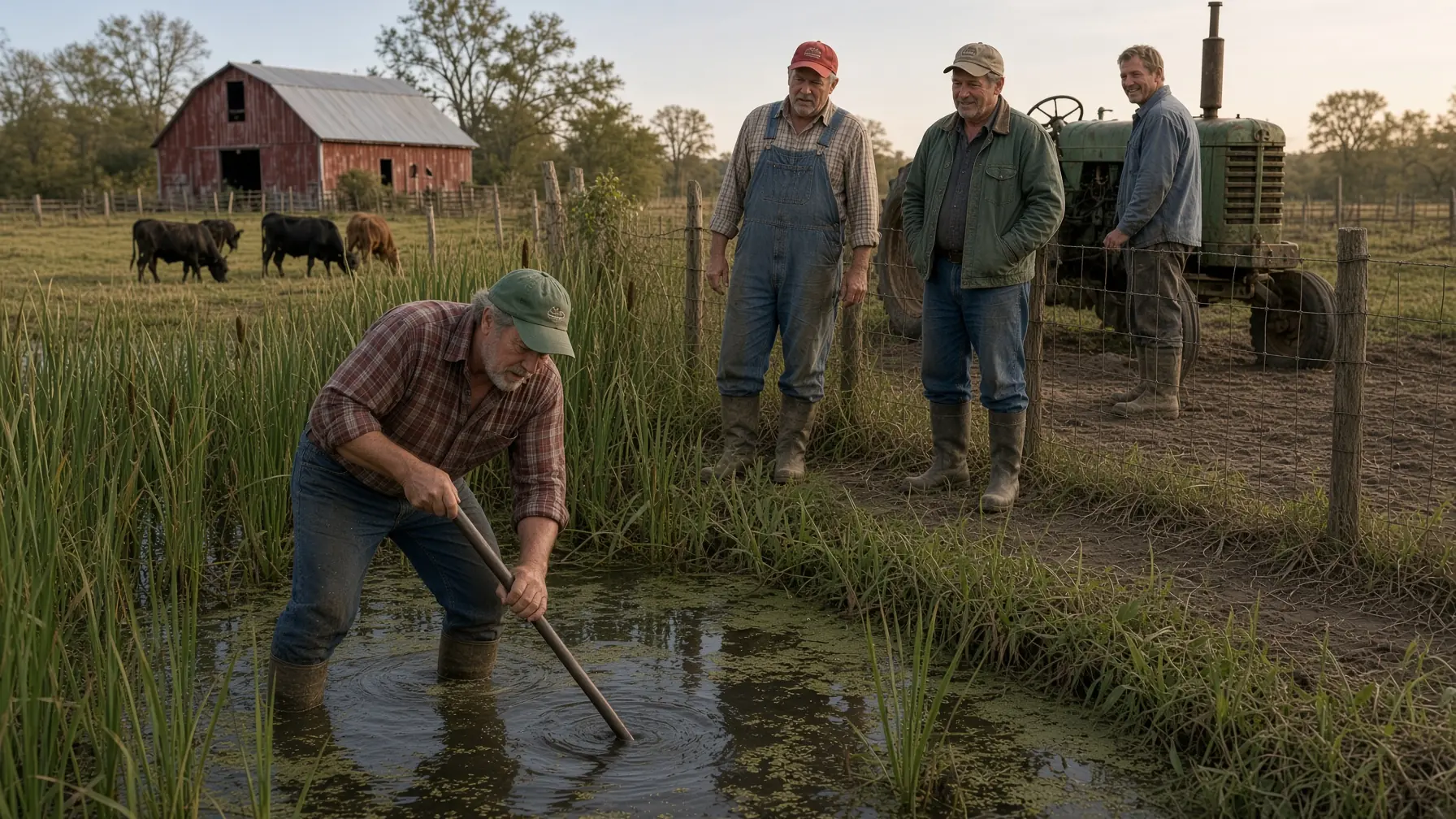
The two men spent nearly an hour clearing mud from the object.
By then, they could see that the curved metal continued beneath the swamp.
Farther than either expected.
Dale stood.
“That ain’t a tank.”
Caleb looked at him.
“What is it?”
Dale slowly walked along the exposed shape.
“Could be an old boat.”
“In the middle of my swamp?”
“Florida’s a strange place.”
“That is not an explanation.”
They uncovered another section.
A narrow metal frame.
Something resembling a sealed viewing port.
Dale stopped joking.
Caleb stared at it.
The shape in the mud was long.
Narrow.
Completely enclosed.
And unmistakably built to carry people.
Dale whispered:
“Caleb.”
“I know.”
“Is that…”
“Don’t say it.”
“A submarine?”
Caleb looked across his dry cattle pasture.
Then at the rusted cylinder buried in black swamp mud.
“You’re going to say it anyway, aren’t you?”
Dale nodded.
“That is a submarine.”
Caleb called the sheriff’s office.
He felt ridiculous explaining it.
The dispatcher asked him to repeat himself.
“A what?”
“A small submarine.”
“In your pond?”
“Swamp.”
“Sir, are you certain it isn’t a boat?”
“I am not certain of anything except that I am not opening it.”
That sentence changed the dispatcher’s tone.
Deputies arrived first.
Then Florida wildlife officers.
By midafternoon, yellow tape surrounded a section of land Caleb had ignored for most of his life.
One wildlife officer named Rebecca Sloan crouched near the exposed hull.
“Anybody touch the hatch?”
“No.”
“Try opening it?”
“No.”
“Good.”
Dale said:
“We scraped dirt.”
Rebecca looked toward him.
“With what?”
“Shovels.”
She sighed.
“Anything else?”
Caleb pointed at Dale.
“He named it.”
Rebecca looked confused.
Dale said proudly:
“The Swamp Sub.”
She stared at him.
“We’re going to call it unidentified submerged equipment for now.”
Dale whispered to Caleb:
“Swamp Sub’s better.”
Rebecca heard him.
“Much better.”
The first serious concern appeared before sunset.
A technician examining the hull found several welded modifications that did not resemble anything commercially manufactured.
No registration markings were visible.
No identifying numbers appeared on the exposed surfaces.
And the vessel seemed too narrow and crude to have been built for recreation.
A section on one side was crushed inward.
Whatever brought it into the swamp had not been gentle.
By evening, the sheriff ordered the area secured overnight.
Caleb stood beside his fence as vehicles left.
Rebecca remained behind long enough to speak with him.
“How long have you owned the land?”
“Five years personally. Family’s had it since 1978.”
“Your father ever mention anything unusual out here?”
“No.”
“Strangers?”
“Plenty over forty years.”
“Specifically near the swamp.”
Caleb thought.
“Not to me.”
Rebecca looked toward the buried vessel.
“How deep is the water normally?”
“Depends on season. Three feet, maybe five in spots.”
“Enough to float that?”
“Maybe during hurricane season.”
She nodded.
“We’ll have a recovery team tomorrow.”
Caleb hesitated.
“What do you think it is?”
Rebecca looked at him.
“I think it’s something someone didn’t want found.”
That was not the answer Caleb wanted before trying to sleep in a house less than half a mile away.
He did not sleep much.
At 2:17 in the morning, his motion light came on.
Caleb sat up.
His dog, Hank, began growling near the bedroom door.
Caleb walked to the window.
A vehicle was parked along the county road.
No headlights.
Too far away to identify.
He watched for nearly a minute.
Then it moved.
Slowly.
Gone.
Caleb called the sheriff.
A deputy drove past.
Found nothing.
Maybe it was coincidence.
Maybe somebody had heard about the discovery.
In a small rural community, news traveled faster than official vehicles.
By sunrise, Caleb had already received twelve messages.
One claimed the object was a World War II Japanese submarine.
Another said it belonged to Cuban spies.
Dale sent:
TOLD YOU.
Caleb turned off his phone.
The recovery operation took most of the next day.
The vessel was smaller than anyone first believed.
About thirty feet long.
Low profile.
Crude construction.
No military markings.
No sophisticated equipment visible externally.
Mud had packed around nearly the entire hull.
Vegetation grew through cables attached near the rear.
Investigators pumped water from the surrounding depression and used heavy equipment to raise the vessel slowly.
When it finally broke free, black water poured from its sides.
Everyone watching became quiet.
The hull looked less like a submarine from a movie and more like something built secretly in a workshop by people who valued concealment more than comfort.
One side had a long crushed section.
The propeller assembly was badly damaged.
The sealed hatch remained closed.
Rebecca stood beside Caleb.
“You ever see this before?”
“No.”
“Your dad?”
“Not that I know.”
She nodded.
“Go back toward the house.”
“Why?”
“Until we know what’s inside, this is no longer just an interesting piece of junk.”
Caleb looked at the sealed hatch.
Something about the metal suddenly felt different.
Not mysterious.
Wrong.
State investigators arrived by afternoon.
Then federal agents.
That was when Caleb stopped asking whether this might be some forgotten experimental craft.
Nobody sent that many agencies to examine abandoned farm equipment.
One investigator named Marcus Vale introduced himself.
“Mr. Foster, we’re going to need a complete history of this property.”
“You think I put that there?”
“I think it’s on your property.”
“Not the same thing.”
“No.”
Marcus gave the faintest smile.
“It isn’t.”
They interviewed Caleb for nearly two hours.
Previous owners.
Farm employees.
Hunting leases.
Trespassers.
Old roads.
Storm damage.
His father’s records.
Anything unusual around the western acreage.
One question caught him.
“Did your father ever complain about people using the old canal?”
Caleb looked up.
“What canal?”
Marcus pointed toward an aerial map.
A narrow water route ran behind Dead Man’s Pocket toward a larger drainage system.
Caleb had always considered it a seasonal ditch.
Decades earlier, it had apparently been deeper.
Wide enough during high water for a small vessel to move through.
Caleb stared at the map.
“So somebody could have brought that thing here from outside?”
“In theory.”
“When?”
“That’s what we’re trying to determine.”
The hatch was opened late that afternoon.
Caleb did not see it happen.
Authorities had moved everyone farther back.
But he saw their faces afterward.
The first technician climbed down from the recovery platform.
He removed his gloves.
Spoke quietly to Marcus.
Marcus stopped writing.
Another investigator approached.
Then the medical examiner was called.
Caleb knew before anyone told him.
There were people inside.
He stood beside his barn nearly an hour later when Rebecca walked over.
Her expression had changed completely.
“You okay?”
“That depends on what you’re about to tell me.”
She looked toward the secured recovery area.
“There are human remains inside.”
Caleb said nothing.
“Two individuals.”
“How long?”
“We don’t know yet.”
“What happened?”
“Too early.”
Caleb looked toward the swamp.
For years he had let cattle graze within a quarter mile of two dead men trapped inside steel.
That thought made his stomach turn.
Rebecca continued.
“There’s something else.”
He waited.
“Packages.”
“What kind?”
“Sealed.”
Caleb understood from her face.
“Drugs?”
“We haven’t completed testing.”
“But that’s what you think.”
“Yes.”
He looked away.
Suddenly every ridiculous rumor from that morning seemed almost preferable.
World War II submarine.
Secret experiment.
Anything except the ordinary ugliness of people moving poison for money.
Within forty-eight hours, investigators had a working theory.
The vessel was not a military submarine.
It was a homemade semi-submersible built for smuggling.
The design was crude.
Barely enough room for a small crew and cargo.
It had probably entered Florida through a connected water route during unusually high seasonal flooding years earlier.
Something went wrong before it could leave.
The damaged side of the hull suggested a collision with submerged debris or a hard bank.
The propulsion system failed.
The vessel drifted into the swamp.
Then sank into mud.
The sealed compartment that helped hide it also became a trap.
The two men inside never escaped.
Caleb listened.
“How long ago?”
Marcus answered.
“Possibly eighteen to twenty years.”
Caleb stared.
“My father was alive.”
“Yes.”
“He never found it.”
“Water levels were higher then.”
Marcus showed him an old satellite image.
The area where the submarine was recovered had once been completely underwater beneath thick vegetation.
“Your drought exposed it.”
“So if it rained normally this year…”
“We probably wouldn’t be standing here.”
The packages tested positive for cocaine and other controlled substances.
Enough to make the discovery part of a much larger investigation.
The dead men were harder to identify.
No useful documents survived.
Fingerprints were unavailable.
Dental records eventually provided one lead.
One man had been reported missing in Mexico nearly two decades earlier.
The second remained unidentified for months.
Agents found evidence connecting the vessel to a trafficking organization active along Gulf routes during that period.
But not every mystery was solved.
No dramatic cartel kingpin was arrested because of the discovery.
No secret map appeared.
No suitcase full of cash.
The submarine had been a failed machine from an old criminal operation.
Its crew died.
The organization moved on.
The swamp kept the evidence.
What bothered Caleb most was a different question.
Why his farm?
Not Florida.
Not the Everglades.
His land.
One evening he found an old ledger among his father’s papers.
Most entries concerned cattle.
Fuel.
Feed.
Fence repairs.
Then he noticed something from nineteen years earlier.
August 17 — found gate open west side again. Tire tracks.
Two days later:
Strange engine noise near marsh after midnight. Checked morning. Nothing.
Then:
August 26 — water high. Hank Sr. won’t go west.
Caleb read the entries repeatedly.
His father had noticed.
He simply had not understood what he was noticing.
Another entry appeared in September.
Blue truck near canal. Two men said they were fishing. Told them private land.
Caleb photographed the pages and called Marcus.
Investigators collected the ledger the following day.
It did not solve the case.
But it helped narrow the timeline.
The vessel likely entered the swamp during that August.
Caleb realized his father might have stood within several hundred yards of it while the men inside were still alive.
That thought stayed with him.
“What if Dad could have helped them?”
Rebecca, who had become a regular presence during the investigation, looked at him.
“Helped armed smugglers inside a sealed vessel he couldn’t see?”
“He heard something.”
“He heard an engine.”
“He saw tracks.”
“He thought fishermen were trespassing.”
“Because that was the reasonable explanation.”
Caleb looked toward the swamp.
Rebecca continued.
“Your father wasn’t supposed to solve something he had no way to understand.”
Caleb knew she was right.
Still, the ledger made the past feel close enough to touch.
The story brought reporters.
Caleb hated that.
For three weeks, trucks parked along the road.
Headlines described:
SUBMARINE FOUND ON FLORIDA FARM
Some called it an Everglades mystery even though Caleb’s land sat outside the protected heart of the Everglades.
One television reporter asked him whether he believed “cartel treasure” remained buried elsewhere on the farm.
Caleb stared at her.
“No.”
“How can you be certain?”
“I’m not.”
She brightened.
Caleb continued:
“I’m also not certain there isn’t a Roman chariot under my barn. That doesn’t mean we should put it in your headline.”
The interview ended shortly afterward.
Dale Patterson became far more popular with journalists.
He enjoyed every second.
“I told him it was a submarine.”
Caleb heard him say on television.
“He didn’t believe me.”
Caleb threw a pillow at the screen.
Eventually the investigators left.
The swamp became quiet again.
Authorities removed contaminated debris from the recovery site.
The depression gradually filled after summer rain returned.
Grass grew near the old recovery track.
Cattle wandered closer.
Life resumed with the irritating ease it always showed after something extraordinary.
But Caleb could not stop thinking about the metal hull.
A machine designed to hide.
Men who believed water and darkness could erase what they were doing.
A swamp that had preserved the truth longer than anyone expected.
One morning, he walked back to Dead Man’s Pocket.
The water had returned.
Only a few inches.
Enough to reflect the sky.
He carried his father’s copied ledger pages.
At the edge of the swamp, he found the line:
Strange engine noise near marsh after midnight. Checked morning. Nothing.
Nothing.
That was what his father saw.
Nothing.
Because the important thing had already disappeared beneath the surface.
Caleb smiled faintly.
Farmers spent their lives learning that the visible part of land was rarely the whole story.
Roots lived beneath soil.
Water moved below limestone.
Old fence lines disappeared.
Flood channels changed.
People buried machinery.
Storms uncovered things everyone assumed were gone.
And sometimes a drought lowered a swamp enough to reveal thirty feet of rusted steel that had been holding two dead men and a forgotten crime beneath a farmer’s cattle pasture for nearly twenty years.
Months later, authorities released the vessel back to federal custody for evidence storage and eventual disposal.
Caleb did not ask to keep any part of it.
Dale thought he should.
“Imagine putting the hatch over your barn.”
“No.”
“Conversation piece.”
“No.”
“Mailbox?”
“Absolutely not.”
Dale sighed.
“You have no appreciation for history.”
“I have enough history.”
Caleb looked toward the western pasture.
His father’s fence posts still leaned there.
The spring rains had returned.
Dead Man’s Pocket was becoming a swamp again.
Soon the exact place where the submarine had rested would disappear under dark water.
Caleb found that appropriate.
Not every discovery needed a monument.
Some only needed to be uncovered long enough for the truth to be recorded.
Before the water rose completely, Caleb placed one new fence post beside the recovery site.
No plaque.
No dramatic sign.
Just a small carved date.
The day he found the metal.
Years later, people still occasionally asked:
“How did you know something was there?”
Caleb always gave the same answer.
“I didn’t.”
“You saw the submarine.”
“I saw three feet of rust.”
“So what made you investigate?”
Caleb would think of the cow refusing to follow him.
The curved metal beneath the mud.
The hollow sound of a branch striking steel.
His father’s old ledger.
Then he would shrug.
“It didn’t belong.”
That was all.
Something in a familiar place did not belong.
And instead of walking past it, he stopped.
The drought had exposed the metal.
But curiosity had opened the story.
For nearly twenty years, two men, their illegal cargo, and the machine that failed them had remained sealed beneath the Florida mud while cattle grazed nearby and one farming family lived its ordinary life without ever knowing what rested below.
No curse.
No buried fortune.
No supernatural secret.
Just a strange object in a swamp, a crime forgotten by almost everyone involved, and a farmer who happened to look down at exactly the right moment.
Sometimes that was all mystery required.
Not someone searching for treasure.
Just someone noticing that the ground was trying to show them something.