The first thing Maya Thompson lost was her seat.
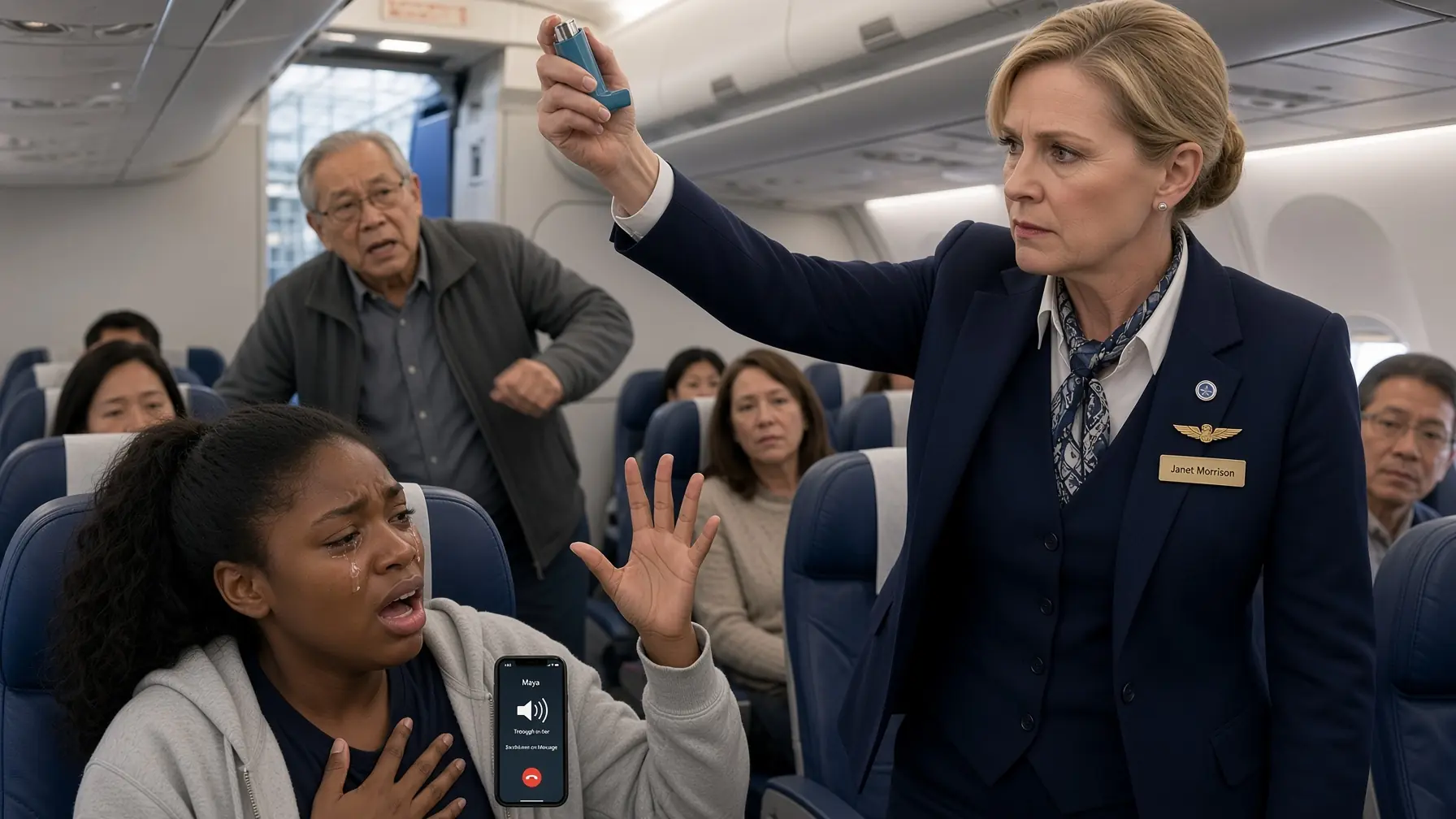
The second was her inhaler.
By the time the third thing began slipping away—her ability to breathe—the senior flight attendant responsible for both mistakes was still convinced she was protecting the airplane.
Skyline Airways Flight 447 sat at Gate 31 at John F. Kennedy International Airport on a humid Tuesday morning, ten minutes from scheduled departure to Los Angeles. Boarding was nearly complete. Overhead bins slammed shut. Passengers searched for charging cables, folded jackets beneath seats, and sent final messages before airplane mode.
Seventeen-year-old Maya Thompson had already had a terrible week.
Her grandmother had died four days earlier.
Her father had wanted to travel with her, but a weather disruption had stranded him overnight in Denver after a company flight assignment. Maya’s aunt was waiting for her in Los Angeles, and after several discussions, her father had agreed that she could make the nonstop trip alone.
Maya had flown alone before.
She knew airports.
She knew how to find a gate, read a boarding pass, and ask for help.
More importantly, she knew her asthma.
It had been severe since childhood.
Most days, nobody would know she had it. She ran track, traveled, stayed up too late studying calculus, and rolled her eyes whenever her father reminded her to keep a rescue inhaler within reach.
But when an attack came, it could become serious quickly.
That was why the blue inhaler was never in checked luggage.
Never in an overhead compartment.
Never buried beneath clothes.
It stayed in the small zippered pocket of her crossbody bag.
Her father had taught her that before he taught her how to drive.
Maya’s boarding pass said:
SKYLINE 447
JFK — LAX
SEAT 2A
She had a paid First Class ticket.
Her father had purchased it himself because the family had been moving between funeral arrangements, work schedules, and last-minute travel changes, and he wanted his daughter somewhere comfortable for six hours.
Maya boarded wearing black jeans, white sneakers, a gray sweatshirt, and a faded canvas backpack covered in two small college pins.
One said MIT 2027.
The other was a tiny airplane.
Senior flight attendant Janet Morrison saw neither.
Janet saw a Black teenager walking into First Class.
“Coach is behind you,” she said.
Maya stopped.
“Sorry?”
“Your seat will be farther back.”
Maya looked at her boarding pass.
“I’m 2A.”
Janet gave the kind of smile adults sometimes used when they were correcting children.
“Let me see.”
Maya handed over the pass.
Janet looked at it.
Her smile disappeared for perhaps half a second.
Then returned.
“Interesting.”
Maya waited.
Janet checked the electronic manifest.
Seat 2A.
Maya Thompson.
Confirmed.
There was nothing to dispute.
Still, Janet looked at Maya again.
“Are you traveling on employee standby?”
“No.”
“Upgrade?”
“I don’t think so.”
“You don’t know?”
“My dad bought the ticket.”
Janet handed the boarding pass back.
“All right.”
Not welcome aboard.
Not sorry.
Just:
“All right.”
Maya sat in 2A.
She noticed.
Then decided not to care.
She had more important things on her mind.
Her grandmother’s funeral was the following morning.
Maya had written half of what she planned to say.
The document remained open on her phone:
Grandma Ruth never entered a room quietly…
She could not get beyond that sentence.
Several minutes later, Janet returned.
“Miss?”
Maya looked up.
“Yes?”
“We need to move you.”
Maya frowned.
“Why?”
“Operational seating.”
“To where?”
“23F.”
Maya looked toward the First Class cabin.
Nearly every seat was occupied.
“Is there something wrong with this seat?”
“No.”
“Then why am I moving?”
Janet’s expression tightened.
“I said operational seating.”
Maya had been raised by a father who believed asking one clear question was not disrespect.
“My boarding pass says 2A.”
“I can see that.”
“So is the seat broken?”
“No.”
“Then what’s the operational reason?”
Janet leaned slightly closer.
“Miss Thompson, I have thirty years of boarding experience in this cabin between myself and the rest of this crew. I’m asking you not to make this difficult.”
Janet had actually worked for Skyline for twelve years.
But Maya did not know that.
Neither did it matter.
A man in 2D looked up from his laptop.
A younger flight attendant named Elise Warren paused near the galley.
Maya felt the familiar pressure of being seventeen in a disagreement with an adult.
No matter how calm she was, she could already feel the possibility that asking one more question would be turned into attitude.
“Am I required to move?”
Janet answered:
“Yes.”
That was not true.
But Maya did not know it yet.
So she stood.
She removed her backpack.
Walked through First Class.
Past Premium Economy.
Into the main cabin.
Seat 23F was a window seat.
A woman occupied 23E.
Maya sat down without argument.
Five minutes later, an older white man entered the aircraft, spoke briefly with Janet, and was seated in 2A.
Elise saw it.
So did the man in 2D.
Maya did not.
She was already staring through the window trying not to cry.
Losing the seat was embarrassing.
But still manageable.
Then her chest tightened.
At first, Maya thought it was anxiety.
That happened sometimes.
Stress mimicked the beginning of an asthma episode so closely that she had learned not to panic at the first sensation.
She inhaled slowly.
Exhaled.
Tried again.
The tightness remained.
Then came the faint whistle.
Maya reached into her crossbody bag.
The woman beside her glanced over.
“You okay?”
“I have asthma.”
Maya removed the inhaler.
It was a standard metered-dose rescue inhaler inside a blue plastic actuator.
The woman nodded.
“Do what you need.”
Maya shook it.
Removed the cap.
That was when Janet passed through the aisle.
She stopped.
“What is that?”
Maya looked up.
“My inhaler.”
“Let me see it.”
Maya hesitated.
“It’s prescribed.”
“I said let me see it.”
The words were loud enough that nearby passengers looked over.
Maya held the inhaler where Janet could see it.
Janet reached out.
Maya instinctively pulled it slightly back.
“I need it.”
Janet’s expression changed immediately.
“Give it to me.”
“Why?”
“There have been problems with vaping devices and controlled substances being disguised in containers.”
“This is albuterol.”
“Give it to me.”
Maya stared at her.
“My name is on the prescription label in my bag.”
“Then show me.”
Maya began opening the bag.
Her breathing was already getting worse.
Janet reached down and took the inhaler from her hand.
Maya froze.
“Please give that back.”
Janet examined it.
The pharmacy sticker normally stayed on the cardboard box, not on the plastic actuator itself. Maya had discarded the box after the prescription was refilled.
There was no printed name on the inhaler.
Janet looked satisfied.
“No label.”
“My prescription is on my phone.”
“Of course it is.”
The woman in 23E frowned.
“What does that mean?”
Janet ignored her.
Maya raised her wrist.
A stainless-steel medical identification bracelet rested against her skin.
SEVERE ASTHMA — ALBUTEROL RESCUE INHALER — ICE CONTACT
Janet glanced at it.
“That doesn’t prove what’s inside this device.”
Maya stared.
“It’s an inhaler.”
Janet held it up.
“Ma’am, that’s not how medication verification works.”
A passenger across the aisle began recording.
Maya’s breathing shortened.
“Please.”
Janet looked at her.
“I need it.”
“Then you should have proper documentation.”
“I do.”
“You just told me the label isn’t on it.”
“My pharmacy account—”
Janet shook her head.
“Young lady, I’ve seen passengers try every story imaginable.”
Maya’s eyes filled.
“This isn’t a story.”
Janet lowered her voice, but not enough.
“For all I know, there could be THC or something else inside here.”
The woman beside Maya stared at her.
“Seriously?”
Janet looked toward her.
“Please stay out of this.”
Maya whispered:
“I can’t breathe.”
Janet heard the words.
She interpreted them as manipulation.
That would later become the most serious fact in the entire investigation.
Not that she initially questioned an unfamiliar device.
Crew members were allowed to ask questions when they genuinely believed an item might create a safety concern.
The problem was what she did after the answers began arriving.
Maya showed the medical bracelet.
Maya offered the pharmacy record.
Maya identified the medication.
Maya displayed visible respiratory distress.
And instead of checking, Janet became more certain.
She held the inhaler in one hand.
“Either we verify this with ground personnel or it stays with me until Los Angeles.”
Maya stared at her.
“Six hours?”
“Those are the options.”
“No.”
Janet’s expression hardened.
“What did you say?”
“I said no.”
Maya pressed one hand against her chest.
“I need my medicine.”
Now several phones were recording.
The cabin had become quieter.
Janet noticed the attention.
Instead of causing her to slow down, it made her more determined to demonstrate control.
She looked at Maya’s sweatshirt.
Her inexpensive backpack.
Then toward First Class.
Recognition crossed her face.
“You’re the passenger who was sitting up front.”
Maya nodded weakly.
Janet folded her arms.
“Right.”
“What does that have to do with anything?”
“Nothing.”
But the tone said otherwise.
The woman beside Maya said:
“She has asthma. Give her the inhaler.”
Janet turned.
“Ma’am, interfering with a crew member is not helpful.”
“I’m not interfering.”
“You are.”
Maya reached toward Janet.
Not to grab her.
Toward the inhaler.
Janet stepped back.
“Do not reach for me.”
Maya immediately lowered her hand.
Her eyes widened.
“I wasn’t.”
“I saw you.”
“I was reaching for my medicine.”
“And I told you not to.”
The cabin door was still open.
Flight 447 had not moved an inch.
There were gate agents thirty feet away.
Airport paramedics could be called.
A medical professional could examine Maya.
Her pharmacy could be contacted.
Her father could be called.
The inhaler could be visually inspected.
There were perhaps half a dozen ways to slow the situation down.
Janet chose none.
Instead, she carried the inhaler toward the forward galley.
Maya called after her.
“Please!”
Janet did not turn.
Elise Warren met Janet halfway forward.
“What happened?”
“Possible prohibited device.”
Elise looked at the inhaler.
“That’s albuterol.”
“You don’t know that.”
“It looks exactly like mine.”
Janet stopped.