The first slap stopped every conversation in the first-class cabin.
The second one stopped the airplane.
Ten-year-old Elijah Bennett stood beside seat 2A with one hand pressed against his burning cheek. A torn authorization letter lay in two pieces near his shoes, and his small red backpack remained tucked beneath the window seat he had been told did not belong to him.
Around him, passengers stared in disbelief.
Phones began rising above armrests.
A silver-haired woman in the first row covered her mouth with one hand while continuing to record with the other.
Elijah did not shout.
He did not strike back.
He did not even move away from the flight attendant standing over him.
He simply looked at her.
The woman’s name was Denise Harper.
She was the senior cabin attendant aboard Meridian Air Flight 406, scheduled to travel from Dallas to Los Angeles that morning. Her dark-blue uniform remained perfectly pressed, and a silver name badge shone above her left pocket.
Her breathing was no longer controlled.
“You do not challenge a member of the flight crew,” she said.
Elijah’s cheek had already begun turning red.
“I asked for water.”
“You refused to follow instructions.”
“You told me to leave the seat on my ticket.”
“I told you this cabin was not appropriate for an unaccompanied child.”
The businessman seated across the aisle leaned forward.
“He showed you a boarding pass.”
Denise turned toward him.
“Sir, remain seated.”
“You tore up the document his mother gave him.”
“I am handling a security issue.”
“You struck a child.”
The statement moved through the cabin.
A child.
Not an unruly passenger.
Not a threat.
Not a problem requiring control.
A ten-year-old boy standing alone while an adult in uniform attempted to explain why hitting him had been necessary.
Elijah lowered his hand from his face.
His eyes were wet, but the tears had not fallen.
He looked toward the watch on his left wrist.
The device appeared simple—black screen, narrow metal frame, dark rubber strap. It resembled the type of fitness watch worn by thousands of travelers.
Elijah touched the screen three times.
Then he held two fingers against it for two seconds.
A small green light flashed beneath the glass.
No one else noticed.
In the cockpit, a red message appeared on the communications display.
PRIORITY CHILD SAFETY ALERT
HOLD POSITION
The aircraft had just begun moving away from the gate.
The captain stopped it immediately.
The low vibration beneath the floor changed as the engines returned to idle.
Passengers glanced toward the windows.
Denise looked toward the front galley.
“What happened?”
The cabin speaker chimed.
“Ladies and gentlemen, this is Captain Reynolds. We have received an operational security instruction and will remain at the gate. Please stay seated with your seat belts fastened.”
A murmur spread through the aircraft.
Elijah climbed back into seat 2A.
He placed his hands in his lap.
Denise stared at the watch.
“What did you do?”
Elijah looked out the window.
“I asked someone to call my mother.”
One hour earlier, he had entered Dallas Fort Worth International Airport believing the most difficult part of the morning would be saying goodbye.
Elijah had flown before, but never alone on a commercial flight.
His mother, Camille Bennett, walked beside him through a private security entrance with one hand resting lightly on his shoulder.
Camille was known publicly as the founder of the Bennett Global Initiative, a charitable organization funding hospitals, clean-water systems, and education programs across several continents. Business publications also described her as one of the most influential technology investors in the United States.
Elijah knew her simply as Mom.
She checked his backpack three times before they reached the departure lounge.
“Snacks?”
“Side pocket.”
“Phone charger?”
“Inside pocket.”
“Medication?”
“Blue pouch.”
“Authorization letter?”
Elijah tapped his back pocket.
Camille nodded.
“And the watch?”
He lifted his wrist.
“I know.”
“What is the emergency code?”
“Three taps, two-second hold.”
“And when do you use it?”
“When I’m in danger and I can’t call.”
“Not because the flight is delayed.”
“I know.”
“Not because someone gives you the wrong snack.”
“I know.”
She smiled.
Elijah was traveling to Los Angeles to spend a week with his father. The family had arranged an airline escort, priority monitoring, and an authorization file noting that he was an unaccompanied minor requiring special handling.
Camille had also asked one of her legal advisers, Nathan Cole, to travel on the same flight without announcing his connection to Elijah.
Nathan would sit several rows behind him.
He would observe.
He would not interfere unless Elijah signaled that something was wrong.
Camille disliked hiding security from her son, but she disliked frightening him more.
“You’ll be safe,” she told him.
“I’m not scared.”
“It’s all right if you are.”
“I’m only a little nervous.”
“That means you’re paying attention.”
She kissed his forehead.
“Seat 2A. Enjoy the window.”
Elijah watched her leave.
Then he joined the boarding line.
Most of the passengers in the priority group were adults carrying leather briefcases, designer luggage, or expensive headphones. Elijah wore a gray sweater, tan trousers, and clean sneakers. His red backpack made him look younger than ten.
The gate agent looked down when he approached.
“Are you with someone, sweetheart?”
“I’m flying alone.”
“Where is your guardian?”
“My mother checked me in through special services.”
He handed her the boarding pass.
The scanner showed a green confirmation.
Seat 2A.
Priority passenger.
Special-handling notation.
The agent hesitated before forcing a smile.
“All right. Go straight down the jet bridge.”
Elijah thanked her.
A tall man with gray at his temples watched from several places behind him.
Nathan Cole carried a navy coat over one arm and a legal briefcase in the other. He had served as counsel to the Bennett family for nine years.
He noticed the gate agent’s hesitation.
He also noticed that she did not call a cabin attendant to receive the unaccompanied child, as airline procedure required.
Nathan recorded the time in a small notebook.
He did not intervene.
Not yet.
The first crew member aboard greeted Elijah warmly.
“Good morning.”
“Good morning.”
“Seat number?”
“Two A.”
“Right here by the window.”
Elijah placed his backpack beneath the seat and sat down.
The first-class cabin smelled of leather, coffee, and lavender cleaning solution. Outside the window, baggage carts moved beneath the wing while ground workers guided containers toward the aircraft.
Elijah liked watching systems work.
People in reflective vests moved with clear responsibilities. Vehicles followed painted lines. Bags traveled from one conveyor to another.
Everything had an order.
He found that comforting.
Nathan boarded several minutes later and took seat 3A, diagonally behind Elijah.
He opened a newspaper.
From that position, he could hear without appearing to listen.
More passengers entered.
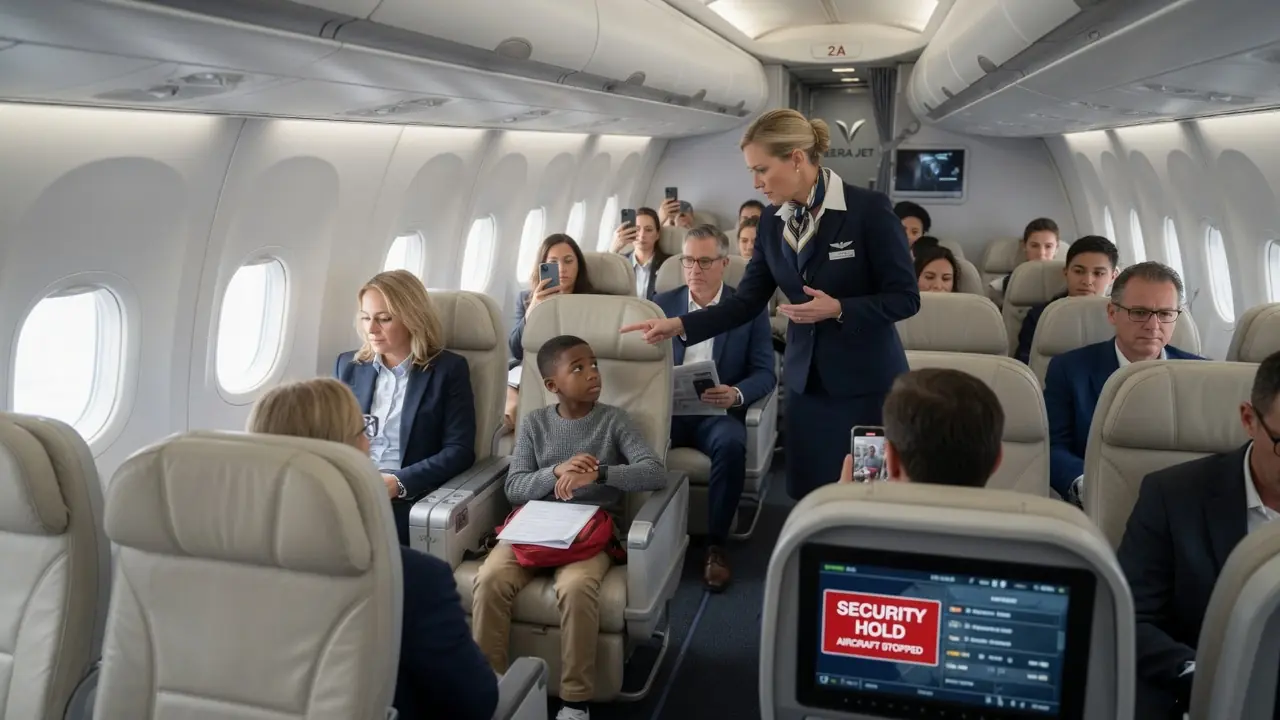
A married couple settled across the aisle. An elderly professor took seat 2F. A silver-haired woman carrying a leather handbag sat in the first row.
Elijah remained quiet.
He declined juice politely.
He fastened his seat belt without assistance.
He folded his sweater across his lap after becoming warm.
Then Denise Harper entered the cabin.
She was reviewing a clipboard when she saw him.
Her footsteps slowed.
She looked at seat 2A.
Then at Elijah.
Then back at the seat number.
The expression that crossed her face was subtle but unmistakable.
Suspicion.
She did not greet him.
Instead, she walked into the forward galley and spoke quietly with another attendant.
A few minutes later, she returned.
“Are you sure you’re supposed to be here?”
Elijah looked up.
“Yes, ma’am.”
“This is first class.”
“I know.”
“Where are your parents?”
“My mother took me to the special-services lounge.”
Denise held out one hand.
“Boarding pass.”
Elijah gave it to her.
She read the seat number.
Her expression did not soften.
“Sometimes the system assigns seats incorrectly.”
“The scanner turned green.”
“I’ll verify it.”
She walked away with the pass.
Elijah watched her disappear behind the curtain.
Across the aisle, the woman in 2C looked toward him.
“Are you all right?”
“Yes, ma’am.”
Denise returned several minutes later.
“The manifest does not identify you as an unaccompanied minor.”
“My mother gave me a letter.”
“What mother allows a ten-year-old to travel alone without informing the airline?”
“She did inform them.”
“Show me the letter.”
Elijah opened the red backpack and removed the folded page from its side pocket.
It bore Bennett Global Initiative letterhead, an embossed seal, contact numbers, the signature of the family’s security director, and confirmation from Meridian Air’s special-services office.
Denise glanced at it for less than three seconds.
“Anyone can print something like this.”
“It has phone numbers.”
“I don’t need you to explain paperwork to me.”
She folded it carelessly.
Elijah reached toward it.
“Please don’t bend it.”
The word please should have lowered the tension.
Instead, Denise heard correction.
“I said I am handling this.”
She tore the page in half.
The sound drew several passengers’ attention.
Elijah stared at the pieces.
Denise placed them on his tray table.
“You’ll be moved to the rear cabin after boarding is complete.”
“But this is my seat.”
“Stand up.”
“My ticket says—”
“I am not asking again.”
Elijah slowly released his seat belt.
He stood in the aisle while Denise took the torn letter.
His face became warm as more people looked toward him.
The businessman in 2C removed an earbud.
“He was already seated.”
Denise turned.
“This does not concern you.”
“You destroyed his documents.”
“They could not be verified.”
“Then verify them.”
“I am following procedure.”
Nathan lowered his newspaper.
He watched Elijah’s hands close around the pieces of the authorization letter.
The boy did not argue.
That worried him more than anger would have.
A junior flight attendant named Lauren Park entered from the galley.
She was twenty-seven and had worked for Meridian Air for eight months.
Denise gave her the passenger manifest.
“Find him another seat after departure.”
Lauren looked at the page.
“His name is listed here.”
Denise’s eyes narrowed.
“Not as a normal unaccompanied minor.”
Lauren pointed toward the notation beside Elijah’s name.
“Priority Alpha. Special Services.”
“I already checked it.”
“Shouldn’t we call operations?”
Denise moved closer.
“Do you want to challenge me in front of passengers?”
“No.”
“Then prepare the cabin.”
Lauren looked at Elijah.
The boy stood beside seat 2A, staring at the floor while trying to hold the torn letter together.
She wanted to intervene.
Instead, she walked away.
The decision would remain with her long after the flight ended.
Denise told Elijah to remain standing until she found a “more suitable” seat.
He stood through the final boarding announcement.
Passengers whispered.
Several had begun recording.
The silver-haired woman in the first row lifted her phone openly.
“You haven’t even asked his name,” she said.
Denise ignored her.
The aircraft door closed.
The jet bridge moved away.
Elijah sat on the floor beside seat 2A because his legs had begun to hurt.
Denise returned.
“You cannot sit there.”
“I don’t have another seat.”
“Get up.”
“I want someone to call my mom.”
“You are not making demands.”
“I’m asking.”
“You have delayed this flight enough.”
Elijah looked toward the red backpack.
His mother’s words returned to him.
If you are frightened, do not panic. Signal.
He touched his watch for the first time.
Three short taps.
A two-second hold.
The device sent an encrypted message containing his name, location, flight number, heart rate, and cabin position.
The alert reached the Bennett Global security center.
It also notified Nathan Cole’s secure phone.
Nathan felt one vibration inside his coat.
He folded the newspaper and placed it aside.
The flight had begun taxiing when the cockpit received the hold order.
The airplane stopped.
Denise returned to Elijah.
“What did you activate?”
“I want to call my mother.”
“You’re creating a security problem.”
“I’m sitting beside my seat.”
“You are refusing crew instructions.”
“I showed you my ticket.”
The elderly professor in 2F stood carefully.
“Give the child some water.”
Denise faced him.
“Sir, sit down.”
“He has been standing for fifteen minutes.”
“He is disrupting cabin procedure.”
“He is ten years old.”
“Sit down, or you may be removed.”
Lauren approached and gently guided the professor back into his seat.
Her eyes met Elijah’s.
“I’m sorry,” she whispered.
Denise heard her.
“We will discuss your conduct after the flight.”
Lauren’s face went pale.
Elijah raised one hand.
“May I please have water?”
Denise looked down at him.
Her voice became cold.
“Passengers who refuse instructions do not receive special treatment.”
“I’m thirsty.”
“Return to your assigned place.”
“Seat 2A is my assigned place.”
“You think you’re smarter than the crew?”
“No.”
“You think the rules don’t apply to you?”
“No.”
“My mom would be disappointed if she saw how you were treating me.”
The sentence was quiet.
It contained no threat.
But Denise heard the authority of someone beyond the aircraft.
Her restraint broke.
She struck Elijah across the face.
The first slap forced his head to the side.
The cabin gasped.
The silver-haired passenger stood halfway from her seat.
“Did you just hit him?”
Denise’s own hand remained raised.
“He was being disrespectful.”
Elijah pressed his palm against his cheek.
A tear escaped despite his effort to hold it back.
The businessman in 2C unfastened his seat belt.
“You assaulted a child.”
“Remain seated.”
“He didn’t do anything.”
“I am the lead cabin attendant.”
“That does not give you the right to hit him.”
More phones appeared.
Lauren stood frozen near the galley.
Nathan rose from seat 3A.
He did not reveal himself yet.
“Elijah,” he said calmly, “are you injured?”
Denise turned toward him.
“Sir, do not address the passenger.”
Nathan ignored her.
Elijah shook his head.
“I’m okay.”
“Sit in your seat.”
Denise stepped between them.
“He is being relocated.”
Nathan looked at the boarding pass still clipped to Denise’s clipboard.
“His assigned seat is 2A.”
“This is a security matter.”
“You have become the security matter.”
Her face flushed.
“Sit down.”
Nathan remained standing.
“I suggest you call the captain.”
“I do not take instructions from passengers.”
“No,” he said. “But you should take advice from counsel.”
Denise stared at him.
Before he could explain further, Elijah asked again for water.
The request appeared to infuriate her.
“You’re still making demands?”
“I only asked—”
She slapped him a second time.
The sound was sharper than the first.
Elijah’s body turned with the impact.
His hands gripped the seatback to remain upright.
For half a second, the entire cabin froze.
Then voices erupted.
“She hit him again!”
“Call the police!”
“I recorded it!”
“Keep filming!”
Denise stepped backward.
Her authority vanished beneath the glow of a dozen phone screens.
Elijah slowly faced forward again.
Both cheeks were red now.
He looked directly at her.
“You hit me twice.”
Denise opened her mouth.
No explanation came.
Nathan stepped into the aisle.
“Lauren, contact the captain immediately.”
This time, Lauren obeyed.
The cabin speaker chimed less than a minute later.
“Ladies and gentlemen, due to an onboard incident, we are returning to the gate. Airport police and operations personnel will meet the aircraft. Remain seated.”
Denise attempted to move toward the galley.
Nathan blocked her path without touching her.
“My name is Nathan Cole.”
He removed a credential case from his jacket.
“Special counsel for the Bennett Global Initiative.”
Denise looked at the card.
Then at Elijah.
“That is not possible.”
“I have been seated behind him since boarding.”
“You allowed this to happen?”
“I documented it.”
He lowered his voice.
“And Elijah activated an emergency protocol before you struck him the first time.”
Denise’s face lost color.
Nathan continued.
“The aircraft’s forward security system has preserved the cabin audio and relevant video. Passengers have independent recordings. Your junior colleague located the priority notation that you ordered her to ignore.”
Lauren looked toward the floor.
Denise turned to her.
“You told him?”
“I didn’t tell anyone.”
“She didn’t have to,” Nathan replied. “The alert recorded everything after activation.”
Elijah sat in seat 2A.
His hands trembled now that the danger had begun passing.
Nathan knelt beside him.
“Would you like me to call your mother?”
Elijah nodded.
“Please.”
The aircraft returned to the gate.
Two airport police officers entered first.
Officer Daniel Ruiz had spent sixteen years working aviation security. His partner, Officer Megan Shaw, carried a small recording device clipped to her uniform.
Denise approached them before they reached the first row.
“Officers, thank goodness. We have an unaccompanied child who refused crew instructions, created a disturbance, and interfered with departure.”
Ruiz looked toward Elijah.
“The child in 2A?”
“Yes.”
Shaw noticed the red marks on his cheeks.
“How was he injured?”
“He became physically resistant.”
Passengers reacted immediately.
“That’s a lie.”
“She slapped him.”
“Twice.”
“I have video.”
Ruiz raised one hand.
“We will speak to everyone individually.”
Nathan presented his credentials.
“I represent the child and his guardian.”
Denise stepped forward.
“He has no authority on this aircraft.”
“The aircraft is parked,” Ruiz said. “The door is open. This is now an active investigation.”
Denise’s mouth tightened.
Ruiz crouched beside Elijah.
“Can you tell me your name?”
“Elijah Bennett.”
“What happened?”
“She said I didn’t belong in first class.”
He pointed toward the torn paper.
“I showed her the letter from my mom. She ripped it up and told me to stand. I asked for water. She hit me twice.”
“Did you threaten her?”
“No.”
“Did you touch her?”
“No.”
“Did you refuse to show identification?”
“I gave her my boarding pass and letter.”
The silver-haired passenger offered her phone.
“I recorded nearly everything.”
The businessman across the aisle lifted his device.
“So did I.”
Others raised their hands.
The evidence was no longer dependent upon one child’s word against an employee’s.
It existed from multiple angles.
Denise looked around the cabin.
“I did not know who he was.”
Ruiz turned toward her.
“What difference would that make?”
She said nothing.
Nathan stood.
“It shouldn’t make any difference.”
Elijah watched Denise.
“You didn’t ask my name until the police came.”
The statement landed harder than an accusation.
Ruiz asked whether Elijah wanted medical attention.
“My face hurts,” he admitted.
A paramedic met him at the gate.
Nathan walked beside him through the jet bridge.
Lauren followed several feet behind after being instructed to provide a statement.
Passengers remained aboard until officers collected contact information and copies of the recordings.
Denise sat alone in the forward galley.
The perfectly pressed uniform no longer made her look authoritative.
It made her look trapped inside the role she had abused.
In a private airport interview room, a paramedic examined Elijah’s cheeks and checked his jaw.
“No serious injury,” she said. “There may be some bruising.”
Nathan handed him a secure phone.
Camille answered before the first full ring.
“Elijah?”
“Hi, Mom.”
“Are you safe?”
“Yes.”
“Are you hurt?”
“My face is sore.”
Nathan stepped away to give them privacy.
Elijah stared at the carpet.
“The flight attendant hit me.”
There was a pause.
When Camille spoke again, her voice remained calm.
“Twice?”
“Yes.”
“Did you use the alert?”
“Yes.”
“Did you do anything to hurt her?”
“No.”
“Then you did exactly what I taught you.”
Elijah swallowed.
“I almost cried.”
“You’re allowed to cry.”
“I didn’t want her to think I was scared.”
“Being scared doesn’t make her right.”
He was quiet.
“Are you angry?” he asked.
“Yes.”
“At me?”
“Never.”
Another pause followed.
“I’m proud of you,” Camille said. “Not because you stayed silent. Because you asked for help without hurting anyone.”
Elijah looked at the two pieces of the authorization letter, which Nathan had recovered from the aircraft.
“She tore your letter.”
“We can print another letter.”
“She said I didn’t belong there.”
Camille’s tone softened.
“Your seat was yours even before anyone knew your last name.”
Outside the room, airline executives had begun arriving.
Meridian Air’s initial concern had been operational delay.
Then passenger videos reached the internet.
Within twenty minutes, the first recording had been viewed more than half a million times.
The clearest clip showed Elijah standing beside seat 2A.
It captured him asking for water.
It captured Denise accusing him of challenging her.
Then it captured the second slap.
The video ended with Elijah saying, “You didn’t even ask my name.”
The public reaction spread quickly.
Yet the detail that caused the greatest damage to Meridian Air was not Camille Bennett’s influence.
It was a question repeated beneath thousands of posts:
What would have happened if nobody had recorded?
The airline’s chief operating officer arrived at the airport before noon.
Denise was placed on immediate suspension.
She sat across from compliance investigators in a plain interview room, no longer wearing her name badge.
“I followed procedure,” she insisted.
A compliance officer placed nine witness statements on the table.
“Which procedure permitted you to strike a passenger?”
“He became defiant.”
“He was ten.”
“He refused to move.”
“His boarding pass assigned him to 2A.”
“The manifest was confusing.”
“A junior attendant found the special-services notation and suggested contacting operations.”
Denise looked toward Lauren, who sat near the door with a union representative.
“She should have followed the chain of command.”
The investigator leaned forward.
“She did. The chain failed.”
Denise’s eyes moved to the video screen on the wall.
The footage had been paused on the moment her hand struck Elijah’s face.
“I didn’t know who his mother was.”
The room became silent.
The airline attorney spoke for the first time.
“Would your conduct have been acceptable if his mother cleaned offices for a living?”
Denise looked down.
No one rescued her from the question.
Lauren gave her statement next.
She admitted finding the priority notation.
She admitted that Denise ordered her away from the communications phone.
Then she acknowledged her own failure.
“I should have called operations anyway.”
The investigator asked why she had not.
“I was afraid of losing my job.”
“And what did the child risk losing?”
Lauren began to cry.
“His safety.”
Meridian Air terminated Denise after completing the initial evidence review.
Airport prosecutors evaluated assault charges. Federal aviation regulators opened a separate investigation into the airline’s handling of unaccompanied minors and the failure to follow its own special-services protocol.
Nathan advised Camille against making the story solely about wealth or influence.
“She treated him differently before she knew who he was,” he said. “That is the center of it.”
Camille agreed.
Her public statement was brief.
“My son’s identity should not determine whether striking him is considered wrong. Every child deserves dignity, including children whose parents have no legal team, no security system, and no public platform.”
Elijah did not appear before reporters.
He asked instead to write something.
That evening, he sat at a desk in the airport lounge with a sheet of plain paper.
He crossed out the first sentence twice.
Then he wrote slowly:
I am not angry forever. I hope people learn to treat children kindly before they know whether the child belongs to someone important. Every child belongs to someone.
Camille read it after arriving in Dallas.
She did not correct the grammar or change a word.
The note was released exactly as he wrote it.
It became more widely shared than any statement from the airline.
Several days later, a former Meridian Air employee contacted investigators.
She reported that Denise had been accused previously of using unnecessary physical force against an elderly passenger. The complaint had been dismissed as a misunderstanding after no video could be found.
Other employees came forward.
Some described Denise humiliating junior attendants.
Others reported that complaints against senior staff were routinely discouraged to protect flight schedules and customer-service ratings.
The incident aboard Flight 406 was no longer viewed as a single loss of control.
It revealed a culture in which authority had been protected more carefully than passengers.
Meridian Air introduced new procedures in the months that followed.
Unaccompanied minors would be personally transferred from gate personnel to a named cabin employee.
Special-service flags could no longer be dismissed without direct verification through operations.
Any physical contact between crew and a passenger required immediate review.
Junior staff were given the authority to bypass senior attendants when they believed a child or vulnerable traveler was unsafe.
Lauren returned to work after cooperating fully.
On her first flight back, she noticed a frightened eight-year-old girl traveling alone.
Lauren knelt beside the child’s seat.
“My name is Lauren. I will be checking on you during the flight.”
The girl held tightly to a stuffed rabbit.
“Can I have water before we leave?”
Lauren smiled.
“You don’t have to earn water.”
She brought it immediately.
Elijah traveled to Los Angeles two weeks after the original incident.
This time, Camille accompanied him to the gate but did not arrange hidden counsel inside the cabin.
He wore the same black watch.
The airline supervisor greeted him by name, verified his documents, and introduced him to the lead attendant.
Elijah chose seat 2A again.
Camille stood in the jet bridge entrance.
“Are you sure?”
He nodded.
“I like the window.”
She hugged him.
“You can call me for any reason.”
“I know.”
“And you can cry.”
“I know that too.”
As the aircraft prepared to depart, a flight attendant offered him juice.
Elijah asked for water instead.
“Of course,” she said.
She handed him the cup without hesitation.
He drank while watching the ground crew move beneath the wing.
The systems outside worked as they always had.
Vehicles followed painted lines.
Bags moved along conveyor belts.
People performed assigned tasks.
But Elijah understood something now that no security protocol could fully solve.
Systems were only as safe as the people trusted to use their authority well.
His watch could send an alert.
Cameras could preserve evidence.
Lawyers could arrive.
Police could investigate.
None of those protections should have been necessary for a child politely sitting in the seat printed on his ticket.
Elijah placed the empty cup on the tray table.
The aircraft began moving.
This time, nobody told him he did not belong.
He leaned toward the window as the runway opened ahead.
Below him, the airport became smaller.
The gate where the first flight had stopped disappeared among dozens of others.
Elijah did not feel powerful because his mother’s name had forced people to listen.
He felt something quieter.
He had been frightened and humiliated, yet he had not allowed an adult’s cruelty to decide who he became afterward.
He had asked for help.
He had told the truth.
And when the world finally listened, he reminded it that justice mattered most when nobody important was watching.