The slap was not loud.
That was what Zahara West remembered most.
It did not crack through the cabin like something from a movie.
It was a quick backhand across her forearm.
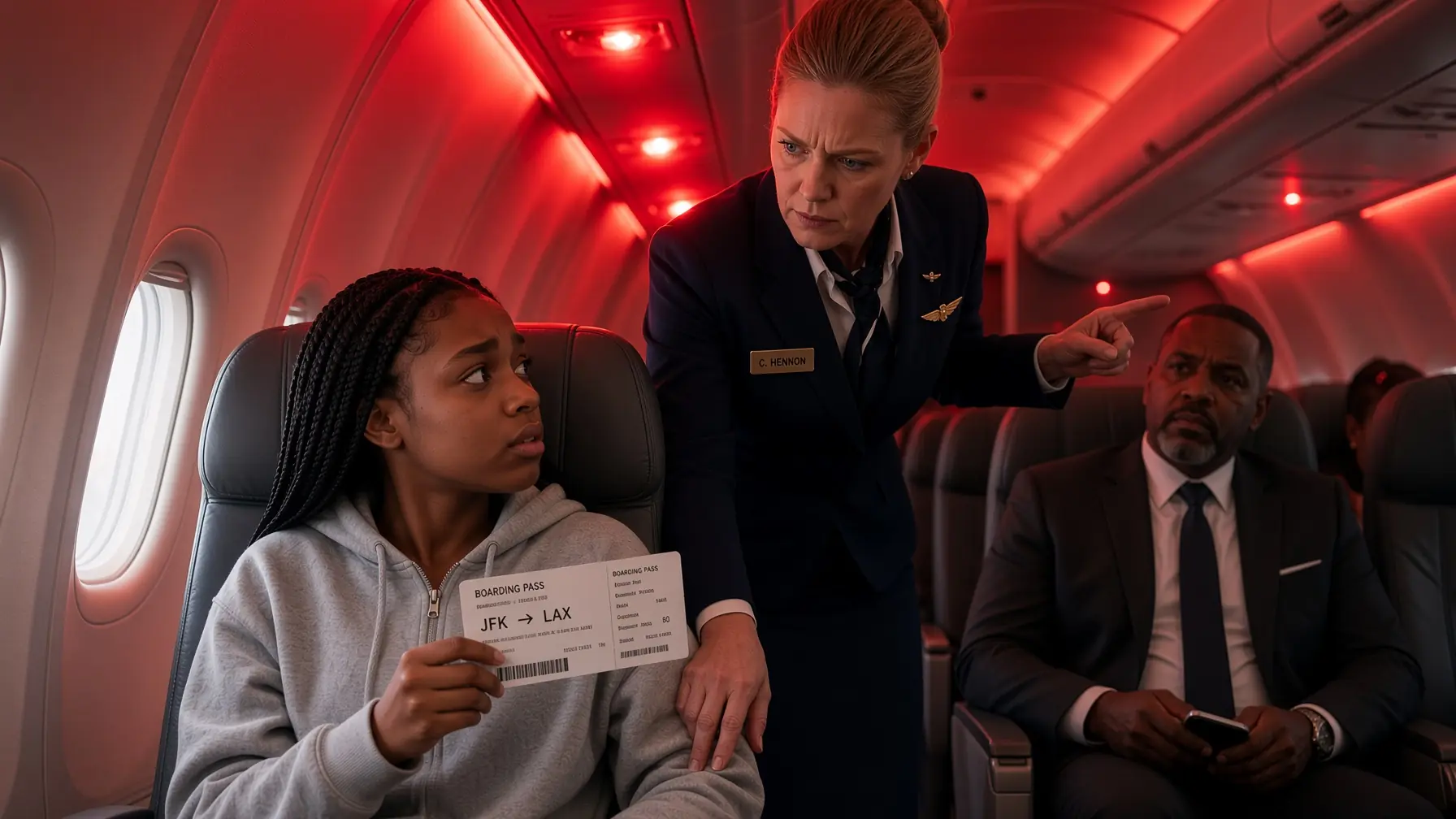
Sharp.
Controlled.
Almost casual.
But every person in the first-class cabin heard it.
A coffee cup trembled in its saucer.
A businessman two rows back lowered his newspaper.
Someone whispered:
“Oh my God.”
Zahara looked down at the red mark forming across her skin.
Then up at the flight attendant.
The woman stood over her in a dark navy uniform, jaw tight, one hand still half raised.
“You need to move.”
Zahara blinked once.
“My ticket says 1A.”
“I already told you.”
“This section is for first-class passengers.”
“I know.”
Zahara held up her boarding pass again.
The attendant barely looked.
“You can either move voluntarily or I can have the captain deal with you.”
Zahara stared.
Seven minutes earlier, she had boarded North Continental Flight 748 like any other passenger.
Seventeen years old.
Black.
Braids tied behind her head.
Gray hoodie beneath a wool coat.
Notebook under one arm.
Backpack over one shoulder.
Seat 1A had been booked months earlier.
Not as a status symbol.
Not because Zahara cared about champagne or wider seats.
Her father had bought it because this was her first solo international trip.
She was flying from Atlanta to Zurich to speak at a youth human-rights forum.
Her father told her:
“If you’re going to spend nine hours rewriting a speech, you might as well have room for your elbows.”
Zahara had rolled her eyes.
Now she stood in the aisle while everyone watched.
The attendant pointed toward the rear cabin.
“Take your things.”
Zahara’s voice was quiet.
“You saw my boarding pass.”
“I said move.”
“What exactly is wrong with it?”
The attendant’s face tightened.
“Do not make this difficult.”
“I’m asking a question.”
That was when the woman struck her arm.
Not hard enough to knock Zahara down.
Hard enough to make the message unmistakable.
Move.
Obey.
Stop asking.
Zahara looked at the faces around her.
Nobody stood.
Nobody objected.
Several people looked away.
That hurt almost as much as the slap.
She picked up her backpack.
Then walked toward the rear cabin.
Three rows behind seat 1A, a man closed the book in his lap.
His name was Elliot West.
He was Zahara’s father.
She did not know he was on the flight.
That had been intentional.
Elliot had a meeting in Zurich the following day and had booked his own ticket only after Zahara insisted she was old enough to travel alone.
He had considered telling her.
Then decided against it.
She wanted independence.
He would give it to her.
So he boarded after her.
Sat in 3A.
And let his daughter believe she was handling the trip herself.
He watched the flight attendant approach her.
Watched the woman ask for proof Zahara belonged in first class.
Watched Zahara show the boarding pass.
Watched the woman reject what was directly in front of her.
Then watched her strike his daughter.
Elliot’s first instinct was immediate.
Stand up.
Cross the aisle.
Tell the woman exactly who Zahara was.
Who he was.
Who she had just hit.
But the instinct passed.
Something colder replaced it.
Because Elliot had spent more than twenty-five years working in aviation finance and corporate governance.
He knew what happened when powerful people intervened too early.
The story changed.
Instead of:
A passenger with a valid ticket was humiliated.
It became:
A wealthy executive demanded special treatment for his daughter.
Elliot refused to give anyone that escape.
He took out his phone.
Typed one message.
Are you okay?
Several seconds passed.
Then Zahara replied.
You’re here?
Yes.
Another pause.
She hit me.
Elliot looked toward the front galley.
I saw.
Zahara replied:
Don’t make a scene.
Despite everything, Elliot almost smiled.
That sounded exactly like her mother.
He wrote:
I won’t. I’m documenting it. You do the same.
Then he opened his notes app.
Time.
Seat.
Crew member’s name.
Passenger positions.
Words he remembered.
He requested the cabin supervisor quietly.
Not as an executive.
As a passenger.
Zahara found an empty seat in economy after another passenger agreed to move.
She sat beside the window.
Her arm still stung.
A little boy behind her kicked the seat every thirty seconds.
Normally she would have turned around and smiled at him.
She could not make herself move.
She pulled out her notebook.
On the first page of her speech were the words:
Dignity is not something institutions grant us. It belongs to us before anyone decides whether we deserve it.
Zahara stared at the sentence.
Then closed the notebook.
She suddenly hated it.
It sounded polished.
Academic.
Easy.
Nothing about dignity felt easy when twenty strangers watched someone take yours away and decided silence was safer.
Her phone buzzed again.
Her father.
Did anyone check on you?
Zahara looked around.
No.
No.
Then:
A woman across the aisle gave me a tissue.
Elliot replied:
Get her name if she’s willing.
Zahara almost laughed.
Her father could turn a family dinner into an evidentiary record.
Then she understood.
He was making sure this would not depend on memory later.
Zahara looked across the aisle.
The woman was perhaps fifty.
Asian American.
Short hair.
Green scarf.
“Excuse me.”
The woman turned.
“Yes?”
“Would you mind telling me your name?”
“Lena Cho.”
“I’m Zahara.”
“I know.”
Lena hesitated.
“I should have said something.”
Zahara looked at her.
“You saw it?”
“Yes.”
“All of it?”
Lena nodded.
Zahara opened her phone.
“Would you be willing to write down what you saw?”
Lena’s expression changed.
Not defensive.
Ashamed.
“Yes.”
Then she added:
“And I’m sorry.”
“For what?”
“For sitting there.”
Zahara said nothing.
But she handed Lena her phone.
At the front of the cabin, the lead flight attendant arrived.
Her name was Melissa Grant.
She had not witnessed the confrontation.
The attendant involved was Claire Henson, a twelve-year employee with a clean disciplinary record.
Melissa approached Elliot.
“Sir, I understand there’s a concern?”
“Yes.”
“What happened?”
“My daughter had a valid seat in 1A.”
Melissa looked toward the empty seat.
“Your daughter?”
“Yes.”
“She was removed from that seat.”
Melissa frowned.
“Why?”
“You need to ask Ms. Henson.”
“I’m asking you.”
Elliot looked at her.
“She told my daughter she did not belong in first class.”
Melissa’s face changed.
“Was there a ticketing issue?”
“No.”
“Name?”
“Zahara West.”
Melissa checked the passenger manifest on her tablet.
There it was.
WEST, ZAHARA — 1A
She looked up.
“Her reservation is valid.”
“Yes.”
Melissa lowered her voice.
“Where is she now?”
“Row twenty-two.”
“Why?”
“Because Ms. Henson moved her.”
Melissa stared at the screen.
Then at Elliot.
“And you were seated here the entire time?”
“Yes.”
“Why didn’t you intervene?”
Elliot answered carefully.
“Because I wanted your airline to handle an incident involving one of its employees without first knowing the affected passenger’s father had influence in your industry.”
Melissa looked at him more closely.
“What kind of influence?”
“That’s not relevant yet.”
Then:
“My daughter says she was struck.”
Melissa stopped.
“Struck?”
“Yes.”
“With what?”
“Her hand.”
Melissa straightened immediately.
That changed procedure.
“I need to notify the captain.”
“Good.”
“And speak with your daughter.”
“Ask her permission first.”
Melissa nodded.
That answer made her realize she was dealing with someone who understood process.
Not merely anger.
Captain Daniel Reynolds received the report at cruise altitude.
He did not turn the aircraft around.
There was no immediate medical emergency.
No ongoing physical threat.
No reason to make an unsafe operational decision solely for dramatic effect.
Instead, he followed company procedure.
The incident was entered into the flight log.
Claire Henson was removed from direct interaction with Zahara.
Another attendant took over her section.
The captain asked that potential witnesses be identified.
The airline’s operations center was notified.
Zahara was offered medical evaluation upon landing.
Then Melissa walked to row twenty-two.
She crouched beside Zahara rather than standing over her.
“Ms. West?”
Zahara removed one earbud.
“Yes.”
“My name is Melissa.”
“I’m the lead cabin attendant.”
“I understand there was an incident involving Ms. Henson.”
Zahara’s expression did not change.
“There was.”
“I’d like to hear what happened directly from you.”
Zahara looked toward her father in first class.
She could barely see him.
Then back at Melissa.
“She asked whether I was supposed to be in 1A.”
“I showed my boarding pass.”
“She told me to move anyway.”
“I asked what was wrong with my ticket.”
“She said I didn’t belong in that seat.”
“Then she hit my arm and told me to move.”
Melissa paused.
“Did she use those exact words?”
“Which?”
“That you didn’t belong?”
“Yes.”
“Did she say why?”
“No.”
“Did you threaten her?”
“No.”
“Touch her?”
“No.”
“Raise your voice?”
“No.”
Lena Cho leaned across the aisle.
“She didn’t.”
Melissa turned.
“I saw the whole thing.”
Another passenger two rows forward raised his hand.
“So did I.”
Melissa looked around.
The silence from first class was starting to break.
Not because Zahara’s father had revealed himself.
Because once one witness spoke, others found it easier.
A man said:
“She showed the attendant the boarding pass.”
Another:
“I heard her say first class wasn’t for her.”
Someone else:
“I didn’t see the contact, but I heard people gasp.”
Melissa began collecting seat numbers.
Zahara watched.
Earlier, every person’s silence had felt like a verdict.
Now she realized some of them had simply been afraid of becoming involved.
That did not make the silence harmless.
But it made it human.
Melissa said:
“Ms. West, your assigned seat remains 1A.”
“I can return you there immediately.”
Zahara looked toward the front.
For a moment, she wanted to refuse.
The seat no longer felt comfortable.
It felt contaminated.
Then she remembered her speech.
Dignity was not something you surrendered because someone made occupying it painful.
“I’ll go back.”
Melissa nodded.
Zahara stood.
As she entered first class, people looked up.
This time they did not look away.
Claire Henson stood near the galley.
Melissa had told her not to approach Zahara.
But as Zahara passed, Claire said:
“Miss West.”
Melissa turned sharply.
Claire continued:
“I’d like to apologize for the misunderstanding.”
Zahara stopped.
She looked at her.
“Which part was a misunderstanding?”
Claire blinked.
“The seating issue.”
“You saw my ticket.”
“I may not have looked closely enough.”
“You looked at it twice.”
Claire’s face reddened.
“I misjudged the situation.”
Zahara’s voice remained calm.
“You didn’t ask anyone else to prove they belonged.”
The first-class cabin became still.
Claire looked around.
Then back at Zahara.
“I’m sorry for the inconvenience.”
Zahara stared.
“Inconvenience?”
Claire swallowed.
Zahara continued:
“You put your hand on me.”
“Yes.”
“You told me I didn’t belong in the seat printed on my ticket.”
“Yes.”
“Then say what you’re apologizing for.”
Claire’s mouth opened.
Nothing came out.
Zahara waited.
Finally Claire said:
“I’m sorry I touched you.”
“And I’m sorry I removed you from your assigned seat.”
Zahara nodded once.
“Thank you.”
Then she sat in 1A.
Not because the apology fixed anything.
Because accountability had at least begun speaking accurately.
Only after Zahara was seated again did Elliot walk forward.
He stopped beside her.
She looked up.
“You’re annoying.”
He smiled.
“I missed you too.”
“You were really three rows behind me?”
“Yes.”
“And you just sat there?”
“I was trying to respect your request not to make a scene.”
“I made that request after you already sat there.”
“Fair.”
Zahara looked at him.
Then saw his face.
The controlled expression.
The jaw.
The anger underneath.
“Dad.”
“Yes?”
“Don’t destroy anybody.”
He almost laughed.
“That is a very specific instruction.”
“I mean it.”
Elliot sat in the empty seat across from her.
“What do you think I’m going to do?”
“You know people.”
“Yes.”
“You sit on boards.”
“Yes.”
“You fund half the things with wings.”
“Not half.”
“Dad.”
He sighed.
“Fine.”
Zahara continued.
“I don’t want some story where she gets punished because she happened to hit the wrong rich girl.”
Elliot’s face softened.
“I don’t either.”
“Then don’t make it about you.”
He nodded.
That was the moment the direction of everything changed.
Not when Claire hit Zahara.
Not when Elliot recognized a compliance violation.
When Zahara refused to let her father’s power become the lesson.
Elliot West was wealthy.
Very wealthy.
He had built SkyBridge Capital from a small infrastructure fund into one of the largest private investors in airport services, aircraft leasing, and aviation technology.
He sat on advisory boards.
Knew airline executives.
Had financed terminals.
His firm held investments connected indirectly to North Continental.
But Elliot did not control the airline.
He could not press a button and freeze its fuel.
He could not revoke gates.
Could not suspend crews.
Could not create federal law from an airplane seat.
Money created influence.
Influence was not the same thing as lawful authority.
Elliot understood that better than most.
So he did not call the CEO during the flight.
He called SkyBridge’s general counsel.
The instruction was simple.
“My daughter is involved in a passenger-rights incident on North Continental 748.”
“Preserve any business conflicts.”
“Do not contact the airline on my behalf until their own process begins.”
“I want outside counsel for Zahara.”
The lawyer asked:
“Do you want us to review our investments?”
“Later.”
“Not as leverage.”
“As governance.”
“Understood.”
Elliot ended the call.
Then wrote another note.
Do not let personal retaliation masquerade as compliance.
He underlined it.
Twice.
When Flight 748 landed in New York for its scheduled connection, airline representatives were waiting.
Not federal “ethics agents.”
Not armed investigators.
A station manager.
An HR representative.
Airport police because a passenger alleged unwanted physical contact.
And a medical technician.
Claire Henson was removed from duty for the remainder of the trip pending review.
She was not publicly marched through the terminal.
Her badge was not ceremonially taken.
She was interviewed.
So was Zahara.
So were witnesses.
Airport police documented the physical contact complaint and informed Zahara and Elliot of their options.
Zahara chose to provide a statement.
The airline preserved cabin records and crew reports.
Several passengers voluntarily submitted written accounts.
Lena Cho provided hers.
So did a businessman from 2C who admitted:
“I knew the girl had shown a boarding pass.”
The investigator asked:
“Why didn’t you say anything?”
The man looked down.
“I didn’t want trouble.”
Zahara heard that answer later.
It stayed with her.
Not wanting trouble was how trouble found protection.
North Continental offered to place Zahara and Elliot in a private lounge while arrangements were made for the next leg.
Zahara refused.
“I’ll wait at the normal gate.”
An airline executive who had arrived from headquarters said:
“Ms. West, we want to make you comfortable.”
Zahara replied:
“I was comfortable in 1A.”
He had no answer.
Her father looked away.
He was proud of that line.
He also knew enough not to say so.
The flight continued to Zurich with a replacement crew member.
Zahara kept seat 1A.
Elliot remained in 3A.
She spent the first hour rewriting her speech.
She removed the opening paragraph.
Then wrote:
The most dangerous kind of exclusion is not always loud. Sometimes it is one person making an assumption and twenty others deciding it is safer not to interfere.
She stopped.
Then added:
Power is not proved by how quickly you can punish someone who mistreats you. It is proved by whether the same protection exists for someone who has no powerful parent sitting three rows away.
She read it twice.
Then kept writing.
The video emerged two days later.
Not from Zahara.
A passenger had recorded part of the confrontation.
The clip began after Claire first questioned Zahara.
It showed Zahara holding up her boarding pass.
Claire standing over her.
Then the movement of Claire’s hand.
The strike.
Zahara rising.
Walking away.
No screaming.
No threat.
No aggressive movement from Zahara.
Someone posted it.
Within hours, millions watched.
The story traveled faster than the investigation.
That created its own problems.
People found Claire’s social-media accounts.
Posted her address.
Threatened her.
Zahara issued her first public statement.
It surprised everyone.
Do not harass her.
Then:
What happened to me was wrong. Accountability does not require cruelty. If you are angry about what happened, use that anger to ask what systems allow these decisions to happen and how passengers without influence are treated when nobody is filming.
Some people applauded Zahara.
Others accused her of protecting racism.
She ignored both.
She was learning quickly that once the internet turned a person into a symbol, everyone wanted ownership of what the symbol should say.
North Continental announced an independent review.
Not just of Claire.
Of first-class seating disputes over the previous five years.
That decision came after airline leadership discovered something uncomfortable.
Zahara’s case might not be isolated.
Complaints existed.
Black passengers asked for additional verification of premium tickets.
Younger travelers challenged more often than older ones.
Employees making subjective decisions about whether someone “looked misplaced.”
Most complaints had been resolved individually.
Refund.
Apology.
Travel credit.
No one had studied them together.
Now outside investigators did.
Patterns appeared.
Not proof that every incident involved bias.
But enough disparity to justify change.
Claire was interviewed several times.
Her initial explanation was that Zahara appeared too young to be traveling in first class alone and that she believed a seat-assignment mistake had occurred.
Investigators asked:
“Why did you not verify the manifest before ordering her to move?”
Claire had no good answer.
“Why did you accept the boarding passes of other young first-class travelers without the same challenge?”
No good answer.
“Why did you physically touch her?”
Claire said she was trying to direct Zahara into the aisle.
Video contradicted that description.
Eventually, she stopped trying to make the event smaller.
At a disciplinary hearing, Claire said:
“I made an assumption.”
Her representative asked what assumption.
Claire was silent for a long time.
Then:
“That she probably wasn’t supposed to be there.”
“Why?”
Claire looked down.
“I don’t know.”
The investigator replied:
“You may not know consciously.”
“But you acted on it.”
That became the central finding.
Bias did not require a person to wake up planning discrimination.
It could arrive as certainty without evidence.
Claire’s employment ended months later.
Not solely because of a public campaign.
The airline concluded she had disregarded a valid boarding pass, used unnecessary physical contact, provided an inaccurate initial account, and violated passenger-treatment policies.
The union contested portions of the discipline.
The process took time.
Zahara did not celebrate.
When a journalist asked whether she was satisfied Claire had been fired, Zahara answered:
“I’m satisfied the investigation took evidence seriously.”
“That isn’t the same as enjoying what happened to her.”
The larger changes were slower.
North Continental revised premium-cabin verification procedures.
If a seat appeared mismatched, crews were instructed to verify the digital manifest before confronting a passenger.
Physical contact could not be used merely to enforce seating.
Bias training changed from abstract annual videos to scenario-based evaluation.
Passenger complaints involving removal from purchased cabin classes received automatic supervisory review.
The airline also created an outside passenger-rights advisory panel.
Zahara declined a permanent seat.
She was seventeen.
She had school.
She had a life.
But she agreed to speak once.
Her first sentence to the panel was:
“Please do not name anything after me.”
Everyone laughed.
She did not.
“I mean it.”
Then:
“The goal should be that nobody needs my name to be treated correctly.”
The room became quiet.
Elliot’s company conducted its own review.
SkyBridge held investments in several aviation businesses.
For years, its governance screens had focused on financial stability.
Safety.
Environmental exposure.
Corruption.
Labor risk.
Passenger-treatment metrics existed mostly as reputation indicators.
After Zahara’s flight, Elliot proposed something narrower and more defensible than the magical system people online imagined.
Portfolio companies receiving new capital would have to disclose substantiated passenger-rights complaints, employee discipline related to discrimination, and remediation procedures.
Not because Elliot could dictate airline law.
Because investors were allowed to decide what governance risks they considered relevant.
The proposal faced resistance.
One director said:
“We’re an investment company.”
Elliot replied:
“Yes.”
“And mistreating customers creates legal, operational, and reputational risk.”
Another asked:
“Would you be proposing this if it hadn’t happened to your daughter?”
Elliot stopped.
That was a fair question.
“Probably not this year.”
He admitted.
“That should embarrass me.”
The room went silent.
He continued.
“The fact that I ignored a risk until it entered my family does not mean we should continue ignoring it.”
The policy passed.
Not unanimously.
That mattered too.
Real change rarely arrived with every person suddenly enlightened.
Zahara’s speech in Zurich changed as well.
The organizers had expected a prepared fifteen-minute talk about youth dignity.
She walked onto the stage with no slides.
No viral video.
No mention of her father’s company.
She told the audience what happened on the airplane.
Then said:
“The easiest version of my story is that a powerful man’s daughter was mistreated and powerful people fixed it.”
“That version makes everyone feel safe.”
“Because it suggests injustice is dangerous only when you accidentally choose someone important.”
She paused.
“The harder question is what would have happened if my father had not been on that flight.”
No one moved.
“If nobody recorded it?”
“If I did not know how to file a complaint?”
“If my family could not hire counsel?”
“If I needed that airline for work?”
“If I was afraid being labeled difficult would cost me something?”
Zahara looked across the hall.
“I did not deserve dignity because my father was wealthy.”
“I deserved it because I was a passenger.”
“Because I was seventeen.”
“Because I was human.”
Then:
“And Claire Henson did not become wrong the moment she learned who my father was.”
“She was wrong while she still thought I was nobody.”
That line traveled farther than the video.
Back home, life did not become normal immediately.
Zahara received invitations.
Television.
Universities.
Political groups.
Companies.
Foundations.
Some wanted her story.
Some wanted her face.
Some wanted her father’s name attached to an event.
She declined most of them.
Her mother, Naomi, asked:
“You sure?”
“Yes.”
“You could do a lot with the attention.”
“I’m tired of being looked at.”
Naomi nodded.
That was enough.
Zahara returned to school.
Finished assignments.
Argued with friends.
Forgot to answer emails.
Burned toast.
Missed a chemistry quiz because she wrote the date down wrong.
Being a symbol did not prevent ordinary teenage incompetence.
She liked that.
Months later, Lena Cho visited New York.
She emailed Zahara first.
They met for coffee.
Lena looked nervous.
“I still think about that flight.”
“So do I.”
“I should have stood up.”
Zahara stirred her drink.
“Maybe.”
Lena blinked.
Zahara continued.
“You did give a statement.”
“After.”
“Yes.”
“That doesn’t erase before.”
“No.”
Lena looked down.
Zahara said:
“But I don’t think people become better by pretending the moment they failed is the only moment that counts.”
Lena looked up.
“You forgive me?”
Zahara smiled slightly.
“I’m not sure I was angry at you personally.”
“I was angry at the room.”
That answer made Lena cry.
Zahara handed her a napkin.
“Please don’t do that.”
“Why?”
“I’m bad when people cry.”
Lena laughed.
The tension broke.
Elliot carried guilt too.
One evening he asked Zahara:
“Do you think I should have stood up immediately?”
She looked at him.
“I don’t know.”
“That’s not helpful.”
“You always tell me uncertainty is intellectually honest.”
“I regret teaching you that.”
She smiled.
Then became serious.
“You could have stopped it sooner.”
“Yes.”
“But if you had stood up and said, ‘That’s my daughter,’ everyone would have changed because of you.”
Elliot nodded.
“I wanted them to change because of what happened.”
“I understand.”
She studied him.
“But I still had to walk twenty rows alone.”
That hurt.
Elliot did not defend himself.
“I know.”
Zahara continued:
“I’m not saying you made the wrong decision.”
“I’m saying your decision cost me something.”
He looked down.
“You’re right.”
That became another lesson neither had expected.
Even restraint could have consequences.
Doing the principled thing from a distance did not erase the pain experienced by the person closest to the harm.
Elliot apologized.
Not for refusing to use power improperly.
For not finding a way to protect his daughter sooner while still preserving the truth.
She accepted.
Their relationship became stronger because neither needed the story to make either of them perfect.
A year after Flight 748, Zahara flew alone again.
Actually alone.
New York to London.
Her father offered to book first class.
She said:
“Economy premium.”
He looked shocked.
“You have become unreasonable.”
“I’m saving you money.”
“That is not how children of investors behave.”
She laughed.
At the airport, she boarded without incident.
The flight attendant scanned her pass.
“Welcome aboard, Ms. West.”
That was all.
No recognition.
No special treatment.
No suspicious pause.
No second verification.
Zahara found her seat.
Put her backpack away.
Sat down.
For several minutes, nothing happened.
She realized that was exactly what she had wanted.
Nothing.
No lesson.
No confrontation.
No viral moment.
Just travel.
A young Black girl belonging somewhere without anyone turning her presence into a question.
People continued telling the story incorrectly.
Online posts claimed Elliot West had frozen billions in airline funding from seat 3A.
Not true.
Others claimed he forced an emergency landing.
Not true.
Some said federal agents boarded the plane and arrested the flight attendant.
Also false.
The real story was slower.
Less cinematic.
More important.
A seventeen-year-old passenger had a valid ticket.
An employee saw her and made an assumption.
The employee trusted that assumption more than the boarding pass in her hand.
She used physical force when the girl questioned her.
Passengers initially stayed silent.
Then witnesses spoke.
The captain documented.
The airline preserved records.
Airport police took a report.
A video confirmed key facts.
An independent investigation followed.
A worker faced consequences.
A company changed procedures.
Investors reconsidered what they measured.
And a young woman used the attention not to prove she was exceptional, but to ask why anyone needed to be exceptional before a system protected them.
That was less satisfying to people who wanted a billionaire father to destroy an airline with one phone call.
Zahara preferred it.
Because revenge stories ended with the powerful person winning.
Her story asked whether the person without power would be protected next time.
Years later, Zahara still kept the notebook from Flight 748.
The original speech remained inside.
So did the revised version she delivered in Zurich.
On one page, she had written a sentence during the flight.
The handwriting was shaky.
The ink smeared slightly where her hand had rested against it.
A system is not fair because it eventually recognizes an important person. It is fair only when importance is irrelevant.
That became the sentence she remembered.
Not her father’s name.
Not the airline.
Not the disciplinary decision.
Not the millions of video views.
Seat 1A was never important because Zahara West happened to be the daughter of Elliot West.
It was important because she had bought the right to sit there.
The boarding pass said so.
The manifest said so.
The facts said so.
And none of those facts became more true when someone finally discovered who her father was.
The flight attendant’s mistake was not that she chose the wrong girl to humiliate.
It was believing there was any girl for whom that humiliation would have been acceptable.
Zahara understood that at seventeen.
Some institutions took considerably longer.
But eventually, they began to understand it too.