“Sir, I need you to move to seat 34E.”
The flight attendant stood beside row six with a tablet held against her uniform. Her professional smile had disappeared, replaced by the tight expression of someone who believed the matter had already been decided.
Thomas Avery looked up from seat 6C.
At eighty-seven, he moved slowly, but there was nothing uncertain in his pale blue eyes. He wore a charcoal suit that had been carefully brushed that morning, a white shirt, and a dark blue tie with a faint crease near the bottom.
The suit was old.
It was also the best one he owned.
“I reserved this aisle seat four months ago,” Thomas said.
“There is a family assigned to 6A, 6B, and 34E. They need to remain together.”
Thomas looked toward the people waiting in the aisle.
A mother stood beside the window seat, holding a backpack covered in silver rockets. Her husband rested one hand on the shoulder of a boy who appeared to be nine or ten.
The child wore noise-canceling headphones and pressed both palms over them. His breathing was rapid, and his eyes kept moving between the crowded aisle and the aircraft door.
Thomas understood immediately.
The boy was overwhelmed.
“What seat does the father have?” Thomas asked.
“Thirty-four E.”
“Then his father can sit there. The boy can remain here with his mother.”
The father looked embarrassed.
“That would be fine,” he said. “Really.”
The flight attendant turned toward him.
“We are trying to keep your family together.”
“My son will be okay if I’m a few rows away.”
“Thirty-four isn’t a few rows.”
The flight attendant’s name tag read MARISSA COLE.
She looked back at Thomas.
“Seat 34E is available. Please gather your belongings.”
Thomas rested both hands on the handle of his cane.
“I cannot sit in a middle seat for nearly four hours.”
“Many passengers prefer the aisle.”
“This is not a preference.”
Boarding continued around them. Suitcases struck seatbacks. A baby cried near the rear of the cabin. Passengers waiting in the aisle began checking their watches.
Liberty Atlantic Flight 317 was scheduled to depart Washington National Airport for San Antonio in twenty-seven minutes.
The previous aircraft had arrived late.
The crew had already been warned that another delay would require an operational report.
Marissa had been awake since three forty-five that morning.
The gate agent had handed her the seating conflict and whispered, “Move the easiest solo traveler.”
Thomas appeared to fit that description.
He was elderly.
He traveled alone.
He wore no expensive watch and carried only a small leather overnight bag.
Nothing on the passenger manifest indicated airline status or corporate importance.
Marissa had concluded that moving him would be simple.
Now his refusal felt personal.
“Sir,” she said, “this is a crew instruction.”
Thomas lowered his voice.
“I have surgical hardware in my left hip and lower spine. My leg becomes numb unless I can stretch it periodically. I requested an aisle accommodation when I purchased the ticket.”
Marissa checked her tablet.
“There is no accommodation note on your reservation.”
“It was there when I booked.”
“I can only work with the information I have.”
Thomas reached slowly toward the inside pocket of his jacket.
Marissa raised one hand.
“Please stop reaching.”
Thomas froze.
Passengers in the nearby rows turned toward them.
“I was retrieving my medical information card.”
“You can show it to a gate agent after you move.”
The mother of the anxious boy stepped forward.
“We don’t want him forced out of the seat.”
Marissa’s cheeks reddened.
“We’ve already begun resolving the issue.”
“No,” Thomas said quietly. “You selected a solution.”
The distinction irritated her.
She leaned closer.
“You may move to 34E, or you may leave the aircraft and speak with customer service.”
Thomas looked through the window.
Rain slid across the glass. Ground crews hurried beneath the low gray sky, directing baggage carts between parked aircraft.
He had not visited Texas in forty-nine years.
Inside his jacket was a letter that had taken six months to reach him and another two weeks for him to open.
Its author was already dead.
The funeral would begin that afternoon.
Thomas had missed too many opportunities to speak when people were alive.
He had promised himself he would not miss this final one.
“I do not wish to delay anyone,” he said.
“Then please stand.”
Thomas tightened his hand around the cane.
He had survived injuries far worse than the pain waiting inside his hip.
Pain was not what frightened him.
Falling was.
Falling in front of strangers who had already begun seeing him as an inconvenience.
Still, he pushed himself upright.
A sharp current ran from his left hip into his spine. Numbness followed, spreading down his thigh.
He grabbed the seatback in front of him.
The cabin quieted.
Thomas reached toward the overhead compartment for his small bag.
His left leg failed.
His knee struck the edge of the seat.
The cane slipped from his hand.
He fell sideways.
The boy’s father caught him beneath the arms before his head hit the floor.
A woman in row seven gasped.
Something metallic dropped from Thomas’s jacket and landed in the aisle.
The anxious boy lowered his hands.
He bent down and picked it up.
It was a pair of silver military pilot wings, worn dark by age.
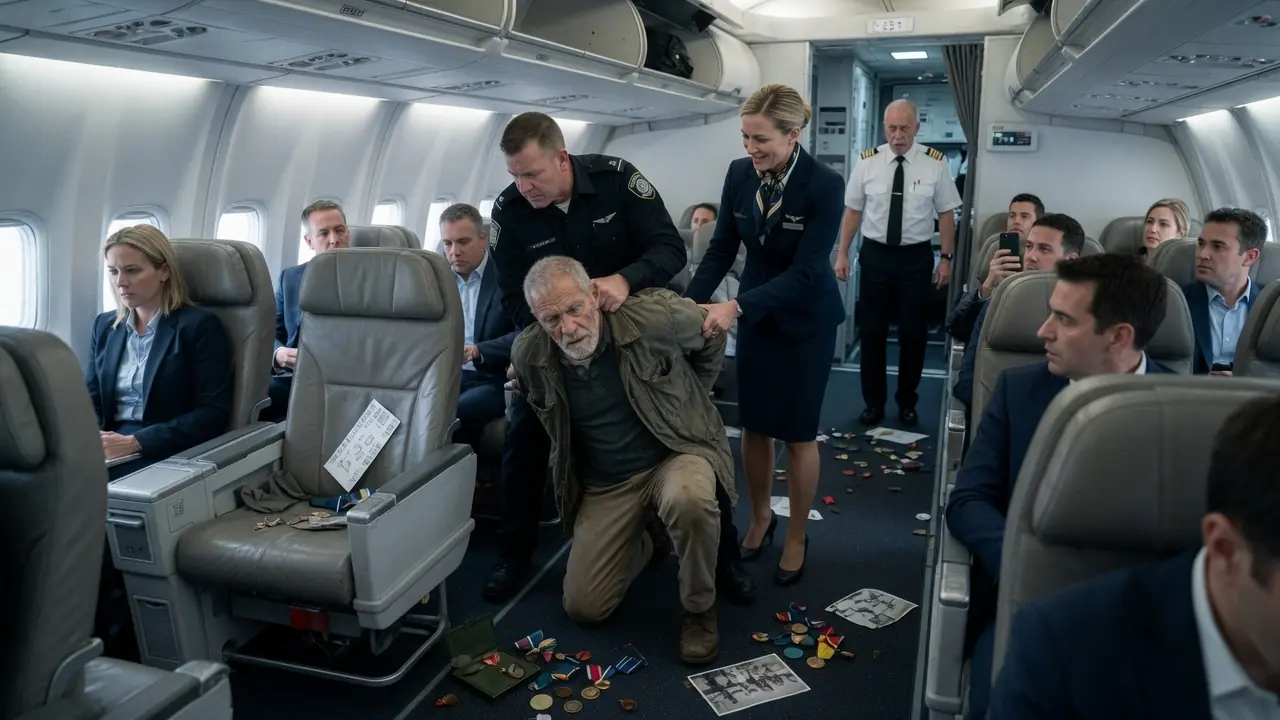
One side was bent upward. A deep scratch crossed the center, and a faint reddish-brown stain remained inside the damaged metal.
The boy held the wings out.
“You dropped these.”
Thomas’s expression changed.
He accepted them as carefully as if the child were returning something alive.
“Thank you.”
“Were you a pilot?”
Thomas closed his fingers around the wings.
“A long time ago.”
Marissa recovered the cane.
“If you cannot walk safely, airport medical personnel may need to assist you off the aircraft.”
A young man across the aisle lowered the phone he had been using to record.
“He told you standing could hurt him.”
Marissa turned.
“This is a crew matter.”
“You made it everyone’s matter when you threatened to remove him.”
Murmurs moved through the first several rows.
Marissa’s shoulders stiffened.
Then another crew member emerged from the forward galley.
Teresa Nguyen was the lead flight attendant. At fifty-three, she had spent twenty-six years in commercial aviation and had learned that minor problems became serious when pride entered the cabin before judgment.
“What happened?” Teresa asked.
Marissa answered first.
“The passenger in 6C is refusing a seat reassignment. The family needs to sit together, and 34E is the only open seat.”
Thomas remained supported by the father.
“I asked to keep an aisle seat because of a documented injury.”
Teresa looked at him.
“Please sit back down.”
Marissa frowned.
“We need to finish boarding.”
“We also need to prevent him from falling.”
The father helped Thomas lower himself into 6C.
His breathing had become shallow. He placed the cane against the armrest and rubbed the side of his hip.
Teresa crouched beside him.
“Are you injured from the fall?”
“Only my dignity.”
The answer was dry enough that she almost smiled.
“May I see the medical card you were trying to retrieve?”
Thomas removed it slowly.
Teresa read the card. It confirmed permanent injuries to the pelvis and lumbar spine, restricted mobility, and the need for periodic leg extension during prolonged travel.
She looked at the reservation screen.
“The accommodation isn’t displaying.”
“It was confirmed in February,” Thomas said.
Teresa nodded.
“I believe you.”
The simplicity of the words changed his expression more than an elaborate apology would have.
Teresa turned toward Marissa.
“Call the gate and have them check the original booking notes.”
“We’re already behind.”
“Then make the call quickly.”
Marissa went toward the galley.
Teresa looked at the father.
“Would you be willing to take the other seat?”
“Of course.”
His wife nodded.
“We never requested that anyone be forced to move.”
Teresa stood.
“Then we may already have a solution.”
Before she could complete the arrangement, the cockpit interphone rang.
Captain Jonathan Mercer had noticed the delay through the flight deck monitoring system.
Teresa answered.
“Cabin.”
“What’s holding boarding?” Jonathan asked.
“Seating conflict in row six. We are resolving it.”
“What kind of conflict?”
“An elderly passenger was assigned 6C. He has a medical need for the aisle, but the accommodation note disappeared from the active reservation. Marissa attempted to move him to 34E for a family.”
“Is he all right?”
“He fell while trying to stand. No obvious injury.”
The captain’s tone sharpened.
“What’s his name?”
Teresa glanced at the boarding pass.
“Thomas Avery.”
Silence followed.
Jonathan did not respond for several seconds.
“Captain?”
“How old is he?”
“Eighty-seven.”
“What does he look like?”
“White hair. Blue eyes. Dark suit. Cane.”
Jonathan’s hand stopped over the preflight checklist.
Beside him, First Officer Lucas Reed looked over from the right seat.
Jonathan’s father had kept an old photograph in his study throughout Jonathan’s childhood.
Five Air Force men stood beside a helicopter that looked as though it had been dragged through a war.
One man wore a bandage around his waist. His shirt was torn, and a set of pilot wings hung crookedly above the pocket.
On the back of the photograph, Jonathan’s father had written:
MAJOR THOMAS AVERY. HE CAME BACK WHEN EVERYONE ELSE SAID WE WERE LOST.
Jonathan picked up the interphone again.
“Does he have old pilot wings?”
Teresa looked toward Thomas.
He still held the bent silver insignia inside his palm.
“Yes.”
Jonathan closed his eyes.
His father had spent fifty years searching for the man in that photograph.
“Do not close the aircraft door.”
“Captain, operations is already asking—”
“Tell them departure is paused under my authority.”
Jonathan removed his headset.
Lucas studied him.
“You know the passenger?”
“My father spent most of his life trying to find him.”
Thomas unfolded the letter while the crew conferred near the galley.
The paper trembled slightly between his hands.
It had been written six months earlier by retired Air Force Lieutenant General Samuel Mercer.
Thomas had received it only two weeks ago. It had traveled through three old addresses, a veterans’ association, and an Air Force records office before reaching his apartment in Maryland.
The envelope had been marked in Samuel’s handwriting.
Thomas recognized the hand before opening it.
Tom,
If this letter finally reaches you, then somebody has succeeded where I failed for nearly half a century.
I am dying. Don’t be angry about it. I have had eighty-five years, a wife who somehow tolerated me, two sons, six grandchildren, and more mornings than I was promised.
Every one of them exists because you came back.
My funeral will be held in San Antonio on the twenty-second. You hate ceremonies, and I know you will tell yourself your presence is unnecessary. Come anyway.
My oldest son, Jonathan, is a captain with Liberty Atlantic. You met him once when he was an infant, though I doubt you remember.
Sit with my family. You belong there whether you accept it or not.
Your brother,
Sam
Thomas had read the letter seven times.
He remembered Jonathan as a sleeping infant held against Samuel’s chest in a military hospital.
He had not known what the child became.
The cockpit door opened while the aircraft was still connected to the jet bridge.
First Officer Reed remained in the flight deck as required.
Captain Jonathan Mercer stepped into the cabin.
Passengers turned toward him.
Four gold stripes marked each shoulder of his uniform.
He passed the first row.
Then the second.
His attention never left Thomas.
Marissa stood near the galley, suddenly understanding that the conflict was no longer an ordinary seating problem.
Jonathan stopped beside 6C.
For several moments, neither man spoke.
Thomas studied his face.
He saw Samuel immediately.
Not in the hair or the shape of the jaw.
In the eyes.
Samuel had looked at danger with those same gray eyes while pretending he felt no fear.
“Jonathan?” Thomas asked.
The captain swallowed.
“Yes, sir.”
Thomas placed one hand on the cane and began to rise.
Jonathan raised his palm.
“Please remain seated.”
Then he stepped back into the aisle.
His heels came together.
His shoulders straightened.
In the center of the crowded commercial aircraft, Jonathan Mercer raised his right hand in a precise military salute.
The cabin became completely silent.
“Major Avery,” he said, his voice steady despite the emotion beneath it, “my father told me that if I ever stood before you, I was to salute first and thank you second.”
Thomas stared at him.
Jonathan held the salute.
“I had a father because of you, sir.”
A woman nearby covered her mouth.
The young man who had been filming lowered his phone.
Even the restless child sat motionless.
Thomas looked at the captain’s hand.
Then at the bent pilot wings resting in his own palm.
Slowly, he raised his fingers toward his brow.
His salute trembled.
It was not as sharp as Jonathan’s.
It did not need to be.
Jonathan lowered his hand only after Thomas did.
Marissa stood frozen near the galley.
Jonathan turned slightly so the nearby passengers could hear.
“In September 1972, my father was a twenty-eight-year-old Air Force lieutenant flying a reconnaissance mission over territory where rescue crews had been ordered not to enter.”
Thomas looked down.
Jonathan continued.
“His aircraft crashed during a monsoon. Two crew members died on impact. The survivors were injured, surrounded, and without reliable communication.”
Thomas spoke quietly.
“It wasn’t a monsoon.”
Jonathan glanced at him.
“No?”
“Just the worst rain I had ever seen.”
A faint ripple of laughter moved through the tense cabin.
Jonathan smiled briefly.
“Every available rescue crew was grounded. Major Avery flew anyway.”
Thomas shook his head.
“I had a volunteer crew.”
“You had one mechanic and a medic who had never flown combat rescue.”
“They were competent.”
Jonathan continued.
“The helicopter entered the valley under fire. Major Avery landed beside the wreck and loaded seven survivors.”
He paused.
“The aircraft was hit twice during departure. One engine failed before they crossed friendly lines.”
Thomas’s left hand moved toward his hip.
Jonathan’s voice grew quieter.
“The helicopter crash-landed in a flooded field. Major Avery suffered a shattered pelvis and spinal damage.”
He looked directly at Thomas.
“Before the fuel caught fire, he carried my father away from the wreck.”
Passengers looked toward Thomas differently.
His suit had not changed.
Neither had his cane.
Only their understanding had.
“My father lived fifty-two more years,” Jonathan said. “He married my mother. He raised two sons. He watched six grandchildren grow.”
His voice weakened.
“He taught me to fly.”
Thomas unfolded Samuel’s letter.
“I did my job.”
“No, sir.”
Jonathan shook his head.
“You returned after being ordered to abandon the rescue.”
“Your father talked too much.”
“He spent fifty years trying to thank you.”
“He thanked me in the hospital.”
“He believed one lifetime was not enough.”
Thomas looked toward the letter.
“I should have answered more of his letters.”
Jonathan saw the regret in his face.
“You came now.”
“Too late.”
“For the funeral.”
Thomas nodded.
Jonathan crouched beside the seat.
“My mother will be waiting at the airport.”
“She doesn’t know I’m coming.”
“She will when we land.”
“I don’t want a ceremony.”
Jonathan smiled.
“My father warned us you would say that.”
The mother of the anxious boy stepped forward.
“Major Avery, we never asked the crew to make you move.”
“Mr. Avery is fine.”
Her husband nodded.
“I’ll take 34E.”
The boy looked at the pilot wings.
“Did those get bent in the crash?”
Thomas held them out.
“Would you like to see?”
The child touched the damaged metal carefully.
“Were they yours?”
“No. Mine were lost.”
“Then whose were they?”
“Samuel Mercer gave them to me after the hospital. He had two sets.”
“Why did he give you one?”
Thomas looked at Jonathan.
“To remind me I was still a pilot.”
A man in business class stood.
He was traveling alone in seat 2D.
“The boy’s father may take my seat,” he said. “I’ll go to 34E.”
The father protested.
“You paid for that seat.”
“So did Mr. Avery.”
The businessman picked up his briefcase.
“Apparently that should mean something.”
Teresa coordinated the switch.
The mother and child remained in 6A and 6B.
Thomas kept the aisle seat he had selected.
The father moved to business class.
The volunteer took the middle seat in row thirty-four without complaint.
A problem that had seemed impossible disappeared once the cabin stopped expecting the most vulnerable passenger to absorb all the inconvenience.
Jonathan stood.
He looked toward Marissa.
“May I speak with you in the galley?”
She followed him forward.
Her face had become pale.
Inside the galley, Jonathan kept his voice low.
“Did Mr. Avery explain his medical condition?”
“Yes.”
“Did you verify it?”
“The note wasn’t on my tablet.”
“That was not my question.”
Marissa looked down.
“No.”
“Why not?”
“We were already late. I thought moving one person would be easier than rearranging several.”
“Easier for whom?”
She had no answer.
“He warned you that standing could cause him pain.”
“I believed he might be exaggerating because he wanted the aisle.”
“You believed that based on what?”
Marissa opened her mouth.
Nothing came out.
Jonathan waited.
Finally, she said, “He seemed like the easiest passenger to move.”
“That is not a reason. It is an admission.”
Her eyes filled.
“I made a mistake.”
“Yes.”
Jonathan looked toward row six.
“But do not misunderstand why.”
“Because he saved your father?”
“No.”
His answer surprised her.
“That only makes the mistake visible.”
He lowered his voice further.
“The real failure occurred when an elderly passenger told you he was in pain and you decided his explanation mattered less than the schedule.”
Marissa wiped beneath one eye.
“I was trying to help the child.”
“Helping one passenger does not require humiliating another.”
“I know.”
“Not yet.”
Jonathan’s tone remained controlled.
“But after landing, you will document the incident honestly. You will include the warning, the fall, and the alternative offered by the family.”
“Am I going to lose my job?”
“That decision belongs to inflight management.”
She nodded.
Jonathan opened the cockpit door.
Before returning inside, he looked back.
“Major Avery would have deserved the same respect if he had never worn a uniform.”
Marissa closed her eyes briefly.
“I understand that.”
“Make sure your report proves it.”
Flight 317 departed twenty-three minutes late.
No passenger complained.
At cruising altitude, Teresa brought Thomas a pillow for his hip and a cup of coffee.
Marissa remained near the rear galley for the first hour.
Whenever she looked toward row six, she saw Thomas sitting quietly with Samuel’s letter across his knees.
He did not appear angry.
That made her shame harder to manage.
The boy beside him eventually removed his headphones.
His name was Owen.
He asked Thomas several questions about helicopters.
Thomas answered most of them and redirected the rest toward Owen’s father, who had moved into the business-class seat.
A retired teacher across the aisle introduced herself as Margaret Fields.
“Captain Mercer’s story sounded incomplete,” she said.
“It was.”
“What did he leave out?”
“The helicopter had two engines when we entered the valley.”
“And one when you left?”
“Half of one.”
Margaret smiled.
“Why did you lose contact with General Mercer?”
Thomas looked through the window at the clouds.
“Life.”
“That answer usually means the real explanation is painful.”
Thomas folded the letter.
“Sam returned to flying. I didn’t.”
The crash had ended Thomas’s operational career.
Doctors said he might never walk again.
He proved them partly wrong.
He walked with a cane, but the Air Force would not clear him to fly military aircraft.
Samuel visited during rehabilitation.
Then assignments changed.
Thomas married a nurse named Ruth. They had one son.
Ruth developed cancer.
Their son later died in an industrial accident at thirty-four.
Grief narrowed Thomas’s world.
Samuel kept writing.
Thomas answered less often.
“I thought he had a good life,” Thomas said. “I did not want him feeling responsible for mine.”
“Was he?”
“No.”
“Then why disappear?”
Thomas watched the sunlight brighten above the clouds.
“I was ashamed of becoming the man people held doors for.”
Margaret studied him.
“You flew through enemy fire, but the cane frightened you?”
“Not the cane.”
“What, then?”
“The look people gave me when they saw it.”
She nodded slowly.
“Pity.”
“Yes.”
“So you avoided the people who knew you before.”
“It seemed easier.”
“Was it?”
“No.”
The answer came immediately.
Halfway through the flight, Marissa approached row six.
She carried a bottle of water and a folded blanket.
“Mr. Avery?”
Thomas looked up.
She had considered calling him Major.
Doing so now felt like hiding behind the title.
“I owe you an apology.”
Thomas waited.
“I treated your injury as an obstacle to solving my seating problem.”
Nearby passengers pretended not to listen.
Marissa continued.
“I spoke to you as though your age made you unreliable. I made you stand after you explained the risk, and I threatened to remove you instead of verifying the information.”
Her voice shook.
“I’m sorry. Not because Captain Mercer recognized you. I was wrong before anyone knew your name.”
Thomas studied her for several seconds.
“That is a better apology.”
She exhaled.
“I don’t expect forgiveness.”
“Then what do you expect?”
“Nothing.”
“Good.”
Marissa looked down.
Thomas continued.
“You were trying to help Owen.”
“Yes.”
“You forgot that helping one person can become harm when you choose someone else to carry the cost without consent.”
“I did.”
“You’ll forget again.”
She looked surprised.
“Everyone does,” Thomas said. “Character is noticing sooner the next time.”
Marissa nodded.
“I’ll try.”
“Trying is useful when followed by practice.”
He accepted the water.
She placed the blanket beside him.
“Is there anything else I can bring you?”
Thomas lifted the coffee cup Teresa had delivered.
“This could use help.”
Marissa almost laughed.
“I’ll make a fresh one.”
“Then perhaps your career can still be saved.”
The people nearby smiled.
The tension softened.
It did not erase what happened.
It allowed the cabin to move forward without pretending the mistake had never existed.
When Flight 317 landed in San Antonio, two airport fire vehicles waited near the gate with lights flashing.
Thomas looked through the window.
“What is all that?”
Jonathan’s voice came over the speakers.
“Ladies and gentlemen, we have a small reception waiting at the jet bridge. Please remain seated briefly after the seatbelt sign is turned off.”
Thomas closed his eyes.
“I told him no ceremony.”
Margaret smiled.
“Pilots are not known for listening.”
The aircraft door opened.
An Air Force honor guard stood inside the jet bridge.
Behind them waited Samuel’s widow, Evelyn Mercer.
She was eighty-two and dressed in black. A folded flag rested against her chest.
Jonathan left the cockpit and walked toward row six.
“Ready?”
“No.”
“Excellent.”
Thomas used the cane to stand.
This time, nobody hurried him.
No one touched him without asking.
Teresa remained nearby in case he requested assistance.
Marissa stood at the aircraft door.
As Thomas approached, she placed two fingers over her heart.
He nodded.
Jonathan walked beside him into the jet bridge.
The honor guard came to attention.
Evelyn saw Thomas and began crying before he reached her.
He stopped several feet away.
“I’m sorry I took so long.”
She crossed the distance and embraced him.
Thomas’s cane shifted.
Jonathan caught it before it fell.
Evelyn held the man who had given her fifty-two additional years with her husband.
“Sam knew you would come.”
“I almost didn’t.”
“He knew that too.”
She opened the folded flag slightly and removed a small cloth pouch.
Inside was another set of pilot wings.
They had been broken through the center.
Evelyn placed one half into Thomas’s palm.
“Sam carried this piece from the day of the crash.”
Thomas removed his own damaged wings.
The broken edges matched.
He stared at them.
“He kept half?”
“He said neither of you deserved to carry the whole memory alone.”
Thomas’s face folded.
For the first time that day, he cried.
Jonathan placed one hand on his shoulder.
Passengers entered the jet bridge behind them but stopped at a respectful distance.
The businessman who had volunteered his seat removed his hat.
Owen stood between his parents.
The boy raised one hand in a clumsy salute.
Thomas noticed.
Slowly, he returned it.
Lieutenant General Samuel Mercer’s funeral took place that afternoon at Fort Sam Houston National Cemetery.
Thomas sat beside Evelyn in the front row.
Jonathan stood on her other side.
When the honor guard folded the burial flag, Evelyn asked that it rest temporarily in Thomas’s hands.
The chaplain spoke about Samuel’s leadership, family, and decades of service.
Then Jonathan approached the lectern.
“My father received many decorations,” he said. “But the story he told most often was about a pilot who returned for him when every rational calculation said the rescue was impossible.”
Thomas lowered his eyes.
“For most of my life, I believed the lesson was courage.”
Jonathan paused.
“It was not.”
The mourners waited.
“The lesson was that no life becomes disposable simply because saving it is inconvenient.”
Thomas’s fingers tightened around the flag.
“This morning, I watched the man who taught my father that lesson nearly lose the seat he needed because listening to him was considered less convenient than moving him.”
Marissa stood near the back of the funeral gathering.
Her schedule had allowed several hours before the return flight. With the approval of her supervisor and Evelyn’s invitation, she had come quietly.
Jonathan did not identify her.
He had no interest in converting accountability into public humiliation.
“The greatest failure was not that the crew failed to recognize a decorated veteran,” he continued.
“It was that recognition became necessary before his dignity was restored.”
Thomas looked across the cemetery.
Many people buried there had never become generals or heroes known outside their families.
Mechanics.
Medics.
Loadmasters.
Young airmen who died before receiving promotion.
Their lives had never required extraordinary stories to become valuable.
After the service, Thomas remained beside Samuel’s grave.
Jonathan waited several yards away.
Thomas placed the reunited pilot wings against the headstone.
“You talked too much,” he whispered.
Wind moved through the cemetery trees.
Thomas smiled through the tears.
“You always did.”
After several minutes, he separated the wings.
He returned one half to his jacket.
He carried the other to Jonathan.
“Your father held this.”
Jonathan closed his hand around it.
“So did you.”
“What am I supposed to do with it?”
Thomas looked toward the sky.
“Remember what flying is for.”
Liberty Atlantic opened a formal review of the cabin incident.
The original accommodation request was found in an archived reservation record. A software update had failed to transfer it to the crew’s active display.
That explained why Marissa could not see the note.
It did not explain why she refused to verify it or ignored Thomas’s description of his injury.
Marissa received formal discipline, additional disability-access training, and temporary removal from lead-cabin assignments.
She was not fired.
Thomas sent a letter to the airline stating that punishment should not become an excuse to avoid improving the system.
His request did not control the employment decision, but investigators considered it.
The airline introduced a new process requiring crew members to contact the gate or accessibility desk before overriding a medical seating request.
Cabin staff were also required to evaluate reasonable alternatives before directing a passenger with restricted mobility to move.
Inside the training department, employees began referring to the change as the Avery Procedure.
Marissa disliked the name.
At first.
It reminded her of the worst interaction of her career.
Later, she understood that discomfort could preserve a lesson that embarrassment alone would eventually allow her to forget.
Six months afterward, she worked a flight from Chicago to Phoenix.
Boarding was nearly complete when an elderly woman arrived with a portable oxygen concentrator.
Her assigned seat was in the middle of the last row.
“I requested an aisle,” the woman said. “The tubing catches when I climb over people.”
The gate agent looked toward the departure clock.
“The aircraft is full.”
Marissa felt the old impulse.
Find the easiest solo passenger.
Solve the problem quickly.
Then she remembered Thomas standing with one hand on his cane while the entire cabin watched his leg fail.
“Give me three minutes,” she said.
She checked the seating map.
She spoke privately with two travelers.
She offered mileage compensation to a volunteer instead of exposing the woman’s medical details to the cabin.
Within four minutes, the woman had an aisle seat.
A young couple received adjacent seats closer to the front.
No one was publicly singled out.
The elderly passenger touched Marissa’s wrist.
“Thank you for listening.”
Marissa looked toward the cockpit.
“Someone taught me.”
Thomas spent several days with the Mercer family.
Evelyn showed him boxes of Samuel’s letters, photographs, and flight records.
Jonathan introduced him to children and grandchildren who had grown up hearing the story of the impossible rescue.
At first, Thomas felt like an intruder.
Then Samuel’s youngest granddaughter handed him a plate at dinner and said, “Grandpa told us you were family.”
No one asked him to earn the place.
That was what made him finally accept it.
Before returning to Maryland, Thomas visited Samuel’s grave alone.
He carried the second half of the pilot wings.
For almost fifty years, he believed disappearing spared Samuel the burden of Thomas’s grief.
Now he understood that silence had created a different burden.
Samuel spent a lifetime wondering whether his rescuer knew the life his courage had made possible.
“I know now,” Thomas said beside the grave.
He placed two fingers against the name carved into the stone.
“You had a good life.”
The wind moved gently across the cemetery.
“So did I,” Thomas added.
The words surprised him.
His life had contained loss.
It had also contained Ruth.
Their son.
Years of flying.
Samuel’s letters.
A boy named Owen touching old wings and asking whether helicopters could fly in rain.
A life did not become empty because it failed to resemble the future once imagined for it.
Years later, Jonathan still carried half of the broken pilot wings inside his flight bag.
Owen sent Thomas a drawing of a helicopter crossing a storm.
Beneath it, the boy had written:
I WANT TO BE A PILOT WHO GOES BACK.
Thomas framed it beside Samuel’s final letter.
When people retold the story of Flight 317, they usually focused on the salute.
They described the cockpit door opening, the four stripes on Jonathan’s shoulders, and the silence that fell across the cabin when he thanked the old man.
Thomas believed they remembered the wrong moment.
The salute was powerful.
It was not the lesson.
The lesson existed during the nine minutes before anyone knew who he was.
An elderly passenger said he was in pain.
A person with authority decided the explanation was inconvenient.
A cabin watched while he was forced to prove that his needs were real and his dignity had been earned.
Jonathan’s salute did not make Thomas worthy of respect.
His rank did not make him worthy.
Neither did the rescue, the pilot wings, or the general whose life he saved.
Thomas had been worthy while sitting quietly in a worn suit.
He had been worthy before the cockpit door opened.
He had been worthy when everyone believed he was only an old man traveling alone.
And so was every other person whose story remained invisible.