The Old Woman Was Looked Down Upon in a Luxury Hotel — Then the Manager Read the Name on Her Passport
The elderly woman entered the Grand Meridian Hotel at 7:42 on a rain-soaked Thursday evening.
Water dripped from the hem of her weathered brown coat and formed a dark line across the polished marble floor.
She carried one small leather suitcase in her right hand. The corners had been repaired with black tape, and one brass latch had been replaced by a loop of wire. Her shoes were clean but old, the leather cracked across the toes. Silver hair lay damp against her forehead, and deep lines framed a face that carried more patience than weakness.
Nothing about her matched the lobby.
The Grand Meridian was one of the most expensive hotels in Boston. Crystal lights hung three stories above the reception area. Fresh white orchids stood in black stone planters. A pianist played softly beside the bar while guests in tailored suits crossed the floor without looking down.
The old woman paused near the entrance.
A bell attendant named Tyler glanced toward her, then looked away.
The doorman had already decided she was not a guest.
At the front desk, Claire Donnelly was helping a couple check into a corner suite. She smiled warmly, handed them two key cards, and wished them a pleasant anniversary.
Then she saw the elderly woman approaching.
Her smile changed.
Not enough to become openly rude.
Only enough to become efficient.
“Good evening,” the woman said.
“Good evening, ma’am.”
Her voice carried a faint European accent Claire could not immediately place.
She set the worn suitcase beside her leg.
“I would like a room.”
Claire looked at her coat.
Then at the suitcase.
The hotel was nearly full because an international investment conference had taken over two ballrooms and most of the upper floors.
She could have checked availability.
Instead, she said, “There is a motor lodge about three blocks east. Their rates may be more suitable.”
The woman remained still.
“I did not ask for a motor lodge.”
A young man waiting behind her smirked.
His companion whispered something, and both laughed quietly.
Claire’s cheeks warmed.
She kept her professional tone.
“Our standard rooms begin at nine hundred eighty dollars tonight, before taxes and incidental deposits.”
“I understand.”
“The deposit is two thousand dollars.”
“I understand that too.”
Claire finally looked directly at her.
The woman’s eyes were dark, calm, and more alert than she expected.
“What type of room were you hoping for?”
“The Presidential Suite.”
The young couple behind her stopped pretending not to listen.
One of them laughed openly.
Tyler turned from the entrance.
Even the pianist missed a note.
Claire stared.
The Presidential Suite occupied most of the hotel’s thirty-second floor. It had two bedrooms, a private library, a dining room for twelve, and views across the Charles River.
The nightly rate was twenty-four thousand dollars.
It had been reserved for the conference’s keynote speaker, but the booking had been canceled that afternoon because of a delayed flight.
Claire assumed the woman had overheard someone mention it.
“Ma’am,” she said carefully, “the Presidential Suite is twenty-four thousand dollars per night.”
“Yes.”
“Plus a ten-thousand-dollar authorization.”
“Yes.”
The laughter behind her grew louder.
The woman turned slightly.
The young man in line wore an expensive blue suit and a conference badge.
He lifted both hands.
“Sorry, Grandma. It’s just ambitious.”
The woman looked at the badge.
NATHAN COLE
SENIOR VICE PRESIDENT
ARCLIGHT GLOBAL PARTNERS
She said nothing.
Claire glanced toward the assistant manager standing near the concierge desk.
Martin Vale had been watching since the woman entered.
He was thirty-nine, impeccably dressed, and believed good management meant ensuring discomfort never reached wealthy guests.
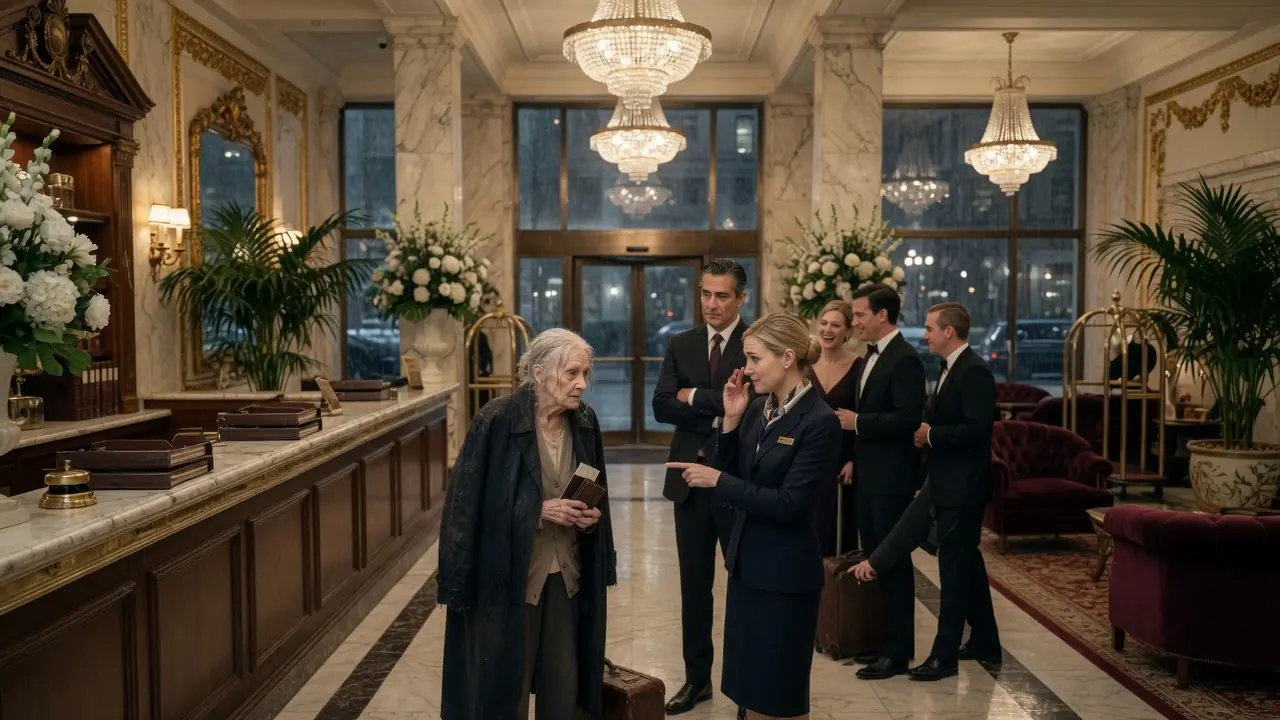
Martin approached with a controlled smile.
“Is there a problem?”
“No problem,” Claire said. “The lady is requesting the Presidential Suite.”
Martin looked at the old woman.
For less than a second, surprise crossed his face.
Then came amusement.
“Ma’am, perhaps there has been a misunderstanding.”
“There has,” the woman replied.
Martin nodded as though they agreed.
“Our Presidential Suite is not a promotional room. It is generally used by heads of state, royal families, and distinguished corporate guests.”
“I know who generally uses it.”
“Then you understand why we require extensive verification.”
Tyler stiffened near the entrance.
Martin’s eyes moved to her hand.
She removed a black card.
Then placed it on the desk.
Claire recognized it immediately.
An invitation-only charge card available to clients with substantial wealth.
The laughter stopped for a moment.
Martin picked it up.
It appeared genuine.
“That card could belong to anyone,” Nathan Cole said behind her.
Martin did not correct him.
Instead, he looked toward Claire.
“Run the authorization.”
Claire inserted the card into the terminal.
The machine processed.
A green message appeared.
APPROVED.
Ten thousand dollars.
Claire blinked.
Martin leaned closer to the screen.
“Run the room charge as well.”
The woman watched without expression.
Claire authorized the full amount.
Again, the screen turned green.
The lobby became quieter.
Nathan lowered his drink.
His companion stopped smiling.
Martin’s expression did not collapse, but it became more careful.
“Of course,” he said. “We will require identification.”
The woman reached inside her coat again.
This time, she removed a passport.
The cover was dark red.
Not American.
She placed it on the counter.
Martin opened it.
His eyes found the photograph first.
The woman was younger there, but unmistakably the same.
Then Martin read the name.
His face lost its color.
He looked at her.
Then back at the passport.
Claire noticed his fingers tighten around the cover.
“What is it?” she asked.
Martin did not answer.
The woman held out her hand.
“My passport.”
Martin returned it immediately.
Claire leaned slightly, trying to see the name.
The woman closed the document before she could.
Martin swallowed.
“Ms. Varga.”
The name meant nothing to Claire.
It meant everything to Martin.
He straightened so quickly that his shoulders nearly snapped into military posture.
“Madam, I apologize. I was not informed that you would be arriving personally.”
The woman placed the passport inside her coat.
“You were not meant to be.”
Martin’s eyes moved toward the lobby.
Every employee who had laughed or watched was now silent.
Claire looked between them.
“Who is she?”
Martin ignored the question.
He turned toward Tyler.
“Notify security that Ms. Varga has arrived.”
The woman raised one hand.
“No.”
Martin stopped.
“No security.”
“Of course.”
“No announcement.”
“Yes, ma’am.”
“And no special treatment beyond what any paying guest should receive.”
Martin’s face tightened.
That last sentence had not been accidental.
Nathan Cole stepped forward.
“Wait. Varga?”
He studied the elderly woman.
“Adriana Varga?”
She turned.
Nathan’s confidence disappeared.
He had recognized the name.
Others in the lobby began to whisper.
Adriana Varga.
Founder of Varga Meridian Holdings.
The woman whose company owned the Grand Meridian Hotel.
Not only that property.
The entire Meridian Collection.
Thirty-eight luxury hotels across North America and Europe.
For more than twenty years, Adriana had remained nearly invisible. Business magazines used old photographs from corporate archives because she rarely attended public events. She had handed daily operations to professional executives, rejected interviews, and spent most of her time working through charitable foundations connected to refugee housing, hospitals, and vocational schools.
Employees knew the name.
Few knew the face.
Martin knew both because he had attended a private executive seminar where Adriana’s photograph appeared beside a list of controlling shareholders.
The old woman standing at the desk was not merely the hotel’s owner.
She was the person whose signature could remove every executive between Martin and the corporate board.
Claire felt the blood leave her own face.
She looked at the worn coat again.
The repaired suitcase.
The rainwater spreading across the marble floor.
Every assumption she had made now stood exposed.
Adriana turned toward her.
“What is your name?”
“Claire Donnelly.”
“How long have you worked here, Ms. Donnelly?”
“Three years.”
“Do you enjoy it?”
The question frightened Claire more than anger would have.
“Yes, ma’am.”
“Do you?”
She hesitated.
“Most days.”
Adriana nodded.
“That is a more useful answer.”
Martin stepped in.
“Ms. Varga, I assure you this is not representative of our service standards.”
Adriana looked at him.
“You stood ten feet away.”
Martin opened his mouth.
“You heard Ms. Donnelly direct me to a cheaper motel before checking availability.”
“I believed she was attempting to help.”
“You heard guests laugh.”
“We cannot control every guest.”
“You can control whether your staff joins them.”
Martin glanced toward Claire.
She looked down.
Adriana continued.
“You then explained which kinds of people were considered suitable for the suite.”
“That was not my meaning.”
“It was exactly your meaning.”
The pianist had stopped playing.
No one complained.
The entire lobby listened.
Adriana picked up the room key Claire had begun preparing.
“Where is the general manager?”
Martin’s expression changed.
“Ms. Bennett is attending the conference dinner.”
“Call her.”
“It may be difficult to reach her during—”
Adriana looked at him.
“Call her.”
Martin removed his phone.
Claire stood frozen behind the counter.
Adriana looked toward her again.
“Please finish the registration.”
Her hands shook as she typed.
“How many nights?”
“Three.”
“Any additional guests?”
“No.”
“Would you like your luggage brought up?”
Adriana looked at the small suitcase.
“I think I can manage it.”
Tyler stepped forward.
“I can take it, ma’am.”
Adriana studied him.
“You did not offer when I entered.”
Tyler stopped.
“No, ma’am.”
“Why now?”
The young attendant’s face reddened.
“Because I know who you are.”
“Then it would not be service.”
Tyler lowered his head.
“No, ma’am.”
Adriana lifted the suitcase herself.
Claire handed her the keys.
“Your suite is on the thirty-second floor. The private elevator is to your left.”
“Thank you.”
She walked away.
Guests moved aside for her.
Not because her clothes had changed.
Because their understanding of her value had.
Adriana noticed.
At the elevator, she turned.
“Nathan Cole.”
Nathan stiffened.
“Yes, Ms. Varga?”
“You are attending the Arclight conference?”
“Yes.”
“I was scheduled to meet your chief executive tomorrow.”
Nathan’s expression became hopeful.
“I would be honored to introduce—”
“That meeting is canceled.”
Nathan stared.
“Ma’am?”
“I do not invest with people who use wealth as permission to humiliate strangers.”
Nathan’s companion looked away.
Adriana entered the elevator.
The doors closed.
The silence remained.
Martin ended the call.
“Ms. Bennett is returning.”
Claire leaned against the desk.
“What happens now?”
Martin glared at her.
“What were you thinking?”
She looked at him in disbelief.
“You were standing there.”
“I arrived after you had already offended her.”
“You told her the suite was for distinguished guests.”
“I was trying to contain the situation.”
“You were laughing too.”
“I did not laugh.”
“You smiled.”
Martin stepped closer.
“Be very careful.”
The old authority returned to his voice, but it sounded weaker now.
Claire looked toward the elevator.
“For three years, you told us to identify a guest’s value before deciding how much attention to give them.”
“That is not policy.”
“No.”
She met his eyes.
“It is culture.”
The general manager arrived fifteen minutes later.
Evelyn Bennett entered through the revolving doors still wearing her evening dress beneath a black coat. She was fifty-one, elegant, sharp-minded, and known for remembering the preferences of repeat guests better than she remembered employees’ birthdays.
Martin met her halfway across the lobby.
He spoke quickly.
Evelyn’s face changed when she heard the name.
“Adriana Varga is here?”
“In the Presidential Suite.”
“Why was I not informed?”
“She did not notify us.”
“What happened?”
Martin hesitated.
Claire watched him decide how much truth to offer.
“There was an unfortunate misunderstanding at check-in.”
Evelyn looked toward the front desk.
“Explain.”
“She arrived without a reservation and requested the Presidential Suite. Claire suggested a more affordable property before verifying her payment.”
Evelyn’s eyes moved to Claire.
“And you?”
“I intervened.”
“How?”
Martin said nothing.
Evelyn understood.
“Lobby camera footage,” she said.
Martin’s face tightened.
“There is no need to turn this into—”
“Pull the footage.”
Evelyn took an elevator to the thirty-second floor.
She found Adriana sitting alone in the suite’s library.
She had removed the wet coat and placed it over the back of a chair. Beneath it, she wore a plain charcoal sweater. The repaired suitcase rested unopened beside the fireplace.
A tray of untouched champagne stood on the table.
Evelyn paused in the doorway.
“Ms. Varga.”
“Ms. Bennett.”
“I am deeply sorry.”
“For what?”
“For the way you were treated.”
“You have not reviewed what happened yet.”
“Martin explained.”
“Then you know his version.”
Evelyn accepted the correction.
“I have ordered the security footage preserved.”
“Good.”
She stepped farther into the room.
“I understand this property is personally important to you.”
Adriana looked toward the rain-streaked windows.
The city lights blurred beyond the glass.
“Do you know why it is called the Grand Meridian?”
“The original hotel stood near the old shipping district.”
“That is the marketing answer.”
Evelyn waited.
Adriana opened the worn suitcase.
Inside were three blouses, a shaving kit that had belonged to her father, a bundle of letters tied with string, and an old black-and-white photograph.
She handed Evelyn the photograph.
It showed a much younger Adriana standing beside her parents and brother in front of a small hotel in Vienna.
The building had six windows and a crooked sign.
MERIDIAN HOUSE.
“My parents arrived in Austria after the Hungarian uprising,” Adriana said. “They had almost nothing.”
Evelyn looked at the photograph.
“My father repaired heating systems. My mother cleaned rooms in a boardinghouse. The owner allowed us to live in the basement.”
She touched the image.
“One winter, a family arrived from Yugoslavia. Their clothes were wet. Their luggage was tied with rope. The receptionist told them the house was full.”
“But it was not?”
“There were four empty rooms.”
Adriana’s expression hardened slightly.
“The owner said poor guests frightened wealthy ones.”
Evelyn looked down.
“My mother gave the family our basement room and moved us into the laundry room.”
Adriana took the photograph back.
“She told me that hospitality begins when appearance stops being evidence.”
She placed it carefully inside the suitcase.
“I named the first Meridian hotel after that boardinghouse. Every property was built around one promise.”
Evelyn knew the wording.
It appeared in employee training manuals.
Every guest enters with dignity already intact. Our task is not to grant it, but to protect it.
She had repeated the sentence in orientation sessions.
Hearing its origin made it feel like an accusation.
“Why did you come without warning?” she asked.
“Three months ago, my foundation director stayed at our Chicago property under another name. Staff directed her to a service elevator because they assumed she was a delivery worker.”
Evelyn remained silent.
“Last month, a retired schoolteacher complained that employees at the Seattle hotel ignored her until they saw her platinum card.”
Adriana looked toward her.
“Both properties had excellent inspection scores.”
“You believed the inspections were staged.”
“I believed managers had learned how to perform values during scheduled visits.”
“And tonight?”
“I wanted to see this hotel without the name arriving before me.”
Evelyn sat opposite her.
“Was the coat deliberate?”
“No.”
“The suitcase?”
“It belonged to my father.”
She looked surprised.
“I attended a memorial outside Worcester this afternoon. The rain delayed my driver, so I took the train and walked the last four blocks.”
“You truly arrived as they saw you.”
“Yes.”
That made the incident worse.
This had not been theater designed to trap the staff.
Adriana had merely entered her own hotel.
“They failed,” Evelyn said.
“No.”
She looked at her.
“They revealed themselves.”
Adriana leaned back.
“Failure can be corrected. Revelation tells us what must change.”
Evelyn asked the question she had been avoiding.
“Are you closing the hotel?”
“No.”
“Firing Martin?”
“I have not decided.”
“Claire?”
Adriana’s expression softened slightly.
“She followed the culture presented to her.”
“That does not excuse her.”
“No.”
“But accountability should move upward before it moves downward.”
Evelyn understood.
The next morning, Adriana attended the executive conference.
She wore the same charcoal sweater and carried no entourage.
The Grand Meridian ballroom held nearly four hundred investors, executives, and financial advisers. A large screen displayed the conference title:
WEALTH, LEGACY, AND RESPONSIBLE GROWTH.
Nathan Cole stood near the front, visibly nervous.
His company’s chief executive had already learned that Adriana canceled their private meeting.
At nine o’clock, Evelyn stepped onto the stage.
“Ladies and gentlemen, our scheduled keynote speaker was unable to attend. However, we are fortunate to have another guest willing to speak.”
Adriana walked to the podium.
A murmur moved through the room as people recognized her.
She rarely appeared publicly.
Phones rose.
Cameras began recording.
Adriana placed no notes on the podium.
“Last night,” she began, “I entered this hotel carrying an old suitcase and wearing a wet coat.”
The room quieted.
“I was advised that a cheaper motel might better suit me.”
Several people glanced toward hotel staff standing near the walls.
“I then asked for the Presidential Suite.”
A few nervous laughs followed.
Adriana waited until they stopped.
“When my card was approved, the staff became uncertain.”
She looked toward Nathan Cole.
“When my passport was read, they became respectful.”
Nathan lowered his eyes.
“That sequence describes a dangerous form of hospitality.”
Adriana rested both hands on the podium.
“Respect that begins after proof of wealth is not respect. It is calculation.”
No one moved.
“Many of you manage companies, funds, hotels, and institutions. You are trained to identify value quickly.”
She looked across the ballroom.
“The danger begins when you confuse market value with human worth.”
On the screen behind her, the conference logo disappeared.
A still image from the lobby camera appeared.
Adriana standing at the desk in her wet coat.
Claire looking toward Martin.
Nathan laughing behind her.
The ballroom shifted uncomfortably.
“I am not showing this image to shame one receptionist,” Adriana said. “I am showing it because she did not create the room around her.”
The next image showed Martin standing near the concierge desk.
Watching.
“Culture is the behavior leadership permits while claiming to value something else.”
Martin stood at the rear wall.
His face had gone pale.
Adriana continued.
“A receptionist can be retrained. A bell attendant can learn to greet before judging luggage. But when a manager watches humiliation and remains silent, the lesson spreads through every employee beneath him.”
Martin left the ballroom before the speech ended.
Nathan remained seated.
Adriana spoke for twenty-three minutes.
She did not mention her personal wealth.
She spoke about her mother giving away a basement room.
About immigrants, elderly travelers, tired parents, and guests who entered luxury spaces already preparing to be judged.
She spoke about the way institutions tested people before offering dignity.
Then she turned toward the conference organizers.
“Yesterday, a man laughed because he believed I could not afford a room.”
Nathan’s chief executive looked at him.
“He became respectful only after learning I controlled an investment his company wanted.”
Nathan stared at the floor.
Adriana’s voice remained calm.
“Character revealed after a name is read is often performance. Character shown before the name is known is evidence.”
The audience rose when she finished.
Adriana did not appear pleased.
Applause was easy.
Change was expensive.
That afternoon, the hotel’s executive team met in the library of the Presidential Suite.
Evelyn attended.
So did Claire, Tyler, human resources, security, and six department heads.
Martin’s chair remained empty.
He had submitted a resignation by email.
Adriana read it aloud.
Martin claimed the event had been misrepresented, that he had attempted to protect hotel standards, and that his reputation no longer allowed him to continue effectively.
“Do you accept it?” Evelyn asked.
“No.”
Claire looked surprised.
Adriana placed the letter down.
“He will attend a formal review. Resignation does not erase responsibility.”
Tyler shifted in his chair.
Adriana looked at him.
“What should you have done when I entered?”
“Offered help with the suitcase.”
“Why?”
“Because I was a bell attendant.”
“Not because I might own the hotel.”
“No, ma’am.”
Adriana turned to Claire.
“What should you have done?”
“Checked availability before deciding what you could afford.”
“And?”
“Explained the rates without using them to make you leave.”
“And?”
Claire swallowed.
“I should have stopped the guests from mocking you.”
“How?”
“I could have said their comments were inappropriate.”
“Would that have risked upsetting them?”
“Yes.”
“Is that why you stayed silent?”
She looked down.
“Yes.”
Adriana nodded.
“Thank you for answering honestly.”
Evelyn looked at her.
“What happens to Claire?”
Claire’s hands tightened.
Adriana answered slowly.
“She remains employed.”
Claire looked up.
“Under conditions.”
She nodded quickly.
“You will complete additional training.”
“Yes.”
“You will also help redesign the arrival process.”
Claire stared.
“Me?”
“You understand exactly how assumptions enter the desk.”
“I was part of the problem.”
“That is why you may be useful in correcting it.”
Adriana turned to Evelyn.
“Every Meridian property will undergo an unannounced dignity audit.”
“What does that include?”
“Guests of different ages, clothing, accents, disabilities, and apparent income levels.”
“Secret shoppers?”
“No.”
Adriana shook her head.
“Human beings are not props. We will partner with organizations whose members already travel and document their real experiences with consent.”
Evelyn took notes.
“Results will affect executive compensation.”
Several department heads shifted.
Adriana noticed.
“If values do not affect reward, they remain decoration.”
The reforms began immediately.
Job evaluations changed.
Employees were assessed on how they treated guests before payment status was known.
Complaint patterns became visible to the board.
Managers could no longer remove negative service reports from internal files without independent review.
The hotel replaced its old guest-ranking software, which alerted staff to high-value clients, with a system that displayed necessary preferences but concealed wealth tiers from most employees.
At first, some executives resisted.
Luxury service, they argued, depended on recognizing important guests.
Adriana answered in one sentence.
“Every guest should be recognized before anyone decides whether they are important.”
Claire became one of the strongest advocates for the changes.
Not because she wanted praise.
Because she had watched herself become someone she did not like.
Months later, she spoke during new employee orientation.
She displayed no photograph of Adriana.
She told them about an old woman with a worn suitcase.
“I thought I was protecting the hotel from someone who did not belong,” she said. “What I was actually protecting was my own assumption from being challenged.”
A trainee asked whether she would have been fired if the woman had not been the owner.
Claire paused.
“No.”
“Then why did it matter?”
“It should not have.”
She looked around the room.
“That is the entire lesson.”
Tyler changed too.
He began greeting every guest before checking luggage, clothing, or transportation.
One evening, another elderly woman arrived carrying grocery bags instead of suitcases.
The doorman assumed she was lost.
Tyler approached and asked whether she needed assistance.
She turned out to be visiting a long-term employee recovering from surgery.
She was not wealthy.
She did not book a room.
Tyler carried the bags anyway.
No executive watched.
That was how he knew the change had become real.
Martin’s formal review uncovered more than silence.
Guest complaints revealed a pattern.
He repeatedly instructed employees to discourage visitors who appeared unable to afford the property.
He altered staff schedules to ensure younger, more attractive employees worked during celebrity events.
He ignored reports that conference guests had harassed housekeeping workers.
He had built a system where wealth received patience and vulnerability received removal.
The company terminated him.
Nathan Cole faced consequences of a different kind.
Arclight Global Partners lost access to a major Meridian investment opportunity.
His chief executive removed him from the conference leadership team.
A video of his laughter spread online after another guest posted the lobby footage.
Nathan issued an apology written by public relations professionals.
Adriana declined to respond publicly.
Six months later, Nathan requested a private meeting.
Adriana agreed.
They met in the Grand Meridian lobby.
Nathan arrived without an assistant.
“I was cruel,” he said.
“Yes.”
“I had been drinking.”
“That made you less careful, not different.”
Nathan accepted the rebuke.
“I lost a promotion.”
“Is that why you are sorry?”
Nathan looked toward the desk.
“At first.”
“And now?”
“My mother was a seamstress. My father repaired elevators. We did not have much money when I was young.”
Adriana waited.
Nathan continued.
“I spent my whole career trying to become someone people could not dismiss.”
“And succeeded by dismissing someone else.”
“Yes.”
Adriana looked at him for a long moment.
“What do you want from me?”
“Another chance.”
“At the investment?”
Nathan hesitated.
“No.”
That answer surprised her.
“I want to know how to stop becoming that person.”
Adriana glanced toward the worn suitcase displayed temporarily near the lobby library.
“You begin by noticing how often that person is rewarded.”
Nathan did not receive the investment.
But he began volunteering through a financial-literacy program Adriana’s foundation supported.
Whether he truly changed remained his responsibility.
Adriana did not believe redemption should be confused with restored access.
The old suitcase became famous after the conference speech.
Evelyn wanted to place it in a glass case with a plaque.
Adriana refused.
“It is luggage.”
“It has become a symbol.”
“That is usually what people call an object before they stop using its lesson.”
She continued carrying it.
The wire loop remained on the broken latch.
When luxury cars arrived at hotels ahead of her, she sometimes asked drivers to stop one block away.
Not to set traps.
To remember what the buildings looked like from the outside.
Three years later, Adriana returned to the Grand Meridian without warning.
This time, she wore an ordinary raincoat.
The suitcase remained worn.
A new doorman opened the door before seeing her face.
“Good evening, ma’am.”
A bell attendant approached.
“May I help with your luggage?”
Adriana handed him the suitcase.
At the desk, a young receptionist greeted her.
“Welcome to the Grand Meridian. Do you have a reservation?”
“No.”
“That is no problem. Let me see what we have available.”
She checked the screen before asking about budget.
“Our standard rooms begin at eight hundred forty dollars tonight. We also have several suites available. I can explain the options or help locate another property if you prefer something different.”
Adriana looked toward Claire.
She now stood several feet away wearing an assistant manager’s badge.
She did not intervene.
The receptionist continued.
“What kind of room would make you most comfortable?”
Adriana smiled faintly.
“The smallest quiet room you have.”
The receptionist completed the booking.
She never asked whether Adriana could afford it.
Only how she wished to pay.
Afterward, Claire approached.
“Did we pass?”
Adriana looked at her.
“This was not a test.”
“It felt like one.”
“That is because you remembered.”
Claire glanced toward the suitcase.
“Do you still carry that everywhere?”
“Almost.”
“Why?”
“My father repaired that latch.”
Claire touched the wire loop carefully.
“You could replace it.”
“Yes.”
“But you won’t.”
“No.”
She smiled.
Adriana studied the lobby.
Guests moved across the marble.
A family in wet coats entered from the rain. Their children carried plastic grocery bags filled with clothes.
The doorman welcomed them.
No one laughed.
No employee looked toward Claire for permission before offering help.
Adriana nodded.
“What?” Claire asked.
“Nothing.”
She took her key.
The Grand Meridian never became perfect.
No institution did.
New employees brought old assumptions.
Wealth continued to influence expectations.
Guests still mistreated staff.
Managers still faced the temptation to protect revenue before people.
But the hotel became honest about the danger.
Every year, new employees heard the story.
Not as a fairy tale about an owner disguising herself as a poor woman.
Adriana had never disguised herself.
She arrived wearing her own coat.
Carrying her father’s suitcase.
The disguise existed only in the minds of those who believed wealth had one appearance.
When Adriana died at eighty-six, the Meridian Collection held a memorial in the Boston ballroom.
Evelyn spoke first.
Claire spoke next.
Tyler, now director of guest services at another property, flew in from Chicago.
The old passport rested beside Adriana’s photograph.
The name that had once drained the color from a manager’s face appeared beneath it.
ADRIANA ILONA VARGA
FOUNDER, MERIDIAN COLLECTION
But the passport was not the most important object in the room.
The repaired suitcase sat beside it.
During the memorial, Claire told the audience what happened the night Adriana arrived.
She did not soften her role.
“I barely looked at her,” she said. “I sent her toward a cheaper motel because I believed her coat told me what she deserved.”
She paused.
“When her card was approved, I became nervous.”
Her voice tightened.
“When her passport was read, I became respectful.”
The room remained silent.
“Ms. Varga taught me that the most revealing part of that night was not that I failed to recognize an owner.”
She looked toward the hotel employees seated near the front.
“It was that I believed an ordinary old woman deserved less.”
After the memorial, the board placed a small brass inscription inside every Meridian lobby.
Not behind the desk.
Near the entrance where employees and guests could both see it.
It read:
A NAME MAY REVEAL STATUS.
APPEARANCE MAY SUGGEST WEALTH.
NEITHER CREATES DIGNITY.
IT ARRIVES WITH THE PERSON.
The Grand Meridian still offered the Presidential Suite.
Heads of state stayed there.
Actors.
Billionaires.
Royal families.
But employees also remembered the elderly guest who entered during a rainstorm wearing a weathered coat.
The woman they nearly turned away possessed enough wealth to buy the building many times over.
That was not why their treatment of her was wrong.
It was only why their mistake became impossible to hide.
Years later, people told the story as though the passport had transformed the old woman in the lobby.
It had not.
Adriana Varga was exactly the same person before Martin read the name.
The coat was still wet.
The suitcase was still worn.
Her voice was still quiet.
The only thing that changed was what everyone else believed she was worth.
And that was the secret the hotel could never again pretend not to see.