Nathan Reed had eighteen dollars left in the world.
Not eighteen dollars in his wallet with more waiting in the bank.
Not eighteen dollars until payday.
Eighteen dollars total.
It was the money standing between his seven-year-old daughter and an empty kitchen.
Yet when the frightened woman beside him whispered that she could not afford the bus fare home, Nathan handed her every crumpled bill.
All eighteen dollars.
An hour earlier, he had lost his job.
The next morning, five black SUVs stopped outside his apartment.
And walking toward his door was the woman from the bus stop—only now she wore a charcoal suit, carried herself like someone accustomed to being obeyed, and was surrounded by attorneys and security officers.
“We need to talk,” she said.
Nathan had no idea that the eighteen dollars he had given away were about to pull him into a betrayal involving stolen money, a staged robbery, and the most powerful woman he had ever met.
But first, he had to survive the night.
Nathan had not eaten since the previous morning.
At first, his stomach had complained loudly.
By evening, even the hunger seemed tired.
He walked through the industrial district with his hands inside the pockets of his worn work jacket, replaying the meeting that had ended his employment.
The supervisor’s office had smelled of burned coffee and machine oil.
Across the desk sat Martin Graves, the operations manager of Westbridge Equipment Supply. Beside him were two employees Nathan had worked with for years: Colin Price and Teresa Boone.
Colin kept staring at the floor.
Teresa would not look at Nathan at all.
Martin slid several photographs across the desk.
They showed expensive electronic components missing from a secured storage cage.
“We have two witnesses who saw you near the inventory room after your shift,” Martin said.
“I was repairing the scanner system.”
“You did not have authorization.”
“I had a work order.”
“No work order was entered.”
Nathan stared at him.
“Colin called me.”
Colin finally looked up.
“I never called you.”
The lie landed quietly.
That made it worse.
Nathan had worked at Westbridge for six years. He maintained the inventory scanners, supervised loading records, and corrected shipping discrepancies before they became expensive mistakes.
He had never stolen so much as a box of screws.
“Check the call logs,” Nathan said.
Martin folded his hands.
“Your access code opened the cage.”
“Because Colin asked me to reset the reader.”
Colin shook his head.
Nathan understood then.
This was not a misunderstanding.
The conclusion had been arranged before he entered the room.
Martin pushed the termination form toward him.
“We are not contacting police if the equipment is returned.”
“I didn’t take it.”
“The company is giving you an opportunity to leave quietly.”
“You are firing me based on two people saying the same lie.”
Martin’s expression did not change.
“Sign the form.”
Nathan did not sign.
He stood, placed his access badge on the desk, and walked out with a cardboard box containing a photograph of his daughter, a chipped coffee mug, and a screwdriver set he had purchased himself.
His truck had been repossessed two months earlier after medical bills from his late wife’s illness finally caught up with him.
That left the bus.
The last route home was due at eleven.
Nathan reached the stop shortly after ten.
A flickering light illuminated the metal bench. He sat down and leaned back, the cardboard box between his shoes.
His daughter, Ellie, would be waiting at their apartment.
Mrs. Kate from downstairs had agreed to watch her after school. Nathan had promised he would bring groceries home.
Milk.
Bread.
Eggs.
A small box of the cereal Ellie liked.
He touched the eighteen dollars in his wallet.
It was not enough for all of it.
But it was something.
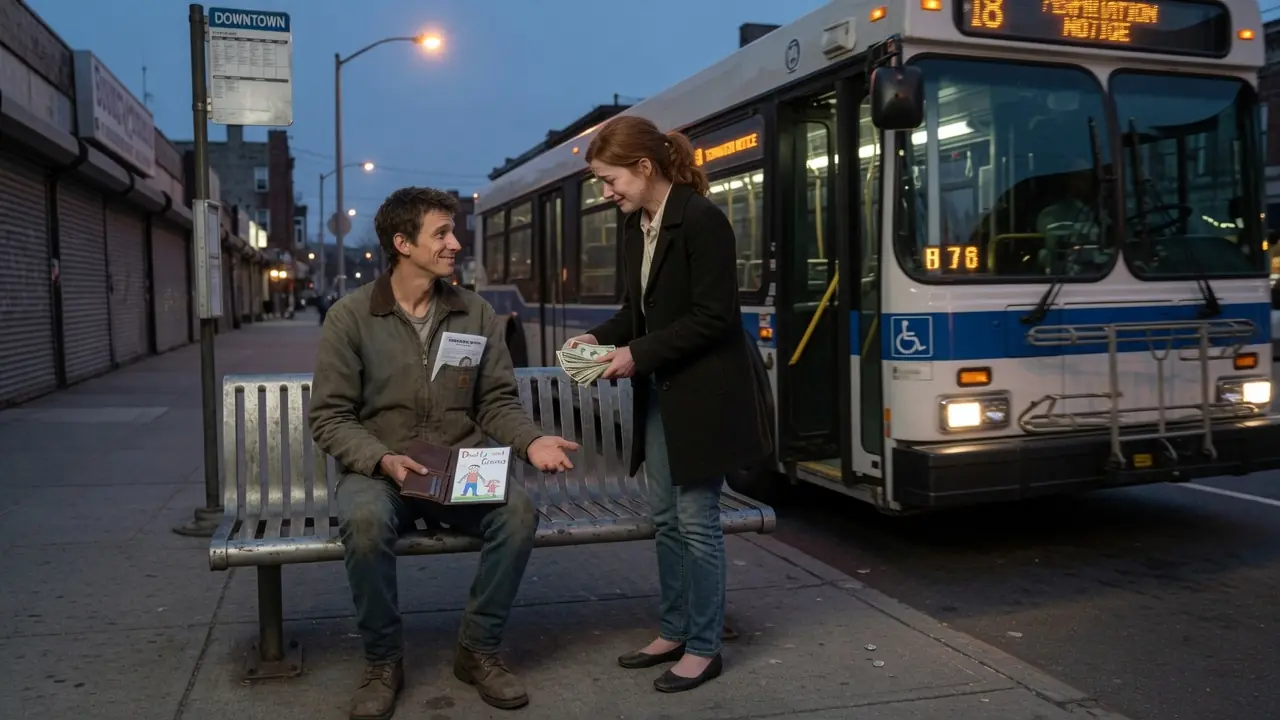
A woman sat at the far end of the bench.
Nathan barely noticed her until he heard the sound of coins falling.
She crouched quickly and gathered them from the pavement.
Her hands were shaking.
She appeared to be in her late thirties. Her jeans were dirty near one knee, and a rip crossed the sleeve of her blouse. Her hair, normally arranged with care, had come loose around her face.
She counted a small stack of bills.
Then counted again.
Each time, her expression became more desperate.
Finally, she looked toward Nathan.
“Excuse me.”
Her voice cracked.
“I’m sorry. Do you have any change?”
Nathan studied her.
Tear tracks marked both cheeks. Her breathing was shallow, and one wrist was badly scraped.
“How much do you need?”
“I’m short for the bus.”
She looked embarrassed by the admission.
“My purse was stolen. My phone too. I just need to get across town.”
Nathan opened his wallet.
Two five-dollar bills.
Eight ones.
Eighteen dollars.
If he kept it, he could ride home and purchase enough food for breakfast.
If he gave it away, he would walk four miles in the dark.
The woman stared at the coins in her palm.
Something about her expression reminded Nathan of the night the doctor told him his wife, Sarah, had only weeks left.
The same helpless calculation.
Too much needed.
Not enough available.
Nathan removed the money.
“Here.”
The woman looked at the bills.
“That’s too much.”
“Take it.”
“I only need the fare.”
“You may need something when you get there.”
Her eyes filled.
“I can’t accept all of it.”
Nathan held the money between them.
“Please.”
She took it slowly.
“I don’t know what to say.”
“You don’t have to say anything.”
“My name is Vivian.”
“Nathan.”
“I will pay you back.”
He nodded, though he did not expect to see her again.
The bus arrived.
Before boarding, Vivian looked back.
“Why did you do this?”
Nathan glanced at his box from Westbridge.
“You looked like you were having a worse night than I was.”
Vivian stepped onto the bus.
Nathan watched it disappear.
Then he lifted the cardboard box and began walking.
The journey home took more than an hour.
His left shoe developed a blister.
Rain began during the final mile.
By the time he reached the apartment building, his clothes were wet and his legs ached.
Mrs. Kate opened her door before he could climb the stairs.
“She ate macaroni and cheese,” the elderly woman said. “I put her to bed about an hour ago.”
Nathan looked toward the ceiling.
“Thank you.”
“You look terrible.”
“I lost the job.”
Mrs. Kate’s face softened.
“Oh, Nathan.”
“I’ll figure it out.”
“You always say that.”
“So far, I’ve been right.”
She touched his arm.
“There is soup in my refrigerator.”
“I’m not taking your dinner.”
“It is too late to argue.”
Nathan ate half the soup and saved the rest for Ellie.
Then he stood in his daughter’s doorway.
Ellie slept on her side with one hand beneath her cheek, exactly as Sarah once had.
A drawing rested near the pillow.
Three figures stood beneath a yellow sun.
Ellie.
Her father.
Her mother.
Sarah had been gone for three years.
Ellie still drew her into every family picture.
Nathan sat at the kitchen table until dawn.
He arranged unpaid bills into separate piles.
Rent.
Electricity.
Sarah’s final hospital balance.
The school lunch account.
He wrote down the names of construction companies that sometimes hired day laborers.
At seven, Ellie entered the kitchen in purple pajamas.
“You’re home.”
“I am.”
“Did you bring cereal?”
Nathan looked at the empty counter.
“No.”
Her face fell.
“Mrs. Kate gave us soup.”
“For breakfast?”
“We are pioneers.”
Ellie smiled.
“Pioneers eat soup?”
“The successful ones do.”
They warmed the soup.
At eight, someone knocked.
Nathan expected Mrs. Kate.
Or the landlord.
When he opened the door, he forgot how to speak.
Five black SUVs lined the street outside the building.
Men and women in expensive suits stood along the sidewalk. One wore an earpiece. Another carried a leather folder.
Walking toward Nathan was Vivian.
The frightened woman from the bus stop had disappeared.
This Vivian wore a charcoal suit and low black shoes. Her hair was neatly tied behind her head. A small bandage covered the scrape on her wrist.
She stopped at the bottom of the steps.
“Good morning, Nathan.”
He looked toward the vehicles.
“What is this?”
“My security director overreacting.”
A tall man beside one SUV raised an eyebrow.
Vivian added, “Slightly.”
Ellie appeared behind Nathan.
“Daddy, are we in trouble?”
Vivian’s expression softened.
“No. Your father helped me last night.”
Ellie looked at the cars.
“Did he fix all of those?”
Vivian smiled.
“Not exactly.”
Nathan stepped outside and closed the door halfway behind him.
“How did you find me?”
“You gave me your first name. The bus camera gave my security team a clear image. The employment badge inside your box provided the rest.”
Nathan looked down.
The Westbridge logo remained printed on the cardboard.
“That feels invasive.”
“It was.”
Vivian did not defend it.
“I wanted to find the man who gave a stranger his last eighteen dollars. But I should have considered how appearing like this would feel.”
She turned toward the security director.
“Please move the vehicles down the street.”
The man began issuing instructions.
Vivian looked toward Nathan.
“May I come inside?”
His apartment had peeling paint near the windows. One dining chair was held together with silver tape.
He felt ashamed of the sudden comparison between her world and his.
Then he remembered how she had looked the night before.
He opened the door.
“Come in.”
Vivian entered alone.
Ellie sat at the table with her soup.
Vivian crouched beside her.
“I’m Vivian.”
“I’m Ellie.”
“I know.”
Ellie narrowed her eyes.
“How?”
“I asked people about your father.”
“Are you a police officer?”
“No.”
“Teacher?”
“No.”
“Spy?”
“Not officially.”
Nathan cleared his throat.
“Ellie, get dressed for school.”
After she left, Vivian placed eighteen dollars on the table.
Nathan looked at it.
“You didn’t need an attorney and five cars to return that.”
“I didn’t come only for the money.”
She sat across from him.
“My full name is Vivian Cross. I own Crosswell Strategy Group.”
Nathan recognized the name.
The company managed advertising, logistics, and market research for major national brands. Its headquarters occupied a glass tower downtown.
Newspapers estimated Vivian’s personal wealth at more than sixty million dollars.
Nathan looked toward the doorway Ellie had entered.
“Last night you said your purse was stolen.”
“It was worse than that.”
Vivian folded her hands.
“Someone directed me into a trap. My car, phone, wallet, and work laptop were taken. The thieves knew where I would be and which vehicle I was using.”
“Did they hurt you?”
“One pushed me down. The wrist is the worst of it.”
Nathan nodded toward the security outside.
“I understand the cars now.”
“My staff found me after the bus reached the western terminal. By then, someone had tried to access company accounts using information from my laptop.”
“Who knew where you were?”
“My executive assistant, my driver, three senior officers, and the client I was meeting.”
“You think it was someone inside your company.”
“Yes.”
“Then call the police.”
“I have.”
Vivian looked at the bills on Nathan’s table.
“I came because my security team investigated you while searching for me.”
Nathan’s face tightened.
“You investigated me too.”
“I authorized a basic background check before coming here.”
She did not soften the truth.
“I learned that you were fired yesterday for theft.”
“I didn’t do it.”
“I know.”
Nathan stared at her.
“How?”
“Westbridge’s security chief formerly worked for my company. I asked him to preserve the access logs. Your code opened the cage, but the warehouse camera shows Colin Price entering twenty minutes later and leaving with two containers.”
Nathan’s hands became still.
“The camera shows that?”
“Yes.”
“Then why was I fired?”
“The relevant section had been removed from the file reviewed by management. The original remained on the server.”
He looked away.
For twelve hours, Nathan had believed his life might collapse because nobody cared enough to examine the complete evidence.
Vivian continued.
“I also learned what you did at Westbridge. Inventory controls. Equipment records. Vendor verification.”
“I repaired scanners.”
“You also identified a shipping fraud two years ago.”
“That was my job.”
“And now I have a problem involving internal access, fraudulent transactions, and people I no longer know whether to trust.”
Nathan understood where the conversation was going.
“No.”
Vivian looked surprised.
“You have not heard the offer.”
“You want to hire me because I gave you money.”
“I want to offer you temporary work because you have relevant experience and because the existing evidence suggests you were framed.”
“You don’t know me.”
“I know you made an irrationally generous decision when you believed there was no reward.”
“That does not make me an investigator.”
“No.”
She nodded.
“It makes you someone I’m willing to place beside trained investigators.”
Vivian explained the proposal.
Nathan would not lead the criminal inquiry.
A forensic accounting firm and outside counsel were already involved.
He would work as a temporary operations consultant, reviewing inventory data, access records, vendor invoices, and shipment histories under the supervision of the company’s chief financial officer.
The contract would last sixty days.
His compensation would be established by the firm’s standard consulting rate—not by Vivian personally.
“If you find nothing,” she said, “you are still paid.”
“And if I refuse?”
“Westbridge has already been told to review your termination. That is separate.”
“You did that?”
“I asked them to preserve evidence. Their leadership made its own decision after seeing the video.”
Nathan looked toward Ellie’s school backpack near the door.
“What happens to Colin and Teresa?”
“That is for Westbridge and the police.”
Vivian leaned forward.
“Nathan, I am not offering charity.”
“It feels like it.”
“Then say no.”
He looked at her.
She did not plead.
She did not mention the eighteen dollars again.
For the first time since losing his job, Nathan was being offered a choice rather than a rescue.
“When would I start?”
“Tomorrow.”
“I don’t own a suit.”
“The position requires judgment, not expensive fabric.”
Vivian stood.
“Think about it until this afternoon. My attorney will leave the contract.”
Ellie returned wearing her school clothes.
Vivian smiled at her.
“Do you like soccer?”
Ellie’s face brightened.
“I play forward.”
“Are you good?”
“I’m fast.”
“Nobody asked if you were humble.”
Ellie laughed.
Nathan watched them.
Something inside him, exhausted and frightened, allowed a small amount of hope.
He accepted the contract.
His first morning at Crosswell Strategy felt like entering another country.
The lobby contained polished stone, modern sculptures, and windows stretching three stories high. Employees moved through the building with badges clipped to tailored clothing.
Nathan wore a department-store shirt borrowed from Mrs. Kate’s grandson and a tie he had not used since Sarah’s funeral.
Vivian met him near reception.
“You look uncomfortable.”
“I feel underdressed.”
“Half these people are underqualified. Clothing is easier to fix.”
She led him to a conference room.
Inside waited Elena Torres, Crosswell’s chief financial officer, and David Mercer, the head of the outside forensic team.
Elena was in her fifties, with silver beginning at her temples and the skeptical expression of someone paid to distrust convenient explanations.
She looked at Nathan’s file.
“You have no accounting degree.”
“No.”
“No corporate investigative experience.”
“No.”
“What exactly qualifies you to review our records?”
Nathan could have mentioned Vivian’s confidence.
Instead, he answered honestly.
“I know how inventory systems are manipulated because I repaired them for six years. I know what false work orders look like, how vendors hide duplicate numbers, and how employees borrow access codes from people they plan to blame.”
Elena looked toward Vivian.
“That is a better answer than ‘I trust him.’”
Vivian sat down.
“I thought so too.”
For the first week, Nathan reviewed data nobody else considered important.
Delivery times.
Laptop serial numbers.
Temporary vehicle assignments.
Employee access badges.
Purchase orders entered just below the amount requiring senior approval.
He did not solve the case through instinct.
He found small inconsistencies and brought them to people with more expertise.
One company repeatedly billed Crosswell for courier services.
Its registered address was a rented mailbox.
The invoices were approved by Vivian’s executive assistant, Derek Sloan.
Another vendor supplied electronic equipment that never appeared in company inventory.
Derek approved those invoices too.
The amounts began small.
Four hundred dollars.
Eight hundred.
Then several thousand.
Over eighteen months, more than one hundred and twenty thousand dollars had moved through false vendors.
Elena and the forensic team traced the money to accounts controlled by Derek’s cousin.
The staged robbery had a separate purpose.
Vivian’s laptop contained an encrypted copy of an internal audit scheduled to begin the following week.
Derek knew the false vendors would be discovered.
He arranged for a security contractor to take the car and devices after Vivian’s client dinner. He intended to make the financial losses appear connected to an outside breach.
The thieves were supposed to abandon Vivian unharmed.
Instead, one panicked and pushed her.
Derek planned to leave the country before auditors understood what had happened.
Nathan spread the timeline across the conference table.
“He didn’t expect you to recover the laptop account quickly.”
Vivian studied the records.
“He expected me to spend the night dealing with the robbery.”
“And he expected you to trust him because he would appear helpful.”
Elena looked toward Nathan.
“What made you check the temporary vehicle request?”
“Derek insisted Vivian use his car.”
“That seemed suspicious?”
“No.”
Nathan pointed toward the digital form.
“The request was entered after she had already left the office. Someone changed the time stamp.”
The forensic technician confirmed it.
Police arrested Derek two days later at the airport.
He was carrying two passports, a laptop, and a one-way ticket to Lisbon.
As officers led him through the Crosswell lobby, he saw Nathan beside Vivian.
“You hired the warehouse thief?” Derek said.
Nathan did not react.
Vivian did.
“He was cleared.”
“You found him at a bus stop.”
“No,” Vivian said. “I found him when nobody else was looking.”
Derek laughed bitterly.
“You think this makes him loyal?”
Vivian’s expression hardened.
“No. His choices make him trustworthy. That is a distinction you never understood.”
Derek was removed.
The investigation continued for months.
Nathan’s contract was extended, then converted into a permanent position inside Crosswell’s compliance department.
He did not report directly to Vivian.
At Elena’s insistence, his salary, promotion reviews, and assignments were controlled independently.
“You saved the company from a conflict,” Vivian told Elena.
“I saved both of you from foolishness neither of you has committed yet,” Elena replied.
At the time, Nathan pretended not to understand.
He understood perfectly.
Vivian began visiting his office more often than necessary.
Sometimes she brought coffee.
Sometimes she asked questions that could have been sent by email.
Nathan noticed the way she laughed when work stopped pressing against her shoulders.
Vivian noticed that Nathan never agreed merely because she was the owner.
Outside the office, their lives began crossing through Ellie.
Vivian attended a Saturday soccer match after Ellie invited her.
She arrived late, wearing jeans and carrying a handmade sign with Ellie’s number.
Ellie ran across the field before the game began.
“You came!”
“You asked me.”
“Adults say things and then get busy.”
Vivian looked toward Nathan.
“Some do.”
She crouched beside Ellie.
“I promised.”
During the second half, Ellie scored from the edge of the penalty area.
Vivian leaped from the bleachers and shouted louder than anyone.
Nathan was supposed to watch his daughter.
Instead, he watched Vivian.
The joy on her face contained no calculation.
After the match, they bought ice cream and walked through the park.
Ellie ran ahead, chasing pigeons.
“She is remarkable,” Vivian said.
“She gets that from Sarah.”
“Her mother?”
Nathan nodded.
“She died three years ago.”
Vivian slowed.
“I’m sorry.”
“She had ovarian cancer. We spent two years fighting it.”
“You loved her.”
“I still do.”
Vivian looked toward Ellie.
“That doesn’t end because the person does.”
Nathan glanced at her.
Most people became uncomfortable when he spoke about Sarah. They treated grief as evidence that he was not ready for the present.
Vivian did not.
“My father left when I was eight,” she said. “My mother raised me alone.”
“Is that why you built the company?”
“Partly.”
They reached a bench.
“My mother worked three jobs. I thought money would make me feel safe.”
“Did it?”
“It made certain problems easier.”
Vivian looked toward the office towers in the distance.
“But it also attracted people who became skilled at appearing loyal.”
“Like Derek.”
“Like others before him.”
Ellie called from a tree.
“Daddy, look!”
Nathan lifted his head.
“You’re too high.”
“I’m an explorer.”
“You’re an insurance claim.”
Vivian laughed.
The moment between them passed.
It did not disappear.
Over the following months, Vivian became part of their weekends.
She attended soccer games.
She helped Ellie build a model solar system for school.
She learned that Nathan’s pancakes were always burned on one side.
He learned that Vivian could manage a multimillion-dollar negotiation but could not braid a child’s hair without watching three instructional videos.
Ellie began drawing three people again.
This time, Sarah remained in the corner as a small figure near a star.
Vivian stood beside Nathan and Ellie.
The first time Nathan saw the drawing, fear moved through him.
Ellie was attaching herself to Vivian.
So was he.
Yet Vivian was still the owner of the company employing him.
She had found him when he was desperate.
Every difference between them mattered.
Money.
Power.
Gratitude.
Access.
Nathan began creating distance.
He stopped joining weekend outings.
He kept conversations professional.
When Vivian asked whether something was wrong, he claimed to be busy.
She did not believe him.
Elena confronted him first.
“You have two options.”
Nathan looked up from his computer.
“About what?”
“You either stop looking at Vivian as if she is the answer to a question you are afraid to ask, or you create enough professional distance to ask it honestly.”
Nathan closed the spreadsheet.
“She is my employer.”
“Correct.”
“She changed my life.”
“You changed hers too.”
“That is not the same.”
“No. It is equally complicated.”
Elena sat across from him.
“There is an open position with the independent compliance subsidiary we are creating. It reports to the board committee, not Vivian.”
“You’re offering it because of this?”
“I’m offering it because you are qualified.”
“And the timing?”
“The timing is because everyone in this building has eyes.”
Nathan accepted the new role after a formal interview.
Vivian did not participate in the decision.
Three months passed before he allowed himself to ask her to dinner.
Not a business dinner.
Not an evening involving Ellie.
Just the two of them.
Vivian listened to the invitation.
Then she said, “Are you sure?”
“No.”
“That is not encouraging.”
“I’m sure I want to go. I’m not sure we understand everything that comes with it.”
“Good.”
“Good?”
“I would worry if you thought this was simple.”
Their first date took place at a small Italian restaurant.
Vivian arrived without security inside the dining room.
Nathan paid.
When she protested, he said, “You already returned the eighteen dollars.”
“That did not cover interest.”
“There was no loan agreement.”
“You work in compliance. You should know verbal agreements matter.”
They laughed.
They spoke about their fears directly.
Nathan did not want to become a project.
Vivian did not want love confused with gratitude.
He refused to let her solve every financial problem.
She refused to pretend their wealth difference did not exist.
They continued seeing a counselor for several months—not because the relationship was failing, but because neither wanted to repeat patterns that had already cost them too much.
Vivian helped Ellie only with Nathan’s agreement.
Nathan accepted assistance only when it did not place control in Vivian’s hands.
The unpaid hospital bills were settled through a debt-reduction program available to other families as well, not through a private payment designed to make Nathan indebted.
Vivian learned that generosity without permission could feel like invasion.
Nathan learned that accepting care did not erase independence.
They argued.
Sometimes badly.
He accused her of trying to manage emotions like a company.
She accused him of treating poverty as proof that he understood suffering better than anyone else.
Both apologized when the accusation contained truth.
A year after the bus stop, Vivian stood inside Nathan’s apartment kitchen while Ellie decorated a birthday cake.
The kitchen was still small.
The chair still carried silver tape.
Vivian had stopped offering to replace it.
Ellie placed too many candles on the cake.
“How old do you think your father is?” Vivian asked.
“Very.”
Nathan entered from the hallway.
“Thank you.”
Ellie looked between them.
“Are you going to get married?”
Nathan nearly dropped the plates.
Vivian remained calm.
“Why do you ask?”
“Because you already argue like married people.”
Nathan sat down.
“Marriage is more complicated than arguing.”
“Mrs. Kate says it’s mostly arguing and sharing blankets.”
Vivian laughed so hard she had to lean against the counter.
Eighteen months after they began dating, Nathan took Vivian back to the bus stop.
The light had been repaired.
The bench had been replaced.
He carried no elaborate decorations.
Ellie waited inside Mrs. Kate’s apartment, though she knew exactly what was happening.
Nathan stood with Vivian beneath the new light.
“I hated this place for a while,” he said.
“Why?”
“Because people told the story as if I gave away eighteen dollars and won a wealthy woman.”
Vivian looked toward him.
“You did not win me.”
“I know.”
He removed a small ring from his pocket.
“I gave you money because you were frightened. You offered me work because you needed someone honest. Everything after that required choices neither of us owed the other.”
Vivian’s eyes filled.
Nathan continued.
“I loved Sarah. I will always love her.”
“I know.”
“I love Ellie more than I know how to explain.”
“I know that too.”
“And I love you without needing those truths to compete.”
Vivian covered her mouth.
“Nathan.”
“I do not have five black SUVs.”
“Thank God.”
“I have one unreliable sedan and a daughter hiding nearby because she refused to miss this.”
A small face disappeared behind the corner of the bus shelter.
Vivian laughed through her tears.
Nathan lowered himself onto one knee.
“Vivian Cross, will you build a life with us?”
She looked at the ring.
Then at the man who once walked four miles home because he could not watch a stranger suffer.
“Yes.”
Ellie ran from hiding before Nathan had finished placing the ring on Vivian’s finger.
“I knew it!”
She threw both arms around them.
The three nearly fell onto the bench.
Their wedding took place the following spring in Vivian’s mother’s garden.
It was small.
Elena attended.
Mrs. Kate sat in the front row.
Ellie carried the rings and spoke briefly about her mother, Sarah, before welcoming Vivian into the family.
Nathan cried openly.
Vivian did too.
They did not describe their marriage as fate.
Derek’s betrayal did not deserve credit.
The wrongful termination did not become necessary because something good followed it.
Pain was not made beautiful simply because people survived.
What mattered was what Nathan and Vivian chose after the worst nights of their lives.
Nathan chose compassion when he believed it would cost him.
Vivian chose to investigate before accusing anyone.
Nathan accepted opportunity without surrendering his dignity.
Vivian learned that love could not be structured as repayment.
Years later, the eighteen dollars remained inside a small frame in their home.
Not the original bills.
Those had been spent on the bus fare, a bottle of water, and a public telephone call.
Vivian replaced them with one ten, one five, and three ones.
Beneath the glass were two sentences.
He did not give because he expected a return.
She did not return because she owed him a life.
Ellie, older by then, asked why they kept money on the wall.
Nathan looked toward Vivian.
“Because people remember the SUVs.”
Vivian nodded.
“They forget the walk home.”
That was the part that mattered most.
When Nathan handed over his last eighteen dollars, no security team was waiting.
No company knew his name.
No reward had been promised.
He was a hungry father who had just been falsely accused, and the woman beside him looked as though the world had abandoned her.
He could not repair his own life that night.
So he helped someone survive the next hour.
It was not a business decision.
It was not an investment.
It was kindness offered without evidence that kindness still mattered.
The next morning, five black SUVs arrived outside his apartment.
But the vehicles did not change Nathan’s life.
The choice he had made before they appeared already had.