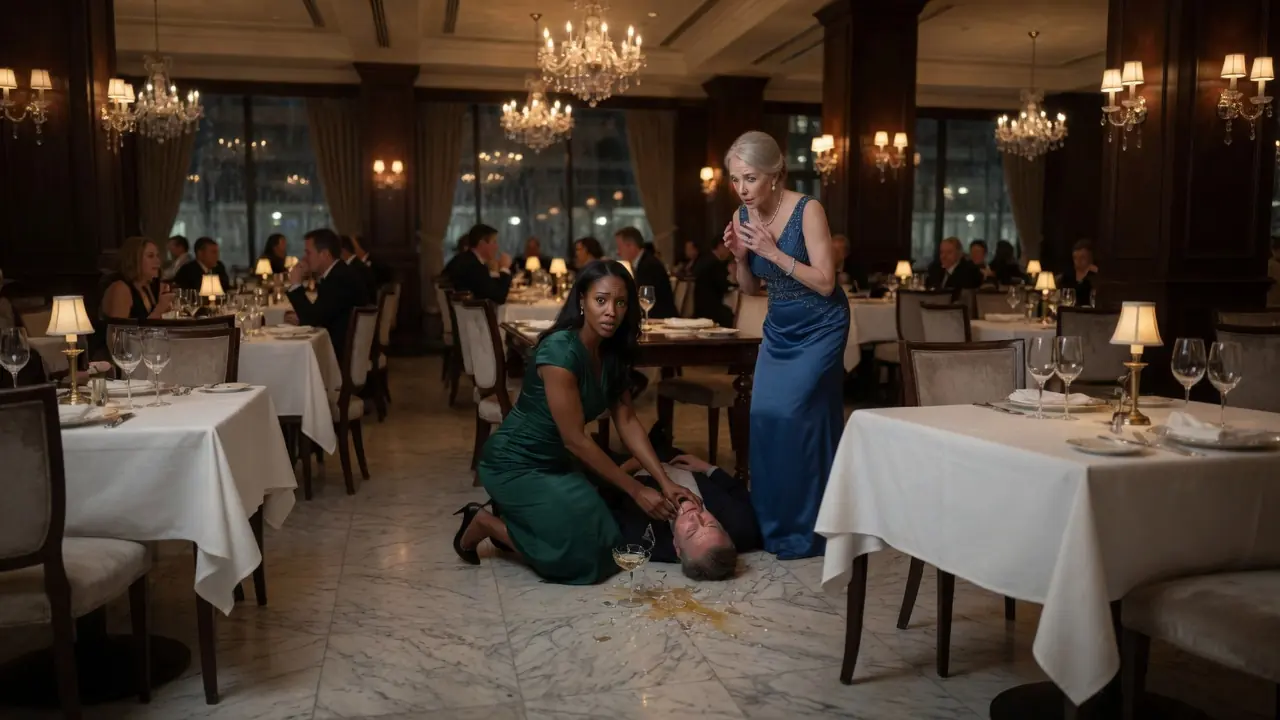
The crystal champagne glass slipped from William Harper’s trembling hand before anyone understood what was happening. One second he was standing beside the bar at Lux Haven, smiling weakly at a business acquaintance under the glow of chandeliers. The next second, the glass fell, struck the marble floor, and shattered with a sound sharp enough to cut through the string quartet’s music. Champagne spread in a pale stream beneath the mahogany table, and the entire restaurant seemed to hold its breath.
Dr. Quinn Marshall turned at the sound before anyone screamed. She had been standing near the reserved Harper table with her coat in one hand, seconds away from leaving the dinner and the relationship that had brought her there. Her emerald green silk dress brushed the floor as she pivoted, her long black hair moving over her shoulder, her deep brown eyes sharpening instantly. The hurt that had been sitting in her chest only moments earlier disappeared behind the calm focus of a doctor.
William tried to steady himself on the back of a chair. His hand missed. The chair scraped backward, legs shrieking against the marble, and his knees buckled beneath him. He collapsed beside the broken glass, his navy suit crumpling as his body hit the floor hard enough to send a wave of panic through the room.
Evelyn Harper froze across from Quinn. Only minutes earlier, Evelyn had stood in her sapphire evening dress, pearl necklace shining, silver-blonde hair arranged in a perfect chignon, speaking to Quinn with polished cruelty about background, family, and belonging. She had made it clear that Quinn’s Columbia degree, medical career, and grace were still not enough to make her worthy of William’s world. But now William was on the floor, pale and barely responsive, and Evelyn’s old-money confidence cracked into fear.
“William!” Evelyn cried, her voice breaking so sharply that people at nearby tables turned. Rachel Harper stood behind her mother, her ivory dress glowing under the chandelier, her hands flying uselessly to her mouth. Guests rose from their chairs, champagne glasses clinking, forks dropping, whispers becoming gasps. But no one moved toward William. No one knew what to do.
Quinn dropped her coat at once. She crossed the space in two fast steps and knelt beside William, careful to avoid the broken glass near his hand. Her fingers went to his wrist, then to his neck, checking for pulse with practiced precision. His skin was cold and damp, his breathing uneven, his face drained of color. The man who had failed to defend her ten minutes ago was no longer her silent boyfriend; he was a patient in danger.
“He’s having a serious medical emergency,” Quinn said, her voice firm enough to stop the room from unraveling. “Call 911 now.” The words cut through the panic like a command bell. A server fumbled for his phone, nearly dropping it before another guest snatched it up and dialed.
Evelyn stared at Quinn as if seeing her for the first time. Quinn’s hands moved with certainty, turning William carefully onto his side, keeping his airway clear, watching the rhythm of his chest. She checked his response, called his name, and studied the slight pull at one side of his mouth. Her face remained composed, but her mind was moving through possibilities quickly and cleanly.
“Will, stay with me,” Quinn said, her voice lower now, meant for him. “Can you hear me?” William’s eyes fluttered, unfocused and frightened. He tried to speak, but only a broken sound escaped. Quinn placed one steady hand near his shoulder. “Don’t fight it. Breathe.”
The restaurant had transformed from elegance into helpless confusion. Lux Haven’s marble floors, velvet drapes, gold-trimmed walls, white tablecloths, and glittering chandeliers suddenly looked useless against the crisis unfolding beneath them. A moment ago, the room had been a stage for status. Now it was only a room full of people who had money, manners, and no control.
Evelyn took one step forward, then stopped. “Quinn,” she whispered, voice trembling. The name sounded different now. Earlier, she had said it like a test, like something she could weigh and reject. Now she said it like a plea.
Quinn did not look up. “Step back, Mrs. Harper. Give him air.” Evelyn obeyed immediately, though the command came from the same woman she had spent the evening belittling. Rachel clutched her mother’s arm, tears gathering in her eyes. She looked between Quinn and William, finally understanding that every cruel word she had thrown across the table now sat between them like broken glass.
Only fifteen minutes earlier, the dinner had been unbearable in a quieter way. Quinn had arrived at Lux Haven hoping to meet the family of the man she loved. William Harper, thirty-four, a white tech entrepreneur with a quick smile and big dreams, had promised her his mother and sister would see what he saw. He had told her they would love her. He had said it with such certainty that Quinn had wanted to believe him.
But from the moment she sat down, Evelyn and Rachel had examined her like an intruder in silk. Evelyn had questioned her background with a smile too clean to be called openly hostile, asking about Brooklyn as if it were a stain. Rachel had called her success lucky, asked whether being a general practitioner was enough to make a real living, and wondered aloud whether Quinn’s parents were surprised she had climbed so far. Each sentence wore perfume and pearls, but underneath, the message was clear.
Quinn had answered with dignity. She spoke of her parents, a nurse and a bus driver who had worked until their bodies hurt so she could study. She spoke of Columbia Medical School, years of training, and patients she had helped. She defended herself without raising her voice. But William had not been there when she needed him.
He had drifted toward the bar, laughing with an associate, leaving Quinn alone with his mother and sister. Maybe he had not heard everything. Maybe he had heard enough and chosen comfort over courage. Either way, his absence had landed harder than their insults. By the time Quinn stood to leave, she had already decided that love without protection was not love she could keep.
Now William lay on the marble floor, and Quinn was saving him anyway. Not because Evelyn deserved mercy. Not because Rachel deserved grace. Not because William had earned forgiveness in the last hour. Quinn saved him because that was who she was.
The server returned from the host stand, speaking urgently into the phone with emergency services. “They’re asking what happened,” he said, voice shaking. Quinn answered without looking away from William. “Adult male, thirty-four, sudden collapse, altered responsiveness, possible neurological event. Breathing uneven but present. Tell them we need paramedics immediately.”
The server repeated her words into the phone. Around them, guests began to clear the area, not because they knew how to help, but because Quinn’s authority gave them something to obey. Chairs moved back. Someone pulled the broken glass farther away with a folded napkin. Another server brought towels. The room began to organize itself around Quinn’s calm.
Evelyn’s hands trembled against her pearl necklace. “Is he going to die?” The question came out small, stripped of all the social polish she had worn like armor. Quinn looked up for half a second. “I’m doing everything I can until paramedics arrive.” There was no comfort in her voice, but there was truth. At that moment, truth was more valuable than comfort.
Rachel began crying openly. “Quinn, please,” she said. “Please help him.” Quinn’s eyes flicked to her. “I am.” The answer was not cruel. It was exact. Rachel lowered her gaze, ashamed by the simplicity of it.
William’s hand twitched near the floor. Quinn noticed immediately. “Will, squeeze my fingers if you can hear me.” She placed two fingers into his palm. His grip was weak, uneven, but present. “Good,” she said quietly. “Stay with me.” His eyes moved toward her voice. Something like recognition flickered there.
For one painful second, Quinn remembered the man she had loved. She remembered late-night takeout after long hospital shifts, him waiting in her apartment with soup when she had the flu, his nervous laugh the first time he told her he loved her. She remembered the plans they had made, the apartment listings they had saved, the quiet mornings she thought might one day become a life. Then she remembered him standing across the room while his family cut into everything she was.
Her hand stayed steady. Heartbreak could wait. Medicine could not.
Sirens rose outside, faint at first, then louder. The sound sent a ripple through the restaurant. Evelyn turned toward the entrance, then back to Quinn, unable to decide where to place her fear. Quinn kept her attention on William’s breathing. “Tell them to come straight through the main entrance,” she said. “No delays.”
The glass doors opened minutes later, and paramedics entered with red bags and a stretcher. Their boots moved quickly across the marble. The lead medic, a broad man with graying hair and steady eyes, knelt opposite Quinn. “What do we have?” he asked. Quinn gave the report clearly, every word precise, every detail relevant. Age, timeline, collapse after glass drop, responsiveness, breathing, pulse changes, possible neurological signs.
The medic nodded as he worked. “You a doctor?” Quinn replied, “General practitioner. Ten years in practice.” The medic looked at her once, then back at William. “Good work, Doctor.” The words were simple, but in the restaurant they landed like a verdict. The woman Evelyn and Rachel had dismissed was not pretending. She was the reason William had made it to the paramedics with time still on his side.
Evelyn heard it. Rachel heard it. So did the guests standing in stunned silence around the dining room. The elite restaurant that had once seemed to measure Quinn now found itself measured by her. The guests whispered, not with the same cold curiosity as before, but with awe. “She’s a doctor.” “She knew exactly what to do.” “She saved him.”
William was lifted carefully onto the stretcher. His eyes opened briefly as the oxygen mask settled over his face. He looked toward Quinn, panic and apology swimming together in his gaze. Quinn stood slowly, smoothing the front of her dress with one hand. She was still breathing evenly, though the adrenaline had begun to drain from her body, leaving behind a deep ache.
As the paramedics wheeled William toward the entrance, Evelyn followed two steps, then stopped and turned back to Quinn. Her face was wet with tears, her earlier elegance undone. “Dr. Marshall,” she said, voice shaking. “Thank you. I was wrong. I was terribly wrong.”
Quinn looked at her for a long moment. Around them, the restaurant remained silent. The apology might have been sincere. Fear often made people honest, if only for a moment. But sincerity did not erase the way Evelyn had spoken about Quinn’s parents, her background, or her right to sit at the table.
“I did what I was trained to do,” Quinn said. “Saving lives is my duty, not a favor.” Evelyn flinched, not because the words were harsh, but because they were calm. Quinn did not offer warmth she did not feel. She did not punish Evelyn with anger. She simply refused to let the woman turn Quinn’s skill into something owed.
Rachel stepped forward, her face crumpled. “Quinn, I’m sorry,” she said. “I was awful to you. What you did for Will…” Her voice broke. “You’re incredible.” Quinn met her eyes. “Words matter, Rachel. So do silences.” Rachel lowered her head, and her shoulders shook once. She had no defense.
The lead medic called from the doorway. “Doctor, are you coming?” Quinn looked toward William’s stretcher. She had been ready to walk away from him, but she was still the person who had kept him alive. “Yes,” she said. “I’ll follow to the hospital.” Then she picked up her coat from the floor and turned toward the exit.
Guests parted for her, but this time the movement felt different. Not shame only, not curiosity only, but respect. A man in a tuxedo nodded once. A woman near the window whispered, “Godspeed, doctor.” Quinn did not stop. She walked through the glass doors into the January night, her emerald dress catching the cold air as if the world had suddenly grown sharper.
At Seattle General Hospital, the opulence of Lux Haven disappeared into fluorescent lights, rubber soles, clean walls, and the steady beeping of monitors. Quinn stood outside room 304, no longer in command of the case but still close enough to hear updates from the medical team. William had been stabilized, and early intervention had mattered. That knowledge brought relief, but not peace. Saving a life did not heal what had broken before the collapse.
When she finally entered his room, William looked smaller than he had at dinner. His navy suit was gone, replaced by a hospital gown. His sandy hair lay flat against his forehead, and his blue eyes were dull with exhaustion. The monitor beside him marked each beat with soft electronic patience. He turned his head when she stepped inside.
“Quinn,” he rasped. His voice was weak, but the urgency inside it was unmistakable. “You saved my life.” He reached for her hand, but she remained at the foot of the bed. His fingers fell against the sheet. “I’m sorry,” he said. “I should have stopped them. I should have stood up for you.”
Quinn listened without interrupting. His apology sounded real, but it arrived after the damage. “I didn’t save you for an apology, Will,” she said. “I saved you because I’m a doctor.” The words struck him harder than accusation would have. He closed his eyes briefly.
“I love you,” he said. “I know I failed tonight. I know it. But please, give me a chance to make it right.” Quinn looked at the man she had imagined a future with. She had loved his tenderness, his ambition, his humor, his quiet moments. But love was not only what happened in private. It was also what happened when the world tested you in public.
“I gave you three years,” Quinn said softly. “And tonight, when your family questioned my place, my work, my parents, and my worth, you left me alone at that table.” William’s mouth trembled. “I didn’t hear all of it.” Quinn’s eyes did not harden, but they did not soften either. “You heard enough to come back. You didn’t.”
He looked away. The monitor continued its steady rhythm. In the hallway outside, nurses moved with practiced speed, a familiar music of wheels, footsteps, and low voices. Quinn had spent her life in places like this, fighting for people at their weakest. She knew the difference between regret and change. Regret could come in a hospital bed. Change had to show up before the emergency.
“I’ll change,” William whispered. “I’ll talk to them. I’ll fix it.” Quinn stepped closer, but only enough that he could hear her clearly. “You deserve to heal,” she said. “But I deserve a love that sees me before the crisis. A love that stands beside me before someone falls.” His eyes filled with tears.
The words hurt her too. She wished they did not. Three years did not disappear because of one dinner, but one dinner could reveal the foundation was weaker than she had believed. The collapse at Lux Haven had saved William’s life, but it had also exposed the truth of theirs. Quinn had been alone before the glass fell. She could not unknow that.
“Take care of yourself, Will,” she said. Her voice was gentle but final. He tried to say her name again, but it came out as a broken whisper. Quinn turned toward the door. When she stepped into the corridor, the fluorescent light felt harsh, but honest. She placed one hand briefly against the wall, breathed in, and kept walking.
In the weeks that followed, the story spread quietly at first, then everywhere. Someone at Lux Haven had recorded part of the crisis. Not the cruelty at the table, not all of it, but enough to show the shift: the wealthy family frozen, the Black doctor kneeling beside William, the paramedics listening to her report, Evelyn crying behind her. Seattle talked. Then medical circles talked. Then newspapers turned it into a story of grace under pressure.
Quinn did not give interviews. She returned to Marshall Health, her clinic in a diverse Seattle neighborhood where people came because they trusted her, not because she belonged to the right family. The waiting room smelled faintly of antiseptic and coffee. Children’s drawings hung beside thank-you notes from patients. A little girl named Aisha hugged Quinn after a follow-up for asthma, and Quinn smiled for the first time in days.
Her work became her anchor. She diagnosed fevers, managed chronic illness, counseled families, and stayed late when patients needed more than a prescription. At night, she worked on her sepsis detection protocol, a research project that had already drawn attention from hospitals across the country. Pain became fuel, but not in a bitter way. It became clarity.
Rachel Harper texted her two months later. Quinn, I know I hurt you. I am sorry. I want to do better, not just say better. Quinn stared at the message for a long time before answering. Actions matter. Start there. It was not forgiveness. It was a door left slightly open for accountability.
Evelyn sent a handwritten letter on thick cream paper. The apology was formal, careful, and full of regret. Quinn read it once and placed it in a drawer. She was not ready to answer. Maybe one day she would. Maybe she would not. Healing did not owe anyone a schedule.
By spring, Quinn’s clinic expanded. Donations came from grateful patients, including one CEO whose rare infection Quinn had caught early when specialists missed it. She used the money to buy new equipment, hire another nurse, and launch weekend screening programs for uninsured families. The work mattered more than any seat at Evelyn Harper’s table ever could. It reminded Quinn of who she had been before the dinner and who she still was after it.
At a medical conference in downtown Seattle, Quinn presented her sepsis protocol to a packed room. Her voice was clear, her data precise, her confidence steady. When the applause rose, she accepted it with grace but not surprise. She had earned this. Every long night, every patient saved, every room that doubted her had brought her here.
After the presentation, Dr. Thomas Bennett, director at Seattle General, approached her. He was in his early forties, white, with silver-flecked dark hair, hazel eyes, and a calm manner that made respect feel natural rather than performed. “Dr. Marshall,” he said, “your work could change emergency response across the state.” Quinn studied him for a moment, waiting for the hidden edge she had learned to expect. It did not come. “Then let’s talk about implementation,” she said.
Their professional collaboration began with charts, training schedules, and patient outcomes. It grew into coffee after meetings, long discussions about healthcare access, and mutual admiration built slowly and honestly. Thomas did not ask Quinn to explain her worth. He witnessed it and acted accordingly. That difference mattered.
A year later, on a bright autumn evening by the Seattle waterfront, Quinn stood beside Thomas at a community health event hosted by Marshall Health. Families moved along the pier under strings of lights. Volunteers handed out brochures, checked blood pressure, and helped patients enroll for free screenings. Quinn wore a sapphire dress and laughed as a child offered her a sticker for being “the best doctor.” Her heart felt lighter than it had in a long time.
Rachel Harper arrived near sunset, carrying a folder. She looked nervous, different from the woman at Lux Haven, softer around the edges, less certain of her place in every room. “I’ve been volunteering at one of the outreach clinics,” Rachel said. “I put together a proposal for a mobile health unit. I know that doesn’t undo what I said, but I want to keep showing up.”
Quinn took the folder and read the first page. It was thoughtful. Imperfect, but sincere. “This is a start,” Quinn said. Rachel’s eyes shone with cautious hope. “Thank you,” she whispered. Quinn nodded. “Actions matter, Rachel. Keep choosing them.”
Thomas stood beside Quinn as Rachel walked away. “You didn’t have to do that,” he said. Quinn watched the water catch the last light of the day. “No,” she said. “But healing is bigger than the people who deserve it.” Thomas smiled softly. “That sounds like you.” Quinn looked at him, and this time she did not feel the need to guard every inch of herself.
The past had not vanished. Lux Haven remained a scar, but not an open wound. William recovered, sent one more apology, and eventually accepted the relationship was over. Evelyn began funding community health work through quiet donations, not public announcements. Quinn did not mistake that for redemption, but she allowed that people could change when consequences finally reached them.
What mattered most was what Quinn built after walking away. Marshall Health became a model for community-centered care. Her sepsis protocol was adopted by hospitals nationwide. Her parents stood beside her at the opening of her second clinic, her mother crying proudly, her father squeezing her shoulder with hands that had worked too hard for too many years. Quinn looked at them and knew no insult at any dinner table could touch the truth of what they had given her.
On the wall of the new clinic, near the entrance, Quinn hung a simple framed sentence. Skill saves lives. Dignity saves souls. Patients asked about it sometimes, and she only smiled. She knew exactly where the words came from. They came from a night when a glass fell, a man collapsed, and a room full of judgment suddenly needed the woman it had looked down on.
Quinn Marshall had saved William Harper because she was a doctor. She left him because she was whole. She built something greater because she understood that pain could become purpose if carried with courage. And every time she walked through the doors of her clinic, she remembered the sound of that glass hitting marble, not as the beginning of loss, but as the moment everyone finally saw who she had always been.