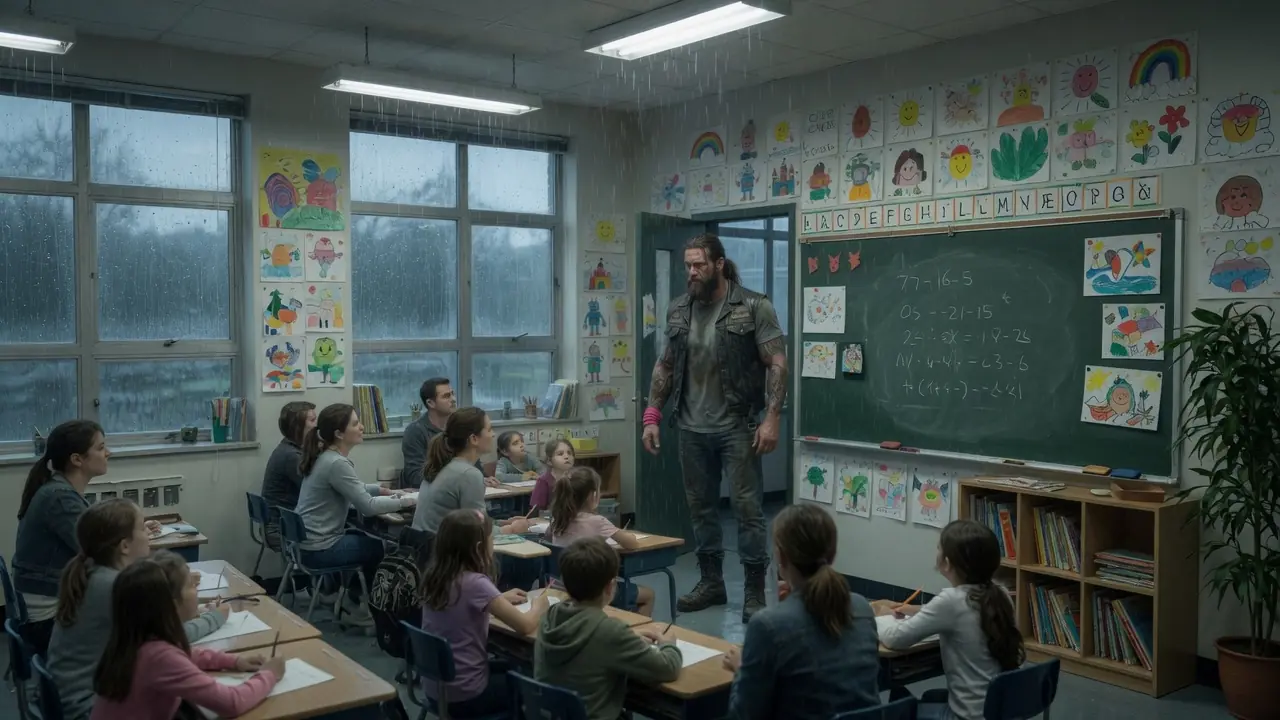
The next afternoon, the strange video of the biker and the pink collar had reached his daughter’s elementary school. That was when the joke stopped being funny. Lily Pike was only eight, small enough to disappear inside her raincoat, and she had already spent the day trying not to cry. Kids whispered behind their hands in the hallway. Parents stared in the pickup line like they had never seen a man like Warren Pike before.
Warren looked terrifying standing there in leather and tattoos, his broad shoulders filling the doorway of the school office. But he wasn’t trying to scare anyone. He was trying to hide the thing they were laughing at before it hurt his little girl even more. The pink collar, soft and sparkly, still circled his thick wrist like a bracelet that didn’t belong on a man with his reputation. It had started as a silly game at home, a promise he made when Lily was scared of the dark after her mother left them.
When a parent lifted a phone to record, Warren didn’t shout. He simply stepped in front of Lily and said one sentence that made the room go quiet. “This collar means my daughter feels safe, and I’ll wear it every day if that’s what it takes.” The words hung in the air, heavy and honest. No one laughed after that.
Lily had given him the pink collar two weeks earlier on a rainy Tuesday night. She had fastened it around his wrist with tiny fingers and whispered that it was magic, that it would keep the bad dreams away from both of them. What she didn’t know yet was that the collar had once belonged to her mother, a small keepsake Warren had saved from the night she walked out. He wore it now as both a reminder of loss and a vow to never let Lily feel abandoned again.
That evening at their small house on the edge of town, Warren sat on the porch steps while Lily played with her dolls nearby. “Daddy, are you embarrassed?” she asked quietly. He pulled her into his lap and kissed the top of her head. “Never. This is the best thing I’ve ever worn.” She giggled for the first time that day, the sound healing something deep inside him that years on the road had hardened.
Warren had left the club life behind when Lily was born, choosing midnight feedings and storybooks over late-night runs. But the tattoos and the reputation followed him everywhere. The pink collar became their secret armor against a world quick to judge. Over the next few years, he showed up at every school event wearing it proudly, turning whispers into quiet respect. Lily grew taller, braver, always reaching for her father’s hand when the world felt too big.
By high school, Lily had become a quiet artist with a fierce heart. She still kept a photo of her dad’s wrist on her phone as a reminder of unconditional love. But life threw harder punches. Her mother reappeared one day, asking for forgiveness and a second chance. Warren let Lily decide, standing silently beside her as tears fell. The pink collar stayed on his wrist through every difficult conversation, a symbol that some promises outlasted pain.
The real twist came on Lily’s eighteenth birthday. While cleaning out an old box, she discovered letters her mother had written but never sent. In them, she admitted the pink collar had been a gift meant for Warren on the day Lily was born, a silly token of joy before addiction pulled her away. Reading those words, Lily finally understood why her father had guarded it so fiercely. It wasn’t just a child’s game. It was the last piece of their broken family he refused to let go.
Lily went to college far from Texas, studying art and child psychology. She faced her own storms there, battling anxiety that sometimes made her feel small again. Late one night during finals week, overwhelmed and alone, she called her dad. Warren answered on the first ring. “Put on that old picture of us,” he said. “The one with the collar. You’re never alone, peanut.”
Years passed. Lily became a counselor helping children from difficult homes find their voice. She met a kind man who understood her scars and together they built a life filled with laughter and late-night talks. On their wedding day, Warren walked her down the aisle, the faded pink collar now turned into a bracelet charm on her bouquet. He whispered in her ear, “You made it, kid. We both did.”
The deepest twist arrived when Lily gave birth to her own daughter. Holding the tiny baby in her arms, she felt the full circle of love and protection her father had fought so hard to give her. Warren visited the hospital, now older with gray in his beard but the same steady strength. He slipped the worn pink collar, carefully preserved, around his granddaughter’s tiny wrist for a moment. “This belongs to the brave ones,” he said, voice thick with emotion.
Lily’s daughter grew up hearing stories of Grandpa Warren and the magic pink collar that once made the whole world stop laughing. She wore it proudly on her own wrist during tough days at school, just as her mother and grandfather had. The cycle of judgment and resilience continued, but now it carried healing instead of shame. Warren passed away peacefully one spring morning, surrounded by the family he had built from broken pieces.
Lily lived a full life after that, writing children’s books about a biker and his brave little girl. She traveled to schools across the country, sharing their story and encouraging kids to wear their differences with pride. Her own daughter grew into a confident young woman who one day fastened the faded pink collar around her own child’s wrist, continuing the legacy. What began as a silly promise between a father and daughter became a testament to love that refused to break, no matter how the world tried to mock it.
In the end, the pink collar wasn’t just fabric and sparkles. It was proof that the greatest twists in life often come wrapped in the quietest acts of devotion. Warren Pike may have looked terrifying to strangers, but to those who knew him, he was simply a man who loved fiercely. And Lily carried that love forward, generation after generation, turning old pain into new strength under Texas skies that stretched on forever.
The years after the school incident forged a bond between Warren Pike and his daughter Lily that no road could ever break. Warren had stepped away from the full outlaw life when Lily was born, but he never truly left the club. The Hells Angels chapter in their corner of Texas still claimed him as a respected member, and the brothers looked out for the single father raising a little girl in a world of chrome, leather, and late-night runs. Lily grew up surrounded by the roar of Harleys and the rough laughter of men who would lay down their lives for one another, learning early that family came in many forms, some wearing patches and carrying scars.
Warren balanced club duties with fatherhood in ways that often left him exhausted but never regretful. Mornings started with Lily on the back of his bike for short rides to school, her small arms wrapped tight around his waist and the pink collar peeking from under his sleeve. Evenings meant homework at the clubhouse table while old timers told sanitized stories of the road. The brothers treated Lily like their own, spoiling her with ice cream runs and teaching her basic bike maintenance when she showed interest. “She’s got the grease in her blood,” they’d say proudly, watching the quiet girl with the big curious eyes grow into someone who wasn’t afraid of the noise.
As Lily entered middle school, the challenges deepened. Kids at her new school heard rumors about her dad’s club connections, and the teasing evolved from silly jokes about the pink collar to darker whispers about criminals and danger. Lily came home one afternoon with a bruised cheek after standing up for her father’s honor. Warren found her in the garage, quietly polishing his Harley with tears in her eyes. He sat beside her on the concrete floor and listened as she poured out her hurt. “They say you’re bad people, Daddy. But I know you’re the best.” That night, Warren took her to the clubhouse and let her see the other side of club life: men helping a widowed brother fix his roof, collecting toys for a local children’s hospital, and sharing meals like one big, loud, imperfect family.
The club became Lily’s extended home. She learned the code of loyalty that bound these men together through good times and bad. When a rival group tried to push into their territory, Warren kept Lily close but never hid the reality from her. He taught her to ride a small bike of her own by age twelve, emphasizing respect for the road and the importance of protecting those you love. The pink collar stayed on his wrist through every club meeting, a quiet reminder amid discussions of runs, rivalries, and the constant shadow of law enforcement. Lily watched her father navigate the tightrope between club obligations and raising her right, and she admired him more with every passing year.
High school brought new storms. Lily excelled in art class, drawing detailed sketches of motorcycles and desert landscapes, but she also faced pressure from peers who wanted her to rebel or distance herself from her biker roots. A boyfriend once mocked the pink collar during a visit to their home, calling it embarrassing. Lily ended things that same night, choosing her father’s quiet strength over superficial acceptance. Warren never pushed her toward or away from the club life. Instead, he encouraged her dreams, paying for art supplies with money earned from legitimate garage work the club ran. “You get to choose your own road, peanut,” he would say, but he always left the garage light on for late-night talks when she needed them.
One summer, the club faced its greatest test. A federal investigation swept through their chapter, targeting members for old crimes. Warren, who had kept his record mostly clean for Lily’s sake, still spent tense weeks under scrutiny. Lily, now sixteen, watched her father leave for long meetings and return with worry lines etched deeper on his face. She stepped up in ways that surprised even the hardened bikers, organizing fundraisers at the clubhouse to help with legal fees and cooking meals for families affected by the raids. The pink collar became a symbol of resilience for the whole chapter. Brothers would touch it lightly when greeting Warren, a silent acknowledgment of the man who balanced two worlds so fiercely.
During those difficult months, Lily discovered more about her mother through hidden letters and quiet conversations with her father. The woman had struggled with addiction and left when the club life became too much, but she had once loved the open road as much as Warren did. Learning this truth helped Lily forgive the absence that had shaped her childhood. On her seventeenth birthday, Warren took her on a long ride across the Texas plains at sunset. They stopped at a quiet overlook where he finally opened up about his own regrets, the nights he spent wondering if he was failing her by staying connected to the club. Lily hugged him tight, the wind whipping around them. “You never failed me, Dad. You showed me how to be strong.”
Lily graduated high school with honors and a scholarship to art school in Austin. Leaving home was harder than she expected. The first few months away, she called her father every night, missing the rumble of bikes and the familiar faces at the clubhouse. Warren rode down to visit whenever he could, bringing care packages from the brothers and wearing the now-faded pink collar proudly. Lily’s art flourished as she channeled her unique upbringing into powerful pieces depicting biker culture, family loyalty, and the beauty found in unexpected places. Her professors were captivated by the depth in her work, unaware at first of the real-life inspiration behind it.
College also brought romance and new challenges. She met Marcus, a fellow student whose quiet steadiness reminded her of her father. When she finally brought him home to meet Warren and the club, she worried about how the two worlds would collide. The brothers gave Marcus the classic tough-guy welcome, but Warren pulled him aside for a private talk. “She’s my whole world,” he said simply. “Hurt her and the road gets real long for you.” Marcus passed the test with flying colors, respecting the club’s values while supporting Lily’s dreams. Their relationship grew strong, built on honesty and shared respect for where she came from.
After college, Lily returned closer to home and opened a small studio in town. She taught art classes to local kids, many from rough backgrounds, using her own story to inspire them. The club supported her efforts, turning part of their garage into a makeshift gallery space for her students’ work. Warren watched with quiet pride as his daughter turned the lessons of loyalty and resilience she learned in the biker world into something that helped heal others. The pink collar, now a cherished bracelet, passed from father to daughter during a special ceremony at the clubhouse. Warren fastened it on her wrist himself, tears in his eyes. “You’ve always worn it in your heart,” he told her. “Now the world can see it too.”
Life in the club continued with its ups and downs. There were weddings, births, and heartbreaking funerals as older members passed. Lily was there for all of it, no longer just the little girl in the raincoat but a respected woman in her own right. She married Marcus in a beautiful outdoor ceremony attended by club members in their best cuts alongside her art school friends. Warren walked her down the aisle, the love between father and daughter palpable to everyone present. When their first child was born, a boy they named after Warren’s favorite road captain who had passed years earlier, the entire chapter celebrated. Lily placed the pink collar around her newborn son’s wrist for a photo, continuing the tradition that had defined her life.
As the years unfolded, Lily balanced motherhood, her art career, and supporting the club’s community work. She organized charity rides that raised money for children’s causes, turning the biker image from one of fear to one of fierce protection. Warren retired from long runs but remained a guiding figure, offering wisdom to younger members while spoiling his grandchildren rotten. The bond between father and daughter only grew deeper with time. They took annual rides together, just the two of them, talking about everything from club politics to Lily’s latest painting. Those rides became sacred, moments when the roar of the engine drowned out the noise of the world and reminded them both where they had come from.
One crisp autumn evening, as Warren’s health began to decline, Lily sat with him on the porch of the old house. He was in his seventies now, the tattoos faded but the pink collar still on his wrist, though he had given her the original years ago. “I never regretted choosing you over the full club life,” he said, voice rough but steady. “Every mile I rode with you on the back was worth more than all the runs I missed.” Lily held his hand, the bracelet version of the collar catching the porch light. She told him about her plans to write a book about their life, about a little girl who grew up loved fiercely in a world others didn’t understand.
Warren passed peacefully a few months later, surrounded by his club brothers, his daughter, and his grandchildren. The funeral procession stretched for miles, bikes rumbling in respect as they escorted him to his final resting place. Lily rode at the front beside the club president, wearing her father’s old cut over her dress. At the graveside, she spoke of the man who taught her that strength came in many forms, from the roar of an engine to the gentle fastening of a pink collar on a scared child’s wrist. The club planted a tree near his grave, and Lily hung the faded pink collar from one of its branches, letting the wind carry his memory across the Texas plains.
In the years that followed, Lily’s life bloomed in ways that honored everything her father had sacrificed. She published her book, which became a quiet bestseller, sharing the real stories of biker families and the love that held them together. Her children grew up riding with their mother and learning the same values of loyalty and courage. The club remained part of their lives, a second family that showed up for birthdays, school events, and tough times. Lily eventually took on a mentorship role within the chapter, advising on family matters and helping younger members balance club life with raising kids.
Looking back on her journey, Lily realized the pink collar had been the thread connecting every chapter of her story. From a frightened eight-year-old hiding in her raincoat to a strong woman raising her own family, it symbolized the unwavering protection of a father who chose love over everything else. She continued riding, teaching her children the roads her father had shown her, and ensuring that the legacy of Warren Pike lived on in laughter, loyalty, and the occasional sparkle of pink against leather. The biker world had given her a unique upbringing filled with both danger and profound beauty, and she carried it forward with pride, knowing her dad was riding beside her in spirit on every new adventure.
The club threw a massive celebration on the anniversary of Warren’s passing, sharing stories late into the night. Lily stood among them, her own children by her side, feeling the full weight and warmth of the life they had built together. In the end, the pink collar wasn’t just a silly accessory or a viral joke. It was the heart of their story, proof that even in the roughest worlds, tenderness could thrive and change everything. Lily Pike had grown from that little girl into a woman who understood that true belonging came from being deeply loved, exactly as you are, pink collar and all. And somewhere on the open road, she knew her father was smiling, engine rumbling, forever proud of the daughter who had ridden beside him through it all.