“There’s a young man dying.”
Thomas Bennett pressed the phone tightly against his ear while kneeling on the wet pavement.
Blood spread beneath the stranger’s body, darkening the faded gray sweatshirt around his stomach. The young man’s eyes opened and closed without focus. His breathing came in shallow, uneven pulls.
Thomas looked up and read the street sign again.
“Corner of Ninth and Fulton,” he said. “Behind the closed pharmacy. He’s been shot. Please send an ambulance immediately.”
The emergency operator released a tired sigh.
“Sir, I need you to lower your voice.”
“I’m not shouting at you.”
“You’re speaking aggressively.”
Thomas stared at the young man.
His skin had begun turning pale.
“I apologize if I sound upset. A person is bleeding to death in front of me.”
“And I’m trying to ask questions.”
“Then ask them.”
“Is he conscious?”
“Barely.”
“Do you know whether he has a weapon?”
“I don’t see one.”
“Is this gang-related?”
“I don’t know.”
“What does he look like?”
Thomas described him.
Young.
Black.
Perhaps nineteen or twenty.
Thin.
Short hair.
Gray sweatshirt.
The operator became quiet for a moment.
Then his voice changed.
“Ninth and Fulton?”
“Yes.”
“That neighborhood generates a lot of false calls.”
“This is not a false call.”
“People there call about shootings every week.”
Thomas felt something cold settle inside him.
“Then you should understand the urgency.”
“You don’t get to tell me how to do my job.”
“No. But I do get to tell you that this boy is dying.”
The young man’s fingers moved weakly across the pavement.
A gold watch hung loosely around his wrist.
Thomas saw the cracked face.
The narrow leather band.
A small engraved letter beneath the six.
J.
The world around him went silent.
Thomas reached for the watch with trembling fingers.
He turned the young man’s wrist toward the streetlight.
The inscription on the back remained exactly as he remembered it.
To Julian.
Time is what we give to the people we love.
Dad.
Thomas stopped breathing.
The operator continued speaking, but the words came from far away.
“Sir? Are you still there?”
Thomas looked down at the young man’s face.
“Where did you get this watch?”
The stranger’s eyes opened.
“What?”
“The watch. Where did you get it?”
“I don’t know.”
“You do know.”
The young man coughed and curled around the wound.
“Please.”
Thomas leaned closer.
“Tell me your name.”
The stranger hesitated.
Then he whispered, “Malik.”
“Malik what?”
“Malik Turner.”
Thomas had not heard the name spoken aloud in five years.
But he remembered it from the police officer standing on his porch.
From newspaper reports.
From court documents.
From nights when he searched the internet until sunrise, looking for a face that never appeared clearly enough to hate.
Malik Turner.
The seventeen-year-old suspected of shooting Julian Bennett during an attempted robbery.
The young man the police never found.
The person Thomas had imagined confronting thousands of times.
Now Malik lay bleeding at his feet.
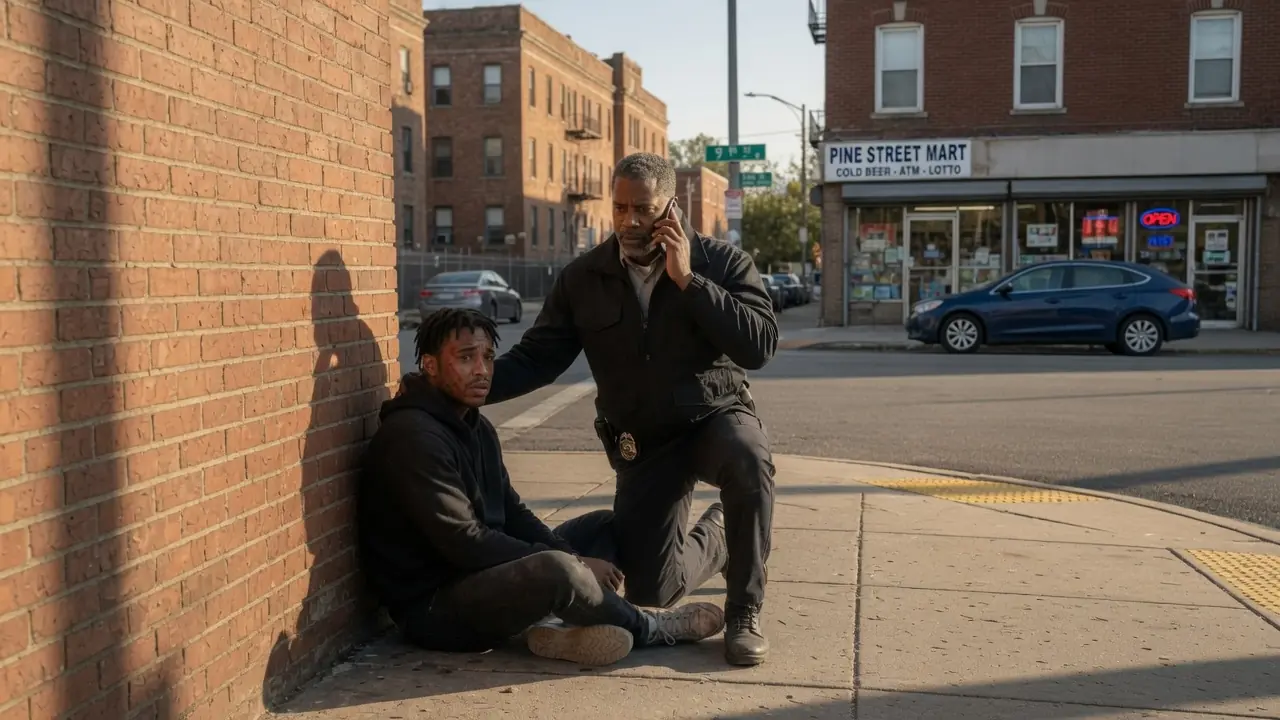
Thomas’s son’s watch rested around his wrist.
He could release the phone.
He could stand and walk away.
He could allow the darkness to finish what it had started.
No one would know.
For one terrible second, Thomas wanted to.
Then he heard Julian’s voice.
Always help if you can, Dad.
Even if they don’t deserve it?
Especially then. That’s when it means something.
Five years earlier, Thomas Bennett had been sitting at the kitchen table when his eighteen-year-old son entered holding a large white envelope.
Julian did not speak immediately.
He placed the envelope in front of his father and smiled.
Thomas looked at the return address.
Stanford University.
“You opened it?”
Julian nodded.
“And?”
“I got in.”
Thomas stared at him.
“You got in?”
“I got in.”
Thomas rose so quickly that the chair fell backward.
He wrapped both arms around his son and lifted him slightly from the floor despite Julian’s protests.
“My boy is going to Stanford.”
“Dad.”
“My boy is going to be a doctor.”
“I have to finish college first.”
“Details.”
Julian laughed.
The sound filled the small apartment.
Thomas had raised Julian alone since the boy was nine.
His wife, Evelyn, died after a long struggle with leukemia. Julian spent much of his childhood in hospital corridors, learning the sounds of infusion pumps and the careful language adults used when hope had become uncertain.
After her death, he told Thomas he wanted to become an oncologist.
“I couldn’t save Mom,” he said. “But maybe I can help somebody else’s mother.”
Thomas worked as an architect for a mid-sized firm in Columbus, Ohio. He designed schools, libraries, and affordable housing developments.
He earned enough to keep them comfortable, but Stanford would require loans, scholarships, and sacrifices.
None of that mattered during the celebration.
Thomas ordered pizza.
Julian invited two friends.
They sat in the living room and imagined California.
Warm weather.
Large lecture halls.
Brilliant professors.
Students from countries Julian had only read about.
When the friends left, Thomas brought out a small wooden box.
Inside lay a gold watch with a worn leather band.
“My father gave me this when I left for college.”
Julian lifted it carefully.
“You never let me touch this.”
“You dropped my phone into a bowl of soup when you were seven.”
“That happened once.”
“You also dismantled my radio.”
“I improved it.”
“It never worked again.”
Julian smiled.
Thomas fastened the watch around his wrist.
“When you have a child old enough to leave home, pass it on.”
Julian studied the engraving.
“You added this?”
“Last week.”
“You knew I would get in?”
“I believed you would.”
Julian’s expression softened.
“What if I hadn’t?”
“I would have given it to you anyway.”
They sat quietly for a moment.
Thomas looked toward Evelyn’s photograph on the bookshelf.
“She would be proud.”
“I know.”
“She would also ask why your room looks like a storage unit.”
“She would wait until tomorrow.”
“No. Your mother never delayed criticism.”
Julian laughed again.
Later that evening, he asked permission to celebrate with friends.
Thomas agreed.
“Be home by midnight.”
“I will.”
“Keep your phone charged.”
“I will.”
“Don’t get into anyone’s car if they’ve been drinking.”
“I know.”
Thomas followed him to the door.
“Julian.”
His son turned.
Thomas nearly said something ordinary.
Be careful.
Call me.
Do not stay out too late.
Instead, he said, “I’m proud of the man you’re becoming.”
Julian grinned.
“I learned from the best.”
Those were the final words they spoke to each other.
At 11:46, someone knocked.
Officer Rebecca Harris stood in the hallway beside a second officer.
Thomas understood before either spoke.
Parents often did.
There was something in the officers’ faces—a practiced gentleness that could not exist beside good news.
“Mr. Bennett?”
“Yes.”
“Are you Julian Bennett’s father?”
Thomas held the doorframe.
“What happened?”
“There was an attempted robbery outside a convenience store on East Broad Street.”
“Where is my son?”
The officer’s eyes lowered.
“Julian was shot.”
Thomas stepped into the hallway.
“Which hospital?”
“Mr. Bennett—”
“Which hospital?”
“I’m sorry. He died before paramedics arrived.”
The sentence did not enter Thomas’s mind as language.
It became pressure.
A physical force that bent his body forward and removed sound from the world.
He remembered sitting on the floor.
He remembered Officer Harris kneeling beside him.
He remembered asking whether Julian had been alone.
He had not.
Two friends were present.
A young man approached with a handgun and demanded wallets, phones, and jewelry. Julian gave him everything except the watch.
The robber tried to pull it from his wrist.
Julian resisted.
The gun fired.
Witnesses identified the shooter as a local teenager named Malik Turner, who had previous arrests for burglary and theft.
Malik disappeared before police could find him.
The watch disappeared with him.
Thomas attended the funeral in a dark suit he could not remember purchasing.
Julian’s acceptance letter lay inside the coffin beside him.
The university sent flowers.
Teachers spoke.
Friends cried.
Thomas stood near the grave and felt nothing because grief had grown too large for emotion.
For months, he imagined revenge.
He imagined finding Malik.
He imagined making the young man understand exactly what he had taken.
Then shame followed.
Evelyn had taught Julian compassion.
Thomas had reinforced it.
What kind of father wanted another child dead?
A father whose son had been murdered, he answered himself.
That was the truth.
He did not become cruel.
He became quiet.
He returned to work.
Stopped attending church.
Stopped answering friends who invited him to dinner.
He visited Julian’s grave every birthday.
On the fifth anniversary, he stood beside the headstone in freezing rain.
“You would have been twenty-three,” he said.
Thomas placed a Stanford pennant against the stone.
“You might have been starting medical school.”
Rain ran across his face.
“I’m sorry I wasn’t there.”
He knew the statement made no sense.
He could not have known Julian needed him.
Still, grief was built from impossible responsibilities.
If I had called earlier.
If I had driven him.
If I had insisted he remain home.
If I had been standing beside him.
The thoughts repeated until they felt like memories.
That evening, Thomas remained at the cemetery until the gates closed.
He drove home through the older east-side neighborhoods, avoiding the highway.
At Ninth and Fulton, he heard two sharp cracks.
Gunshots.
A man emerged from the alley behind a closed pharmacy.
He stumbled into the street, pressed both hands against his abdomen, and collapsed.
Thomas stopped.
The man who had spent five years believing he would do anything to save his son saw another person bleeding and moved before thought could stop him.
He parked.
Called emergency services.
Knelt beside the stranger.
Then he saw the watch.
Now Malik Turner looked up at him through half-closed eyes.
“You’re Julian’s father.”
Thomas’s hand tightened around the phone.
The operator was still speaking.
“Sir, are you in immediate danger?”
Thomas stared at Malik.
“No.”
“Then move away and wait for police.”
“He needs an ambulance.”
“I have not finished assessing the scene.”
“You have the address. Dispatch medical help.”
“Sir, I warned you about your tone.”
Thomas looked toward the street.
No ambulance.
No sirens.
The operator continued.
“I know that neighborhood. My friend was killed near there last year. You don’t understand what those people are like.”
Thomas felt rage rise.
“Those people?”
“Criminals. Gang members. You said he was shot. Maybe this is what happens when people live that way.”
“You are refusing help because of where he was shot?”
“I didn’t say that.”
“You said enough.”
“Why don’t you help him yourself if you care so much?”
The line disconnected.
Thomas stared at the phone.
For several seconds, he could not accept what had happened.
Then Malik groaned.
“I don’t want to die.”
Thomas looked at him.
Part of him wanted to say Julian had not wanted to die either.
Part of him wanted Malik to feel every second of fear Julian had felt on the pavement.
Instead, he removed his jacket and pressed it against the wound.
“Keep pressure here.”
“I can’t.”
“You can.”
Malik’s hands shook.
Thomas placed them over the jacket.
“Push.”
Malik cried out.
“You have to stay awake.”
“I’m tired.”
“No.”
“I can’t see right.”
“Look at me.”
Malik tried.
Thomas pulled him toward the car.
“I’m taking you to the hospital.”
Malik’s weight nearly brought them both down.
Thomas struggled beneath him.
The hospital was twelve minutes away without traffic.
Perhaps eight if Thomas ignored several laws.
He placed Malik across the back seat and kept the phone on speaker while calling emergency services again.
A different operator answered.
Thomas gave the address, described the first call, and explained that he was transporting the patient himself.
“Do not drive if you cannot do so safely,” she said. “An ambulance is being dispatched toward your route. Where are you now?”
“Fulton, approaching Madison.”
“Continue straight. Police will intercept and escort you.”
Thomas drove.
In the mirror, Malik’s eyes closed.
“Stay awake.”
“I’m trying.”
“What do you want to become?”
Malik laughed weakly.
“What?”
“When you were a child. What did you want to be?”
“A surgeon.”
Thomas’s hands tightened on the steering wheel.
“Why?”
“I don’t know.”
“That is not an answer.”
Malik breathed with difficulty.
“I saw one on television.”
“You chose your future from television?”
“I never knew any doctors.”
“Then you could have become the first one you knew.”
“Kids like me don’t become surgeons.”
“I grew up three blocks from here.”
Malik’s eyes opened slightly.
Thomas continued.
“My mother cleaned offices at night. My father installed roofs until he fell and injured his back. Nobody in my family had finished college. I became an architect.”
“You’re lying.”
“About being an architect?”
“About growing up here.”
“I attended Fulton Elementary before they tore it down.”
Malik stared toward the ceiling.
“I went there.”
“Then stop telling me what children from this neighborhood cannot become.”
A police cruiser appeared behind them.
Lights flashed.
The officer pulled alongside and signaled Thomas to follow.
The cruiser cleared intersections while Thomas drove behind it.
Malik whispered, “I don’t have parents.”
Thomas looked into the mirror.
“My mom died when I was six. Never knew my dad. Foster homes after that.”
“That does not excuse what you did.”
“I know.”
Thomas’s voice hardened.
“Do you?”
“Yes.”
“Julian was eighteen.”
Malik began crying.
“I know.”
“He wanted to be a doctor.”
“I know.”
“He had his whole life planned.”
“I didn’t mean to shoot him.”
Thomas nearly lost control of the car.
He corrected the wheel.
“Do not explain it now.”
“I got scared.”
“Be quiet.”
“I’m sorry.”
“Save your breath.”
The hospital entrance appeared ahead.
Doctors and nurses met them outside.
They placed Malik on a stretcher and rushed him through the emergency doors.
A nurse tried to move Thomas aside.
“He has lost a lot of blood.”
Thomas’s jacket remained pressed against the wound.
“We need you to release him.”
Thomas looked at Malik’s wrist.
The watch was still there.
He unfastened it.
Malik did not resist.
Then the doors closed.
Thomas stood outside the trauma bay holding the object he had last seen on his son.
Blood covered the leather band.
Officer Harris—the same officer who had delivered the news five years earlier—arrived after hearing the name connected to the shooting.
She recognized Thomas.
Her eyes moved toward the watch.
“Is that Julian’s?”
Thomas nodded.
“We have Malik Turner in custody?”
“He’s in surgery.”
“What happened?”
Thomas told her.
Not every emotion.
Only the facts.
Harris listened carefully.
When Thomas described the first emergency operator, her expression darkened.
“All calls are recorded.”
“Good.”
“Did the operator delay the ambulance?”
“He refused to send one while arguing with me.”
“We will preserve the recording.”
Thomas looked toward the surgical doors.
“He confessed in the car.”
“Did you record it?”
“My phone was still connected to the second dispatcher.”
“Then the call may have captured it.”
Thomas sat in the waiting room.
Hours passed.
A surgeon finally approached.
“Mr. Bennett?”
Thomas stood.
“Is he alive?”
“Yes.”
The bullet damaged part of Malik’s liver and caused severe internal bleeding. He required multiple transfusions, but the surgical team had stabilized him.
“He would likely have died if he arrived ten minutes later,” the doctor said.
Thomas closed his eyes.
Ten minutes.
The amount of time he could have spent deciding whether Malik deserved help.
The amount of time the first operator had treated a dying person as an inconvenience.
Officer Harris arranged for the watch to be photographed and processed as evidence before returning it to Thomas.
Malik remained under police guard.
The hospital had no family contact for him.
No parent.
No sibling.
No friend willing to come.
Thomas told himself that was not his responsibility.
He went home.
Washed Malik’s blood from his hands.
Placed Julian’s watch inside the wooden box.
Then he sat at the kitchen table until sunrise.
He did not feel relief.
He did not feel justice.
He felt as though he had betrayed his son by saving the person who killed him.
At the same time, he knew Julian would have done exactly what Thomas had done.
That knowledge hurt most.
Three days later, Officer Harris called.
“Malik asked to speak with you.”
“No.”
“I understand.”
“Has he confessed formally?”
“Yes. The recorded call captured part of the statement. He provided a full interview after surgery.”
“Then you don’t need me.”
“The prosecutor will probably contact you.”
“Fine.”
Harris paused.
“The 911 call was reviewed.”
“And?”
“The call-taker has been suspended pending investigation. A supervisor heard the recording.”
Thomas remembered the contempt in the man’s voice.
“Did an ambulance ever get dispatched from that call?”
“No. The second call generated the medical response.”
“So if I had stayed and waited—”
“Yes.”
Thomas looked toward Julian’s photograph.
“He would have died.”
“Most likely.”
The city launched an investigation.
The call-taker, Leonard Price, had worked in emergency communications for six years. Previous complaints described him as impatient, dismissive, and particularly hostile toward callers from several low-income neighborhoods.
Supervisors had coached him.
No one removed him from emergency calls.
The recording became evidence in both an internal disciplinary case and a civil rights review.
Price was terminated.
Prosecutors examined whether his refusal constituted criminal misconduct. The legal standard was complicated, but the city eventually acknowledged that his behavior violated policy and endangered a life.
More important than the punishment were the changes that followed.
Emergency call centers introduced real-time supervisory monitoring for delayed high-priority calls.
Operators received additional training on bias, de-escalation, and the obligation to dispatch aid before personal judgments about a caller or neighborhood.
Thomas did not celebrate.
A policy could prevent another tragedy.
It could not return Julian.
One week after the shooting, Thomas went to the hospital.
He carried the wooden watch box.
Malik lay in a guarded room with an IV in his arm and a bandage across his abdomen.
He appeared younger without the blood and darkness.
Barely twenty-two.
Thomas stopped near the door.
Malik’s face tightened.
“You came.”
“I’m not sure why.”
“I told them everything.”
“That does not bring Julian back.”
“I know.”
“Stop saying you know.”
Malik lowered his eyes.
Thomas placed the box on the table but did not open it.
“Tell me what happened.”
Malik swallowed.
“I was seventeen. I’d been staying with a group of guys in an abandoned house.”
“Why?”
“I ran from a foster home.”
“Because they hurt you?”
“No. They had rules.”
Thomas stared at him.
Malik continued.
“One of the older guys gave me the gun. He said we could get money from college kids near the store.”
“Julian gave you his wallet.”
“Yes.”
“His phone.”
“Yes.”
“Why did you take the watch?”
“It looked valuable.”
“He told you it was from his family.”
Malik’s breathing became unsteady.
“I grabbed his wrist. He pulled back. Somebody shouted. I thought he was trying to take the gun.”
“So you shot him.”
“I pulled the trigger.”
“Then you ran.”
“Yes.”
“You left him bleeding.”
“Yes.”
Thomas’s voice shook.
“You wore his watch.”
“At first, I was going to sell it.”
“But you didn’t.”
“I don’t know why.”
“Do not make it sound like guilt.”
“I’m not.”
Malik looked toward the wooden box.
“I kept it because every time I looked at it, I remembered him asking me not to take it.”
Thomas wanted to strike him.
He imagined closing both hands around Malik’s throat.
The desire frightened him because it felt clean.
Simple.
Much simpler than grief.
“I saved your life,” Thomas said. “Do you understand what that cost me?”
Malik’s eyes filled.
“No.”
“That is the first honest thing you have said.”
“I don’t expect forgiveness.”
“You shouldn’t.”
Malik nodded.
“I’m going to plead guilty.”
“That is not a favor to me.”
“I know.”
“It is not courage.”
“I know.”
“It is the minimum truth should require.”
“Yes.”
Thomas opened the watch box.
“You stole this from my son.”
Malik looked at it.
“I’m sorry.”
Thomas closed the box.
“Sorry is a word. Responsibility is what happens after the word.”
Malik wiped his face.
“I wanted to be a doctor once.”
Thomas felt anger rise again.
“You told me.”
“I wasn’t lying.”
“My son wanted the same thing.”
“I know.”
Thomas stood.
“You do not get to use his dream to make yourself sound tragic.”
“I’m not trying to.”
“You are alive because the person you killed taught me to help people.”
Malik covered his face.
Thomas walked toward the door.
“Mr. Bennett?”
Thomas stopped.
“I won’t ask you to forgive me.”
“Good.”
“But thank you for not letting me die.”
Thomas did not turn around.
“I did it for Julian.”
Malik pleaded guilty to murder, attempted robbery, unlawful possession of a firearm, and related charges.
Because he had been a juvenile at the time of the crime, the court considered his age, history in foster care, lack of prior violent convictions, and full confession.
The judge sentenced him to a lengthy prison term with the possibility of parole after twenty years.
At sentencing, Thomas spoke.
He did not ask for the maximum punishment.
He did not ask for mercy.
“My son was not a lesson in someone else’s redemption,” he said. “He was a person. Julian loved science, terrible action movies, spicy noodles, and his little cousins. He wanted to heal people because he watched his mother die.”
Thomas looked toward Malik.
“Mr. Turner must live with what he did. Whether he becomes better is his responsibility. It does not reduce our loss.”
Afterward, Malik wrote letters.
Thomas did not read the first three.
He placed them unopened inside a drawer.
The fourth arrived on Julian’s birthday.
Thomas opened it.
Malik did not ask for forgiveness.
He described earning his high school equivalency diploma in prison.
He had begun tutoring another inmate in mathematics.
He wrote that becoming a surgeon was no longer possible in the way he once imagined, but he wanted to study enough biology to work in health education if he were ever released.
At the bottom, he wrote:
I know none of this is repayment. There is no repayment. I am trying to become someone who would not have harmed your son.
Thomas read the letter twice.
He did not answer.
A year later, another letter arrived.
Malik had completed emergency medical responder coursework available through the prison education program.
He was helping in the infirmary as an orderly.
The third year, Thomas responded with one sentence.
Continue doing the work even if no one forgives you.
Malik wrote back:
I will.
Their correspondence remained limited.
Thomas never called him son.
Never visited regularly.
Never forgot what Malik had done.
But as the years passed, the hatred inside him changed.
It did not disappear because Malik deserved peace.
It loosened because Thomas could no longer carry it without allowing the murder to take more of his life.
On the tenth anniversary of Julian’s death, Thomas visited the prison.
Malik entered the visiting room wearing a gray uniform.
He had grown older.
His face no longer resembled the frightened young man in the alley.
They sat across from each other.
“I brought something,” Thomas said.
He placed a copy of Julian’s Stanford acceptance letter on the table.
Malik stared at it.
“Why?”
“Because you knew how Julian died. I wanted you to remember how he lived.”
Malik read the first paragraph.
His hands trembled.
“He would have done great things.”
“He already did.”
Thomas looked toward the glass window separating the room from the corridor.
“He taught me what to do when I found you.”
Malik lowered his head.
“I don’t deserve what you did.”
“No.”
The answer surprised him.
Thomas continued.
“Help is not always given because the person deserves it.”
“Then why?”
“Because the person giving it must decide who he wants to be.”
Malik began crying.
Thomas did not comfort him.
He allowed the silence to remain.
After several minutes, Malik spoke.
“Do you forgive me?”
Thomas had asked himself that question for years.
He once believed forgiveness would mean pretending Julian’s death mattered less.
It did not.
He once believed forgiveness would release Malik from responsibility.
It could not.
The sentence would remain.
The past would remain.
Julian would remain gone.
“I forgive you,” Thomas said at last, “but forgiveness is not the same as trust, and it is not the same as forgetting.”
“I understand.”
“You may spend the rest of your life becoming a good man. It will not make the shooting unhappen.”
“I know.”
“But I no longer want your death.”
Malik covered his mouth.
Thomas felt something inside him give way.
Not grief.
Grief stayed.
But the hatred he had carried like a second skeleton finally became lighter.
Years later, Thomas founded the Julian Bennett Emergency Scholarship.
It supported young people from foster care who wanted careers in medicine, nursing, emergency response, architecture, or public service.
The program also funded emergency-communications training focused on equitable response in underserved neighborhoods.
Thomas refused to place Leonard Price’s name anywhere in its materials.
The scholarship was not about the man who refused to help.
It was about Julian.
A life should be remembered for what it gave, not merely for the way it ended.
Malik eventually became eligible for parole after serving more than twenty years.
Thomas did not oppose release.
He also did not advocate for it.
The board considered Malik’s record, remorse, education, and the severity of the crime.
He was released under strict supervision.
By then, he was in his early forties.
He could not become a surgeon.
He trained as a certified peer-health educator and began working with a reentry organization serving young people leaving juvenile detention and foster care.
The first time he spoke at a scholarship event, Thomas sat in the final row.
Malik did not describe himself as a victim.
He did not use his childhood to excuse murder.
He told the students that pain explained many choices but absolved none.
Afterward, he approached Thomas.
“I’m trying to keep the promise.”
“What promise?”
“To become someone who would not have harmed Julian.”
Thomas nodded.
“That work does not end.”
“I know.”
Malik looked at the gold watch on Thomas’s wrist.
Thomas had begun wearing it again.
“Will you ever pass it on?”
Thomas looked toward a photograph of Julian displayed near the scholarship banner.
“My niece starts college next year.”
Malik smiled faintly.
“That seems right.”
Thomas extended his hand.
Malik looked at it before accepting.
It was not a father embracing a son.
It was not a family restored.
It was one man acknowledging that another had chosen responsibility after causing an irreversible loss.
That was enough.
Thomas continued visiting Julian’s grave every birthday.
He brought photographs from the scholarship program.
Graduates in white coats.
Students holding nursing certificates.
Young architects beside their first completed projects.
Emergency dispatchers completing bias-response training.
“You wanted to heal people,” Thomas told the headstone. “You still are.”
The afternoon sun reflected from the watch.
Time is what we give to the people we love.
For years, Thomas believed the inscription referred only to family.
He eventually understood it differently.
Time given to grief.
Time given to accountability.
Time given to changing a system that failed.
Time given to a dying person when every wounded part of him wanted to walk away.
Saving Malik did not betray Julian.
It proved that Julian’s life had taught Thomas something stronger than revenge.
Always help when you can.
Not because everyone has earned it.
Not because every wrong can be repaired.
Not because forgiveness erases justice.
Help because another person’s cruelty does not get to choose the limits of your humanity.
On the night Thomas found Malik in the alley, he could have allowed hatred to make the decision.
Instead, he remembered his son.
He picked up a man who had once left Julian dying on the pavement.
He carried him to the car.
And while an emergency operator judged the value of a life by the neighborhood where it was bleeding, a grieving father chose to believe that a human life still mattered—even when it belonged to the person who had broken his own.