At 5:12 on a wet April morning, the first bulldozer pushed through the east edge of Harold Sutton's soybean field before the birds had fully started up in the hedgerow. The lights came first. Then the grind of tracks over soft ground. Then the ugly, final sound of planted rows being flattened under steel.
Harold heard it from his kitchen before he understood what it was. He was 77 years old, long-backed, stiff in both hands, and awake most mornings before daylight had habit rather than necessity. For 50 years he had timed his life to weather, debt, seed, diesel, and the moods of land that never cared what calendar a bank or county office preferred.
He knew the sound of rain on tin, the sound of a combine belt slipping, the sound of a calf in trouble, the sound of wind pushing hard out of the south. This was not any of those sounds. This was heavy equipment where no heavy equipment had any right to be.
He stepped onto the porch in boots half-laced and saw white construction lights moving low across the field beyond the pecan trees. For a second his mind refused the sight. Those were his rows. His spring soybean stand.
Three weeks of work, two rechecks of the seed depth after the last cold snap, and the only field he had left that still broke level enough to plant without fighting washout on every pass. Then the second machine came into view. A track dozer with the logo of Varney's Dominion Infrastructure stenciled along the side in clean corporate lettering, rolling straight across the young crop like it had been invited.
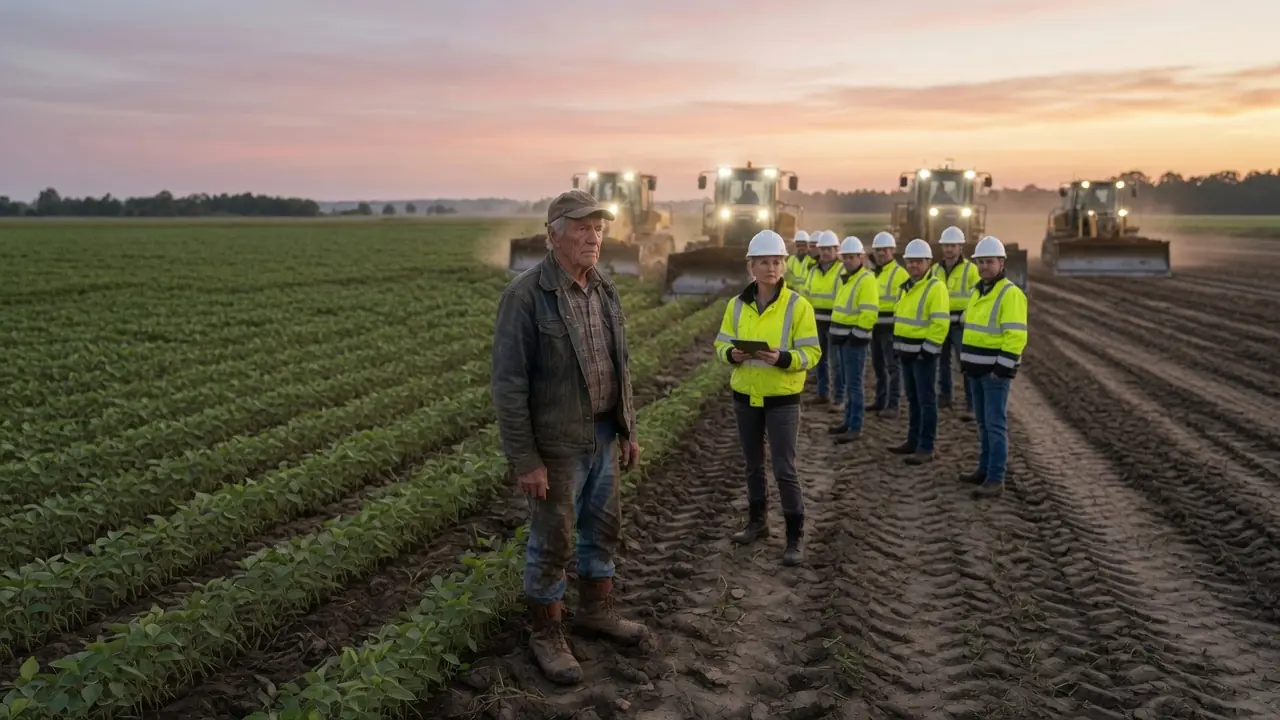
He did not shout first. He ran. He cut across the yard, through the gate, and into the field road with more speed than his knees wanted to give him. Mud kicked up the backs of his jeans.
The nearer he got, the worse it looked. Survey flags had planted in a bright orange line through the middle of the east tract. Two bulldozers were cutting a raw lane across the crop. A third machine sat near the drainage ditch.
Pickup trucks were parked by the county road. Men in reflective jackets stood drinking coffee while Harold's field disappeared under their schedule. "Turn those things off," he shouted. One of the men raised a hand but did not wave.
Harold stopped just far enough away that the nearest driver killed the throttle down a notch but not enough to call it stopped. "That's my crop," Harold said. "What work zone?" The woman glanced at the tablet.
"Varis Dominion is commencing corridor preparation under emergency acceleration authority tied to the East River Materials Connector." Harold stared at her. "You didn't answer me." "The corridor has been lawfully approved."
"This field has not." She tried again in the calm, irritating tone corporate people use when they think the problem is not what they are doing but the fact that a local person is still reacting to it. "Our survey indicates this section falls within the active corridor buffer."
Harold looked down at the orange flags, then past her to the dozer blade pushing black spring dirt over green shoots that had not even had time to become strong enough to resist. "Your survey lies," he said. By then the sky was paling behind the tree line.
Across the yard, the upstairs light came on in the small room where his grandson slept when he stayed over on weekends. A few seconds later the porch screen banged open. Eli Sutton stepped out holding a drone case in one hand. He took one look at the field, then at Harold, and said, "Granddad, don't move."
Harold never turned around. But he heard the case snap open. And 30 seconds later, something small and sharp-winged rose into the morning air.
Varis Dominion Infrastructure had spent the past year presenting itself as the future of rural logistics, green materials transfer, and multi-state industrial expansion. That was the kind of language investors liked because it sounded both expensive and inevitable. In counties like Gray Hollow, where storefronts emptied faster than they filled and young people left after high school if they had any decent chance to, the corporation sold something simpler.
Jobs. Roadwork. Tax revenue. A connector route. A processing hub. A future.
The East River Materials Connector was marketed as a public-private corridor that would move aggregate, industrial minerals, and equipment between a rail junction and a planned processing site 40 miles south. County officials posed beside maps. Regional television ran bright graphics over drone renderings of clean roads and clean money. The route, at least on the public slides, stayed well east of Harold Sutton's farm.
That mattered because Harold had already refused one approach from Varis Dominion 6 months earlier. Their land agents had come in polished trucks with maps and smiles and offers that grew more impatient each time he declined. They wanted an easement crossing his east track to straighten a haul route and avoid a wetland mitigation headache on neighboring land.
Harold told them no the first time because the field fed him. He told them no the second time because their map line crossed his drainage tile. He told them no the third time because a man who comes back too many times for the same strip of dirt is usually asking for more than he is saying aloud.
His daughter Lena, who taught high school history two towns over, told him the corporation would eventually go around him. Harold had answered, "Men who can't take no in a conference room usually try to take yes with machinery." He was right.
What Varney's Dominion discovered, however, was that Harold Sutton was not living alone in 1987 with no witnesses beyond a dog in a county paper that only came twice a week. He had a grandson named Eli, 19 years old, back from a semester at community college, half farm boy and half machine-minded tinkerer, the kind of young man who could rebuild a carburetor and edit video on the same afternoon.
Eli flew drones for local roof inspections, crop stand checks, and side cash. He knew angles, timestamps, mapping overlays, and battery life better than most county officials knew their own meeting minutes. And unlike the corporation, he had no reason to keep the camera pointed only where the script said it belonged.
At first, Eli only meant to record the trespass. That was enough reason by itself. He launched from the back porch, sent the drone up over the pecan trees, and centered the live feed on the bulldozers. The screen showed exactly what Harold had seen from the ground, but worse because height makes intention easier to read.
The machines were not edging a line. They were cutting deep. Straight through planted rows. Past the fence marker.
Past the drainage ditch turn. Past the place where any honest corridor crew would have stopped if this had been a survey mistake. Eli kept recording.
The first thing he captured that mattered beyond the crop was a conversation near the white pickup on the county road. The corporation's field supervisor, name badge visible when Eli later zoomed in, was standing beside a county commissioner named Wade Hollister. Hollister had sworn at two public meetings that no work would begin on private agricultural land without final marked consent and recorded clearance.
In the drone footage, Hollister pointed not at the posted route from the county handouts, but at Harold's field. The supervisor nodded. A surveyor moved the orange flags another 10 yards inward. That was bad.
Then it got worse. At 5:31, Eli's drone caught a pickup from the corporation's environmental subcontractor backing toward the ditch at the field edge. Two men unloaded rolls of black silt barrier and began placing them after the bulldozers had already crossed the drainage path, as if they were constructing compliance for the camera rather than practicing it before the damage.
More troubling still, one of them kicked aside a white post already set in the ground and replaced it with an orange flag farther west. Eli zoomed. The white post had a metal cap. A boundary marker.
Not a survey ribbon. At 5:38, the drone caught the clearest thing of all. The woman in the white hard hat, later identified as regional project director Dana Bress, looking up at one of the bulldozer operators and drawing her hand in a forward line past the marked corner where the county plan had previously shown the route stopping.
She knew exactly where she was sending him. And then, as if the morning had not yet decided it had given them enough, Eli drifted the drone farther south to capture the full cut line and accidentally found the reason the corporation seemed so desperate to get through Harold's East tract in one violent pass.
Beyond the tree belt, hidden from the road, lay a second prepared area not shown on any county presentation boards. Crushed stone, portable fuel tanks, a staging pad, and survey markings that curved not toward the approved connector route, but toward the sudden East Ridge and the neighboring Hendrix pasture, together forming a shortcut around the wetland parcel Varney's Dominion had told investors would be fully mitigated.
It was not an accident. It was not a misunderstanding. It was a field decision made in advance. Eli landed the drone 8 minutes later with hands shaking hard enough that he nearly missed the case latch.
Harold, still in the field road, did not ask first about the crop. He asked, "Did it see?" Eli looked at the screen once more and said, "Granddad, it saw everything."
By 9:00, Varney's Dominion had already shifted its language. First, the corporation told local radio there had been a limited early entry preparation on land reasonably believed to be within the corridor zone. Then Commissioner Wade Hollister told a reporter there had been temporary confusion involving agricultural boundaries.
By noon, the corporation's legal office emailed Harold's daughter Lena a short notice offering a crop damage review under standard utility interference procedures. Standard utility interference. As if they had clipped a fence line instead of gutting a field before sunrise with county blessing and moved markers in the mud.
Lena arrived at the farm carrying printouts from the county website and fury she had inherited from both sides of the family. Eli spread the drone footage across a laptop timeline while Harold sat in the kitchen and looked out the window toward the wrecked East tract without saying much at all. That silence worried Lena more than shouting would have.
"What do you want to do?" she asked him. Harold answered with the same steadiness he used when telling someone a gate had to be rehung before dark. "I want them to quit talking like they stepped wrong."
Lena nodded once. "Then we don't treat this like crop damage." She called the only lawyer in the region she trusted with land fights bigger than boundary hedges and inheritance meanness. Ruth Calder answered from the courthouse parking lot in Benton Ridge and drove out before lunch.
Ruth was 61, thin as wire, and had the useful courtroom habit of making rich people sound cheap by simply reading back their own documents slowly. Eli showed her the footage in full. She watched it once in silence. Then she watched the boundary post segment twice.
Then the hidden staging pad. Then the commissioner pointing. When she finished, she closed the laptop halfway and said, "Do not release this all at once."
Lena frowned. "Why not?" "Because if they know what we have before they commit to a public lie, they'll retreat into caution. Right now they think this is a farmer and some crushed beans."
Ruth looked over at Harold. "What it actually is," she said, "is trespass, potential permit fraud, boundary manipulation, and investor misrepresentation if that hidden route changes what they told the market." Harold finally turned from the window. "And the county?"
Ruth gave him a hard smile. "The county is about to become very interested in memory." By late afternoon, Ruth had filed for an emergency injunction in county court and a preservation order covering all project communications, survey logs, contractor instructions, and environmental compliance records tied to the Sutton tract and adjacent route.
But that was only the local fight. The larger danger to Varis Dominion sat somewhere else entirely. The company was publicly traded. Its shares had climbed for months on the promise of accelerated corridor execution, reduced mitigation cost exposure, and an upcoming quarterly call where executives intended to reassure analysts that the East River connector remained on schedule and within budget.
The hidden staging pad mattered because if the corporation had quietly redirected the route through unapproved private farmland to avoid wetland cost and delay, then what it told county officials was one lie and what it implied to investors might be another. Ruth brought in a securities attorney from Kansas City by video that evening. Her name was Priya Desai, and she did not waste time pretending this was just a rural nuisance with good visuals.
If the footage shows undisclosed route deviation, deliberate marker movement, and pre-planned construction outside represented approvals, Priya said, "The crop damage is almost the small part." Eli sat very still at the table while she spoke, his drone case on the floor by his boots. "So, what happens?" he asked.
Priya looked at him through the screen. "What happens?" she said, "depends on whether they lie before the market opens or after." They did not have to wait long.
At 7:14 that night, Varis Dominion filed a brief statement with local media and sent the same language to regional business reporters. The company described the incident as "minor edge encroachment during corridor mobilization," denied intentional route deviation, and said no work had occurred outside surveyed and authorized operational assumptions. Ruth looked at the statement, then at Eli, then at Harold.
"Well," she said, "now they've earned the footage." Eli did not post the video to impress anybody. He posted it because lies should not be allowed to dry. At 8:02 that night, with Ruth and Priya's guidance, he uploaded a short timestamped compilation showing five specific sequences: the bulldozers crossing planted rows well inside the Sutton field, Commissioner Hollister directing survey movement, the boundary post being displaced, the hidden staging pad beyond the approved route, and Dana Bress signaling the operator to keep pushing past the marked line.
They paired it with still images from public county presentation maps and a plain statement from the Sutton family. Varis Dominion entered private cropland before sunrise, destroyed planted acreage, moved field markers, and cut a route inconsistent with what county residents were shown. Full footage preserved. Legal action filed.
At first the post moved locally. Then fast. A farm reporter in Springfield shared it. Then a regional environmental account.
Then a transportation analyst who asked why a public route map did not match the visible staging geometry. By 9:30, three market watch accounts were asking whether Varis Dominion had misrepresented corridor status and mitigation exposure. At 10:12, someone clipped the segment showing the commissioner pointing and the boundary marker being replaced.
That clip reached national business feeds before midnight. Harold had gone to bed by then, not because the matter was over, but because he was old enough to know some wrecks keep happening while a man sleeps. Eli stayed at the table with Lena and watched the numbers on the screen change.
Varis Dominion's overnight sentiment collapsed before the market even opened. By the next morning, journalists were not calling it a crop dispute. They were calling it what it looked like. Drone footage appears to show unauthorized route push by Varis Dominion.
Possible permit inconsistency. Possible investor disclosure risk. Possible county coordination scandal. At 9:31 a.m., the stock opened down hard.
By 10:07, after the longer clip hit two financial news programs and analysts began asking whether the hidden route implied a larger undisclosed mitigation problem, the sell-off accelerated. Eli looked at the live chart and said in a voice barely above a whisper, "Granddad's field is hitting their stock harder than the dozers hit the beans." Lena answered, "No."
The truth is, Varis Dominion did what corporations always do when their own confidence presentation turns into evidence. First, they blamed a subcontractor. Then, they called the footage incomplete. Then, they placed Dana Bress on administrative leave.
Then, they said Commissioner Wade Hollister had no authority over internal route alignment. Unfortunately for them, the preserved drone file included metadata, full flight path, timestamps, and audio fragments from the original recording. Ruth used it to shred the incomplete footage claim in court before lunch.
Priya used the same material to send a notice to the company's outside lender group and investor council. Environmental groups demanded a permit halt. County residents who had shrugged at the Sutton fight now wanted to know what else lay off map behind the tree belts.
Commissioner Hollister resigned 3 days later after text messages surfaced showing he had been assured the Sutton tract could be pushed through quick before final opposition organized. Dana Bress did not save herself by staying quiet. Her lawyers accidentally made things worse when they admitted she had been under schedule pressure from above because the approved wetland route threatened quarterly guidance.
That sentence alone was enough to tell every serious person watching that the bulldozers were not improvising. They were obeying pressure. Varis Dominion's board announced an internal review. Analysts started downgrading the stock.
One large institutional investor questioned route integrity assumptions in the latest earnings materials. The share price slid for four straight sessions. People in Gray Hollow who had once spoken of the corporation like weather now spoke of it like meat gone bad.
And through all of it, Harold Sutton still cared first about his field. He walked the destroyed rows on the fourth morning with hands in his jacket pockets and Eli beside him holding the drone controller like a second kind of witness. "They'll talk for months about the stock." Harold said.
Eli looked across the flattened East tract. "Yeah." Harold bent, picked up a smashed seedling, and rubbed black dirt between thumb and forefinger. "But this is what they actually did."
The injunction became permanent before trial on the route issue. Varis Dominion was barred from entering the Sutton East tract or adjoining disputed alignment zones pending full permit review. The County Connector approval was suspended. State regulators opened separate inquiries into survey manipulation and environmental compliance.
Investor litigation began in three jurisdictions. By the time the corporation finally reached settlement with the Sutton family, the stock had lost nearly a third of its value from the week before the bulldozers rolled. Harold Sutton's private settlement covered crop destruction, punitive damages, drainage repair, soil restoration, legal costs, and a permanent recorded prohibition against corridor use through the east tract without direct family consent.
The amount would have sounded enormous if told plainly over coffee in Gray Hollow. Harold never told it plainly over coffee. What he did say, when people asked how it felt to see a giant corporation stagger because of a little farm and a drone, was simpler. "They didn't stagger because of the drone," he told them.
"They staggered because the drone refused to blink." That line stayed with Eli. So did the morning. The flattened beans.
The blade marks. The way the men in hard hats kept moving until the camera forced them to imagine somebody else might one day watch them from above. A month later, after the crews were gone and the field had been partly reworked, Eli flew the drone again at Harold's request.
This time not for evidence. Just to look. From above, the scar across the east tract was still visible, but so were the new passes Harold had made after replanting the late section that could still be saved. Green was returning where steel had gone through.
The drainage line had been reopened. The ditch edge was holding. Harold stood by the fence, one hand raised against the sun, looking up at the machine his grandson now brought down slow and careful into the yard.
When Eli landed, Harold said, "Show me." They stood shoulder to shoulder at the truck hood while the video played. Not the destruction footage. The new field.
The repaired rows. The green returning. Harold watched in silence for a while. Then he nodded once.
"They bulldozed my crops," he said. Eli glanced at him. Harold kept looking at the screen. "Then your footage bulldozed everything they told the money men."
The old farmer shut the screen, rested one hand on the drone case, and looked out over the field that was still his. And after that, nobody in Gray Hollow ever called the sky empty again.