The hatchery manager looked embarrassed before he even began speaking.
“I hate asking this, Evelyn.”
Evelyn Mercer stopped beside the loading dock and adjusted the gloves tucked beneath her arm.
“Go ahead.”
The manager pointed toward a stack of wooden trays in the far corner of the building.
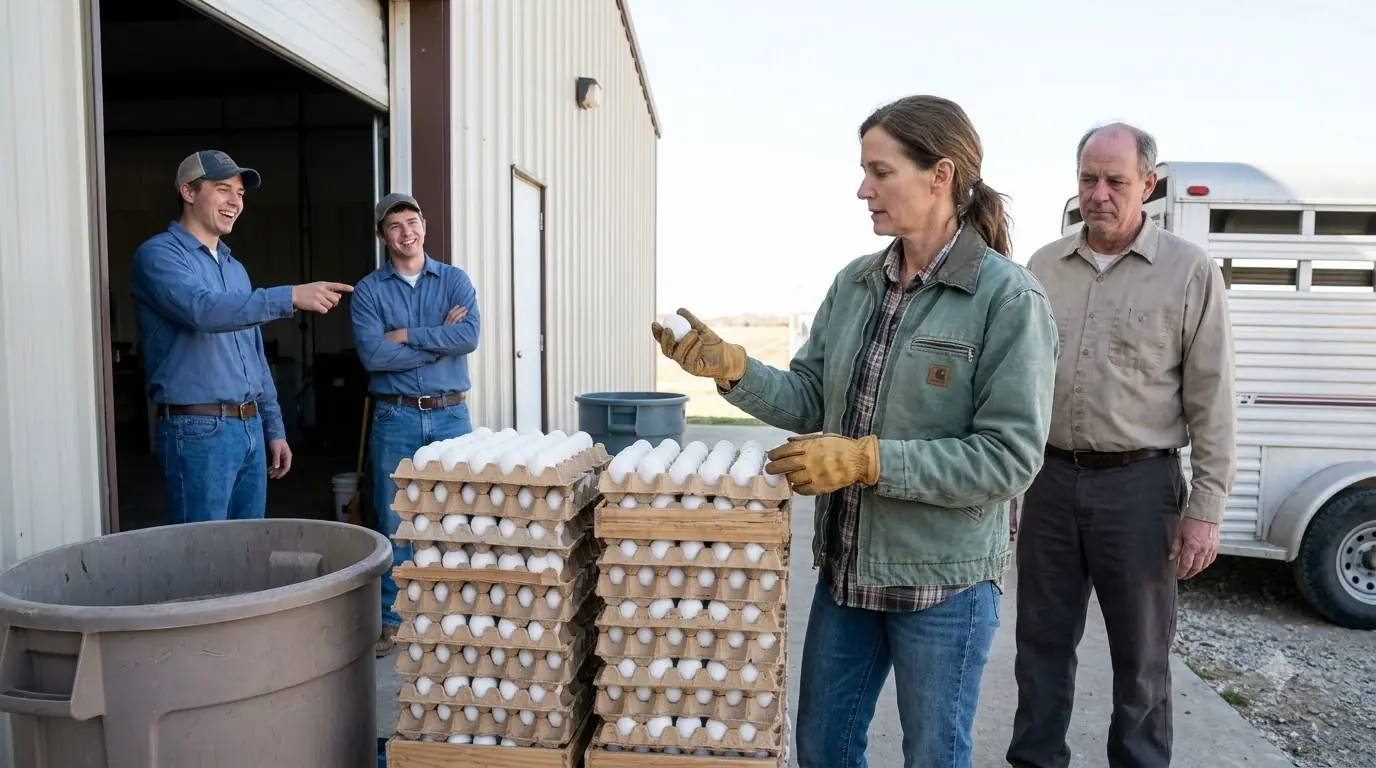
Three hundred twenty turkey eggs rested there in neat rows.
They were clean.
Uncracked.
Carefully sorted.
Nothing about them appeared wrong.
Evelyn walked closer and picked up one egg, holding it gently between both hands.
“What happened to these?”
“They’re too old for our commercial customers.”
“How old?”
“Several days beyond the preferred setting window.”
“Are they fertile?”
“Most should be.”
The manager sighed and looked toward the trucks waiting at the opposite end of the dock.
“Large hatcheries work on strict schedules. Breeder eggs arrive, get graded, and go into incubators within a fixed number of days. If a shipment is delayed or a customer cancels, anything outside that window becomes a liability.”
Evelyn looked back at the trays.
“So these become waste?”
“Usually.”
Two employees stacking feed bags nearby exchanged amused glances.
One whispered, not quietly enough, “Nobody’s hatching those.”
The other laughed.
“They’ll be pig feed by tomorrow.”
Evelyn returned the egg to its tray.
“How much?”
The manager blinked.
“For all of them?”
“Yes.”
A weak smile crossed his face.
“If you haul them away, they’re free.”
The two workers stopped laughing.
Evelyn nodded once.
“I’ll take every tray.”
“You’re serious?”
“I have space.”
The manager removed his cap and rubbed the top of his head.
“You understand the hatch rate could be terrible.”
“I understand.”
“You might spend weeks heating empty shells.”
“That’s possible.”
“Then why take them?”
Evelyn looked at the eggs again.
“Because they are still eggs.”
Twenty minutes later, her husband, Daniel Mercer, arrived with a livestock trailer attached to an old blue pickup.
He stepped onto the loading dock and stared at the stacked trays.
“That is more than I expected.”
“Three hundred twenty.”
Daniel lifted one tray carefully.
“They really gave them away?”
“They couldn’t sell them.”
“What is the plan?”
Evelyn secured another tray inside an insulated transport box.
“We’re going to hatch turkeys.”
“All three hundred twenty?”
“We’ll see how many cooperate.”
Daniel laughed.
“You always say things like that right before our lives become complicated.”
The Mercer farm was not known for poultry.
For nearly thirty years, Evelyn’s family had raised sheep, dairy goats, and a small flock of heritage chickens. Their land stretched across rolling hills in southeastern Ohio, where oak woods bordered open pasture and an old apple orchard stood behind the farmhouse.
Turkeys had never been more than an occasional Thanksgiving project.
Yet Evelyn had always admired them.
Not because they were graceful.
They were not.
Young turkeys could be curious to the point of foolishness. Adult toms strutted as though every fence post had been erected for their personal admiration. They could fly better than most people expected and roost in places no farmer had invited them to occupy.
But the older breeds possessed qualities modern agriculture often overlooked.
They were alert.
Hardy.
Excellent foragers.
Evelyn’s grandfather, Henry Mercer, understood that long before she did.
When Evelyn was twelve, Henry took her to visit an orchard maintained by one of his friends.
A flock of bronze turkeys wandered beneath the apple trees.
They did not peck the fruit from the branches or damage the trunks. They moved methodically through the grass, catching beetles, grasshoppers, caterpillars, and ticks.
Evelyn watched a hen scratch beneath a fallen apple and swallow three insects in less than a minute.
“I thought they would ruin the orchard,” she said.
Henry smiled.
“Most people only see Thanksgiving dinner when they look at a turkey.”
“What do you see?”
“Farmhands.”
She laughed because she thought he was joking.
He was not.
Years later, after Henry died, the statement returned to Evelyn during two difficult summers.
Grasshopper populations increased across the county.
Ticks spread through the sheep pastures.
Feed prices climbed.
Veterinary expenses followed.
Evelyn tried rotational grazing, pasture clipping, biological controls, and every reasonable treatment recommended by the county extension office.
Some helped.
Nothing solved the entire problem.
Then she remembered the orchard.
Perhaps one answer had been walking through American farms for centuries.
Back home, Evelyn and Daniel converted an old brooder building behind the machine shed.
The structure had once housed chicks during the years when Evelyn’s parents sold eggs. For the past decade, it had stored unused fencing, heat lamps, and equipment no one wanted to throw away.
They scrubbed the walls.
Repaired the ventilation system.
Tested electrical outlets.
Disinfected every surface.
Evelyn brought three incubators from storage.
A neighbor loaned her two cabinet models.
The county school’s agriculture teacher contributed another small unit that had not been used since the previous spring.
By evening, the brooder barn sounded like a machine room.
Fans hummed.
Thermostats clicked.
Digital displays glowed across the wall.
Daniel watched Evelyn label each tray by source position, estimated collection date, and incubator number.
“You made charts.”
“I always make charts.”
“There are six pages.”
“There are three hundred twenty eggs.”
He leaned over her shoulder.
“Temperature log. Humidity log. Turning schedule. Candling record.”
“Correct.”
“What is this column?”
“Egg weight.”
“You are weighing them?”
“A sample from each tray. Weight loss helps estimate moisture exchange.”
Daniel nodded slowly.
“I should have known better than to ask.”
The eggs had to be warmed gradually.
Moving them directly from cool storage into a hot incubator could cause condensation and contamination.
Evelyn allowed them to rest at room temperature while monitoring the shells.
Then she set them carefully, large end up, inside the incubators.
Turkey eggs normally required about twenty-eight days.
These had already spent too long in storage.
Some embryos would have stopped developing before incubation began.
Others might develop poorly.
Evelyn knew the numbers could be disappointing.
She wrote the first entry in her notebook.
Day 0. Three hundred twenty eggs set. Condition externally good. Viability unknown.
Dr. Calvin Reeves, the local veterinarian, visited later that week to vaccinate several lambs.
When he saw the incubator room, he stopped in the doorway.
“That is ambitious.”
“Maybe.”
“How old are the eggs?”
“Older than recommended.”
“You understand hatchability declines with storage time.”
“I do.”
“Development may be uneven.”
“I know.”
“Some poults could be weak.”
“We’ll monitor them.”
Calvin smiled.
“You’ve already decided.”
“I decided when I loaded the first tray.”
He looked through one incubator window.
“Then I hope they surprise everybody.”
Every morning began the same way.
Evelyn entered the barn before sunrise, washed her hands, checked the room temperature, and examined each incubator.
She recorded heat and humidity.
She confirmed that the automatic turning racks had moved.
She checked vents and water reservoirs.
When one thermostat varied by less than a degree, she spent an hour calibrating it.
Daniel brought coffee and tried not to touch anything without permission.
On the seventh evening, they began candling the first group.
Evelyn darkened the room and held each egg above a bright light.
Some remained clear.
Nothing had developed.
She marked them and checked again before removing them.
Others revealed thin red vessels spreading beneath the shell.
Daniel stared through the light.
“I can see something moving.”
“So can I.”
“That’s actually alive.”
Evelyn smiled.
“That was the idea.”
They worked until after midnight.
By the end of the first complete candling, enough eggs showed development to justify every hour spent preparing the barn.
Not all.
But many.
More than Evelyn had allowed herself to hope.
The hatchery manager called several days later.
“I was curious about the eggs.”
“They’re developing.”
There was a pause.
“How many?”
“Too early for a final number, but a strong portion appears viable.”
“Seriously?”
“Yes.”
“I expected maybe ten percent.”
“So did the men on your loading dock.”
He laughed awkwardly.
“I’ll admit I didn’t expect much better.”
“Neither did I. That’s why we’re measuring instead of predicting.”
News traveled through farming communities faster than weather.
By the second week, people in the county knew that Evelyn Mercer was attempting to hatch three hundred twenty discarded turkey eggs.
At Wilson’s Diner on Saturday morning, Frank Dawson sat at the counter reading the agricultural section of the newspaper.
Tom Briggs entered smiling.
“You hear what Evelyn brought home?”
Frank looked over his glasses.
“What now?”
“Three hundred turkey eggs.”
“Why?”
“The hatchery was throwing them away.”
A cattle farmer at the next table laughed.
“They were free for a reason.”
“Apparently she has every incubator in the county running.”
Frank shook his head.
“Turkeys.”
“Turkeys,” Tom confirmed.
Evelyn entered carrying a list of fencing supplies.
Frank raised his coffee cup.
“Morning.”
“Morning.”
“How are your imaginary turkeys?”
“They are still eggs.”
The diner laughed.
Evelyn smiled, paid for her order, and left.
She had spent enough years farming to understand that ridicule was often nothing more than uncertainty wearing a louder voice.
People laughed when they did not yet know which ending they were watching.
On day eighteen, a power storm moved through the county.
Lightning struck a transformer two miles from the farm.
The incubators went dark.
Evelyn heard the fans stop from inside the farmhouse.
She was already running before Daniel reached the back door.
The emergency generator had not been started in almost a year.
Daniel pulled the cord once.
Nothing.
Again.
The engine coughed and died.
Inside the brooder barn, heat began escaping.
Evelyn closed every incubator door and placed insulated blankets over the cabinets without blocking ventilation.
“How long?” she asked.
Daniel checked his watch.
“Three minutes.”
He adjusted the fuel line and pulled again.
The generator started on the fourth attempt.
Lights flickered.
Fans resumed turning.
Evelyn stood between the incubators listening for irregular sounds.
The outage had lasted eleven minutes.
For the rest of the night, she slept in a folding chair beside the generator.
Daniel brought her a blanket at two in the morning.
“You could come inside.”
“So could the generator.”
“It is too loud for the kitchen.”
“Then I’m staying here.”
He sat beside her.
Neither returned to the farmhouse until sunrise.
Day twenty-six began quietly.
Evelyn completed her morning inspection and noticed that one egg in incubator three had shifted slightly.
She waited.
A faint sound came from inside.
Tap.
Then silence.
Daniel entered carrying two cups of coffee.
Evelyn held up one finger.
He stopped.
Tap.
The shell moved again.
Daniel nearly dropped both cups.
“It’s happening.”
“I can see that.”
A tiny crack appeared near the wide end of the egg.
Then another.
Evelyn did not touch it.
Hatching could take hours. Helping too early could cause bleeding or kill a poult that had not fully absorbed its yolk.
They watched from outside the incubator window.
The crack widened slowly.
A small beak appeared and vanished.
The poult rested.
Tapped again.
By afternoon, the shell opened enough for a damp bronze head to emerge.
Several hours later, the first poult pushed free and collapsed against the tray.
It looked exhausted and impossibly small.
Daniel exhaled as if he had been holding his breath all day.
“One.”
Evelyn smiled.
“Only three hundred nineteen possibilities left.”
The hatch accelerated overnight.
Soft tapping filled the incubators.
Shells cracked in every tray.
Poults emerged wet and unsteady, then rested beneath the warm circulating air until their feathers dried.
Evelyn moved healthy birds into prepared brooders only after they became active.
Some eggs failed.
Others pipped but could not complete the hatch.
A few poults were too weak to survive despite careful attention.
Evelyn recorded each outcome.
Hope did not excuse poor records.
The hatch continued for three days.
Peeping filled the barn from before sunrise until long after dark.
Daniel counted birds twice because he did not trust the first total.
Late Sunday evening, he entered the farmhouse carrying the notebook.
Evelyn was washing bottles at the sink.
“You ready?”
She turned.
“Tell me.”
“Two hundred thirty-seven healthy poults.”
For several seconds, she did not respond.
“What?”
“Two hundred thirty-seven.”
She dried her hands and took the notebook.
“That’s more than seventy percent.”
“Seventy-four point zero six.”
“You calculated it.”
“I made a chart.”
Evelyn laughed.
“Better than some commercial batches,” Daniel said.
The hatchery manager drove to the farm the following afternoon.
He stood beside the brooders watching hundreds of poults move beneath the heat plates.
They pecked at feed, chased one another, and stared curiously at his shoelaces.
“I threw away the best hatch I’ve seen this month.”
“You didn’t throw it away.”
“I intended to.”
“They needed a chance before they needed a market.”
He crouched beside one brooder.
“How did you get that many?”
“Careful handling. Stable temperatures. Enough humidity. Patience.”
“That’s all?”
“That is rarely all.”
The poults grew quickly.
Within weeks, their down gave way to feathers marked with bronze, brown, and black.
Unlike the broad-breasted commercial turkeys commonly raised for meat, these heritage birds were active and athletic.
They flew onto fence rails.
Roosted on beams.
Explored every corner of the farm.
They followed Evelyn when she crossed the yard, not because of affection, Daniel claimed, but because she carried feed.
Evelyn believed it was both.
At eight weeks, the young turkeys began spending supervised time in pasture pens.
At twelve weeks, they moved through rotational paddocks behind the sheep.
That was when Daniel noticed the first significant change.
He stood beside the southern pasture one morning and watched the flock spread through the grass.
“You seeing this?”
Evelyn followed his gaze.
The turkeys moved like a slow bronze wave.
Every few seconds, a bird snapped up a grasshopper.
Another scratched through manure and swallowed fly larvae.
Several worked along the fence line where ticks and beetles gathered beneath weeds.
The sheep grazed behind them without stamping or shaking their heads as often as usual.
“They’re hunting constantly,” Daniel said.
“That’s what turkeys do.”
“I know. I didn’t understand how much of it they do.”
Dr. Reeves returned in midsummer.
He watched the flock for several minutes before beginning the sheep vaccinations.
“I had forgotten how useful old turkey breeds could be.”
“At what?”
He pointed across the pasture.
“Pest control.”
The birds moved through the grass without crowding the sheep.
“They’re reducing insects, breaking apart manure, and disturbing parasite habitat.”
Evelyn smiled.
“My grandfather called them farmhands.”
“He was right.”
By late summer, neighboring farmers began asking questions.
Why were Evelyn’s sheep less bothered by flies?
Why did the grass recover more evenly after grazing?
Why were there fewer grasshoppers near the hayfield?
At first, few connected the answer to the eggs that had been considered useless.
Then the county agricultural extension agent, Andrew Collins, arrived unexpectedly.
He spent an hour walking through the fields.
He watched the turkeys forage.
Examined manure pats.
Studied vegetation along the fence lines.
Finally, he stopped beside Evelyn.
“I have a question.”
“Go ahead.”
“How many insects do you think those birds consume each day?”
“I have never counted.”
Daniel laughed.
“I’m glad.”
Andrew lowered his binoculars.
“You may not need to. The pasture is counting for you.”
He returned the following week carrying insect traps, sample containers, and field markers.
Andrew established comparison areas.
One pasture contained sheep without turkeys.
Another followed the integrated rotation.
A third was measured before and after the birds passed through.
Each week, he collected samples.
Grasshopper populations fell sharply where the turkeys foraged.
Tick counts dropped.
Fly larvae became harder to find in disturbed manure.
The sheep spent more time grazing and less time stomping, bunching, or seeking relief in shaded corners.
Pasture regrowth improved because fewer insects damaged young plants.
Andrew closed his notebook after the fifth collection.
“This is significant.”
Evelyn shrugged.
“They are only behaving like turkeys.”
“That is what makes it significant. You are not forcing an artificial behavior. You are fitting natural behavior into a farm system.”
Autumn brought another problem.
Feed prices increased again.
Poultry farmers throughout the region complained that grain costs were consuming what little profit remained.
Evelyn expected the large flock to become expensive.
Instead, her records showed something different.
The heritage turkeys spent most of their days finding food independently.
Grass seeds.
Acorns.
Wild berries.
Tender weeds.
Insects.
They still received balanced feed every evening to ensure proper nutrition, but they consumed considerably less purchased grain than commercial production estimates predicted.
Daniel reviewed the numbers.
“We’re using almost forty percent less feed.”
“I noticed.”
“Your grandfather was right again.”
“He usually was.”
At Wilson’s Diner, the conversation changed.
Frank Dawson folded his newspaper.
“You hear about Evelyn’s turkeys?”
Tom Briggs looked up.
“What did they do now?”
“The extension office measured the insects.”
“And?”
“Way down.”
A sheep farmer beside them stirred his coffee.
“My neighbor says Evelyn used fewer parasite treatments this year.”
The room became quiet.
No one laughed.
Evelyn entered carrying a box of fence staples.
Frank raised one hand.
“Morning.”
“Morning.”
“I owe those birds an apology.”
“They probably won’t notice.”
“What about you?”
“I noticed.”
The room laughed, including Frank.
Winter arrived gently.
The pastures entered dormancy in better condition than previous years.
During routine health checks, Dr. Reeves compared the sheep records.
“You used fewer deworming treatments.”
“By nearly a third.”
“And the flock’s body condition is better.”
Daniel looked toward the bronze turkeys scratching through dry grass.
“You think it’s connected?”
“I would not claim the birds did everything. Rotation, weather, and grazing management matter.”
Calvin pointed toward the pasture.
“But I don’t believe their contribution is accidental.”
The hatchery manager returned shortly before Thanksgiving.
He had not seen the turkeys since they were poults.
Now the flock covered the hillside.
Toms spread broad tails marked with copper and bronze. Hens moved beneath the oak trees, their feathers flashing green and purple when sunlight struck at the right angle.
The manager stopped beside the fence.
“I gave these away.”
“You did.”
“I nearly sent all of them to waste.”
“That is also true.”
A large tom lifted his head and studied him.
The manager laughed softly.
“I’ve worked around poultry for thirty-five years. This may be the finest heritage flock our hatchery produced.”
Evelyn opened the gate and lifted one calm young hen.
“They simply needed more time than your system allowed.”
He watched the bird settle against her arm.
“We discard older fertile eggs every season.”
“I know.”
“What if we sorted them instead?”
“For what?”
“Viability and breed. Anything safe but outside the commercial window could be offered to small farms, schools, and beginning poultry keepers before disposal.”
Evelyn smiled.
“That would be worth trying.”
The hatchery launched a surplus egg program the following spring.
Older fertile eggs no longer moved automatically toward waste bins.
Small farms could collect them for a minimal handling fee.
Agriculture teachers used them in classroom incubators.
Beginning farmers established heritage flocks they could not otherwise afford.
Not every egg hatched.
No one pretended it would.
The program existed because zero percent was the only guaranteed hatch rate for eggs never given a chance.
The local newspaper published a front-page story.
FROM WASTE TRAYS TO WORKING FARMS.
Agricultural colleges invited Evelyn to speak.
She disliked standing at podiums, but she accepted when the events included practical discussions about integrated grazing and heritage breeds.
During one presentation, a young farmer raised his hand.
“What made you believe those eggs would hatch?”
“I didn’t.”
The audience looked surprised.
“You didn’t believe?”
“I believed some might.”
“What if none had?”
“Then I would have learned something.”
Evelyn rested both hands on the podium.
“I knew some would fail. Older eggs carry real risks. But I also knew every one of them would fail if no one tried.”
The room remained quiet before the applause began.
By the second summer, the original flock had matured.
Healthy hens nested beneath hedgerows and inside sheltered grass.
The toms displayed across the hills.
Natural reproduction began.
Daniel walked into the pasture one morning carrying the familiar notebook.
“Guess what?”
“What?”
“Forty-three nests.”
Evelyn laughed.
“They have decided to stay.”
The farm began selling fertile eggs and breeding pairs to other small producers.
Evelyn selected for health, temperament, foraging ability, and natural mating rather than rapid growth.
The flock became known throughout the region.
Yet its greatest value did not come from sales.
The birds became part of a larger farming system.
After sheep left a paddock, the turkeys followed.
They spread manure.
Consumed insects.
Searched beneath weeds.
Then the pasture rested.
Nothing worked alone.
The sheep affected the grass.
The grass supported insects.
The turkeys altered insect populations.
Rest allowed roots to recover.
The soil held more water.
Each part influenced the next.
One autumn, an orchard owner named Paul Jensen visited.
“My apples are being destroyed by insects.”
“What kind?”
“Beetles, larvae, grasshoppers. I am spraying more every year.”
Evelyn listened.
Paul looked toward the flock.
“Would turkeys work beneath fruit trees?”
“They can.”
“Will they damage the orchard?”
“They may investigate low fruit and young trees. We would need guards and careful timing.”
“I’m willing to try.”
After the apple harvest, several dozen turkeys moved into one section of Paul’s orchard.
Evelyn used portable fencing and mobile roosts.
The birds scratched beneath trees, ate insects from fallen fruit, and disturbed larvae overwintering near the soil surface.
They remained for several weeks.
The following spring, Paul called.
“You need to see this.”
The orchard floor held fewer damaged leaves and less insect activity.
Paul had reduced early spraying.
“I am not saying they solved everything,” he said.
“They never will.”
“But they solved enough to matter.”
Word spread.
Vineyards asked about post-harvest grazing.
Berry growers requested small trial flocks.
Nut orchards experimented with turkeys beneath mature trees.
Vegetable farmers used them only during safe periods between crops.
The birds were not presented as a miracle.
They could damage seedlings.
They required protection from predators.
Their manure needed management.
Moving fences demanded labor.
But where the system fit, they performed work that had previously required chemicals, fuel, or hired equipment.
One evening, Frank Dawson leaned against the Mercer pasture fence.
The setting sun turned the flock’s feathers brilliant copper.
“I still think about that morning in the diner.”
“When you called them imaginary turkeys?”
“That too.”
He watched a hen catch a grasshopper.
“I called them garbage eggs.”
“You did.”
“They weren’t garbage.”
“No.”
“They were opportunities.”
Evelyn nodded.
“They always were.”
The hatchery manager stood beside them.
“I nearly missed the best flock I ever produced.”
Evelyn looked toward the birds settling beneath the trees.
“You produced the eggs.”
“What did you do?”
“Gave them somewhere to continue.”
Darkness moved across the hills.
The turkeys began flying toward their roosts, heavy bodies lifting with surprising strength.
Evelyn remembered another lesson from her grandfather.
After storms, Henry gathered fallen apples from beneath the orchard trees.
Bruised fruit went to livestock.
Good sections became cider.
Damaged pieces entered the compost pile.
Very little left the farm without serving another purpose.
“Nature usually finishes what people abandon,” he often said.
As a child, Evelyn thought he meant compost.
Standing beside hundreds of bronze turkeys, she finally understood the larger meaning.
Months earlier, three hundred twenty eggs had sat forgotten in a hatchery corner.
The workers saw expired inventory.
A disposal expense.
Something no longer worth occupying shelf space.
Evelyn did not see guaranteed success.
She had known better.
She saw possibility inside fragile shells.
Two hundred thirty-seven poults hatched.
They grew into a working flock that reduced insects, improved pasture management, supported healthier sheep, lowered purchased feed costs, supplied breeding stock, helped orchards, and inspired a program that redirected thousands of fertile eggs toward small farms.
The eggs had not changed while sitting on the loading dock.
Only the question changed.
The hatchery asked whether they could still be sold to commercial customers.
Evelyn asked whether they could still become turkeys.
Those were not the same question.
Years later, visitors continued arriving at the Mercer farm to see the flock.
Some expected a dramatic secret.
A special incubator.
A miracle supplement.
A hidden technique.
Evelyn always disappointed them.
She showed them clean equipment.
Accurate thermometers.
Detailed records.
Careful breeding.
Rotational fencing.
Daily work.
There was no single magical act.
Only attention applied to something others had dismissed too soon.
By then, nobody in the county remembered laughing when Evelyn loaded the trays.
They remembered the bronze birds moving across green hills.
They remembered pastures recovering.
They remembered young farmers building flocks from eggs that once would have entered waste bins.
But Evelyn remembered the loading dock.
The weak smile on the manager’s face.
The workers whispering that no one could hatch those eggs.
The quiet weight of the first shell in her hand.
She had not known what would happen.
That was precisely why the decision mattered.
Certainty asks very little from a person.
Possibility asks for work.
Sometimes the greatest harvest begins not with the finest seed, the newest equipment, or the safest investment.
Sometimes it begins in the corner of a loading dock with something everyone else has already decided is too old, too uncertain, or too inconvenient to deserve another chance.