Mara Whitfield arrived at Calaham Family Farm on a dry afternoon when the fields looked tired enough to speak.
The old county road bent past soybean stubble, weathered fence posts, and a shallow ditch that had not carried rainwater in weeks. Dust clung to the wagon wheels and lifted behind every passing truck like the land was slowly giving itself away. Ahead of her, the Calaham barn stood broad and gray beneath a faded sign that read, “Calaham Family Farm, Est. 1888.” It looked less like a place of abundance than a place still standing out of habit.
Mara stepped down with one canvas bag, two work dresses, a worn coat, and a folded letter tucked inside her pocket.
The letter had been plain, written by a man who did not waste words pretending kindness. Caleb Calaham needed someone who could cook, preserve meat, keep the farmhouse running, and work without complaint. Room and board would be included. If things suited them both, the arrangement might become permanent before winter.
Mara had read that last line more than once.
Permanent was a dangerous word for a woman who had already buried a husband, a child, and most of her easy hopes. She was thirty-one years old, with hands that had known kitchens, barns, sick animals, account books, sewing needles, and grief. She had answered Caleb’s advertisement not because she dreamed of becoming a farmer’s wife, but because she needed work that did not ask her to pretend she was untouched by loss. A family farm in trouble seemed honest enough about suffering.
Caleb Calaham met her near the barn gate.
He was not old, though hard seasons had carved extra years around his eyes. His shirt was sun-faded, his boots muddy, and his hat brim bent from use rather than style. Behind him, cattle moved slowly near the fence, thin but not hopeless, their ribs showing only when the light struck wrong. A few chickens scratched near the porch like they owned the place more confidently than anyone else did.
“You Mara Whitfield?” Caleb asked.
“I am.”
His eyes moved over her bag, then her face.
“Long ride?”
“Long enough.”
He nodded, as if that was the most useful answer either of them could give.
For a moment, neither spoke. Mara looked past him toward the farmhouse, the barn, the cattle, the dry lot, the shallow water trough, and the low fields beyond the fence. It was not neglect exactly. The place was worked, repaired, and kept alive. But it was being worked by someone who had been reacting to trouble for too long instead of planning ahead of it.
Caleb must have seen her looking.
“The house is this way,” he said.
Mara followed without asking questions.
The kitchen told her more than Caleb did. There were clean counters but poor storage habits, good cast-iron pans but dull knives, sacks of flour stacked where damp could find them, and a pantry that had been filled in bursts rather than by plan. The stove worked, the pump needed repair, and the ledger on the shelf had loose receipts tucked between pages like apologies. Mara set her bag by the wall and tied on her apron.
Caleb stopped in the doorway.
“You can rest first.”
“Do you want supper?”
He looked surprised.
“Yes.”
“Then I’ll rest after.”
That was the first evening at Calaham Family Farm.
Mara found beans, potatoes, onions, and a strip of beef that had been preserved badly enough to irritate her. She cut away what could not be saved, salted what could, and stretched the rest into a stew that smelled better than the kitchen had any right to smell. Caleb washed at the basin and sat at the table, watching her in the reflection of the window without pretending very well. When she set the bowl down, he stared at it before lifting his spoon.
“You found all this in my own pantry?” he asked.
“I found the ingredients,” Mara said. “The meal took work.”
He ate quietly after that.
Later, an older hired man named Cale Mercer came in from the barn with his shoulders bent and his knees stiff from years on concrete and frozen ground. He looked at Mara the way practical men look at unfamiliar tools: not dismissing them, not trusting them yet. She set a bowl in front of him. He tasted it once, then looked toward Caleb.
“She staying?”
“That’s the plan,” Caleb said.
Cale took another spoonful.
“Good plan.”
Mara turned back to the stove before either man saw the corner of her mouth soften.
By morning, she had already found the first problem.
The salt barrel was too close to the stove and had hardened from heat. The smoked beef hanging in the shed had uneven curing, which meant some pieces would spoil before Thanksgiving. The pantry inventory was not matched against the ledger, and Caleb was feeding cattle from the wrong stack of hay because no one had labeled cutting dates. Mara did not announce any of this.
She made breakfast.
Then she asked to see the farm.
Caleb hesitated at the door with his coffee halfway to his mouth.
“You came to cook.”
“I came to work.”
“There’s a difference.”
“Only if a person is hiding from the larger job.”
Cale made a sound into his cup that might have been a cough, but Mara suspected it was not.
Caleb took her out after breakfast.
They crossed the yard first, past the chicken coop, the smoke shed, and the small equipment lean-to where a broken cultivator sat half-covered under canvas. The barn roof was patched in three places, the water pump leaned slightly, and the south pasture gate dragged against the dirt each time it moved. Mara noticed Caleb lifting the gate in one practiced motion to keep it from catching. A man could live with small problems so long that he stopped naming them.
The cattle were worse up close.
Not dying, not abused, but thin with that long, quiet look animals get when the land has stopped giving enough. Their coats lacked shine. Their movements were slow. The calves stayed too close to their mothers, and the mothers nosed the ground like memory might still hold grass where the field did not. Mara stood at the fence a long time without speaking.
Caleb shifted beside her.
“You know cattle?”
“I know sick,” she said.
“That wasn’t my question.”
“It’s the answer that matters.”
He frowned but did not argue.
They rode the east field next.
Mara had learned land before she learned marriage. Her father had kept sheep on poor Missouri ground, and her mother had kept the books so tightly that a missing nickel felt like a storm warning. Mara knew what overworked soil looked like, what tired grass looked like, and what water did when a farmer kept asking it to behave without giving it anywhere to go. Calaham Farm had good bones, but it was bleeding in small places.
At the far edge of the east field, she dismounted and pressed two fingers into the soil.
The top inch was loose dust. Beneath that, the ground was compacted hard from cattle being left too long in one rotation. The lower ditch showed old water paths, but they had been choked by silt and weeds. Beyond the ridge, Mara saw a strip of greener grass that did not match the rest of the field.
“What’s over there?” she asked.
“North meadow.”
“Why isn’t the herd there?”
Caleb’s face changed slightly.
“Fence line’s been down for years.”
“Why?”
“Because fixing it takes time I haven’t had.”
Mara stood, dusting her hands on her apron.
“You’ve been feeding cattle from hay while grass is waiting behind a broken fence?”
His jaw tightened.
“You’ve been here one day.”
“Yes.”
“And you already know how to run my farm?”
Mara looked toward the thin herd, then back at him.
“No,” she said. “I know how to read what’s starving.”
The words landed harder than she meant them to.
Caleb turned away first, staring across the field as if the land had betrayed him by agreeing with her. Mara did not apologize. Some truths were cruel only because they arrived late. After a moment, Caleb gathered the reins and said they should head back before the afternoon heat made the horses restless.
But something had shifted.
That evening, Caleb did not speak much at supper.
Cale did.
He asked Mara where she had learned to judge pasture, and she told him about the sheep farm in Missouri, about drought summers, about moving animals before the roots were stripped, about her mother keeping notes on rain by month and yield by field. Cale listened with both elbows on the table. Caleb pretended to read the ledger but turned no pages.
After supper, Mara took the ledger from the shelf without asking.
Caleb looked up.
“That’s private.”
“It’s a mess.”
“That’s also private.”
She opened it anyway.
Receipts spilled out like dry leaves. Feed purchases, tax notices, seed invoices, butcher payments, equipment repairs, and unpaid credit from the feed store were all folded together without order. Mara spread them across the kitchen table and began sorting. Caleb stood in the doorway, arms crossed, offended but curious despite himself.
“You always handle another person’s affairs this way?” he asked.
“Only when they hire me into a sinking house.”
“I didn’t hire you to fix books.”
“No. You hired me to salt beef.”
She looked up at him.
“But the beef is not the problem. It is only where the problem shows up.”
Cale laughed outright then.
Caleb did not.
But he did not take the ledger away.
The next two weeks became a quiet war between Caleb’s pride and Mara’s order.
She labeled the hay stacks. She moved flour away from damp. She reworked the smoke shed curing schedule and saved nearly forty pounds of beef that would have spoiled under the old method. She repaired the pantry inventory, sharpened knives, cleaned jars, and created a weekly meal plan that used less without feeling like less. The men noticed before they admitted it.
The hired hands stopped leaving the table hungry.
Caleb stopped buying extra goods from town “just in case.”
Cale began bringing her broken items before Caleb approved the repairs.
By the third week, Mara had mapped the north meadow fence and listed every post needed to reopen it. Caleb found the list beside his coffee one morning. He stared at it for a long time. Then he folded it and put it in his shirt pocket without a word.
That afternoon, he hitched the wagon.
Mara saw him loading wire and posts at the supply yard in town.
She said nothing when he returned.
The fence took six days.
Caleb, Cale, and two hired boys worked the line while Mara handled the house, food, records, and calf checks. But on the fourth day, she came out after lunch with gloves tucked into her apron and began tying wire. Caleb stopped hammering and stared at her. She ignored him and tightened the line properly.
“You done this before?” he asked.
“I grew up on a farm, Caleb. Women do not just float through kitchens carrying biscuits.”
Cale laughed from three posts down.
Caleb looked away, but she saw the embarrassment in his neck.
When they finally moved the herd into the north meadow, the cattle changed within days.
Not dramatically. Farming did not reward impatience with miracles. But the animals walked farther, grazed better, and stopped crowding the trough so desperately. The calves grew more active. The cows spread out instead of standing dull-eyed in the same exhausted pasture.
Caleb watched from the fence one evening, his hands resting on the top rail.
Mara stood beside him.
He did not look at her when he spoke.
“My father used to say that meadow saved this place twice.”
“Maybe it is saving it a third time.”
He breathed out slowly.
“I let it sit there.”
“Yes.”
“You don’t soften anything, do you?”
Mara looked across the grass.
“Soft words don’t always make hard truth easier.”
He turned to her then, not angry, just worn.
“My wife used to soften things.”
Mara went still.
It was the first time he had mentioned her.
Caleb looked back at the herd.
“Anna died four years ago. Fever. Fast. After that, I kept the farm running the only way I knew how.”
“By working harder.”
He nodded once.
“Harder than smart.”
Mara did not answer immediately.
Then she said, “Grief makes work feel like penance.”
Caleb looked at her sharply.
She met his eyes.
“I know.”
That was all she said.
But from then on, his pride did not stand quite so tall between them.
Fall deepened.
The farm moved into a rhythm that belonged partly to Mara now. Mornings began with coffee, feed checks, and ledger entries. Afternoons were filled with salting beef, patching sacks, checking calves, cleaning equipment, and walking fields before supper. Evenings settled into quiet table work, Caleb repairing harness or reading invoices while Mara updated numbers with careful handwriting.
The house changed too.
Curtains were washed. Shelves were repaired. The stove no longer smoked. The pantry looked less like panic and more like intention. Mara placed a jar of dried field grass on the windowsill after Caleb brought it in one evening without explanation.
He said, “It was growing near the spring ditch.”
She said, “Then it belongs where we can see it.”
The spring ditch became her next battle.
Caleb had avoided it because clearing it meant admitting how long he had neglected it. Mara knew that. She did not shame him for it. She simply woke before dawn one Saturday, packed food, gathered tools, and told him the ditch would not clear itself.
He stared at her from the table.
“You giving orders now?”
“Yes.”
Cale stood with his coffee.
“Best follow them. She gets worse if ignored.”
The ditch took two days.
The work was miserable, muddy, and slow. They cleared dead roots, silt, stone, and packed debris from a channel that had once carried spring runoff toward the lower field. Mara worked until her palms blistered. Caleb tried twice to make her stop. She refused both times.
On the second afternoon, water began to move.
At first, it was only a darkening line through mud.
Then a trickle.
Then a steady thread slipping along the shallow channel toward the field. Caleb stood with the shovel in both hands and watched it as if seeing something return from the dead. Mara wiped sweat and dirt from her cheek with the back of her wrist.
“There,” she said.
Caleb’s voice was quiet.
“You saw it before I did.”
“No,” Mara replied. “You saw it. You just stopped believing it mattered.”
He looked at her then.
Not like hired help.
Not like a problem.
Like someone who had stepped into the broken middle of his life and started naming the pieces without fear.
That winter, Calaham Family Farm did not thrive.
But it survived better than anyone expected.
The pantry lasted. The cattle held weight. The preserved beef sold cleaner in town because Mara’s method improved quality, and customers began asking specifically for Calaham beef again. Caleb reopened an old account with the butcher and negotiated better terms after Mara rewrote the numbers twice and told him exactly where to stand firm. He came home stunned.
“He agreed.”
“Of course he did.”
“You knew?”
“I knew what the numbers said.”
Caleb set his hat on the table.
“I spent years thinking numbers were punishment.”
“They are warnings,” Mara said. “Warnings are mercy if you read them early enough.”
By spring, the farm felt different underfoot.
The north meadow came back greener than Caleb had dared hope. The ditch carried water after every rain. Cale said the calves looked better than they had in five seasons, and he was old enough to make such statements sound like court testimony. Even the house seemed to stand straighter, though Mara knew houses did no such thing.
People in town noticed.
At first, they credited Caleb.
Then they saw Mara at the feed store correcting a seed order, or at the butcher’s counter negotiating curing prices, or beside the wagon checking mineral supplements before paying. The whispers changed from curiosity to respect, though slowly. Small towns seldom admit they misread a woman until her work becomes too useful to ignore.
One afternoon, the bank man came.
His name was Harold Meeks, and he arrived wearing a black coat too polished for a farmyard. He brought papers, warnings, and the pleasant tone of a man who believed land was worth more than the people sweating over it. Caleb met him by the porch. Mara stood at the prep table, salting beef, listening without looking up.
Meeks explained that the farm’s past-due obligations still made foreclosure possible if payment schedules were not met.
Caleb’s jaw tightened.
“I know what I owe.”
“Then you understand we may need to discuss selling off the north meadow parcel.”
Mara’s hand stopped over the meat.
Caleb said nothing for one dangerous second.
Meeks continued, “It is underused acreage.”
Mara turned then.
“No, it isn’t.”
Both men looked at her.
Meeks blinked once.
“Excuse me?”
She wiped her hands on her apron and walked to the porch table where the ledger sat open.
“The north meadow reduced hay dependency by twenty-eight percent since reopening. The ditch restoration improved grazing spread and calf weight by measurable margins. Selling it would force feed costs back up by winter and make repayment less likely, not more.” She turned the ledger toward him. “Your proposal protects the bank’s impatience, not its money.”
Cale coughed behind the barn wall.
Caleb stared at her with something close to awe.
Meeks looked down at the numbers.
Then at her.
“You keep these records?”
“Yes.”
“And you are?”
Mara lifted her chin.
“The person making sure this farm stays alive.”
Silence fell.
Caleb stepped beside her.
“She speaks for Calaham Farm.”
The words were simple, but Mara felt them like a hand at her back.
Meeks left without the north meadow.
Two months later, Calaham Farm made its first full scheduled payment in years.
Not enough to celebrate loudly.
Enough to breathe.
That evening, Caleb built a second chair for the porch. He did not present it as a gift. Mara came outside after supper and found it beside his, facing the fields where the late light rested on the recovering grass. She looked at the chair. Then she looked at him.
“You made this?”
“Had extra boards.”
“You had extra boards last month.”
“Didn’t have the reason.”
She sat down slowly.
For a while, they watched the cattle move in the distance.
The silence between them was no longer empty. It had become something shared and steady, like work done side by side without needing praise. Caleb leaned forward, elbows on knees, hat hanging from one hand.
“I thought I was hiring someone to salt beef,” he said.
“You did.”
“No,” he said softly. “I hired someone who could see the farm after I stopped looking.”
Mara’s hands tightened in her lap.
“I did not come here to take Anna’s place.”
He looked at her.
“I know.”
“I would not stay if that is what you wanted.”
“It isn’t.”
The light faded slowly across the fields.
Caleb’s voice lowered.
“I don’t want the past replaced. I want a future that doesn’t feel like betrayal.”
Mara looked toward the barn, the cattle, the water trough, the house, the field grass in the kitchen window.
Then she looked at him.
“That takes time.”
“I have time.”
She gave the smallest smile.
“For a man nearly foreclosed, you sound confident.”
He almost laughed.
“Woman, you saved the north meadow from a banker. Let me have one foolish statement.”
Mara’s smile stayed a little longer.
Harvest season brought work hard enough to leave everyone silent by supper.
But it also brought proof. The calves sold stronger. The preserved beef brought better prices. The feed debt shrank, the butcher renewed his order, and the bank sent fewer letters. Calaham Family Farm did not become rich, but richness had never been the first measure of survival.
The farm was breathing again.
So was Caleb.
So was Mara.
By the following year, her name appeared beside his on farm contracts, first because it was practical, then because no one questioned it anymore. Caleb introduced her in town as the woman who ran the farm’s numbers better than any banker. Cale called her “the boss” whenever Caleb was close enough to hear. Mara pretended not to like it.
She liked it.
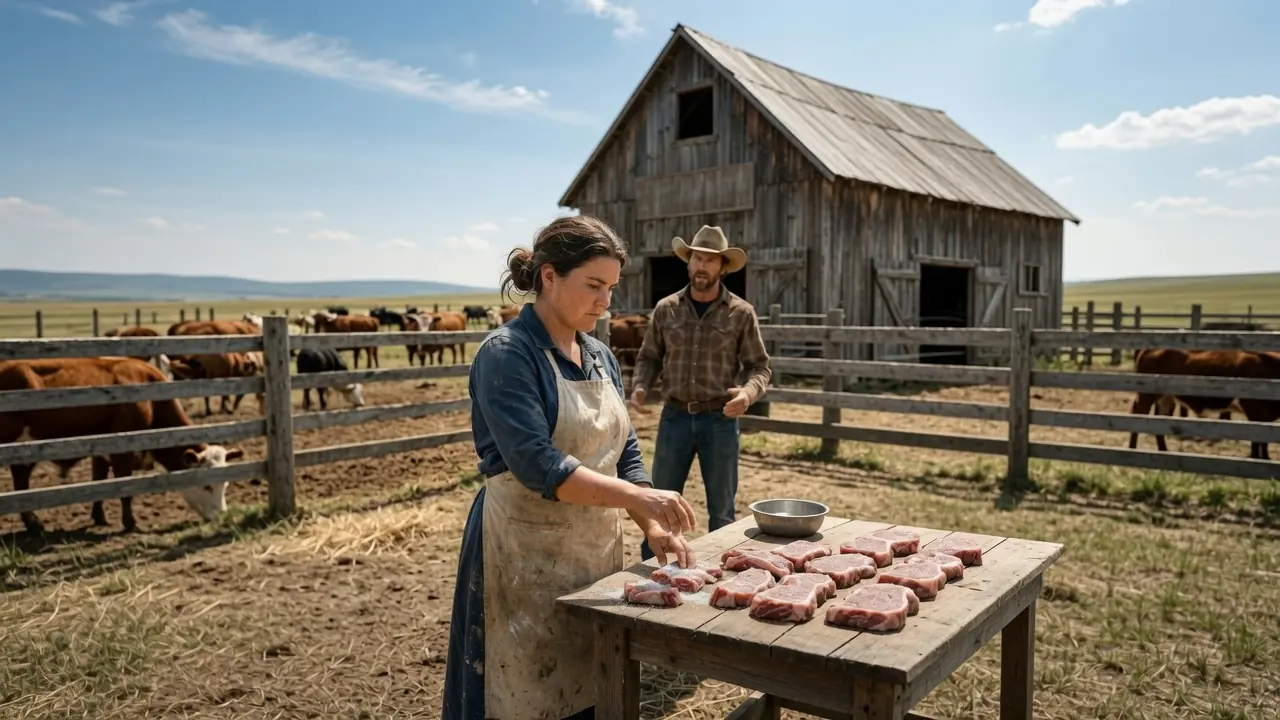
One October afternoon, almost exactly a year after she arrived, Caleb found her at the same outdoor prep table where he had once argued with her about salting beef. The barn sign had been repainted. The cattle behind the fence looked stronger. The north meadow stretched green beyond the ridge, and water moved faintly in the ditch after a morning rain.
Mara was salting beef again, methodical and focused.
Caleb stood a few steps behind her, remembering the day he had thought she was only hired help.
She looked up without turning.
“You’re staring.”
“I am.”
“Need something?”
“Yes.”
She stopped then.
Caleb came around the table, removed his hat, and stood facing her with the nervous stiffness of a man more comfortable with storms than words.
“I need you to stay,” he said.
Mara’s face softened, but her eyes stayed careful.
“For the farm?”
“For me.”
The wind moved lightly across the yard.
Cale, who had been halfway out of the barn, quietly stepped back inside.
Mara looked down at her salt-dusted hands.
“I stayed a long time after needing work stopped being the reason.”
Caleb swallowed.
“Then maybe we should speak to the reverend.”
She looked up.
“If it suits us both?”
He smiled faintly.
“If it suits us both.”
Mara wiped her hands on her apron, then placed one palm against the rough wooden table.
“This farm will still be hard.”
“Yes.”
“There will still be debt.”
“Less than before.”
“There will still be seasons where the land asks more than it gives.”
Caleb nodded.
“Then we answer together.”
That was the first time she reached for his hand.
Years later, people around Harlan County would tell the story differently depending on who was speaking.
Some said Caleb Calaham saved his family farm by reopening the north meadow. Others said the farm turned around when the cattle prices recovered, or when the bank finally gave them breathing room, or when the rain returned in the right months. But those who had been close enough to see the truth knew better.
The farm changed when Mara Whitfield walked into a kitchen, opened a ledger, and refused to accept that a dying place was already dead.
She had not arrived with money.
She had not arrived with land.
She had arrived with a canvas bag, a sewing basket, a sharp eye, and the kind of discipline grief gives to people who survive it without becoming cruel. She salted beef, fixed books, read soil, tracked water, fed men, guarded calves, fought bankers, and taught a proud farmer that working hard was not the same as listening well.
The sign on the barn eventually changed.
Not all at once.
Caleb repainted the old board first, then hesitated before adding anything beneath it. Mara found him standing there one afternoon with the brush in his hand, staring like the blank space had challenged him. She climbed the ladder, took the brush, and painted the words herself.
Calaham Family Farm
Caleb and Mara
He stood below her, laughing softly.
“You sure?”
She looked down from the ladder.
“I keep the books. I’m sure.”
And every fall after that, when beef was salted and hay was stacked and the cattle moved slow through fields that had finally learned rest again, Caleb would sometimes stand behind Mara at the prep table and watch her work. Not because he doubted her. Not because he forgot what she had done. But because the sight reminded him how easily a person could mistake help for weakness, silence for surrender, and a woman with a stained apron for anything less than the force that saved everything.
Mara always knew when he was watching.
She would keep salting the beef, eyes lowered, hands steady.
Then she would say, “If you’re going to stand there, Caleb, at least bring me another bowl.”
And he always did.